

(click to view full)
In DID’s January 2006 “Cobham Catches $A 1B Australian Coastwatch Contract,” we described Australia’s innovative approach to maritime border patrol, explained the program’s assets and structure, and noted that Cobham had been named the preferred bidder (vs. Raytheon Australia) for the next phase of the twelve-year, A$ 1 billion CMS04 program. That status was finalized in a contract as of March 3, 2006.
This announcement has in turn triggered a pair of contracts from Cobham subsidiaries for additional aircraft and accompanying modifications. As noted in DID’s earlier Coastwatch post, the current Surveillance Australia fixed-wing aircraft roster currently includes:
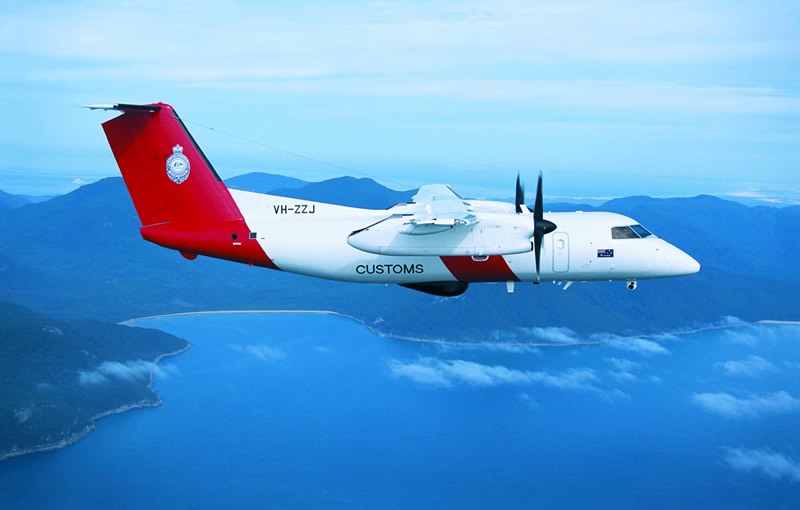
* 5 Bomardier Dash-8 Q200 Maritime Patrol Aircraft.
* 3 Cessna Reims F406 turboprop aircraft fitted with surveillance radar and night vision systems for inshore surveillance.
* 6 Pilatus Britten-Norman BN2B Islander aircraft, fitted for the Visual Surveillance role.
* 1 Shrike AC500 Aero Commander, fitted for the Visual Surveillance Role

(click to view full)
To fulfil the CMS04 contract’s new requirement for “all electronic surveillance” from January 2008, Cobham notes that this fleet of will be augmented to 10 Bomardier Dash-8 Maritime Patrol Aircraft (MPA): 6 Q200s, and 4 larger and longer-range Q300s. All of these aircraft will be equipped with new generation surveillance sensors, communications and data management systems, including a range of Cobham products.
At least some of the smaller turboprop and piston-engined aircraft in the current fleet will be progressively retired as the new aircraft arrive and the new contract takes effect.
Toward that end, Cobham subsidiary National Air Support (NAS) of Adelaide, Australia has placed a firm order for 3 Bombardier Dash-8 Q300 MPAs for the Surveillance Australia Coastwatch program. Bomardier’s release observes that “The list price value for the three aircraft on firm order is approximately $53 million US.”
National Air Support CEO Peter Nottage noted that the Dash-8 Q300 aircraft will be the ‘long arms’ of the fleet, a role that has been played thus far by RAAF AP-3C Orions with guaranteed availability quotas. He praises their greater flexibility, especially their growth capacity for future equipment upgrades, and the extra fuel capacity which will allow them to retain full mission capability during Northern Australia’s tropical “wet season” despite weather-related fuel holding requirements. He added that “we will be able to use them on missions requiring extra range, but they will also be able to loiter in a given area, or shadow a target of interest, for much longer periods of time on tactical missions.”
In addition to the 3 new Q300 aircraft acquired from Bombardier, the firm will also purchase and convert 2 Dash-8 Q200 Series aircraft from the existing fleet of sister company National Jet Systems. All 5 aircraft will then be delivered to Field Aviation Co. at Toronto’s Pearson International Airport for conversion to maritime patrol.

(click to view full)
Cooperation between Field Aviation and Surveillance Australia dates back to the early 1990s when the two companies teamed up to create the Dash 8 Maritime Surveillance Aircraft (Dash 8 MSA) to meet upcoming Australian surveillance requirements. The first Coastwatch-related contract saw Field modifying three Dash-8 Series 200 aircraft into MSAs. This was followed up with two additional units when the Coastwatch operation was expanded in 2000.
Field Aviation notes that This set of 5 more Dash 8 aircraft will be modified to include a mission interior, large conformal observation windows, and increased Maximum Take Off Weight, as well as provisions for the latest technology surveillance sensors to include updated models of Raytheon’s SeaVue 360 degree surface search radar and a stabilized electro-optical multi-spectral imaging system. A new suite of modern mission navigation and communications systems will also be fitted. The aircraft modifications will start in April 2006 and be performed at the Field Aviation Mod Centre in Toronto, Canada’s Lester B. Pearson International Airport.
Of special note is the Immarsat SATCOM capability. This was added to existing Coastguard Dash-8s several years ago, allowing them to transmit real time video, still images from the installed FLIR or daylight TV systems, radar profiles, voice and data from the patrolling Coastwatch aircraft via satellite direct to the Customs National Surveillance Centre in Canberra or to a mobile ground station. In other words, Australian Customs Service personnel can see what the aircraft crew is seeing. The Surveillance Australia aircraft are the first civil maritime surveillance and border protection aircraft anywhere in the world to field such a system.
Each aircraft will be capable of searching an area of more than 110,000 square kilometers per flight and operate from existing bases in Broome, Darwin, Horn Island and Cairns, providing all weather, day and night electronic surveillance of Australia’s maritime Exclusive Economic Zone (EEZ).
Field Aviation is a specialist in modifying of regional aircraft and business jets for special missions, and the Maritime Surveillance Aircraft version of the Dash-8 is properly their development as well as Bombardier’s. Additional customers for Field’s Dash-8 MSA modifications include US Customs and Border Protection where the first of a fleet of Q200 MSAs entered service in 2005; and the Swedish Coast Guard, which will receive three larger Q300 MSAs in 2007.
UPDATE: The Dash-8s may have company. General Atomics’ Mariner UAV will be trialed during the summer of 2006 for a potential Coastwatch role; see below.
Additional Readings and Sources
* DID (Jan 3/06) Cobham Catches $A 1B Australian Coastwatch Contract. Describes the core of the Coastwatch program.
* Australian Customs Service – Coastwatch, An Overview
* CASR; Excerpts from a Canadian Senate Committee on National Security and Defence report – The Hon. Colin Kenny, Chair (July 2004) – Maritime Security: Lessons Learned from Other Middle-Power’s [sic] Approaches to Guarding the Coasts – Australia
* Australian Ministerial Paper, The Hon Peter Reith MP, Minister for Defence (October 2001) – Coastal Surveillance and Protection: a “US-Style” Coast Guard or the Australian Coastwatch?
* Australia’s Defense Science & Technology Organization (DSTO) – North West Shelf UAS Trial Site. Covers the ongoing UAV trials using a General Atomics Mariner platform. Runs from August – October 2006.
* Australian DSTO (Sept 1/06) – Flying Start to North West Shelf Unmanned Aircraft Trial. The trial involves a Mariner demonstrator UAV working with a Royal Australian Navy Armidale Class Patrol Boat, the Joint Offshore Protection Command, and the Pilbara Regiment to conduct surveillance and response missions.
* Australia Defence Ministers & Parliamentary Secretary (May 22/06) – Unmanned Aircraft Trial For North West Shelf Going Ahead
* DID (May 11/06) – Australia to Beef Up Northern Border Protection. Includes some additional Coastwatch-related funding.
* The Australian (Dec 6/05) – $1bn plan to boost coastal defences
* CASR (July 2002) – Australia’s ‘Coastwatch’ – What Can Canada Learn?