

(click to view full)
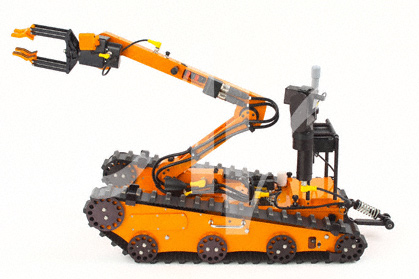
The USA has led the way in robots for explosives/ordnance disposal, but interest from allies is growing. Now Allen-Vanguard Corp. of Ottawa, Canada has been selected for the Canadian Forces (CF) 5-year “MINI-ROV” program by the Canadian Department of National Defence (DND). Ultimate quantities and contract values including in-service support over the life of the program are not yet established, but the initial order for its Vanguard Mk2 ROV robots is valued at CDN$ 3.7 million, with an option for additional robot orders at a value of CDN$ 1.6 million. The Company expects to fulfill the initial order in the first half of its 2007 fiscal year commencing October 1st, 2006.
The Vanguard Mk2 ROV is a smaller, lower-end military/civilian UGV, as opposed to the firm’s larger and more capable BombTec Defender D2. Instead, the Vanguard emphasizes portability, modularity and field maintenance, and low cost. This combination won it an award in an evaluation of competing robots for the Technical Support Working Group (TSWG) of the USA’s National Institute of Justice. The TSWG is the U.S. national forum that identifies, prioritizes, and coordinates interagency and international research and development (R&D) requirements for combating terrorism.
On the other hand, Vanguard robots received very poor evaluatrions from US forces in Iraq. A National Defense Magazine article reports:
“Insurgents place rocks, chunks of concrete and garbage near roadside bombs to create obstacles for the robots, in an effort to slow the ordnance teams down and make them stay on site longer. Speed, maneuverability and the ability to climb over curbs are vital for the robots, the specialists said.
Both the PackBot and Talon generally performed well in these areas. A third robot, the Vanguard, manufactured by Allen-Vanguard Inc. of Reston, Va., did not handle the Iraqi terrain well, those who used it in the field said. It worked fine on smooth surfaces, but as soon as it left a road or hit a gravelly surface, the tracks would often come off, said Army Specialist Jacob Chapman.
“We ended up trying to get rid of [the Vanguards] as soon as we could,” Chapman said. The robots also had difficulty dealing with the complex radio frequency environment. “It usually wouldn’t make it 10 feet past the truck,” he added.
The Vanguards were eventually pulled out of Iraq.”
The article did not specify which variant was used. Hopefully, these issues have been fixed – or Canadian Forces personnel will suffer.