

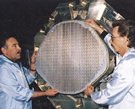
Back in December 2005, “Elec Tricks: Turning AESA Radars Into Broadband Comlinks” covered some preliminary breakthroughs by Raytheon and Northrop Grumman, and discussed the implications. Their work involved using cutting-edge AESA radars as direct transmitters for secure, high-bandwidth communications, a move that could vastly increase the transmission and information-sharing capacity of planes like the F-15 C/SG (with the new APG-63v2/3 radar), F/A-18 E/F Super Hornet (APG-79), F-16 E/F Block 60 (APG-80), F-35 Lightning II (APG-81), and F-22 Raptor (APG-77). A follow-on article noted that one of DID’s readers had also done preliminary work in this area as a Ph.D. thesis, including some work that wrestled with the issues of long range transmission.
It would appear that these investigations have now moved beyond the preliminary research stage.
Contracts & Key Events
June 13/07: Northrop Grumman Corp. and its teammates L-3 Communications, Inc. and Lockheed Martin Corp. have successfully conducted the first in-flight communication’s link with an active electronically scanned array (AESA) radar. Using off-the-shelf, L-3 programmable modems and a new R-CDL waveform, the Radar Common Data Link (R-CDL) used the AESA radar’s fire control transmitter and antenna to perform high-data rate, two-way communications, streaming synthetic aperture radar map imagery and streaming video from a Northrop Grumman BAC 1-11 test aircraft to an L-3 Communications ground station. During the mission, the team transmitted and received in full duplex at 274-megabits per second burst rate. NGC release.
Jan 11/07: A Raytheon release said that efforts “to design and develop the next-generation wideband common data link for active electronically scanned array radar systems [under] The Radar Common Data Link program…” and adds that “The five-year program calls for Raytheon to develop specifications and open-standards interfaces for a radar common data link to determine how it would operate with current and future AESA systems, to formulate concepts of operations with the Air Force, and to demonstrate feasibility.”
Raytheon is teamed with L-3 Communications (experience with common data link waveforms) and Boeing (platform partner for integration of the AESA technology on the F-15 and F/A-18 aircraft) on the program; no mention of Northrop Grumman. At this time, $1.6 million has been obligated. Solicitations began June 2006, negotiations were complete October 2006, and work will be complete in October 2011. The Air Force Research Laboratory at Wright-Patterson Air Force Base, OH issued the contract. (FA8F650-07-D-4502).
Oct 17/06: Raytheon Co. in El Segundo, CA receives a $9.7 million indefinite delivery/indefinite quantity, cost-plus-fixed-fee contract:
“This effort will determine the technical feasibility of using radar apertures/systems as a data link to transmit synthetic aperture radar data (and other data types) using a modified common data link waveform (or equivalent) in near real time. The demonstration will occur in three phases. A phased approach will be used to reduce technical, cost and schedule risk by demonstrating technical feasibility prior to awarding any further task orders.”
Additional Readings
* Northrop Grumman – AESA Radar: Revolutionary Capabilities For Multiple Missions [PDF]. Details a number of the radar type’s characteristics that make it special, and offers insights into some of the developments within the AESA field.
* Raytheon – Raytheon’s Revolutionary AESA Technology. Includes links to their various AESA radar designs and capabilities, and adds as a list of related press releases at the bottom.
* DID (Dec 18/05) – AESA Comlinks: DID Reader Has Done Prior Research. Dr. Carlo Kopp has already done a fair bit of work in the field, beginning with his PhD thesis in Melbourne in 1999. He has some insights into the hard parts ahead for Northrop-Grumman and L-3, and would be happy to share. Read the article for an outline and links to more in-depth materials.
* DID FOCUS Article – The Wonders of Link 16 For Less: MIDS-LVTs (updated). MIDS-LVT is a very popular way of getting Link-16 capability into aircraft, and other variants are installed on ground or naval platforms. The Swiss, with mountains that can disturb other communications, are even installing a Link-16 network that will cover their whole country. Will Link 16 find itself replaced by these new radar capabilities?
* Aviation Week & Space Technology (Dec 11/05) – Talking Radars
* DID (Oct 24/05) – Supersonic SIGINT: Will F-35, F-22 Also Play EW Role?