


(click to view full)
The Netherlands’ Secretary of Defense Cees Van der Knaap has signed the Production Sustainment & Follow On Development (PSFD) MoU in Washington D.C. together with his American counterpart, Deputy Secretary of Defense Gordon England. See the Ministerie Van Defensie release [Dutch], and the speech given during the signing ceremony [English].
Meanwhile, an ANP story in the Dutch media offers an overview of the political tensions beneath the surface as the country heads toward general elections very soon. DID Netherlands correspondent Vincent van Neerven was good enough to provide a translation, allowing a summary of its additional insights:
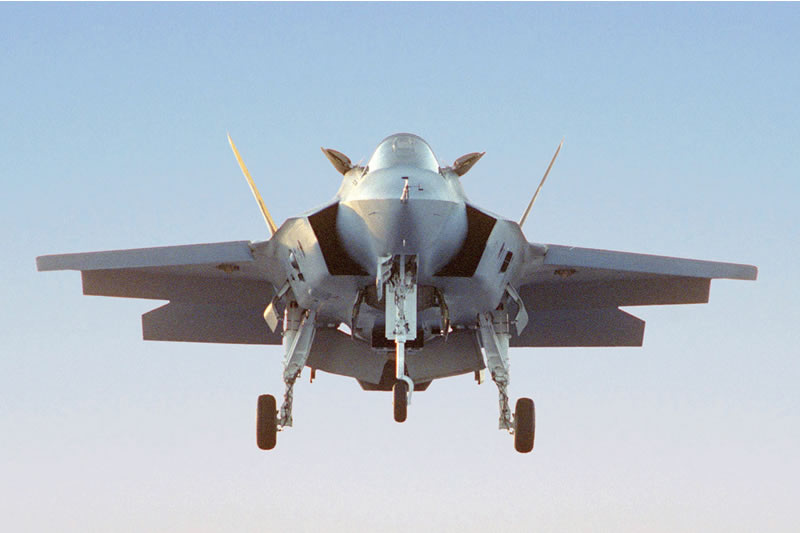
flaperons in use
(click to view full)
Dutch undersecretary of Economic Affairs Karien Van Gennip describes the JSF as “a success story to be continued,” repeating the government’s figure of $720 million (more than EUR 570 million) in orders under the program thus far. By comparison, Australia’s government, which is a Tier 3 partner and invested about an eighth as much, received around $90 million in contracts. Stork Fokker’s world-class aerospace specialties in key areas like wiring and precision machining have played a significant role in achieving that level of success under a predominantly “global best value” contracting framework that offered no guarantees.
The article adds, however, that [DID translation follows, with some explanations]:
“This signing of the agreement, right before the elections, goes against the grain of the left wing, social democrat opposition who fear that the Netherlands will enter into an uncertain adventure that might cost the tax payer a great deal of money. All this notwithstanding, CDA [Christian Democrats], VVD [Liberal Right] LPF [Pim Fortuyn’s Party] and the small Christian parties gave the green light in Parliament.
…In 2002 the second ‘Purple’ [Christian Democrats + Liberal Right] Cabinet joined the project to develop the Joint Strike Fighter [as a Tier 2 partner, with an $800 million commitment]… After signing the agreement with the USA’s main contractors for the JSF, the Netherlands would still be able to abandon the project and this is what the PVDA [Social Democrats] actually plans to do. This, however, will become increasingly more expensive as the program continues. Next year or at the very latest in 2008, our country has to decide whether to buy the JSF as replacement for the F-16 fighter aircraft.”
DID discussed the case being made for the Dutch F-35s in some depth in our October 2005 article “Dutch Close to Approving F-35 Production Participation.” We’ve also covered the concerns expressed in The Netherlands re: the JSF program’s cost and commitment level, in “Dutch Rekenkamer Issues F-35 JSF Program Report.”
Unlike the Australian debate, strategic issues and capability questions don’t figure into the Dutch debate. RNAF forces do not have pressing air superiority problems from potentially hostile countries in their own backyard, cover a much smaller territory, and will operate abroad mostly as members of international/NATO coalitions providing air support to troops on the ground, while others handle air superiority if necessary. The F-35A’s capability set matches up with these needs quite well, and so the main debate in The Netherlands revolves around more industrial/financial questions of risk, reward, and value.
Alternative candidates are waiting in the wings if the F-35 effort fails.
While a significant shift in the Dutch Parliament could still result in changes or even a pullout from the F-35 program, pre-election indicators are currently trending toward a pretty status quo result followed by the usual coalition-building maneuverings. Anything can happen in politics, but barring a real November surprise, it would appear that the Netherlands is on board the Joint Strike Fighter program for at least 2 more years.
DID will continue to follow this issue… with a little help from local correspondents like David Vandenberghe, Vincent van Neerven, and others who enhance our work by stepping up and contributing. We thank them on our readers’ behalf, and our own.
UPDATES:
F-35 PLANS UPDATE (Oct 30/07): Reader David Vandenberghe sends in a translation of a written parliamentary Q&A document related to the Dutch MoD Budget:
“(number 25) concerning possible alternatives to the JSF. In Short there are 3 alternatives to the JSF for the Netherlands: The Rafale F4, Eurofighter tranche 3 and the Advanced F-16. The governmental cabinet has decided, during the formation talks [to form a new Dutch government], to present its conclusion to replace the F-16 to the parliamentary chamber in 2010. For that purpose a re-evaluation will be made of all possible alternatives to the F-16 replacement…from JSF to the three above mentioned.”
Of the 3, the Eurofighter’s $100+ million price tag rules it out as a cost substitute, though its superior air-air prowess could make it a capability substitute if the Netherlands decides that the F-35 can’t meet its needs. The French might be persuaded to cut an excellent deal on the 4+ generation Rafale due to that jet’s export failures, which might make it a cost substitute as well as a capability substitute if the F-35A’s price rises much over $55 million. The F-16 E/F Block 60 with the APG-80 AESA radar and built-in infrared tracking currently serves with the UAE, and is a clear cost substitute option at $40-50 million per aircraft.
ELECTION 2006 UPDATE: The Dutch elections were not a major change; the Christian Democrats remained the largest party, but the underlying dynamics are likely to make forming a coalition difficult. The [CDA] took 41 of the 150 seats in the lower house of parliament (down from 44), and its allies the Liberal Party won 22 (down from 28). The D66 democratic party whose walkout from the coalition forced the election won 3 seats (down from 6). Across the aisle, the left-wing Labour Party [PvdA] took 32 seats (down from 42), while the nationalist-oriented Socialist Party led by a leader with a Maoist background won 26 seats (up from 9). Among the smaller parties, the Green Party won 8 seats (down from 9), the middle of the road Christian Party [Christen Unie] won 6 seats (up from 3), the reformed protestant party [SGP] held steady at 2 seats, the single-issue Party of the Animals [Partij van de Dieren] won 2 (up from 0), and the new Freedom Party led by Geert Wilders, who expressed vocal concerns about an unassimilated Islamic minority in the Netherlands, won 9 seats (up from 0). See election roundup, plus an opinion piece in Newropean that sees the results as bad news for Eurocrats.
It seems unlikely that this result will create a coalition that can pull the Dutch _out_ of the F-35 production phase agreement that was signed before the election. The next key milestone is 2008, and another election appears likely before that milestone hits.
Additional Readings
* APN, via Luchtvaartniews (Nov 9/06) – Succesverhaal JSF voortzetten
* DID FOCUS Article – F-35 JSF.
* DID Spotlight – Dutch Rekenkamer Issues F-35 JSF Program Reports. October 2006 and December 2007.
* DID (Dec 4/07) – F-35 JSF Hit by Serious Design Problems (updated). By Johan Boeder of the Netherlands. Notes serious testing issues that have grounded the test aircraft for several months, and also the lack of transparency in the project, which eventually creates some rather sharp political questions in the Dutch Parliament.
* DID (Oct 5/06) – Dutch Close to Approving F-35 Production Participation