

(click to view full)
Good car owners take their vehicle in for maintenance after a certain number of months, or a certain number of miles, whichever comes first. Depending on the vehicle’s age and mileage, the dealer’s mechanic will have a list of standard systems to check and/or replace. It’s the same for the military, with the added pressure that vehicle breakdowns in a combat zone are not acceptable. So the inspections and rebuilds take place regularly, and it’s considered better to replace a working part with a new one than risk problems later. Unless, of course, land vehicles included the same sort of proactive diagnostics (“prognostics”) that are making their way into aircraft and helicopters. Maintenance could then take place only when necessary, keeping a higher percentage of vehicles in service, saving some money, and creating faster turnaround time for real problems.
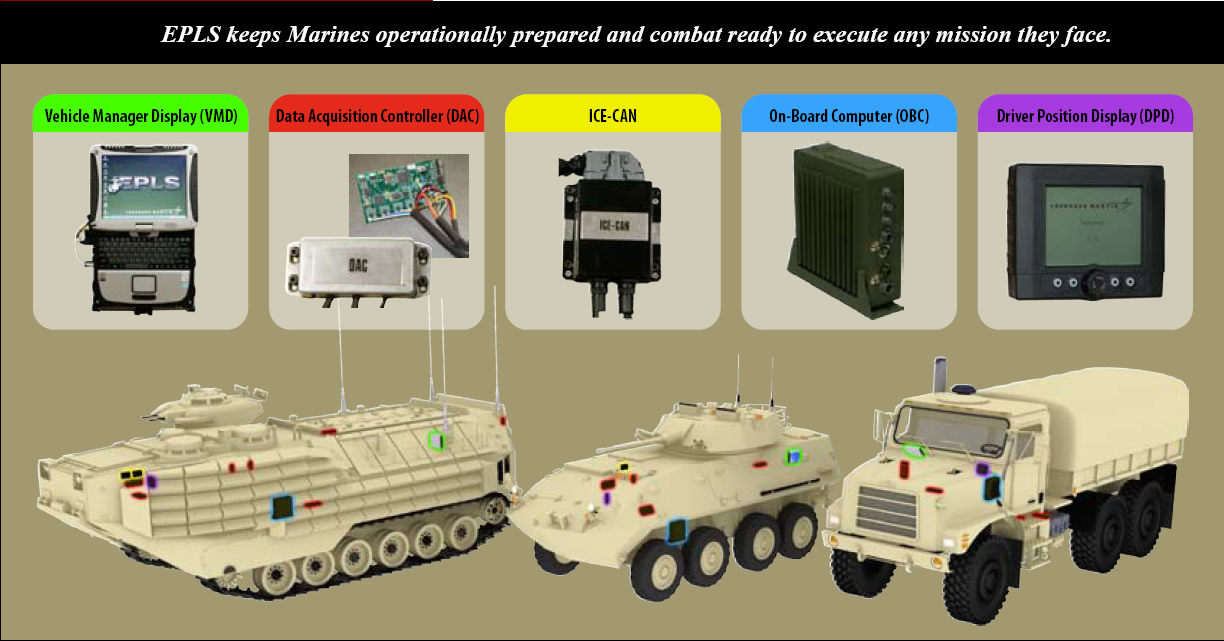
That’s the aim of the US Marine Corps’ Embedded Platform Logistics System…

(click to view full)
In September 2007, Lockheed Martin announced a $144.8 million firm-fixed-price, indefinite-delivery/ indefinite-quantity contract to develop it for the Marines’ aging AAV7 Amtracs amphibious assault vehicles, its LAV wheeled APCs, and MTVR medium trucks. The system is being designed to be flexible enough to expand to other Marine Corps vehicles in the future.
As part of the Marine Corps Logistics Modernization programs, modifications will be made to add sensors, on-board computers, displays and devices necessary to monitor vehicle performance. Using data captured from individual vehicle sensors, the Enhanced Platform Logistics System will provide predictive data and failure analysis.
Once that data is available, of course, it has applications well beyond just the individual vehicles. The contract also calls for the creation of databases and end-user management applications to offer accurate fleet operational status and system health reporting, and improve the availability of logistics information to commanders.

(click to view full)
According to Debra Palmer, vice president of Lockheed Martin Enterprise Logistics Solutions, the new system leverages many of the concepts and lessons learned from Lockheed Martin’s F-35 Lightning II fighter program’s Autonomic Logistics Information System; and from the United Kingdom’s Joint Asset Management Engineering System (JAMES).
Updates
June 30/09: Qinetiq North America announces a prime contract to provide a wide range of services to the Marine Corps Systems Command’s (MCSC) Program Manager for Autonomic Logistics (PM AL). The contract has a one-year base period of performance plus 2 one-year options, and a ceiling value of $17.4 million.
As the prime contractor, QinetiQ North America’s ‘s Systems Engineering Group under the Commercial Enterprise Omnibus Support Services (CEOss) Engineering and Scientific domain will provide engineering, programmatic, information assurance, test and evaluation, logistics, configuration management and financial support for the Embedded Platform Logistics Systems (EPLS); Electronic Maintenance Support System (EMSS); and Autonomic Logistics programs.
The Autonomic Logistics family of systems will enable Marine Corps ground tactical equipment to monitor and report health and logistics needs, supporting the U.S. DoD’s Sense and Respond initiative. The contract will be managed by MCSS’ Acquisition Center for Support Services (ACSS).
March 20/08: Lockheed Martin announces that a March 2008 Critical Design Review for the project has confirmed that the Embedded Platform Logistics System is on track for delivery in summer 2008 – less than a year after contract award. Once system testing is concluded in July 2008, Lockheed Martin will move forward with the production of sensors and related systems and begin outfitting more than 7,000 Marine Corps vehicles. Lockheed Martin’s release adds that:
“The mobility and firepower of the LAV has been essential to the Corps’ dangerous mission in Iraq. But, the gearboxes that power the eight-wheeled vehicle sometimes overheat in the blistering desert terrain, potentially stranding the crew in hostile territory. “Without EPLS, they have to literally stop to see if the gearboxes are hot…”
Additional Readings
* Lockheed Martin – Embedded Platform Logistics System. See also PDF brochure.