

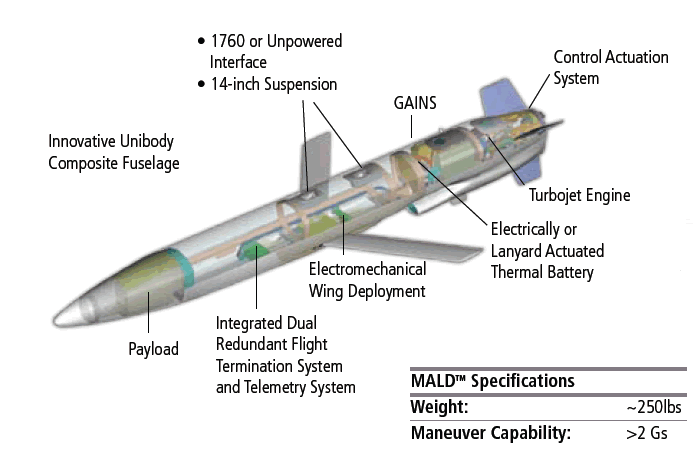
(click to view full)
The Bosnian “Nighthawk Down” incident in 1999 showed that even old air defense systems could still be dangerous, and that smart tactics and selective use could keep those systems alive against heavy opposition. The challenge is finding them and targeting them. Against truly advanced air defense systems like the Russian SA-20 family, however, the challenge is survival. Advanced stealth technologies, advanced anti-radar weapons, and successful electronic jamming are required.
Air-launched decoys can help, and they are not a new concept by any means. The same technologies used in cruise missiles allow construction of “stealth in reverse” decoys that fly long distances along pre-planned flight patterns, carrying radar reflectors that simulate the radar return of fighter or bomber aircraft. Enemy air defenses see them as incoming aircraft, and must decide to either shut down and hide, or activate and reveal their position. If American aircraft are flying behind a wave a decoys, either option can be dangerous. The USAF’s ADM-160B/C Miniature Air-Launched Decoy (MALD) program began as a DARPA effort in 1996, but made it all the way into production, and is branching out into new fields. The US Navy already has their own ITALD, but they liked one of the new MALD variants enough to add it, too.
MALD and Its Variants

The ADM-160 MALD has changed over its program lifespan. One big change was required range, which forced the Air Force to move to a larger decoy. That led to a re-compete, which Raytheon won from original incumbent Northrop Grumman in 2003. Prices have increased along with size and capability, from $30,000 to $120,000 per decoy. This is still much cheaper than a $70 million fighter. Range for the 300 pound system has also increased, to 500 nm/ 575 miles, with the ability to loiter over targets.
With its range and loiter time, however, MALD lends itself to other uses as well. One obvious use is to install radar jamming equipment, instead of radar reflecting equipment. The resulting system can add realism to an incoming wave of MALD decoys while neutralizing specific threats, or fly ahead on a mission of its own. The “MALD-J” electronics will have to be powerful enough to be useful, however, while remaining small and light enough to fit into a 300 pound MALD decoy.
[youtube:v=5Pu_PKpEhqU]
The USAF wants to explore those possibilities. Raytheon received a 2-year, $80 million US Air Force contract for MALD-J Phase II risk reduction in April 2008, and MALD-J received its milestone C go-ahead into low-rate production in November 2011. Deliveries begun in the fall of 2012, for use with USAF F-16 fighters and B-52H bombers. Meanwhile, the US Navy is working to integrate it with its regular F/A-18E/F Super Hornet fighter fleet, as a lower-end alternative to its dedicated EA-18G Growler electronic attack variant.
A 3rd MALD type, MALD-V, would have an open payload space for insertion of modular surveillance gear, jammers, or other equipment. This may provide the go-forward architecture, and give customers the option of turning MALD into a UAV, or even a hunter-killer that homes in and destroys radars targeting it. But after several test failures in 2010/11, the Air Force clipped the program’s wings by terminating research on MALD-J Increment II.
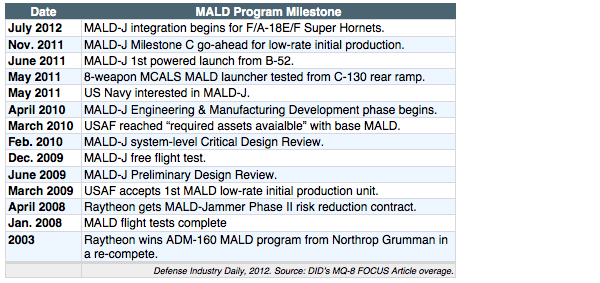
Program Timeline
Industrial Team
More than 125 Raytheon employees design and build the MALD and MALD-J in Tucson, AZ; Goleta, CA; and El Segundo, CA. Key suppliers for MALD and MALD-J components include:
* AUSCO in Port Washington, NY
* Advanced Industries Inc. in Wichita, KS
* CEI in Sacramento, CA
* Celestica in Austin, TX
* Eagle Pitcher in Joplin, MO
* EDO in Bohemia, NY
* Enser in Pinellas Park, FL
* Engineered Fabrics Corp in Rockmart, GA
* GDOTS in Redmond, WA
* Hamilton-Sundstrand in Rockford, IL & San Diego, CA
* LaBarge in Joplin, MO
* Moog in East Aurora, NY
* Tecom in Westlake Village, CA
* Teledyne Microelectronics in Los Angeles, CA
* Daico, in Carson, CA
* Cobham in San Diego, CA
Boeing and Lockheed Martin don’t supply components, but will be responsible for making MALDs work with their respective aircraft.
Contracts and Key Events
FY 2018
DOTE not sure about navigational accuracy. Lot 7 and beyond. Radio link.
September 27/18: MALD-N The Navy is one step closer in acquiring new decoys for its warplanes. Raytheon will be responsible to mature the technological concept and reduce associated risks in the Miniature Air Launched Decoy-Navy (MALD-N) development program. The cost-plus-fixed-fee contract is valued at $49.6 million. The MALD-N is a navalised version of the MALD-X, which will be the successor to the currently fielded MALD-J. MALD-X enhances the modular nature of the mini cruise missile with the ability to accommodate different electronic warfare payloads that are more advanced than those found on MALD-J. What is planned to come out of MALD-X is a networked decoy that can use its adaptive electronic warfare payload to deliver electronic attacks on air defense nodes autonomously or at the direction of operators from a afar in a semi-autonomous fashion. Work will be performed at multiple locations including – but not limited to – Tucson, Arizona; Papendrecht, Netherlands and Indianapolis, Indiana. The contract is set to run though November 2020.
August 28/18: Decoys The US Strategic Capabilities Office (SCO) has achieved a milestone in its Miniature Air-Launched Decoy X (MALD-X) development. MALD-X decoys are mini-cruise missiles, which are used to distract and deceive an enemy air defense system so that a real strike package can succeed and survive. The ‘stealth in reverse’ decoys fly long distances along pre-planned flight patterns, carrying radar reflectors that simulate the radar return of fighter or bomber aircraft. MALD-X enhances the modular nature of the mini cruise missile with the ability to accommodate different electronic warfare payloads that are more advanced than those found on its predecessors. A series of flight demonstrations were recently held at Naval Air Warfare Center Point Mugu, with additional tests to take place next year. Raytheon was awarded $34.8 million by the USAF to develop a new version in 2016.
FY 2014 – 2016
July 12/16: Raytheon has secured a $34.8 million USAF contract to modify its ADM-160 Miniature Air-Launched Decoy (MALD) for carriage on the Navy’s F/A-18E/F. Used currently on USAF F-16 and B-52s, the MALD deceives adversaries by replicating the signature of friendly aircraft, and the new development will see it receive an improved electronic warfare payload, the ability to carry out low-altitude flight, and an enhanced net-enabled datalink. The development will last for 24 months and see two demonstrations of the system.
September 11/15: Raytheon and the Navy have demonstrated the use of electronic warfare payloads fitted to the Miniature Air Launched Decoy – Jammer (MALD-J), with the system tested through a dozen different mission profiles. Known as Cerberus, the open architecture system was tested during Exercise Northern Edge in June. The tests showed how the payloads could be swapped into the MALD-J vehicle rapidly, using adapted motor sport technology.
Dec 9/14: data link. Almost 6 years after a January 2009 award to study the feasibility of adding a data link to MALD-J, Raytheon announces that it has conducted successful tests of that capability with the US Marines in Yuma, AZ. The benefit is to allow in-flight targeting adjustments.
Oct 15/14: Lot 9-11. The Air Force intends to award multiple sole source contracts for a total of $471M to Raytheon Missile Systems (RMS) for MALD-J lots 9-11; parts obsolescence management, sustainment, aircraft integration, non-warranty repair, technical support, and development of any future variants based on the MALD design.
June 30/14: USAF procurement. The Air Force releases a justification & approval document dated Oct. 31/12 that explains how lots 7 to 10 plan to procure 200 units each year from 2014 to 2017, on a Firm Fixed Price basis. Lots 7 and beyond should be contracted under a 10-year warranty, like lots 5 and 6, vs. 15 years for the first 4 lots. Source: FBO [PDF].
June 27/14: Lot 7. RMS is awarded a $80.8 million firm-fixed-price and cost-plus-fixed-fee contract for the Lot 7 Miniature Air Launched Decoy Jammer (MALD-J) missile that includes data, mission planning, process verification program, and operational flight software. Work will be performed at Tucson, AZ, and is expected to be completed by June 30, 2016. Fiscal 2012, 2013 and 2014 procurement and operations and maintenance funds are being obligated in the amount of $79,112,476 at time of award. Air Force Life Cycle Management Center/EBJM, Eglin Air Force Base, FL, is the contracting activity (FA8682-14-C-0004).
[youtube:v=5Pu_PKpEhqU]
May 2014: state of program. Raytheon says it has delivered a total of 1,000 MALD-Js, and all 33 flights performed during the past 2 years were successful, without elaborating on the success criteria.
January 2014: DOTE. The Pentagon’s Office of the Director, Operational Test and Evaluation, released its FY2013 report, with a section on problem discovery affecting OT&E. On MALD-J:
“All MALD-J vehicles launched during developmental testing performed within the navigational accuracy requirements. During IOT&E at an open-air flight test range (a more challenging operationally representative environment), several MALD-J vehicles experienced unexpected navigational accuracy issues. There were several different causes of the navigational errors, all classified, but all arose from technical performance issues that should have been uncovered during developmental testing.”
There is also a dedicated brief [PDF] on the program that details test activity so far.
FY 2011 – 2013
Milestone C for MALD-J; Lot 4-6 orders are all MALD-Js; Work begins to add MALD-J to MQ-9 UAVs, F/A-18E/F Super Hornets, and transport aircraft; MALD-J Increment II terminated; MALD-V for surveillance? IOT&E.
[youtube:v=vZyL-zEoMfM]
April 22/13: Lot 6. Raytheon announces a USAF contract for 202 more MALD-Js and containers as Production Lot 6. It was exercised as an option under the Lot 5 contract “in Raytheon’s first quarter of 2013.”
As usual, contract work will take place primarily at Raytheon’s missile facility in Tucson, AZ.
Feb 13/13: MQ-9 UAVs. Raytheon Company and General Atomics Aeronautical Systems, Inc. announce that they’re working to integrate MALD/MALD-J decoys onto the MQ-9 Reaper UAV. The Reaper’s slow speed means that their use would need to be timed well, and arranged carefully so as not to make their mission obvious. On the other hand, the Israelis have made an art form out of using drones to provoke air defense batteries into using their radars and communications, then harvesting the emissions for analysis and counter-programming. Enough of that in advance, and the MALDs could just look like the big killer strike wave has finally arrived.
Ground Verification Test phase completed in November 2012 at GA-ASI’s Gray Butte Flight Operations Facility in Palmdale, CaA. Integration is estimated to conclude in 2013.
Aug 22/12: Lot 5. An $81.8M firm-fixed price contract for MALD-Js, to be completed by the end of August 2014 (FA8682-12-C-0002). FBO.gov.
July 6/12: F/A-18E/Fs. Raytheon announces that the MALD-J has begun integration with the US Navy’s F/A-18E/F Super Hornets. That will involve additional tests and demonstrations once work is finished to tie it into the Super Hornet’s systems. Meanwhile, the USAF is preparing to begin receiving MALD-Js for its F-16s and B-52s by the end of 2012.
The dedicated EA-18G Growler electronic warfare fighter doesn’t have the space to add MALD-J without badly compromising its range, but MALD-Js on regular Super Hornet fighters will give the US Navy additional electronic attack options beyond the Growler fleet.
June 01/12: In an interview with Defense Daily, Raytheon business development manager Jeffrey White defends the program, thanks to several successful tests so far this year. He adds that swarms of up to 192 decoys can be loaded on and dumped from heavy transport aircraft (see May 25/11 entry on MCALS). Now wouldn’t that be nice for business?
March 29/12: GAO report. The Government Accountability Office reviews the Pentagon’s airborne electronic attack efforts and starts its section on underperforming programs with MALD/MALD-J:
“In September 2011, citing ‘successful completion of MALD-J engineering and manufacturing development activities,’ the Air Force exercised a priced option to upgrade 240 of its planned MALD units to the MALD-J configuration, subsequently decreasing MALD quantities to 596. Because all future production lots are now planned as jammer-configured decoys (MALD-J), the 596 total represents the full MALD procurement – without the program having ever met the criteria necessary to proceed into full rate production. Since the MALD and MALD-J designs are identical – except for the addition of a jammer module to MALD-J–the absence of a proven manufacturing process for MALD introduces schedule risk to production of MALD-J.”
February 27/12: The FY 2013 President Budget terminates work on MALD-J Increment II. The USAF had previously planned to spend $272 million in order to develop this new version, which was intended to improve sensitivity and jamming power.
No MALD-J Increment II
Dec 2011: DOTE. The Director, Operational Test & Evaluation, issues its annual report [PDF]. They are satisfied by the Air Force’s follow-up on past recommendations, but urge a change to the Concept of Operations (CONOPS) so that some decoys can be used during exercises and training. The current CONOPS doesn’t allow that because of the device’s expendable nature. Overall, 2011 has been a better year for MALD-J than MALD.
Nov 29/11: Raytheon announces that the USAF has approved the MALD-J jammer variant for Milestone C, clearing it to enter Low Rate Initial Production. They also exercised a $5 million contract option, to convert Lot 4 production of the baseline MALDs into MALD-Js.
Milestone C
Sept 6/11: Raytheon touts a successful test with multiple MALD-Js in both free-flight and carry modes, simulating an electronic attack. That’s the last major hurdle toward a Functional Configuration Audit, and once that’s official, the USAF could authorize Milestone C and begin production by the end of 2011.
June 29/11: Boeing touts the first MALD-J powered launch “earlier this month” from a B-52 flying over the Gulf of Mexico, at the Eglin Air Force Base, FL test range. Boeing designed the avionics software on board the B-52 that controls and launches Raytheon’s MALD-J. Boeing.
May 27/11: LRIP-4. Raytheon Missile Co. in Tucson, AZ receives an $83 million firm-fixed-price contract modification MALD low rate initial production lot four (LRIP-4) production.
Work will be performed at Tucson, AZ. The contract is managed by the AAC/EBJM at Eglin Air Force Base, FL (FA8682-10-C-0007, PO 0019).
May 27/11: MALD-J/V. A Flight International article discusses US Navy interest in the USAF’s jammer variant, and notes work on a MALD-V, with an empty payload compartment that could carry surveillance payloads as well.
May 25/11: MALD MCALS. Raytheon announces that they’ve launched two MALD “instrumented shapes” from the ramp of a C-130 Hercules, using the new Raytheon-funded MALD Cargo Air Launched System (MCALS).
Adding cargo aircraft as a platform would offer many more options for using MALDs, on both combat strike and cargo missions. MCALS’ steel, birdcage-like framework body sits on a standard cargo pallet, and can hold as many as 8 MALDs. At a pre-determined altitude, the ramp is opened and MCALS rapidly ejects the MALDs, which then initiate a standard wing deployment and engine ignition sequence.
March 10/11: The US Navy posts FedBizOpps notice #N0016411RWS47: “14–SOLE SOURCE – MINIATURE AIR LAUNCHED DECOY (MALD)/ MINIATURE AIR LAUNCHED DECOY JAMMER (MALDJ)”:
“Naval Surface Warfare Center (NSWC) Crane Division plans to enter into a five year Basic Ordering Agreement (BOA) with Raytheon Missile Systems… ceiling in the amount of [$12.5 million, for] engineering, logistics and test support, test item hardware and software, support equipment hardware and software, prototypes, test and assembly fixtures, repair services, training, and various data products. This requirement will be negotiated on a sole source basis in accordance with the statutory authority 10 U.S.C. 2304(c)(1) as implemented by FAR 6.302-1… The POC for information regarding this requirement is Mr. Matthew Lucas, Code CXMN, telephone (812)854-8864, fax 812-854-3805 or send a request via e-mail (E-MAIL preferred)…”
FY 2006 – 2010
MALD-J: From initial R&D to EMD contract and free flight; MALD free-flight from F-16; USAF reaches initial target level for MALDs.

(click to view full)
May 5/10: LRIP-3. Raytheon Co. in Tucson, AZ receives a $96.7 million MALD low rate initial production contract for a 24-month effort, to include operational test and evaluation. Raytheon expects to supply 300 MALD decoys. At this time, $89.8 million has been committed by the 692th ARSS/PK at Eglin Air Force Base, FL (FA8682-10-C-0007).
Raytheon has already delivered more than 100 units to the USAF, and this Lot-III order for 300 is nearly equal to the total of Lots I and II combined. Additionally, the contract requires the delivery of the MALD-Jammer, in preparation for the MALD-J initial operational test and evaluation phase. Raytheon release
April 30/10: MALD-J EMD. Raytheon Co. in Tucson, AZ receives a $53.1 million contract to develop the MALD-J active jamming variant. This includes the associated engineering, program management, supportability, mission planning, modeling and simulation, hardware fabrication, production readiness, software and testing efforts. At this time, $24.5 million has been committed by the 692th ARSS/PK at Eglin Air Force Base, FL (FA8682-10-C-0010).
During EMD, Raytheon will put MALD-J through an aggressive series of free-flight and captive-carry tests, in order to meet the required operational availability date of 2012. Raytheon states that MALD-J has successfully completed all 27 test events so far, culminating in a free-flight test in December 2009, and a 2nd free-flight test April 27/10. Production is expected to begin in 2011. Ken Watson, the U.S. Air Force’s MALD program manager, explains the stakes:
“In executing the MALD-J program, Raytheon has been ahead of schedule and under budget for 39 months in a row… The success of this program is crucial because it will reduce or eliminate the need for manned stand-in jamming aircraft.”
MALD-J EMD
March 31/10: MALD. Raytheon announces that they have now delivered “an operationally significant quantity” of MALD decoys to the USAF, allowing the service to reach its “required assets available” as scheduled. Raytheon had committed to a 2010 delivery schedule in 2003.
Raytheon will continue to deliver additional MALDs to the U.S. Air Force, and expects to deliver its first system to the U.S. Air Force in 2012. It also says that it “continues to make progress developing a jamming variant of the MALD.”
Feb 18/10: MALD-J. Raytheon announces that the USAF completed a critical design review (CDR) for the MALD-J variant. Passing the CDR follows completion of the 1st MALD-J free-flight test in December 2009. This sets the stage for a final system design and development and low rate initial production.
MALD-J CDR
Jan 13/10: MALD-J. Raytheon announces that the USAF completed the 1st free-flight test of the MALD-J variant. The test demonstrated that the MALD-J has reached a technology readiness level 7 and sets the stage for the system to enter engineeing and manufacturing development. The Feb 18/10 announcement notes that the free-flight test was conducted in December 2009.
June 14/09: MALD-J. Raytheon announces that the company and the USAF completed a preliminary design review of the MALD-J variant.
MALD-J PDR
March 17/09: MALD-J. Raytheon announces that the USAF accepted delivery of the 1st MALD low-rate initial production unit. With this delivery, Raytheon said that it is on schedule to meet the USAF required asset availability date of March 2010.
1st MALD-J delivery
Jan 15/09: Datalink? Raytheon announces that it received a $12.2 million USAF contract to study the feasibility of increasing power and adding a data link capability for the MALD-J. The contract requires Raytheon to integrate a data link and more powerful jammer amplifiers into the baseline MALD/MALD-J vehicle. Raytheon will also determine the technical feasibility and performance capability of MALD-J Block II prior to building and flight testing the new vehicle.
April 9/08: MALD-J. Raytheon announces that it received a 2-year, $80 million contract from the USAF for Phase II risk reduction for the MALD-J. The contract calls for Raytheon to further develop, integrate and test the MALD-J variant.
MALD-J Phase II Dev
Feb 26/08: MALD. Raytheon announces that MALD completed government and Raytheon verification team flight testing on Jan 11/08. This sets the stage for MALD to enter low-rate initial production later in 2008. The testing, which began in June 2007, put the MALD through a series of flight profiles including jettison and powered flight tests from both F-16 and B-52 aircraft.
MALD flight testing
Oct 24/06: MALD. Raytheon announces that a series of MALD vehicles have demonstrated successful separation when launched from an F-16 fighter. The flight tests took place at Eglin Air Force Base, FL, under a development contract managed by the 728th Armament Systems Group. In total, 9 free-flight launches took place from May to July 2006 at Eglin.
Additional Readings
* Raytheon – Miniature Air Launched Decoy. See also brochure [PDF]
* GlobalSecurity.org – Miniature Air-Launched Decoy
* Deagle.com – MALD-J
* Wapedia – ADM-160 MALD
* Designation Systems – Northrop Grumman (Teledyne Ryan) ADM-160A MALD/ Raytheon ADM-160B/C MALD