Technology Training - Click Here!

Showing results 1 - 10 of 91 for the search terms: bradley.

Results for "bradley"

Up to $12M to Atlantic Marine Mayport for USS Robert G. Bradley Repairs

08-Nov-2009 08:20 EST  |  Related Stories: Americas - USA, Bases & Infrastructure, Contracts - Awards, Other Corporation, Support & Maintenance, Surface Ships - Combat

FFG-49_USS_Robert_G_Bradley
USS Robert G. Bradley
(click to view larger)

Atlantic Marine Mayport in Jacksonville, FL received a $10 million firm-fixed-price contract for repair work onboard the USS Robert G. Bradley [FFG-49], an Oliver Hazard Perry-class frigate. This contract includes 8 options which, if exercised, would bring its cumulative value to $12 million.

This contract is for the drydock selected restricted availability of USS Robert G. Bradley to include drydock and topside maintenance repair work…

Continue reading…


US Military Orders 352 More Strykers

15-Oct-2009 17:55 EDT  |  Related Stories: Americas - Other, Americas - USA, Contracts - Awards, Engineering Vehicles, General Dynamics, Guns - Artillery & Mortars, Tanks & Mechanized

M1130 Stryker MV
M1130 Stryker MC
(click to view full)

The 8×8 wheeled Stryker armored vehicle is the backbone of the US Army’s 7 medium armored brigades, with an 8th on the way. The base vehicle is also known as the LAV-III (Canada) and Piranha-III (GD MOWAG Switzerland), but American Stryker family APCs are outfitted with a set of communications and electronics equipment that makes them a unique variant. Stryker program’s production contracts began in 2000; to date, General Dynamics Land Systems in Canada and the USA have delivered 2,988 vehicles to the US military. Now, a $647 million order will add another 352 Strykers to the Army.

Consultation with General Dynamics Land systems has yielded the full breakdown of this Stryker order among all variants…

Continue reading…


Have Guns, Will Upgrade: The M109A6 Paladin PIM Partnership

07-Oct-2009 15:47 EDT  |  Related Stories: Americas - USA, BAE, Contracts - Intent, Electronics - General, Spotlight articles, Tanks & Mechanized

LAND M109A6 and M992 FAASV
Before: M109 & M992
(click to view full)

The USA’s M109 self-propelled 155mm howitzers were first introduced in 1962, as a form of armored mobile artillery that could stand up to the massed fire tactics of Soviet heavy artillery and rockets. They and their companion M992 Armored Ammunition Resupply Vehicles have been rebuilt and upgraded several times, most recently via the M109A6 Paladin upgrade.

Even with the Paladin’s computerization and fast, safe set-up and take-down, however, a noticeable capability gap exists between the M109 and newer self-propelled guns like Britain’s AS90 Braveheart, Germany’s PzH-2000, or innovative long-range systems like South Africa’s G6. America’s comparable XM2001 Crusader/ XM2002 ARRV was canceled as an $11 billion Cold War relic in 2002, and the light 155mm NLOS-C may also be dead with the recent removal of the Future Combat Systems ground vehicle program.

In the mean time, the Army has re-learned a few home truths. Artillery arrives in seconds rather than minutes or hours, is never unavailable due to bad weather, and delivers a possible volume of explosive destruction that would otherwise require bombers and precision weapons worth hundreds of millions of dollars. Most combat casualties in the gunpowder age have come from artillery fire, and the US Army will need its mobile fleet for some time to come. So, too, will the many countries that have bought the M109 and still use it, unless BAE wishes to cede that market to South Korea’s modern K9/K10 system, or new concept candidates like the KMW/GDLS DONAR. What to do? Enter the Paladin Integrated Management (PIM) program….

  • M109 Limitations & the M109A6 Paladin
  • PIM: A New M109A6 Paladin
  • Contracts and Key Events [updated]
  • Additional Readings

    Continue reading…

JLTV: Hummer v2.0, or MRAP Lite?

06-Oct-2009 09:11 EDT  |  Related Stories: Americas - USA, BAE, Boeing, Contracts - Awards, Design Innovations, Europe - Other, FOCUS Articles, Finmeccanica, General Dynamics, L3 Communications, Lockheed Martin, Middle East - Israel, New Systems Tech, Northrop-Grumman, Partnerships & Consortia, R&D - Contracted, R&D - Private, Raytheon, T&C - SAIC

Ultra APV
Ultra APV demonstrator
(click to view full)
DII

In an age of non-linear warfare, where front lines are nebulous at best and non-existent at worst, one of the biggest casualties is the concept of unprotected rear echelon vehicles that do not need to be designed for combat. That imperative is being driven home on 2 fronts. One front is operational. The other front is buying trends.

These trends, and their design imperatives, found their way into the USA’s Joint Light Tactical Vehicle (JLTV) program, which aims to replace many of the US military’s 120,000 or so Hummers as its main tactical vehicle in combat zones. The military’s goal is a 7-10 ton vehicle that’s lighter than the MRAPs and easier to transport aboard ship, while offering substantially improved protection over existing up-armored Hummers. They’d also like a vehicle that can address front-line issues like power generation, in order to recharge all of the batteries troops require for electronic gadgets like night sights, GPS devices, etc. The end of October 2008 saw 3 contract awards out of 7 qualifying submissions, which will be developed over the next 27 months into rival designs for the JLTV’s systems design and development phase.

DID’s FOCUS articles offer in-depth, updated looks at significant military programs of record. JLTV certainly qualifies, though its future remains cloudy due to expected spending cutbacks and the possible presence of “good enough” substitutes. Recent updates include Australia’s continued participation, India’s interest, and a progress report…


Double-Jointed & Popular: The Bv Family of Infantry Support Vehicles (updated)

04-Oct-2009 14:46 EDT  |  Related Stories: Americas - Other, Americas - USA, Asia - Central, BAE, Britain/U.K., Contracts - Awards, Design Innovations, Europe - France, Europe - Other, FOCUS Articles, Field Reports, Forces - Marines, New Systems Tech, Other Corporation, Project Successes, Tanks & Mechanized, Transformation

LAND_BVS-10_Viking_Ashore.jpg
A Viking comes ashore
(click to view full)

The BvS-10 is the successor to the wildly popular Bv206, 11,000 of which have been sold to 40 countries around the world – including the USA (M978). It is in use in both Britain and the Netherlands as a key armored vehicle for their respective Marines, and is under evaluation elsewhere. Singapore has developed and manufactured an improved variant of its own called the Bronco ATTC, and Finland and Norway also have their own local Bv-206 variants.

What makes this unusual-looking vehicle family so popular? They aren’t like Hummers or similar wheeled mainstays. They aren’t full armored personnel carriers, either – they’re armored, but Bv family vehicles can’t take the kind of punishment that a Bradley or LAV can absorb. Instead, the secret to their success lies in a remarkable all-terrain capability, and their ability to fill a rare and critical role: air-portable and amphibious infantry enhancement.

These success factors are discussed below, along with contracts and key developments related to this vehicle family. The latest developments involve a follow-on order from the British – who picked Singapore’s ATTC Bronco, but are still ordering more BvS10s…


RESET of the US Army’s Vehicle Fleet Continues

04-Oct-2009 13:34 EDT  |  Related Stories: Americas - USA, BAE, Boeing, Contracts - Awards, Contracts - Modifications, FOCUS Articles, General Dynamics, Guns - Artillery & Mortars, Helicopters & Rotary, Policy - Procurement, Procurement Innovations, Support & Maintenance, Tanks & Mechanized, Trucks & Transport, Warfare - Trends

M1A1 Fallujah firefight
USMC M1A1 settles a
firefight in Fallujah
(click to view full)
DII

The RESET process takes used vehicles apart, inspects the parts, then replaces any defective parts and refurbishes the equipment to like-new condition. Sometimes upgrades are also performed. RESET and related processes like remanufacture/upgrades are being performed on M1 Abrams tanks, Bradley IFV/CFVs, HMMWV jeeps, and even helicopters. It usually takes place when the vehicles return from the front lines in Iraq, Afghanistan, and other locations, where sand damage and increased wear have taken their toll.

In truth, many of these vehicles were produced in the 1980s, and are reaching an age where “deep maintenance” is a wise and necessary measure. A July 2006 Washington Times article noted the effect age and wear have had on the USA’s vehicle fleet, and DID has also covered this subject under the wider rubric of the Army’s maintenance overhang. DID believes these efforts are sufficiently important that the consolidated visibility of a FOCUS Article is in order.

Note that this is not a complete list of RESET contracts; DID will seek to backfill its roster as opportunities arise, and newly-added materials will be presented in green as a reader convenience. Recent additions include a contract to reset FMTV medium trucks…


Phalanx CIWS: The Last Defense, On Ship and Ashore

24-Sep-2009 15:50 EDT  |  Related Stories: Americas - USA, Asia - Central, Australia & S. Pacific, Contracts - Awards, Guns - 20-59 mm direct, Middle East - Israel, New Systems Tech, Northrop-Grumman, Other Corporation, Protective Systems - Naval, Raytheon, Spotlight articles, Support & Maintenance, Warfare - Trends

ORD_Phalanx_CIWS_Firing.jpg
Phalanx, firing
(click to view full)
DII

The radar-guided, rapid-firing Mk. 15 Phalanx Close-In Weapons System (CIWS, pron. “see-whiz”) can fire between 3,000-4,500 20mm cannon rounds per minute, either autonomously or under manual command, as a last-ditch defense against incoming missiles and other targets. Phalanx uses closed-loop spotting with advanced radar and computer technology to locate, identify and direct a stream of armor piercing projectiles toward the target (see video: MPEG | AVI, with hat tips to the good folks at Digg.com).

These capabilities have made the Phalanx CIWS a critical bolt-on sub-system for naval vessels around the world. The latest fielded development is C-RAM/Centurion, a land-based system designed to defend against incoming artillery and mortars. This DID Spotlight article offers updated, in-depth coverage that describes ongoing deployment and research projects within the Phalanx family of weapons, the new land-based system’s new technologies and roles, and international contracts from FY 2005 onward. As of Feb 28/07, More than 895 Phalanx systems had been built and deployed in the navies of 22 nations.

The latest additions include a program to upgrade Canada’s weapons, and a technical services contract…


The US Army’s Bradley Remanufacture Program (updated)

24-Sep-2009 13:22 EDT  |  Related Stories: Americas - USA, BAE, Contracts - Awards, Contracts - Modifications, Field Reports, Support & Maintenance, Support Functions - Other, Tanks & Mechanized

M3A3 Bradley Charge
M3A3 Bradley CFV: Charge!
(click to view full)

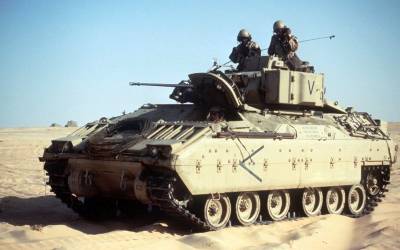
In the 1970s, middle eastern wars demonstrated that tanks without infantry screens were vulnerable to infantry with anti-tank missiles. Unfortunately, armored personnel carriers were easy prey for tanks, and sometimes had trouble keeping up with newer behemoths like the 60+ ton, 50+ mph M1 Abrams main battle tank. In response, the Americans rethought the armored personnel carrier, taking a page from the Soviet book. They created a more heavily armored, faster “Infantry Fighting Vehicle” named after WW2 General Omar “the soldier’s general” Bradley, and gave it an offensive punch of its own. M2/M3 tracked, armored IFVs can carry infantry – but they also have 25mm Bushmaster cannons, networked targeting sensors, and even TOW anti-armor or Stinger anti-aircraft missiles at their disposal.

LAND_M2_Urban_Range.jpg
Bradley puts on wear
(click to view full)

Even well-serviced vehicles must suffer the pangs of age and wear, however, and the pace of electronics breakthroughs is far faster than the Army’s vehicle replacement cycle. The US Army plans to keep its Bradley fleet for some time to come, and new technologies have made it wise to upgrade part of that fleet while renewing the vehicles. Hence the remanufacture program, which complements the restore-only RESET programs DID has covered elsewhere.

This free-to-view DII Spotlight article explains the differences between the Bradley variants involved, details the re-manufacture process, offers additional research sources, and covers associated contracts from FY 1999 to the present. Including the latest award, a $30+ million order for transmissions…


The 2006 Saudi Shopping Spree: $2.9B to Upgrade M1 Abrams Tank Fleet

20-Sep-2009 12:10 EDT  |  Related Stories: Americas - USA, Contracts - Intent, Force Structure, General Dynamics, Support Functions - Other, Tanks & Mechanized

LAND_M1A1_Desert_Overwatch.jpg
M1A1 Abrams
(click to view full)

On July 28/06, the US DSCA informed Congress [PDF format] that Government of Saudi Arabia wishes to purchase 58 M1A1 Abrams tanks, then upgrade these M1A1s along with its existing 315 M1A2 Abrams tanks to the M1A2S (Saudi) Abrams configuration. The sale will include kits, spare and repair parts, communications and support equipment, publications and technical data, personnel training and training equipment, contractor engineering and technical support services and other related elements of logistics support. The estimated cost is $2.9 billion. This contract also dovetails well with their recent $276 million Cooperative Logistics Supply Support Agreement, which ensures support and spare parts for their American-made land equipment.

This proposed M1 Abrams sale and upgrade program will be executed in 3 phases, and has begun to attract contracts…

Continue reading…


Digital Abrams: The M1A2 SEP Program (updated)

20-Sep-2009 11:21 EDT  |  Related Stories: Americas - USA, Contracts - Awards, Contracts - Modifications, Delivery & Task Orders, Electronics - General, FOCUS Articles, General Dynamics, New Systems Tech, Other Corporation, Simulation & Training, Tanks & Mechanized

LAND_M1A2-SEP_Motoring.jpg
M1A2 SEP
(click to view full)
DII

America’s M1 Abrams tanks come in a number of versions. In addition to the M1A1 that is now standard, the US Army is beginning to field its M1 TUSK for urban warfare. It also operates the M1A2 System Enhancement Program (SEP), currently the most advanced standard variant.

The M1A2 SEP is builds on the digitized M1A2 platform with an improved armor package of third generation steel-encased depleted uranium armor, a new command and control system, second-generation FLIR thermal sights that include a Commander’s Independent Thermal Viewer (CITV) for “hunter-killer” operation, the Under Armor Auxiliary Power Unit (UAAPU) that lets crews run key electronics without running the engine, and a Thermal Management System (TMS – i.e. air conditioning for crew & electronics). The M1A2 SEP also features enhanced electronics like color maps and displays, improved networked communications, high-density computer memory and increased microprocessing speed, a more user friendly “Soldier Machine Interface (SMI)”, and an open operating computing system that will make future upgrades and additions easier.

This DID article covers the M1A2 Abrams SEP upgrade program, and will be updated and backfilled as new contracts are issued and key events take place. New materials will be noted in green. The most recent additions are a CROWS-II RWS order, and a number of RESET contracts…


Images on Defense Industry Daily

Defense Industry Daily does not own the rights to the images displayed on our site. We use images under "fair use" copyright doctrine, from public sources and private organizations, or use images under Creative Commons/ GNU licenses that make them available to the general public, or with explicit and noted permission. All rights remain with the original image owners.

If you believe that a DID image may violate these conditions, please discuss it with us via an email to editorial@defenseindustrydaily.com

The sizes displayed on DID are the only sizes we have to offer.


Close