


(click to view full)
Raytheon Co. in El Segundo, CA received a maximum $48.7 million firm-fixed-price sole-source contract for spare AN/APG-73 radar systems and parts for the U.S. Navy F/A-18C/D Hornet fighter aircraft. Raytheon will perform the work in California, Massachusettes, Mississippi and Texas. There was originally 1 proposal solicited with 1 response. The date of performance completion is July 2012. Defense Logistics Agency Procurement Operations in Philadelphia, PA manages the contract (N00383-07-G-700H-TBD).
The AGP-73 radar is still in wide use, hence the radar’s Phase II upgrades. It’s being replaced in newer planes by the next-generation AN/APG-79 AESA…
(click to view full)
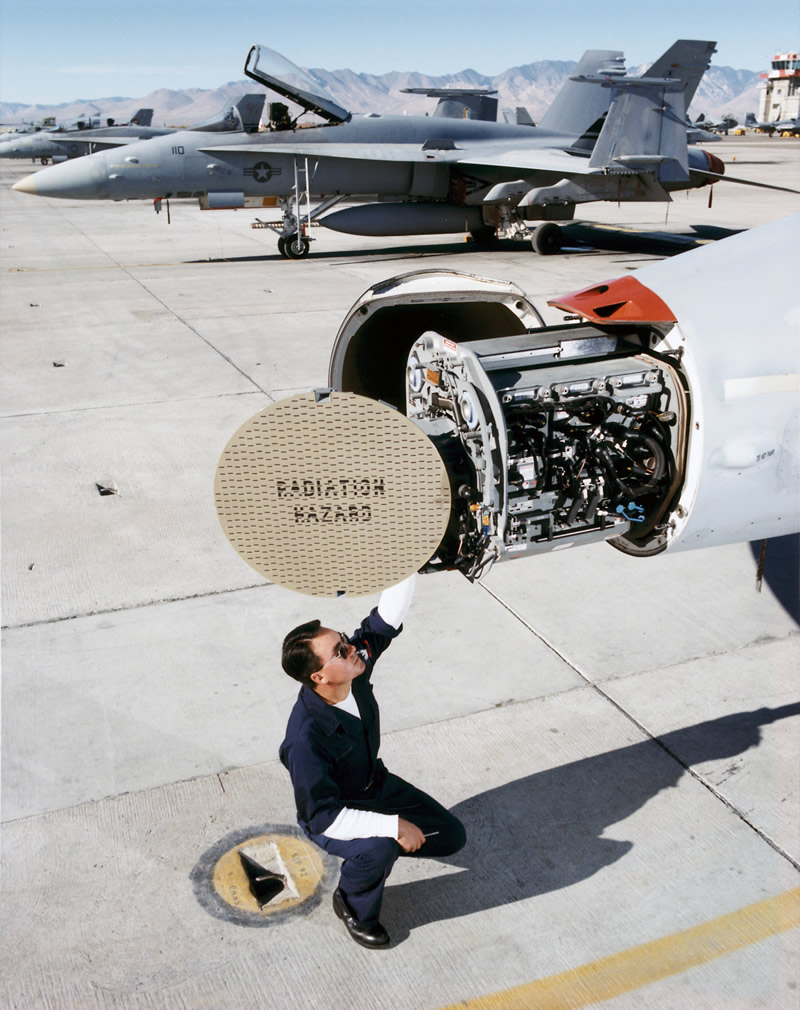
The APG-73 is an all-weather, multimode, multiwaveform search-and-track sensor that uses programmable digital processors needed for both air-to-air and air-to-surface missions. It is an upgrade of the AN/APG-65 that provides higher throughput and greater memory. The APG-65 equipped original F/A-18 Hornet fighters, and still serves in that capacity with some air forces.
The most modern APG-73 Phase II upgrade incorporates a motion-sensing subsystem with reconnaissance software, a stretch waveform generator module, and a special test equipment instrumentation and reconnaissance module. With these enhancements, the F/A-18 aircraft have the hardware capability to make high-resolution radar ground maps comparable with those of the F-15E and the U-2 aircraft, and be able to perform precision strike missions using advanced image correlation algorithms.
Raytheon lists the APG-73 as operational in U.S. Navy F/A-18 C/D Hornets and E/F Super Hornets; U.S. Marine Corps F/A-18 A+, C and Ds; upgraded F/A-18 A/Bs flown by Australia and Canada; and in the F/A-18 C/Ds flown by Finland, Malaysia, and Switzerland.
For the F/A-18E/F Super Hornets, the Navy is introducing the next generation AGP-79 Active Electronically Scanned Array (AESA)radar. Production planes now ship with the APG-79, and older aircraft are being retrofitted. Unlike the “mechanically scanned” APG-73, the APG-79’s AESA array is composed of solid-state transmit and receive modules that are fixed in place, eliminating a common cause of breakdowns and providing numerous other advantages. Other system components include an advanced receiver/exciter, ruggedized commercial-off-the-shelf (COTS) processor, and power supplies. With its novel structure, it changes what the aircrew can do with the radar – and does so in a smaller, lighter package.
“APG-79 AESA Radars for Super Hornets” has an in-depth examination of the APG-79 radar.