
(click to view full)
Australia has moved ahead on a number of fronts to bolster its forces in the field with unmanned aerial vehicles. At the squad level, Elbit Systems’ Skylark IV mini-UAVs provide immediate surveillance capabilities. For longer and wider-ranging surveillance, the JP129 competition resulted in additional orders for IAI’s I-View 250, via a partnership with Boeing Australia.
Recently, the ADF began contracting with Boeing for additional UAV services. The ScanEagle UAV has proven to be very popular with the US Marines and Navy, has been fitted with sniper spotter and WMD-detection packages, and can be deployed from ship or ashore. Boeing has received contracts to work alongside the ADF and operate the UAV in Iraq – and now, in Afghanistan as well.

(click for alternate view)
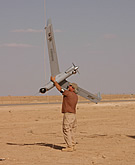
Originally developed as a commercial venture by Insitu Inc. to help fishing boats track tuna schools and dolphins, the ScanEagle’s combination of range, long loiter time, and small logistical and operational footprints makes it somewhat unique. ScanEagle is launched autonomously via a pneumatic wedge catapult, and flies pre-programmed or operator-initiated missions guided by GPS and its onboard flight control system. Like the parachute-landed I-View, ScanEagle has an all-terrain recovery system; it uses a “Skyhook,” in which the UAV catches a rope hanging from a 50-foot/ 15 meter high pole. The patented system allows ScanEagle to be runway-independent and operate from rough terrain or ships.
The ScanEagle requires fewer people and less support than other long-endurance UAVs like the MQ-1 Predator that require a runway, C-130s to transport the system, and a large logistical “tail” of technicians, operator, and maintenance. The aircraft, launch system, skyhook, personnel, et. al. can be carried in just 4 HMMWV jeeps.
Unlike mini-UAVs, this 4-foot aircraft with a 10 foot wingspan can keep its sensors on a pre-set target or flight path for 10-15 hours without requiring operator intervention. That’s over twice as long as Australia’s I-View 250 system, let alone the smaller Skylarks.
Boeing partnered with Insitu to bring their UAV to the military marketplace and provide support, and the firm already provides contractor support in-theater for the US Marines and Navy. Creating a similar arrangement with Australia was not a big stretch for them.
Contracts & Key Events

(click to view full)
March 16/09: Boeing’s two-fer. Australia’s Project JP129 failure has created an opening for Boeing’s ScanEagle UAV, but its flagship “Wedgetail” E-737 AWACS faces questions. Boeing responded by linking 2 birds with one datalink: a live demonstration in which a not-yet-delivered Wedgetail aircraft flying over Washington State, USA controlled and received sensor data from 3 ScanEagle UAVs.
The 3 ScanEagles were launched from Boeing’s Boardman Test Facility in eastern Oregon, approximately 120 miles/ 190 km away from the airborne Wedgetail. Using the company’s UAS battle-management software, airborne operators issued NATO-standard sensor and air-vehicle commands via a UHF satellite communication link and ground-station relay. Operators tasked the UAVs with area search, reconnaissance, point surveillance and targeting, while the UAVs sent back real-time video imagery of ground targets.
Boeing will conduct a follow-on demonstration for the Australian government in early May 2009 at RAAF Base Williamtown in New South Wales. A Wedgetail will take control of ScanEagles operated by Boeing Defence Australia personnel at Woomera Test Facility in South Australia, approximately 1,080 miles/ 1,730 km from Williamtown.
Feb 8/08: Boeing announces that ScanEagle UAVs have successfully delivered 10,000 surveillance and reconnaissance flight hours on behalf of Australian troops on active duty in Iraq and Afghanistan.
June 7/07: Boeing Australia Ltd. announces an A$ 20 million contract (about $16.9 million) to provide ScanEagle Unmanned Aerial Vehicle (UAV) based services to the Australian Army in Afghanistan. Throughout the 6-month agreement, Boeing Australia Limited will work closely with the Australian Army to provide vital surveillance and reconnaissance capabilities for Australian and coalition forces. The Boeing release adds that “The level of ScanEagle services to be provided will be at a significantly higher operational tempo those currently being provided for the Army’s Overwatch Battle Group in Iraq.”
Jan 05/07: Boeing Australia Limited announces an unspecified-value contract to provide reconnaissance and surveillance services to the Australian Army using the ScanEagle autonomous unmanned aerial vehicle (UAV).
The Boeing release adds that: “The services provided by ScanEagle are currently being used in southern Iraq by Australian soldiers operating with the Overwatch Battle Group (West)-2 in Operation Catalyst.”