


(click for alternate view)
Super-carriers may be cheaper than building the same amount of aircraft and mission capacity via smaller carriers, but they aren’t cheap. Just how expensive, however, has recently become an item of some debate. Speciality publications like GovExec.com, and mainstream media papers as well, have put forward figures of $13.7-14 billion for the CVN-21 Class. House Armed Services Committee Chairman Duncan Hunter [R-CA] has been quoted giving similar figures.
In the wake of DID’s anchor article covering the new carriers, Pat Dolan of NAVSEA got in touch with DID to protest those figures. She made a solid case, some minor changes were made, and DID began asking a slew of detailed questions. After all, the US Navy’s own on-line Fact File pegs the cost of a Nimitz Class carrier at $4.5 billion, but Navy representatives claim a cost of $8.1 billion per ship for the CVN-21 Class – and note that this is cheaper than building a new Nimitz Class ship! NAVSEA also claims up to $5 billion of savings over the ship’s lifetime vs. a Nimitz carrier.
How does this math square, and how specifically do the innovations in the CVN-21 Class rack up $5 billion in savings over the ship’s 50-year service life?
The CVN-21: Per Ship Costs
(click to view full)
Defense News’ May 16, 2005 article “Gauging the True Growth in Ship Costs” is a good start for those new to the general subject – and see also May 2005 Northrop-Grumman Analysis Center document [MS Word format] from which it was derived. Let’s accept these conclusions for the moment, and delve into the details of the CVN-21 project.
The derivation of the $13.7 billion figure for CVN 78 is pretty straightforward. What it is not, however, is the cost per ship in the CVN-21 Class. It has often been presented that way.
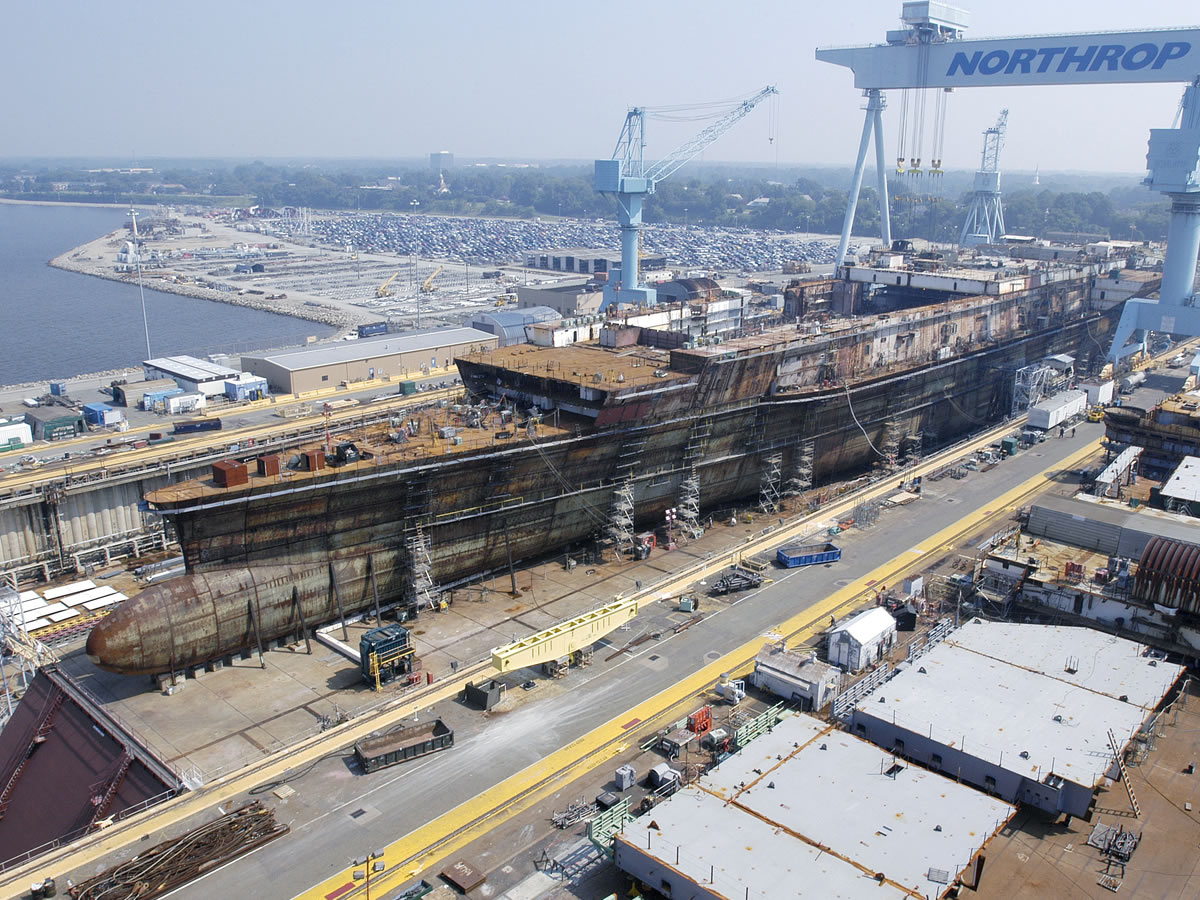
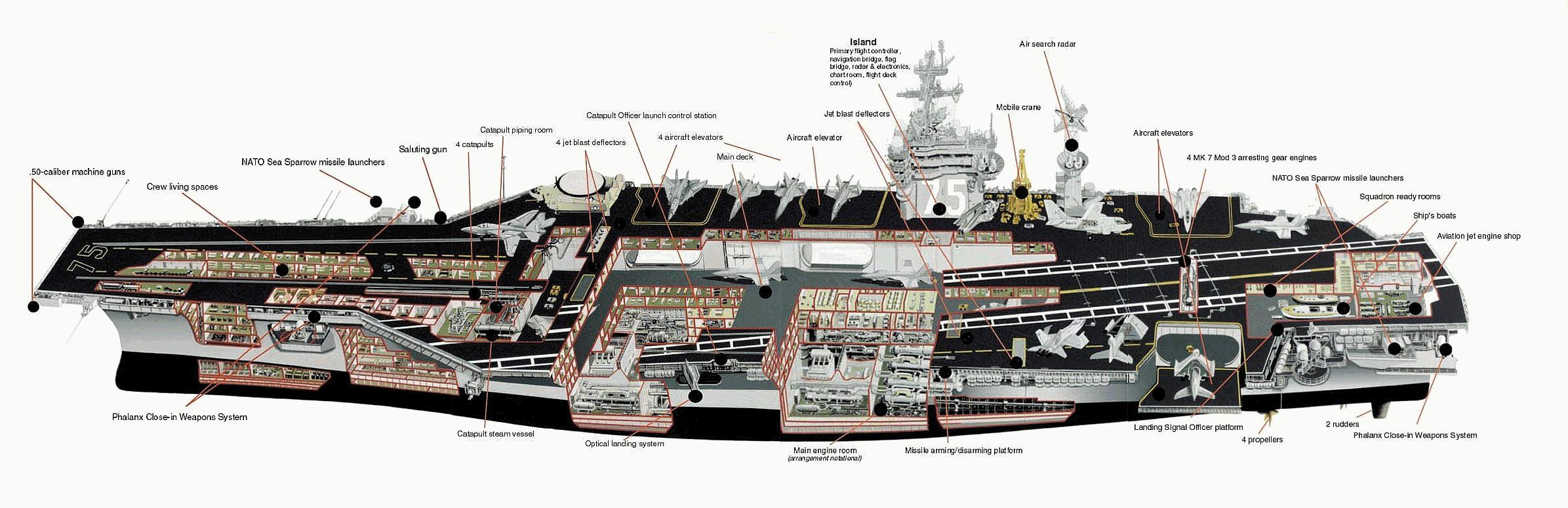
CVN-21 was based on a modernized Nimitz Class, with a number of modifications made to improve the ship’s layout and a number of new technologies. These include a nuclear reactor based on the new designs that power Seawolf Class and Virginia Class nuclear subs, an electro-magnetic launch system rather than the traditional steam catapults to get Navy jets up to flight speed in a small space, etc. DID’s earlier article details these changes, and this article’s cost savings section will explain some of their lifetime cost effects.
Design costs for these changes, improvements, their accompanying new technologies, etc. are currently estimated at $5.6 billion. Once the class as a whole is designed, however, each new carrier is estimated to cost $8.1 billion. Both of these figures are estimated in FY 2008 dollars.
Assuming no increases in non-recurring costs beyond the FY08 $5.6 billion figure, and actual construction costs as forecast, the money spent to launch the first-of-class, unnamed CVN 78 is indeed FY08 $13.7 billion ($5.6 + $8.1 billion)… but the figure is misleading because this is not the cost of each ship in the class.
We should note here that a May 2005 Congressional Research Service report noted in DID’s CVN-21 Class focus article gave different figures. Leaving out the rigamarole of normalizing all figures to FY 2008 dollars, etc., here’s the bottom line. The “Shipbuilding & Conversion, Navy” (SCN) account for CVN 78 ends up at $10.5 billion. To get a figure for subsequent ships, however, NAVSEA notes that “costs of new systems normally leave the non-recurring [one-time] costs [like design] out, so the cost to build the lead ship can be identified.”
Of that $10.5 billion for CVN 78, NAVSEA notes that $2.4 billion was spent on “non-recurring detail design.” This applies to the first ship, but carries over to the entire class since the blueprints don’t have to be reinvented each time. That leaves $8.1 billion to build the CVN 78 ($10.5 – $2.4 billion), and subsequent ships of class. After FY08 normalization and additional expenditures outside the report’s 2001-2011 time frame are thrown in, CVN-21 Class R&D works out to $3.2 billion, and so $3.2 + $2.4 = $5.6 billion for ship design and related R&D.
CVN 79, which is expected to begin construction in 2011-2012, would then be expected to have a construction cost of $7.9 to 8.1 billion in FY 2008 dollars, as NAVSEA expects the cost of follow-on ships to go down by about $100-200 million per ship due to production and workforce efficiencies.
CVN-21: The Nimitz Class Comparison, Apples to Apples
(click to view full)
The US Navy’s Fact File web page puts the cost of a Nimitz class carrier at $4.5 billion, which is hard to reconcile with the idea that a Nimitz Class CVN 78 would be over $8.1 billion. How does that math work?
NAVSEA replied that the costs on the Navy Fact File are not adjusted for inflation and contemporary costs. The $4.5B figure, they note, represents an average cost across the period of 1968-2008. The actual cost of each ship must consider the effects of inflation, and also the effects of shipyard workload.
“Inflation and shipyard workload/labor rate changes play a major role in ship construction costs. CVN 76 [USS Ronald Reagan, est. costs of $4.8-5 billion] reflect a ship procured in FY 1995. This cost does not reflect 13 years of inflation. Correcting the inflation effects alone would increase the $4.8B price to $8.0B. Shipyard workload differences would further increase this cost.”
$4.8 billion at (4% annual inflation x 13 years) does in fact work out to $7.99 billion. NAVSEA’s overall conclusion from its studies:
“The estimated cost for a repeat of the CVN 77 [DID: CRS est. absolute dollars procurement cost: $6.35B] in FY08 dollars would be $8.5B.”
Which would indeed by more than the $8.1 billion construction costs for the new CVN-21 ships, assuming all goes well.
DID also asked about development and non-recurring costs for the Nimitz Class over its lifetime. This might give us a baseline for thinking about carrier class design and innovation costs. While each Nimitz class carrier shares many commonalities, they are not cookie-cutters – each individual ship is slightly different, and over time, those differences can add up. NAVSEA replied:
“It is not possible to make a direct comparison of the development costs of the Nimitz class to the CVN 21 Class. At the time the Nimitz class was designed (1960’s), the Navy maintained significant government engineers and designers who did much of the ship design work. The cost of this work was not captured, as it is today where a contract is awarded to industry for the design.
That was interesting. It’s easy to forget how different things were.
DID also pointed out that some people even speak, unofficially, of “Theodore Roosevelt Class” carriers for USS Theodore Roosevelt (CVN 71) and beyond. As the Reagan years began, a number of design and construction changes were made following the multi-year hiatus after the order for USS Carl Vinson (CVN 70). NAVSEA:
“It is true that the CVN 71 design included structural changes, however [although] CVN 71 required more manhours to build than other ships, it was delivered in the shortest time of the ten ships. The CVN 76 [DID: USS Ronald Reagan] design included some structural changes, such as a new island structure, and an elliptical bulbous bow.
…[The US] Navy does not have historical data on early Nimitz class ship construction projections (40 years ago). The lead ship of the new class (CVN 78) will deliver in 2015. If we build 12 ships as described in our acquisition strategy report, the last ship will deliver in 2058. It is reasonable to assume that new technologies will evolve in that time, which could add great capability to future follow-on ships. At that time Navy will decide if these new capabilities warrant an additional investment in the class design. The cost estimate to build the CVN 78 in $FY08 is $8.1B, and the designs of the first three ships will remain fairly consistent.”
That should help to keep costs consistent over those first three ships. NAVSEA also added this interesting note:
“It should also be noted that four of the Nimitz class ships were contracted as two-ship buys, which saved considerable cost due to economic order quantities of material, and leveling of the workload.”
Ms. Dolan would be referring to USS Abraham Lincoln (CVN 72) and George Washington (CVN 73), ordered together in December 1982; and USS John C. Stennis (CVN 74) and United States (CVN 75, later USS Harry S. Truman), ordered together in June 1988. This approach heakens back strongly to one of the points made in Defense News’ article on ship costs, and DID’s own coverage of the effects of certainty vs. uncertainty on the shipbuilding industry. Congress, too, has a role to play in keeping weapons system costs affordable.
In addition to class lifecycle design and innovation costs, however, there is also the matter of ship operating costs over its total lifecycle. Which brings us to our next subject.
CVN-21: Where Will Expected Cost Savings Come From?

(click to view full)
CVN-21 carriers are expected to generate savings in two major ways. One is through an array of design and automation changes to various areas of the ship that reduce the required number of sailors aboard. The other is through reduction in the number of major maintenance overhauls required.
NAVSEA expects these changes to save $5 billion per ship over the ships’ projected 50-year lifetime. How does that figure?
In FY 2004 dollars, NAVSEA told DID that the average annual cost of a sailor (including both direct and indirect costs) is $90,000. Direct costs include military compensation, retirement pay accrual, separation costs, enlistment bonus, re-enlistment bonus, special pay, and other benefits. Indirect costs include recruiting, medical support, base support and admin support.
NAVSEA told DID that the US Navy is looking for a reduction of 800 sailors throughout the 50-year life span of each CVN-21 ship. DID has seen estimates ranging from 500 (Rear Adm. Dwyer in 2003) to 1,000. Even a figure of 500 sailors, however, equates to approximately $45 million per year in savings. Over 50 years, that works out to $2.2 billion in FY 2004 funds, which is slightly more in FY 2008 funds owing to inflation. A reduction of 800 sailors, meanwhile, would translate into $3.6 billion in FY 2004 dollars.
How will CVN-21 create those reductions? These cuts in manpower will come about in various ways.
A redesigned nuclear reactor based on lessons from the powerplants of the SSN-21 Seawolf and SSN-744 Virginia Class subs is expected to supply 25% more power for propulsion – but according to NAVSEA, it will require 30% less maintenance.
Removing the steam catapults and replacing them with an electro-magnetic EMALS launch system and advanced arresting gear will also reduce manning and maintenance on the ship. This works in tandem with the power plant changes, as EMALS largely eliminates the maintenance-heavy steam conduits, while allowing the 614kg of steam per aircraft launch to be put to use generating electricity. CVN-21 ships will switch to all electric auxiliaries, and Rear Adm. Dennis M. Dwyer has noted that CVN-21 will have three times the electrical power generation capability of the Nimitz Class. They may need it, if our personal experiences with power hungry electronics over the last 20 years are anything to go by; but another happy side effect of all of these changes is a 50% reduction in propulsion staffing requirements.
The accountants will appreciate reduced maintenance bilge designs, which reduce the preservation work required on the ship. More automation overall using lessons from the cruise ship industry is also expected, in order to reduce crew size requirements. Indeed, automation and crew reduction have become something of a trend in future US ship designs from the CVN-21, to the Littoral Combat Ships and the DD (X) future destroyer.
All of these changes will have the effect of reducing CVN-21 maintenance and personnel costs, in ways large and small. The other area of savings lies in maintenance.
DID also covered the recent $3.1 billion refueling overhaul and mid-life refit of the Nimitz Class CVN 70 USS Carl Vinson. Nimitz Class ships receive 1 Refueling Overhaul, 4 Drydocking Planned Incremental Availabilities,12 Planned incremental availabilities over a 50 year lifetime. CVN-21’s design changes are expected to reduce that to 1 Refueling Overhaul, 2 Drydocking Planned Incremental Availabilities (from 4), and 8 Planned incremental availabilities (from 12). NAVSEA notes that this will equate to total life cycle savings of $1.9 billion in FY 2008 dollars.
These changes also equate to an increase in ship availability. That doesn’t factor into official dollar savings, but does reduce the total dollars the US must spend, in order to have a given amount of naval airpower on call over a ship’s lifetime.
A much more modular electronics setup using commercial off the shelf (COTS) technology is also expected to improve the ship and reduce upgrade costs. DID isn’t so sure about the upgrade costs; our observed and experienced result at home and at work is that upgrades happen more frequently, which may even raise costs but will also raise average lifetime capabilities. Upgradeability can also impact complexity and maintainability, depending on how it’s handled.
A more definite IT-related savings comes from the use of flexible fiber optic wiring that can be “blown” through the ship during installation, upgraded by changing the gear attached to its ends, and even removed much more easily than copper should the need arise. Wiring problems can easily become “must fix” issues, and bandwidth limitations can easily force expensive upgrades in future if the system is inflexible. Flexibility and cost improvements in that area are welcome.
Finally, the US Navy continues to experiment in smaller ways, including improved non-skid materials for carrier flight decks. The pounding of tailhooks ands tires, and the effect of leaking oil and hydraulic fluids et. al., have meant that the materials must be repaired and/or replaced during and after every 6-month carrier deployment.
Accordingly, Texas Research International-Austin Inc. (TRI-Austin) received a Small Business Innovative Research agreement to develop a new solvent-free material called “Tough-Grip,” with lower installation costs and a 50% longer lifespan. The Navy has invested approximately $1.1 million in developing, testing and qualifying the new non-skid material, which has been applied with varying success to CVN 75 USS Harry S Truman and CVN 65 USS Enterprise.
The Navy orders $4 million to $6 million in non-skid material each year, and on top of that there are significant installation costs. If the variances can be worked out and the new coatings implemented across the USA’s carrier fleet, savings of over $100 million could be possible by 2012.
Conclusion
America’s new CVN-21 Class clearly has the potential to become a very successful acquisition program, one that pays financial and operational dividends throughout the lifetimes of its ships. The challenges before it are threefold:
(1) Contain new technology R&D costs, while delivering technology that performs.
Several of the most important money-saving innovations in CVN-21 are high R&D items. The new nuclear reactor designs and EMALS launch system, for instance, could be subject to cost growth given their unproven state. This would affect political support, but as high-payoff items there would be a solid business case for extra R&D efforts.
At the end of the day, however, these key items must end up delivering on their performance promises in everyday operation or many of the carrier’s cost and performance improvements will vanish. Ask the French what operating the CVN Charles de Gaulle Class has been like.
(2) Deliver on maintainability improvements.
US defense programs have often been sold on reduced lifecycle cost arguments that later turned out to be untrue in practice. This has been particularly true in the aerospace realm, as increased weapon system complexity actually boosted maintenance requirements and forced a large increase in centralized rather than field maintenance, thus reducing aircraft reliability/ availability.
The CVN-21’s focus on personnel reduction is a somewhat more straightforward savings approach that offers far more guarantees, and it will be possible to evaluate its effectiveness very shortly after CVN-21 is commissioned. Some other engineering improvements also have the virtue of being proven on commercial vessels or other civilian applications, and are thus low risk.
On the other hand, potential risk areas do exist and are undoubtedly being managed closely. The US record on nuclear reactor design has been excellent (esp. as compared to the French), but the new power plant is certainly one of the biggest potential technology performance/ maintenance risk areas – one that could feed into both personnel requirements and lifetime ship maintenance requirements. EMALS is another. As such, the progress of these research programs is worth watching especially carefully.
(3) Deliver on upgradeability in practice as well as in architecture.
Designing any weapons system to be able to serve effectively for 50 years is no easy task. The aircraft on it will change several times, as will its built-in weapons systems. Meanwhile, Moore’s Law will continue its relentless march on the electronics front. The carrier must adapt to all of these changes over its life cycle, and the increased dependence on electronics and automation in risks escalating maintenance requirements if any of the components prove buggy or don’t integrate well together.
The US Navy has much tighter tolerances in this area than, say, Microsoft, but the problem of rising integration complexity as the number of components increase will remain a significant challenge. As it moves toward greater modularity on all of its ships, this will have to become an even stronger competency in the future US Navy. The future US Navy may have fewer people in it, but the need for cross-training and factors like this mean that average skills level intake requirements are almost certainly going to rise.