



Both BAE Systems and EADS have confirmed that BAE has initiated a discussion on the potential disposal of BAE Systems’ 20% stake in Airbus.” Negotiations were described as being in “the very early stages”; BAE’s 20% holding is valued at EUR 3.5 billion ($4.3 billion) in EADS’s books, but The Scotsman newspaper noted that analysts expect any sale to be worth GBP 3.0-4.5 billion ($5.2-7.8 billion at current conversion). EADS adds that the initiation of these discussions does not represent an exercise of the put option held by BAE Systems in relation to this stake.
More details regarding the potential deal, its military procurement significance, and some analysis regarding both its strategic implications and BAE’s future options can be found below… along with updates as the deal progresses.
The Deal: Background Basics

(click to view full)
BAE’s association with Airbus stretches back 37 years, and BAE is selling its last commercial-aerospace holdings after a record year of plane orders for Airbus and chief competitor Boeing Co. Indeed, as DID’s coverage of BAE’s FY 2005 year-end report notes, civil aircraft were the company’s second-biggest revenue, cash and earnings contributor. Airbus contributed GBP 273 million in underlying earnings in 2005, nearly a third of BAE’s total. It also contributed sales of almost $3 billion to the British company.
Airbus employs about 13,000 people in Britain to manufacture the wings of its aircraft, but despite the recent contracting out of A350 wing assemblies to Germany, the sale of BAE’s Airbus shares will not affect UK Airbus jobs in the short term. The British government had invested more than GBP 1.2 billion in Airbus over 20 years; when the Airbus single corporate entity was formed in 2001, it naturally requested that BAE Systems and EADS put in place a mechanism to safeguard UK jobs and work. These safeguards would simply transfer to the UK government and EADS upon BAE’s sale. At this point, EADS is also reiterating its determination to continue its work in the UK over the longer term.
In addition to its civil successes thus far, Airbus’ A321 will be the base platform for NATO’s new AGS ground-surveillance aircraft, and Airbus also offers aerial refueling platforms like the A310 MRTT in limited service with Germany and Canada, and the new A330 MRTT which will be entering service in Britain, Australia – and possibly the USA as well. With the exception of the potential KC-30 order from the USA, however, these military sales are very small compared to its larger civil market successes.

Bloomberg notes that BAE’s planned sale is the third announced in Europe’s aerospace industry this week. In addition to BAE’s announcement and major EADS shareholders DaimlerChrysler, and Lagardere’s announcement that they each plan to sell 7.5% shares in EADS, Europe’s biggest military-electronics maker Thales SA announced on April 5, 2006 that it will buy Alcatel SA’s satellite division for EUR 1.67 billion ($2.03 billion at current conversion) in stock and cash. In January 2006, BAE itself divested its Atlas Elektronik sonar and naval electronics holding… which ironically went to EADS.
Richard Aboulafia of the Teal Group has expressed concerns to the International Herald-Tribune (IHT) that the combined BAE, DaimlerChrysler, and Lagardere sales totaling 35% of EADS shares may create cash issues that would affect its ongoing ability to invest heavily in R&D. If true, this could be a critical weakness given its need to match Boeing’s 777 and 787 aircraft in the market. Yet EADS’ release noted that the company “was anticipating the possibility of such a move and is fully prepared to move ahead constructively.” The IHT meanwhile, notes that the French, German and Spanish company has more than EUR 5 billion ($6.05 billion at current conversion) of cash on hand, and that many of these shares are likely to be floated on the open market. The exact structure of these deals remains to be seen.
Patience is especially good advice for observers with respect to BAE’s deal. Discussions of this magnitude will take as long as the parties believe they need to take, with no guaranteed outcome, and no commentary from the key participants until an outcome is reached.
Ongoing updates can be found here.
Analysis Op/Ed: BAE – Building A Winning Hand?

(click to view full)
Bloomberg quotes Andy Lynch, a fund manager in London at Schroder Investment Management: “They have had the right to sell the stake for several years and haven’t done it yet…” Which leads to the obvious question: why now?
Most forecasts show positive growth trends for the civil aircraft market. Airbus is the world’s biggest civil aircraft manufacturer, outselling US arch-rival Boeing and set to begin deliveries of the mammoth 555-seat A380 double-decker late this year. In fairness, some believe that the A380 super-jumbo is a cardinal strategic mistake in a world of escalating fuel prices and hence rising air travel costs. Meanwhile, he A340 faces very stiff competition in Boeing’s 777, and A350 design efforts aimed at closing the gap with Boeing’s newer 787 Dreamliner offering are preliminary at best. Some analysts quoted by the IHT simply believe that BAE is selling high.
On the other hand, Airbus will continue to enjoy significant support from its existing customer base, and Airbus Military is getting closer to a fly and field date for its A400M tactical transport. The A400M’s main competitor, the $65 million C-130J Hercules, has a 21-ton capacity that acts as a bottleneck to the transport of survivable armored vehicles; its limitations have bedeviled expensive and failed R&D efforts to make first the USA’s Stryker/IAV family of wheeled APCs and then its Future Combat Systems vehicles fully air-portable via this platform. In contrast, the EUR 100 million ($121 million at current conversion) A400M’s 40.5 ton capacity and larger space offers much broader tactical transport options and short field performance without spending $200 million on a heavier 85-ton capacity C-17 that may be about to go out of production, or buying less expensive Russian aircraft like the IL-76MF “Candid” or the giant AN-124-200 “Ruslan”. The USA’s lock-in to the C-130J program, meanwhile, ensures that absent the acquisition of Ilyushin by an American firm, none of them will have the domestic order base to justify investment in a true A400M peer competitor.
The A400M has already taken future orders away from Lockheed’s C-130 Hercules, and its combination of tactical survivability transport and international industrial strategy seems poised to do to Lockheed in tactical aerial transports what its parent did to Boeing in civil aviation.
Which leads, again, to the questions: “Why this? Why now?”
Lynch believes that the key trigger is that BAE is close to an acquisition in the US market, where it is the USA’s 7th-largest military supplier. That’s part of the equation, and it is supported by BAE CEO Michael Turner’s quote that: “We believe that now is the right time for us to divest our Airbus shareholding to allow us to concentrate on our core transatlantic defence and aerospace strategy.” This certainly has been BAE’s trend over the last couple of years – not necessarily away from Europe or at its expense, just dwarfing it in terms of the opportunities pursued.
Along these lines, removing themselves from involvement with Airbus could help BAE in three ways:
(click to view full)
One is to take BAE out of any potential line of fire in future protectionist disputes. This is insufficient in and of itself, however, as it also forgoes a great deal of revenue. “The Airbus factor” had not been a major problem for BAE thus far as it sold electronics, naval systems, and land vehicles to the Pentagon, and the A330/KC-30 partnership with Northrop Grumman is seen as having good odds in the $200 billion US Future Tanker Aircraft competition.
The second possible benefit floated in discussions is connected to BAE’s European entanglements with EADS, MBDA, et. al., and the potential for growing conflict with the US market due to escalating concerns about the potential for technology transfers to hostile regimes via French and other European partners. This has been a major sticking point in Britain’s battles around its promised exemptions to the USA’s ITAR process. That was an incidental issue for BAE as long as it was focused heavily on land systems in the US market, but acquisitions that drive BAE deeper into US markets for sensitive electronic components and aerospace would exacerbate this problem. Unfortunately, Britain’s military partnerships with EADS, MBDA et. al. remain intact. This deal won’t help BAE on that front.
As noted above, the third potential benefit is acquisition. BAE vastly expanded its US defense role in 2005 wwith its multi-billion dollar buy of United Defense LP, the makers of well known military vehicles like the M2/M3 Bradley, AAV7 Amtracs, M113, et. al. Another acquisition could also be in the offing, and names like L-3 Communications, DRS Inc., Honeywell, and others have been floated. Some analysts are debating whether BAE has a broad portfolio approach in mind, or intends to make one very major acquisition the centerpiece of its shift.
These are, I submit, questions about the periphery not the fundamentals. BAE spokesman John Neilson is reported to have specifically denied that an acquisition was in the works. BAE will “continue to look at investments that fit its strategic goals.”
OK. What might those be?
A move on this scale has to be strategic and build critical global capabilities in order to convey long-term success, and not merely stand as a geographical play. Especially since it would remove BAE from competition in one of the US military’s largest upcoming aerospace contract opportunities: its aerial tanker fleet replacement effort. This is not an opportunity to be surrendered lightly, or for uncertain cause.
As DID noted to a British reporter recently, one might begin by looking at BAE’s FY 2005 numbers, which featured sales of GBP 15.41 billion, EBITA of GBP 1.18 billion, and cash inflow of GBP 2.1 billion.
Here are the major business groups within BAE. All figures are in British pounds, and in millions unless specified as billions:
| Area | Sales | Share | EBITA | Share | Cash + | Order Book |
| Customer Support | 2.92 b | 18% | 419 | 35% | 850 | 5.0 b |
| Electronics | 3.7 b | 23% | 324 | 27% | 323 | 3.5 b |
| Comm. Aero | 3.23 b | 21% | 179 | 15% | 327 | 29.5 b |
| (Airbus) | 3.0 b | 19% | 273 | 23% | 403 | ? |
| Programs | 2.82 b | 18% | 133 | 11% | 285 | 12.3 b |
| Partnerships | 1.83 b | 12% | 109 | 9% | 17 | 5.9 b |
| Land | 1.67 b | 8% | 42 | 3% | 168 | 4.4 b |
(Figures updated to full FY 2005 from DID’s September 2005 coverage, which was BAE’s 6-month interim report, and presentation upgraded via table)
Customer Solutions & Support’s primary activities involve long term partnerships with the UK MoD’s Defence Logistics Organisation, together with the company’s extensive Al Yamamah military support activities in the Kingdom of Saudi Arabia. While its sales were not the highest, its EBITA and cash flow were. Significantly, many of its contracts are very long term and hence less cyclical.
Commercial Aerospace could be argued as BAE’s #2 or #3. While electronics outperforms it, the size of its order book and business volume make a case for it as BAE’s #2 group. Note that Airbus’ contributions to EBITA and cash inflow were higher than the group of which it was a part; indeed, its contribution to cash inflow would place it in the #2 position among BAE’s business groups. Hence its break-out appearance in our table.
Electronics, Intelligence & Support undertakes projects like aircraft avionics, network-centric weapons systems and communications, geopositioning software, IT contracts for the FBI, and defenses against shoulder-fired missiles for both military and civilian aircraft. It could easily be argued to be BAE’s #2 line of business, with very good contributions to EBITA and cash flow.
Whatever BAE does next, however, it needs to strengthen its #1 business line in Customer Solutions & Support. This backstops another trend DID has been covering – namely, its long-term “life-cycle contracting for availability” maintenance and support arrangements for critical platforms in Britain’s military arsenal.
This is basic corporate strategy – you don’t generally sacrifice your #2 to boost your #3, or a peer group whose future volume is less certain. You sacrifice it only to boost your #1. Such an opportunity may exist.
(click to view full)
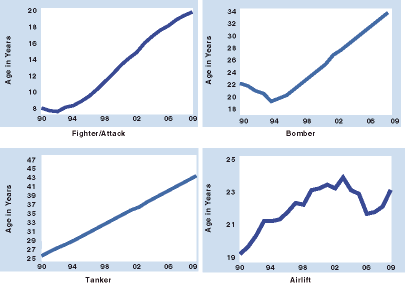
The average age of the USA’s military aircraft fleet will continue to increase even if the Pentagon were to get all it wanted in terms of existing projects, which is itself a dubious assumption. As this trend continues, preservation and maintenance efforts for aircraft like the P-3 Orion, B-52 Stratofortress, KC-135 aerial tanker, et. al. will be breaking new ground in the history of flight due to these platforms’ anticipated ages. BAE execs have undoubtedly seen those figures, and noted the rising averages in many other groups including tactical fighters.
Nor is the USA the only nation with this problem. DID has covered similar issues being faced by Canada and South Africa, but given the rising costs of weapons systems and shrinking budgets, the issue is nearly universal throughout the Western world. Universal, significant – and rising in importance.
If BAE acquires a solid US player in the aircraft maintenance field – which L-3 definitely is – and can combine that with their unique “life-cycle contracting for availability” expertise from Britain, they’d be uniquely positioned to address that growing market need in the USA, Europe, and beyond. Indeed, the result could be a world-leading corporate competency. As a bonus, L-3 would also strengthen BAE’s #3 area, which is electronics.
That’s a potential payoff which may be worth the sacrifice of Airbus civil and A400M revenues. Now, this payoff may be pursued via an L-3 acquisition or a portfolio approach; nevertheless, DID submits that the effects BAE needs to aim at have a lot less inherent variability than its specific acquisition options or approaches.
Additional Readings & Updates:
* DID (updated Oct 6/06) – BAE Exercising Its ‘Put Option’ Re: Airbus. The sale was eventually completed; DID covers the entire sequence from announcement, through audits, to BAE’s assessment and shareholder approval.
* Patrick Hosking, The Times (April 8/06) – Has BAE misjudged its exit from Airbus?
* Leeham Co. LLC (April 13/06) – EADS net cash at 5bn Euros; how will it finance BAE stock buy? [PDF] EADS answers interview questions, leaving Leeman Co. more concerned than ever.