

(click to view full)
The long-range C-17 Globemaster III heavy transport aircraft remains the backbone of US Air Mobility Command inter-theater transport around the world, and its ability to operate from shorter and rougher runways has made it especially useful during the Global War on Terror. Recent buys by Australia, Britain, and Canada have broadened the plane’s its global use. Now NATO, who has relied on the SALIS arrangement and its leased super-giant AN-124s from Russia, is looking to buy and own 3 C-17s as NATO pooled assets with multinational crews. Participating countries will receive allocated flight hours relative to their participation, and thus far they include 12 nations: Bulgaria, Estonia, Finland, Hungary, Lithuania, the Netherlands, Norway, Poland, Romania, Slovenia, Sweden, and the United States.
This order will not materially change the coming shut-down of C-17 production, but it does look like the inauguration of a pool that will fill a gaping hole in Europe’s defense capabilities – its complete lack of heavy airlift. This article covers NATO C-17 acquisition program, including its structure and ongoing announcements.
The program now has an adequate name, as NATO SAC has signed a contract, all 3 aircraft have been delivered, and SAC C-17s have been busy on missions for a couple of years now.
The NATO C-17 Pool

headed to Afghanistan
(click to view full)
An international consortium made up of NATO allies is forming the NATO Strategic Airlift Capability (NSAC) consortium; the ownership entity will be a chartered NATO Weapon System Partnership (WSP) of allied nations, and the NATO Maintenance and Supply Agency (NAMSA) will administer the WSP. Many observers believe that this pool will probably expand as additional aircraft (probably Airbus A400Ms) roll off of future active production lines. Defense Aerospace has a pair of compilation articles with releases for the initial announcement.
The following NATO nations have been members of the NSAC initiative: Bulgaria, Czech Republic (not an MoU signatory), Denmark (dropped out), Estonia, Hungary, Italy (not an MoU signatory), Latvia (not an MoU signatory), Lithuania, Netherlands, Norway, Poland, Romania, Slovakia (not an MoU signatory), Slovenia, and the United States. Sweden and Finland, both Partnership for Peace Countries, are also SAC Members.
Membership in the airlift fleet remains open to other countries, upon unanimous agreement of the consortium members.
Under the current plans, NATO will buy 2 C-17s under Foreign Military Sales (FMS) through the NATO Airlift Management Agency. The USA will buy a 3rd aircraft. NAMA will also join the C-17 Globemaster III Sustainment Partnership, which provides support all in-service C-17s around the world. The first C-17 was originally scheduled to be delivered to NATO by the middle or end of 2007, but that was moved back to mid-2008, then to late 2008, and finally to July 2009. The 2nd and 3rd planes will be delivered in September and October 2009, respectively.
The plan was an initial operating capability by July 27/09, which happened on time, and full operating capability in 2009-2010. All 3 aircraft were in place for FOC by the end of 2009.

(click to view full)
The C-17s are configured to the same general standard as C-17s operated by the US and the UK Royal Air Forces, including night flying and air-to-air refueling capabilities (this means Block 17 standard, in all likelihood). The crews and maintenance personnel will be multinational, drawn from the participating countries and trained to the agreed mission profiles and standards. The planes may be used for whatever purpose the member countries desire, within their allocated flight hours.
Shares of the 3-plane fleet’s expected 3,165 flight hours will be proportional to financial contributions. For instance, the USA has provided roughly 30% of the funding, will use 30% of the annual flying hours and has committed 41 Airmen, which is about 30% of the Heavy Airlift Wing’s 131 total positions. In contrast, the Dutch MvD is a proportionally smaller contributor; they expect 500 flight hours per year, in exchange for about EUR 10-15 million per year over 30 years.
The aircraft were originally slated to be based alongside American C-17s at Ramstein air base in Germany, but NATO decided to run SAC from Papa Air Base instead, a reserve base in NW Hungary near Austria. This was a political decision, as Ramstein has already undergone significant NATO-funded infrastructure upgrades required to support operation of C-17s and other large aircraft. Acting as the NATO C-17 base would have qualified Ramstein for further NATO Security Investment program funding, however, and that is surely true of Papa in Hungary as well.
The Hungarian Air Force will manage the airfield, air traffic control operations, and base infrastructure support. NATO’s multinational HAW crews will handle front line duties, while a Boeing team provides backup, materials management, and depot maintenance support, under the C-17 Globemaster III Sustainment Partnership program.
Contracts, Notifications & Key Events
2009 – 2014
Final delivery; 1st mission; GISP contracts for support.
(click to view full)
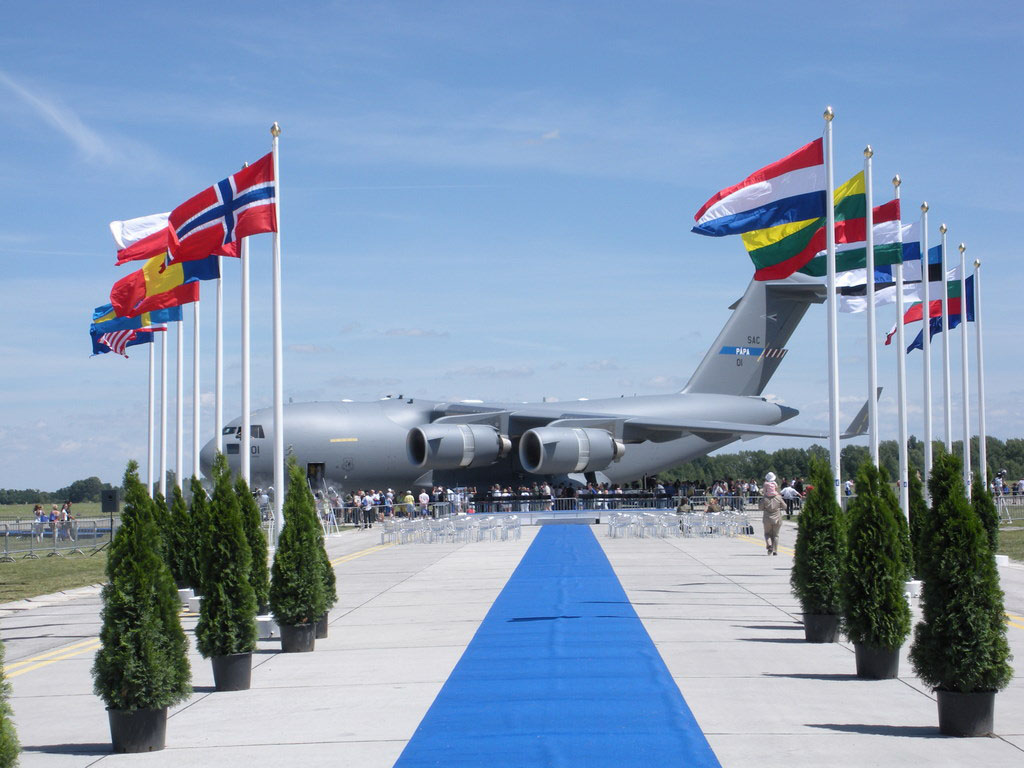
Jan 29/14: Infrastructure. The SAC Heavy Airlift Wing inaugurates an 1,800 m2 Interim Cargo Facility at Papa AB, Hungary. Really, it’s just a tent with aluminum support structure and heating and ventilation, fencing, a vehicle maneuvering area, and roads connecting the facility to the taxiways of the base. Despite these limits, a covered and semi climate controlled facility is a notable step forward for the base, which needs that sort of capability to route and shift incoming supplies.
The HUF 282 million ($about 1.3 million) project was designed by local firm UVATERV Zrt., and carried out by STRABAG Zrt. Source: Heavyairliftwing.org, “Strategic Airlift Capability Interim Cargo Facility Inaugurated for Use at Pápa Air Base, Hungary”.
Nov 13/13: SAC’s 3 Boeing C-17As break the 12,000 flight hour mark during a combined Finnish, Swedish and Norwegian combined mission.
Since its launch in July 2009 the Heavy Airlift Wing has carried out over 840 missions delivering over 36,220 tons (79.9 million pounds) of cargo and carrying over 47,000 passengers. 2013 alone is expected to reach 3,165 annual flying hours. Sources: HeavyAirliftWing.org, “Strategic Airlift Capability Heavy Airlift Wing C-17 Fleet Reaches 12.000 Flying Hours”.
April 17/13: The US DSCA announces [PDF] an official export request from the NATO Airlift Management Program Office (NAMO) for follow-on contractor logistics support, to include participation in the C-17 Global Reach Improvement Program, alternate mission equipment, publications and technical data, spare and repair parts, support equipment, personnel training and training equipment, and other forms of US Government and contractor technical assistance.
The estimated cost is $300 million, and Boeing in Huntington Beach, CA is the prime contractor. This won’t be blocked in Congress, but as a NATO request, the deadline to do so is only 15 days instead of 30.
DSCA: GISP support request
November 2012: Full Operational Capability declared for the Heavy Airlift Wing. Sources: HeavyAirliftWing.org, “Strategic Airlift Capability Heavy Airlift Wing C-17 Fleet Reaches 12.000 Flying Hours”.
Oct 3/11: New GISP. Boeing in Huntington Beach, CA receive a maximum $11.75 billion indefinite-delivery/ indefinite-quantity contract for the C-17 Globemaster III Integrated Sustainment Program (GISP). Discussions with Boeing explain the major shift underway. In January 2010, the USAF approved a 10-year Justification and Approval (J&A) request for Boeing to provide continued, sole source lifecycle support to the C-17 fleet from FY 2012 through 2021. This is that contract. It switches from GSP to GISP because it’s a partnership with the USAF, one that brings their depots into the arrangement.
About $1.175 billion of this contract will be managed by the USAF as a Foreign Military Sales agent for Australia, Britain, Canada (“CC-177”), NATO Strategic Airlift Capability, Qatar, and the United Arab Emirates. The missing C-17 customer is India, who signed their own long-term deal for their initial fleet of 10 planes.
The Product Support Integrator lead role will actually transition to the Warner Robins Air Logistics Center (ALC), GA, but Boeing will maintain a significant role for both domestic and international customers. Support shall include, but not be limited to: program management; sustaining logistics; material and equipment management; sustaining engineering; quality assurance; depot level aircraft maintenance and modifications; F117 jet engine management (the engines are bought separately from the planes); long-term sustainment (LTS) planning; field services, unique foreign military customer services, and Air Logistics Center Partnering Support. The level of support required will be outlined in individual task orders, which will spend from this pool of funds, up to the maximum. The Aerospace Sustainment Directorate Contracting Section at Robins AFB, GA manages this contract, and acts as the FMS agent (FA8526-12-D-0001).
Support shifts to GISP contract
Oct 22/10: Boeing receives a $64.6 million contract modification, covering for the continued performance of the C-17 Globemaster III sustainment partnership for NAMA (NATO) and Qatar. At this time, $32.5 million has been obligated (FA8614-04-C-2004).
Oct 7/09: SAC 03. Boeing delivers the 3rd and final C-17 Globemaster III to the NATO Airlift Management Organization (NAMO), as the final plane in the 12-nation Strategic Airlift Capability (SAC) initiative’s initial purchase. Boeing release.
All 3 delivered
Oct 6/09: Support. A $61.1 million contract to exercise the FY 2010 option for the continued performance of the C-17 Globemaster III Sustainment Partnership for North Atlantic Treaty Organization Airlift Management Agency aircraft. At this time, $28.8 million has been obligated (FA8614-04-C-2004, P00337).
Sept 28/09: 1st mission. NATO’s Strategic Airlift Capability (SAC) conducts its first mission, delivering supplies for Swedish troops in Mazar-e Sharif, Afghanistan. Sweden has contracted for 550 SAC flight hours per year. NATO release | Aviation Week.
1st SAC mission
Sept 17/09: SAC 02. Boeing delivers SAC 02 to the NATO Airlift Management Organization (NAMO) at Boeing’s final assembly facility in Long Beach, CA. SAC 02 arrives at Papa AB on Sept 21/09. Boeing intends to deliver SAC 03 in early October 2009, completing the existing order. Boeing.
July 27/09: Activated. NATO’s Heavy Airlift Wing activates as an operational unit, as SAC 01 arrives at Papa AB.
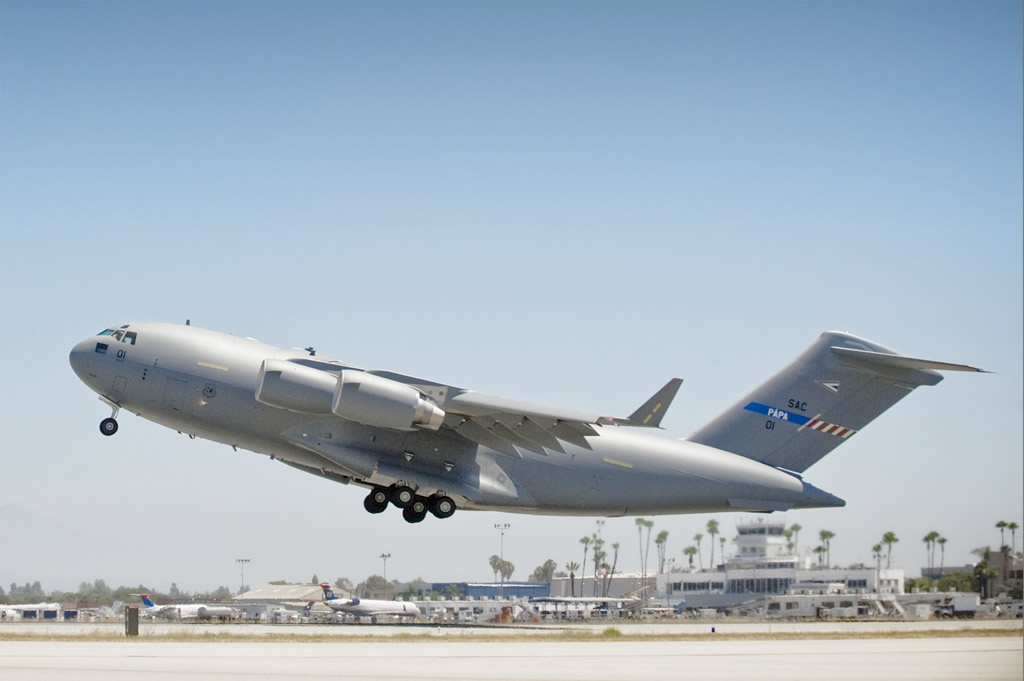
July 14/09: SAC 01. NATO’s multinational Heavy Airlift Wing commander Col. John Zazworsky, USAF, takes delivery of its first C-17 Globemaster III in Long Beach, CA. “SAC 01” then takes off, beginning its flight to Charleston, SC on the way Papa AB in Hungary, with pilots from Norway, Sweden and the USA at the controls.
The USAF estimates that the wing will fly about 630 hours before the end of 2009, with some of those hours logged on SAC 02 (September 2009) and SAC 03 (October 2009). In 2010, the wing expects more than 3,100 flight hours. USAF | Boeing | Flight International.
1st delivery, unit operational
June 5-15/09: France. With a fleet of aging C-160 and Lockheed Martin C-130H tactical transports that continue to see heavy demand, French Defense Minister Hervé Morin is quoted as saying that the government has expanded its stopgap options. France has also approved the modernization of its 10 newest C160 Transalls so they can remain in service until the first A400Ms arrive, which is now expected to happen in 2014-15.
Other possibilities for France include leased or purchased C-130Js, stepped up per-hour leasing of Russian AN-124s under NATO’s SALIS pool, per-hour C-17 leasing under NATO’s SAC pool, acquisition or lease of EADS’ smaller C-295Ms, or advancing their planned Airbus 330 MRTT aerial tanker & transport buy.
These interim options group themselves by tradeoffs. Some contenders (C-295M, A330 MRTT) lack the reinforced floors required for dense tactical loads like armored vehicles. Others (AN-124, A330 MRTT, C-17s to lesser extent) require longer runways. Range and refueling capability are potential issues for some (C-295M, some C-130Js), while maintaining overall fleet strength and front line airlift availability is a concern in other cases (AN-124/ C-17 time-shares, A330 MRTT to some extent). Aviation Week | Defpro | Bloomberg News.
March 13/09: Industrial. Boeing announces the “major join” ceremony for the SAC consortium’s first C-17. During major join, the C-17 airlifter’s 4 major sections (forward/ center/ aft fuselages. and wing assembly) are put together.
Jan 12/09: UK. British Defence Secretary John Hutton declares that the 3-4 year delay in fielding the Airbus A400M is unacceptable, and will create too much stress on the existing fleet. With first flight of the A400M now expected in 2013, no production planned before that milestone, and the possibility of changes to the A400M’s range and carrying weight, Lockheed Martin is moving to sell smaller C-130Js to disappointed countries as an interim solution.
In every crisis, however, there an opportunity, and NATO SAC participation would be another option. Read “A400M Delays Creating Contract Controversies” for updates, and further details.
2008
NATO orders 2, 3rd coming from USA; NATO Heavy Airlift Wing created; Italy out.

(click to view full)
Nov 29/08: Dutch Defence State Secretary Jack de Vries proposes to funnel EUR 70 million into the NATO SAC program, from his military’s personnel shortage savings of EUR 90 million. The other 20 million will cover higher than expected fuel prices. NIS news.
Nov 24/08: Boeing announces that the NATO Airlift Management Agency (NAMA) general manager, on behalf of the Strategic Airlift Capability (SAC) nations, has signed a Letter of Offer and Acceptance with the U.S. government to buy 2 Boeing C-17 Globemaster IIIs.
Contract for 2
Nov 10/08: EDA A400M pool. Aviation Week reports that 12 European Defense Agency (EDA) member countries have agreed to pool airlifter resources in the future, with the focus on the new Airbus A400M. A formal letter of agreement is due in 2009 from existing A400M customers Belgium, France, Germany, Italy, Luxembourg, and Spain; as well as prospective customers the Czech Republic, Greece, the Netherlands, Romania, and Slovakia.
The Netherlands and Romania are the only overlapping NATO SAC participants. Initial operational capability is planned for 2014, with full operational capability planned for 2017. The scope of this cooperation, and number of aircraft involved, has yet to be worked out. See also: “European Air Transport Command Agreement Signed.”
Nov 4/08: Italy out. Defense News reports that Italy has pulled out of NATO’s SAC C-17 pool, after indicating a need for up to 300 flight hours per year during initial planning. Italy’s 2008 defense budget is set to slash investment/procurement by over 20%, and it has already opted not to participate in the F-35 test program despite its status as a Tier 2 partner. Giovanni Gasparini of the IAI think tank in Rome:
“Italy was favorable, but the funds are not there and it has withdrawn from the starting lineup… It is not a good sign. We are effectively sending a signal that we will not always support commitments to NATO.”
The Italian Air Force will be inducting 4 Boeing KC-767A tanker/transports into the fleet, which will enhance some forms of strategic lift capability but cannot carry heavy equipment. Leased Russian AN-124 aircraft under NATO’s SALIS program will remain the country’s main option, with a secondary option of trading flight hours involving its KC-767A, C-130, and C-27J aircraft with other countries. NATO said it remained open for other members to join the SAC in the future, if conditions change.
Italy out
Oct 1/08: The 12 participating nations complete the signature of the SAC Memorandum of Understanding (MOU), bringing the Charter of the NATO Airlift Management Organisation (NAMO) into force. Under the agreement with the U.S. Department of Defense and the NATO Airlift Management Agency, 2 of the aircraft will be purchased from Boeing by NAMA, while a 3rd aircraft will be provided by the U.S. Air Force.
A NATO Heavy Airlift Wing (HAW) will now be created, under the initial command of a US Air Force officer with a Swedish Deputy Commander, and eventually manned by international crews from the participating nations. The 1st aircraft is anticipated to be delivered in Spring 2009, and the 2nd and 3rd aircraft are expected to arrive at Papa AFB, Hungary in Summer 2009. NATO release | Boeing release.
SAC memo signed, wing created
Aug 8/08: Despite hopes for an agreement by he end of June, an American Forces Press Service article notes that the service is still “a few signatures away…” See also USAF release.
June 12/08: A NATO release states that the 15 SAC nations have agreed to purchase 3 C-17s. The DSCA request was only for 2 Globemasters, but it is generally believed that the USA will contribute 1 airplane.
The NATO announcement also confirmed that the USA, the Netherlands, and Slovenia have all signed the SAC Memorandum of Understanding, joining Bulgaria, Hungary, Lithuania and Sweden. Other SAC nations are expected to join the signatories by the end of June 2008.
3 C-17s agreed
May 9/08: The US DSCA(Defense Security Cooperation Agency) notifies Congress [PDF format] that NATO’s Strategic Airlift Capability (including Finland and Sweden) wishes to purchase 2 Boeing C-17 Globemaster III aircraft with 4 Turbofan F117-PW-100 engines installed on each aircraft (8 total), AN/ALE-47 Counter-Measures Dispensing System (CMDS), AN/AAR-47 Missile Warning System, Government Furnished Equipment, spare and repairs parts, pyrotechnics, flares, other explosives, Global Positioning System security devices, crew armor, mission planning system software, COMSEC(COMmunications SECurity) equipment and support, supply support, training equipment and support, publications and technical data, U.S. Government and contractor technical assistance and other related elements of logistics support. The estimated cost is $700 million.
This is a drop from the 4 C-17s in the December 2006 DSCA request, below, but it is also more money. The release adds that the 2 C-17s will partially serve NATO’s agreed military requirement for 8 “C-17 equivalents to rapidly deploy a force around the globe, including the NATO Response Force (NRF)”. The USA is expected to supply a 3rd C-17, and one wonders what the other 5 C-17 equivalent aircraft will be. Meanwhile:
“The new NATO Airlift Management Organization (NAMO) will purchase, own, and manage the aircraft. A multinational military unit to be named the Heavy Airlift Wing (HAW) will conduct airlift operations… NAMO has agreed to pursue basing the C-17s at Papa Air Base, in Hungary… Papa AB has already undergone significant NATO-funded infrastructure upgrades required to support operation of C-17s and other large aircraft, and this capability will qualify Papa AB for further NATO Security Investment program funding.”
Key contractors are Boeing in Long Beach, CA and United Technologies Cooperation subsidiary Pratt & Whitney Military Engines in East Hartford, Connecticut. Additional subcontractors will also be involved via Boeing, who will also be responsible for establishing a facility at Papa AB to provide C-17 logistics support under the current Globemaster Support Partnership. The proposed plan will require approximately 7 of the personnel to be US citizens and 7 personnel to be local hires. Approximately 50 United States Air Force personnel will also be stationed with the SAC HAW at Papa AB, Hungary, and implementation of this proposed sale will require the participation of up to 10 each U.S. Government and contractor representatives for annual 2-week program management and technical reviews in Europe or the US.
DSCA: Request drops to 2 NATO C-17s
April 4/08: Latvia. Latvia’s Cabinet of Ministers (CoM) has issued a regulation that clears the way for participation in the NATO C-17 pool. Costs have gone up, as the Latvian Ministry of Defence release confirms:
“The MoD Budget 2008 has allotted 3.72 million lats [about $8.5 million] for the Latvian participation in the SAC programme. However, in accordance with the current estimations, the Latvian share of costs in 2008 will be 4,377,506 lats [about $10 million]; therefore, Amendment to Budget is required to increase the total amount of funds by at least 656,962 lats, so that Latvia can meet its liabilities set by the Memorandum of Understanding concluded in 2008.”
March 25/08: Finland. The Finnish government formally announces that it intends to join NATO’s C-17 pool, and other reports have Finland and Sweden undertaking a joint buy on behalf of the EU’s Nordic Battlegroup.
Finland’s Ministry of Defense has estimated its required usage to be 100 hours, while Sweden’s higher-pitched usage is estimated to be between 130 and 150 hours. Newsroom Finland | Defense News.
March 18/08: Sweden. Sweden presents its associated bill in the Riksdag. The country’s stated flying time requirement of in 2006 was 550 flying hours per year, and they announce that the Swedish share of flying time over a 25 – 30 year period is estimated at a maximum of SEK 200 million (about $33.4 million) per year.
Swedish participation in the arrangement is conditional on approval by the Riksdag, and the C-17 pool will not enter into force until all participating countries have signed the agreement. Swedish MoD.
March 18/08: Finland. Sweden’s Aktuelt reports that Finland, who is not a formal member of the negotiating group but has been mentioned in conjunction with the C-17 pool, is also planning to become a member. YLE news | SVT news (Swedish).
2006 – 2007
NATO finally signs Letter of Intent, makes DSCA request; NAMO & NAMA agencies set up; Denmark out.
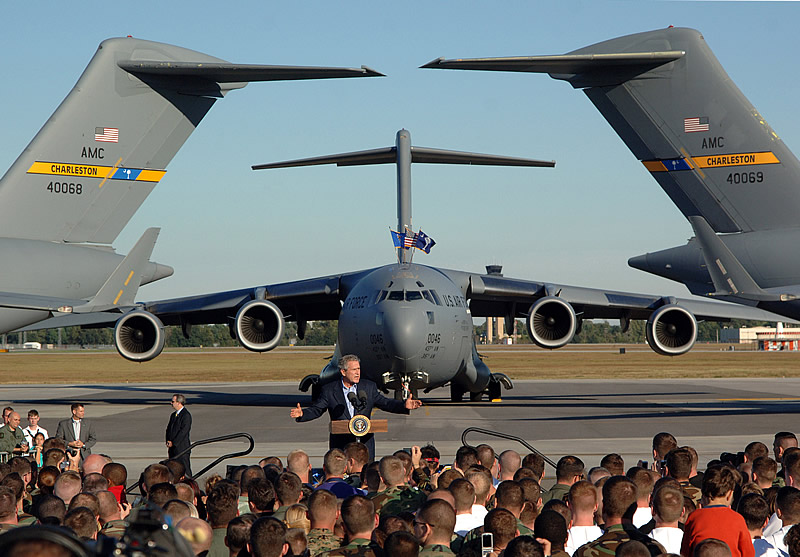
October 2007: Denmark. Denmark withdraws from the program, citing cost factors.
Denmark out
June 19/07: NATO finally agrees to set up a NATO Airlift Management Organization (NAMO) and NATO Airlift Management Agency (NAMA) to acquire and support the C-17s. The SAC plans to acquire 3-4 C-17s, and announces that the first is expected to be delivered in mid-2008. This is almost a year later than the expected date given when the original decision was made in September 2006. NATO release.
NAMA & NAMO set up
Dec 7/06: The US DSCA(Defense Security Cooperation Agency) notified Congress [PDF format] that NATO wished to purchase a set of equipment and support related to its purchase of 4 C-17s. The cost, if all options are exercised, could be as high as $589 million. This proposed sale includes up to:
* 2 spare Pratt & Whitney F117-PW-100 engines
* 4 AN/AAQ-24V(13) Large Aircraft Infrared Countermeasures (LAIRCM) Systems
* 15 AN/AVS-9 Night Vision Goggles
* Electronic Combat International Security Assistance Program software equipment
* Plus spare and repair parts, mission planning system and software, Personnel Life Support equipment, flares, COMSEC equipment, supply support, training equipment and support, publications and technical data, U.S. Government and contractor technical assistance and other related elements of logistics support for use by the to support the aircraft.
This proposed sale will involve the following contractors:
* AAI Services Corporation in Goose Creek, SC
* Boeing Company in Long Beach, CA
* Boeing subsidiary McDonnell Douglas Training Systems in St. Louis, MO
* United Technologies Cooperation, Pratt & Whitney Military Engines in East Hartford, CT
* Northrop Grumman Systems Corporation in Rolling Meadows, IL
Additional subcontractors may be needed depending on the exact nature of the contracting arrangements established. This proposed sale will require Boeing to enhance a facility at Ramstein to provide C-17 logistics support under the current GLOBEMASTER Support Partnership, and will require approximately 14 U.S. Government representatives at the facility. Implementation of this proposed sale will require the assignment of up to 8 each U.S. Government and contractor representatives in country for annual participation in training, program management, and technical review.
DSCA: Request to buy 4 NATO C-17s
Nov 27/06: NATO Secretary General Jaap de Hoop Scheffer, the President of Latvia, Vaira V??e-Freiberga, and senior Alliance military officials attend a display of C-17 airlift capability in Riga, the day before the NATO summit. NATO’s release states that “initial operating capability is planned for the latter half of 2007, with the full complement of aircraft and full operating capability in 2009.” As of March 2008, initial operating capability is still a distant eventuality. NATO release, includes video and audio of associated speeches.
Oct 9/06: Lithuania. Lithuania announces and explains its participation, which it expects will be LTL 3 million (about $1.1 million) per year for 30 years, in return for 45 flight hours per year. The release is in English.
Sept 14/06: USA. US State Department – “NATO Allies Agree To Buy C-17 Aircraft, Reducing Airlift Shortage.” The USA’s contribution may include purchasing a full C-17 for the pool.
Sept 12/06: Netherlands. The Dutch Ministerie Van Defensie comments: “Nederland Neemt Deel Aan C-17 Initiatief.” They expect to pay EUR 10-15 million per year (about $12.5-20 million) per year for 30 years, in return for 500 flight hours per year.
Sept 12/06: A Letter of Intent (LOI) is publicly released by 13 NATO Allies to launch contract negotiations for the purchase of C-17 transport aircraft. On behalf of these nations, the NATO Maintenance and Supply Agency (NAMSA) has begun negotiations with Boeing, and the development of a formal Weapons System Partnership among the nations. NATO release.
NATO Letter of Intent
July 26/06: US State Department – “U.S. Suggests NATO Allies Could Pool Money to Buy C-17 Aircraft.”
Additional Readings
* DID FOCUS Article – The Global C-17 Sustainment Partnership. Set to public access. Describes the C-17, and the performance-based support partnership that maintains and upgrades all C-17s around the globe.
* DID (Oct 30/07) – Interactive: C-5s vs. C-17s in Washington. Includes downloadable Excel spreadsheet with Congressional Research Service figures for C-17 price, operating costs.
* DID (May 25/07) – European Air Transport Command Agreement Signed. Not related to the C-17, or NATO. It’s an agreement to share aircraft (which will mostly be Airbus A400Ms), and create a de facto EU pool alongside NATO’s. That agreement now has 12 members, only 2 of which overlap with SAC.
* NATO – Strategic Airlift Capability. A sidebar offers ongoing news.