

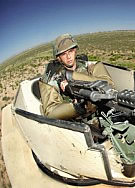
The Interceptor OTV body armor vests DID has been covering lately have proven very effective at reducing injuries; indeed, we’ve heard several reports of soldiers who only realized they’d been hit when they got back to base and noticed the bullets their armor had stopped. One side effect has been a big increase in the proportion of arm injuries, however, often damaged beyond repair due to burns and shrapnel penetration from roadside bombs et. al.
Now Gizmag reports that a new arm-armour known as the Sandia Gauntlet has now been tested in Iraq, and may offer some help. Of course, as an earlier DID article noted, the simple installation of proper gunshields per the USAF’s M1116 HMMWV, plus a transparent frontal gun shield, would also go a long way toward reducing these injuries. At any rate…
Sandia criteria were for a one-size-fits-all design with blunt trauma protection for the hand, wrist and elbow, as well as heat and blast protection.
In December, several Sandia Gauntlet sets were given to the 1-82 FA, 1st Cavalry Division out of Ft. Hood, Texas; 515th Corps Support Battalion, 720th Transportation Company; and the US Air Force 355th Logistics Readiness Squadron/CCDE. The gauntlets were then shipped to forces in Iraq for recommendations, where they were well received. Recommendations for modifications were provided to Sandia, and improvements to the prototypes were made.
The primary recommendations from the field tests included straps to hold the gauntlets in place and modifications to the forearm armor to increase flexibility and maneuverability. Army and Air Force members requested that the Sandia Gauntlets be attached in the rear (left and right sleeve) with a quick-release buckle. This allows wearers to shed the gauntlets after an initial attack if they must fight in a dismounted role. Other suggestions included adding a neoprene sleeve inside the forearm to allow for a more secure fit and placing a thumb-hole in the composite to ensure the Sandia Gauntlet rotates and moves with the lower arm. Military personnel also preferred cutting the composite back from the knuckles to the wrist, to allow the wearer more dexterity when using the Sandia Gauntlets for loading and charging a weapon system, driving or acting as an assistant driver.
Several military units have apparently inquired about the gauntlets and would like to know when they will be available for full usage.