


(click to view full)
Lockheed Martin Corp. in Grand Prairie, TX recently received a pair of different but related contracts. One was for the M142 High Mobility Artillery Rocket System (HIMARS), a cut-down, truck-mounted, C-130 transportable version of the M270 Multiple Launch Rocket System (MLRS). The other was for 227mm rockets containing the DPICM submunitions that helped earn its MLRS parent the nickname “steel rain.”
The total for both orders was $182.8 million. With respect to the specific contracts:

(click to view full)
Lockheed received a $99.9 million firm-fixed-price and cost-plus-fixed-fee contract for the High Mobility Artillery Rocket System (HIMARS). Work on this contract will be performed in East Camden, AR (77%), and Grand Prairie, TX (23%), and is expected to be complete by Feb. 28, 2008. This was a sole source contract initiated on April 1, 2005 by the U.S. Army Aviation and Missile Command at Redstone Arsenal, AL (W31P4Q-06-C-0001).
HIMARS is based on the need for a lighter weight, more deployable version of the M270 MLRS tracked vehicle, one that can fit in a C-130 Hercules and be sent anywhere in the world to provide lethal long-range rocket artillery fire. The M142 HIMARS uses the same controls, communications, and even crew as the tracked M270 MLRS launcher, but carries only one rocket or missile set on a 5-ton FMTV truck chassis instead of the MLRS’ twin setup mounted on a tracked vehicle. Unlike the M270, which requires a C-17 Globemaster III or C-5 Galaxy to transport it, HIMARS can roll on and off a C-130 Hercules transport aircraft and be ready to operate within 15 minutes of landing when carried with a combat load.
In November 2004, HIMARS successfully completed Initial Operational Test & Evaluation, and in June 2005 it entered US Army service with the 18th Airborne Corps at Fort Bragg, NC. Three prototype HIMARS launchers were successfully used in combat during Operation Iraqi Freedom, and a total procurement of about 900 launchers is planned.
(click to view full)
Lockheed also received an $82.9 million firm-fixed-price contract for the Dual Purpose Improved Conventional Munition Rocket. Work will be performed in East Camden, Ark. (80%), and Grand Prairie, Texas (20%), and is expected to be complete by Nov. 30, 2008. This was a sole source contract initiated on April 5, 2005 by the U.S. Army Aviation and Missile Command at Redstone Arsenal, AL (W31P4Q-06-C-0002).
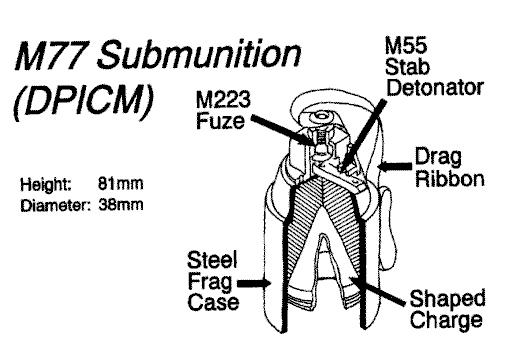
The updated 227mm M30 Guided MLRS tactical rocket has a range of around 40 miles/ 70km, and contains 404 DPICM submunitions which can be deployed to cover a 0.23 square km area when they burst in mid-air. It is this lethal grenade storm that gave the original MLRS system its nickname of “steel rain.”