08-Feb-2010 14:16 EST
Related Stories: Americas - USA, Contracts - Awards, Contracts - Modifications, FOCUS Articles, Forces - Marines, GE, Helicopters & Rotary, IT - Software & Integration, L3 Communications, Lockheed Martin, New Systems Tech, Northrop-Grumman, Other Corporation, Simulation & Training, Thales
FY 2011 budget request, $50.4 million for long lead materials. (Feb 5/10)
The US Marines’ helicopter force is aging at all levels, from banana-shaped CH-46 Sea Knight transports that are far older than their pilots, to the 1980s-era UH-1N Hueys and AH-1W Cobra attack helicopters that make up the Corps’ helicopter assault force. While the tilt-rotor V-22 Osprey program has staggered along for almost 2 decades under accidents, technical delays, and cost issues, replacement of the USMC’s backbone helicopter assets has languished. Given the high-demand scenarios inherent in the current war, other efforts are clearly required.
Enter the H-1 program, the USMC’s plan to remanufacture older helicopters into new and improved UH-1Y utility and AH-1Z attack helicopters. The new versions would discard the signature 2-bladed rotors for modern 4-bladed improvements, redo the aircraft’s electronics, and add improved engines and weapons to offer a new level of performance. It seemed simple, but hasn’t quite worked out that way. The H-1 program has encountered its share of delays and issues, but the program survived its review, and continues on into the low-rate initial production stage and Initial Operational Capability.
DID’s FOCUS articles offer in-depth, updated looks at significant military programs of record. This article covers the H-1 helicopter programs’ rationales and changes, the upgrades involved in each model, program developments and annual budgets, the full timeline of contracts and key program developments, and related research sources.
07-Feb-2010 15:45 EST
Related Stories: Americas - USA, Boeing, Contracts - Modifications, Engines - Aircraft, Europe - E.U., GE, Helicopters & Rotary, Issues - Political, New Systems Tech, Other Corporation, Policy - Procurement, Rolls Royce, Spotlight articles

(click to view full)
$122.5 million for spares and extra engine maintenance. (Feb 5/10)
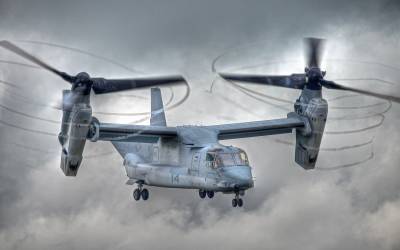
In March 2008, the Bell Boeing Joint Project Office in Amarillo, TX received a $10.4 billion modification that converted the previous advance acquisition contract (N00019-07-C-0001) to a fixed-price-incentive-fee, multi-year contract. The new contract now sits at $10.8 billion, and will be used to buy 141 MV-22 (for USMC) and 31 CV-22 (Air Force Special Operations) Osprey aircraft, plus associated manufacturing tooling to move the aircraft into full production.
The V-22 tilt-rotor program has been beset by controversy throughout its 20-year development period. DID’s “V-22 Osprey: A Flying Shame?” offers a focused look at a number of specific allegations associated with the program, with material from Pentagon test reports, critical reviews, ongoing news reports, and the US military’s responses. Despite these issues, and the emergence of competitive but more conventional compound helicopter technologies like Piasecki’s X-49 Speedhawk and Sikorsky’s X2, the V-22 program continues to move forward. This DID Spotlight article looks at the V-22’s new multi-year purchase contract, associated contracts for key V-22 systems, and program developments that arise after the contract conversion.
07-Feb-2010 12:04 EST
Related Stories: Americas - USA, Contracts - Awards, GE, Lockheed Martin, New Systems Tech, Northrop-Grumman, Other Corporation, R&D - Contracted, Transformation, UAVs

UCAS-D concept
(click to view full)
N-UCAS receives $2 billion QDR push, aims for quasi-operational status. (Feb 4/10)
In early 2006 the future of the J-UCAS program seemed uncertain. It aimed to create Unmanned Combat Aerial Vehicles (UCAV) for the USAF and Navy that could approach the capabilities of an F-117 stealth fighter. Boeing’s X-45C was set to face off against Northrop Grumman’s X-47B Pegasus, the program had demonstrated successful tests that included dropping bombs, and aerial refueling tests were envisioned.
J-UCAS was eventually canceled, but the technologies have survived, and the US Navy remains interested. A May 2007 non-partisan report discussed the lengthening reach of ship-killers. Meanwhile, the US Navy’s carrier fleet sees its strike range shrinking to 1950s distances, and prepares for a future with 11 operational carriers – but just 10 carrier air wings. Could UCAV/UCAS vehicles with longer ranges, and indefinite flight time limits via aerial refueling, solve these problems? Some people in the Navy seem to think that they might. Hence UCAS-D/ N-UCAS, which has received a major push in the FY 2010 defense review.
04-Feb-2010 19:47 EST
Related Stories: Americas - USA, Asia - India, Engines - Aircraft, Europe - France, FOCUS Articles, Fighters & Attack, GE, Issues - Political, Missiles - Air-Air, New Systems Tech, Other Corporation, Policy - Procurement, Project Management, RFPs, Rolls Royce, United Technologies

Tejas LCA
(click to view full)
India committing another $1 billion to development; engine partnership contenders expanding and evolving. (Feb 3/10)
India’s fighter strength has been declining in recent years, as the MiG-21s that form the largest component of its fleet are lost in crashes, or retired due to age and wear. Some MiG-21s are being modernized to MiG-21 ‘Bison’ configuration, while other current fighter types are undergoing modernization programs in order to maintain the fighter force until replacements can arrive. On which note, an ongoing tender has Russian, French, American, Swedish and European manufacturers dueling for the MMRCA, a multi-billion dollar, 126+ plane light-medium fighter sale.
This still leaves India without a low-end solution to the twin problems besetting its overall fleet: numbers, and age. The MiG-21bis program adds years of life to those airframes, but that extended lifespan is still quite finite; by 2020, it is very unlikely that any MiG-21s will remain. MMRCA may replace some of India’s mid-range fighters, but that still leaves replacement of the MiG-21 fleet. Hence the Tejas Light Combat Aircraft (LCA) project’s importance to the Indian Air Force’s future prospects. Choices made in the LCA’s design will also affect the lightweight fighter’s export potential, which feeds back into the overall program’s lifetime costs and viability. As time presses, however, India’s rigid domestic-only policies are gradually being relaxed, in order to field an operational and competitive aircraft.
03-Feb-2010 14:21 EST
Related Stories: Americas - Other, Americas - USA, Asia - India, Australia & S. Pacific, Boeing, Contracts - Awards, Contracts - Modifications, Delivery & Task Orders, Europe - Other, FOCUS Articles, GE, New Systems Tech, Northrop-Grumman, Other Corporation, Partnerships & Consortia, Project Failures, Raytheon, Specialty Aircraft

P-8A Poseidon
(click to view full)
FY 2011 budget request, the US Navy’s self-inflicted 6-month delay, P-8i may have air-air surveillance capability. (Jan 29/10)
Maritime surveillance and patrol is becoming more and more important, but the USA’s P-3 Orion fleet is falling apart. The P-8A emerged from the ashes of the P-7 Long Range Air ASW (Anti-Submarine Warfare) Capable Aircraft program that was begun in 1988. That program originally envisaged an improved P-3, but cost overruns, slow progress, and interest in opening the competition to commercial designs led to cancellation for default in 1990. The successor MMA program was begun in March 2000, and Boeing beat Lockheed’s “Orion 21” with a design based on the ubiquitous 737 passenger jet.
This is DID’s FOCUS Article concerning the P-8A Poseidon Multi-mission Maritime Aircraft, and it will be updated as events and contracts are announced. Filling the P-3 Orion’s shoes is certainly no easy task. What missions will the new P-8A Poseidon face? What do we know about the platform, the project team, and ongoing developments? Will the P-3’s level of global customer coverage give its successor a comparable level of export opportunities? Australia and India have already signed on, but has the larger market shifted in the interim?
02-Feb-2010 19:38 EST
Related Stories: Alliances, Americas - USA, BAE, Britain/U.K., Contracts - Awards, Contracts - Modifications, Design Innovations, ECM, Electronics - General, Engines - Aircraft, Europe - Other, FOCUS Articles, Fighters & Attack, Finmeccanica, GE, Issues - International, Issues - Political, Lobbying, Lockheed Martin, Middle East - Israel, Northrop-Grumman, Official Reports, Other Corporation, Partnerships & Consortia, Policy - Procurement, R&D - Contracted, Radars, Rumours, Security & Secrecy, Sensors & Guidance, Testing & Evaluation, Transformation

F-35A: incoming…
(click to view full)
FY 2011 budget proposals, withheld performance fees, a change in program leadership, Australian reaction. (Feb 2/10)
The $300+ billion F-35 Joint Strike fighter may well be the largest single global defense program in history. This major multinational program is intended to produce an “affordably stealthy” multi-role fighter that will have 3 variants: the F-35A conventional version for the US Air Force et. al.; the F-35B Short Take-Off, Vertical Landing for the US Marines, British Royal Navy, et. al.; and the F-35C conventional carrier-launched version for the US Navy. The aircraft is named after Lockheed’s famous WW2 P-38 Lightning, and the Mach 2, stacked-engine English Electric (now BAE) Lightning jet. Lightning II system development partners included The USA & Britain (Tier 1), Italy and the Netherlands (Tier 2), and Australia, Canada, Denmark, Norway and Turkey (Tier 3), with Singapore and Israel as “Security Cooperation Partners.” Now the challenge is agreeing on production phase membership and arrangements, to be followed by initial purchase commitments in 2009-2010.
This updated article has expanded to feature more detail regarding the F-35 program, including contracts, sub-contracts, and notable events and reports. New material is highlighted by putting it in green type.
02-Feb-2010 15:41 EST
Related Stories: Alliances, Americas - USA, Avionics, BAE, Boeing, Contracts - Intent, ECM, Electronics - General, Engines - Aircraft, Equipment - Other, Fighters & Attack, GE, GPS Infrastructure, Guns - 20-59 mm direct, Issues - International, L3 Communications, Lockheed Martin, Middle East - Other, Northrop-Grumman, Protective Systems - Aircraft, Radars, Raytheon, Sensors & Guidance, Support Functions - Other, United Technologies

Egyptian Air Force F-16D
(click to view full)
Egypt chooses its engines. (Feb 1/10)
The Egyptian government wants to buy 24 F-16C/D Block 50/52 aircraft, associated parts, weapons, and equipment to modernize its air force. The October 2009 request, made through the US Defense Security Cooperation Agency (DSCA) to Congress, could be worth as much as $3.2 billion to Lockheed Martin and the other contractors involved.
The Egyptian Air Force is the 4th largest F-16 operator in the world, mustering about 195 aircraft of 220 ordered. Their overall fighter fleet is a mix of high-end F-16s and Mirage 2000s, low-end Chinese F-7s (MiG-21 copy) bought from the Chinese, a few F-4 Phantom II jets, and upgraded but very aged Soviet MiG-21s and French Mirage 5s. The formal request comes a few months after the Obama administration conveyed to Egyptian President Hosni Mubarak its support for Egypt’s long-standing request to buy the Block 50/52 aircraft…
Continue Reading… »
26-Jan-2010 20:18 EST
Related Stories: Boeing, Contracts - Awards, Engines - Aircraft, GE, Northrop-Grumman, Raytheon, Rolls Royce, T&C - SAIC, Transport & Utility
Reuters reports that draft FY 2011 budget documents show the Pentagon targeting at least 7 programs for cancellation. Nothing is final yet, and the Pentagon will not comment, but here’s the rundown.
Two of those programs are familiar. One is the F-35’s alternate-engine F-136 sub-program. The other is the C-17. The USAF has been trying to cancel production of this heavy transport plane for years, but lack of faith in the Pentagon’s mobility requirements studies, and frequent testimony that airlift into theater is a bottleneck, have led Congress to add funds to the final military budget year after year. Those efforts have had an export spinoff as well, as open production lines have allowed new orders from Australia (4), Britain (3 more), Canada (4), NATO (3), Qatar (2), and The UAE (6), with India expressing interest of its own (10) in late 2009. FY 2011 seems set to give the Department of Defense another attempt to end the program, which is currently set to go out of production at the end of FY 2012.
Other programs Reuters marks for the chopping block include:
Continue Reading… »
26-Jan-2010 14:22 EST
Related Stories: Alliances, Americas - USA, Boeing, Bombs - General, Bombs - Smart, Conferences & Events, Contracts - Awards, Contracts - Intent, Fighters & Attack, GE, General Dynamics, Guns - 20-59 mm direct, Lockheed Martin, Middle East - Other, Missiles - Air-Air, New Systems Tech, Northrop-Grumman, Raytheon, Simulation & Training, Support & Maintenance

F-16F “Desert Falcon”
(click to view full)
Aircraft costs don’t stop after purchase, or even maintenance. Now, the UAE wants its most advanced fighters to carry equally advanced dual guidance mode bombs.
The most advanced F-16s in the world are not American. That distinction belongs to the United Arab Emirates, whose F-16 E/F Block 60s are a half-generation ahead of the F-16 C/D Block 50/52+ aircraft that form the backbone of the US Air Force, and of many other fleets around the world. The Block 60 has been described as a lower-budget alternative to the forthcoming F-35A Joint Strike Fighter – and is being treated as such in countries like India and the Netherlands, as they contemplate their future fighter needs.
The UAE invested in the type’s development, and with that investment comes inevitable fielding, training, and equipping needs. This DID article showcases the F-16 E/F “Desert Falcon,” and offers a window into its associated costs and life cycle.
- The F-16E/F “Desert Falcon”
- Contracts and Key Events [updated]
- Additional Readings
Continue Reading… »
14-Jan-2010 14:19 EST
Related Stories: Americas - USA, Contracts - Awards, Electronics - General, GE, IT - General, Medical, Support Functions - Other

Patient Monitoring System
GE Healthcare in Wauwatosa, WI won a maximum $43.2 million fixed price with economic price adjustment contract to supply patient monitoring systems to the US military as well as federal civilian agencies.
GE Healthcare received its 1st contracts to supply patient monitoring systems to the US military in March 2009, after 2 years of negotiations between the company and the US Defense Supply Center Philadelphia. GE received two 10-year contracts (1 year base with 9 one-year options), worth a maximum of $63 million annually, to supply patient monitoring systems as well as supporting communications equipment and IT systems…
Continue Reading… »