

(click to view full)
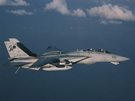
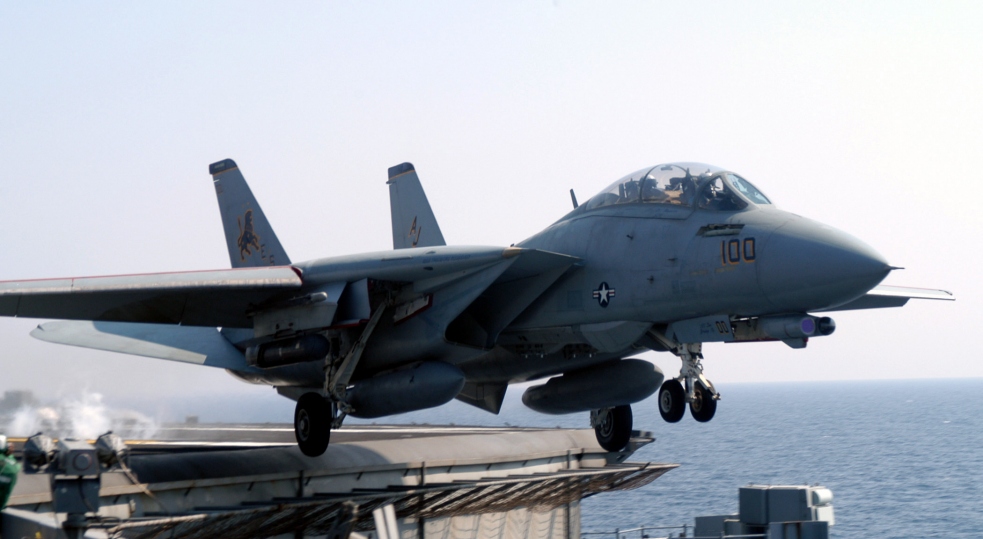
DID has covered the “Tomcatters” of Fighter Squadron VF-31 and the “Black Lions” of VF-213, whose ROVER-compatible F-14D “Bombcats” have been performing missions in Iraq from the deck of CVN 71 USS Theodore Roosevelt. Their six-month deployment ended at Naval Air Station Oceana on March 10, and with it the F-14 Tomcat fighter fades into US naval aviation history. The swing-wing F-14 remains a capable aircraft in both air-air and air-ground roles; yet it lacks electronics upgrades for the most modern weapons, and its maintenance burden is several times that of the competing F/A-18 Super Hornet. On average, NNS reports that an F-14 requires nearly 50 maintenance hours for every flight hour, while the Super Hornet requires 5-10 maintenance hours for every flight hour.
(click to view full)
VF-213 “Black Lions” pilots will begin training on the two-seat F/A-18F Super Hornet in April. VF-31 “Tomcatter” pilots, who have borne that name since 1948, will be transitioning to the single-seat F/A-18Es after September 2006, when they will fly the last Tomcat in the Navy’s inventory from NAS Oceana. “We’re putting the premier fighter to sleep,” said pilot Lt. Jon Jeck. See the Navy Newsstand article for more.
Ironically, the last Grumman F-14s flying will belong to Iran…
Iran’s residual fleet of F-14s and Phoenix missiles racked up an impressive list of kills (Major Jalal Zandi, with 9 kills, is believed to be the most prolific Tomcat ace) and demonstrated the value of an “air dominance intimidator” fighter capability during the 1980-1988 Iran/ Iraq war. The Iranians proved ingenious in evolving an infrastructure to keep their aircraft flying, and the Islamic regime resorted more than once to pulling former IIAF pilots out of prison to fly missions. During later stages of the war when the US was providing intelligence data to Iraq, it got to the point where the Iraqi MiGs and Mirages would simply stop flying in an area once the USA notified the Iraqis that Iranian Tomcats were present.
These experiences have interesting implications for current US debates over the F-22A Raptor.
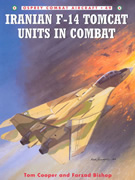
Tom Cooper and Farzad Bishop’s books “Iranian F-14 Units In Combat” and their more comprehensive but poorer publishing quality work “Iran-Iraq War in the Air 1980-1988” are probably the best sources for more detailed information on the combat performance of Iranian F-14s, including much first-hand research.