


(click to view larger)
The USA’s AGM-154 Joint Stand-Off Weapon (JSOW) precision glide-bomb has proven to be popular with the US DoD as well as foreign buyers. Indeed, the program has gone so well that the U.S. Department of Defense presented Raytheon’s JSOW program with its highest acquisition honor in November 2005. The David Packard Excellence in Acquisition Award is given to civilian and military organizations that have made highly significant contributions or demonstrated exemplary innovations and best practices in the defense acquisition process.
Block II JSOW manufacturing began in FY 2006, maintaining all standoff and survivability capabilities but costing less.

(click to view full)
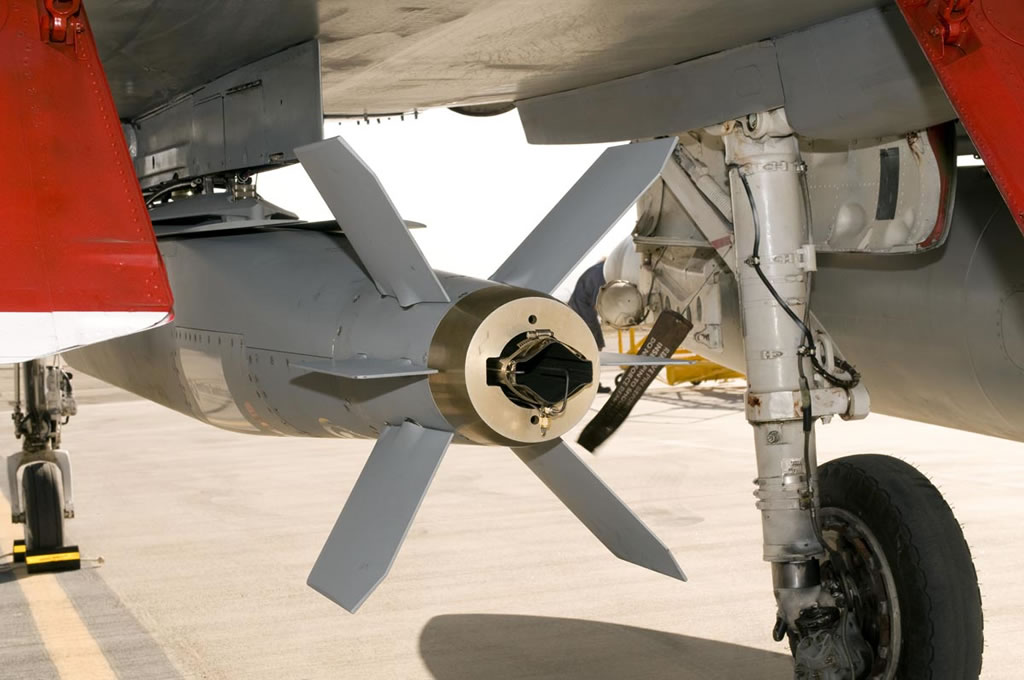
JSOW is a family of low-cost, air-to-ground weapons that employ an integrated Global Positioning System/Inertial Navigation (GPS/INS) system for flight guidance, which can be augmented by imaging infrared (IIR) seekers that can lock on to specific targets. The modular weapon body is capable of carrying various payloads, and Raytheon’s policy is to ensure that all JSOW variants retain the same size, weight, and center of gravity. That way, any JSOW variant can be used on any JSOW-capable aircraft. At present, JSOW has been integrated with F-15E Strike Eagles, the F-16 family, F/A-18 Hornet family A-G fighters, and the USA’s B-52 Stratofortress, B-1 Lancer, and B-2 Spirit bombers. It is also one of the weapons slated for initial fielding with the base F-35A Lightning II fighter and the Navy’s carrier-launched F-35C. The F-35 will be capable of carrying the weapons internally for improved stealth, or on external pylons.
Unlike Lockheed’s JASSM, which shares its weapons interface, most JSOW variants are unpowered. This really makes them GPS-guided glide bombs with a range of 15-70 nautical miles (up to 80 miles/ 130km), allowing aircraft to launch their weapons outside the range of most short and medium range air defenses.
The AGM-154A (also called JSOW-A) variant dispenses BLU-97 combined-effect bomblets for use against soft and area targets. It is no longer in production. Raytheon is also offering a new payload option for the JSOW-A that will use a unitary 500-pound BLU-111 (MK-82) warhead in place of the present cluster bombs; it is designated the AGM-154A-1. This unitary variant eliminates the unexploded ordnance concerns of cluster munitions, and is intended for the international market.
The AGM-154C, or JSOW-C, variant adds an imaging infrared seeker for last-stage high precision, plus a Broach multi-stage warhead that has both blast-fragmentation and hard target penetration capability. JSOW-C is in full rate production, and achieved initial operation capability in February 2005 with the U.S. Navy and Marine Corps.

(click to view full)
The JSOW Block I is no longer in production, as a result of Value Engineering Change Proposals (VECP) submitted by Raytheon. VECP follows the same supplier model that Chrysler used to revitalize its competitiveness in the 1990s. This Pentagon program lets a contractor or sub-contractor submit proposals for cost savings, then share the savings with the government if their proposals are adopted.
JSOW Block II used this framework to reduce the weapon’s unit cost by 25%-33%, improve performance, and fund follow-on development of the AGM-154-C1. Key Block II decisions included redesigning the “airframe” to a major single piece instead of multiple parts, reducing the number of parts generally, using less expensive components, and employing advanced technologies. JSOW’s shelf life has also been increased through a combination of more exacting estimates, and material changes affecting the seeker and parts. This reduces inspection needs, which drops maintenance costs. Estimates place the US Navy’s savings at $133.5 million in future-year defense purchases, plus an additional $421 million in savings over the weapons’ life-cycle.
JSOW Block II weapons are manufactured under a production contract with U.S. Naval Air Systems Command, and Raytheon delivered the first JSOW Block II on May 31/07. JSOW Block II weapons can be either JSOW-As or JSOW-Cs, but add an improved Raytheon SAS “Raptor” anti-jam GPS receiver. Raptor GPS integrates the Raytheon Advanced Protection Technology Receiver and Selective Availability Anti-Spoofing Module into the guidance system, and is planned for use in other Raytheon products.

(click to view full)
JSOW Block III, otherwise known as the AGM-154C-1, was an internally-funded Raytheon project that used the proceeds from its successful Block II VECP. Changes include some moving target capability via a 2-way weapons data link, and an improved imaging infrared seeker. This ensures that targeting can be received, and missile health, status and position can be transmitted back, right up to the time of impact. That option is currently found only at the high end of the cruise missile market, giving the AGM-154C-1 an interesting positioning as a cheaper short-range alternative.
JSOW Block III’s moving target capabilities are designed to give the weapon a secondary capability against enemy ships and boats; additional spiral development would be required before they would be suitable for smaller moving land targets. Block III missiles received their production go-ahead in early FY 2009, followed by a production contract in March 2009. As of that contract award, all US Navy JSOW production is expected to switch to JSOW Block III weapons.
Raytheon has undertaken private research to develop a new warhead for JSOW-C1, which costs less than the existing Broach dual warhead but offers equivalent performance. It could become the subject of a future VECP, but government funding and cooperation will be needed for full testing before it can become eligible for production. That may happen as part of the JSOW program’s continued development funding, or it could be incorporated into funding for a new version of the weapon.
(click to view larger)
One obvious possibility is the JSOW-ER, which becomes a true missile by adding a flush inlet on the belly, and a Hamilton Sundstrand 150-pound thrust engine from Raytheon’s MALD decoy. It is otherwise based on the AGM-154C-1, and the goal is to offer a JSOW with moving target and datalink capability, a range of up to 300 nautical miles/ 345 miles/ 575 km, and a price goal of $FY06 350,000. The engine engages upon safe separation, then uses a 100:1 ratio glide to about 15,000 feet. It can also be fired at low altitude, flying over 200 miles at wave-skimming altitudes on full engine power. No matter what its flight profile, JSOW-ER will travel at low subsonic speeds, rather than the Mach 0.8-0.95 that characterizes most anti-ship missiles.
JSOW-ER’s slow speed means more time in an enemy ship’s engagement zone, a disadvantage that is only partly compensated by its stealthy profile’s shorter radar detection range. This disadvantage, and its restriction to aerial launches, means that it cannot be a full alternative to existing anti-ship missiles. On the other hand, it will be a low cost land attack alternative to missiles like the KEPD Taurus, MBDA Storm Shadow, and Lockheed Martin’s troubled AGM-158 JASSM. An alternative that includes features like the 2-way datalink and anti-ship capability, which are absent from some its more expensive competitors.
JSOW-ER began as a company-funded project, but in early 2008 the Navy awarded Raytheon a $4.5 million contract to conduct a free-flight test with a prototype, which is scheduled for spring 2009. At that point, if Navy decides to make JSOW-ER a future requirement, Raytheon plans to go back to company funding and make final modifications before delivering its proposal to the US Navy. JSOW-ER production would be expected to begin around 2011, if an order is placed.
As of January 2009, Raytheon has produced about 3,650 JSOWs of all variants for the USAF, US Navy, and foreign customers in Australia, Greece, Poland, Singapore, and Turkey. About 3,425 of these weapons were for various branches of the American armed forces. Finland has also requested the weapon, and a small contract is in the works.
The Pentagon budgeted $158.4 million for the JSOW program in FY 2006. its FY 2007 budget request was $151.5 million ($127.4 million for 390 weapons, $27.4 million R&D), and the FY 2008 request is $156.2 million ($131.3 million for 421 JSOW-Cs, $24.9 million RDTE(research, development, test & evaluation) for JSOW-ER and JSOW Block III). All of this production is going to the US Navy, as The US Air Force terminated their JSOW orders in FY 2005, favoring other weapons instead.
Additional Readings & Sources
* DID (March 12/07) – US Issues JSOW Block III Development Contract
* Raytheon (Feb 20/07) – Raytheon Demonstrates Engine for Powered Joint Standoff Weapon Extended Range. Includes details of the new Block III/ AGM-154C-1, as well as the JSOW-ER powered version designed to offer 300 mile range for $350,000.
* Raytheon (Feb 22/06) – Raytheon’s JSOW Program Receives Top Department of Defense Acquisition Award.