May 24, 2013 12:28 UTC
Latest updates[?]: Multinational support contract; UAE confirmed in customer roster via social media search.
(click to view larger)
In the 1970s, fighter aircraft began to appear with Head-Up Displays (HUD) that projected key information, targeting crosshairs etc. onto a seemingly clear piece of glass. HUDs allowed pilots to keep their eyes in the sky, instead of looking down at their instruments. In the 1990s, another innovation appeared: helmet-mounted displays (HMDs) put the HUD inside the pilot’s helmet, providing this information even when the pilot wasn’t looking straight ahead. The Israelis were already pioneering a system called DASH (Display And Sight Helmet) when a set of former East German MiG-29s, equipped with Soviet HMDs, slaughtered USAF F-16s in NATO exercises. Suddenly, helmet-mounted displays became must-haves for modern fighters – and a key partnership positioned Elbit to take DASH to the next level.
This DID Spotlight article offers insights into the rocky past, successful present, and competitive future of a program that has experienced its share of snags and controversy – but went on to become the #1 helmet-mounted sight in the world. It also details the game-changing effects of Joint Helmet Mounted Cueing Systems on air combat, its production sets and known customers, and all contracts since full-rate production began.
Continue Reading… »
May 22, 2013 15:57 UTC
Latest updates[?]: ATK's GATR gets evaluation contract from US Special Forces; TALON entries improved.
(click to view larger)
Sen. Leahy’s [D-VT] worked in the mid-2000s to keep the Hydra 70mm rocket family alive through special appropriations, just in time for the Hydras’ potential on the battlefield to rise again. The key was the addition of low-cost precision guidance, which would expand the number of precision weapons carried by helicopters, aircraft, and even UAVs.
Over the last few years, the US Army’s 2nd attempt at an APKWS 70mm guided rocket had a near-death experience, before righting the program with Navy funding. Meanwhile, private development efforts from Lockheed Martin, Thales TDA, and a raft of international partnerships involving major defense firms and partners in Korea, the UAE, Canada/Norway, and Israel are introducing new competitors into the precision-guided rocket space. This DID FOCUS article covers the most prominent competitors within the guided rocket trend. Their products will sit between full anti-armor missiles like Hellfire, TOW, and Brimstone, and an emerging class of ultra-small precision attack weapons like Northrop Grumman’s Viper Strike, Raytheon’s Griffin, etc.
Continue Reading… »
May 21, 2013 12:00 UTC
Latest updates[?]: Advance order for 2014; 2014 Budgets.
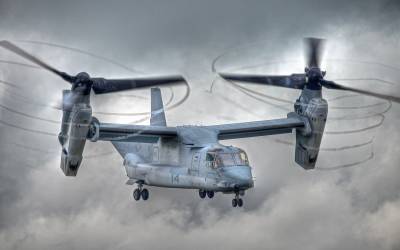
In March 2008, the Bell Boeing Joint Project Office in Amarillo, TX received a $10.4 billion modification that converted the previous advance acquisition contract (N00019-07-C-0001) to a fixed-price-incentive-fee, multi-year contract. The new contract now sits at $10.92 billion, and will be used to buy 143 MV-22 (for USMC) and 31 CV-22 (Air Force Special Operations) Osprey aircraft, plus associated manufacturing tooling to move the aircraft into full production.
The V-22 tilt-rotor program has been beset by controversy throughout its 20-year development period. Despite these issues, and the emergence of competitive but more conventional compound helicopter technologies like Piasecki’s X-49 Speedhawk and Sikorsky’s X2, the V-22 program continues to move forward. This DID Spotlight article looks at the V-22′s multi-year purchase contract from 2008-12 and 2013-2017, plus associated contracts for key V-22 systems, program developments, and research sources.
Continue Reading… »
May 12, 2013 15:30 UTC
Latest updates[?]: Over $175M in contracts.
Breakthrough…
The US Navy flies the F/A-18 E/F Super Hornet fighters, and has begun operating the EA-18G Growler electronic warfare & strike aircraft. Many of these buys have been managed out of common multi-year procurement (MYP) contracts, which aim to reduce overall costs by offering longer-term production commitments, so contractors can negotiate better deals with their suppliers.
The MYP-II contract ran from 2005-2009, and was not renewed because the Pentagon intended to focus on the F-35 fighter program. When it became clear that the F-35 program was going to be late, and had serious program and budgetary issues, pressure built to abandon year-by-year contracting, and negotiate another multi-year deal for the current Super Hornet family. That deal is now final. This entry covers the program as a whole, with a focus on 2010-2015 Super Hornet family purchases. It has been updated to include all announced contracts and events connected with MYP-III, including engines and other separate “government-furnished equipment” that figures prominently in the final price.
Continue Reading… »
May 02, 2013 18:55 UTC
Latest updates[?]: Budgets 2012-2018; Training system contract makes Warren Buffett happy; The perils of restructuring KC-X; Basing options and contenders; USAF plans higher usage for KC-46As than KC-135s.
KC-135: Old as the hills…
DID’s FOCUS articles cover major weapons acquisition programs – and no program is more important to the USAF than its aerial tanker fleet renewal. In January 2007, the big question was whether there would be a competition for the USA’s KC-X proposal, covering 175 production aircraft and 4 test platforms. The total cost is now estimated at $52 billion, but America’s aerial tanker fleet demands new planes to replace its KC-135s, whose most recent new delivery was in 1965. Otherwise, unpredictable age or fatigue issues, like the ones that grounded its F-15A-D fighters in 2008, could ground its aerial tankers – and with them, a substantial slice of the USA’s total airpower.
KC-Y and KC-Z buys are supposed to follow in subsequent decades, in order to replace 530 (195 active; ANG 251; Reserve 84) active tankers, as well as the USAF’s 59 heavy KC-10 tankers that were delivered from 1979-1987. Then again, fiscal and demographic realities may mean that the 179 plane KC-X buy is “it” for the USAF. Either way, the stakes were huge for all concerned.
In the end, it was Team Boeing’s KC-767 NexGen/ KC-46A (767 derivative) vs. EADS North America’s KC-45A (Airbus KC-30/A330-200 derivative), both within the Pentagon and in the halls of Congress. The financial and employment stakes guaranteed a huge political fight no matter which side won. After Airbus won in 2008, that fight ended up sinking and restarting the entire program. Three years later, Boeing won the recompete. Now, they have to deliver.
Continue Reading… »