02-Feb-2010 19:38 EST
Related Stories: Alliances, Americas - USA, BAE, Britain/U.K., Contracts - Awards, Contracts - Modifications, Design Innovations, ECM, Electronics - General, Engines - Aircraft, Europe - Other, FOCUS Articles, Fighters & Attack, Finmeccanica, GE, Issues - International, Issues - Political, Lobbying, Lockheed Martin, Middle East - Israel, Northrop-Grumman, Official Reports, Other Corporation, Partnerships & Consortia, Policy - Procurement, R&D - Contracted, Radars, Rumours, Security & Secrecy, Sensors & Guidance, Testing & Evaluation, Transformation

F-35A: incoming…
(click to view full)
FY 2011 budget proposals, withheld performance fees, a change in program leadership, Australian reaction. (Feb 2/10)
The $300+ billion F-35 Joint Strike fighter may well be the largest single global defense program in history. This major multinational program is intended to produce an “affordably stealthy” multi-role fighter that will have 3 variants: the F-35A conventional version for the US Air Force et. al.; the F-35B Short Take-Off, Vertical Landing for the US Marines, British Royal Navy, et. al.; and the F-35C conventional carrier-launched version for the US Navy. The aircraft is named after Lockheed’s famous WW2 P-38 Lightning, and the Mach 2, stacked-engine English Electric (now BAE) Lightning jet. Lightning II system development partners included The USA & Britain (Tier 1), Italy and the Netherlands (Tier 2), and Australia, Canada, Denmark, Norway and Turkey (Tier 3), with Singapore and Israel as “Security Cooperation Partners.” Now the challenge is agreeing on production phase membership and arrangements, to be followed by initial purchase commitments in 2009-2010.
This updated article has expanded to feature more detail regarding the F-35 program, including contracts, sub-contracts, and notable events and reports. New material is highlighted by putting it in green type.
02-Feb-2010 15:41 EST
Related Stories: Alliances, Americas - USA, Avionics, BAE, Boeing, Contracts - Intent, ECM, Electronics - General, Engines - Aircraft, Equipment - Other, Fighters & Attack, GE, GPS Infrastructure, Guns - 20-59 mm direct, Issues - International, L3 Communications, Lockheed Martin, Middle East - Other, Northrop-Grumman, Protective Systems - Aircraft, Radars, Raytheon, Sensors & Guidance, Support Functions - Other, United Technologies

Egyptian Air Force F-16D
(click to view full)
Egypt chooses its engines. (Feb 1/10)
The Egyptian government wants to buy 24 F-16C/D Block 50/52 aircraft, associated parts, weapons, and equipment to modernize its air force. The October 2009 request, made through the US Defense Security Cooperation Agency (DSCA) to Congress, could be worth as much as $3.2 billion to Lockheed Martin and the other contractors involved.
The Egyptian Air Force is the 4th largest F-16 operator in the world, mustering about 195 aircraft of 220 ordered. Their overall fighter fleet is a mix of high-end F-16s and Mirage 2000s, low-end Chinese F-7s (MiG-21 copy) bought from the Chinese, a few F-4 Phantom II jets, and upgraded but very aged Soviet MiG-21s and French Mirage 5s. The formal request comes a few months after the Obama administration conveyed to Egyptian President Hosni Mubarak its support for Egypt’s long-standing request to buy the Block 50/52 aircraft…
Continue Reading… »
31-Jan-2010 18:40 EST
Related Stories: Americas - Other, Americas - USA, Australia & S. Pacific, Avionics, Boeing, Britain/U.K., Contracts - Awards, Contracts - Intent, Contracts - Modifications, ECM, Europe - Other, FOCUS Articles, Middle East - Other, Power Projection, Procurement Innovations, Support & Maintenance, Support Functions - Other, Transport & Utility, United Technologies

C-17 over Hawaii
(click to view full)
The program will be restructured after 2012. (Jan 29/10)
While the C-17 may have limited production time in its future, the C-17 Globemaster Sustainment Partnership is likely to continue for many years. The rising cost of maintenance has made it a greater concern to the world’s militaries, and new contract vehicles are reflecting that. Under the C-17 Globemaster III Sustainment Partnership, Boeing has total system support responsibility for the big transport aircraft, including materiel management and depot maintenance, for fleets around the world. The goal is total aircraft sustainment support under a single contract, in order to achieve improvements in mission readiness, while reducing operating and support costs. The initial contract had an estimated total value of $4.9 billion, which is likely to grow as Boeing’s customer base grows in Australia (4), Britain (6), Canada (4), Qatar (2), and NATO (3).
This is DID’s in-depth, updated FOCUS Article covering this major international program, offering key statistics for the aircraft, explaining the GSP’s components, and detailing its contracts.
27-Jan-2010 12:39 EST
Related Stories: Americas - USA, Contracts - Awards, ECM, Electronics - General, Fighters & Attack, Other Corporation, Radars

TWT, conceptual
Traveling wave tube (TWT) amplifiers are used to amplify radio signals to high power. They are commonly used by the US military in satellite transponders, radar, and electronic warfare systems.
The US Navy uses the TWT ampliers for electronic countermeasure (ECM) systems on aircraft. One application is to increase the radar reflectivity of a decoy deployed by an aircraft. The enhanced decoy fools an enemy surface-to-air or air-to-air missile into thinking that the decoy is the aircraft.
The Navy recently awarded a $13.2 million contract to small business qualifier dB Control to supply TWT ampliers for aircraft ECM systems…
Continue Reading… »
13-Jan-2010 16:14 EST
Related Stories: ATK, Americas - USA, BAE, Contracts - Awards, ECM, Electronics - General, Helicopters & Rotary, Lockheed Martin, New Systems Tech, Other Corporation, Protective Systems - Aircraft, R&D - Contracted, Radars, Sensors & Guidance, Support Functions - Other

MV-22 Osprey: JATAS Ready?
(click to view full)
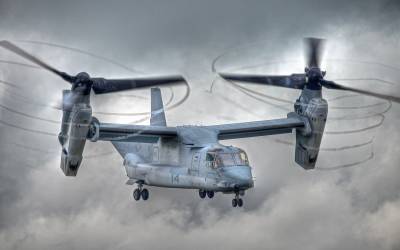
The US Navy is looking to improve protection of Navy and Marine Corps tilt-rotor aircraft and helicopters from missiles and rocket-propelled grenades through development of the Joint and Allied Threat Awareness System (JATAS). The JATAS will provide an infrared-based missile and laser warning and hostile fire indication defensive suite.
In particular, the JATAS will provide advanced missile warning capability; aircrew warning of laser-based weapon systems such as range finders, illuminators, and beam riders; and a hostile fire indication for small arms, rockets, and other threats. It will be initially tested on the MV-22B Osprey, but will eventually be available for all Navy and Marine Corps rotary-wing aircraft.
The Naval Air Systems Command (NAVAIR) recently awarded 2 contracts worth a combined $65.3 million for the JATAS technology demonstration phase…
Continue Reading… »
13-Jan-2010 12:07 EST
Related Stories: Americas - USA, Boeing, Contracts - Awards, Contracts - Modifications, Delivery & Task Orders, ECM, FOCUS Articles, Force Structure, IT - Software & Integration, New Systems Tech, Northrop-Grumman, Other Corporation, Raytheon, Specialty Aircraft

EA-6B Prowler
(click to view full)
The USA’s electronic attack fighters are a unique, overworked, and nearly obsolete capability. With the retirement of the US Air Force’s long-range EF-111 Raven “Spark ‘Vark,” the aging 4-seat EA-6B Prowlers are now the USA’s sole remaining tactical aircraft type for radar jamming, communications jamming and information operations like signals interception [1]. Despite their age and performance limits, they’ve been predictably busy on the front lines, used for everything from escorting strike aircraft against heavily defended targets, to disrupting enemy IED land mine attacks by jamming all radio signals in an area.

EA-18G at Pax
(click to view full)
All airframes have lifespan limits, however, and the EA-6B is no exception. The USA’s new electronic warfare aircraft will be based on Boeing’s 2-seat F/A-18F Super Hornet multi-role fighter and has 90% commonality with its counterpart. That will give it decent self-defense capabilities as well as electronic attack potential. At present, however, the EA-18G is slated to be the only dedicated electronic warfare aircraft in the USA’s future force – and since the USA is currently the only western country with such aircraft, it would become the sole source of tactical jamming support for NATO air forces as a whole.
DID’s FOCUS articles offer in-depth, updated looks at significant military programs of record. This article describes the EA-18G aircraft and its key systems, outlining the program, and keeping track of ongoing developments, contracts, et. al. that affect the program. New items will be highlighted via green type. The latest news involves a minor contract, and the possibility of an additional 24 aircraft orders between 2011-2015…
03-Jan-2010 18:30 EST
Related Stories: Africa, Alliances, Americas - USA, Avionics, Boeing, C4ISR, Contracts - Awards, ECM, Europe - France, Events, Fighters & Attack, Force Structure, GE, General Dynamics, Guns - 20-59 mm direct, Issues - Environmental, L3 Communications, Lobbying, Lockheed Martin, Northrop-Grumman, Other Corporation, Policy - Procurement, Protective Systems - Aircraft, Radars, Raytheon, Sensors & Guidance, Signals Radio & Wireless, Specialty Aircraft, Spotlight articles, United Technologies

French Mirage F1s
(click to view full)
Morocco’s combat air force currently flies 2 squadrons of old F-5s, and 2 squadrons of only slightly newer Mirage F1s; T-37 light jets serve as key transitional trainers. Their neighbor and rival Algeria flies MiG-23s of similar vintage, but the Force Aérienne Algérienne also flies SU-24 Fencer and SU-25 Frogfoot strike aircraft, even more modern and capable MiG-29s, and is set to receive multi-role SU-30MKs as part of a multi-billion dollar weapons deal with Russia.
Morocco can’t beat that array. Instead, they’re looking for replacement aircraft that will prevent complete overmatch, and provide a measure of security. Initially, they looked to France. France’s Rafale is part of a set of European 4+ generation fighters that were developed and fielded during the 1990s-early 21st century, with the aim of surpassing existing offerings among America’s “teen series” fighters, as well as Russia’s MiG-29 Fulcrum and SU-27/30 Flanker family. “Dogfight at the Casbah: Rafale vs. F-16” discussed the French sales slip-ups that cost Dassault its first export order for the 4+ generation fighter. That outcome is now official.
Just to make things worse, the final multi-billion dollar deal involves new-build F-16s, at a price comparable to the rumored figures for the Rafale. Not to mention an accompanying American deal to replace Morocco’s T-37 trainer fleet with T-6Cs, and contracts for air-launched weapons, targeting pods, and C-27J short-haul transports. The latest development includes the main funding contract for 24 F-16s…
16-Dec-2009 14:17 EST
Related Stories: Americas - USA, Australia & S. Pacific, Avionics, Boeing, Contracts - Intent, ECM, Engines - Aircraft, Fighters & Attack, Force Structure, Issues - Political, Missiles - Air-Air, Missiles - Precision Attack, Radars, Sensors & Guidance, Signals Radio & Wireless, Spotlight articles

RAAF F/A-18F rollout
(click to view full)
Australia’s Super Hornet purchase began life in a storm. “The Australian Debate: Abandon F-35, Buy F-22s?” offers full coverage of the controversies over Australia’s involvement in the F-35 Lightning II program, amid criticisms that the F-35A will (a) be unable to compete with proliferating SU-30 family fighters in the region, (b) lack the range or response time that Australia requires, and (c ) will either be extremely expensive at $100+ million per aircraft during early production, or will have to be bought at after 2018 or so when prices have dropped. The accelerated retirement of Australia’s 22 long-range F-111s in 2010 sharpened the timing debate, by creating a serious gap between the F-111’s retirement and the F-35’s likely arrival.
In December 2006, therefore, The Australian reported that Defence Minister Brendan Nelson was discussing an A$ 3 billion (about $2.36 billion) purchase of 24 F/A-18F Block II Super Hornet aircraft around 2009-2010. A move that came as “a surprise to senior defence officials on Russell Hill”; but became an official purchase as requests and contracts were hurriedly submitted. Australia’s new Labor government’s later decided to keep the Super Hornet purchase rather than pay cancellation fees, and ministerial statements place the program’s final figure at A$ 6.6 billion, which includes basing, training, and other ancillary costs.
This DID Spotlight article describes the model chosen, links to coverage of the key controversies, and offers a history of contracts and key event’s from the program’s first official DSCA requests to the present day. The latest addition involves a delivery, and a contract, that set the foundations for fleet support…
15-Dec-2009 19:49 EST
Related Stories: Americas - Other, Americas - USA, Australia & S. Pacific, Contracts - Awards, Delivery & Task Orders, ECM, Europe - Other, General Dynamics, Lockheed Martin, Mines & Countermine-IED, New Systems Tech, Other Corporation, Partnerships & Consortia

Symphony on Iraqi vehicle
(click to view larger)
Vehicle mounted systems are one element of the USA’s Joint Counter Radio-Controlled Improvised Explosive Device (RCIED) Electronic Warfare (JCREW 2) program. Lockheed Martin’s Symphony IED Jammer System is a programmable, vehicle mounted radio-frequency IED jammer with a role that’s similar to other fielded systems including Elisra’s EJAB, as well as ICE and ITT’s Warlock/ JCREW.
Neither Lockheed nor the Army are releasing details concerning the Symphony system, but it is known to come from the Canadian/UK firm Allen-Vanguard, who also acts in this capacity for General Dynamics ATP via their Med-Eng subsidiary. Outside the USA, Allen-Vanguard supplies jamming devices directly to Canada, Australia, and various European militaries. Symphony orders are continuing, and the latest addition is a major new 5-year contract…
Continue Reading… »
15-Dec-2009 11:19 EST
Related Stories: Americas - USA, Contracts - Modifications, ECM, Protective Systems - Aircraft, Raytheon

ALE-50 “Little Buddy”
(click to view full)
The entire ALE-50 system consists of a launcher and launch controller attached to one of the aircraft’s weapon pylons, containing one or more expendable towed decoys. These trail behind the aircraft when deployed, attracting radar-guided missiles to themselves instead. Each decoy and payout reel is delivered in a sealed canister, and has a 10-year shelf life.
The Multi-Platform Launch Controller (MPLC) is the standard launch controller for all future installations, but the US Navy’s F/A-18E/F Super Hornet fighter, the USAF’s B-1B Lancer heavy bombers, and Raytheon’s AN/ALQ-184(V)9 ECM pod that equips a number of different aircraft each use the MPLC, with platform-specific launchers. This flexibility makes the AN/ALE-50 adaptable to any tactical or combat support aircraft.
Contracts and key events include an ancillary order to Boeing…
Continue Reading… »