JHMCS: Fighter Pilots’ “Look & Shoot” Helmets Changing Aerial Warfare

HMD JHMCS Collage
(click to view larger)

In the 1970s, fighter aircraft began to appear with Head-Up Displays (HUD) that projected key information, targeting crosshairs etc. onto a seemingly clear piece of glass. HUDs allowed pilots to keep their eyes in the sky, instead of looking down at their instruments. In the 1990s, another innovation appeared: helmet-mounted displays (HMDs) put the HUD inside the pilot’s helmet, providing this information even when the pilot wasn’t looking straight ahead. The Israelis were already pioneering a system called DASH (Display And Sight Helmet) when a set of former East German MiG-29s, equipped with Soviet HMDs, slaughtered USAF F-16s in NATO exercises. Suddenly, helmet-mounted displays became must-haves for modern fighters – and a key partnership positioned Elbit to take DASH to the next level.

This DID Spotlight article offers insights into the rocky past, successful present, and competitive future of a program that has experienced its share of snags and controversy – but went on to become the #1 helmet-mounted sight in the world. It also details the game-changing effects of Joint Helmet Mounted Cueing Systems on air combat, its production sets and known customers, and all contracts since full-rate production began.

S-80: A Sub, for Spain, to Sail Out on the Main

S-80 Cutaway
S-80 cutaway, labeled

The CIM-2000 Scorpene class diesel-electric attack submarine partnership was just the first step for Spain’s Navantia, as it joined with France’s DCNS to enter the global submarine market. Now Navantia is building on that base of expertise, to field its own S-80 Class for the Spanish Armada. Spain’s new submarines will be larger boats than Navantia/DCNS’ Scorpene Class, with Air-Independent Propulsion (AIP) systems as standard gear, and completely new designs for both external shape and internal systems.

This article will cover the S-80 submarines’ capabilities and associated key events and contracts – including sub-contracts to American, British, and Italian firms.

India’s Multi-billion Dollar Scorpene Sub Contract

Advertisement
SSK Scorpene OHiggins Cutaway
Scorpene cutaway

India’s submarine fleet currently consists of 16 boats: 10 Russian SSK Kilo (Sindhugosh) Class, 4 locally built SSK U209 (Shishumar) Class, a leased nuclear-powered Improved Akula Class SSN from Russia (INS Chakra), and its own INS Arihant SSBN. Most of the Kilos have been modernized, but readiness rates for India’s existing submarine fleet sits below 40%, and the U209s will have trouble lasting much beyond 2015. With Pakistan acquiring modern submarines, and Chinese submarine building exploding, expanding India’s submarine fleet became an obvious national priority.

In 2005, India confirmed that it would buy 6 Franco-Spanish Scorpene diesel submarines, with an option for 6 more and extensive technology transfer agreements. Unfortunately, 7 years after that deal was signed, “Project 75″ has yet to field a single submarine. A poor Indian procurement approach, and state-run inefficiency, are pushing the country’s overall submarine force toward an aging crisis. This DID FOCUS article covers the Scorpene deal and its structure, adds key contracts and new developments, and offers insights into the larger naval picture beyond India.

ER/MP Gray Eagle: Enhanced MQ-1C Predators for the Army

MQ-1C Hellfires
ER/MP, armed

In August 2005, “Team Warrior” leader General Atomics Aeronautical Systems, Inc. in San Diego, CA won a $214.4 million cost-plus-incentive-fee contract for research, development, test and evaluation (RDT&E) of the Extended Range/ Multi Purpose Unmanned Aerial Vehicle System (ER/MP UAS). That was just the first step along the US Army’s $5 billion road to fielding a true Medium Altitude, Long Endurance, armed UAV, modified from the USAF’s famous MQ-1 Predator.

The ER/MP program was part of the US Army’s reinvestment of dollars from the canceled RAH-66 Comanche helicopter program, and directly supports the Army’s Aviation Modernization Plan. Its position got a boost when a 2007 program restructuring cut the Future Combat Systems Class III UAV competition, in favor of ER/MP. Next, the US Air Force saw this Predator derivative as a threat and tried to destroy it, but the program survived the first big “Key West” battle of the 21st century. Now the MQ-1C “Gray Eagle” is moving into full production, as the US Army’s high-end UAV. This FOCUS article offers a program history, key statistics and budget figures, and ongoing coverage of the program’s contracts and milestones.

AH-64E Apache Block III: The Once and Future Attack Helicopter

AH-64D helos Afghanistan
AH-64 in Afghanistan

With the collapse of the RAH-66 Comanche program, and rededication of its funding into the Armed Reconnaissance Helicopter (ARH) and Light Utility Helicopter (LUH), and other programs, the AH-64 Apache will remain the USA’s primary attack helicopter for several more decades. Apaches also serve with a number of American allies, some of whom have already expressed interest in upgrading or expanding their fleets.

The AH-64E Guardian Block III (AB3) is the helicopter’s next big step forward. It incorporates 26 key new-technology insertions that cover flight performance, maintenance costs, sensors & electronics, and even the ability to control UAVs as part of manned-unmanned teaming (MUT). In July 2006, Boeing and U.S. Army officials signed the initial development contract for Block III upgrades to the current and future Apache fleet, via a virtual signing ceremony. By November 2011, the 1st production helicopter had been delivered. So… how many helicopters will be modified under the AH-64 Block III program, what do these modifications include, how is the program structured, and what has been happening since that 2006 award? The short answer is: a lot, including export interest and sales.

LCAC Hovercraft: US Navy’s Champion Schleppers Get SLEPped

US Navy LCAC Brushes Shoreline
LCAC versatility

The US military calls them Landing Craft, Air Cushion (LCAC). They’re high-speed, fully amphibious hovercraft capable of carrying a 60-ton payload (75 tons in overload) over water and land at speeds in excess of 40 knots and a nominal range of up to 200 nautical miles. Carrying equipment, troops, and/or supplies, the LCAC launches from inside the well deck of an amphibious warship, then travels the waves at high speed, runs right through the surf zone near the beach, and stops at a suitable place on land. Its cargo walks or rolls off. The LCAC returns to the surf to pick up more. Rinse. Agitate. Repeat.

LCAC ashore
LCAC, ashore

A total of 91 LCACs were built between 1984-2001, and their design itself dates back to the 1970s. They require regular maintenance, refurbishment, upgrades, and even life extension programs to keep them operational into the future. This free-to-view Spotlight article will covers the program from 2005 forward, tracking contracts and key events.

Bringing Home the BACN to Front-Line Forces

E-11A, Kandahar
E-11A BACN

In late June 2009, the USAF awarded Northrop Grumman Defense Mission Systems Inc., of San Diego, CA an urgent requirement contract for its Battlefield Airborne Communications Node (BACN) System. Under current plans, Northrop Grumman will help the USAF deploy BACN in up to 4 “E-11″ Bombardier BD-700 Global Express (see also BACN-modified photo) ultra-long-range business jets, and in up to 4 EQ-4B Global Hawk Block 20 UAVs, for sustained deployment through 2015.

BACN is an airborne communications relay that extends communications ranges, bridges between radio frequencies, and “translates” among incompatible communications systems. That may sound trivial, but on a tactical level, it definitely isn’t.

P-8 Poseidon MMA: Long-Range Maritime Patrol, and More

P-8 MMA, changed wing
P-8A Poseidon

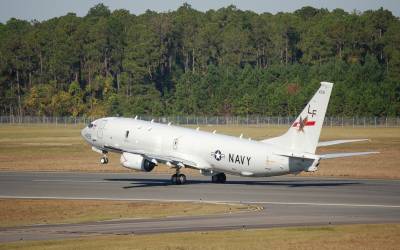
Maritime surveillance and patrol is becoming more and more important, but the USA’s P-3 Orion turboprop fleet is falling apart. The P-7 Long Range Air ASW (Anti-Submarine Warfare) Capable Aircraft program to create an improved P-3 began in 1988, but cost overruns, slow progress, and interest in opening the competition to commercial designs led to the P-7′s cancellation for default in 1990. The successor MMA program was begun in March 2000, and Boeing beat Lockheed’s “Orion 21″ with a P-8 design based on their ubiquitous 737 passenger jet. US Navy squadrons finally began taking P-8A Poseidon deliveries in 2012, but the long delays haven’t done their existing P-3 fleet any favors.

Filling the P-3 Orion’s shoes is no easy task. What missions will the new P-8A Poseidon face? What do we know about the platform, the project team, and ongoing developments? Will the P-3′s wide global adoption give its successor a comparable level of export opportunities? Australia and India have already signed on, but has the larger market shifted in the interim?

Digital Abrams: The M1A2 SEP Program

M1A2 SEP Motoring
M1A2 SEP

America’s M1 Abrams tanks come in a number of versions. In addition to the M1A1 that is now standard, the US Army is beginning to field its M1 TUSK for urban warfare. It also operates the M1A2 System Enhancement Program (SEP), currently the most advanced standard variant.

This Spotlight article covers the M1A2 Abrams SEP upgrade program, and will be updated and backfilled as new contracts are issued and key events take place.

The USCG’s Legend Class National Security Cutters

CGC NSC Bertholf Machinery Trials
WMSL-750 Bertholf

The US Coast Guard’s massive $25 billion Deepwater meta-program (really Deepwater-II given post-9/11 changes) has endured more than its share of ups and downs. Nevertheless, Congressional support has remained strong, and efforts are being made to restructure the program and get it back on track. Yet the USCG’s Island Class cutter modification program, and the Deepwater Fast Response Cutter supposed to replace it, have faced many difficulties.

The Legend Class National Security Cutters are the largest ships in the Deepwater program, and represent the program’s flagship in more ways than one. The 418 foot, 4,400 ton ships will be frigate-sized vessels with a 21 foot draughts [1], and are rather larger than the 379 foot, 3,250 ton Hamilton Class High Endurance Cutters (HECs) they will replace. Controversies regarding durability and potential hull fatigue, as well as significant cost overruns, have shadowed the new cutter’s construction. Nevertheless, the program appears to be moving forward. This DID FOCUS Article covers the Legend Class cutters’ specifications, program history, and key events.

  1. 1
  2. 2
  3. 3
  4. 4
  5. 5
  6. 6
  7. 7
  8. ...
  9. 45

Stay Up-to-Date on Defense Programs Developments with Free Newsletter

DID's daily email newsletter keeps you abreast of contract developments, pictures, and data, put in the context of their underlying political, business, and technical drivers.