CD-Adapco

$50M for Construction at NS Guantanamo Bay

Related Stories: Americas - Other, Americas - USA, Bases & Infrastructure, Chemicals & HAZMAT, Contracts - Awards, Other Corporation

MIL_NAVFAC_Logo.gif

The Naval Facilities Engineering Command, Southeast in Jacksonville, FL has issued several indefinite-delivery/ indefinite-quantity, multiple award, design-build construction contracts for general building type projects at Naval Station, Guantanamo Bay. Each contract consists of a base year and 4 option years, for a maximum of 60 months, or a maximum value of $50 million for all contracts, whichever comes first. Each contract comes with a guaranteed minimum of $10,000, a normal procedure that helps to defray the expenses of bidding and preparing to execute contracts of this type. Expected completion date is May 2009, or May 2013, with all options exercised; contract funds will expire at the end of the current fiscal year.

Work to be performed is for general building type projects (new construction, renovation, alteration, and repair of facilities and infrastructure, roofing, demolition, and routine renovation) including but not limited to: 1) aviation and aircraft facilities, 2) marine facilities, 3) barracks and personnel housing facilities, 4) administrative facilities, 5) warehouses and supply facilities, 6) training facilities, 7) personnel support and service facilities, 8) security level facilities, 9) abatement and handling of hazardous/ regulated materials.

The basic contract was competitively procured via the Navy Electronic Commerce Online website, with 5 proposals received. Winners include:

Continue Reading… »

US Army in Flight on Production of (Re)New H-47 Chinooks - updated

Related Stories: Americas - Other, Americas - USA, Avionics, BAE, Boeing, Contracts - Awards, Contracts - Modifications, Europe - France, Europe - Other, FOCUS Articles, Forces - Special Ops, Helicopters & Rotary, New Systems Tech, Other Corporation, Protective Systems - Aircraft

AIR_CH-47Fs_Take-off.jpg
CH-47Fs take off
(click to view full)
DII

Trying to make sense of government releases and contracts is challenging at the best of times. Trying to make sense of defense-related contracts takes the challenge to a whole new level. Research quickly revealed that the scattered CH-47F contracts we’ve been seeing were part of a much larger effort to recapitalize America’s CH-47 Chinook helicopter fleet. The USA expects to be operating Chinooks in their heavy-lift role past 2030, and the history and structure of that effort is detailed below thanks to some help from Boeing.

This is DID’s FOCUS Article for the CH-47F/MH-47G helicopter programs, in the USA and abroad. While the forced re-compete of the HH-47’s $10-15 billion CSAR-X program win goes on, Boeing has completed operational testing of the CH-47F, and delivery orders are in for CH-47Fs and MH-47G Special Forces configuration helicopters. The latest news involves an RFP from Canada, and an engine services contract related to SOCOM’s MH-47G…

Double-Jointed & Popular: The Bv Family of Infantry Support Vehicles (updated)

Related Stories: Americas - Other, Americas - USA, Asia - Central, BAE, Britain/U.K., Contracts - Awards, Design Innovations, Europe - France, Europe - Other, FOCUS Articles, Field Reports, Forces - Marines, New Systems Tech, Other Corporation, Project Successes, Tanks & Mechanized, Transformation

LAND_BVS-10_Viking_Ashore.jpg
A Viking comes ashore
(click to view full)

The BvS-10 is the successor to the wildly popular Bv206, 11,000 of which have been sold to 40 countries around the world – including the USA (M978). It is in use in both Britain and the Netherlands as a key armored vehicle for their respective Marines, and is under evaluation elsewhere. Singapore has developed and manufactured an improved variant of its own called the Bronco ATTC, and Finland and Norway also have their own local Bv-206 variants.

What makes this unusual-looking vehicle family so popular? They aren’t like Hummers or similar wheeled mainstays. They aren’t full armored personnel carriers, either – they’re armored, but Bv family vehicles can’t take the kind of punishment that a Bradley or LAV can absorb. Instead, the secret to their success lies in a remarkable all-terrain capability, and their ability to fill a rare and critical role: air-portable and amphibious infantry enhancement.

These success factors are discussed below, along with contracts and key developments related to this vehicle family. The latest development involves a bulletin from the Dutch, who are finding that they need to fix some issues with the BvS-10 Vikings headed for duty in Chad…

$321.7M for 84 F414 engines et. al.

Related Stories: Americas - Other, Americas - USA, Contracts - Modifications, Engines - Aircraft, Fighters & Attack, GE, Specialty Aircraft

GE_F414_400_engine.jpg
F414-GE-400 engine
(click to see in sections)

General Electric Aircraft Engines business group in Lynn, MA received a $321.7 million modification to a previously awarded firm-fixed-price contract (N00019-06-C-0088), exercising an option for FY 2008 Lot 12 full rate production of 84 F-414-GE-400 engines and device kits and 10 engine fan modules. They will be installed in F/A-18E/F Super Hornet fighters and EA-18G Growler electronic warfare aircraft.

Work will be performed in Lynn, MA (50%); Madisonville, KY (22%); Hooksett, NH (13%); Albuquerque, NM (6%); Rutland, VT (5%); Dayton, OH (2%); Evandale, OH (1%); and Bromont, Canada (1%), and is expected to be complete in December 2009. The Naval Air Systems Command in Patuxent River, MD issued the contract.

F-18 Hornets: Keeping ‘Em Flying

Related Stories: Americas - Other, Americas - USA, Australia & S. Pacific, Boeing, Contracts - Awards, Contracts - Modifications, Fighters & Attack, L3 Communications, Northrop-Grumman, Spotlight articles, Support & Maintenance

AIR_CF-18_Reverse_Cockpit.jpg
CF-18: which way?
(click to see clearly)

The Hornet is the F/A-18 E/F Super Hornet’s predecessor, and the first models were introduced in the late 1970s as a spinoff of the USAF’s lightweight fighter competition. While the General Dynamics F-16 won, Northrop’s YF-17 eventually evolved into the McDonnell-Douglas (now Boeing) F/A-18 Hornet.

The F/A-18 Hornet is currently flown by the US Marine Corps as their front-line fighter, by the US Navy as a second-tier fighter behind its F/A-18 E/F Super Hornets, and by 7 international customers: Australia, Canada, Finland, Kuwait, Malaysia, Spain, and Switzerland. The USA’s aircraft were expected to have a service life of 20 years, but that was based on 100 carrier landings per year. The US Navy and Marines have been rather busy during the Hornets’ service life, and so the planes are wearing out faster.

This is forcing the USA to take a number of steps and issue a series of contracts in order to keep their Hornets airworthy, replacing center barrel sections, re-opening production lines, and more. Some of these efforts will also be offered to allied air forces, who have their own programs and services to call upon. The latest additions involve a contract for spare rudders…

Continue Reading… »

General Dynamics Wins MRAP Orders of Its Own

Related Stories: Africa, Americas - Other, Americas - USA, Delivery & Task Orders, Field Reports, General Dynamics, Spotlight articles, Trucks & Transport

LAND_RG-31_USMC_IEDed.jpg
USMC RG-31,
IEDed in Iraq
(click to view story)

BAE OMC’s RG-31 was the first mine-resistant vehicle fielded by US forces in Iraq and Afghanistan, where it was used by the 101st Airborne (and reportedly by SOCOM) as a patrol vehicle. Since hostilities began, a series of orders have been placed by US forces through an odd triumverate: General Dynamics Land Systems Canada was partnered with BAE OMC of South Africa and its GDLS parent in the USA. All contracts are signed through the Canadian Commercial Corporation, a Crown Agency of the Canadian Government (who also use RG-31s).

According to General Dynamics, as of August 2007, U.S. forces had ordered 492 RG-31 vehicles, including 309 of the improved RG-31 Mk5 variant for the U.S. Army and Special Operations Command (SOCOM). Almost none of these orders had come through the MRAP program, however – just 20 vehicles as of July 2007, even as competitors like Navistar and Force Protection had seen order book totals approaching 2,000.

General Dynamics does reap 50% of every Cougar MRAP order to Force Protection, via the Force Dynamics partnership, but the RG-31 had been MIA. An August 2007 order for 600 more vehicles put General Dynamics back in the game as a distant 4th place producer; hopefully, US forces will be able to avoid the initial maintenance issues that have given Canadian RG-31s problems in Afghanistan. The latest developments involve American contract involving what appear to be some design changes…

Better Than X-Rays: The Z-Backscatter Scan-Van

Related Stories: Africa, Americas - Other, Americas - USA, Asia - Central, Contracts - Awards, Contracts - Modifications, Design Innovations, Domestic Security, Europe - Other, IT - Software & Integration, Issues - Political, Middle East - Other, New Systems Tech, Other Corporation, Other Equipment - Land, R&D - Private, Sensors & Guidance, Support & Maintenance, Transformation, Trucks & Transport, WMD Detection

ELEC Z-Backscatter vs X-ray Briefcase
X-ray vs. ZB
(click to view full)

American Science and Engineering’s Z Backscatter Van™ (ZBV) is a low-cost, extremely maneuverable screening system built into a commercially available delivery van. The ZBV employs AS&E’s patented Z Backscatter technology, which reveals contraband that transmission X-rays miss – such as explosives (including car bombs), plastic weapons, and people – providing photo-like imaging for rapid analysis.

The Z-Backscatter Van is also capable of identifying low levels of radioactivity from both gamma rays and neutrons with optional Radioactive Threat Detection (RTD) technology. Here’s how it works…

Continue Reading… »


Let’s Stay Engaged: CH-47D Chinooks for Canada’s Afghan Mission

Related Stories: Americas - Other, Americas - USA, Boeing, Contracts - Intent, Helicopters & Rotary, Issues - Political, Other Corporation, Sensors & Guidance

AIR_CH-47_Afghanistan_Rooftop_Pickup.jpg
Afghanistan drop-off
(click to view full)

In December 2005, “Canada Purchases $200M in Equipment for Operation ARCHER in Afghanistan” noted 2 things: the wide variety of emergency equipment that Canada was buying prior to its second Afghan deployment, and the critical omission of battlefield support helicopters from that list. Canada’s absence of helicopter support capability would prove costly in the field, and was discussed again during Canada’s delayed RFP for 16 CH-47F helicopters.

This issue was also discussed in Parliament. The January 2008 Manley Report [PDF] recommended that Parliamentary approval for Canada’s continued participation in the Afghan mission should hinge on having Canadian battlefield transport helicopters available by February 2009. Since Stephen Harper’s current Conservative Party government is a Parliamentary minority government, that recommendation became a de facto requirement.

In order to be useful, however, any helicopters bought would need to deliver useful loads despite Afghanistan’s performance-sapping hot weather season and consistent high altitudes. Which led to the problem: where to get the helicopters? The problem was simple. Available helicopters weren’t adequate. Adequate helicopters weren’t available.

Continue Reading… »

P-8 Poseidon MMA: Long-Range Maritime Patrol, and More

Related Stories: Americas - Other, Americas - USA, Asia - India, Australia & S. Pacific, Boeing, Contracts - Awards, Contracts - Modifications, Delivery & Task Orders, Europe - Other, FOCUS Articles, GE, New Systems Tech, Northrop-Grumman, Other Corporation, Partnerships & Consortia, Project Failures, Raytheon, Specialty Aircraft

P-8 MMA, changed wing
P-8A Poseidon
(click to view full)
DII

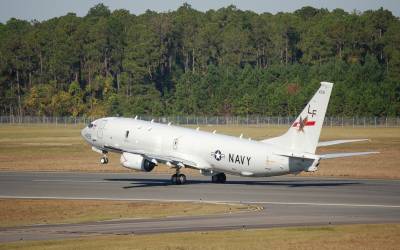
Many people would contend that the P-3 Orion is the greatest maritime patrol aircraft ever flown. These aircraft entered service in 1959 and will continue to serve past 2011. Modifications to their equipment have sharpened their capabilities, and even given them a land-attack and surveillance role. In service with 15 countries, the Orion is a great success – but it’s a very old success, and a replacement is needed.

The P-8A has emerged from the P-7 LRAACA program that was begun in 1988. That program originally envisaged an improved P-3G design, but program cost overruns and interest in opening the competition to commercial designs led to cancellation in 1990. The successor MMA program was begun in March 2000, and Boeing beat Lockheed’s “Orion 21” for the contract with a design based on the ubiquitous 737 passenger jet.

Filling the P-3 Orion’s shoes will be no easy task. What missions will the new P-8A Poseidon face? What do we know about the platform, the project team, and ongoing developments? Will the P-3’s level of global customer coverage give its successor a comparable level of export opportunities? Australia has already signed on, but has the larger market shifted in the interim?

This is DID’s FOCUS Article concerning the P-8A Poseidon Multi-mission Maritime Aircraft, and it will be updated as events and contracts are announced. In the latest news, India may be about to join the program…

DID Focus: The Global C-17 Sustainment Partnership

Related Stories: Americas - Other, Americas - USA, Australia & S. Pacific, Avionics, Boeing, Britain/U.K., Contracts - Awards, Contracts - Intent, Contracts - Modifications, ECM, Europe - Other, FOCUS Articles, Power Projection, Procurement Innovations, Support & Maintenance, Support Functions - Other, Transport & Utility, United Technologies

AIR_C-17_Hawaii.jpg
C-17 over Hawaii
(click to view full)

The C-17 Globemaster III remains the backbone of US Air Mobility Command inter-theater transport efforts around the world, and its ability to operate from shorter and rougher runways has made it especially useful during the Global War on Terror. The USA may cap production at 191 planes (though the House has inserted 10 more in the Fy 2008 bill), but a fierce fight is underway to preserve the program and even think tanks are lobbying hard. Meanwhile, various upgrades (including LAIRCM defensive systems) continue – along with heavy usage that is accumulating fatigue hours far faster than originally planned.

Which brings us to the subject of maintenance. The rising cost of maintenance has made it a greater concern to the world’s militaries, and new contract vehicles are reflecting that. Under the C-17 Globemaster III Sustainment Partnership, Boeing has total system support responsibility for the big transport aircraft, including materiel management and depot maintenance, for fleets around the world. The goal is total aircraft sustainment support under a single contract, with the goal of achieving improvements in logistics support and mission readiness while reducing operating and support costs. The initial contract had an estimated total value of $4.9 billion, which is likely to grow slightly just as Boeing’s customer base has done via buys by Australia (4), Britain (6), Canada (4), and NATO (4).

While the C-17 may have limited production time in its future, the C-17 Globemaster Sustainment Partnership is likely to continue for many years. This is DID’s FOCUS Article covering that effort; it will be backfilled and updated as time goes on. The latest addition involves Britain’s annual installment for its 6 C-17s…