Advertisement

The UK’s Watchkeeper ISTAR UAV

Latest updates: UK reviews Watchkeeper; NAO dings Watchkeeper for lateness; France may join.

Watchkeeper WK450
Watchkeeper 450

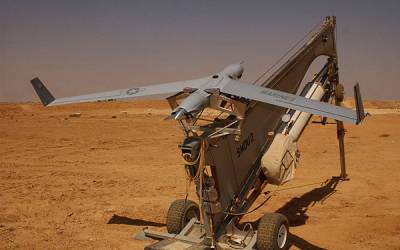
Britain has given the green light to the Watchkeeper Unmanned Aerial Vehicle Program. The initial August 2005 contract award to Thales UK’s joint venture was worth around GBP 700 million, and the program expected to create or sustain up to 2,100 high-quality manufacturing jobs in the UK. The Watchkeeper platform is based on Elbit Systems’ Hermes 450 UAV platform, which is serving as a contractor-operated interim solution on the front lines of battle.

Watchkeeper will be an important system, working as the likely medium-range mainstay within a complementary suite of manned (vid. ASTOR Sentinel R1) and unmanned (Buster, Desert Hawk, MQ-9 Reaper) aerial Intelligence Surveillance Target Acquisition Reconnaissance (ISTAR) systems. This will make it a core element of the UK Ministry of Defence’s Network-Enabled Capability strategy.

T3: Triple Target Terminator’s Terminus

Advertisement
Latest updates: Next-Gen Missile Termination.
AGM-88E AARGM Launch Concept
AARGM Concept
(click to view larger)

In early FY 2011, DARPA awarded a pair of initial contracts for something called the Triple Target Terminator. In their own words:

“The Triple Target Terminator (T3) program will develop a high speed, long-range missile that can engage air, cruise missile, and air defense targets. T3 would be carried internally on stealth aircraft or externally on fighters, bombers and UAVs. The enabling technologies are: propulsion, multi-mode seekers, data links, digital guidance and control, and advanced warheads. T3 would allow any aircraft to rapidly switch between air-to-air and air-to-surface capabilities. T3’s speed, maneuverability, and network-centric capabilities would significantly improve U.S. aircraft survivability and increase the number and variety of targets that could be destroyed on each sortie.”

Oddly, T3 sounds very similar to an ongoing Air Force Research Laboratory project – and seems to confirm a trend toward multi-guidance, multi-role smart weapons. But can the USAF develop and field its desired Next Generation Missile from among these development programs? Seems not.

Korea’s T-50 Family Spreads Its Wings

Latest updates: Israeli loss; US T-X delayed. (Feb 17/11)

T-50 Side Left lg
T-50 Golden Eagle

Korea’s defense industry is advancing on all fronts these days. On the armored vehicle front, vehicles like the XK2 tank and K9/K10 self propelled howitzer are beginning to win export orders, and its XK-21/KNIFV amphibious infantry fighting vehicle may not be too far behind. All fill key market niches, promising performance at a comparatively inexpensive price. Its shipbuilding industry, one of the world’s busiest, is beginning to turn out LHDs, and December 2008 saw its first-of-class KDX-III AEGIS destroyer accepted into service on time and on budget. Now its aerospace industry is in flight abroad with the already-exported KT-1 trainer. Not to mention a clever entry into the global trainer and light fighter markets.

Enter the T-50 Golden Eagle family, which offers a supersonic high-end trainer and lightweight fighter aircraft at an attractive price. The aircraft is hitting the international market just as many of the world’s jet training fleets are reaching ages of 30 years or more, and high-end fighters are pricing themselves out of reach for many countries. The TA-50 LIFT variant and FA-50 lightweight fighter are especially attractive as lightweight export fighters, and the ROKAF’s own F-5E/F Tiger II and F-4 Phantom fighters are more than due for replacement. Now the key question for the platform is whether it can find corresponding export sales…

Galileo GPS Project Faces More Certain Future

Advertisement

Latest updates: 2nd large contract series; EC: We want another EUR 7 billion; New build site opened; 1st operational launch; Major article updates.

Satellite Galileo System Concept
Galileo concept

The USA’s Global Positioning System service remains free, but the European Union is spending billions to create an alternative under their own control. In addition to civilian GPS (the Open Service), services to be offered include a Safety of Life Service (SoL) for civil aviation and search and rescue, a paid Commercial Service with accuracy greater than 1 meter, plus a Public Regulated Service (PRS) for use by security authorities and governments. PRS/SoL aims to offer Open Service quality, with added robustness against jamming and the reliable detection of problems within 10 seconds.

Organizational issues and shortfalls in expected progress pushed the “Galileo” project back from its originally intended operational date of 2007 to 2014/15. After a public-private partnership model failed, the EU gained initial-stage approval for its plan to finance the program with tax dollars instead of the expected private investments. Political issues were overcome in 2007 by raiding other EU accounts for the billions required, but by 2011, it became clear that requests for billions more in public funds were on the way. Meanwhile, doubts persist in several quarters about Galileo’s touted economic model. Security concerns regarding China’s involvement, and its Beidou-2/Compass project overlap, have been equally persistent. On a European political level, however, Galileo is now irreversible.

This article offers background, players, developments, contracts, and in-depth research links for Galileo, as well as linked EU programs like GIOVE and EGNOS:

Rapid Fire 2012-01-26: 2011 Results Start to Come in for Primes

  • Full 2011 financial results: Textron saw growth at Bell, revenue decrease at Textron Systems. At $7.3B, Bell’s backlog has recovered from a reporting error announced by the company last quarter.
  • Meanwhile General Dynamics generated $32.7B of revenue last year. It has potentially almost 3 years worth of revenue in backlog depending on how its indefinite quantity contracts pan out. Aerospace revenue grew but combat, marine and IT systems lost ground, translating into an almost flat topline for the prime contractor.
  • Raytheon wrapped up 2011 with slightly lower revenue ($24.9B) but higher bookings ($25.2B) than the previous year. Its backlog rose by $700M to $35.3B though most of that growth is not appropriated yet.
  • The RAND Arroyo Center is rather bullish on the potential for UAV logistics applications such as convoy overwatch and other surveillance tasks, but reminds decision makers that bandwidth is going to be critical. Note: the study doesn’t cover the use of UAS for Army resupply, separate research that General Dynamics was tasked with.
  • According to the Guardian the British government is considering selling its RAF Norholt to possibly be converted into a satellite of the nearby Heathrow airport. Philip Hammond was Secretary of State for Transport before he replaced Liam Fox last October.
  • The Stockholm International Peace Research Institute (SIPRI) notes that defense budgets in Latin America have been growing faster than institutional transparency on policy, let alone on spending.
  • BAE Systems and Caterpillar Inc. have signed a 20-year supply agreement to integrate the Cat CX family of transmissions into its HybriDrive parallel propulsion system, and use it to outfit and retrofit heavy trucks. It’s a civilian deal – but the same technologies can be used on military armored vehicles, and the civilian sector is pioneering this technology.
  • The US Army is concerned about Facebook use. Yes, it can endanger lives, they say. People in the security community need to use it responsibly, and they have some tips.

Rapid Fire 2012-01-16: Competition Under National Security Exception

  • The latest US GAO reports on the DOD: how to increase competition in procurements that use the national security exception; Arctic capabilities. Note that the GAO recently redesigned their website for the better, these report pages are significantly more legible than in the past.
  • Consultancy ICF International studied the potential for solar energy generation on DOD bases in California and Nevada and found that there’s plenty of usable space suitable for solar development, to the tune of 25,000 acres (10,000 hectares). Edwards AFB and Fort Irwin are the 2 sites with the largest potential. PDF report.
  • A French Mirage and a Saudi F-15 collided during a joint exercise in Saudi Arabia. The 3 pilots ejected safely.
  • Australia’s Defence Department reviews undertaken in the last couple of years have tallied up to more than $20M, according to the Advertiser.

Brazil’s $1B+ Order for EC725 Cougar Helicopters

Latest updates: Manufacturing facility opened; 1st flight test; 1st 3 delivered and operating; 5-year support contract.
EC725 Brazil
Brazilian Navy EC725

Brazil’s “Project H-X BR” medium transport helicopter competition featured 3 established players: AgustaWestland’s EH101 has found success in Britain, Europe, and Japan, and was chosen as the base for the USA’s VH-71 Presidential helicopter before that program was canceled. Eurocopter’s EC725 Cougar is an updated version of the popular AS332/532 Super Puma, and has been ordered in limited quantities by the French and Mexican governments. An up-to-date version of Russia’s widely used Mi-17 was the 3rd contender; like the Super Puma, Mi-8 and Mi-17 helicopters are already in wide use within Latin America.

In truth, however, Eurocopter always had an edge. The Brazilian Army’s Aviacao do Exercito already uses the AS532/”HM-3” Super Puma, basing them in the Amazon at Manaus. Its Navy also uses Super Puma variants: AS332s and AS532s both serve in the Navy as the UH-14, flying from Brazil’s NAe Sao Paulo aircraft carrier, and from the southeastern base of Sao Pedro da Aldeia in support of Brazil’s Marines. Now, Eurocopter’s offering will become Brazil’s medium-lift helicopter across all services… thanks to a new contract.

Rapid Fire 2011-12-07: FYDP Not Sequestered

  • It’s not just the pending US FY13 President Budget that won’t reflect sequestration, the 5-year Future Years Defense Program (FYDP) projection won’t either, based on an Office of Management and Budget (OMB) document seen by Bloomberg. OMB states this is still “pre-decisional material” though, but this matches our expectation that budgets made of a relatively flat DoD baseline and a reduced OCO (i.e. war spending) line item are the mostly likely outcome in the next few years. But because of that cloud of uncertainty some firms plan to increase the share of their revenue coming from civilian customers.
  • The Aerospace Industries Association (AIA) sent a letter to US SecDef Leon Panetta to push back against the Pentagon’s attempt to shift more project risk on contractors. The latest F-35 contract negotiations are no doubt prominently in their mind.

UK’s Eurofighters Fly To Availability-Based Contracting

FAR takeoff
New dawn?

How available are the RAF’s Typhoons? (Dec 6/11)

Implementation of Britain’s “future contracting for availability” approach of paying for machines in service, rather than parts and hours, generally involves a phased set of contracts and agreements. As each party’s understanding the risks and demands grow, the contract’s complexity and comprehensiveness grow as well, and the framework moves closer and closer to the desired goal of a full availability contract. “Britain Hammers Out Through-Life Support Framework for Tornado Fleet” described how this approach works on the ground, and talked about some of the keys to success. “UK’s “Contracting for Availability” Adds Hawks, Looks Ahead” mentioned the MoD’s March 2007 Long Term Partnering Agreement Foundation Contract with BAE Systems, which aims to place all British military aircraft under this kind of framework.

In late 2007, the UK’s Eurofighter Typhoon fleet entered Quick Reaction Alert service with the RAF, and began flying with new ground-attack capabilities. In step with its growing operational responsibilities, the UK MoD began moving toward an availability contracting maintenance model. A 5-year contract signed in March 2009 accelerated that shift, and the Typhoon Availability Service has begun operations. Recent reports have raised the question: how successful has it been?

Elbit & GD Create, Dissolve UAS Dynamics LLC for US Market

Elbit
Elbit

The UAV market’s low cost of entry is spurring manufacturers around the world to enter, or re-enter, the military aircraft market as prime contractors. That’s also true in the USA, where former aviation powerhouses Northrop and Grumman have a stable of high-end UAVs; and Raytheon unveiled the Killer Bee 4, which will become a full-spectrum UAV family.

Even former fighter manufacturer General Dynamics stepped back in for a while, via a May 2009 partnership between Elbit Systems of America, LLC and General Dynamics Armament and Technical Products…