May 24, 2013 17:37 UTC
Latest updates[?]: WGS-5 launched - but only after a major technical investigation cleared the Delta IV class rockets.
The US military needs a bigger data firehose. In an era of streaming data from proliferating UAVs and other persistent surveillance platforms, and the need for control of those systems anywhere in the world, bandwidth is almost as important as fuel. Commercial satellite communications (SATCOM) can fill some of the gaps, but it’s expensive, and may not be available when needed. The Wideband Gapfiller SATCOM (now Wideband Global SATCOM) program began as a way to ease these problems in the near term, but went on to become one of the twin pillars of US military communications, alongside the hardened AEHF constellation. Both satellite types expanded their roles after the super-high bandwidth T-SAT program was canceled. instead, the USA is adding WGS and AEHF satellites in space, even as it makes both programs multi-national efforts here on earth.
WGS is a set of 13-kilowatt spacecraft based on Boeing’s model 702 commercial satellite. These satellites will handle a significant portion of the USA’s warfighting bandwidth requirements, supporting tactical C4ISR(command, control, communications, and computers; intelligence, surveillance, and reconnaissance); battle management; and combat support needs. Upon its 2007 launch into geosynchronous orbit, WGS Flight 1 became the U.S. Department of Defense’s highest capacity communication satellite. WGS F4, launched in January 2012, offers further improvements, as do satellites from WGS F8. The constellation is set to grow to 10, including international participation.
This is DID’s FOCUS Article covering the WGS program’s specifications, budgets, travails, international partnerships, and contracts, with links to additional research materials.
Continue Reading… »
May 22, 2013 12:56 UTC
Latest updates[?]: 1st flight: we have video; Will the Triton fly to Pax River?
BAMS Operation Concept
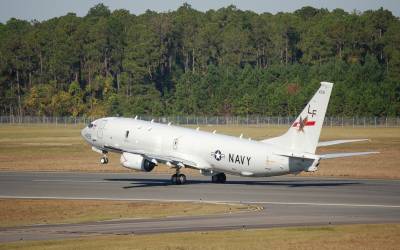
The world’s P-3 Orion fleets have served for a long time, and many are reaching the end of their lifespans. In the USA, and possibly beyond, the new P-8 Poseidon Multi-mission Maritime Aircraft will take up the P-3′s role. While the P-8′s base 737-based airframe offers strong service & maintenance arguments in its favor, the airframe is expensive enough that the P-3s cannot be replaced on a 1:1 basis.
In order to extend the P-8 fleet’s reach, and provide additional capabilities, the Poseidon was expected to work with at least one companion UAV platform. This DID FOCUS Article explains the winning BAMS (Broad Area Maritime Surveillance) concept, the program’s key requirements, and its international angle. We’ll also cover ongoing contracts and key events related to the program, which chose Northrop Grumman’s navalized MQ-4C Triton Global Hawk variant.
Continue Reading… »
May 15, 2013 13:44 UTC
Latest updates[?]: Electronic Warfare pod: from CAESAR to NERO.
ER/MP, armed
In August 2005, “Team Warrior” leader General Atomics Aeronautical Systems, Inc. in San Diego, CA won a $214.4 million cost-plus-incentive-fee contract for research, development, test and evaluation (RDT&E) of the Extended Range/ Multi Purpose Unmanned Aerial Vehicle System (ER/MP UAS). That was just the first step along the US Army’s $5 billion road to fielding a true Medium Altitude, Long Endurance, armed UAV, modified from the USAF’s famous MQ-1 Predator.
The ER/MP program was part of the US Army’s reinvestment of dollars from the canceled RAH-66 Comanche helicopter program, and directly supports the Army’s Aviation Modernization Plan. Its position got a boost when a 2007 program restructuring cut the Future Combat Systems Class III UAV competition, in favor of ER/MP. Next, the US Air Force saw this Predator derivative as a threat and tried to destroy it, but the program survived the first big “Key West” battle of the 21st century. Now the MQ-1C “Gray Eagle” is moving into full production, as the US Army’s high-end UAV. This FOCUS article offers a program history, key statistics and budget figures, and ongoing coverage of the program’s contracts and milestones.
Continue Reading… »
May 08, 2013 20:00 UTC
Latest updates[?]: VXX RFP details - but what will Boeing bid?; HMX-1 gets 1st of 12 V-22 Osprey tilt-rotors; FY 2014 budget highlights the cost of delay; GAO report on VXX; Article reorganized.
Aborted landing
In January 2005, the U.S. Navy selected the US101 as the new “Marine One” baseline helicopter, for use by the President of the United States. The US101 is an American variant of AgustaWestland’s successful AW101 multi-mission medium helicopter; it beat out Sikorsky’s S-92 Superhawk, which is already in use as a government VIP transport in countries like South Korea.
That $1.7 billion victory was first endangered, and then destroyed, by ongoing changes from the White House staff. In 2008, the program’s ballooning costs and requirements got a temporary reprieve when US Navy agreed to proceed with the VH-71, despite a cost per aircraft equal or greater than the President’s Air Force One 747s. By June 2009, however, the VH-71 program had shot itself down.
Another round of competition is on the way, and back in 2009 the Pentagon said it was considering buying 2 different helicopters in the VXX follow-on program. Faced with an initial Analysis of Alternatives deemed too expensive, the OSD accepted the Navy’s revised approach in May 2012, setting things in motion for a new program of record.
Continue Reading… »
May 06, 2013 15:02 UTC
Latest updates[?]: France preparing to contribute to ground systems budget; Airspace certification problems in Germany, and what they mean for AGS; Do USAF budgets threaten to make AGS an orphan system?
What is it good for?
The Alliance Ground Surveillance (AGS) program began in 1995, and it has taken a very long time. Its MoU was late, its contract will be both late and smaller in scope, and it won’t meet even a revised 2012 – 2014 fielding window. At long last, however, one can be assured that it will exist.T his is DID’s in-depth FOCUS Article covering the AGS program, from its platforms to its program structure to its long-awaited contracts.
The original AGS plan involved an Airbus A321 counterpart to Northrop Grumman’s E-8C Joint Surveillance Target Attack Radar System (J-STARS), a Boeing 707 derivative whose powerful ground-looking Synthetic Aperture Radar (SAR) offers American commanders combat-changing battlefield surveillance and communications. AGS would be a pooled NATO asset, adding 7 RQ-4B Global Hawk UAVs and dedicated ground stations to complement the manned planes. It has since been reduced to just 5 RQ-4 Block 40 Global Hawk UAVs and dedicated ground stations, but could expand again if countries decide to make some of their national surveillance assets part of the program.
Continue Reading… »
May 01, 2013 16:30 UTC
Latest updates[?]: 6th - and maybe final? - ship ordered; Arctic mission; Construction progress; Full acceptance of USCGC Stratton; Article formatting improvements highlight milestones.
WMSL-750 Bertholf
The US Coast Guard’s massive $25 billion Deepwater meta-program (really Deepwater-II given post-9/11 changes) has endured more than its share of ups and downs. Nevertheless, Congressional support has remained strong, and efforts are being made to restructure the program and get it back on track. Yet the USCG’s Island Class cutter modification program, and the Deepwater Fast Response Cutter supposed to replace it, have faced many difficulties.
The Legend Class National Security Cutters are the largest ships in the Deepwater program, and represent the program’s flagship in more ways than one. The 418 foot, 4,400 ton ships will be frigate-sized vessels with a 21 foot draughts [1], and are rather larger than the 379 foot, 3,250 ton Hamilton Class High Endurance Cutters (HECs) they will replace. Controversies regarding durability and potential hull fatigue, as well as significant cost overruns, have shadowed the new cutter’s construction. Nevertheless, the program appears to be moving forward. This DID FOCUS Article covers the Legend Class cutters’ specifications, program history, and key events.
Continue Reading… »