CD-Adapco

BAE’s Turret to Trial in CV-22s

Related Stories: Americas - USA, BAE, Contracts - Awards, Design Innovations, Forces - Special Ops, Guns - under 20mm direct, Helicopters & Rotary, Testing & Evaluation

ORD RWS RGS on MV-22 Slide
RGS for V-22
(click to view full)

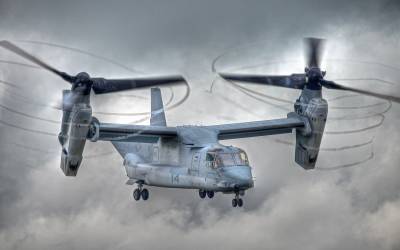
V-22 Osprey: A Flying Shame?” detailed a number of very detailed and specific allegations concerning the V-22 Osprey’s performance, testing flaws, and survivability issues in anything beyond low-threat situations like the present Anbar deployment in Iraq. Despite direct offers, US NAVAIR chose not to respond or address any of those allegations. One of the flaws that appeared headed for correction, however, was the issue of 360 degree covering fire. This capability is useful for fire support generally, and is especially helpful when entering or covering landing zones, where rotary aircraft are most vulnerable. The Osprey’s huge propellers and the positioning of its engines had created obstruction issues with normal machine gun mounting locations, but AUSA 2007 saw BAE Systems promoting a retractable belly turret solution based on a 3-barrel 7.62mm GAU-17 minigun.

Now BAE Systems has announced that will develop this Remote Guardian System for the CV-22 Ospreys that will be flown by US special forces. The $491,000 U.S. Special Operations Command contract calls for rapid development, installation, testing, and qualification of this solution, and has a potential value of $16.3 million if all options are exercised and the solution goes into production for the SOCOM fleet. The US Marine Corps’ MV-22B tilt-rotors are not involved in this contract, nor have they signed a separate contract with BAE Systems at this time.

May 1/08: Production begins. BAE Systems Inc. in Johnson City, NY receives a FFP pre-priced contract modification for $8 million for a CV-22 interim defense weapon system productions option in support of U.S. Special Operations Command and NAVAIR. Work will be performed in Johnson City, NY from April 30/08 through Jan 31/09, using FY 2006 SOCOM procurement funds and FY 2008 Navy aircraft procurement funds. This is a within scope modification to a competitive contract where 2 offers were received (H92222-08-C-0006-P00003).

V-22 Osprey: A Flying Shame?

Related Stories: Americas - USA, Boeing, Design Innovations, Events, Forces - Marines, Guns - under 20mm direct, Helicopters & Rotary, Issues - Political, Lobbying, New Systems Tech, Official Reports, Other Corporation, Policy - Procurement, Remote Weapons Systems, Scandals & Investigations, Testing & Evaluation, Think Tanks, Transformation

AIR MV-22 Osprey Tilting Rotor
MV-22 Osprey
(click to view full)

Every once in a while, a defense-related controversy becomes large enough to hit mainstream news outlets. Making the cover of TIME Magazine is often a good sign for world leaders, but it’s almost always a very bad sign for military programs. Especially a program that is just making its combat debut. TIME’s Oct 8/07 cover story “V-22 Osprey: A Flying Shame” pulls few punches:

“The saga of the V-22 – the battles over its future on Capitol Hill, a performance record that is spotty at best, a long, determined quest by the Marines to get what they wanted – demonstrates how Washington works (or, rather, doesn’t). It exposes the compromises that are made when narrow interests collide with common sense. It is a tale that shows how the system fails at its most significant task, by placing in jeopardy those we count on to protect us. For even at a stratospheric price, the V-22 is going into combat shorthanded. As a result of decisions the Marine Corps made over the past decade, the aircraft lacks a heavy-duty, forward-mounted machine gun to lay down suppressing fire against forces that will surely try to shoot it down. And if the plane’s two engines are disabled by enemy fire or mechanical trouble while it’s hovering, the V-22 lacks a helicopter’s ability to coast roughly to the ground – something that often saved lives in Vietnam. In 2002 the Marines abandoned the requirement that the planes be capable of autorotating (as the maneuver is called), with unpowered but spinning helicopter blades slowly letting the aircraft land safely. That decision, a top Pentagon aviation consultant wrote in a confidential 2003 report obtained by TIME, is “unconscionable” for a wartime aircraft. “When everything goes wrong, as it often does in a combat environment,” he said, “autorotation is all a helicopter pilot has to save his and his passengers’ lives.”

Recent developments are about to address one of these concerns, but TIME has hardly been the Osprey’s only critic, or the most thorough. That distinction probably belongs to a report published by the left-wing Center for Defense Information, which makes a number of very specific allegations re: the V-22’s technical and testing failings…

Rock n’ Recoil: MK93 Mounting Systems

Related Stories: Americas - USA, Delivery & Task Orders, Guns - 20-59 mm direct, Guns - under 20mm direct, Other Corporation

MK93
Mk93 mount & M2

The Mk93 Heavy Machine Gun Mounting System is used to lessen the recoil of heavy weapons like the 40mm MK19 Grenade Machine Gun (GMG) and the .50 caliber/12.7mm M2 Heavy Machine Gun (HMG), improving their accuracy. It attaches to a tripod for infantry use, but it’s seen much more frequently as part of a vehicular mount, using the MK175 pintle pedestal. The MK93 requires no external adapters or tools, and consists of a gun carriage and cradle assembly, a train stop bracket, an ammunition can holder, a bolt-on small pintle, a bolt-on large pintle, and a stowage bar assembly. The U.S. Army Tank Automotive and Armaments Command in Rock Island, IL recently announced a set of contracts for these items to:

Continue Reading… »

$8.5M for 12,278 M3 Tripods

Related Stories: Americas - USA, Contracts - Awards, Guns - 20-59 mm direct, Guns - under 20mm direct, Issues - Political, Small Business, Soldier's Gear

ORD MK19 on M3 Tripod1
Mk19 on M3
(click to view full)

Cape Fox Professional Services in Ketchikan, Alaska received an $8.5 million firm-fixed-price contract for 12,278 M3 tripod mount. The M3 tripod (see associated Field Service manual) is the standard ground mount for M2 12.7mm heavy machine guns and Mk19 40mm grenade machine guns.

CFPS is an Alaska Native Company (ANC) certified in the Small Business Administrations 8(a) Business Development program, and is HUB Zone certified as well. Their web site states that “the purpose of CFPS is to engage in the business of providing information technology IT services and integrated solutions.” Parent firm Cape Fox Corp. has a number of subsidiaries, however, including interests in HDPE piping and coating.

GEAR M3 Tripod Labeled
M3 tripod, labeled
(click to view full)

Work will be performed in Ketchikan, AK and is expected to be complete by Dec. 31, 2010. Web bids were solicited on Aug 1/07, and 4 bids were received by the US Army Tank Automotive and Armaments Command in Rock Island, IL (W52H09-08-D-0107).

Ma Deuce Still Going Strong

Related Stories: Americas - USA, Contracts - Awards, Contracts - Modifications, FOCUS Articles, General Dynamics, Guns - under 20mm direct

ORD M2 Mounted Lance
“Aroint thee!”
(click to view full)

Built since the 1920s, the reliable, powerful, air-cooled .50 caliber (12.7 mm) M2 Browning Machine Gun (aka. “Ma Deuce”) is still one of the world’s most effective heavy machine guns. It can be carried by a team of soldiers, or mounted on vehicles and aircraft. Despite its age, its combination of reliability, durability, and kick-butt firepower has made it one of the most requested weapons in the Iraqi theater of war, and it remains popular around the world. Modern alternatives like FN’s M3M/GAU-21 have been introduced, and the XM307/312 remains a future possibility, but the M2 remains, as one of our correspondents put it, “the mounted lance of the US cavalry.” The USA has even had to ramp up .50 cal ammunition production, in order to keep up.

This article covers the venerable, and valuable, M2 machine gun, and associated contracts…

Continue Reading… »

Comanche’s Child: The ARH-70 Armed Reconnaissance Helicopter (updated)

Related Stories: Americas - USA, Avionics, BAE, Boeing, Contracts - Awards, FOCUS Articles, Force Structure, Guns - under 20mm direct, Helicopters & Rotary, L3 Communications, New Systems Tech, Other Corporation, Policy - Procurement, Procurement Innovations, Project Methodologies, Sensors & Guidance, T&C - CSC

AIR_ARH_Bell_407_Hydras.jpg
YRH-70 w. Hydras
(click to view full)
DII

The ARH (Armed Reconnaissance Helicopter) is a program by the United States Army to replace around 375 Bell Textron OH-58D Kiowa Warrior helicopters. The Army’s initial replacement, the $14.6 billion RAH-66 Comanche program, was canceled in 2004 in favor of buying a larger number of less expensive platforms with reduced capabilities.

Bell Helicopter Textron won the ARH competition, beating rival MD Helicopters. and the contract calls for 368 ARH-70 aircraft (a request raised to 512 aircraft and $5.4 billion) during FY 2006 – 2013. Unit costs of approximately $6-11 million have been suggested (calculation methodologies vary), vs. much more advanced Comanche’s estimated $36 million. As DID has noted re: a similar $500-600 million competition in India, Bell’s ARH-70 is a militarized version of its highly successful 407 single-engine commercial helicopter.

This will serve as DID’s FOCUS Article for the ARH-70 program, providing updated background, details, and contract award information. The latest additions include a recommendation by the House Armed Services Committee in Congress to cancel and recompete the ARH-70 program, shortly after the Army both raised its request for the number of ARH helicopters from 368 to 512 and issued a stop-work order on the program. Now the Army says it will continue working with Bell Helicopter, rather than re-competing the program… and there are rumblings in Congress in favor of full program cancellation and replacement by an armed UH-72A Light Utility Helicopter. Meanwhile, Bell Helicopter continues to work on the ARH-70 at its own expense, including a contract for sensor systems worth up to $1.2 billion – even as a recent Pentagon report continues to document rising program costs…

  • The ARH Program
  • The ARH Program Winner: Bell’s ARH-70
  • The ARH Program: Contracts & Events
  • Appendix A: Weary Warriors – The Army’s OH-58D Kiowa Warrior Fleet
  • Appendix B: Additional Readings & Sources

    Continue Reading… »

Germany Up-Gunning Its CH-53Gs

Related Stories: Asia - Central, Europe - Other, Guns - under 20mm direct, Helicopters & Rotary, Other Corporation

AIR CH-53G
CH-53G
(click to view full)

Germany’s CH-53G medium-heavy helicopters are already slated for a EUR 520 million upgrade, as Germany extends their useful lives until the HLH program’s replacements are ready around 2020. Some of those CH-53Gs are currently serving in Afghanistan as the only helicopter assets available to ISAF’s Regional Command North, which encompasses 9 of the easier Afghan provinces and contains Provincial Reconstruction Teams from Germany, Hungary, Norway and Sweden. Because they are ISAF RCN’s only helicopter assets, the CH-53Gs normally fly as a pair for mutual support, further limiting their reach.

At present, the 2 door-mounted 7.62mm machine guns mounted in the CH-53Gs aren’t considered powerful enough to deliver effective suppressive fire in an ambush situation. The Afghan helicopters will be among the first to receive an armament upgrade in 2008, which begins by adding a .50 caliber/ 12.7mm M3M machine gun. It’s also mounted on American CH-53s, where it’s known as the GAU-21. Phase 2 of the upgrade will also see the CH-53Gs’ door guns replaced with FN Herstal’s M3Ms. It isn’t much, but it’s something – and more than they currently have available. Aviation Week Ares.


$7.3M for Helicopter Machinegun Mounts

Related Stories: Americas - USA, Contracts - Modifications, Europe - Other, Guns - under 20mm direct, Helicopters & Rotary, Other Corporation

ORD M3M HMG on CH-53E lg
M3M on CH-53E
(click to view larger)

FN Herstal, S.A. in Herstal, Belgium received a $7.3 million modification to a previously awarded firm-fixed-price contract in return for 334 GAU-21 Left Hand and Right Hand Medium Window Pintle Connections for the CH-53D and CH-53E heavy-lift helicopters used by the US Marines. The GAU-21 is also known as the M3M, and is a .50 caliber machine gun manufactured by FN Herstal; it is typically mounted on the CH-53’s rear ramp.

Work will be performed in Johnstown, PA (72%) and Liege, Belgium (28%) and is expected to be complete in June 2009. The Naval Air Systems Command at Patuxent River, MD issued the contract (N00019-06-C-0092).

Norwegian Firm’s GMG Soft Mount Wins US Interest

Related Stories: Americas - USA, Contracts - Awards, Design Innovations, Europe - Other, Forces - Special Ops, Guns - 20-59 mm direct, Guns - under 20mm direct, Other Corporation, Testing & Evaluation

ORD_GMG_MK47_on_HMMWV.jpg
MK47 Striker on Hummer
(click to view full)

Vinghog AS in Tonsberg, Norway received an $8.4 million firm-fixed-price, indefinite-delivery/ indefinite-quantity contract for an Improved Crew Served Weapons Mount (ICSWM) for the MK47 “Striker” Advanced Lightweight 40mm Grenade Launcher (ALGL). Vinghog’s ICSW Mount, with adapters, will also be used with other fielded machine guns such as the M2 .50 caliber and M240 7.62mm. It is envisioned that the ICSWM will improve accuracy when firing on the move.

This project will evaluate a soft-mount for Special Operations Forces (SOF) crew served weapons such as the MK47 MOD 0 ALGL and machine guns. The ICSWM mount program will test the soft-mount technology to verify that it does improve the performance of the MK47 Weapon System in accordance with objective joint Operational Requirements Document. Work will be performed in Tonsberg, Norway, and is expected to be complete by November 2011. All funding will expire at the end of the current fiscal year. The contract was competitively procured and advertised on the Internet, with 1 offer received by the Naval Surface Warfare Center, Crane Division in Crane, IN (N00164-07-D-4883).

Continue Reading… »

$76M to DRS for over 7,500 Weapon Thermal Sights

Related Stories: Americas - USA, Contracts - Modifications, Guns - Personal Weapons, Guns - under 20mm direct, New Systems Tech, Other Corporation, Rockets, Sensors & Guidance, Soldier's Gear

ELEC_DRS_Thermal_Weapon_Sights.jpg
DRS TWS: Light, Hvy., Med.

DRS Technologies, Inc. announced that it has received approximately $76 million in new orders to produce next-generation advanced uncooled Thermal Weapon Sights II (TWS II) for U.S. Army soldiers. DRS makes thermal imaging night vision sights that currently support the U.S. Army, Marine Corps, Air Force and Special Operations forces, and the order was issued on behalf of US Army Program Executive Office Soldier by the Army’s Communications-Electronics Command (CECOM) acquisition center in Fort Monmouth, NJ. It is is part of a competitively secured 5-year contract awarded to DRS in March 2004, with a total potential value of $375 million if all options are exercised.

The specific quantities, capabilities, and compatibile weapons for the thermal sights ordered are described below. We’ve also included links that explain how thermal sights work, and offer industry forecasts for the larger electro-optical market.

Continue Reading… »