CD-Adapco

Lexington: US Politics and the Defense Budget

Related Stories: Americas - USA, Budgets, Issues - Political, Projections & Assessments, Think Tanks

GOP-Dem

With American elections approaching, questions are being asked in the industry about the potential implications for American defense policy. In January 2007, “The Impact of Recent Political Changes on the Defense Sector” transcribed Loren Thompson of the Lexington Institute think tank, during the Raymond James Washington Technology & Services Summit. It offered some interesting thoughts on the contractor/ military political gap, and added:

“The bottom line on the Democratic defense agenda is that it doesn’t reflect much support for new technology outlays, but it also doesn’t herald an era of rapidly declining defense budgets. What’s likely to change is the composition of defense spending rather than the scale.”

Fast forward to February 2008, where Thompson is speaking to US Army Leaders at the RAND Arroyo Center. “The Role Of Party Politics In Shaping Defense Priorities” offers an impartial presentation of how the two major parties evolved, how they think about national security, their inclinations and allocation preferences with respect to the defense budget, and what a victory by either side probably means. Unusually, it is a fair presentation that puts forward each party’s broad view reasonably faithfully. Which matters, because:

GOP-Dem

”...we need to understand how party politics shapes defense policy—not because we like it, but because it is a fundamental reality of life in a democracy. Did you know that a recent study of weapons outlays found 91% of all the variation in spending over the last four decades was traceable directly or indirectly to which party controlled the Senate and the White House? Like me, you probably thought that threats were the main driver of weapons spending, but the data show otherwise.

Read both speeches, consider your own experiences, and decide what you think. Thompson also changes his tune slightly, however, when he says that:

”... if the Democratic Party wins control of the White House and Congress in November, it will take a huge demand stimulus from the likes of Osama bin Laden to prevent a leveling off and then decline in defense spending in subsequent years.”

V-22 Osprey: A Flying Shame?

Related Stories: Americas - USA, Boeing, Design Innovations, Events, Forces - Marines, Guns - under 20mm direct, Helicopters & Rotary, Issues - Political, Lobbying, New Systems Tech, Official Reports, Other Corporation, Policy - Procurement, Remote Weapons Systems, Scandals & Investigations, Testing & Evaluation, Think Tanks, Transformation

AIR MV-22 Osprey Tilting Rotor
MV-22 Osprey
(click to view full)

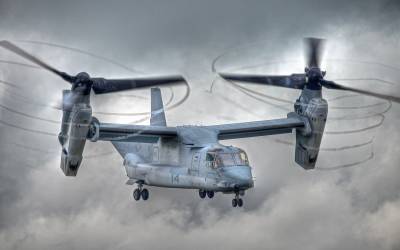
Every once in a while, a defense-related controversy becomes large enough to hit mainstream news outlets. Making the cover of TIME Magazine is often a good sign for world leaders, but it’s almost always a very bad sign for military programs. Especially a program that is just making its combat debut. TIME’s Oct 8/07 cover story “V-22 Osprey: A Flying Shame” pulls few punches:

“The saga of the V-22 – the battles over its future on Capitol Hill, a performance record that is spotty at best, a long, determined quest by the Marines to get what they wanted – demonstrates how Washington works (or, rather, doesn’t). It exposes the compromises that are made when narrow interests collide with common sense. It is a tale that shows how the system fails at its most significant task, by placing in jeopardy those we count on to protect us. For even at a stratospheric price, the V-22 is going into combat shorthanded. As a result of decisions the Marine Corps made over the past decade, the aircraft lacks a heavy-duty, forward-mounted machine gun to lay down suppressing fire against forces that will surely try to shoot it down. And if the plane’s two engines are disabled by enemy fire or mechanical trouble while it’s hovering, the V-22 lacks a helicopter’s ability to coast roughly to the ground – something that often saved lives in Vietnam. In 2002 the Marines abandoned the requirement that the planes be capable of autorotating (as the maneuver is called), with unpowered but spinning helicopter blades slowly letting the aircraft land safely. That decision, a top Pentagon aviation consultant wrote in a confidential 2003 report obtained by TIME, is “unconscionable” for a wartime aircraft. “When everything goes wrong, as it often does in a combat environment,” he said, “autorotation is all a helicopter pilot has to save his and his passengers’ lives.”

Recent developments are about to address one of these concerns, but TIME has hardly been the Osprey’s only critic, or the most thorough. That distinction probably belongs to a report published by the left-wing Center for Defense Information, which makes a number of very specific allegations re: the V-22’s technical and testing failings…

F-35 Joint Strike Fighter: Events & Contracts 2008 (updated)

Related Stories: Alliances, Americas - Other, Americas - USA, Australia & S. Pacific, Avionics, BAE, Bases & Infrastructure, Bombs - Smart, Britain/U.K., Budgets, Contracts - Awards, Contracts - Intent, Contracts - Modifications, Design Innovations, Engines - Aircraft, Europe - Other, Events, FOCUS Articles, Fighters & Attack, Guns - 20-59 mm direct, Issues - International, Issues - Political, Lobbying, Lockheed Martin, Middle East - Israel, New Systems Tech, Northrop-Grumman, Official Reports, Other Corporation, Partnerships & Consortia, Policy - Procurement, Project Management, R&D - Contracted, Radars, Support & Maintenance, Think Tanks, Transformation

AIR F-35A AA-1 Test Flight
F-35A AA-1
(click to view full)
DII

The F-35 Lightning II is a major multinational program which is intended to produce an “affordably stealthy” multi-role strike fighter that will have three variants: the F-35A conventional version for the US Air Force et. al.; the F-35B Short Take-Off, Vertical Landing for the US Marines, British Royal Navy, et. al.; and the F-35C conventional carrier-launched version for the US Navy. The aircraft is named after Lockheed’s famous WW2 P-38 Lightning, and the Mach 2, stacked-engine English Electric (now BAE) Lightning jet. System development partners included The USA & Britain (Tier 1), Italy and the Netherlands (Tier 2), and Australia, Canada, Denmark, Norway and Turkey (Tier 3). Now the challenge is agreeing on production phase membership and arrangements, to be followed by initial purchase commitments around 2008-2009.

This updated article has expanded to feature more detail regarding the $300 billion F-35 program, including other contracts as well as notable events. As a result of reader feedback, we’ll make the new material more visible by putting it in green type. Recent news involves insight into the program’s integrated global design & production process, a weapons change, and an effort to make its engine lighter…

KC-X: Rating the Contenders

Related Stories: Americas - USA, Boeing, EADS, Issues - Political, Northrop-Grumman, Policy - Procurement, Projections & Assessments, Rumours, Specialty Aircraft, Think Tanks, Transport & Utility

KC-X
KC-X contenders
(click to view full)

As the $35 billion KC-45 tanker purchase flies into the teeth of Washington’s political battles, the Lexington Institute think-tank discusses the relative ratings of each contestant in the USAF’s aerial tanker competition. This is a bit unusual, as even Boeing has yet to hear the official debrief – a fact that has them somewhat upset. DID would not normally consider a report of this nature credible, but the think-tank has a wide range of contacts in Washington, and has been focusing on this deal for some time. Their broad assessment also mirrors commenets made by Sen Richard Shelby [R-AL], so it is possible – but not certain – that their report is correct.

Lexington defense analyst Loren Thompson contends that the Airbus/Northrop Grumman proposal would be able to deliver 49 operational tankers by 2013, whereas Boeing would have been able to deliver just 19 aircraft within that timeframe. That’s an interesting calculation whose basis DID would be interested in viewing, but public access may be an issue as it was attributed to USAF reviewers. Beyond that, Thompson concludes that Boeing lost out on 4 of 5 key measures, and tied on the 5th. Of course, sharp-eyed DID readers will recall that they were 9 Key Performance Parameters listed in the RFP…

Continue Reading… »

Replacing Canada’s Failing CC-130s: 17 C-130Js

Related Stories: Americas - Other, Boeing, Budgets, EADS, FOCUS Articles, Force Structure, Issues - Political, Lockheed Martin, Other Corporation, Policy - Procurement, Power Projection, Pre-RFP, Procurement Innovations, Project Failures, Project Methodologies, Rolls Royce, Support & Maintenance, Think Tanks, Transformation, Transport & Utility, United Technologies

AIR CC-130 AAR BC
CC-130 over BC
(click to view full)

DID has covered the growing realization in the US military that its aging aircraft fleet will begin posing serious challenges in the coming years. In a related vein, consider the problems that Canada is currently experiencing. In 2005, Chief of the Defence Staff Gen. Rick Hillier said that “Our [CC-130 E/H] Hercules fleet right now is rapidly going downhill. We know that three years and a little bit more than that, the fleet starts to become almost completely inoperational and we will have to stop supporting operations – or else, not be able to start them.”

The CC-130s are used in a wide variety of roles, from tactical transport to aerial refueling and even search and rescue. The Canadian Forces do not own any other aircraft in a similar class, which makes replacement essential. EADS tried to remain in the running with its Airbus A400M, and other alternatives were proposed, but the specific requirements set by Canada’s Department of National Defense (DND) tended to exclude alternatives. In December 2008, a program worth almost C$ 5 billion got underway to buy 17 of Lockheed’s privately-developed C-130J “Super Hercules” planes.

In this revised Spotlight article, DID can offer additional details regarding the Canadian procurement program, and the thinking behind it; some background that points up the parallels between the issues faced by the Canadians, and the experiences of other air services; and some insight into why the buy took so long, after the C-130J was declared Canada’s preferred choice in an “expedited” process. The latest items include the purchase itself, Lockheed Martin’s first announcement re: industrial offsets, and now an announcement from Rolls Royce concerning an engine order…

US Missile Defense Shifting Toward More Realistic Testing?

Related Stories: ABM, Americas - USA, Budgets, Issues - Political, Lobbying, New Systems Tech, Policy - Procurement, Project Management, Testing & Evaluation, Think Tanks

JS Kongo fires SM-3 ABM
JS Kongo fires SM-3
(click to view full)

Aviation Week’s “Obering Wants To Shift MDA to Realistic Testing” is an interesting article in light of today’s headline re: the ballistic missile intercept by a Japanese destroyer. US Missile Defense Agency chief Lt. Gen. Henry (Trey) Obering is quoted as saying that it’s time to incorporate more realism into the MDA’s testing process, now that basic intercepts have racked up a string of successes:

“What we have to do now is to turn our attention to make sure we can fully wring out the system in a variety of operational and realistic scenarios. And that is what we will be doing over the next couple of years.”

There are both technical and political dimensions to that course of action…

Continue Reading… »

Interactive: C-5s vs. C-17s in Washington

Related Stories: Americas - USA, Avionics, Boeing, Engines - Aircraft, Events, Force Structure, GE, Issues - Political, Lobbying, Lockheed Martin, Official Reports, Spotlight articles, Support & Maintenance, Think Tanks, Transport & Utility

AIR C-17 and Troops Runway
C-17, waiting
(click to view full)

A Washington think-tank has gone so far as to call the planned cancellation of C-17 heavy transport aircraft production “The Dumbest Weapons Decision of the Decade”. The US Air Force is loath to close the C-17 line, which would cost them about $1.5 billion, plus another $4+ billion to re-open it if their decision proves to be too hasty. Not to mention the larger $8+ billion economic effects and lost jobs. Still, the cost of its equipment means that funds are tight, and last-minute Congressional earmarks have been necessary to keep the C-17 line going. Concern has also been expressed that by shuttering the line, the USA is effectively handing the global strategic airlift market over to France and Russia; the Airbus A400M and Russia’s super-giant AN-124 would be the only games in town from 2010-2025, or longer.

Worse, there is almost no confidence in the Pentagon’s 2005 Mobility Requirements Study, whose assumptions hadn’t budged from a 2000 study – before 9/11 and the resulting global war saw airlift usage and flight hours skyrocket, before the Army’s Future Combat Systems’ failure to fit into C-130 transports as promised… before a lot of things happened.

The House has authorized $2.4 billion to buy 10 more C-17s in FY 2008, but the Senate’s version of the defense authorization bill doesn’t include anything. Reconciliation negotiations are in progress, and C-17 addition will happen (or not) in the FY 2008 wartime supplemental spending bill #2. That isn’t expected to come to the floor until early 2008.

AIR C-5 Antarctica Deep Freeze 1990
C-5: Baby, it’s
cold outside
(click to view full)

Meanwhile, the C-5M AMP/RERP program to upgrade America’s super-giant Galaxy aircraft with modern avionics and engines has hit project and budgetary turbulence, with an official USAF cost growth notification, and predictions of a rise from $8-9 billion to $16-17 billion. Sue Payton, the Air Force’s acquisition executive, told a Senate committee that per-aircraft costs for C-5 AMP/RERP had ballooned to $146.7 million. Lockheed Martin business ventures vice president Larry McQuien, on the other hand, stands by the company’s $83 million price commitment, and said that even adding additional costs raised by the Air Force like training, spare parts, support equipment, and unanticipated repairs, the per aircraft price would not exceed $118 million.

It’s a turbulent debate. Some Reps. like Rep. Ellen Tauscher [D-CA] and Rep. Mike Castle [R-DE] are pushing “United States Airlift Requirement Act,” demanding a real mobility study that explicitly compares the C-5 and C-17 options. Others believe the C-17 and C-5 programs are not mutually exclusive, given current demands on the fleet and the planned addition of 90,000+ soldiers and Marines in the coming years. In the end, however, funds must be increased, or hard choices must be made, or an innovative “3rd option” out of the bind must be found.

To shed a bit of light on some of the key variables involved and what they really mean, DID has taken data from Congressional Research Service’s testimony to Congress in March 2007. We’ve added information from other sources, and structured an Excel spreadsheet that looks at the 2 programs and compares each aircraft’s program costs, lifetime costs to operate, and more. Red “tags” in a cell are pop-up explanations; just move your mouse over them, and they display a quick explanation or relevant insight. Best of all, the key variables are adjustable, so you can change some of the figures and see how it flows through to the final totals:

Excel DID’s C-5 vs. C-17 program comparison

Additional readings and relevant news items can be found below – and this spreadsheet is open to improvement. Readers are invited to submit important data we may have missed (source must be indicated), or take issue with anything they believe to be a mistake, via editorial@... here at defenseindudstrydaily.com. We’ll look at it, and update the Excel sheet (and article) as required. This is a bit of a new approach for DID, so let us know what you think!

Continue Reading… »


CSBA on Future US Naval Aviation: Unmanned, Too?

Related Stories: Americas - USA, Issues - Political, Lobbying, Projections & Assessments, Think Tanks, UAVs, Warfare - Lessons

AIR_UAV_X-47B_Concept_On_Carrier_Near F-18s.jpg
Concept: X-47B on Carrier
(click to view full)

From the non-partisan Washington Center for Strategic & Budgetary Assessments (CSBA) May 10/07 publication: “The Unmanned Combat Air System Carrier Demonstration Program: A New Dawn For Naval Aviation?” [PDF format]

”...the combat reach of the 2020 carrier air wing will not have improved much beyond that of the mid-1980s air wing, which had trouble dealing with 1970s Soviet land-based anti-access/area-denial technologies. Perhaps more significantly, the CVW’s ability to establish persistent orbits at range will not have improved much beyond that of the 1950s… Said another way, will an operational strike system with limited tactical reach and persistence – one optimized for pulsed strikes against land targets at ranges out to about 450-475 nm – be able to tackle future operational challenges and threats that are likely to appear over the long term? The answer is: probably not…. As this short discussion suggests, then, there is a growing strategic imperative to increase the range, persistence, and stealth of the Navy’s carrier air wing. Indeed, failing to increase the CVW’s reach, endurance, and survivability risks the long-term operational and tactical relevance of the US carrier fleet.”

PUB_US_Persistent_Coverage_Gaps.gif
The Persistence Gap
(Animation: click & wait…)

Along the way, their paper deals with a number of issues. The historic lack of interest in UAVs within the US Navy, which manifested as early as Vietnam. The choice of shrinking strike range for current US carrier groups, but greater strike density within that limited range. The emergence of land-based “surveillance-strike complexes” in other nations, designed to keep US carriers well outside of that range. International carrier plans. Not to mention a future in which the USA will have 11 operational carriers – but just 10 US Navy/ USMC carrier aircraft wings. This is followed by a look at the history of the J-UCAS unmanned combat air vehicle program to date, and recommendations for the future in light of emerging trends. Read the CSBA’s entire 39-page preliminary backgrounder, which serves as a lead-in summary for a forthcoming report.

Continue Reading… »

Germany’s Military Transformation

Related Stories: Europe - Other, FOCUS Articles, Industry & Trends, Issues - Political, Official Reports, Other Corporation, Think Tanks

GOV_German_MinDef_Logo.gif

The German Bundeswehr is no longer the formidable force that some remember from the Cold War. The force has been downsized, significant quantities of its heavy equipment have been sold off, and Germany’s level of defense spending has fallen sharply over the past decade and a half. Is the German military transforming, or just shrinking?

The last White Paper on the Security of the Federal Republic of Germany and the Situation of the Bundesweh was published in 1994. Now, 12 years later, a revised White Paper has been published and is available via the Ministry’s web site (English HTML page | Full Report [PDF format]). Defense Aerospace adds a report from Deutsche Welle Radio concerning the new White Paper, which notes a low level of public discussion as a result of differences within Chancellor Merkel’s coalition.

For additional background regarding Germany’s military, its transition since the Cold War, and its future, readers may wish to peruse the following resources:

Dispatches from Afghanistan: Armored vs. Blast Resistant

Related Stories: Americas - Other, Asia - Central, BAE, Field Reports, Think Tanks, Trucks & Transport, Warfare - Lessons, Warfare - Trends

LAND_RG-31_USMC_IEDed.jpg
USMC RG-31, IEDed in Iraq
(click to view full)

Canadian military think tank CASR notes that:

“On 26 September 2006, a suicide bomber attacked a Canadian convoy 2km from Kandahar Airfield. The bomber detonated a explosives-laden minivan while trying to ram an RG-31 Nyala Armoured Patrol Vehicle. The result differed dramatically from earlier attacks on armoured [Mercedes] G-wagons. Instead of charred wreckage, the blast- resistant [BAE Systems OMC] Nyala limped home with little damage. Instead of wounded or dead, no-one was injured inside the APV.”

See the full CP article describing this situation (only available here thanks to a canoe.ca technical glitch), and note the Canadian troops’ contrasting lack of confidence in their up-armored Mercedes G-Wagens; DID has covered both this specific problem, and the larger global trend of which it’s a part.

CASR’s “Blast-Resistant Vehicles For Beginners” offers contrasting pictures from Afghanistan and explains the basics re: how to make vehicles mine-resistant… something that isn’t the same as up-armoring them. See also Part 2: Tracing the Origins | Part 3: Tweaking the APV | Part 4: The Hybrids | Part 5: Applique or ‘Add-on’ Armour and the Case for Blast-Resistant Support.

In addition to V-hull designs like BAE OMC’s RG-31 Nyala featured in this story, Force Protection’s Cougar, ADI’s Bushmaster, et. al., DID has also covered alternative/additional options like the KMW Dingo 2’s composite blast pan, the Iveco Panther CLV’s collapsible layered approach, et. al. It’s a topic that looms large as the USA considers what will come next after contracts for its Hummers, FMTV medium trucks, and HEMTT heavy trucks end during the FY 2007-2008 time frame.

Continue Reading… »