

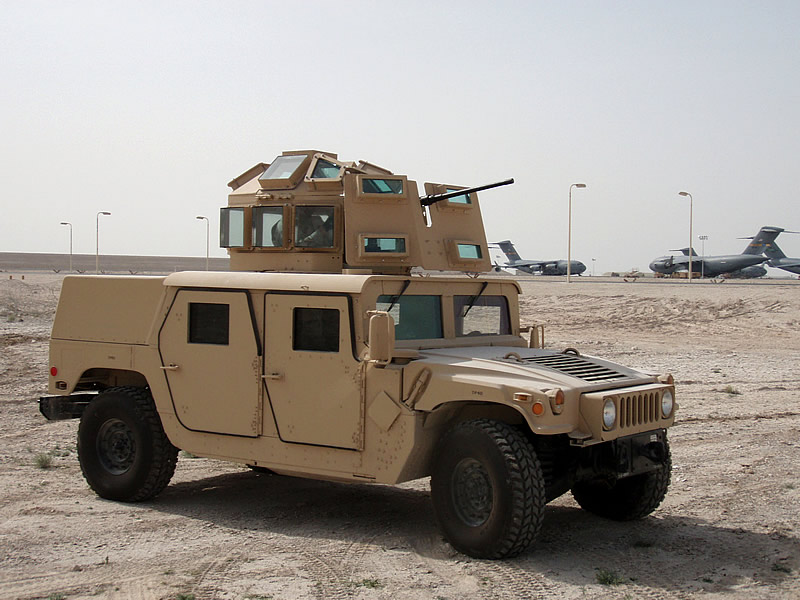
On October 14, 2006, Airman First Class Leebernard E. Chavis, assigned to the USAF’s 732nd Expeditionary Security Forces Squadron, was killed by an enemy sniper near Baghdad, Iraq as he sat in the turret of his armored Hummer. He working as part of a U.S. military police training team supporting Iraqi police. Ironically, the USAF’s M1116 HMMWV has been ahead of its counterparts in the area of gun shield protection – but this death was not unusual in and of itself. What was unusual was the response by his compatriots.
Maintenance workers from the 447th Air Expeditionary Group approached 732nd ESF Sqn security forces personnel who work the streets of Baghdad. Their goal: create a whole new turret design built for the urban battlefield. Using pieces cannibalized from junked or wrecked vehicles, old parts and scrounged materials, their cooperative did just that – and their “Chavis turret” design is winning high praise. In fact, it’s doing more than that – it’s headed into early production.
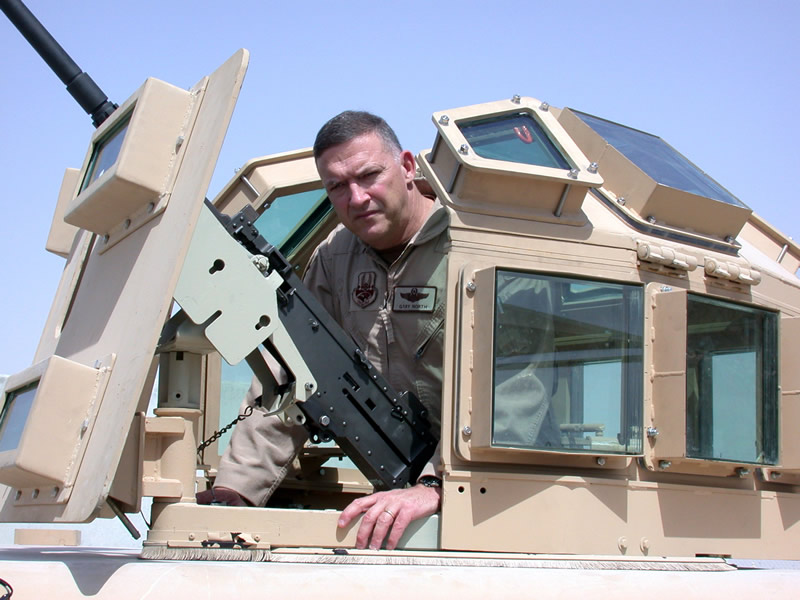
By the time the group’s initial design was complete, they sensed they had something special:
“We believe this new turret design solves many or all of the vulnerabilities that earlier designs have missed… We’ve had a lot of really positive comments from Det. 7 and the Army personnel.” said 447th commander Colonel Gregory Marston. “Right now, there’s no standardization in terms of up-armored humvee turret designs. People have altered them a lot of them on their own, but they still had problems.”
“We were able to protect almost all of the gaps that are in other modified turret designs,” said Tiger Team Staff Sgt. Derrick Bowman “One big benefit is the increased protection from improvised explosive devices. That was one of the biggest things the Det. 7 guys we talked to were worried about. We also added a removable wire cutter to the front of the shield to protect the lead truck from choke wires strung under overpasses.”
(note previous gun shield)
The turret was tested in-house, but quickly expanded its horizons by involving Col. Gerard Jolivette, U.S. Central Command Air Forces’ director of force protection, and the Air Force Security Forces Force Protection Battlelab. John Schneider, lead engineer with the rapid prototyping specialists of NAVSEA Crane Division and a former Marine rifleman, was brought in.
In under 80 days, Schneider’s team assembled and shipped a protective, igloo-shaped structure that included 10″x10″ panels of ballistic glass, and the same 3/8-inch rolled ballistic steel used to armor Hummer door panels. The structure is built to accommodate a heavy weapon and still rotate smoothly and safely, while preserving all-around vision and remaining open enough to admit sound and keep the gunner aware.
Instead of stateside field evaluations, the USCENTAF force protection staff did another smart thing: they brought the next-iteration prototype to the front lines at Sather Air Base, Iraq. Less than 80 days had passed since AFC Chavis’ death.
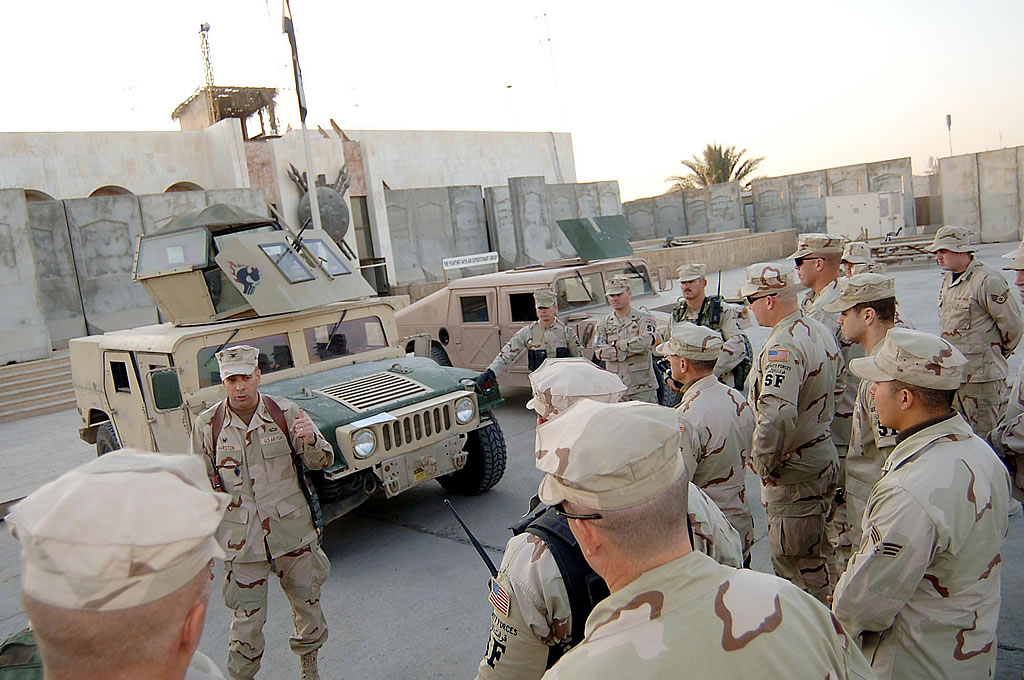
original design
(click to view full)
With a few additional modifications underway as a result of feedback from the front lines, the prototype turret now has the green light from U.S. Central Command Air Force leaders. Soon, 60 operational turrets will be deployed, with the USAF Battlelab estimating shipment of the first 5 “in late March” 2007.
The turret certainly appears to be a major step forward over existing gun shield systems of various designs, which have slowly been added to vehicles from trucks (vid. MCATS design) to armored personnel carriers as death tolls have risen. Col. Marston is also quite correct in stating that “there’s no standardization in terms of up-armored humvee turret designs.”
Having built and demonstrated a better mousetrap, perhaps it’s time that there was.