


(click to view full)
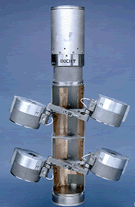
Going after a vehicle such as a surface to air missile launcher, or a cluster of vehicles like a formation of enemy tanks, can be a tricky business for a fast jet pilot. Vehicles hide, they shut off their radars, or there are just too many of them to effectively target and destroy en masse. Weapons like ATK’s AGM-88E AARGM and MBDA’s Brimstone missile can help, but there’s another solution. Textron’s Sensor-Fuzed Weapon (SFW) bomb scatters 40 projectiles to cover 30 acres. The “skeet” projectiles, which look like tuna cans, will search for targets as they descend, then fire the explosive-formed equivalent of a cannon shell through the target’s weak top armor. If no targets are found, 3 safety modes ensure that the area is safe for troops to move through within several minutes – which means it’s also safe for civilians years later.
On Sept 30/08, the US DSCA conveyed India’s formal request for a variant of the SFW with GPS guidance… and now we know which IAF aircraft will carry them.
Contracts & Key Events
(click to view full)
May 14/14: Integration. Textron Defense Systems in Wilmington, MA receives a $17.3 million modification to finish mission control unit software development and IAF Jaguar aircraft integration, as part of CBU-105 sensor fuzed weapon. The total cumulative face value of the contract is $311 million, but it’s a general contract that includes all SFW customers.
All funds are committed immediately. Work will be performed at Wilmington, MA, and is expected to be complete by Sept 30/15. The USAF Life Cycle Management Center’s Long Range Systems Division at Eglin AFB, FL acts as India’s agent (FA8682-11-C-0044, PO 0022).
May 11/14: DARIN-III. The overall Display Attack Ranging Inertial Navigation III program to upgrade India’s Jaguar strike fighter fleet is having problems. The program began in 2009, and the 1st DARIN-III prototype began flying in November 2012, but it hasn’t met its requirements and hasn’t received any operational clearances.
The upgrade was supposed to be done for all 61 aircraft by 2017, but now it will be later than 2019. It doesn’t help that it’s 2014, and the IAF hasn’t even started negotiations with F125 engine-maker Honeywell. Sources: India Today, “Indian Air Force plans to upgrade ageing Jaguars hits roadblock”.
Sept 13/13: Integration. Textron Defense Systems in Wilmington MA receives a $9.1 million contract modification to develop the Sensor-Fuzed Weapon’s remote terminal interface control document for IAF Jaguar munitions control units. All funds are committed immediately.
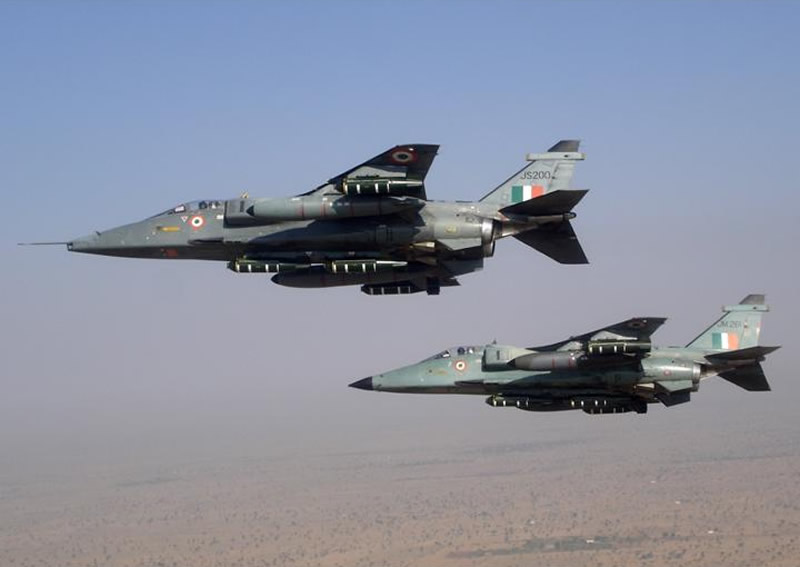
The IAF’s Jaguar fleet is currently undergoing a set of upgrades called “DARIN-III,” which includes new engines (F125) and radars (EL/M-2032 or 2052), as well as a new mission computer and new weapons. Presumably, this is for the larger IAF Jaguar IS fleet, since the maritime Jaguar IMs wouldn’t find it as useful. Once the upgrades are complete, weapons like the SFW will let the Jaguars step into the close support role of the soon to be retired MiG-27M fleet, while enhancing their deep strike role against targets like armored columns, trains, and supply lines.
Work will be performed at Wilmington, MA, with an expected completion date of May 15/14. The USAF Life Cycle Management Center at Eglin AFB, FL acts as India’s agent for the Foreign Military Sale (FA8682-11-C-0044, PO 0015).
April 20/12: Jaguar. Textron Defense Systems SVP Ellen Lord tells AIN that the CBU-105s will be deployed in the IAF’s Jaguars, with assistance from the IAF, HAL, and sub-contractors.
Textron’s industrial offset commitment is $110 million, part of which involves an agreement with Bharat Forge to provide parts for Bell Helicopter Textron. Sources: AIN, “Textron To Produce Weapons for India’s Jaguars”.
Jaguar fleet
May 26/11: Integration. Textron Systems Corp. in Wilmington, MA receives a $9.9 million contract modification for the Sensor Fuzed Weapon India Foreign Military Sales case integration phase. It’s an 8-month effort, but without it, there isn’t much point to buying a bomb that can’t work with your planes.
The AAC/EBJI at Eglin Air Force Base, FL manages the contract, on behalf of their Foreign Military Sale client (FA8682-11-C-0044, PO 0001). DID hasn’t been able to find any information yet re: which Indian aircraft will carry WCMDs (vid. Sept 30/08 entry).
Dec 8/10: Production. Textron Systems Corp. in Wilmington, MA receives a $257.7 million contract to provide 512 sensor-fuzed weapon/ CBU-105 production units, and 44 training units to India. At this time, $126.3 million has been committed.
The AAC/EBJK at Eglin Air Force Base, FK manages the contract on behalf of their Foreign Military Sale customer (FA8682-11-C-0044). See also Textron.
Contract
March 18/10: India Today covers 2 impending buys for the IAF (CBU-105 and Harop drones), and explains their uses via simple scenarios.
The Harop UAV is also known as “Harpy-2,” and builds on its radar-killer predecessor by adding more size, the option of human control, and electro-optic day/night cameras that can be used to pick out a much wider range of targets. The buy is independent of the WCMD, but Harop UAVs would be an effective advance wave, to clear the way for any IAF flight attacking a defended tank or troop concentration.
click for video
Sept 30/08: Request. The US DSCA announces India’s formal request for 510 CBU-105 Sensor Fuzed Weapons, which include Lockheed Martin’s “WCMD” GPS/INS guidance kit that screws into the bomb’s tail. India has also asked for 19 CBU-105 Integration test assets (12 live tails, 7 inert tails); 5 CBU-97 Integration test assets; containers; aircraft modification and integration; spare and repair parts; ad other forms of support.
The estimated cost is $375 million, which compares unfavorably to past American purchases of $108 million for 322 weapons. DSCA numbers are generally maximums, however, and the key term in this description is probably “aircraft integration.” That effort will require installation of MIL-STD-1760 interfaces in the designated aircraft, which must then be integrated with the aircraft’s stores management system.
The prime contractor will be Textron Systems Corporation of Wilmington, MA, and India has requested industrial offsets per its foreign procurement rules. Those offsets will be defined in negotiations with Textron. Implementation of this proposed sale will require annual trips to India involving U.S. Government and contractor representatives for technical reviews/support, and program management for a period of approximately 2 years.
The interesting question is, which aircraft will carry the CBU-105 SFW/WCMD bombs? Integration with Russian aircraft would pose additional challenges, which makes India’s Jaguar strike aircraft or Mirage 2000/Vajra fighters its most likely candidates.
During the 1999 Kargil War, the performance of India’s Mirage 2000H/TH aircraft made them the IAF’s preferred aircraft for high-altitude bombing. That’s a much safer approach, because it keeps the aircraft above short range air defense systems. Thanks to its WCMD kit, the CBU-105 is perfectly suited to that approach, which is why it has been added to USAF B-52, B-1, and B-2 bombers.
DSCA request: 510 SFW
Additional Readings
* DID – $108.1M for 13,280 ‘Cans of Whup-Ass’. Explains the WCMD/ Sensor Fuzed Weapon in detail.