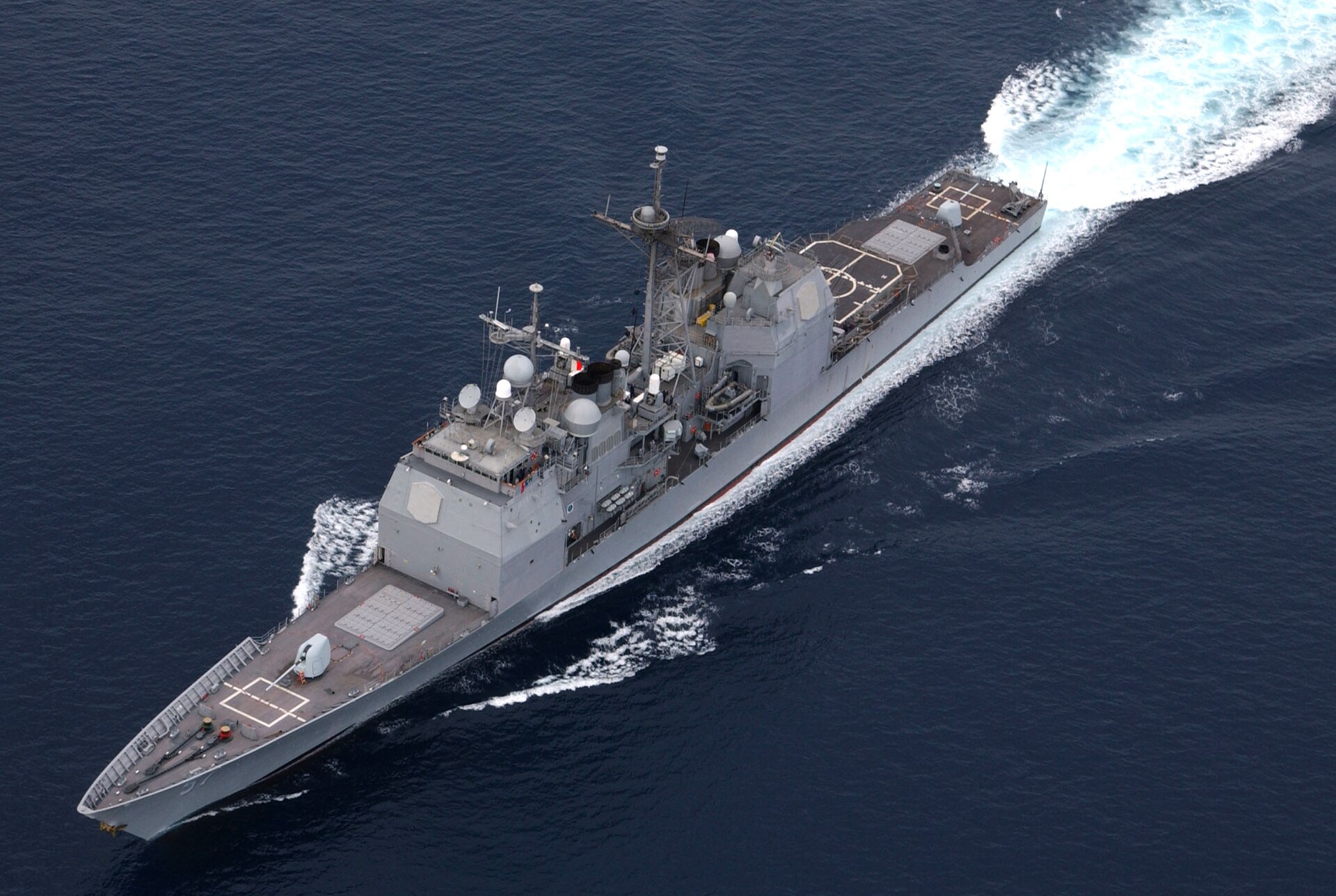
Serious Dollars for AEGIS Ballistic Missile Defense Modifications
Related Stories: ABM, Americas - USA, Contracts - Awards, IT - Software & Integration, Lockheed Martin, Missiles - Surface-Air, Protective Systems - Naval, Radars, Surface Ships - Combat
The Aegis BMD System seamlessly integrates the SPY-1 radar, the MK 41 Vertical Launching System for missiles, the SM-3 Standard missile, and the ship’s command and control system. Like its less-capable AEGIS counterpart, the AEGIS BMD Weapon System can also integrate with other radars on land and sea via Cooperative Engagement Capability (CEC), receiving cues from and providing information to other platforms, in order to create a battle picture that’s more detailed than any one radar could produce alone.
AEGIS has become a widely-deployed gold standard for current western naval defensive systems, and is in service or planned for service with 6 different countries. What does it do? What is AEGIS BMD, and how does it differ? And what enhancements are underway?....
- What Is AEGIS?
- AEGIS Missile Defense Capabilities
- AEGIS BMDS: The Program
- Contracts & Updates, FY 2007 – Present
- Additional Readings
What Is AEGIS?
AEGIS, named after the legendary shield of Zeus, is deployed on 81 serving naval ships around the globe, with more than 25 additional AEGIS-equipped ships planned or under contract. It is the primary weapons control system on board American Ticonderoga Class Cruisers (CG-47) and Arleigh Burke Class Destroyers (DDG-51), as well as Japan’s Kongo Class destroyers, Korea’s KDX-III Class destroyers, Norway’s Fridtjof Nansen Class frigates, Spain’s F-100 Alvaro de Bazan Class frigates, and soon on Australia’s Hobart Class F100 derivatives as well.
The heart of these ships’ defensive suites is the AN/SPY-1 Radar System, a three-dimensional, air/surface search and tracking radar. This high-powered phased array radar is able to perform search, track and missile guidance functions simultaneously, with the ability to track over 100 targets at over 100 miles. AN/SPY-1F is a smaller system for use of smaller ships like frigates, and isn’t presently upgradeable for use in Ballistic Missile Defense roles. The larger AN/SPY-1D variants can be upgraded.

The other key to AEGIS is the AEGIS combat system software, which takes in put from a number of systems in order to create a unified picture of the threat environment. AEGIS equipped ships are key elements in modern carrier and battleship battle groups, providing fleet area defense and communicating an integrated air picture for more effective deployment of naval aircraft.
AEGIS was designed from the outset to operate with the Standard missile family, and both systems reach their maximum potential when deployed together. The current mainstay for air defense is the SM-2 Block IIIB. For missile defense, the longer-range SM-3 is the system’s main option, and is capable of kills 200 miles away as the ballistic missile prepares to re-enter the atmosphere. A new variant of the SM-2 Block IV is being revived and fielded as the Near Term Sea-Based Terminal weapon (NT-SBT), for last-phase intercepts as the warhead descends toward its target.
AEGIS can operate with other systems, however – the shorter-range RIM-162 Evolved Sea Sparrow Missile (ESSM) is also a very popular partner.
AEGIS Missile Defense Capabilities

note rocket booster
During at-sea tests, the Aegis BMD Weapon System has been successful in 15/18 interception attempts, and successfully completed more than 15 successful ballistic missile tracking tests since June 2004. AEGIS BMD went to sea with its initial operating capability in October 2004 and the latest version, AEGIS BMD 3.6, was certified for tactical deployment by the U.S. Navy and the USA’s Missile Defense Agency in September 2006. The contract below will advance that system to AEGIS BMD 4.0.1
Some ships are fitted with a lesser version of this system. AEGIS Long Range Surveillance & Tracking (LRS&T) version 3.0 cannot engage ballistic missiles, but reportedly extends the ship’s radar tracking range to 500 km/ 300 miles, allowing them to support engagements by other ships.
The current certified version as of June 2009 is AEGIS BMD 3.6.1. It retains long range tracking, can engage enemy missiles using SM-3 missiles, and adds the capability to target short-range ballistic missiles as they re-enter the atmosphere in their final stage of flight. This allows them to make full use of SM-2 Block IV variants like NT-SBT.
Capability improvements planned in the next phase of AEGIS BMD include equipment and computer program development and incorporation of the Aegis Ballistic Missile Defense Signal Processor (Aegis BSP) into the AN/SPY-1 radar, which helps the system detect, track and classify objects more effectively to defeat more complex ballistic missile threats like decoys and multiple warheads. The Aegis BSP, which will be installed on all AEGIS BMD ships beginning in 2010, is an open architecture design. Lockheed Martin also adds support for the SM-3 Block 1B long range missiles under development in conjunction with Japan, and an adjunct computing suite that will continue AEGIS BMD’s migration to open architecture. BMD capability will be included in modernized, open architecture combat systems in AEGIS cruisers and destroyers starting in 2012.
Even US Navy AEGIS ships that are not scheduled to be fitted for ballistic missile defense will be changing over to a full open architecture system as part of ongoing upgrades to the DDG-51 and CG-47 ships. The move allows for purchase of commercial components from a much wider variety of suppliers, cost savings, and easier upgrades within a standards-based architecture.
AEGIS BMDS: The Program
Tracking program spending on ship modifications is difficult, as Pentagon budget documents tend to treat “AEGIS BMDS” as a single category, which includes both ship upgrades and SM-3 missiles. Based on Pentagon documents, funding patterns include:
FY 2006: $898 million.
FY 2007: $1.123 billion. Adds 7 SM-3 missiles to the national interceptor inventory.
FY 2008: $1.241 billion, all listed under RDT&E.
FY 2009: $1.17 billion ($1,113.7M RDT&E, $56.8M procurement)
FY 2010 Request: $1.86 billion ($1,690.8M RDT&E, 168.7 procurement). Will fund 6 ship conversions and 18 SM-3 Block 1B missiles, among other components.
As of March 2007, 6 American warships had the ability to engage ballistic missiles, while another 10 were equipped with AEGIS Long Range Surveillance & Tracking version 3.0.
In 2009, USS Lake Erie begins advanced testing with AEGIS BMD 4.0.1 to support the 2011 certification timeline, while the other U.S. Navy Aegis BMD-capable ships have installed or are installing the AEGIS BMD 3.6.1. By 2010, 21 American Arleigh Burke Class AEGIS destroyers and Ticonderoga Class AEGIS cruisers will be fitted with the full AEGIS BMD 3.6.1 system. The FY 2010 budget request would improve that total to 27, once all funded upgrades were complete.
Japan has already issued contracts of its own, and will begin full installation of AEGIS BMD systems in its Kongo Class AEGIS destroyers in 2007. Thus far, the JS Kongo [DDG-173] has received full engagement capability and been successfully tested, while the JS Kirishima [DDG-174] has received AEGIS LRS&T v3.0. The Japanese are also partnered with the USA to develop a larger, faster variant of the SM-3 missile with an improved kill vehicle.
Other foreign warships reportedly equipped with AEGIS Long Range Surveillance & Tracking version 3.0 include the Spanish SPS Mendez Nunez [F 104]. There are reports that the Dutch De Zeven Provincien Class destroyer HNLMS Tromp [F 803] may also be so equipped, despite using the more advanced Thales APAR/SMART-L active array radar system and a Thales combat system. The Tromp, like the Mendez Nunez, has been involved in American anti-missile tests in a tracking capacity.
Contracts & Updates
June 23/09: Lockheed Martin announces that it has installed the latest BMD 4.0.1 evolution and new Aegis BSP signal processor on the cruiser USS Lake Erie [CG-70]. Over the next year, USS Lake Erie will complete a series of tests, leading up to full certification of the system upgrade by the U.S. Navy in early 2011.
May 12/09: Raytheon, Integrated Defense Systems in Sudbury, MA received a $6.5 million cost-plus-fixed-fee delivery order, with delivery incentives, for one AN/SPY-1 radar transmitter multi-mission capability ordnance alteration kit, including radio frequency monitor coherent combiner, technical manual changes and installation/checkout spares.
The AN/SPY-1 radar transmitter multi-mission capability modifications are part of the Aegis modernization program along with the multi-mission capability enhancement, a commercial-off-the-shelf based multi-mission signal processor which is being developed in parallel with this procurement. The multi-mission signal processor, and these transmitter modifications, will provide the AN/SPY-1D radar system with near AN/SPY-1D (V) radar performance, augmented with full AEGIS ballistic missile defense signal processor capabilities.
Work will be performed in Norfolk, VA (67.5%); Sudbury, MA (20.5%); and Andover, MA (12%), and is expected to be complete by October 2010. This contract was not competitively procured by the Naval Sea Systems Command in Washington Navy Yard, DC (N00024-06-G-5109).
March 10/07: General Dynamics Information Technology announces a contract by Naval Sea Systems Command (NAVSEA) to provide support to the Missile Defense Agency’s Aegis Ballistic Missile Defense (BMD) program directorate. The contract has a total potential value of $191 million over 5 years, if all options are exercised. Under the contract, General Dynamics will provide systems engineering and program management assistance to Aegis BMD for production, fleet introduction and fleet operations and support. The company also will provide test and evaluation engineering management and safety, quality and mission assurance engineering; and support international programs including Foreign Military Sales (FMS) and cooperative development activities.
Feb 28/07: Lockheed Martin Maritime Sensors and Systems in Moorestown, NJ received a $979.2 million cost-plus-award-fee contract modification to continue design, test, and deliver the AEGIS Ballistic Missile Defense (BMD) Block 2006/2008 (Consolidated) Weapon System capability (BMD Baseline 4.0.1). Updates will include an improved signal processor, and continue the AEGIS BMD’s migration to open architecture electronics.
Work will be performed at Moorestown, New Jersey and is expected to be complete by Dec. 2010. The contract funds will not expire at the end of the fiscal year. FY2007 research and development funds will be used. The Naval Sea Systems Command, Washington, D.C. is the contracting activity (N00024-03-C-6110).
Additional Readings
- GlobalSecurity.org – AEGIS Weapon System Mk7
- Wikipedia – AEGIS Combat System
- HighFrontier.org – Sea-Based Platforms
- GlobalSecurity.org – AN/SPY-1 Radar. Interesting analysis of some of the systems weaknesses as well.
- DID FOCUS Article – Raytheon’s Standard Missile Naval Defense Family (updated). Includes ongoing information re: naval anti ballistic missile tests.
- DID FOCUS Article – Dead Aim, Or Dead End? The USA’s DDG-1000 Zumwalt Class Program. Its Raytheon SPY-3 active array radar is not an AEGIS family component, but it will have superior performance and offer its own built-in ballistic missile defense capability, while allowing Cooperative Engagement Capability with AEGIS ships. In addition, the Open Architecture listing in the article’s Additional Readings section contains more materials on that topic.
- DID Spotlight – Japan’s Fleet BMD Upgrades. Covers their Kongo Class AEGIS destroyers.
- DID (Dec 18/07) – US Missile Defense Shifting Toward More Realistic Testing?
- Information Dissemination (June 21/07) – US Navy Ballistic Missile Defense. Well researched article covering the USA’s plans in this area, including ships slated to receive ABM capability.
- Lockheed Martin (Feb 28/07) – Lockheed Martin Awarded $ 979 Million For Aegis Ballistic Missile Defense