

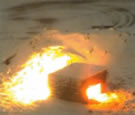
go BOOM…
Thermobaric weapons are also known as “fuel-air explosives,” though their composition has become more complex in recent years, and no longer uses unreliable fuel-air mixes. They’re also no longer confined to the bombs that were used to clear helicopter landing zones in Vietnam, or even the gargantuan 15,000-pound BLU-82 Commando Vault/”Daisy Cutter” [see Graphic | Flash] and 21,000-pound, H6 explosive (RDX, TNT & aluminum powder) filled GBU-43B “MOAB” bombs.
All the way at the other end of the scale, they’re finding their way into portable rocket launchers like the SMAW, RPG, etc. DID noted this very trend in our March 10, 2005 coverage of the LAW rocket’s return, and similar man-portable thermobaric rockets proved extremely effective during the Second Battle of Fallujah in November 2004. Fortified buildings used as strongholds by Islamist paramilitary death squads were sometimes caved in with a single shot from a US Marine Corps SMAW-NE (Shoulder-Mounted Antitank Weapon, New Explosive). As reader Robert Schmidt points out…
SMAW-NE uses PBXIH-135, a mixture of HMX and aluminum that uses the combusting metal to augment the production of hot gases. In a confined space, the gases will flow around barriers like internal subdivisions of a bunker. In contrast, a normal high speed shockwave loses energy from bouncing off walls and such. Robert adds:
“…these new thermobarics have much better reliability, if nothing else, because the material is all solid. The classic FAEs the US used in the Gulf War, had dud rates over 70% because they involved dispersing liquids or actual gases like propane, which simply doesn’t work well. On paper they could then burn massive amounts of O2 out of the air… [and] act like its 15 times its actual weight, but that isn’t so so good if 7 out of 10 didn’t explode anyway. It’s utterly dependent on the wind conditions to create a proper explosive mixture at the preset time in the fuse delay of the igniter. So end result is classic FAEs are much talked about, and little used. Dispersing a solid powder, or just burning it as one piece is far easier as in the modern designs, but it won’t give the same scale of massively enhanced energy release.”
Defense Tech has a link-filled article noting that hand-held thermobaric rockets can be found in Russian and Chinese arsenals as well, and will continue to spread via a combination of exports and local invention. The article also addresses some of the implications these weapons present for issues like vehicle protection design, body armor protection, etc.