

This animated Flash presentation has been making the rounds lately. It shows the structural changes to the American defense procurement process since 1971, as 14 waves of iterative reforms have changed the defense procurement process. It is also available from the Center for Public Integrity, in PPS Power Point format.
Despite these successive changes, the American defense procurement spiral of weapons whose generational replacement cost rises faster than inflation has continued apace. So, too, has the time required to design and field weapons systems, a fact that makes the tendency toward gold-plated or poorly-conceived requirements even worse. The result has been a spiral of shrinking force sizes despite equal or higher costs, a phenomenon that has become widespread around the world.
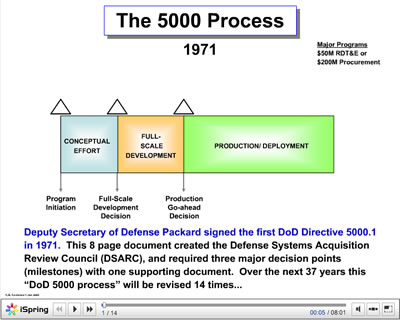
(click to watch)
Procurement reform is an important goal. To succeed, however, future reforms will have to do 3 things that past reforms have consistently failed to do:
# Change the fundamental incentive patterns that reward gold-plated or poorly thought-out requirements, followed by lowball estimates from the military, followed by an unbreakable political foothold once contracts begin. Success requires progress both within the Pentagon, and within the political system. That’s a tall order, but unless these fundamental patterns can be broken, change will be marginal no mater what procurement system is used.
# Fix the Pentagon’s accounting system, which is currently unauditable. Among other benefits, this should give decision-makers have access to reliable data concerning the actual costs of buying and maintaining weapons systems over time, with the ability to compare them to estimates given. This is done to a limited extent by agencies like the Congressional Research Service, but it needs to become far easier and more pervasive.
# Reform Congress’ oversight and management structure, as well as the Defense Department’s. This has been done in limited areas like the Base Realignment and Closing (BRAC) process, allowing the US to break through obstacles that consistently stymie other countries. This requirement includes items that reach beyond issues of incentives for political engineering, such as thought-out appraisals of the ratio and balance between engineering and testing, and bureaucracy-driven reports, throughout the process.