

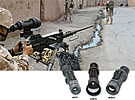
DRS Technologies, Inc. announced that it has received approximately $76 million in new orders to produce next-generation advanced uncooled Thermal Weapon Sights II (TWS II) for U.S. Army soldiers. DRS makes thermal imaging night vision sights that currently support the U.S. Army, Marine Corps, Air Force and Special Operations forces, and the order was issued on behalf of US Army Program Executive Office Soldier by the Army’s Communications-Electronics Command (CECOM) acquisition center in Fort Monmouth, NJ. It is is part of a competitively secured 5-year contract awarded to DRS in March 2004, with a total potential value of $375 million if all options are exercised.
The specific quantities, capabilities, and compatible weapons for the thermal sights ordered are described below. We’ve also included links that explain how thermal sights work, and offer industry forecasts for the larger electro-optical market.
* 1,600 Light Thermal Weapon Sights (LTWS) for 5.56mm M-16/M4 assault rifles and M136/AT-4 anti-tank rockets. These sights include features like a 15 degree horizontal field-of-view lens designed for urban warfare and other and wide-view, close-in focus situations;
* 3,900 Medium Thermal Weapon Sights (MTWS) that mount to M249 “Minimi” 5.56mm Squad Automatic Weapons and M240B 7.62mm machine guns; and
* 2,000 Heavy Thermal Weapon Sights (HTWS) that mount to M2 .50 cal heavy machine guns and MK19 40mm grenade machine guns; and on sniper weapon systems like modified M4/M16s, the 7.62mm M24 sniper rifle, and the .50 cal M107 long range sniper rifle.
All members of DRS’ thermal sight family offer 25um (1 mil) VOx resistive microbolometer (MMB) technology. The medium and heavy sights interface with a variety of 26mm, 52mm, 62mm, 103mm, 150mm and 156mm telescopes and have 3x e-zoom, vs. the light systems’ 2x e-zoom. All are powered by relatively lightweight battery packs (4xL91s lasting 25 hours for LWTS, 6xL91 with 18 hour life for MWTS/HWTS). Menu-based, push-button controls are used for operating reticle selection and adjustment, polarity and brightness, while drop-in upgrades are meant to help ‘future proof’ the sights by making upgrades simpler.
Work will be performed by the company’s DRS Sensors & Targeting Systems – Optronics Division in Palm Bay and Melbourne, FlL; and by DRS’ Infrared Technologies Division in Dallas, TX and Irvine, CA. The firm has recently expanded production facilities and operations in Florida and Dallas to meet the continuing and growing demand, and expects to be producing and delivering in excess of 1,000 systems per month by the end of the year.