

Canada’s military personnel have a reputation for being well-trained, but the state of their equipment and capabilities had become much bleaker after decades of neglect. Significant emergency purchases were required to secure the equipment needed for operations in Afghanistan, and despite being the second largest country in the world, the state of its military airlift capability was poor and deteriorating at all levels. Recent years have seen something of a turnaround, especially the funding injection and the beginning of major airlift (C-17, C-130J) and helicopter (CH-47D, CH-47F) projects in 2005-2006, and the shift away from wheeled armored vehicles to tracked tanks and M113s. Budget 2006 provided $5.3 billion over 5 years to sustain operations, acquire new equipment, and expand both the Regular and Reserve Forces, and ratcheted planned spending by $1.8 billion annually starting in 2011-2012.
Decades of neglect cannot be fixed overnight, however. Over 50% of the country’s military infrastructure is over 50 years old. On the equipment side, Canada’s Tribal Class destroyers, City Class frigates, CP-140/P-3 maritime patrol aircraft, Buffalo fixed-wing search and rescue aircraft, CF-18 fighter aircraft, and land combat vehicles and systems (other than tanks) will all reach the end of their service lives and need to be replaced at varying times over the next 20 years.
To this end, the Conservative Party of Canada led by Prime Minister Stephen Harper is proposing a long-term funding framework that would increase defense spending by about $600 million per year over the next 20 years. Nevertheless, the nature of its timelines, and of Canada’s political system, must both be considered as one evaluates this plan… which is now available in more detail, online.
* The Strategy
* Core Programs
* Future Prospects
* Updates
* Additional Readings
The Strategy

(click to view full)
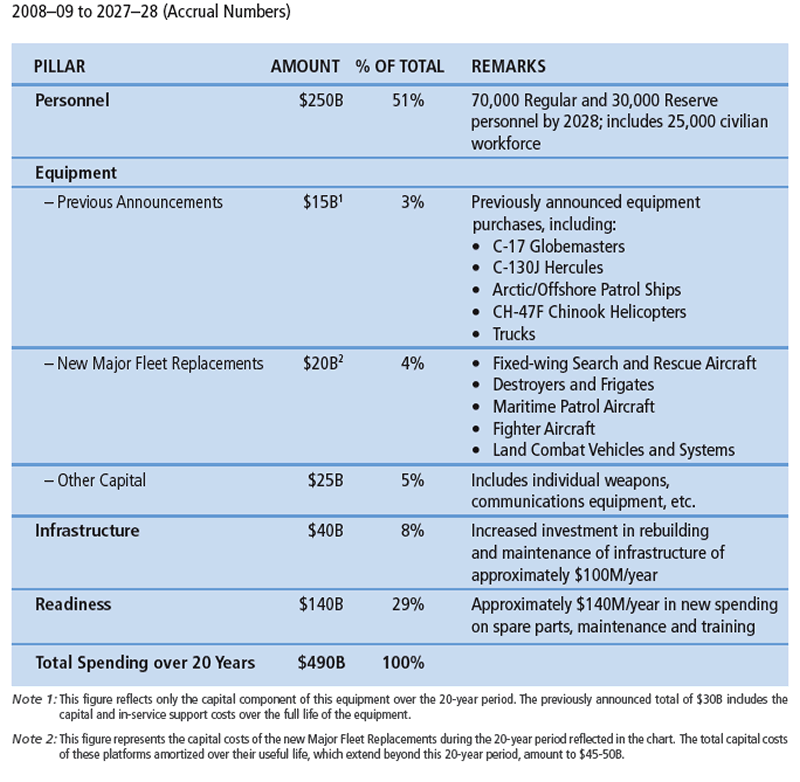
In Budget 2008, the Harper Government’s “Canada First Defence Strategy” aims to establish a predictable, consistent long-term funding plan beginning in 2011-12, based on an automatic annual increase in defense spending from the current 1.5% per year to 2% per year over the next 20 years, bringing in $12 billion in additional revenues. As the DND Backgrounder notes:
“The defence program consists mostly of large, fixed-cost elements such as infrastructure and equipment that have very long life cycles, from acquisition to support through disposal. These types of items require budgetary expenses to be locked in over many years. Without long-term stable funding, it is extremely difficult for the Department of National Defence to confidently plan future acquisitions. The framework brings a unique level of stability to the defence program allowing Defence to confidently plan for tomorrow today.”
Core Programs
(click to view full)
IF the funding materializes, within 10 years the Canadian Forces aims to replace or refurbish approximately 25% of DND’s 21,000 buildings and more than 12,000 roads and utilities on over 800 properties, with approximately 50% being replaced or refurbished over 20 years. It will also fund expansion of the Canadian Forces from their current size of 65,000 regular forces and 24,000 reserves to 70,000 regular forces and 30,000 reserves, including an expanded Arctic Ranger program that recruits Canada’s Inuit to maintain sovereignty in Canada’s North.
It will also fund equipment purchases as about 12% of the total, including:
* Starting in 2015, 15 ships to replace Canada’s old Tribal Class destroyers and its Halifax Class frigates; all are expected to be based on a common hull design, with different capabilities depending on role. The Franco-Italian FREMM design appears to be very well positioned for this requirement, but other contenders may emerge.
* Starting in 2015, 17 fixed-wing search and rescue aircraft to replace the current ageing fleet of Buffalo and Hercules aircraft. Read: “Rescue Required: Canada’s Search-And-Rescue Aircraft Program” for more background regarding this delayed program.
* Starting in 2017, 65 fighter jets (expected to be F-35As, but not committed) to replace Canada’s CF-18s. “The Department will be seeking innovative and cost-reducing solutions for future procurements.” Early reports, however, indicate another sole-source buy.
* Starting in 2020, 10-12 maritime patrol aircraft to replace the CP-140/P-3 Aurora fleet. The aircraft are expected to be part of a “system of systems” that also includes long-endurance UAVs and satellites. Canada has been approached about the P-8 Poseidon, and a naval version of the UK’s ASTOR Sentinel R1 system has also been suggested. Boeing has a strong base in Canada, as does Bombardier with its Challenger Global Express aircraft that forms the basis of ASTOR.
Future Prospects
The question is whether these increases can be relied upon. The Harper government is a minority Parliamentary Government, which means that this 2008 budget and its plan will require additional party support in order to pass. Given that Parliamentary governments can fall on a lost budget vote, the fact that these measures are being proposed at all indicates that the required support is almost certainly lined up and in place.
Even so, In any democratic polity, politics can and does shift. This is what makes “future year” budget figures are especially suspect, since they are by definition outside the control of the present government. Personnel increases take longer to unwind, and equipment purchases cost money to unwind once commitments are made. Until commitments are made, however, Canada’s past offers ample demonstration that even harmful neglect can be continued for some time.
Canada now has a future defense funding strategy, which is a step forward. That strategy offers some realistic hope of reconstituting a basic military capability for the country. If they can keep it.
Updates
June 19/08: The full set of related documents are now available online. DND Page | Full PDF document [5.3 MB] | The Globe and Mail.
Additional Readings
* Canada First Defence Strategy [PDF format, 21 pgs., 5.3 MB]
* Office of the Prime Minister (May 12/08) – PM unveils Canada First Defence Strategy
* DND (May 12/08) – Canada First Defence Strategy – the four pillars
* DND (May 12/08) – Backgrounder: Canada First Defence Strategy – long-term funding framework
* DND (May 12/08) – Backgrounder: Canada First Defence Strategy – Canadian Forces’ contribution to sovereignty and security in the north
* DND (May 12/08) – Backgrounder: Canada First Defence Strategy – equipment acquisitions to date
* Canadian Forces, Navy (March 2005) – “Securing Canada’s Ocean Frontiers: Charting the Course from Leadmark.” Updated the Navy’s key document “Leadmark, The Navy’s Strategy for 2020,” which was published in June 2001.
* Canadian Conference of Defence Associations Forum (May 15/08) – Afghanistan, Canada First defence strategy. Lots of additional links to media coverage et. al.
Globe and Mail (May 15/08) – Tories grilled on defence plan
* Bloomberg (May 12/08) – Harper Plans to Double Defense Budget in 20 Years