
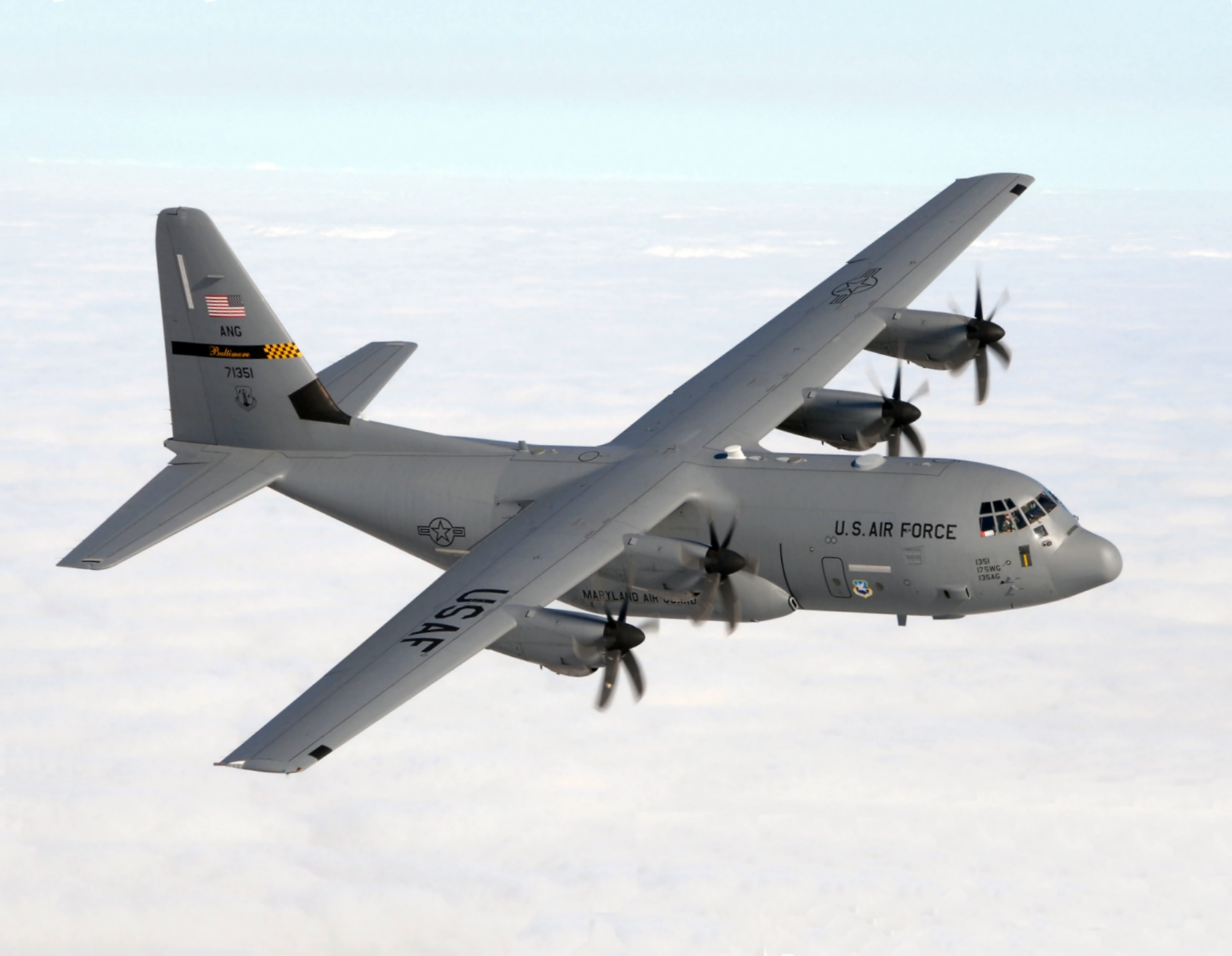

(click to view full)
The C-130 Hercules remains one of the longest-running aerospace manufacturing programs of all time. Since 1956, over 40 models and variants have served as the tactical airlift backbone for over 50 nations. The C-130J looks similar, but the number of changes almost makes it a new aircraft. Those changes also created issues; the program has been the focus of a great deal of controversy in America – and even of a full program restructuring in 2006. Some early concerns from critics were put to rest when the C-130J demonstrated in-theater performance on the front lines that was a major improvement over its C-130E/H predecessors. A valid follow-on question might be: does it break the bottleneck limitations that have hobbled a number of multi-billion dollar US Army vehicle development programs?
C-130J customers now include Australia, Britain, Canada, Denmark, India, Israel, Iraq, Italy, Kuwait, Norway, Oman, Qatar, Saudi Arabia, South Korea, Tunisia, and the United States. American C-130J purchases are taking place under both annual budgets and supplemental wartime funding, in order to replace tactical transport and special forces fleets that are flying old aircraft and in dire need of major repairs. This DID FOCUS Article describes the C-130J, examines the bottleneck issue, covers global developments for the C-130J program, and looks at present and emerging competitors.
The (Private) Labors of Hercules: the C-130J Family

(click to view full)
Most American planes rely on their huge home market as their base, then seek exports. The privately-developed C-130J “Super Hercules” was different. Australia, Britain, Denmark, and Italy were all ahead of the curve, and have been operating this heavily redesigned upgrade of the popular C-130 Hercules transport aircraft for several years. By the time the C-130J finally reached “initial operating capability” for the US military late in 2006, these faster-moving foreign customers were already banding together to create a common upgrade set for their serving fleets. A number of variants are currently flying in transport (C-130J), stretched transport (C-130J-30), aerial broadcaster (EC-130J), coast guard patrol (HC-130J), aerial tanker (KC-130J), special forces (MC-130J), and even hurricane hunter weather aircraft (WC-130J).
The C-130J looks a lot like its predecessors, except for the new 6-bladed Dowty propeller. In reality, a number of changes have been made to its construction and components, and its internal systems are almost wholly new. Unlike most defense programs, however, the C-130J was not a government contract. Lockheed Martin spent almost $1 billion of its own funds developing the update, then began selling it in the USA and abroad.
Base Platform: The C-130J
[youtube:http://www.youtube.com/watch?v=cL9T89tm2h8]
click to play video
The C-130J’s improvements are mostly clustered around 2 key characteristics: performance, and operational costs. Instead of Rolls Royce 4,600 shp T56 Series III turboprop engines, it uses lighter Rolls-Royce AE2100D3 engines, coupled with a 6-blade Dowty R-391 propeller system made of composite materials. The overall system generates 29% more thrust, while increasing fuel efficiency by 15% and offering improved reliability and maintenance. Compared to the 1960s-era C-130E (note: there was an intermediate C-130H version), maximum speed is up 21%, climb-to-altitude time is down 50%, cruising altitude is 40% higher, and range is about 40% longer.
The enhanced capacity of the “J” variant is especially noteworthy in hot climates and/or high altitude operations, where the new plane can deliver 40% better payload/range performance than earlier versions. US experience in places like Afghanistan and Iraq indicates that as many as 3 C-130H models may be required to do the job of 1 C-130J in these “hot and high” conditions.

(click to view full)
The C 130J only requires 2-3 crew members for most missions instead of 4, and avionics have been changed to incorporate more advanced capabilities into the night-vision-system compatible “glass cockpit” (computer screens, not dials) and heads-up display. A pair of mission computers and 2 backup bus interface units provide dual redundancy. Equally important, they host an integrated diagnostics system to assist with maintenance and reduce long-term ownership costs.
The interior of the C-130J has also seen a number of improvements, simplifying and automating key cargo tasks. An automated airdrop system, for instance, delivers parachute loads more precisely. These kinds of additions have dropped the crew required for airdrops from 4 to 2 (pilot, co-pilot). In addition, innovations such as flip-over rollers allow loaders to reconfigure the cargo area in about 5 minutes instead of the traditional 25, getting planes out of airstrips quickly and maximizing overall loading/unloading efficiency during larger operations.
An optional dorsal aerial refueling system can extend the C-130J’s range significantly, while optional aerial taker kits can convert the C-130J into a flying gas station that offloads fuel faster than previous KC-130 versions, and can handle both helicopters and jets due to its range of flight speeds.
Finally, the C-130J Maintenance and Aircrew Training System (MATS) is designed to complement the C-130J, adding a high-tech simulation angle to both flying and maintenance training.
The worldwide fleet of C-130Js exceeded 355,000 flight hours As of August 3/07.

The stretched C-130J-30 adds 15 feet of fuselage length over its C-130J counterpart, most of which is placed forward of the wing as the plane stretches from 97’9″ (29.3 m) to 112’9″ (34.69 m). The extra cargo space allows it to add adds 2 standard pallets (to 8), 23 litters (to 97), 8 CDS bundles (to 24), 36 combat troops (to 128), or 28 paratroopers (to 92) over C-130H/J models, and the aircraft’s maximum weight increases by 9,000 pounds (to 164,000 pounds/ 74,393 kg).
Maximum allowable cargo payload rises by a ton over the C-130J, from 42,000 pounds to 44,000 pounds/ 19,958 kg); the 36,000 pound maximum normal C-130J-30 payload is 2,000 pounds higher than the C-130J, but 500 pounds lower than the C-130H’s 36,500 pounds. Even so, the extra space comes in handy. C-130J-30s can carry 33% more pallets of equipment or supplies, 39% more combat troops, 31% more paratroopers, or 44% more aeromedical evacuation litters than previous unstretched Hercules versions. The stretched C-130J-30 also shares the C-130J’s ability to use much more of its theoretical cargo capacity in hot or high altitude environments than previous C-130 versions.
In exchange, the stretched C-130J-30 suffers a speed drop of 7 mph (410 mph at 22,000 feet) vs. the C-130J, a 2,000 foot lower ceiling (26,000 feet with full payload), and maximum range at full payload that falls by 115 miles to 1,956 miles. It does outshine the smaller C-130J when carrying only 35,000 pounds of cargo, however: its 2,417 miles is a 576 mile increase over the C-130J, and a 921 mile increase over the C-130H.
Note that except for maximum normal payload, all of the C-130J’s figures remain significantly better than the C-130H, with statistics of 366 mph cruise speed at 22,000 feet, a 23,000 foot ceiling, and range at maximum normal payload of 1,208 miles.
C-130J Variants

As one might imagine, Special Forces variants are undergoing the most change, but the platform’s versatility is also pushing Lockheed Martin toward an advanced naval variant.
AC-130J “Ghostrider”. This new gunship will be based on the MC-130J, but it won’t carry hose-and-drogue refueling pods. It will have a 400 Amp power supply, added defensive systems, more surveillance sensors, terrain-following radar, and a Precision Strike Package (PSP).
The PSP includes a side-firing 30mm GAU-23A chain gun, wing-mounted GBU-39 GPS-guided SDB-I bombs, and laser-guided AGM-176 Griffin missiles launched from a “Gunslinger” attachment on the rear cargo door. It may eventually add a side-firing 105mm howitzer like existing AFSOC AC-130H/Us, and AGM-114 Hellfire missiles like the USMC’s KC-130J Harvest Hawks, but those aren’t currently funded. These weapons will be controlled from a dual-console Mission Operator Pallet in the cargo bay, which will include multiple video, data, and communication links.
Ghostrider surveillance equipment will include 2 day/night surveillance and targeting pods and a ground-looking synthetic aperture radar pod, tied into the pilot’s helmet-mounted display. Defensive systems will include the AN/ALR-56M radar warning receiver, AN/AAR-47(V)2 missile warning system, and AN/ALE-47 countermeasures dispensing system, along with standard options like fuel tank foam, system redundancy, and some armoring.
One sore point is its comparative lack of armor compared to the AC-130H/U, with no armoring for the Mission Operator Pallet and just 7.62mm level protection elsewhere. Most AC-130s brought down in Vietnam were killed by 37mm guns.
HC/MC-130J Increment 1. Modifications include additional defensive countermeasure dispensers, high-altitude ramp and door hydraulics, a 4th flight deck crew member station, an extra intercom panel and 60-Hertz electrical outlets in the cargo compartment.
HC/MC-130J Increment 2. Includes increased 28-volt direct current internal power capacity, crash-worthy loadmaster scanner-position seats, and provisions for Large Aircraft Infrared Countermeasures defensive systems. This is as high as the HC-130J Combat King IIs are expected to go, though they’ll also receive a T-1 communications modification with a Specialized Automated Mission Suite/Enhanced Situational Awareness system (SAMS/ESA: SADL data link, High Power Waveform, and Air Force Tactical Radio System-Ruggedized), Blue Force Tracker, and the Joint Precision Airdrop System.
HC/MC-130J Increment 3. Includes a 400 Amp power supply, dual special mission processors, and a secure file server. MC-130J Commando IIs will be improved to Increment 3.
[youtube:v=kjFijMCgh24]
SC-130J MPRA. A proposed maritime patrol and reconnaissance aircraft, created by moving a number of P-3 Orion systems onto and into the C-130J. A Magnetic Anomaly Detector boom is installed in the tail for submarine detection, along with a sonobuoy storage pallet and 2 rotary launchers in the rear interior. A day/night surveillance turret goes under the nose, a 360 maritime radar is mounted under the fuselage, and ESM electronics for pinpointing and geolocating radars, communications, etc. are mounted via on wingtip pods and fore and aft fuselage points. A set of roll-in console modules would contain the necessary electronics and screens to manage it all.
Countries that wanted to go beyond surveillance would push further development to add wing hardpoints for torpedoes and missiles, and/or a weapons bay and torpedo racks in the front fuselage.
C-130J operator Britain is Lockheed Martin’s biggest SC-130J target, and the plane’s flexibility could appeal to others who see the value in fleet commonality and good mid-range performance, with easier upgradeability than standard MPAs. The downside is that the C-130J is designed for short-field performance first, and efficient cruising operation second. That will make it expensive to operate compared to smaller twin-engine competitors, which are typically derived from commercial light cargo and passenger aircraft. The Airbus ATR-72 MPA is an example of a larger competitor that also follows this pattern; ATRs have won significant share in the mid-range regional airline market on the strength of their operating efficiency.
The Value of Variants

(click to view full)
These variants and kits give the C-130J an edge in the global market, and will help Lockheed Martin retain that edge as the 20-ton tactical transport market starts to get crowded in 2020 or so. The type’s strong Special Forces niche has already helped to close orders with export clients like India, who could easily have chosen additional orders of plane types already in its fleet (AN-32, IL-76). The second big edge for the platform is a related niche: multi-role armed transports that can deliver troops and supplies, then provide close-air support for counterinsurgency fights. The KC-130J’s Harvest HAWK kits, and C-130H-derived MC-130W Dragon Spear, offer prospective customers an important set of clip-on capabilities that none of its major competitors (A400M, KC-390, MRTA) are even designing, let alone fielding. The SC-130J maritime patrol option could become a similar kind of selling point.
Those “ecosystem strengths” are going to become more important in future. The C-130XJ, unveiled in December 2011 at the Credit Suisse aerospace and defense conference in New York, NY, may not offer enough savings by itself to prompt orders from target customers like South Africa. A cheaper base aircraft, plus existing modifications available on the market, is more appealing. Likewise, the C-130NG could sell among existing C-130J customers, but its changes by themselves might still leave it lagging behind the price of low-cost turboprop options like China’s Y-9, behind the performance of new jet-powered rivals like Embraer’s multinational KC-390 and HAL/Irkut’s MRTA, and very much behind the capacity of Airbus’ larger A400M.
The existence of clip-on kits and proven specialty variants may have to sell it, instead. Especially if the C-130NG also fails to resolve the biggest limitation in today’s medium tactical transport field…
Turbulent Flight: The C-130J Program

(click to view full)
The privately-developed Hercules variant has been the subject of heavy criticism and a 2005 near-death budget experience, followed by its reinstatement by Defense Secretary Rumsfeld on the stated grounds that canceling the contract would be almost as expensive as completing it – though a later government report established that its cancellation costs were wildly overstated.
In order to comply with the FY 2006 National Defense Authorization Act, however,Air Force Print News reported that the C-130J contract was converted from the existing commercial item procurement to a traditional military procurement in FY 2006. In technical terms, it was converted from a Federal Acquisition Regulation Part 12 to an FAR Part 15 contract, which includes much more extensive Congressional oversight and cost reporting requirements. In bottom line terms, this involved repricing 39 aircraft, resulting in net savings anywhere from $170-245 million (reports vary). Under the restructured contract, the Air Force said Lockheed cut the program cost by 8% for the remaining 26 Air Force C-130Js, and nearly 12% for 13 Marine KC-130Js.
The Wall Street Journal reported this as a decision by Lockheed Martin to cut its profit margins on the plane, after investing $1 billion in private funds to develop it. Lockheed spokesman Tom Jurkowsky was quoted as saying that “national defense outweighs the continued recovery of funds we invested in its development.” It’s widely suspected in reports from Associated Press et. al. that direct criticism of the FAR Part 12 contract by Sen. John McCain [R-AZ] played a role as well.

Since FY 2006, American C-130J orders have continued, and the aircraft has continued to expand its export successes as well. C-130J aircraft are now flown and/or under contract by the USAF and Air National Guard, US Marines, and US Coast Guard; and by Australia, Britain, Canada, Denmark, India, Israel, Italy, Iraq, Kuwait, Norway, Oman, Qatar, Saudi Arabia, South Korea, and Tunisia. DSCA requests that have yet to become publicly-announced contracts include Mexico (2012), Libya (2013), and Brunei (2014).
According to official Pentagon documents, the C-130J’s past and planned American budget breakdowns include:

Note that each year’s procurement budget almost always includes advance “long-lead time material” orders for the next fiscal year. That way, once the main contract is issued, construction isn’t delayed by long waits for predictable items.
The C-130J and the 20-ton Bottleneck

(click to view full)
The C-130J offers a genuine improvement over past versions of the Hercules, especially in hot and/or high-altitude environments where all aircraft lose lift and carrying capacity. It has proven these capabilities during deployments to Iraq and Afghanistan, where its additional reserves of power have come in very handy on the front lines.
On the other hand, the ability to fit into tactical transports is a very common requirement and benchmark for ground systems, including armored personnel carriers. Billions have been spent on R&D for the wheeled Stryker armored vehicle family, and for the USA’s $160+ billion Future Combat Systems MGV armored vehicle family. Both vehicle families were sold as options that would fit into US tactical transports, in order to meet the military’s timeframe goals for deploying units to crisis situations. Both projects failed to meet their goals after spending billions in R&D, leaving the USA’s expensive C-17 fleet overworked, and achievement of the USA’s strategic deployability goals unlikely.
Unlike the pending Airbus A400M, therefore, which offers a larger interior and a 33-35 ton vehicle capacity, the C-130J doesn’t solve the sub-survivable 20-ton armored vehicle limit that has stymied multiple US armored vehicle programs. As such, it represents an improvement that fails to address US tactical airlift’s key bottleneck limitation. Meanwhile, reports from the USAF indicate that C-130Js are often flying with very little weight and/or small cargo, because the demands of counterinsurgency airlift lead to more and smaller requests from a number of front line sources.
The C-130J thus finds itself in the odd position of offering capabilities that are both too great for many tactical needs, while being too small to meet important American strategic goals. Even Special Forces worry that future air defense threats will make the C-130 non-survivable in future gunship and insertion roles.

(click to view full)
That’s the bad news. On the other hand, its major competitor the Airbus A400M went through major delays and contract re-negotiation in System Design & Development, and has a production backlog of over 180 aircraft as deliveries are beginning. Future competitors like the Indo-Russian MRTA, and Embraer’s multinational KC-390 are currently in even earlier R&D stages. Which means that any nations needing to replenish a 20+ ton tactical airlift fleet any time soon are limited to a choice of buying the C-130J, or purchasing old designs like Russia’s AN-12 or China’s Y-8 aircraft.
As the A400M becomes available, and the 20-ton segment begins to crowd with new offerings, the C-130J will face a very different competitive environment. Without major American C-130J buys, or establishment of the C-130J as a market leader in key segments like Special Operations, recouping its $1 billion investment would have been challenging for Lockheed Martin. Fortunately for the firm, they’ve made considerable progress toward both of these goals.
Contracts and Key Events

(click to view full)
The USA’s JMATS contracts for C-130J simulators and training are a critical but separate component, and are covered in their own article. International customers aren’t part of JMATS, so their arrangements may be covered here.
DID has covered C-130J buys in Canada, India, Israel, Iraq, and Norway; and the UAE’s potential buy, as dedicated articles. Important milestones from those purchases may also appear here.
DID also has a separate article covering training and simulators, under the MATS, JMATS, and JMATS-II programs.
Unless otherwise noted, all contracts are issued by the Headquarters Air Force Material Command (AFMC) in Wright Patterson AFB, OH; and the contractor is Lockheed Martin Corporation in Marietta, GA. Note that coverage is complete only from Jan 1/06 forward.
FY 2016 – 2025
Requests: Denmark.

(click to view full)
June 21/24: Lockheed Martin has achieved a significant milestone in tactical airlift with the delivery of the 2,700th C-130 Hercules aircraft. This landmark aircraft, a KC-130J Super Hercules tanker variant, joins the U.S. Marine Corps Aerial Refueler Transport Squadron 252 (VMGR-252) stationed at Marine Corps Air Station Cherry Point, North Carolina. Notably, this delivery coincides with the C-130’s 70th anniversary of first flight this year, further highlighting the enduring legacy of this versatile military transport aircraft. The C-130 Hercules, first introduced in 1954, has become a ubiquitous workhorse in military aviation circles. Renowned for its unmatched versatility and rugged performance, the C-130 operates in over 70 countries, supporting a diverse array of missions ranging from troop transport and cargo delivery to aerial assault and medical evacuation.
June 6/24: The Taiwanese Air Force has unveiled plans to spend billions of New Taiwan dollars in modernizing its fleet of C-130 Hercules transport aircraft. Starting next year, 19 of the Lockheed Martin-manufactured planes will have new integrated cockpit interfaces, as well as enhanced global positioning and collision avoidance systems. There will also be upgrades to the aircraft’s chassis to ensure it can fully support a variety of military missions.
May 1/24: New Zealand’s first C-130J Super Hercules military transport aircraft has conducted its initial flight test in the US. The demonstration saw the vehicle fly for 246 minutes over Georgia and Alabama. It achieved a range of approximately 990 kilometers and an altitude of 3,200 meters. The demonstration followed the 18-month construction of the platform under American defense contractor Lockheed Martin.
March 20/24: The Swiss Federal Office for Armaments (armasuisse) has started delivery of 22 decommissioned F-5E/F Tiger II fighter jets to the United States. The first aircraft was picked up by the United States Marine Corps (USMC) on March 18 from Emmen Air Force Station aboard a Lockheed KC-130J transport aircraft. The sale, finalized in 2020, encompasses 16 single-seat F-5E and 6 twin-seat F-5F variants, along with associated ground equipment, spare parts, and logistical support for in-country storage and preparation for transport to the U.S. The total value of the sale is estimated at $32.4 million.
Wednesday 25/24: The Georgia Air National Guard has received its first of eight C-130J-30 Super Hercules tactical airlifters from defense giant Lockheed Martin. The new jet builds on a tradition of Hercules operation for the 165th Airlift Wing, which received its first model in 1975 and has been operating many versions of the military transport aircraft since.
November 9/22: Digital Cockpit Collins Aerospace and PT Dirgantra Indonesia (PTDI) have signed an agreement to support the Indonesian Air Force’s C-130 Hercules with a new digital cockpit. As part of the air force’s Phase 2 rollout plan, Collins will supply 11 C-130s with its Flight 2 Integrated Avionics System, which includes the latest AOS-7000 digital auto-pilot system. The system offers the military transport aircraft “the most cost-effective and lowest-risk communications, navigation and surveillance systems for air traffic management (CNS/ATM) upgrade solution,” according to Collins.
November 7/22: Final For The USAF Special Operations Command On November 2, the 31st and final AC-130J gunship was delivered by Lockheed Martin to the US Air Force Special Operations Command. The warplane will be assigned to the 27th Special Operations Wing at Cannon Air Force Base.
November 2/22; Australia The Royal Australian Air Force will continue to stick with the C-130J as the platform for its medium air mobility fleet. The Australian government announced on November 1 that Project AIR 7404 Phase 1 has chosen the C-130J. The project’s aim was to replace and expand the current fleet of 12 C-130J with a new aircraft. The defense ministry determined that the C-130J was the only option that meets the requirements for low risk, being certified in all roles, that is proven, mature and affordable.
October 25/22: LC-130 The US Air Force has integrated a new engine for the ski-equipped LC-130 transport aircraft to boost its capabilities in the Arctic and Antarctica. Seven airmen conducted a test flight of the new NP2000 T56-A-15A turbo-prop 3.5 engine at Stratton Air National Guard Base in New York. The new engine’s propellers have eight blades instead of four, increasing torque for takeoffs on ice and snow.
October 3/22: Engines Rolls Royce won a $20 million delivery order for the procurement of four spare AE 2100D3 engines used on the KC-130J aircraft. All work will be performed in Indianapolis, Indiana and work is expected to be completed by March 2024. The KC-130J is a multi-role tanker aircraft designed and developed by Lockheed Martin to replace the KC-130F/R/T aircraft. Work will take place in Indiana. Expected completion will be by March 2024.
September 26/22: Africa The Heavy Airlift Wing (HAW), an international airlift mission based in Europe using three C-17s, could be replicated in Africa using C-130s, based on a proposal put forward by the USAir Force. The disclosure was made by Gen. James Hecker, commander of US Air Forces in Europe-Air Forces Africa, and reported by Aviation Week. The idea will be discussed at the Association of African Air Forces (AAAF) meeting in Senegal next month. Although there are several C-130 operators in Africa. The idea is to pool money together to get new C-130s and share it amongst the users.
August 23/22: Updates BAE Systems won a $13.5 million order, which provides for the ALR-56M radar warning receiver, C-130J Block Cycle F, operational flight program and mission data file generation updates and system services. Work will take place in Totowa, New Jersey. Expected completion date will be August 16, 2024.
August 18/22: Sight Data Link-16 Capability Sierra Nevada won a $9.6 million contract modification, which provides for the integration of a temporary Line of Sight Data Link-16 capability on HC-130J aircraft using portions of the Airborne Mission Networking. Work will take place in Colorado, Arizona, Georgia, Florida and California. Estimated completion date is October 15. 2023.
August 17/22: Kuwait Vertex Aerospace won a $62.8 million deal, which provides for organizational level and authorized intermediate level aircraft maintenance, logistics support, and limited repair of common support equipment for three KC-130J aircraft for the government of Kuwait. Kuwait flies its three KC-130Js on a mix of transport and tanker missions. Work will take place in Kuwait and Mississippi. Expected completion will be in August 2027.
August 11/22: Updates BAE Systems Information and Electronic Systems won a $13.5 million order, which provides for the ALR-56M radar warning receiver, C-130J Block Cycle F, Operational Flight Program and Mission Data File Generation updates and system services. Work will be performed in Totowa, New Jersey, and is expected to be completed August 9, 2024.
August 3/22: Engine Rolls-Royce won an $854.3 million deal provides depot-level engine repair services for the AE2100 D3 engine on the C/KC-130 aircraft in support of the Marine Corps and the government of Kuwait. Work will take place in Canada, Portugal, Texas and Indiana. Expected completion will be in July 2027.
July 27/22: VLF Rockwell Collins won a $16.3 million contract modification, which adds scope to provide for the adoption and application of updated security classification requirements, as well as to provide a preliminary design analysis and solution trade studies for an updated Very Low Frequency receiver solution in support of the developmental design and obsolescence mitigation engineering efforts for the airborne VLF system modernization in order to meet program capability requirements. The modernization effort is required to provide a compatible and producible VLF system to be integrated into a C-130 aircraft. Work will take place in Texas and Iowa. Estimated completion date will be February 2024.
June 21/22: C-390M In The Netherlands Dutch State Secretary Christophe van der Maat has informed lawmakers that the Embraer C-390M will be replacing the country’s aging C-130 fleet. Five aircraft will be acquired to replace the four C-130s, delivery will begin in 2026. Van der Maat explained that the extra aircraft is necessary due to increase flying hours projected. It was also found that the C-390M can already meet the minimum requirement of 2,400 flying hours with 4 aircraft. The rival C-130J needs 5 aircraft for this.
June 9/22: C-130T Replacement Vice Adm. John B. Mustin, chief of US Navy Reserve, told the Senate Appropriations Committee’s Defense subcommittee that the Reserve’s number one equipment priority is to buy the C-130J to replace the aging C-130T. The Reserve now operates 19 C-130Ts and 11 KC-130Ts in five fleet logistics support squadrons and the average age is about 30 years.
May 31/22: Kuwait Rolls-Royce won an $8.4 million contract modification, which increases the scope to procure original equipment manufacturer engineering and logistics support for KC-130J aircraft AE2100D3 engines for the Marine Corps and the government of Kuwait under the Foreign Military Sales program. Work will take place in Indiana, Japan, North Carolina, California, Texas and New York. Estimated completion will be in November 2022.
May 26/22: Airborne Mission Networking Sierra Nevada won a $34 million contract modification for the MC-130J Airborne Mission Networking program low rate initial production. This order provides for the procurement of production kits, spares, interim contractor support and weapon system trainer support. Work will take place in Colorado. Expected completion date is January 19, 2023.
May 16/22: C-130H The first C-130H with eight-bladed propellors assigned to the 133rd Airlift Wing has returned home after modifications. The aircraft arrived home on May 11 at Minneapolis St. Paul International Airport. Another seven C-130Hs are undergoing the modifications with a completion date by the end of September 2023. After which the cargo planes will get new T56 3.5 turboprop engines.
May 13/22: Migration The annual migration of Global Hawks based in Andersen Air Force Base, Guam to Japan has started this year. Aircraft from the 4th Reconnaissance Squadron cross the Pacific Ocean on May 11.
May 6/22: Airborne Mission Networking program Sierra Nevada won a $34 million contract modification for the MC-130J Airborne Mission Networking program low rate initial production. This order provides for the procurement of production kits, spares, interim contractor support and weapon system trainer support. Work will take place in Colorado. Estimated completion date is January 19, 2023.
April 27/22: AMP The first Trial Kit Installation (TKI) onto a C-130H for the Avionics Modernization Program (AMP) Increment 2 program has been completed. 124 C-130Hs and 10 LC-130Hs will undergo this upgrade under a $690 million project. The next step is low rate initial production after the aircraft successfully completes testing.
April 22/22: Radio Frequency Countermeasures System An AC-130J Ghostrider assigned to the 1st Special Operations Wing recently underwent Benefield Anechoic Facility (BAF) testing at Edwards Air Force Base for its new radio frequency countermeasures system. Back in 2017, the US Air Force selected BAE Systems to provide new radio frequency countermeasures equipment for the AC/MC-130J fleet.
April 8/22: New Old Paint The US Air Force’s 53rd Weather Reconnaissance Squadron has started to paint their WC-130J Hurricane Hunters back to the original shiny gray paint scheme and the first repainted aircraft returned back to Keesler Air Force Base on April 5. “Prior to 2007, the squadron’s aircraft all had glossy gray paint, which was used on weather reconnaissance aircraft, primarily for its durability, longevity, and efficiency,” said Lt. Col. Erik Olson, 53rd WRS director of operations.
March 2/22: Italy The Italian Ministry of Defense’s Aeronautical Armaments and Airworthiness Directorate (DAAA) recently approved a contract for the technical-logistical support of the Air Force’s C-130J Super Hercules airlifter fleet. The agreement, which lasts five years and is worth a total of €380 million, was signed on January 28, 2022, between the Italian Air Force and the Temporary Business Grouping (RTI) formed by Leonardo, Avio Aero and Lockheed Martin Aeronautics.
February 24/22: Risk Reduction Collins Aerospace won a $48.4 million contract, which provides developmental design and risk reduction engineering efforts for airborne very low frequency systems modernization in support of Airborne Strategic Command, Control, and Communications Program Office program capability requirements. The risk reduction effort is to meet requirements for the very low frequency integration into a C-130 aircraft. Specifically, this contract provides non-recurring engineering effort to address size, weight, and power cooling in the components, systems, subsystems, or weapons replaceable assembly, model based systems engineering development, weight reduction analysis, cyber security risk assessment, and logistics analysis. Work will take place in Texas and Iowa. Estimated completion is in March 2024.
February 23/22: Bandladesh The Bangladesh Air Force took delivery of its fourth C-130J transport that it acquire from Britain on February 20. The aircraft landed in Bangabandhu after making stops in Cairo and Muscat. Bangladesh is buying a total of five C-130Js from Britain.
February 2/22: Mission Sustainment Lockheed Martin won a $1.4 billion deal from the US Air Force for the C-130J mission sustainment support effort. This contract provides for contractor logistics support and sustainment of the C-130J aircraft fleet. The C-130J is equipped with a Honeywell dual-embedded global positioning system/inertial navigation system (GPS/INS), an enhanced traffic alerting and collision avoidance system (E-TCAS), a ground collision avoidance system, SKE2000 station keeping system, and an instrument landing system (ILS). Work will take place in Georgia. Expected completion date is January 31, 2032.
January 28/22: Australia The Royal Australian Air Force (RAAF) has received the first Lockheed Martin C-130J-30 Hercules transport aircraft upgraded to Block 8.1 standard, the Australian Department of Defence (DoD) announced on January 19. The aircraft, which arrived at RAAF Richmond air base in New South Wales, was upgraded by Lockheed Martin in the United States with support from the United States Air Force.
January 24/22: Engine Repairs Rolls Royce won a $96.3 million vehicle requirements contract modification. The modification incorporates an additional five-month option period to maintain continuity of services for the C-130 engine repairs. The contract modification incorporates an additional five-month option period to maintain continuity of services for the C-130 engine repairs. The C-130 operates throughout the US Air Force, serving with Air Mobility Command, Air Force Special Operations Command, Air Combat Command, US Air Forces in Europe, Pacific Air Forces, Air National Guard and the Air Force Reserve Command, fulfilling a wide range of operational missions in both peace and war situations. Air Force Life Cycle Management Center, Robins Air Force Base, Georgia, is the contracting activity. Work will take place in Indiana. Expected completion date will take place in June 30, 2022.
January 18/22: C-130H The Air Force awarded L-3 Communications Integrated Systems a $24 million deal for C-130H program depot maintenance. The deal provides for the services required to complete C-130H PDM actions, perform required aircraft modifications and all transactional sustainment actions associated for the C-130 Foreign Military Sales Directorate. Work will take place in Waco, Texas. Expected completion date is January 31, 2027.
January 13/22: New Radio The Pentagon has assigned BAE Systems to produce and install a new airborne high frequency radio to replace the AN/ARC-190 on various types of aircraft. The press release says approximately 2,500 radios will be installed on Air Force’s HC-130J, KC-135, C-130H, C-130J, C-17, C-5, B-1, B-52, and E4-B, as well as the Navy’s E6-B, the Marine Corps’ KC-130J, and the Coast Guard’s C-130 and C-130J. BAE Systems will be tasked to install 2,000 radios.
January 3/21: Wescam Aggregate Services The Air Force awarded Canadian Commercial a $70 million deal for the Wescam Aggregate Services Plan. This contract provides for the continuation of contractor logistics support for the three configurations of L-3 Communications/Wescam MX Electro/Optical Infrared (EO/IR) Sensor System line replaceable units installed on the AC-130U/W/J. The AC-130U Spooky is the third generation of C-130 gunships. All gunships evolved from the first operational gunship, the AC-47, to the AC-119, and then the AC-130A which was the basis for the modern C-130 Hercules gunship. Work under the contract will take place in Florida and New Mexico. Estimated completion date is December 31, 2028.
December 22/21: MissionCare Rolls-Royce won an $8.8 million task order for C-130J MissionCare propulsion support. The modification provides for the exercise of option period one for an additional 12 months of performance under the task order. Work will be performed at locations as indicated by task/delivery order, and is expected to be completed by December 31, 2024.
November 10/21: Kentucky The first two of eight C-130Js for the Kentucky Air National Guard arrived at Louisville on November 6. The 123rd Airlift Wing will phase out the C-130H in September to make way for the latest variant of the Hercules. The C-130J Super Hercules is the latest version in the Air Force arsenal. It comes with modern instrumentation, more efficient engines and a stretched fuselage for additional payload capacity.
November 5/21: WC-130J The US Air Force’s 53rd Weather Reconnaissance Squadron Hurricane Hunters are testing WC-130J aircraft – designed to provide data vital to tropical cyclone forecasting – equipped with new satellite communications capabilities. Hurricane Hunters are stationed at Keesler Air Force Base. As one of their WC-130J Super Hercules powers through a hurricane, a loadmaster is in the back, preparing and launching dropsondes (weather device dropped from an aircraft at altitude over water to measure and track storm conditions as the device falls to the surface) that collect atmospheric data.
October 25/21: Philippines The Philippine House of Representatives has approved a request from the Philippine Air Force to buy five C-130J transport aircraft. Lawmakers realigned the 2022 General Appropriations Bill so that funds can be used for the down payment of the aircraft.
September 7/21: Intergovernmental Agreement French and German defense ministers signed the second Franco-German intergovernmental cooperation agreement in the field of tactical air transport on August 30, 2021. It aims to create a bi-national squadron and a training center at the Evreux air base,France with a view to operating a fleet of C-130J planes. This signature will allow the formal establishment of the Franco-German squadron on 1 st September 2021.
August 25/21: Japan Dispatches C-2 And C-130s To Afghanistan Japan is dispatching one C-2 and two C-130s to Afghanistan for the evacuation of its citizens there. The first aircraft, the C-2, will depart Japan tonight. The C-130s will follow the next day.
August 23/21: Germany Lockheed Martin has painted Germany’s first C-130J in Luftwaffe livery. Germany is getting three C-130Js and three KC-130Js.These aircraft will join the French-German allied squadron based in Evreux, France.
August 20/21: Kuwait Vertex Aerospace won a $10 million modification, which exercises an option to provide organizational and intermediate depot maintenance, logistics and supply support for three KC-130J aircraft for the government of Kuwait. Additionally, this modification provides limited repair of common support equipment. The country ordered three KC-130Js in 2010. The tanker is designed for mid-air refueling of military aircraft to extend their range and loitering time. Work will be performed in Abdullah Al-Mubarak Air Base, Kuwait, and is expected to be completed in August 2022.
July 9/21: Grounded In The Philippines The Philippine Air Force has grounded its fleet of C-130 medium transport aircraft after a fatal crash on 4 July in the southern Philippine province of Sulu. The decision to ground the fleet was announced the following day by Armed Forces of the Philippines (AFP) spokesperson Major General Edgard Arevalo, who noted that this is a standard procedure following such incidents.
July 7/21: ISV The US Army’s new Infantry Squad Vehicle (ISV) recently carried out its airdrop certification testing over Fort Bragg. The ISV was delivered by standard low-velocity from US Air Force C-130 and C-17 aircraft. Standard dual row airdrop system from the C-17 was tested as well.
June 14/21 African Lion Exercise African Lion will take place in Kenitra, Morocco over the two-weeks and three C-130J from the 86th Airlift Wing are participating. The C-130J crews will assist in training their Moroccan counterparts in airdrop, airlift and aeromedical evacuation capacities. While on their way to Kenitra, the C-130s airdrop over 150 U.S. and British paratroopers from the 173rd Airborne Brigade, and the 16th Air Assault Brigade over Grier Labouie, Morocco for a joint forcible entry via airborne assault demonstration.
May 7/21: Support American company Lockheed Martin won a $51 million deal in support of the French Air Force for long-term sustainment of C-130 aircraft. This contract provides for the program management, field service representatives, travel and per diem, data, replenishment of spares and other sustainment tasks. The Lockheed Martin C-130 is the US Air Force’s principal tactical cargo and personnel transport aircraft. The C-130J Hercules is the latest model, featuring a glass cockpit, digital avionics and a new propulsion system with a six-bladed propeller. Work will take place in Bae Aerienne, France as well as in Marietta, Georgia. Expected completion date is January 1, 2023.
April 16/21: Poland Poland inked an agreement to procure five C-130H transport aircraft from the US under the Excess Defense Articles (EDA) program, the country’s defense minister announced. The aircraft will join the existing C-130E fleet at 33rd Transport Aviation Base in Powidz.
April 15/21: Litening Pod The Air National Guard Air Force Reserve Command Test Center C-130 Hercules Detachment was at Davis-Monthan Air Force Base to test the LITENING targeting pod. The pod is being evaluated in its role to aid precision airdrops. “The pod helps the C-130 airdrop mission by adding the ability to generate airdrop location coordinates, locate and avoid enemy and sensitive objects, such as people or structures; and track airdropped supplies following the airdrop release,” Lt. Col. Justin Brumley, AATC director of operations said.
November 15/18: Bahrain The Royal Bahraini Air Force is welcoming its first of two ex-UK Royal Air Force C-130Js. The surplus aircraft were acquired via a government-to-government contract. The 19 year old transport aircraft then underwent an excessive overhaul and maintenance process executed by Marshall Aerospace and Defence Group at its Cambridge airport site. The C-130 Hercules remains one of the longest-running aerospace manufacturing programs of all time. The J variant reached its IOC with the US military in 2006 and features a number of key improvements that enhance performance and reduce overall operating costs. Matthew Harvey, International Sales Director Military Aerospace for Marshall Aerospace and Defence Group commented: “Delivery of this aircraft sees the first Government to Government transfer of a C-130J and the Kingdom of Bahrain enter the C-130 community as a new operator – we support more than 15 countries on the C-130 platform and the capability it delivers is proven. We look forward to continuing to support the Kingdom of Bahrain.”
September 28/18: German purchase The German parliament is green-lighting the acquisition of six C-130J-30 transport aircraft. The Luftwaffe will spend about $1.14 billion on a package that includes the planes, spare parts, training and technical maintenance for the first three years of service. The German Air Force will use these aircraft to conduct airlift, air refueling, and air drop missions as part of a French-German allied squadron based in Evreux, France. This common air transport squadron will have unrestricted exchange of aircraft, air crews, and maintainers, as well as technical and logistical support based on a common pool of spare parts and a common service support contract.
August 3/18: Trouble in India Jane’s reports that Lockheed Martin is currently is co-operating with the Indian Ministry of Defense to discharge defense offset obligations linked to its sales of C-130J-30 Hercules transport aircraft to the Indian Air Force (IAF). The comments follow media reports in India that the MoD has cashed in part of a bank guarantee from Lockheed Martin in relation to a fine linked to an alleged breach of offset obligations tied to the C-130J program. The offset package under discussion was linked to the US government’s sale of a second batch of six C-130Js announced in 2013, which was costed at $1.1 billion. The IAF acquired an initial batch of six aircraft in 2007 for $962 million, although Lockheed Martin’s offset obligations linked to this program have already been met. Sales of both batches of C-130Js were conducted under the US Foreign Military Sales route.
July 31/18: Wing-station Sierra Nevada Corp. is being contracted to support the KC-130J tanker aircraft platform. The awarded $10.8 million cost-plus-fixed-fee modification provides for the engineering and manufacturing of an outer wing station-430 to be installed on the aircraft. The KC-130J is a variant of the combat-proven C-130J and is used by the operating forces for aerial refueling, ground refueling, tactical transportation of personnel or cargo, and logistic support missions. The outer wing station, also known as rainbow panels are attached to the center wing and provide the aircraft with lift. The outer wing run from station 0 to 576. Work will be performed in Centennial, Colorado and Sparks, Nevada, and is scheduled for completion in July 2019.
July 19/18: Support for Kuwait The government of Kuwait is set to receive support for its fleet of tanker aircraft as part of a US foreign military sale. The deal is valued at $8.4 million and provides for logistics, supply and maintenance support for three KC-130J aircraft. The KC-130J is a multi-role, medium-sized fixed-wing aerial refueling aircraft manufactured by Lockheed Martin, it essentially is a very advanced derivative of the standard C-130J. The tanker aircraft carries 92 ground troops or 64 paratroopers and equipment in its tactical transport role. It can also be configured as a MEDEVAC aircraft accommodating 74 patients on stretchers, and their accompaniments. In May 2010, the US Government placed a $245m foreign military sales contract with Lockheed Martin for the delivery of three KC-130J aircraft to Kuwait Air Force. The first aircraft was delivered in August 2014. Work will be performed at Abdullah Al-Mubarak Air Base, Kuwait, and is expected to be completed in August 2019.
June 26/18: Support for Iraq The Iraqi Air Force is set to receive another 5-year sustainment package in support for its fleet of C-130J transport aircraft as part of a US foreign military sale. Lockheed Martin will support the government of Iraq with contractor logistics support, technical assistance and logistics, to include aircraft and aerospace ground equipment, spares, repairs and familiarization training on the transport aircraft. The deal is valued at $86,7 million. The C-130 Hercules remains one of the longest-running aerospace manufacturing programs of all time. Since 1956, over 40 models and variants have served as the tactical airlift backbone for over 50 nations. The C-130J looks similar, but the number of changes almost makes it a new aircraft. The C-130J Hercules was an early player in Iraq’s rebuilt air force, which remains small and focused on transport and surveillance missions. Work will be performed at Martyr Mohammed Ala Air Base, Iraq, and is expected to be completed by June 30, 2022.
June 11/18: US-surplus goes to Ethopia Ethiopia will be the next country to have a C-130 aircraft in its inventory. The transport plane was handed over on behalf of the United States Government US Ambassador Michael Raynor. The C-130 Hercules remains one of the longest-running aerospace manufacturing programs of all time. Since 1956, over 40 models and variants have served as the tactical airlift backbone for over 50 nations. The C-130 Hercules primarily performs the tactical portion of the airlift mission. The aircraft is capable of operating from rough, dirt strips and is the prime transport for airdropping troops and equipment into hostile areas. The C-130 will further enhance Ethiopia’s capacity to play a vital role in regional peacekeeping missions, enabling Ethiopia to move humanitarian supplies where they are needed in a timely manner and protect the lives of civilians in conflict areas.
May 16/18: UK-suplus goes to Bangladesh Jane’s reports that Bangladesh is set to receive two C-130J transport aircraft. The country will receive the Hercules from a UK surplus and has already awarded a multi-year support contract to the Marshall Aerospace and Defence Group. This multi-year contract will see Marshall Aerospace and Defence Group deliver a total support solution to the Bangladesh Air Force C-130J covering aircraft maintenance, logistics support including the provision of spare parts and ground support equipment for establishing local capabilities, as well as engineering services to ensure the effective operation of the fleet. The aircraft give the Asian nation better airlift and MEDEVAC capabilities, enabling the Bangladeshi Air Force to carry out tasks within the country and overseas in support of UN missions.
May 7/18: The C-130J flies to Germany The Defense Security Cooperation Agency announced that Germany is set to buy six planes of the Type C-130. The deal provides for the acquisition of three C-130J-30 and three KC-130J aircraft for an estimated cost of $1.4 billion. The aircraft will be equipped with Rolls Royce AE-2100D turboprop engines, a Link-16 MIDS Terminal, an AN/ALE 47 Electronic Countermeasure Dispenser, an AN/AAR-47A(V)2 Missile Warning System and several other packages allowing for Friend or Foe identification and secure communications, among others. The delivery of the aircrafts will increase the airlift, air refueling, and air drop capabilities of the German Air Force. Providing these capabilities to the German Air Force will greatly increase interoperability between the U.S. Air Force and the German Air Force as well as other NATO allies. The German Air Force will use these aircraft to conduct airlift, air refueling, and air drop missions as part of a French-German allied squadron based in Evreux, France. The approval comes as the aircraft’s larger European competitor, Airbus Defense & Space’s A400M transport aircraft, has struggled with production issues and has ramped down its delivery rate. The deal is part of the US government foreign policy and national security strategy that helps to improve the security of a NATO ally and therefore strengthening the alliance and the region as a whole. The prime contractor will be Lockheed Martin, Ft Worth, TX.
February 26/18: Gun issues/Software fix Issues concerning the 30mm GAU-23/A cannon on the AC-130J Ghostrider gunship have been put down to software issues, after testers identified problems such as recentering the cannon after being fired last month. Speaking to reporters, the head of US Air Force Special Operations Command, Lt. Gen. Brad Webb, said he was confident that the problems could be fixed with software patches. “Do we have software issues we need to address? Sure, but the testing continues forward,” he said, adding that news surrounding the snafu has been largely overblown.
January 19/18: Upgraded H-models—Testing The first upgraded C-130H arrived at Eglin Air Force Base on January 11 to begin testing. Operated by the Wyoming Air National Guard’s 153rd Airlift Wing, testing will continue for the next several months, with the evaluations aimed at collecting data to confirm the increased fuel efficiency, reliability and overall performance improvements gained from the new propellers and upgraded engines. According to the Air Force Life Cycle Management Center, the upgrades will give the C-130H’s a shorter take-off roll, improved climb, quieter operations, and lower operating and support costs. The Wyoming Air National Guard was chosen specifically to receive the C-130H because of its involvement in the initial testing with the new systems in 2008, when the Air Force explored the idea of upgrading the H-model.
January 17/18: Induction-France Monday saw the French Armed Forces officially induct its first C-130J Super Hercules turboprop aircraft into service with Armed Forces Minister Florence Parly acting as guest-of-honor, the aircraft’s manufacturer Lockheed Martin has announced. A total of two C-130J-30 airlifters and two KC-130J aerial refuelers have been ordered by Paris, and will join the Armée de l’Air’s 62st Transport Wing based out of Orléans-Bricy Air Base. The model to be inducted was a C-130J-30 transport variant, and France is the 17th country to choose the C-130J for its airlift missions.
January 4/18: FMS Deliveries-Support France finished 2017 with the delivery of its first C-130J tactical transport aircraft on December 22, Flight Global reports. Touching down at Orléans air base, its second transporter will follow later this year, while a pair of KC-130J tanker/transport variants will follow in 2019. Meanwhile, UK firm Marshall Aerospace and Defence Group received a contract to provide engineering services for the French air force’s 14-strong fleet of C-130H transports. While the value of the support deal was not disclosed, the agreement will “ensure the delivery of support to the French air force C-130H aircraft to enable improved availability,” and will be “followed by four years of full service delivery, with two additional option periods,” the firm added.
November 29/17: Contracts-Training Lockheed Martin has announced six contracts totalling almost $200 million, to improve training for C-130 airmen and operators around the world. The contracts are for: Five new C-130J weapon system trainers for the Air Force Special Operations Command (AFSOC); A new, reconfigurable C-130J weapon system trainer for the Air National Guard at Quonset Point Reserve Base in Rhode Island; Four new KC-130J observer trainers for the US Marine Corps based at Cherry Point, North Carolina; Miramar, Florida; Ft. Worth, Texas and Iwakuni, Japan, and obtained through the Naval Air Systems Command (NAVAIR); Upgrades the two AMC C-130J fuselage trainers at Little Rock Air Force Base, Arkansas, as well as two visual systems on the flight simulators located at Dyess Air Force Base, Texas and Ramstein Air Force Base, Germany. Awarded under Air Mobility Command (AMC) Obsolescence Phase-3; Upgrades 13 existing AMC trainers at Air Force Bases throughout the US and Europe under Air Mobility Command (AMC) Obsolescence Phase-4; and a one-year technical support contract to assist the USAF with conducting analyses for common architectures across various simulator elements. Completion of contracts, will be completed up until mid-2020 at the latest.
September 22/17: The US Air Force’s (USAF) newest gunship, the AC-130J Ghostrider, will be declared operational later this month. However, the aircraft will not be combat ready for another two years as the USAF Special Operations Command is behind in training operators. The new configuration has taken the refuelling pods out of an existing MC-130J, replacing them with weapons racks outfitted with precision strike packages. Armaments found on the Block 10 AC-130J configuration includes an internal 30mm gun, GPS-guided small diameter bombs and laser-guided missiles that will launch from the rear cargo door, while the Block 20 adds a 105mm cannon and large aircraft infrared countermeasures. Future updates include the addition of wing-mounted Lockheed AGM-114 Hellfire air-to-surface missiles and radio-frequency countermeasures. A number will have the 30mm gun replaced with a high-energy laser.
July 14/17: US Special Operations Command’s C-130J aircraft are scheduled to receive new electronic warfare systems aimed to enhance the aircrafts’ survivability equipment to detect, identify, locate, deny, degrade, disrupt and defeat various threats. BAE Systems will conduct the work, installing its Radio Frequency Countermeasure (RFCM) system—designed to be integrated on the USAF’s AC-130J Ghostrider and MC-130J Commando II aircraft—over the next 30 months in a $67 million contract modification. The contract’s total value, including all options, is expected to exceed $300 million.
June 23/17: Lockheed Martin have unveiled their C-130J-SOF Super Hercules—a new variant configured specifically for special operations use—at the Paris Air Show. The aircraft can conduct intelligence, surveillance and reconnaissance missions, psychological operations, refueling and resupply missions, as well as infiltration and exfiltration of special operations forces. It can also be equipped with Lockheed’s AGM-114 Hellfire air-to-surface missiles and a 30mm cannon to allow for participation in armed overwatch missions of ground troops. This is the tenth variant of the C-130J, flown by 17 nations.
May 12/17: The US Navy has awarded Rolls Royce a $78.7 million contract to provide logistical and engineering support for originally manufactured engines on the KC-130J tanker aircraft. Under the contract, aircraft in use by the US Marine Corp as well as the government of Kuwait will be affected. The work will primarily be completed in Indianapolis, with smaller contracts spread through other states, as well as Japan and Kuwait. The project is expected to be completed by May 2022.
February 15/17: German initiatives to deepen defensive ties with its neighbors continues as it moves forward with a plan set up a joint fleet of Lockheed Martin Corp C-130J transport planes with France and join a Netherlands-led fleet of Airbus A330 tanker planes. The plans join other collaborative agreements with Norway, Romania and the Czech Republic, and come at a time when NATO members face increasing pressure from the United States to spend more for their own military and reach NATO’s target of devoting 2 percent of gross domestic product to defense spending.
January 19/17: The Israeli Air Force has tested a new self-protection system on its Lockheed Martin C-130Js to protect from surface-to-air missiles. Once equipped with the updated self-protection package, the air force’s new transporters will be able to operate in areas where terrorist groups have ready access to shoulder-launched heat-seeking missiles. At present, Israel operates four C-130Js, with plans to purchase three more.
December 5/16: Lockheed Martin has been contracted to supply two US government-configured C-130J-30 Super Hercules aircraft to France. Work on the $133.4 million deal is expected to be completed by August 2020. A stretched-out version of the C-130J, the Super Hercules acquisition comes as France tries to fill a cargo and refueling capability gap created by problems related to the development and delivery of the A400M by Airbus.
October 20/16: The fourth C-130J “Samson” tactical transporter has been delivered to Israel. Operated by the Israeli air force’s “Elephants” squadron, the aircraft has already been tested during aerial refuelling missions with a Boeing 707 tanker, and is currently testing its low-level flight capabilities using some Israeli-developed systems. Two more will be delivered by the end of the year.
October 6/16: A pooling initiative is to commence between the French and German defense ministries for the purchase and joint use of C-130J transport aircraft following the signing of a declaration of intent in Paris. Berlin announced plans to purchase between four and six of the aircraft from Lockheed Martin which would be added to those recently ordered by France. The move is part of a solution to fill a German cargo and transport aircraft capability gap caused by delays and limitations of the larger A400M from Airbus and the retirement of their older Transall cargo planes.
October 3/16: A decision on Germany’s small transport requirement is expected for later this fall. The winner will replace existing Transall aircraft, due to be retired in 2021, for missions that the new Airbus A400M could not perform due to its larger size. A likely candidate touted by Reuters is Lockheed Martin’s C-130J, which could be purchased and used jointly with France or bought second-hand from the UK.
August 30/16: Lockheed Martin is to provide five additional C-130J Super Hercules aircraft to the USAF. The $287 million modification contract is expected to be completed by April 2020. An update of the C-130 Hercules, the C-130J has attracted a wide number of interested customers, with orders received from at least 15 nations since induction in 1999. It’s expected that the company could see another 100 units produced for US and international customers.
August 22/16: Approval has been given for the Indian ministry of defense to procure one additional C-130J Super Hercules, adding to six recently ordered by New Delhi in a $1 billion deal. The new aircraft was earmarked to replace one that crashed during an exercise in 2014, resulting in the death of five crew members. Once delivered, the aircraft will most likely be based in West Bengal’s Panagarh, which has been slated to be the base of the Indian Air Force’s second C-130J hub.
Last week ended on an extremely good note for both Boeing and Lockheed Martin after the companies were awarded major multi-billion contracts by the USAF. For Boeing, an impressive $2.8 billion award was granted on Thursday as part of the low rate initial production of the KC-46A following the tanker’s Milestone C decision earlier this month. 19 aircraft will be produced alongside spare parts, engines and refueling pods. However, this was astronomically dwarfed on Friday when Lockheed Martin was handed a $10 billion deal for all future orders of the C-130J Super Hercules production program as well as any foreign military sales for the aircraft.
August 19/16: All 13 C-130Js operated by the Australian Defense Forces are now installed with the latest networked battlespace system. Engility’s Joint Range Extension (JRE) TDL system will see its first operational use during exercises at training ranges in the country’s Northern Territory. This marks the first time that a C-130 has integrated Link 16 with a loadmaster station on board.
July 7/16: A laser is to be mounted on the side of the AC-130J Ghostrider instead of on the gunship’s belly in order to increase its fielding time. While this will limit the area of coverage of the weapon, the Air Force Special Operations Command (AFSOC) believe they will still learn a lot about how to employ a laser in AFSOC missions. AFSOC chief Lt. Gen. Bradley Heithold is also aggressively pushing the schedule for the laser gunship and plans to field a testbed by 2020 saying “Let’s go simple, let’s shoot it off the left side and eventually it will evolve.”
June 7/16: According to Joseph Fountain, supervisory contract officer with Air Force Life Cycle Management Center’s Mobility Directorate, a multi-year contract has been signed with Lockheed Martin to procure 78 C-130J Super Hercules with the option to buy up to 83 over the next five years. Under the contract, the second multi-year deal for the C-130J, the Defense Department will save about $680 million and provide the Air Force, Navy and Coast Guard with important airlift capabilities. The contract also funds an affordability program in which Lockheed receives $35 million up front and agrees to $65 million in labor reductions over the life of the contract, which according to Fountain will allow the company to assemble the aircraft more efficiently.
May 13/16: A scheduled to be retired KC-130R Hercules has been transferred to the Chilean Air Force. The plane was delivered on May 2 after being sold to Chile via the foreign military sales (FMS) route. Prior to its transfer, the plane was part of the Test and Evaluation Squadron (VX) 20, at Patuxent River, Maryland as a test evaluation/range support platform.
An ambitious plan is being proposed by the USMC to convert all of its 79 KC-130J aerial refueling aircraft into gunships, equipped with the Harvest Hawk weapons system. The package will also be added to the service’s MV-22 Osprey tiltrotor fleets and will allow both aircraft multi-mission capabilities. For the V-22, the most obvious “Osprey Hawk” benefit is the much-improved strike capability, while the C-130J, would become a multi-mission craft, with a sensor ball allowing for route reconnaissance missions when needed.
May 11/16: South Korea is about to induct four modified C-130s into service. The program to upgrade the aircraft so that they can deploy special operation troops behind enemy lines has been delayed since 2007. Issues causing delays involved malfunctions including the land detection capabilities in multi-purpose radars on the aircraft. The planes will allow South Korean special forces to fly at low altitudes and drop special forces troops and supplies deep behind enemy lines such as North Korean nuclear and missile facilities.
February 3/16: French procurement agency DGA announced the finalizing of an order with Lockheed Martin for four C-130 aircraft. The models to be delivered are two standard C-130J transports, and two KC-130Js equipped for in-flight refueling of helicopters. While the exact figure of the deal is unknown, the core value of the deal is around $355 million, slightly more than the $340 million set aside in the revised multiyear defense budget for acquiring four C-130s. The orders will plug a growing capability gap in the French military caused by the Airbus A400M program. Development of the multi-purpose A400M has seen delays in delivery as Airbus looks to fix technical problems over inflight helicopter refueling capabilities, and for paratroopers to be able to jump from the side door.
January 29/16: Rolls-Royce Corp has been awarded two contracts by the DoD for a combined total of $153 million. The first will see the company supply twenty-four engines for Saudi Arabia’s C-130J Super Hercules aircraft in a foreign military sale worth $77 million. The engines will be delivered by the end of this year. Rolls will also supply C-130J propulsion system sustainment to the USAF in a deal worth $76 million. Due to be completed by this time next year, they will provide logistics support, program management support, engineering services, spares, and technical data for the system.
January 21/16: Pakistan’s C-130 fleet is set to get a series of upgrades with Rockwell Collins selected to carry out the work. The Pentagon awarded the company a $30 million contract to carry out the work including the design, manufacture, integration, training, provision of technical support during installation, and delivery of 11 C-130E model kits and five C-130B integrated avionics suites and kits to Pakistan. Furthermore, they are to develop, validate, and deliver consolidated B/E flight manual and associated checklists, and maintenance supplements required to operate, maintain, and sustain the PAF C-130 fleet. All work will be carried out in Islamabad, and will be completed by the end of 2020.
January 6/16: Northrop Grumman and BAE Systems have been selected to develop a new self-protection suite for Lockheed Martin’s AC-130J and MC-130J gunships. The two electronic super weights will equip the aircraft with next-generation radio frequency countermeasure (RFCM) systems that can “detect, disrupt and defeat” anti-aircraft weapons, radars and other threats that use electromagnetic signals. While the value of the contracts are worth $32.8 million and $20 million respectively, the potential earnings for both companies could rise to $400 million each if the eight potential follow-on contracts are activated. By 2021, the USAF is expected to have thirty-seven MC-130Js and thirty-two AC-130Js ready for combat duty.
January 5/16: France has confirmed that it is to buy four C130 Hercules transport planes from Lockheed Martin. Plans to procure that aircraft are said to have been in the works since May 2015, coinciding with the crashing of an Airbus A400M that month. France, along with several other European NATO members, are set to buy the European A400M, but production delays and technical errors have seen these governments become wary of the planned procurements. Deliveries of the C130s could start as early as 2017 and would see service in missions conducted by France in Syria.
January 4/16: Multi-year funding for orders of C-130 procurement by the Pentagon has been awarded to Lockheed Martin. The first thirty-two aircraft were ordered on December 30 in a deal worth $1 billion. Up to seventy-eight will be delivered by 2020 in contracts potentially worth $5.3 billion of the company. The total order will see the US Air Force receive thirty MC-130Js, thirteen HC-130Js and twenty-nine C-130J-30s. The Marine Corps will get six KC-130Js and the Coast Guard will have the option to buy five HC-130Js.
December 18/15: France is planning to purchase four brand new C-130Js after authorization was given from the French Defense Minister. The news comes as the option to purchase second-hand C-130s from the British RAF failed to get the green light. The deal is said to exceed the $357 million set aside for the acquisition, but the remaining funds will come from adjustments made to other portions of the budget. While it is unlikely that anything will be signed before early 2016, Paris is hoping to receive delivery of the aircraft as soon as possible. The order will fill France’s need for tactical transport and in flight fueling. Other European nations such as Germany and Sweden have been helping coalition air strikes in Syria by offering refueling and transport aircraft.
November 12/15: France is looking to buy four C-130J transport aircraft through the US’ Foreign Military Sales program, with the State Department approving the sale. Previous reports indicate that the sale could be intended to plug a gap in Airbus A400M delivery schedules to the French Air Force, with French officials meeting with Lockheed Martin in June. The French defense budget for FY16 includes the provision of $1.7 billion for four C-130s, with the FMS request running to $650 million, including communications and self-protection systems and support services.
Meanwhile, the US Air Force awarded Lockheed Martin a $968.7 million contract action modification for the production of 17 C-130J variants, including six C-130J-30, one HC-130J, nine MC-130J and one KC-130J aircraft. The Air Force and Lockheed Martin reached an agreement in October to fund a five-year deal for C-130Js, covering 83 aircraft for the Air Force, Marines and Coast Guard.
October 19/15: Lockheed Martin and the Air Force have reportedly reached an agreement on the acquisition of C-130J Hercules transport aircraft. The five-year contract will see 83 C-130Js delivered to the Air Force, Coast Guard and Marine Corps and is anticipated to be finalized by the end of this year. Lockheed Martin sunk nearly $1 billion into the development of the aircraft, with the type seeing significant export success; sixteen countries have purchased the C-130J, including Canada, India, Israel and Norway.
October 5/15: An Air Force C-130J transport aircraft came down in Jalalabad, Afghanistan early on Friday morning, killing the aircraft’s six crew members and five civilian contractors on board. The Taliban claim that they shot down the aircraft as it took off, with this assertion denied by the Air Force. The crash is the sixth loss of a C-130J to date and the second time the USAF has lost one of the aircraft; however this is the first time US service personnel have been killed in a C-130J crash.
October 1/15: Denmark is reportedly looking to buy a fifth C-130J transporter, rejecting the A400M in the process. Plans to buy the Airbus design were reportedly dropped on financial grounds, with operating costs deemed too high by the Danish defense ministry.
FY 2015
Requests: Brunei.
September 18/15: Air Force Special Operations Command is reported to be looking to acquire an expendable unmanned system capable of acting as remote sensors deployable from C-130 gunships. A Coyote UAV is currently being used as a concept-demonstrator, with a longer-term solution also reported to be underway. AFSOC also wants to see lasers incorporated into the gunship of the future, retaining some aging C-130s to use as test beds. The Air Force wants industry to come up with a solution for an electric-powered laser weapon to equip the AC-130J by the end of the decade, the first aircraft of which was delivered at the end of July.
July 29/15: The Air Force has reportedly retained some ageing C-130U Hercules aircraft for use as airborne laser testbed aircraft. Air Force Special Operations Command (AFSOC) plans to use the aircraft to test both offensive laser weapons and defensive lasers designed to act as less-than-lethal options. DARPA has been field testing the use of lasers against hostile projectiles, with the Air Force expecting to field airborne lasers on larger cargo aircraft models from 2021. However, the further development of these capabilities could be hamstrung by sequestration and a lack of political will.
March 24/15: The Air Force is adding one HC-130J to its original 2012 contract, at a cost of $72.7 million.
Oct 7/14: The US DSCA announces Brunei’s export request for 1 C-130J aircraft, 6 AE2100D3 turboprop engines (4 installed and 2 spares), Government Furnished Equipment, communication equipment, spare and repair parts, support and test equipment, publications and technical documentation, personnel training and training equipment, and other forms of US Government and contractor support.
The C-130J would become Brunei’s largest aircraft, far bigger than its 3 ordered CN-235MPA maritime patrol planes. why does such a tiny country need it? Not to haul the Sultan’s famous fleet of over 300 top-end cars, but:
“This proposed sale of a C-130J to Brunei will provide a critical capability to assist in Humanitarian Assistance and Disaster Relief missions. The aircraft will enable Brunei to provide aid and assistance in greater capacities to regional allies and partners in need. The aircraft will also provide the ability to execute maritime patrol missions and contribute to search and rescue missions in the region.”
The principal contractor will be Lockheed Martin-Aerospace in Marietta, GA, and the estimated cost is up to $343 million. That’s over 5x the standard flyaway price for a C-130J, a huge differential given that the notice that no additional contractors will be needed in Brunei. Perhaps they plan to perform long-term support elsewhere; it’s hard to think of another explanation if the notice’s facts are correct. Sources: US DSCA #14-37, “Brunei – C-130J Aircraft”.
DSCA request: Brunei (1 C-130J)
FY 2014
Orders: USA (7 SOCOM etc.), Saudi Arabia (2 KC-130J), India (6 C-130J-30), Israel (2 C-130J-30), Civil (10 LM-100J); Long-term engines supply contract; Indian crash; ROKAF deliveries done; AC-130J flies; DOT&E testing report.
[youtube:v=IMvXenaFAcA]
click for video
Sept 29/14: Engines. GE Aviation Systems (actually Dowty Propellers) in Sterling, VA receives a sole-source $20.6 million firm-fixed-price contract for 42 C-130J propellers (P/N 69703900) and spare parts. All funds are committed immediately using FY 2012-2014 USAF aircraft budgets, and funds from Foreign Military Sales – but the announcement doesn’t identify the foreign customers.
Work will be performed at Gloucester, UK and is expected to be complete by May 31/15. The USAF Life Cycle Management Center at Wright-Patterson AFB, OH manages the contract (SPE4A1-14-G-0009-RJ03).
Sept 29/14: Software. A $6.6 million contract modification to integrate system and Mission Computer (MC) software changes into SOCOM’s HC/MC-130J Increment 2 aircraft. All funds are committed immediately, using FY 2013 USAF RDT&E budgets.
Work will be performed at Marietta, GA, and is expected to be complete by March 31/17. Fiscal 2013 research, development, test and evaluation and procurement funds in the amount of $6,568,120 are being obligated at the time of award (FA8625-11-C-6597, PO 0277).
Sept 26/14: +7. A $413.2 million finalization for 1 HC-130J and 6 MV-130J aircraft, subsuming previous advance procurement funding into full production efforts. That works out to $59 million per aircraft, plus the cost of government-furnished equipment for these special forces planes. All funds are committed immediately, using FY 2012 & 2013 USAF aircraft budgets.
Work will be performed at Marietta, GA, and is expected to be complete by Nov 30/15 (FA8625-11-C-6597, PO 0239).
USA: HC-130J & 6 MC-130Js
Sept 26/14: Sensors. Raytheon in McKinney, TX receives an $18.3 million firm-fixed-price contract modification for 12 Multi-Spectral Targeting Systems (AN/AAS-54) and spare parts for the Air Force C-130 program. Short version: it’s for Special Forces HC/MC-130s. Long version: the AAS-54 combines long-range day and night cameras for high-altitude target acquisition, and adds tracking, range-finding, and laser designation for all tri-service and NATO laser-guided munitions. All funds are committed immediately, using FY 2012 & 2013 USAF aircraft budgets; $7.7 million will expire on Sept 30/14.
Work will be performed in McKinney, TX, and is expected to be complete by September 2016. The US Navy’s Naval Surface Warfare Center in Crane, Indiana manages the contract (N00164-12-G-JQ66).
Aug 6/14: FY15 long-lead. A $116.7 million firm-fixed-price contract modification to buy long lead parts for 14 FY 2015 C-130Js. All funds are committed immediately, using FY 2014 USAF advance procurement budgets.
Work will be performed at Marietta, GA, and is expected to be complete by June 30/15. The USAF Nuclear Weapons Center/WLNNC at Wright-Patterson AFB, OH (FA8625-14-C-6450, PO 0001).
July 23/14: Counter-fighter. Defensive tactics against enemy fighters isn’t the first thing you normally associate with a C-130, but a pair of 317th Airlift Group C-130Js had to do just that en route to Naval Air Station Fort Worth Joint Reserve Base, TX. The exercise demonstrated C-130J capabilities that will be used during the multinational fighter meet at Red Flag-Alaska.
Here’s how it worked: The loadmasters sat high in the flight decks of their aircraft, looking through a bubbled window in the ceiling. They communicated to the pilots, who reacted and maneuvered to delay the fighter pilot’s ability to locate and lock on the C-130Js. 39th AS assistant director of operations for tactics Maj. Aaron Webb described the tactics as “pretty effective,” adding that a casual observer “doesn’t expect a 130,000-pound cargo plane to be able to maneuver as nimbly as the J-model does.” Sources: USAF, “Dyess C-130Js successfully evade F-16”.
July 18/14: India. Lockheed Martin Aeronautics in Marietta, GA receives a maximum $564.7 million contract modification to to fund 6 more India foreign military sales C-130J-30s, field service representatives and 3 years of post-delivery support after the first aircraft delivery. $50.9 million of this contract is committed immediately, and this brings the total cumulative face value of the contract to $2.067 billion; but the contract itself applies to orders beyond India’s.
Work will be performed at Marietta, GA and is expected to be complete by April 30/20. Once all 6 planes are delivered, India’s fleet will rise to 11, given the March 2014 crash of KC3803. The USAF Life Cycle Management Center/WLNNC at Wright-Patterson AFB, OH manages the contract as India’s agent (FA8625-11-C-6597, PO 0273).
India: 6 C-130J-30
July 16/14: LM-100J sale. ASL Aviation Group in Dublin, Ireland signs a Letter of Intent with Lockheed Martin to order up to 10 LM-100J commercial freighters. Their Safair subsidiary in Johannesburg, South Africa currently operates 6 L-100-30 (C-130E/H) aircraft, but the LM-100J will be an entirely new type for their Air Contractors subsidiary in Dublin. Lockheed Martin adds:
“Engineering and detailed design of the LM-100J is currently underway. Assembly of the first aircraft will begin in 2015 and first flight of the LM-100J is expected by early 2017. Because much of the flight test done to civil certify the C-130J in the late 1990s will be directly applicable to the LM-100J, testing and certification of the newest Hercules variant is expected to take about twelve months.”
Which means deliveries can be expected in 2018, unless problems arise in testing. The firm sold 115 L-100s from 1964 through 1992, positioned to address the oversize cargo market and unimproved airfields. They’ve also been used for airdrops and humanitarian aid, VIP transport, aerial spraying, aerial firefighting, etc. Unfortunately, Lockheed acknowledges that legacy L-100s have higher direct operating costs relative to Russian An-12s, or even relative to 737 freighters when the 737’s special ground-handling cargo equipment is available. The LM-100J is intended to address that, while adding CNS/ATM compliance that will allow them to fly in civil airspace after 2015.
The firm predicts double-digit growth in the Latin American, African, and Middle Eastern air freight industries over the next decade, as a subset of overall 4% per year growth in the global market. Sources: Lockheed Martin Code One Magazine, “LM-100J: Airlifter For Hire” | Lockheed Martin, “ASL Aviation Group Signs Letter of Intent To Procure Lockheed Martin LM-100J Freighters”.
Civil: 10 LM-100Js
May 30/14: Korea. The ROKAF’s final 2 C-130J-30s fly out from Marietta, GA, to join their fellows in South Korea (q.v. Dec 2/10, March 27/14). Lockheed Martin is still working under an initial 2-year support and training program for the 4 planes, and is also involved with the ROKAF’s C-130H fleet. Sources: Lockheed Martin, “ROKAF Receives Additional C-130J Super Hercules Aircraft”.
Korea deliveries done
April 25/14: Extended Life. Lockheed Martin in Marietta, GA receives an initial $27.4 million firm-fixed-price contract for extended service life center wing boxes [DID: the section of the fuselage that connects to the wings] on 5 C-130J aircraft. Aging C-130E/H planes have received replacements; USAF C-130Js only began entering service in February 1999, but it’s the mileage that matters. Lockheed Martin would say only that replacement decisions are “based upon the service life of the part”, which can be shorter if a plane is subjected to heavy operational use. Meanwhile, the ESL wing boxes are equipping production line aircraft as well.
All funds are committed immediately, using FY 2013 budgets. Work will be performed at Marietta, GA, and is expected to be complete by Dec 30/16. This award is the result of a sole-source acquisition by the USAF Life Cycle Management Center/WLKCA at Robins AFB, GA (FA8504-14-C-0003).
March 28/14: Crash. An Indian Air Force C-130J-30 (tail #KC 3803) hits a hillock during low-level flight training, and crashes in a riverbed 116 km west of Gwailor. Everyone dies, including the 2nd-in-command of the 77 ‘Veiled Vipers’ squadron, Wing Commander Prashant Joshi, 2 pilots, and a trainee.
The C-130J was reportedly part of a 2-plane formation that had taken off from Agra. Sources: The Indian Express, “5 officers killed as IAF’s new showpiece Super Hercules crashes near Gwalior”.
Crash
March 27/14: Korea. The ROKAF takes delivery of 2 of its 4 ordered C-130J-30s (q.v. Dec 2/10), in a Marietta, GA ceremony. This makes them the plane’s 14th customer. Sources: Lockheed Martin, “Republic Of Korea Air Force Accepts First C-130J Super Hercules”.
March 6/14: Sensors. Raytheon in McKinney, TX receives a $10.1 million firm-fixed-price contract for 10 Multi-Spectral Targeting Systems, to be installed on AFSOC HC/MC-130Js.
All funds are committed immediately, using FY12 aircraft procurement budgets. Work will be performed in McKinney, TX and is expected to be complete by April 2015. There’s 1 set source for these, so this contract was not competitively procured per FAR 6.302-1. The US Naval Surface Warfare Center Crane Division in Crane, IN manages the contract (N00164-12-G-JQ66-0045).
March 4/14: FY15 Budget. The USAF and USN unveil their preliminary budget request briefings. They aren’t precise, but they do offer planned purchase numbers for key programs between FY 2014 – 2019. The C-130J program is still waiting for the full FY 2014 contract (q.v. Dec 6/13, Feb 12/14), but that budget introduced a multi-year contract (q.v. April 10/13), which makes cuts in FY 2015-2018 very difficult.
The USAF’s FY 2015 budget request involves 13 C-130Js (7 regular USAF, 2 MC-130J, 4 HC-130J), while the USMC plans to buy 1 KC-130J. The overall effect will drop US annual production from 17 in FY 2014 (6 C-130J, 1 KC-130J, 5 AC-130J gunships, 1 HC-130J, 4 MC-130J) to 14 in FY 2015, but steady exports should cushion that.
The USAF’s initial materials don’t delve beyond FY 2015, but the USMC plans to order another 5 KC-130Js from FY 2016 – 2019. They’ll finish the FY 2014-2018 deal 1 KC-130J short of their maximum, though, with only 6 planes bought, and make up the 7th in FY 2019. Sources: USN, PB15 Press Briefing [PDF] | USAF, Fiscal Year 2015 Budget Overview.
Feb 28/14: Support. Rolls-Royce Corp. in Indianapolis, IN receives a $54.3 million firm-fixed-price, indefinite-delivery/ indefinite-quantity contract for depot level repair of 50 KC-130 aircraft engines, propellers and other propulsion system components for the US Marine Corps (47 planes/ $50.2M / 92%) and the government of Kuwait (3 planes/ $4.1M/ 8%).
$24.5 million is committed immediately, using FY 2014 Navy O&M budgets. Work will be performed in Indianapolis, IN (92%), Al Mubarak, Kuwait (2.1%); various locations in Japan (2%); Cherry Point. NC (1.3%); Miramar, CA (1.3%); and Fort Worth, TX (1.3%), and is expected to be complete in February 2015. This contract was not competitively procured pursuant to FAR 6.302-1 by US Naval Air Systems Command in Patuxent River, MD (N00019-14-D-0007). See also Rolls Royce, “Rolls-Royce supports US Marine Corps KC-130Js through $50 million contract”.
Feb 25/14: Support. Lockheed Martin Aeronautics Co. in Marietta, GA receives a sole-source $12.2 million firm-fixed-price contract modification to provide spare parts that are unique to US SOCOM’s HC/MC-130Js, and can’t be drawn from general C-130J fleet spares.
All funds are committed immediately, using FY 2012 aircraft budgets. Work will be performed at Marietta, GA, and is expected to be complete by Feb 16/16. USAF Life Cycle Management Center/WISK at Wright-Patterson AFB, OH manages the contract (FA8625-11-C-6597, PO 0209).
Feb 12/14: Engines. Lockheed Martin and Rolls-Royce complete a long-term agreement worth up to $1 billion, to deliver approximately 600 AE2100 turboprop engines for American and international contracts from 2014 through 2018. That works out to about 150 aircraft, but it’s probably closer to 125 with spares added in. Rolls Royce benefits from more predictable demand, while Lockheed Martin presumably benefits from lower prices.
Rolls Royce adds that “the agreement secures the Rolls-Royce AE 2100 as the engine of choice for all variants of the C-130J to 2025.” That was never really in doubt. The most likely break-point for an engine upgrade would be the design of a new C-130NG variant, in order to address competition from jet-powered 20-ton class transports after 2020. Sources: Rolls Royce, “Rolls-Royce and Lockheed Martin agree US$1BN deal to power future C-130J aircraft”.
Multi-year engine contract
Jan 31/14: AC-130J. The USAF flies a fully-converted AC-130J gunship for the 1st time, at Eglin AFB, FL. They also appear to have scales the program back a bit:
“A total of 32 MC-130J aircraft will be modified for AFSOC as part of a $2.4 billion AC-130J program to grow the future fleet, according to Capt. Greg Sullivan, the USSOCOM AC-130J on-site program manager at Det. 1.”
The Pentagon’s recently-released DOT&E report for FY 2013 had placed the AC-130J program at 37 aircraft. Sources: USAF, “New AC-130J completes first test flight”.
Jan 31/14: Support. A $105.3 million indefinite-delivery/indefinite quantity contract modification, exercising the 3rd option under the USAF’s C-130J Long Term Sustainment Program. It’s a 2-year ordering period for sustainment services including logistical support, program management support, engineering services, spares, and technical data. Funds will be committed as needed through task orders.
Work will be performed at Marietta, GA, and is expected to be complete by Jan 31/16. USAF Life Cycle Management Center/WLKCA at Robins AFB, GA manages the contract (FA8504-06-D-0001, PO 0026).
Jan 28/14: DOT&E Testing Report. The Pentagon releases the FY 2013 Annual Report from its Office of the Director, Operational Test & Evaluation (DOT&E). Their focus is on US SOCOM’s variants: HC-130J/MC-130J Combat King II CSAR/ Commando II transports, and AC-130J “Ghostrider” gunships. The USAF intends to field 37 HC-130J Combat King IIs developed to Increment 2 capability, 57 MC-130J Commando IIs developed to Increment 3 capability, and 37 AC-130J Ghostrider gunships that will be converted from MC-103Js (TL: 94 MC-130Js produced).
All: The core problem across this fleet involves the enhanced electrical system and in 400 Amp power supply, which is required for Increment 3 upgrades and AC-130J gunship conversions. At present, the fleet is limited to a 200 Amp system. Minor issues include Mean Time to Diagnose a Fault of 119 minutes (30 required), and just 83% probability of completing a 4-hour mission without a failure (95% required). The good news is that DOT&E deems the HC/MC-130J to be operationally effective and operationally suitable, with a 95% mission availability rate (89% required) and survivable in the low to medium threat environments it was meant for.
AC-130J: The program conducted a Preliminary Design Review in March 2013 and a Critical Design Review in August 2013, and 1st flight was expected in January 2014. The PSP weapon set is planned in 3 increments, and both development and the Live Fire Alternative Test Plan (ATP) will leverage some data from the C-130H-based AC-130W. This was concerning, though:
“Armor requirements and the amount of armor differ significantly between the AC-130U and AC-130J aircraft. The AC-130U armor was designed to provide protection to the aircrew stations, personnel, ammunition, and critical systems against a single 37 mm high-explosive incendiary round at a range of 10,000 feet, while the AC-130J’s primary crewmember positions and oxygen supplies should be protected against single 7.62 mm ball projectile at 100 meters [DID: just 330 feet, where bullet velocity is higher] …. The planned armor layout on the AC-130J does not include the Mission Operator Pallet, which should be considered a “primary crewmember” position and protected in accordance with the associated Force Protection Key Performance Parameter (KPP).”
The 37mm criterion isn’t random: most AC-130 kills over Vietnam involved 37mm guns. It isn’t rare for gunships to face enemies that can deploy 14.5mm – 23mm guns, to say nothing of the common .50 cal/ 12.7mm caliber. Even an unarmored C-130J would be a difficult kill for a 12.7mm machine gun. With that said, it sounds like they’ve left the crew nearly unprotected, in an aircraft that’s designed to go where the enemy is shooting. That does require an explanation.
Jan 27/14: Engines. Rolls Royce in Indianapolis, IN receives an $182.7 million firm-fixed-price, requirements contract modification, exercising the 7th annual option for AE2100-D3 engine logistics support, program management support, engineering services, spares, and technical data.
Funds will be spent as needed. Work will be performed at Indianapolis, IN, and is expected to be complete by Jan 31/15. The USAF Life Cycle Management Center/WLKCA at Robins AFB, GA, manages this contract (FA8504-07-D-0001, PO 0023).
Jan 21/13: LM-100J. No, it’s not gamerspeak for iRobot’s “Looj” gutter cleaner, or for a fast sled. It’s Lockheed Martin’s new civil variant of the C-130J, and the FAA just received Lockheed Martin’s Program Notification Letter for a type design update. FAA documents refer to it as an L-382J, but it will be marketed at the LM-100J. Sources: Lockheed Martin, “Lockheed Martin Files For FAA Type Design Update”.
Dec 26/13: Support. Lockheed Martin in Marietta, GA ereceives an $11,060,628 firm-fixed-price, indefinite-delivery/indefinite-quantity contract for logistics and engineering services in support of the C/KC-130J Aircraft for the U.S. Marine Corps/Marine Corps Reserve, U.S. Coast Guard and the Kuwait Air Force.
Work will be performed in Marietta, GA (65.3%); Afghanistan (12%); Palmdale, CA (9.2%); Kuwait (3.3%); Okinawa, Japan (3%); Miramar, CA (1.8%); Cherry Point, NC (1.7%); Elizabeth City, NC (1.6%); Fort Worth, (1.5%); and Greenville, SC (.6%); and is expected to be completed in December 2014. No funds are being obligated at time of award. Funds will be obligated against individual delivery orders as they are issued. This contract combines purchases for the U.S. Marine Corps/Marine Corps Reserve ($8,886,223; 80.3%); U.S. Coast Guard ($1,423,148; 12.9%); and the Government of Kuwait ($751,257; 6.8%) under the Foreign Military Sales Program. This contract was not competitively procured pursuant to 10 U.SC 2304(c)(1). The Naval Air Systems Command, Patuxent River, MD manages the contract (N00019-14-D-0006).
Dec 6/13: long-lead. A sole-source, maximum $169.7 million firm-fixed-price advance procurement contract for funding related to 18 C-130Js. All funds are committed immediately, using FY 2013 procurement budgets.
Work will be performed at Marietta, GA, and is expected to be complete by Oct 31/16. The USAF Life Cycle Management Center/WLNNC at Wright-Patterson AFB, OH manages this contract (FA8625-14-C-6450).
Dec 3/13: long-lead. A $48.5 million advance procurement contract modification for funding related to 5 more C-130Js. All funds are committed immediately, using FY 2012 procurement budgets.
All funds are committed immediately, using FY 2012 aircraft budgets. Work under this multi-year contract will be performed at Lockheed Martin in Marietta, GA until Dec 31/16. The USAF Life Cycle Management Center/WLNNC at Wright-Patterson AFB, OH manages the contract (FA8625-11-C-6597, PO 0230).
Dec 3/13: #4. Lockheed Martin in Marietta, GA receives a not-to-exceed $81.2 million modification to an existing contract to fund Israeli C-130J-30 aircraft #4, advance long-lead procurement of C-130Js #5 and 6, and external fuel tank modification kits.
Work will be performed at Marietta, GA, and is expected to be completed by June 30/16. This contract is 100% foreign military sales for Israel, with the USAF Life Cycle Management Center/WLNNC at Wright-Patterson AFB, OH acting as Israel’s agent (FA8625-11-C-6597, PO 0231).
Israel: 4th C-130J-30
Oct 10/13: DMS Redesign. Lockheed Martin Corp., Marietta, Ga., was awarded a $21.6 million contract modification to redesign the C-130J’s Color Multipurpose Display Unit and Multi-Function Color Display for C-130J aircraft. Computer equipment goes out of production quickly, and the CDU & MFCDs need new central processor and graphics processor chip sets, in order to cope with “diminishing manufacturing sources.”
Sure beats trying to source spares from grey traders whose supply chain includes Chinese counterfeits.
Work will be performed at Marietta, GA and is expected to be complete by Sept 30/15. This contract actually includes 15% foreign military sales to C-130 customers Norway, Israel and Kuwait, on top of the $21.6 million in FY 2012 in USAF procurement funds that are committed immediately. USAF Force Life Cycle Management Center/WLNNC at Wright-Patterson AFB, OH manages the contract (FA8625-11-C-6597, PO 0228)y. (Awarded Oct. 10, 2013)
Oct 3/13: A maximum $181 million not-to-exceed contract modification lets Saudi Arabia buy 2 KC-130J transport and tanker aircraft under the US umbrella deal, along with associated non-recurring engineering support. It’s just a small part of the 25-plane, $6.7 billion request (q.v. Nov 9/12).
Work will be performed at Marietta, GA, and is expected to be completed by April 2016. This contract is 100 percent foreign military sales for Saudi Arabia. Air Force Life Cycle Management Center/WLNNC, Wright-Patterson Air Force Base, Ohio, is the contracting activity (FA8625-11-C-6597, PO 0177).
Saudi Arabia: 2 KC-130J
FY 2013
US order; Saudi request; DOT&E report.

(click to view full)
July 25/13: Israel. Lockheed Martin Aeronautics in Marietta, GA receives a maximum $13 million unfinalized contract for the advanced procurement of a 4th Israeli C-130J-30 and field services representatives, out of an FMS case for up to 9 planes (q.v. July 30/08). The total cumulative face value of the contract it’s bought under is now $1.631 billion, but most of that contract doesn’t involve Israel.
Work will be performed at Marietta, GA, and is expected to be complete by Dec 30/15. The USAF Life Cycle Management Center/WLNNC at Wright-Patterson AFB, OH manages the contract as Israel’s FMS agent (FA8625-11-C-6597, PO 0172).
July 11/13: Engines. Rolls Royce in Indianapolis, IN a $22.4 million indefinite-delivery/ indefinite-quantity contract modification for more USMC KC-130J Power-by-the-Hour support.
Work will be performed in Indianapolis, IN, and is expected to be complete in February 2014. US Naval Air Systems Command, Patuxent River, Md., is the contracting activity (N00019-09-D-0020).
July 2/13: Training. IKBI Inc. in Choctaw, MS receives a maximum $7.7 million firm-fixed-price contract for a Special Forces HC-130J Simulator Facility at Moody AFB, GA. The bid was solicited through the Internet, with 1 bid received by the Army Corps of Engineers in Savannah, GA (W912HN-13-C-0011).
June 10/13: Libya. The US DSCA announces the new government of Libya’s official export request [PDF] for 2 stretched C-130J-30 aircraft, 10 Rolls Royce AE 2100D3 engines (8 installed and 2 spares), aircraft modifications, Government Furnished Equipment (including radios), support and test equipment, personnel training package, and a 3-year package for other forms of US Government and contractor support. Libya would join their neighbor Tunisia as a C-130J-30 customer.
The DSCA request cites “a mix of legacy C-130s” in operation, but pre-revolution reports weren’t clear on their airworthiness, and it’s unclear if the new government has working C-130s to fly alongside its (former Air Libya) BAe-146. The estimated cost for the 2 stretched C-130Js is $588 million, which is a tremendous amount, but they’ll need to build up the associated infrastructure from a very damaged base. The scale of the support is made clear by the request. A USAF logistics specialist will help Libya establish supply systems for flight operations, supply management, inventory control, and documentation procedures. At the same time, 4 contracted Field Service Representatives (FSR) and 1 Logistics Support Representative (LSR) will need to have expertise in airframe, avionics/electrical systems, propulsion systems, ground maintenance systems, and logistics support. As expected, Lockheed Martin is the prime contractor.
Libya has been making a number of announcements about rebuilding its air force, and favoring countries that helped them during the war. It’s hard to give much credit to reports that the country will be buying both Rafale and Eurofighter jets in the near future, though one understands why they might want to repay France and Britain in some way. Meanwhile, transport is a higher priority for a large country with lots of hostile terrain, and a weak central government.
DSCA request: Libya C-130J-30s (2)
May 31/13: LAIRCM. Lockheed Martin in Marietta, GA receives a $16.4 million firm-fixed-price contract modification to finish designing LAIRCM aircraft modification kits (A-Kits) for the USMC’s KC-130Js, to protect them against shoulder-fired anti-aircraft missiles. This modification includes 10 LAIRCM A-Kits, a test kit installation of a LAIRCM A-Kit, and a validation installation of a LAIRCM A-Kit.
Work will be performed in Marietta, GA (51%); Greenville, SC (31%); and Rolling Meadows, IL (18%), and is expected to be completed in November 2015. All funds are committed immediately, using FY 2012 and 2013 contract dollars. US NAVAIR in Patuxent River, MD manages the contract (N00019-13-C-0017).
April 29/13: Iraq. Lockheed Martin announces that it has ferried Iraqi C-130J-30s #4-6 to the USAF, as an interim step in delivering them to Iraq. Once the planes arrive in Iraq, they will complete the order, though the contract itself will continue with support services. Lockheed Martin.
Iraqi C-130J-30s all delivered
April 10/13: FY 2014 & MYP. The President releases a proposed budget at last, the latest in modern memory. The Senate and House were already working on budgets in his absence, but the Pentagon’s submission is actually important to proceedings going forward. See ongoing DID coverage.
The C-130J program submits a proposed $5.809 billion multi-year buy from FY 2014 – 2018, which would purchase 79 planes: 43 aircraft for SOCOM (25 MC-130J + 13 HC-130J + 5 AC-130J), 29 C-130Js for the USAF, and 7 KC-130Js for the US Marine Corps.
All aircraft would be fully funded with initial spares in their order years, and the multi-year deal would include a priced option for 5 more United States Coast Guard HC-130Js – whose base aircraft and array of radars and equipment are very different from SOCOM’s HC-130Js.
Multi-year buy proposed
April 4/13: Tunisia. Lockheed Martin announces that they’ve delivered the 1st of 2 stretched C-130J-30 Super Hercules to the Republic of Tunisia, marking the first delivery to an African country.
Tunisia currently operates a fleet of C-130Hs and C-130Bs, but they were bought in the mid-1980s. Lockheed Martin’s 2010 contract involved 2 planes between 2013 – 2014, plus training and an initial 3 years of logistics support. The Tunisian government fell in the meantime, but the new government still needs the planes.
Feb 22/13: Engines. Rolls Royce in Indianapolis, ID receives a $16.8 million modification to a previously awarded indefinite-delivery/ indefinite-quantity contract for more additional power-by-the-hour work in support of the USMC’s KC-130Js.
Work will be performed in Indianapolis, IN, and is expected to be complete in July 2013. Funds will be committed by individual delivery orders, as needed. US Naval Air Systems Command in Patuxent River, MD manages the contract (N00019-09-D-0020).
Jan 17/13: DOT&E testing. The Pentagon releases the FY 2012 Annual Report from its Office of the Director, Operational Test & Evaluation (DOT&E). The report covers the C-130J platform generally, as well as the HC/MC-130J special forces variants.
The biggest take-away is that the USAF is scrapping plans to field the Block 7.0 upgrade, or incorporate the set into the production line. Block 7.0 has been experiencing delays, and is expected to enter test & evaluation in early 2013, but the results will probably just be used to plan the USAF’s Block Upgrade 8.1.
On the bright side, the C-130J family’s DTADS maintenance support system is a “significant improvement” in multiple areas, but the Windows XP operating system means it can’t connect to government networks. Windows 7 is apparently the minimum.
With respect to the special forces platforms, the HC/MC-130J got a preliminary rating of being as good or better than previous variants, and availability/ maintenance rates were also improvements (vid. Nov 1/12 entry). Key strengths include better takeoffs from short or unimproved runways, expanding the flight envelope for aerial refueling, and improved cargo loading and unloading features. Despite that latter assessment, airdrops create very high workloads and head-down time for the pilot monitoring the drops. The new HC/MC-130Js may also have to do some retrofits to add standard search and rescue equipment: flare launcher tubes, large forward scanner windows, additional oxygen regulators, and intercom panels.
Survivability and situational awareness were another area mentioned, though the specific survivability issue wasn’t detailed. With respect to situational awareness, pilots would like a tactical datalink such as Link 16, so they’re more aware of what’s around them. Inside, the loadmasters want more control over cargo lighting, especially since the night vision lighting is a bit problematic for covert operations. On an audible level, the loadmasters want the intercom system to transmit system tones for diagnostic or defensive system alerts.
Jan 16/13: India support. Rolls Royce Corp. in Indianapolis, IN receives a $6.7 million contract modification for Power by the Hour support to the IAF’s C-130Js.
Work will be performed at Hindan Air Station in New Delhi, India, and is expected to be complete by Jan 30/13. The AFLCMC/WLKCB at Robins AFB, GA manages the contract on behalf of their FMS client (FA8504-07-D-0001-0501-09).
Aug 6/12: Made in India. The Hindu reports that the offset program has begun to bear fruit, with some components now made in India:
“The latest feather in the Tata cap is that certain critical components for the C-130 are now being ‘Made in India’… on the outskirts of Hyderabad. That is the promise held out by Tata Lockheed Martin Aerostructures Ltd., (TLMAL), a joint venture between Tata Advanced Systems and Lockheed Martin. The Friday gone by was a landmark day with TLMAL delivering the first C-130 Center Wing Box (CWB) to Lockheed.”
Nov 9/12: Saudi Arabia The US DSCA announces [PDF] Saudi Arabia’s DSCA request for up to 25 C-130J family aircraft, in a deal that could be worth up to $6.7 billion once a contract is negotiated.
The RSAF currently operates 30 C-130H medium transport aircraft, and another 7 KC-130H aerial refueling tankers with secondary transport capabilities. External engine fleet and depth maintenance contracts take care of them, but as the hours pile up, replacement looms. The Saudis would replace their fleet with just 20 stretched C-130J-30s, and another 5 KC-130Js. On the other hand, the stretched planes offer more room, and the C-130J’s extra power makes a big difference to real cargo capacity in Saudi Arabia’s lift-stealing heat. The request includes:
* 20 C-130J-30 stretched transports
* 5 KC-130J aerial tankers, which could be armed in future
* 120 Rolls Royce AE2100D3 Engines (100 installed and 20 spares)
* 25 MIDS-LVT Link-16 systems
* Plus support equipment, spare and repair parts, personnel training and training equipment, publications and technical data, and U.S. Government and contractor support.
The prime contractors will be Lockheed-Martin in Bethesda, MD (C-130Js); General Electric Aviation Systems in Sterling, VA; and Rolls Royce Corporation in Indianapolis, IN (engines). Implementation of this sale will require the assignment of U.S. Government and contractor representatives to the Kingdom of Saudi Arabia for delivery, system checkout, and logistics support for an undetermined period of time.
DSCA request: Saudi C-130J-30 & KC-130J (25)
Nov 1/12: MC/HC-130J. Lockheed Martin announces that their HC-130J Combat King II and MC-130J Commando II special operations planes have been formally certified as “Effective, Suitable and Mission Capable” by the USAF’s Operational Test and Evaluation Center.
Oct 23/12: 13 more. An $889.5 million contract modification for the USA’s FY 2012 production aircraft buy of 13 planes: 7 MC-130J CSAR planes and 4 HC-130J Commando IIs for SOCOM, 1 KC-130J for the USMC, and 1 USAF C-130J production aircraft.
Work will be performed in Marietta, GA, and run to July 31/15 (FA8625-11-C-6597, PO 0139).
FY 2012 main buy
FY 2012
Israel buys #3/9; USCG buys 3; Senior Scout SIGINT kit; India’s follow-on request for 6 more; Mexican request; C-130XJ, C-130NG, and SC-130J “Sea Hercules” concepts unveiled; AC-130J gunship appears.

(click to view full)
Sept 28/12: A $218 million contract modification to buy 3 more US Coast Guard HC-130J Long Range Surveillance aircraft, which will bring the USCG fleet to 9, and add 2 more roll-on mission suites. The 3rd plane will get its mission equipment from a future contract, scheduled for FY 2013. By 2016, the Coast Guard plans to accept these aircraft and base them at Air Station Barbers Point, Hawaii.
The HC-130J’s special mission suite is comprised of a 2-person mission system operator station located behind the pilot and co-pilot, a belly-mounted 360-degree Seaspray 7500 long range search radar, nose-mounted day/night surveillance turret, and an advanced mission communications suite. Work will be performed in Marietta, GS, and Greenville, SC. The contract runs until May 31/16 (FA8625-11-C-6597, PO 0069).
The current Coast Guard C-130 LRS fleet includes 23 HC-130Hs, and 6 HC-130Js based at Air Station Elizabeth City, NC. The USCG’s HC-130Hs are running out of useful service life, and by 2027, the USCG is planning to have a uniform fleet of 22 HC-130Js. See also USCG | Lockheed Martin.
3 USCG HC-130Js
Sept 25/12: Mexico. The US DSCA announces [PDF] Mexico’s official request for 2 stretched C-130J-30 aircraft, 10 AE2100D3 engines (8 installed and 2 spares), aircraft modifications, communication equipment, other Government Furnished Equipment, spare and repair parts, support and test equipment and publications, personnel training and training equipment, and other US Government and contractor support. The estimated cost is up to $412 million, which is very expensive for 2 C-130Js, but there are a number of add-ons to consider, and actual cost will depend on contract negotiations.
The DSCA notice says that Mexico will use the planes as “Presidential support,” but local defense expert Inigo Guevara says that they’re mostly intended for regular defense use. The FAM’s existing tactical transport fleet of 7 old C-130E/K/Ls is reaching its limits, and the recent buy of 4 new C-27J Spartan light tactical transports replaced an original requirement for 5 used C-130H aircraft to upgrade that fleet. The 2 C-130J-30s offer a heavier-lift option with some C-27J engine and avionics compatibility. Guevara says that current requirements will eventually add another 2 Super Hercules transports, leaving a tactical transport fleet of 4 C-27Js and 4 C-130Js. Any VIP modules are likely to be “roll-on, roll-of” options. Guevara adds that:
“The Presidential fleet is getting a new aircraft in the form of a strategic transport (very likely a Boeing 787 Dreamliner), which will replace the current B757 and should arrive by 2016. It is apparently being acquired through a [full turnkey] wet lease.”
DSCA request: Mexico C-130J-30s (2)
Sept 21/12: The Air Force’s 19th Special Operation Squadron is retiring its MC-130E Combat Talon I simulator, and they are waiting for an MC-130J simulator to replace it. They do not quite seem to know what to do with it. Any takers? It would be quite the living room conversation piece.
Sept 10/12: Engines. Rolls Royce Corp. in Indianapolis, IN receives a $9.7 million indefinite-delivery/indefinite-quantity contract modification, to meet increased requirements for the USMC’s “power by the hour” per-engine support contract. Translation: the USMC is flying its KC-130J fleet for more hours than the contract had expected.
Work will be performed in Cherry Point, NC, and is expected to be complete in February 2013. All contract funds will expire at the end of the current fiscal year, on Sept 30/12. US Naval Air Systems Command in Patuxent River, MD manages the contract (N00019-09-D-0020).
Sept 5/12: Iraq. The 1st of 6 C-130J-30 Super Hercules for the Iraqi Air Force has completed its first flight, at Lockheed Martin’s Marietta, GA facility. Lockheed Martin.
Aug 30/12: Oman delivery. The 1st C-130J ordered by Oman is formally accepted by the country at a signing ceremony in Marietta. Lockheed Martin initially told DID that the delivery of this plane was likely to happen in early November, but the Sultanate sped up the process and flew its plane home on September 12. Lockheed Martin.
Aug 28/12: Sea Hercules? Defense News reports that Lockheed Martin is working on an SC-130J Sea Hercules modification. It’s designed as a $150 million alternative, to be developed in 3 stages. Stage 1 will involve roll-on/ bolt-on radar and electro-optical sensors, and accompanying processing workstations. Stage 2 would add wing-mounted surface attack weapons, along with upgraded workstations and weapon control systems. Stage 3 would be a full anti-submarine conversion, including sonobuoys, a magnetic anomaly detector boom, extra fuel pods, and 2 added bays for 6 Harpoon missiles.
Lockheed Martin reportedly says they expect to sign at least one contract “in North Africa”. Tunisia, who already has a contract for 2 C-130J-30s that was signed shortly before their revolution, could certainly use that capability. So could Britain, which has its own fleet of C-130s, but no maritime patrol planes since they retired the Nimrod fleets.
Lockheed Martin will have no shortage of competitors around the world. Established competitors include EADS’ CN-235 Persuader, C-295 MPA, ATR-42 MP, and ATR-72 ASW turboprops; and Embraer’s P-99 MP jet. On the development front, Boeing is starting to look at options beyond its P-8A Poseidon, because their customers are saying that they don’t need its full versatility, and find its $200 million price tag prohibitive. Bombardier’s Challenger 600 seems to be the target platform. There’s also some talk in Britain of adding maritime patrol capabilities to its Sentinel R1 ground surveillance jets, based on Bombardier’s Challenger. Saab has options are in development based on the Saab 2000 regional turboprop and Piaggio P-180 executive turboprop, and Russia has a unique offering in development based on its Beriev Be-200 amphibious aircraft.
Aug 8/12: Oman. Flight testing begins for the 1st of Oman’s 3 ordered C-130Js (1 C-130J-30, 2 C-130Js). Oman currently operates a fleet of 3 C-130Hs purchased in the early 1980s, and their first new Hercules is scheduled for delivery later in 2012. Lockheed Martin.
July 23/12: AC-130J. Production begins in Marietta, GA, but the gunship is actually built as an MC-130J Commando II. It will become an “AC-130J” (vid. Feb 19/12 contract) when it’s equipped with a “Precision Strike Package. When queried, Lockheed Martin representatives said that:
“The initial contract is to cross-deck the current MC-130W [DID: link added] equipment to the new AC-130Js. The PSP referenced here is a new package.”
AC-130J Initial Operating Capability is scheduled for 2015, and AFSOC expects to order 16. Lockheed Martin.
AC-130J begins
June 7/12: Norway request. The US DSCA announces [PDF] Norway’s formal request to buy 2 C-130J-30s equipped to the USAF baseline, 9 Rolls Royce AE2100-D3 Engines (8 installed and 1 spare), plus aircraft modifications for Norwegian specifications, Norwegian-compatible communication equipment and support, defensive countermeasure systems, other Government Furnished Equipment, tools and test equipment, publications and technical documentation, personnel training and training equipment, and other forms of US government & contractor support.
If a contract is signed, Norway’s C-130J-30 fleet will rise to 5 planes. The prime contractor will be Lockheed Martin in Marietta, GA, but the proposed sale won’t require any more representatives in Norway. The estimated cost is set at up to $300 million, however, which is about the cost of Norway’s first 4 planes (vid. Nov 7/07 entry). Actual amounts will depend on negotiations, but it looks like Norway is thinking about a significant support contract as well.
DSCA request: Norway C-130J-30 (1)
June 4/12: Norway. Rolls Royce Corp. in Indianapolis, ID receives a $14.3 million (face value) firm-fixed-price contract to purchase spares, field services support and program management, return and repair support, and engineering services support for the Royal Norwegian Air Force’s C-130J fleet at Gardermoen AFB, Norway. Work is to be complete by Jan 31/14. The WR-ALC/GRBKB at Robins AFB, GA manages the contract, on behalf of its Norwegian client (FA8504-07-D-0001-0602).
May 8/12: Canada. The Royal Canadian Air Force formally accepts the 17th CC-130J Super Hercules at a Marietta, GA ceremony, completing the order placed in December 2007. Lockheed Martin.
Canada: all delivered
April 2/12: Engines. Rolls Royce Corp. in Indianapolis, IN receives a $25 million indefinite-delivery/ indefinite-quantity contract modification for contractor logistics support and technical engineering support of USMC KC-130Js’ AE2100-D3 turboprop engines, and R391 propellers.
Work will be performed in Indianapolis, IN, and is expected to be complete in February 2013. All funds will expire at the end of the current fiscal year, on Sept 30/12. US Naval Air Systems Command in Patuxent River, MD manages this contract (N00019-09-D-0020). Navy/USMC C-130Js fall under a separate engine maintenance agreement than the USAF – see also April 6/10, Feb 27/09 entries.
March 9/12: MC-130J “Commando II”. USAF officials announce that the MC-130J’s designation will change from “Combat Shadow II” to “Commando II”.
The 1st aircraft with the “Commando” designation was the C-46, which flew missions “over the hump” from Burma to China in World War II, conducted covert missions during the Korean War, and flew many missions for the CIA’s “Air America”. Some still fly to this day, for civilian airlines in remote areas. Hopefully, the MC-130J won’t also be adopting the C-46’s reputation as a maintenance nightmare that was dangerous to fly on military operations. USAF.
MC-130J becomes “Commando II”
March 15/12: Norway crash. Norway’s newest C-130J-30 crashes into Sweden’s Mount Kebnekaise at an altitude of almost 5,000 feet, during the international military exercise “Cold Response.” All 5 crew are killed, and the RNoAF is left with just 3 C-130J-30s. Read “Norway Renews Its Tactical Transport Fleet” for full coverage.
Crash
Feb 29/12: AC-130J, etc. A $70 million firm-fixed-price advance procurement contract, buying long-lead items for US AFSOC: 2 AC-130J gunships, 1 HC-130J “Combat King” Combat Search And Rescue, and 4 MC-130J “Combat Shadow” transport aircraft. This is the FY 2013 budget request, but long-lead materials to ensure on-time construction are always in the previous year’s budget.
The AC-130J is new, and hasn’t been talked about much. The current AC-130H “Spectre” and AC-130U “Spooky” gunships remain vulnerable to even light defenses like anti-aircraft cannons, and are often restricted to night flying. On the flip side, they offer unparalleled fire support volume and accuracy, up to and including 105mm howitzer fire, to help special forces and friendly troops out of jams. SOCOM’s heavy gunship fleet has seen predictably heavy usage in recent years, and needs replacement. The hanging question is what capabilities a full C-130J gunship option might have.
Work will be performed Marietta, GA, and is expected to be complete during calendar year 2016. The USAF/AFMC Aeronautical Systems Center at Wright-Patterson AFB, OH manages the contract (FA8625-11-C-6597, PO 0081).
Feb 22/12: Israel #3. Israel buys its 3rd C-130J-30, out of a formal October 2008 FMS request for up to 9 special forces capable planes. It does so by exercising a maximum $58.3 million firm-fixed-price option, on top of previous planning and advance long lead procurement funding (vid. April 8/11).
Work will be performed in Marietta, GA, and expected to be complete by Nov 30/14. The ASC/WLNN at Wright-Patterson AFB, OH is Israel’s Foreign Military Sales agent for these buys (FA8625-11-C-6597, PO 0085).
Israel: 1 C-130J-30
Feb 22/12: Support. A $7.8 million firm-fixed-price contract for C-130J and HC/MC-130J spares for at Moody Air Force Base, GA. Work will be performed in Marietta, GA, and the contract runs through Dec 31/13. USAF AMC’s Aeronautical Systems Center at Wright-Patterson AFB, OH manages the contract (FA8625-11-C-6597, PO 0085).
Feb 22/12: Engines. Rolls Royce Corp. in Indianapolis, IN receives a $45.2 million indefinite-delivery/ indefinite-quantity contract modification, exercising an option for AE-2100D3 turboprop engine and R-391 propeller contractor logistics and technical engineering services, for the USMC’s KC-130Js.
Funds will be committed only as services are needed, and work will be performed in Indianapolis, IN until February 2013. US Naval Air Systems Command in Patuxent River, MD manages this contract (N00019-09-D-0020).
Feb 16/12: #250. The 250th C-130J Super Hercules variant ever built is delivered to Dyess Air Force Base, TX. It’s the 15th of 28 planes that will ultimately be delivered to Dyess AFB by 2013.
To put that in perspective, a Jan 30/11 MC-130J delivery to US Special Operations Command marked the 2,400th C-130 delivered, of all types, since production began. Lockheed Martin.
#250
Jan 31/12: Engines. Rolls-Royce Corp. in Indianapolis, IN receives a $112.2 million firm-fixed-price, requirements type contract, exercising Option V/ Year 6 of the C-130J’s AE2100D3 engine and R-391 propeller support contract. That includes logistics support, program management support, engineering, spares and technical data are included.
Work will be performed in Indianapolis, IN until Jan 31/13. The Warner Robbins Air Logistics Center at Robins AFB, GA manages this contract (FA8504-07-D-0001, #0600).
Jan 31/12: Support. Lockheed Martin in Marietta, GA receives a $63 million firm-fixed-price, fixed-price-award-fee, time-and-material, and cost-plus-fixed-fee contract to support systems unique to the C-130J. Their work will include logistics support, program management support, engineering services, repairs, spares and technical data.
Work will be performed in Marietta, GA until Jan 31/14. The Warner Robbins Air Logistics Center at Robins AFB, GA manages this contract (FA8504-06-D-0001, PO 0020; Delivery order 0700).
Jan 31/12: Norway. Lockheed Martin in Marietta, GA receives a $7.8 million firm-fixed-price, time-and-material contract for spares, field support representatives, program management, return and repair support, and engineering services from the Royal Norwegian Air Force, to support their new 4-plane C-130J fleet.
Work will be performed in Marietta, GA until Jan 31/14. The Warner Robbins Air Logistics Center at Robins AFB, GA manages this contract (FA8504-06-D-0001, #0606).
Dec 28/11: Support. An $8.5 million indefinite-delivery/ indefinite-quantity contract for spares and material in support of the USMC’s KC-130Js. Funds will be obligated by individual delivery orders as they are issued. Work will be performed in Marietta, GA, and is expected to be complete in December 2013. US NAVAIR manages this contract (N00019-09-D-0015).
Dec 13/11: Engines. A $10.6 million firm-fixed-price contract for 9 spare C-130J quick change engine assemblies, under the terms of the Fiscal Year Orientation Committee IV contract. The units are a split buy: 5 units for the U.S. Air Force; and 4 as a Foreign Military Sales effort for Kuwait (q.v. May 27/10, July 20/09 entries). Work will be performed in Marietta, GA, and is expected to be complete by Nov 28/14 (FA8625-11-C-6597, PO 0068).
Dec 7/11: SIGINT kit. Lockheed Martin delivers the USAF’s 4th Senior Scout containerized roll-on, roll-off signals intelligence (SIGINT) system. Senior Scout was 1st fielded in Operation Desert Storm (Iraq) in 1991, but the latest model is enhanced to be structurally compatible with the newest C-130J, adds updated system interfaces and technology enhancements, and offers better maintenance access. Lockheed Martin considers Senior Scout to be part of its DRAGON Shield series of modular ro-ro ISR offerings.
Acceptance testing is about to begin, and if all goes well, the USAF’s other 3 Senior Scouts will be converted to the same standard over the next 2 years. Lockheed Martin.
Dec 2/11: New variants. Flight International reports on Lockheed Martin EVP Ralph Heath’s presentation to the Credit Suisse aerospace and defense conference in New York. The presentation mentions 2 new variants: the stripped-down C-130XJ, without the automatic loading system and other niceties; and a more streamlined C-130NG concept aimed at the market beyond 2020.
Oct 27/11: India request. The US DSCA announces India’s official request to buy up to 6 more C-130Js, which would bring its fleet to 12. The previous May 25/07 request also asked for C-130J USAF baseline aircraft, but the order involved stretched C-130J-30s. It remains to be seen whether India will order more stretched C-130J-30s (likely), or 6 of the smaller C-130Js. The estimated cost is up to $1.2 billion.
Read “India Buys C-130J-30 Hercules for Special Forces” for full coverage.
DSCA request: India C-130J (6)
FY 2011
Israel buys #2; MATS II training contract; Block 7.0 software contract; Australian software innovation; Oman’s request; Crashworthy seating; What India left out. Deliveries: 1st SOCOM HC-130J & MC-130J, Qatar’s 4; India’s induction.
[youtube:v=YUw55UsrZ0g]
(click for video)
Sept 29/11: 1st MC-130J delivered. Lockheed Martin delivers the 1st of 20 MC-130J Combat Shadow IIs to United States Air Force Special Operations Command (AFSOC), at Cannon Air Force Base, NM. Delivery had been scheduled for August.
While the HC-130J is the combat rescue model, the MC-130J is the standard special operations insertion and cargo plane. It’s also based on a KC-130J tanker, with the UARRSI boom refueling receptacle, Enhanced Service Life Wing, Enhanced Cargo Handling System, a surveillance and targeting turret, a combat systems operator station on the flight deck, and dual SATCOM. They’re more or less the same planes, actually, just with different roles, and different operators. Initial operational capability is planned for 2012.
Sept 28/11: Qatar. Lockheed holds a delivery ceremony in Marietta, GA for Qatar’s 4 ordered C-130J-30s. Arabian Aerospace.
Qatar – full delivery
Sept 24/11: 1st HC-130J delivered. US Air Combat Command officials receive their 1st HC-130J Combat King II, at Davis-Monthan AFB in Tucson, AZ. Delivery had been scheduled for August.
The new HC-130J will be flown by the testing squadron, then members of the 79th Rescue Squadron will complete the 8 months of training needed to fly and operate the new model. USAF officials expect HC-130Js to begin regular duty at the base in early 2013. USAF.
Sept 16/11: Engines. Rolls Royce Corp. in Indianapolis, IN receives an indefinite-delivery/indefinite-quantity contract modification to increase the ceiling on engine support contract line items for the KC-130J fleet. They include power by the hour, which pays a fixed fee per engine flight hours, and spares. The KC-130J fleet are triple-role aircraft: cargo, aerial refueling, and on-call strike aircraft (with the Harvest Hawk roll-on kit).
Work will be performed in Cherry Point, NC, and is expected to be complete in February 2012. No funding is being committed at time of award, but it’s available if needed. US Naval Air Systems Command in Patuxent River, MD manages this contract, as the KC-130Js are USMC birds (N00019-09-D-0020).
July 11/11: A not to exceed $89 million firm-fixed-price contract modification commits FY 2011 Congressionally-mandated advance procurement funding for 9 C-130J family planes: 1 USAF stretched C-130J-30 aircraft, and 8 US SOCOM HC-130J/ MC-130Js.
These 9 planes will receive their main orders in FY 2012, but advance ordering ensures that manufacturing can start when that order does come in (FA8625-11-C-6597 PO 0029).
May 2/11: Qatar. The 1st of 4 Qatar Emiri Air Force C-130J-30s has completed production at the Lockheed Martin facility in Marietta, GA. It would make its first flight on June 8th. See also Oct 7/08 entry.
April 8/11: Israel #2 & 3. Israel exercises $76.2 million in fixed-price not-to-exceed (NTE) options to buy a 2nd C-130J-30 aircraft, and begin planning and advance long lead procurement for the 3rd Israeli aircraft.
This unfinalized contract also includes recurring in-line production modifications for the 2nd aircraft to include but not limited to the following: Block 6X Operational Flight Program (July 30/08 DSCA cited Block 7.0, looks like Israel-specific mods), enhanced service life wing, 2 embedded Global Positioning System Inertial Navigation System Embedded Module IVs with Precise Positioning System and GAS-1 controlled radiation pattern antenna, and a UARRSI receptacle on top of the plane to accept aerial refueling booms. The 657th AESS at Wright-Patterson Air Force Base, OH manages the contract (FA8625-11-C-6597).
Israel: 1 C-130J-30
April 5/11: MC-130J i3. A $21.4 million contract modification for MC-130J increment 3, to develop 1 trial kit installation, and perform developmental tests of this capability on 1 MC-130J increment 2 aircraft. The overall scope of this effort is to add the C-130J Block 7.0 software upgrades, and “a special mission processor capability that include both developmental [work] and integration of known/low risk improvements.” The ASC/WLNNC at Wright Patterson AFB, OH manages the contract (FA8625-11-C-6597 PO0002).
March 31/11: Lockheed Martin Corp. in Marietta, GA receives a $10 million firm-fixed-price contract to obligate FY 2010 advance procurement funding for 1 FY 2011 C-130J aircraft. Work will be performed at Marietta, GA (FA8625-06-C-6456-P00243).
March 29/11: MC-130J rollout. Lockheed Martin officially rolls out the 1st MC-130J Combat Shadow II for the U.S. Air Force’s Special Operations Command (AFSOC). Contracts have been placed to build 15 MC-130Js, and AFSOC is authorized to buy up to 20, against an approved long term requirement for 37 to replace the aging MC-130H fleet. Initial Operational Capability with the new type is expected in 2012.
All C-130J special forces configurations are based on the KC-130J aerial tanker, as they also have aerial refueling roles for SOCOM helicopters. Beyond that, MC-130Js will have the Enhanced Service Life Wing, a boom refueling receptacle (UARRSI) so they can be refueled in mid-air, more powerful electrical generators, a day/night surveillance turret, a combat systems operator station on the flight deck, and provisions for LAIRCM missile defense systems, among others. Technically, it’s basically the same as the HC-130J, it just performs a different role. Lockheed Martin.
MC-130J rollout
March 29/11: India. Rolls Royce Corp. in Indianapolis, IN receives an $8.5 million firm-fixed-price contract to provide “spares, fuser, and program management support” for the Indian Air Force, to support the arrival of their new C-130J fleet. Work will be performed in Indianapolis, IN, and the Warner Robins Air Logistics Center at Robins AFB, GA manages the contract (FA8504-07-D-0001-0501).
March 22/11: USAF Air Combat Command’s HC-130J personnel recovery aircraft, completes developmental testing by receiving fuel from an aerial tanker boom. This test point also applies to AFSOC’s MC-130J Combat Shadow II aircraft.
Rollout of the first MC-130J is later celebrated at the Lockheed Martin facility in Marietta, GA on March 29/11, and the first HC-130Js and MC-130Js started deliveries in September 2011, instead of August. Initial Operational Capability for both is scheduled for 2012.
March 18/11: Support. An $8.5 million firm-fixed-price contract modification to provide C-130J logistics support through Jan 31/12. Work will be performed at Lockheed Martin Corp. in Marietta, GA (FA8625-11-C6597).
March 1/11: Australia – C-17 or C-130Js? Australian Minister for Defence Stephen Smith confirms that the government is looking into buying a 5th C-17, and has sent a Foreign Military Sale Letter of Request to the United States asking about costs and availability.
The tradeoff under consideration was whether to buy 1 more C-17A, or buy 2 more C-130J-30 Super Hercules tactical transports between 2013-2015 under project AIR 8000 Phase 1. One C-17A can carry up to 4 C-130 Hercules loads in a single lift, and cover twice the distance in three-quarters of the time. On the other hand, it costs over 3 times as much, and can’t be in 4 places at once. In the end, Australia chose to buy the C-17 instead.
Feb 14/11: The 1st MC-130J Combat Shadow II for US AFSOC completes manufacturing, and will begin flight tests after additional special mission equipment like the chin-mounted sensor turret is installed. MC-130Js work insertion missions, almost always at night. Their missions can include low-level aerial refueling missions for special operations helicopters, along with infiltration/ exfiltration, and resupply for special forces teams.
Feb 5/11: India induction. The 1st Indian C-130J-30 with Special Forces enhancements is inducted in a special ceremony at Air Force Station Hindon, India. There’s still work to do, however. IAF chief Air Chief Marshal P.V. Naik says of the American communications and security systems that were left out: “We have our own communication system and yes, we will be integrating them on the aircraft. They are already being made and they will be put on the aircraft.” Andrha News | MSN India.
Jan 31/11: Engines. Rolls-Royce Corp. in Indianapolis, IN receives a $203 million contract modification to cover support services for the C-130J’s AE-2100D3 engines and R-391 propellers, under the Option Year IV (5th overall year) of their support contract. Sustaining services will include logistics support, program management support, engineering services, spares and technical data.
At this time, $49.6 million has been committed by the Warner-Robins Air Logistics Center GRBKA, at Robins Air Force Base, GA (FA8504-07-D-0001, 0500).
Jan 31/11: Support. Lockheed Martin Corp. in Marietta, GA receives a $69.8 million contract modification to cover support for systems unique to the C-130J fleet, as opposed to systems that are common to C-130Js and earlier model Hercules. The contract exercises the 2nd option, covering years 6 through 8 of logistics support, program management support, engineering services, repairs, spares and technical data.
At this time, $20 million has been committed by the Warner-Robins Air Logistics Center GRBKA, at Robins Air Force Base, GA (FA8504-06-D-0001, PO 0015).
Jan 28/11: Iraq, Norway. A $16.9 million contract modification exercises an option to purchase support equipment and spares for Iraq, as well as logistic support services for Norway. Both are C-130J customers, and Norway has already received its 4 aircraft. At this time the entire amount has been obligated by the ASC/WLNNC at Wright-Patterson AFB, OH (FA8625-06-C-6456).
Jan 11/10: USA, Norway. Lockheed Martin Aeronautical Systems in Marietta, GA receives a $13.3 million contract modification, exercising an option to purchase support equipment and spares for the United States and Norway.
While the platform is not named, the contract number is the C-130J contract. At this time, the entire amount has been committed by the ASC/WLNNC at Wright-Patterson AFB, OH (FA8625-06-C-6456).

(click to view full)
Dec 21/10: Sub-contractors. BAE Systems Technology Solutions & Services in Rockville, MD receives a $12 million contract for C-130J/J-30 Loadmaster crashworthy seats systems. The contract will buy 101 systems: 7 “first article” systems for testing, then up to 88 systems and 6 systems of spares. $8.5 million has been committed by the WR-ALC/GRBK at Robins AFB, GA (FA8504-11-D-0003).
Dec 17/10: India. India’s 1st C-130J is formally delivered in a ceremony at Marietta, GA.
Dec 2/10: South Korea. Lockheed Martin announces a contract with the Republic of Korea for 4 stretched C-130J-30 Super Hercules aircraft, which are a one-for-one replacement of the ROKAF’s 4 C-130H-30s in its 12-plane Hercules fleet. Deliveries will take place in 2014, and the contract also contains a 2-year support program including aircrew and maintenance training.
The absence of a previous DSCA announcement indicates that this is a Direct Commercial Sale. Prices were not disclosed, but the flyaway cost of a C-130J-30 is around $65 million, and the modifications and maintenance agreement will be extra.
South Korea: 4 C-130J-30
Nov 30/10: Training. Lockheed Martin Corp. in Orlando, FL receives a $23.3 million contract for the HC/MC-130J Special Operations variant’s weapon systems trainer. At this time, $2,044,798 has been committed by the ASC/WNSK at Wright-Patterson AFB, OH (FA8621-06-C-6300).
Nov 18/10: Oman request. The US DSCA announces [PDF] The Sultanate of Oman’s request for equipment, support and training associated with 1 stretched C-130J-30 aircraft being bought through a separate Direct Commercial Sale (see June 5/09 entry). The RAFO C-130J-30 would receive 1 AN/AAQ-24(V) Large Aircraft Infrared Countermeasures System, 7 AN/AAR-54 Missile Approach Warning Systems, 2 AN/ALR- 56M Radar Warning Receivers, 2 AN/ALE-47 Countermeasure Dispenser Sets, plus communication and navigation equipment, software support, repair and return, aircraft ferry and refueling support, spare and repair parts, support and test equipment, and other forms of U.S. Government and contractor support. The estimated cost is $76 million.
Lockheed Martin sells the C-130, but for this request, the prime contractor will be Northrop Grumman Corporation in Rolling Meadows, IL. Implementation of this proposed sale will require annual trips to Oman involving up to 10 U.S. Government and 10 contractor representatives for technical reviews/support, and program management for a period of approximately 6 years.
DSCA request: Oman support & defensive
Nov 10/10: A $160 million contract modification that commits FY 2010 advance procurement funding for 16 C-130J aircraft that will have their contracts completed in FY 2011. At this time, the entire amount has been committed (FA8625-06-C-6456; P00174).
Nov 8/10: Production accelerating. Flight International reports that Lockheed Martin has entered the final 12 months of F-22A production in Marietta, GA, and details the shifts underway. They add that the plant is also working to treble the C-130J’s production rate, to about 36 aircraft per year.
Oct 7/10: Australian innovation. Australian Defence magazine reports that Australian software investments are about to benefit global C-130J fleets, thanks to strong support from RAAF No. 37 squadron and the DSTO. The software is estimated to save about $2 million in maintenance hours and fuel over the plane’s lifetime. How?
Multi-engine propeller planes need to “balance” their propellers, in order to reduce vibration levels. That’s normally a labor-intensive process involving up to 5 maintenance staff, and multiple ground runs, over 1-2 days. Australia’s DSTO decided to look into a software solution that drew on an existing advanced engine monitoring capability, and coupled it with algorithms that take the flight data. Balancing now takes 2 hours, without the need for engine ground runs.
Flight tests before and after were promising, and the UK, Italy, Denmark, Canada and Norway will begin using the software soon. The USA is still reviewing the software license.
Oct 6/10: India omissions. Indian defense journalist Shiv Aroor lists the technologies that he says will not be in India’s C-130J-30 special forces aircraft, as a result of India’s refusal to sign the USA’s CISMOA End-User Monitoring agreement: AN/ARC-222 SINCGARS radios, KV-119 IFF Digital Transponder (Mode 4 Crypto Applique), TACTERM / ANDVT Secure Voice (HF) Terminal, VINSON KY-58 Secure Voice (UHF/VHF) Module, and no SINCGARS/crypto features in the embedded AN/ARC-210v SATCOM Transceiver.
Oct 5/10: India. The 1st of 6 Indian C-130J-30 special forces aircraft takes flight from Lockheed Martin’s plant and airfield in Marietta, GA.
FY 2010
USA plans to increase buy; Israel buys 1st; Kuwait buys 3; Oman requests 2 and buys 2; Tunisia buys 2; Australian modernization plan; Italian 5-year support deal; US multi-year contract proposal; Deliveries: Canada accepts 1st; Norway’s 4th and last; HC-130J rollout.

(click to view full)
Sept 13/10: A $59.8 million contract modification to buy 1 more FY 2008 OCO C-130J aircraft. At this time, $39.6 million has been committed (FA8625-06-C-6456; PO0193).
DID offers our readers the usual caveats, and reminds them that buying an aircraft doesn’t necessarily include “government furnished equipment” niceties like engines, etc.
Sept 2/10: A $315.6 million contract modification buy 3 FY 2008 “Overseas Contingency Operations” (supplemental wartime funding) C-130Js; 1 FY 2008 OCO KC-130J aerial tanker/ transport for the US Marines; and 1 FY 2010 HC-130J aircraft for US SOCOM. At this time, $250.8 million has been committed (FA8625-06-C-6456; PO0178).
Aug 31/10: Sub-contractors. UK firm GKN Aerospace announces that they have delivered the 1,000th C-130J engine nacelle. The firm has been supplying these since 1993, and plans to increase production from 18 aircraft sets (72 nacelles) per year in 2008 to “near double that” in 2011. GKN has set up a new state of the art production line at their Isle of Wight facility.
To meet this significant production rate increase GKN Aerospace has moved manufacture to an entirely new, state of the art production line at the Company’s site on the Isle of Wight, UK.
Aug 16/10: Oman contract. The Sultanate of Oman buys 2 C-130J aircraft, to complement the stretched C-130J-30 that’s already under contract for delivery in 2012. When this buy is complete, they will have replaced their existing fleet of 3 1980s-vintage C-130Hs with 3 C-130Js.
The 2 new C-130Js will not be the stretched J-30 version discussed in the July 2/10 DSCA announcement, and will be delivered in 2103 and 2014. Price is not disclosed, and the DSCA announcement referred to a “direct commercial sale” of the aircraft themselves, to accompany Oman’s request to buy up to $54 million worth of defensive equipment and support through the Foreign Military Sale procedure.
Oman: 2 C-130J
Aug 5/10: Italian support. Finmeccanica subsidiary Alenia Aeronautica signs a 5-year, EUR 155 million (about $203 million) contract with the Italian Air Force to provide technical and logistical support services to their fleet of 20-21 C-130Js and C-130J-30s.
Alenia will partner with Avio and Lockheed Martin to offer a fully integrated service that will be responsible for the supply of spare parts, management of the supply chain, equipment maintenance including landing gear, the maintenance of the Air Ground Equipment (AGE), and engineering support activities, including responsibility for the C-130J flight simulator based at the 46th Air Brigade of Pisa.
Alenia will have overall responsibility, and will execute most of the work. Avio will be in charge of the complete propulsion system, including overhaul and technical/logistical and engineering assistance to the Aeronautica Militare’s 92 Rolls Royce AE2100D3 engines. C-130J builder Lockheed Martin will be responsible for the supply of repair components produced in the U.S. and for any modifications. These 3 companies have been providing support and technical and logistical assistance to the Italian C-130J fleet since 2007.
Italy support
[youtube:http://www.youtube.com/watch?v=tNcCl34ngfY]
click to play video
July 29/10: The 1st production HC-130J personnel recovery variant flies at Lockheed Martin’s facility in Marietta, GA. It’s due for delivery to USAF Air Combat Command in September 2010, and is scheduled to reach initial operational capability in 2012. An Air Force Special Operations Command (AFSOCOM) MC-130J variant of this aircraft will fly in early 2011.
July 20/10: Canada Engine support. Rolls Royce announces a contract from Lockheed Martin. The base contract to support the Canadian CC-130Js’ AE 2100D3 engines is worth USD $70 million, and the entire contract could be worth up to $260 million over the CC-130J fleet’s lifetime.
Under this contract, Rolls-Royce will be providing all engine management and repair, logistics support and on-site technical support for the engine. It is paired with the long-term fleet support contract mentioned in the Dec 18/09 entry. Read “Replacing Canada’s Failing CC-130s: 17 C-130Js” for full coverage.
Canada engine support
July 1/10: Norway. The last of 4 ordered RNoAF C-130J-30s heads off to Norway. Read “Norway Renews Its Tactical Transport Fleet” for full coverage.
Norway: all delivered
July 2/10: Oman request. The US DSCA announces Oman’s request to buy additional equipment, logistics support, and training for 2 stretched C-130J-30 aircraft, which are being bought via a Direct Commercial Sale outside of the DSCA’s Foreign Military Sales process. Additional military equipment bought under FMS rules includes 2 AN/AAR-47 Missile Approach Warning Systems, 2 AN/ALR-56M Radar Warning Receivers, 2 AN/ALE-47 Countermeasure Dispenser Sets, plus communication equipment, software support, repair and return, installation, aircraft ferry and refueling support, spare and repair parts, support and test equipment, publications and technical documentation, personnel training and training equipment, and other forms of U.S. government and contractor support. The estimated cost is up to $54 million.
The Royal Air Force of Oman currently operates 3 C-130H aircraft, and has already bought 1 C-130J-30 (q.v. June 5/09). They can absorb the new equipment, but a sale would require annual trips to Oman involving up to 10 U.S. Government and 10 contractor representatives for technical reviews/support, and program management for a period of approximately 6 years.
DSCA request: Oman support & training
June 18/10: Multi-year proposal. The Hill reports that Lockheed Martin continues to work on a multi-year C-130J buy, and that the current negotiations for 65 C-130Js would serve as a starting point. Lockheed Martin’s international VP for air mobility business development, Jack Crisler, says the key target is 10% savings demonstrated, adding that his firm plans to propose the multi-year contract in September-October 2010.
The proposal could also become more inclusive, potentially adding US Special Operations and US Coast Guard aircraft. If other multi-year deals serve as any guide, the deal might also end up including foreign buys, which would benefit from the US government’s volume pricing. USAF acquisition chief David Van Buren says the USAF is receptive to the idea, but past discussions haven’t shown that 10%+ savings over the existing year-by-year contracts. The USAF reportedly pegs the current price of a C-130J, without spares or Government-Furnished Equipment such as engines and some electronics, optional refueling pods, etc. at $57.6 million.
June 4/10: Canada acceptance. Canada formally accepts the first of 17 CC-130J Super Hercules aircraft, to the Canadian Forces 8 Wing in Trenton, ON, 6 months ahead of the original delivery schedule. The remaining 16 aircraft will begin delivery in winter 2010 as planned, with deliveries running into 2012. Canadian DND.
May 27/10: Kuwait contract. Lockheed Martin Corp. in Marietta, GA announces a $245 million contract to provide 3 KC-130J aerial tankers to the government of Kuwait. This order is part of a larger approved request to buy up to 8 KC-130Js and associated equipment (see July 20/09 entry).
KC-130Js will provide aerial refueling for the Kuwait air force’s F/A-18 C/D fighter fleet, and augment its current airlift fleet of 3 L-100s (civilian C-130). Kuwait’s KC-130Js also will perform air mobility, disaster relief and humanitarian missions throughout the world.
Kuwait: 3 KC-130J
April 30/10: Israel +1. Lockheed Martin Corp. in Marietta, GA receives a $98.6 million contract, to provide one C-130J aircraft for the government of Israel. The contract also includes additional non-developmental items for the aircraft, and $18.5 million of foreign military financing has been committed by the 657th AESS at Wright-Patterson Air Force Base, OH (FA8625-06-C-6456).
This order has been some time in negotiation, and follows a July 30/08 DSCA announcement that covered up to $1.9 billion for 9 stretched C-130J-30 aircraft, with Special Operations features.
Israel: 1 C-130J-30
April 19/10: HC-130J rollout. Lockheed Martin rolls out the first HC-130J combat rescue tanker, at an official ceremony in Marietta, GA. The 563rd Rescue Group, based at Davis-Monthan AFB, AZ and at Kirtland AFB, NM will be the first bases to receive the new model for training purposes once it has undergone initial testing, which typically takes about a year. Initial Operational Capability is slated for 2012. Maj. Gen. Thomas K. Andersen, USAF Air Combat Command’s director of requirements, said that:
“The recapitalization of the C-130 fleet is a big deal and the new model represents a quantum leap in technology which allows us to continue completing the mission. Right now, the C-130 has one of the lowest availability rates [emphasis DID’s] in the Air Force and the introduction of the J-model will increase that rate by 46% as well as decrease needed crewmembers from 7 to 5.”
The HC-130J, like all of the Special Forces C-130Js, uses a KC-130J tanker baseline. It adds the Enhanced Service Life Wing, Enhanced Cargo Handling System, a dorsal aerial refueling boom receptacle, an electro-optical/infrared sensor, a combat systems operator station on the flight deck, and provisions for the large aircraft infrared countermeasures system (LAIRCM) missile defense system. The maintenance techs especially appreciate the C-130J-standard improved diagnostic systems, as opposed to the C-130H models’ more manual approach. Lockheed Martin is currently contracted to build 21 HC/MC-130Js, and the USAF is currently authorized to buy up to 31 (11 HC-130J, 20 MC-130J). USAF | Lockheed Martin.
HC-130J rollout
April 6/10: Engines. Rolls-Royce announces $51 million engine production and MissionCare services contract for the AE 2100D3 engines on the USMC’s KC-130J tanker. The award falls under a 4-year contract with US Naval Air Systems Command (NAVAIR), which is administered at NAS Patuxent River, MD.
Rolls-Royce will provide engines, engine management, support, trouble shooting, parts supply and logistics support for aircraft operating at 3 US Marine Air Stations: Miramar, CA; Cherry Point, NC; and Okinawa, Japan.
April 3/10: The first HC-130J combat rescue tanker leaves Lockheed Martin’s main assembly building in Marietta, GA. The plane next steps include a trip to the painting facility, production flight testing, and formal presentation to the USAF on April 19/10. The HC-130J will be delivered later in 2010, then undergo operational flight testing to meet an Initial Operating Capability target of mid-2012. Lockheed Martin release.
April 1/10: Support. Lockheed Martin in Marietta, GA received a $77.1 million modification to a previously awarded indefinite-delivery/ indefinite-quantity contract (N00019-09-D-0015) to provide additional funding for logistics and engineering services in support of the US Marine Corps KC-130J aircraft.
Work will be performed in Cherry Point, NC (36%), Miramar, CA (36%), and Okinawa, Japan (28%), and is expected to be complete in December 2010. The Naval Air Systems Command manages the contract.
April 1/10: SAR – more C-130Js. The Pentagon releases its April 2010 Selected Acquisitions Report, covering major program changes up to December 2009. The C-130J is featured, because the US military wants more of them:
“C-130J – Program costs increased $3,148.8 million (+26.2%) from $12,029.3 million to $15,178.1 million, due primarily to a quantity increase of 34 aircraft from 134 to 168 aircraft (+$2,749.3 million), and increases in other support costs (+$972.8 million) and initial spares (+$394.7 million) associated with the quantity increase. These increases were partially offset by decreases for actual contract values for aircraft costs (-$541.5 million), to properly account for advanced procurement that was erroneously reflected in the previous report (-$246.0 million), and for funding reductions in fiscal 2010 through fiscal 2015 (-$140.9 million).”
SAR – more C-130Js
March 2/10: Tunisia contract. Lockheed Martin announces an unspecified contract with Tunisia for 2 C-130J-30 stretched transports, and says the contract was signed in February 2010.
Deliveries are scheduled for 2013-2014, and the Tunisian contract also contains an initial 3 years of logistics support. The country currently operates a fleet of C-130Hs and C-130Bs, first purchased in the mid-1980s.
Tunisia: 2 C-130J-30
Feb 25/10: Australia upgrades. Australia’s government announces that they have approved AUD $45 million to upgrade and modernize their C-130J fleet, as part of a multi-national Joint User Group Global Project Arrangement with United States, the United Kingdom, Denmark, Norway, Canada and Italy. The “Block 7.0” upgrades will address system obsolescence, maintain international compatibility, and enable these aircraft to comply with new global air traffic standards. Defence minister Sen. Faulkner is quoted as saying that:
“Importantly, there is likely to be significant opportunity for Australian Industry to be involved in the national installation and support of the upgrade. Funding for these elements will be considered by Government following successful testing of the first modification kit on an Australian C-130J. [as a] risk management strategy.”
Feb 1/10: Engines. Rolls-Royce Corp. of Indianapolis, IN receives a $146 million firm-fixed-price contract, exercising Option III (year 4) of logistics support, program management support, engineering services, spares and technical data in support of the C-130J propulsion systems. This includes the AE2100D3 engine, and the R-391 propeller as well.
At this time, $42.7 million has been committed by the 330th ACSG/GFKA at Robins AFB, GA (FA8504-07-D-0001, Delivery #0400).
Jan 22/10: Support. A $16.7 million contract completely funds an “engineering change proposal” (ECP) to replace the C-130J’s Star VII mission computer. (FA8625-06-C-6456).
Jan 13/10: Canada. The 1st Lockheed Martin C-130J Super Hercules produced for Canada leaves the company’s paint facility in Marietta, Georgia.

(click to view full)
Dec 18/09: Canada support. The Government of Canada signs a C$ 723 million (currently $698 million) contract amendment with Lockheed Martin. This initial CC-130J fleet support funding covers an initial 5 1/2 year period ending June 30/16.
The contract also includes a mechanism to extend the period of in-service support throughout the fleet’s service life, to 20 years or more. Public Works Canada release.
Canada support
Dec 22/09: Support. Lockheed Martin Corp. in Orlando, FL receives a $14.5 million contract to provide FY 2010 operations and maintenance services for the C-130J. At this time, $3.5 million has been committed (FA8621-06-C-6300, P000046).
Dec 19/09: The 86th Airlift Wing at Ramstein AB, Germany, flies its first C-130J Super Hercules mission in support of U.S. Air Forces Africa to bring home 17 American troops from a training mission in Mali. 37th Airlift squadron of the 86th Airlift Wing, 17th Air Force flew the mission.
The USAF release cites the C-130J’s increased range as a helpful factor in Africa, and also cites the aircraft’s improved cargo capacity, especially in hot and/or high-altitude conditions. A pickup of this nature exercises the former but not the latter, expanding operational familiarity with the aircraft, in return for higher operating costs to perform this particular mission.
Nov 23/09: Italian crash. Italian air force C-130J #MM62176 crashes and burns after a touch-and-go landing, during a routine training sortie from Pisa. The crash kills both pilots, and all 3 passengers. It could have been worse – the plane crashed on a nearby railway line, but an oncoming train managed to stop.
C-130J MM62176 was delivered to Italy in 2000 as its 1st of 12 regular C-130Js, but was later adapted for tanker applications. The Italians have not halted flying operations with their remaining 21 C-130Js, which include 1 KC-130J and 10 stretched C-130J-30s.
This is not the 1st C-130J lost. On Feb 12/07, A UK Royal Air Force C-130J was extensively damaged by 2 land mines that were detonated while it was landing on a semi-prepared strip in southern Iraq. The British decided to destroy the plane. Flight International.
Crash
Nov 9/09: Engines. Rolls-Royce announces an $8.5 million contract to provide AE 2100D3 spare engine parts to power the C-130J military transport aircraft for the US Air Force. As part of this order, deployable kits and initial provisioning spares will be delivered to Cannon AFB in NM, Dyess AFB in TX and Ramstein Air Base in Germany.
The contract, which is managed by Robins Air Force Base in GA, involves an initial 956 AE 2100D3 spare engines parts for delivery through 2011.
Oct 20/09: Industrial. Lockheed Martin CFO Bruce Tanner, discussing Q3 2009 earnings, reveals that global C-130J deliveries will grow from 12 aircraft in 2008 to 16 in 2009 and 26 in 2010. Q3 Earnings slides [PDF] | Flight International.
Oct 19/09: Shadow Harvest. Flight International reports that Lockheed Martin’s Skunk Works division wants clearance to export its “Shadow Harvest” roll-on/roll-off suite of intelligence sensors for the C-130 Hercules, which was developed for the Defense Intelligence Agency (DIA) with sponsorship from the Miami, Florida-based Southern Command.
Shadow Harvest is designed to identify targets concealed under camouflage or foliage, and reportedly includes BAE’s SPIRITT hyperspectral camera, and a low frequency/ multi-band synthetic aperture radar (MB-SAR), among other sensors, plus containerized roll on/off controllers and displays. It’s expected to become an official USAF program of record by 2012.
Oct 19/09: C-130 plans. Flight International has a video of 2 USAF Colonels who are answering questions regarding a number of C-130-related programs, including potential future gunships, programs to add weapons to C-130s beyond the USMC’s KC-130Js, SOCOM programs, etc.
Oct 16/09: Lockheed Martin Corp. in Marietta, GA received an $827.4 million contract for advance procurement funding for 3 FY 2010 C-130J aircraft, 4 FY 2010 HC-130J aircraft, and 4 FY 2010 MC-130J aircraft. An option is being exercised for the acquisition of 1 HC-130J aircraft to be fully funded with FY10 funds. Note that MC/HC-130Js are Special Operations aircraft.
At this time, $8.3 million has been obligated. The 657 AESS/SYKA at Wright-Patterson Air Force Base, OH manages the contract (FA8625-06-C-6456, P00087).
Oct 5/09: Lockheed Martin officially launches production of its HC/MC-130J special forces search-and-rescue aircraft. Future upgrades involve an internal investment to design a retractable housing for the aircraft’s MTS-A turret, in order to reduce drag and extend range. Other possibilities reportedly include airframe changes to accommodate more equipment, possibly including an enlarged nose section, and a wider cross-section for the fuselage. Flight International.
FY 2009
Qatar orders 4; Iraq orders 4; USA begins arming C-130Js; UAE says “maybe”; France interested – really?!?; Australian 5-year support deal; Canadian 5-year support deal; Shadow Harvest kit clearance?; Italian crash; Video re: USAF thinking.

c. Rolls-Royce plc 2009
(click to view full)
Sept 30/09: Support. Lockheed Martin Corp., of Orlando FL received a $9.9 million contract which will provide for FY 2010 C-130J maintenance and training, as orders are placed by the 677th AESG/SYK at Wright-Patterson Air Force Base, OH (FA8621-06-C-6300).
Sept 10/09: Engines. Rolls Royce Corp. in Indianapolis, IN receives an $11.1 million modification to a previously awarded indefinite-delivery, indefinite-quantity contract (N00019-09-D-0020) from the U.S. Marine Corps, for 3 of the C-130J’s AE2100D3 turboprop engines. Work will be performed in Cherry Point, N.C., and is expected to be complete in May 2012. The Naval Air Systems Command in Patuxent River, MD manages this contract.
Aug 24/09: Engines. Lockheed Martin Aeronautics Co. in Marietta, GA receives a $30.2 million modified contract to purchase the quick engine change assemblies for American C/KC/BC/HC/MC-130J aircraft, and Foreign Military Sale aircraft for Norway and India.
“At this time $31,972,726 has been obligated.” The US Aeronautical Systems Center at Wright-Patterson AFB, OH manages this contract (FA8625-06-C-6456).
Aug 11/09: Iraq order. A $140.3 million unfinalized firm-fixed-price contract modification for 2 more Iraqi C-130J-30s, completing their 6-aircraft request. The contract also includes engineering and integration tasks associated with Iraq’s distinctive C-130J-30 configuration.
At this time no funds have been obligated. The 657 AESS at Wright-Patterson Air Force Base, OH manages this contract (FA8625-06-C-6456/P00098). Read “Iraq Orders C-130Js” for all contracts and requests related to that program.
Iraq: 2 C-130J-30
July 20/09: Kuwait request. The US DSCA announces [PDF] Kuwait’s official request to buy up to 8 KC-130J cargo/refueling aircraft and associated equipment, parts and support for an estimated cost $1.8 billion. This would significantly upgrade Kuwait’s air force, which currently lacks aerial refueling aircraft, and depends on just 3 L100 civilian C-130E equivalents for transport duties. Kuwait’s purchase would reinforce a trend in the Gulf Cooperation Council, which has seen similar purchases and requests in the last year from Saudi Arabia (A330s), Qatar (C-130J-30s), and the UAE (C-17s, C-130Js pending).
Kuwait has requested 8 KC-130Js with the accompanying 32 AE-2100D3 Turbo propeller engines, plus 8 spare AE-2100D3 Turbo propeller engines, 4 AN/ALR-56M Radar Warning Receivers, 4 AN/AAR-47 Missile Approach Warning Systems, 4 AN/ALE-47 Countermeasures Dispenser Sets, and 20 AN/ARC-210 (RT-1851A(U)) Very High Frequency/Ultra High Frequency HAVEQUICK/SINCGARS Radio Systems. The contract, to be negotiated, would also include spare and repair parts, support equipment, personnel training and training equipment, and other related elements of program support.
The principal contractor will be Lockheed Martin Aeronautics Company in Marietta, Georgia. There are no known offset agreements proposed in connection with this potential sale.
DSCA request: Kuwait KC-130J (8)
June 5-15/09: France? With the A400M program seriously behind schedule, and a fleet of C-160 and Lockheed Martin C-130H tactical transports that continue to see heavy demand, France is apparently looking at the one option its government had said would not be considered.
French Defense Minister Herve Morin is quoted as saying that the government has expanded its stopgap options to include lease or purchase of some C-130Js; and Bloomberg reports that France has officially requested C-130J availability and performance data for review. Other possibilities for France include stepped up per-hour leasing of Russian AN-124s under NATO’s SALIS pool, per-hour C-17 leasing under NATO’s SAC pool, acquisition or lease of EADS’ smaller C-295Ms, or advancing their planned Airbus 330 MRTT aerial tanker & transport buy. France has also approved the modernization of its 10 newest C160 Transalls so they can remain in service until the first A400Ms arrive, which is now expected to happen in 2014-15.
These options group themselves by tradeoffs. Some contenders (C-295M, A330 MRTT) lack the reinforced floors required for dense tactical loads like armored vehicles. Others (AN-124, A330 MRTT, C-17s to lesser extent) require longer runways to operate from, which removes some of their utility as front line delivery aircraft. Range and refueling capability are potential issues for some (C-295M, some C-130Js), while maintaining overall fleet strength and front line airlift availability is a concern in other cases (AN-124, C-17, A330 MRTT to some extent). The C-130J sits in the middle of many of these tradeoffs, which may be why it has climbed back into consideration. Bloomberg.
June 5/09: Oman order. Lockheed Martin announces that the Sultanate of Oman has ordered a single stretched C-130J-30, to complement its 3 existing C-130H aircraft which were bought in the 1980s. Price is not disclosed.
The Lockheed Martin release doesn’t mention the UAE as a customer, despite earlier reports that contracts had been negotiated at IDEX 2009 (see Feb 25/09 entry). Company representatives informed DID that they are in final negotiations with the UAE, but have no contract yet, adding that negotiations are also underway with Israel (see July 30/08 entry).
Oman: 1 C-130J-30
May 27/09: Engines. Rolls-Royce announces an $80 million contract to provide AE 2100D3 spare engines and parts to power the C-130J military transport aircraft for the U.S. Air Force, U.S. Marine Corps, the Royal Norwegian Air Force and the Indian Air Force.
The contract, which is managed by Robins Air Force Base in GA, involves an initial 27 AE 2100D3 spare engines and parts for delivery through 2011.
May 8/09: Armed C-130Js. Lockheed Martin Aeronautics Co. in Marietta, GA received a $22.8 million firm-fixed-price contract to develop a roll-on, roll-off armed targeting capability for the Marine Corps’ KC-130J. The program is known as Harvest Hawk.
Work will be performed in Palmdale, CA and is expected to be complete in December 2009. Contract funds in the amount of $15.5 million will expire at the end of the current fiscal year. This contract was not competitively procured (N00019-09-C-0053).
May 4/09: Armed C-130Js. The USAF is also interested in roll-on armament for its C-130 fleet, and issues a PIXS solicitation for a “Precision Strike Pkg 360 Degree Situational Awareness Camera System.” The solicitation adds that:
“This system would operate at altitudes at or above 10,000 feet and act as a hostile fire indicator system to provide aircrew with the ability to virtually scan the outside of the aircraft for hostile ground threats that would possibly target them. This system is part of a broader Persistence Strike Package (PSP). The purpose of the PSP program is to add a modular PSP to a medium lift cargo aircraft, to include a medium caliber gun and Stand-Off Precision Guided Munitions (SOPGM).”
April 30/09: Iraq order. Lockheed Martin of Marietta, GA receives a maximum $292.8 million firm-fixed-price contract modification to buy 4 C-130J-30 aircraft for the Iraqi government. At this time, $6.9 million has been obligated. The 657 AESS in Wright-Patterson Air Force Base, OH issued the contract (FA8625-06-C-6456,P00080).
Note the July 25/08 entry. The initial request was for 6 aircraft. Since the DSCA request went unchallenged, Iraq’s government has the freedom to buy up to 2 more aircraft at a later date.
Iraq: 4 C-130J-30
April 30/09: The Air Force is modifying a fixed price contract with Lockheed Martin Corp., of Marietta, GA for $15.8 million. This contract modification will exercise options to purchase Special Forces configuration equipment for 6 MC-130J Global War on Terror aircraft. At this time, the entire amount has been obligated. 657 AESS, Wright-Patterson Air Force Base, Ohio is the contracting activity (FA8625-06-C-6456).
March 11/09: Australia support deal. Australia’s Defence Materiel Organisation (DMO) announces a contract to EADS Eurocopter subsidiary Australian Aerospace to provide Through Life Support services for the RAAF’s fleet of 12 C-130J and stretched C-130J-30 Hercules aircraft. Australian Aerospace already supports the RAAF’s AP-3C maritime patrol aircraft, so this is not a huge departure for the firm. Lockheed Martin will be the sub-contractor for aircraft maintenance, engineering, and supply chain management; and engine support will continue to be provided by Dubai Aerospace Enterprise subsidiary StandardAero under an existing contract arrangement.
The contract is worth up to A$ 292 million, and is structured as a 5-year rolling contract whose continuation will reportedly be linked to demonstrated performance and cost containment, with an eye to: improved delivery of services; performance-based, long-term, support arrangements; relationship with the Commonwealth; price disclosure; and meaningful transfer of risk. Contract extensions can continue under these arrangements, through to expected life-of-type in 2030.
RAAF Air Vice-Marshal Thorne says that the contract will create over 80 additional industry jobs in the Sydney/Richmond area over the next year. Australian DoD.
Australia support
March 5/09: Britain. Britain’s RAF is under strain, trying to sustain an aerial supply bridge for 8,000 deployed troops in Afghanistan. With its 20 C-130Ks (C1/C3) being forced toward retirement, Aviation Week reports [link now broken] that Britain is looking at the possibility of leasing 5 C-130Js as a potential “bridge” until the A400Ms can begin to arrive, and/or finding ways to add to their 6-plane C-17 fleet.
Senior British Defense Ministry officials are believed to have met on March 4/09 to examine proposals for the ministry’s next “Planning Round 09.” Airlift and budget issues would have been prominent within those discussions.
Feb 27/09: Engines. Rolls Royce Corp. in Indianapolis, IN receives a $106 million indefinite-delivery/ indefinite-quantity contract for logistics support, technical engineering support services, and spare engines and associated parts for the U.S. Marine Corps KC-130J, which includes the AE2100D3 turboprop engine and Dowty R391 propeller.
The KC-130J MissionCare contract is a single contract line item number is used to pay a fixed price based on aircraft hours flown. Under the terms of the agreement, Rolls-Royce will provide engine management, support, trouble shooting, parts supply and logistics support for the aircraft, operating at 3 U.S. Marine Air Stations: Miramar, CA, Cherry Point, NC and Okinawa, Japan.
The contract covers a base year plus 3 option years, with the base year funded at $39.1 million and running to February 2010. This contract was not competitively procured by the Naval Air Systems Command in Patuxent River, MD (N00019-09-D-0020).
Feb 26/09: Norway engine support. Rolls-Royce announces a $23 million MissionCare support services and spares contract for AE 2100D3 engines. The engines are installed on the Royal Norwegian Air Force’s (RNoAF) C-130Js.
The contract is modeled after the USAF’s Power By The Hour contract, providing a comprehensive support package to the RNoAF on a per-engine flight-hour basis. The contract covers on-site technical support, maintenance support, training, provision of spare parts, supply replenishment with the original equipment manufacturer (OEM) for the engine, and supply of an R391 Dowty propeller.
Feb 25/09: UAE. The UAE announces an AED 5.9 billion (about $1.6 billion) deal for 12 of Lockheed Martin’s C-130J medium-range tactical transports, which will accompany a deal for 4 of Boeing’s larger C-17s. Abu Dhabi’s privately-owned Waha Capital usually finances airline purchases, and has been tapped to finance the C-17 and C-130J contracts.
Neither deal is finalized, and the C-17 contract takes a while. The C-130J contract remains unsigned as of September 2012.
Feb 2/09: Engines. The USAF is modifying a contract to Rolls-Royce Corp. in Indianapolis, IN for $120 million, in return for spares, program management support, engineering services, and technical data in support of the C-130J’s AE 2100D3 engine and R-391 propeller. At this time $17.5 million has been committed, and the contract will be managed by 330 ACSG/GFKA at Robins AFB, GA (FA8504-07-D-0001, P00004).
Dec 16/08: Industrial. Reuters reports that Lockheed Chairman and CEO Robert Stevens told the Reuters Aerospace and Defense Summit in Washington that the company expected to sell “hundreds [of C-130Js] domestically and hopefully hundreds internationally” in coming years. “We’re building one airplane a month and our goal is to maybe double that…” he said.
Dec 12/08: Engines. Rolls Royce Corp. in Indianapolis, IN received a $6 million modification to a previously awarded indefinite delivery, indefinite quantity contract (N00019-03-D-0002). The Us Marine Corps is buying 2 more AE2100D3 turboprop engines for their KC-130Js.
Work will be performed in Indianapolis, IN and is expected to be complete in July 2010. US Naval Air Systems Command in Patuxent River, MD manages this contract.
Dec 3/08: Canada. The Ottawa Citizen’s defense reporter Davd Pugliese reports that Canada has signed a contract for early delivery of 2 of its 15 ordered C-130Js. One aircraft will arrive in June 2010, and the other will arrive in July 2010.
This still misses the RFP’s original must-deliver date of early 2009, but that was based on a contract being signed in 2006, instead of in 2008. Under the signed 2008 contract, the delivery deadline for the first Canadian C-130J would have been January 2011.
Dec 1/08: MC-130J mods. The USAF is modifying a firm-fixed-price not-to-exceed $74.9 million contract to Lockheed Martin Corp in Marietta, GA. It includes time and material and cost reimbursement, and covers an Engineering Change Proposal for one-time efforts to incorporate Special Operations Forces-unique modifications in the MC-130J. At this time, $19.6 million has been committed (FA8625-06-C-6456).
See also the related June 13/08 entry.
Oct 7/08: Qatar order. Qatar recently moved to upgrade its military transport capabilities by buying 2 C-17 strategic airlifters, and 18 AW139 utility helicopters. Now it will also add 4 stretched C-130J-30 tactical transports, under a recent $393.6 million deal with Lockheed Martin.
Qatar has never flown C-130s, so the package includes 4 aircraft, training of aircrew and maintenance technicians, spares, ground support and test equipment, servicing carts, forklifts, loading vehicles, cargo pallets, and a team of technical specialists who will be based in Qatar during an initial support period. See also July 29/08 entry.
Qatar: 4 C-130J-30
FY 2008
Canada orders 17; India orders 6; HC/MC-130J special forces configurations unveiled, get initial US orders; Qatar orders 4; Italian 3-year support deal; Israel request; Iraq request; 1st US Coast Guard C-130J delivered; As US SAR points to program growth, Lockheed confident C-130J will make it.

(click to view full)
Aug 14/08: Sub-contractors. Rockwell Collins Aerospace and Electronics, Inc. in Portland, OR received a $7.2 (in total ceiling amount) firm-fixed-price, Basic Order Agreement (BOA) for spares, repairs, and engineering services and support of HGS-3000 heads-up display system for the C-130J aircraft sustainment program.
Work will be performed 100% in Portland, Ore and is anticipated to be complete at the conclusion of the BOA in August 2013. Funds will be obligated as each job order is identified. This contract was competitively procured via Federal Business Opportunities, Navy Electronic Commerce Online, and the Naval Surface Warfare Center, Crane website with one offer received by the Naval Surface Warfare Center, Crane Division in Crane, IN (N00164-08-G-WT00).
July 30/08: Israel. The US Defense Security Cooperation Agency notifies Congress [PDF] of Israel’s request for up to 9 stretched C-130J-30s, including a number of ‘non-standard’ equipment items associated with Special Forces use. The total value could be as high as $1.9 billion.
Read Israel Orders ‘Special’ C-130J-30s for full coverage.
DSCA request: Israel C-130J-30 (9)
July 29/08: Qatar. DACIS reports [link now broken] that The Qatari Ministry of Defense has awarded Lockheed Martin an undisclosed contract for C-130J Hercules transports. While no DSCA announcement has been issued, there are civilian versions of the C-130 that would not require a Foreign Military Sale request. Later announcements reveal that Qatar ordered 4 planes.
The move comes just a couple of weeks after Qatar signed deals with an estimated $1.5 billion value, acquiring 2 C-17 strategic transport aircraft, and 18 AW139 light/medium utility helicopters. The Persian Gulf sheikhdom doesn’t have a real military transport fleet at the moment, just a VIP flight of business and passenger jets. With these 3 contracts, Qatar has now modernized its aged utility helicopter fleet, and acquired longer-range military transports to back that up. See subsequent announcement on Oct 7/08.
July 25/08: Iraq request. The US Defense Security Cooperation Agency announces [PDF] Iraq’s official request for 6 stretched C-130J-30 aircraft, which will supplement the 3 refurbished C-130E’s that currently form Iraq’s medium transport fleet.
The estimated cost is $1.5 billion, and the prime contractor will be Lockheed Martin Aeronautics Company in Fort Worth, TX and Rolls-Royce Corporation in Indianapolis, IN. Going forward, up to 10 U.S. Government and 10 contractor representatives will participate in 2-week long annual technical and program management reviews. Lockheed Martin and Rolls Royce aren’t the only contractors for this request, however, which also includes defensive equipment from Alliant Techsystems and BAE Systems. The detailed request includes:
* 6 stretched C-130J-30 aircraft identical to the USAF baseline standard
* 28 Rolls Royce AE 2100D3 engines, (24 installed, 4 spare)
* 8 of ATK’s AN/AAR-47 Missile Warning Systems (6 installed, 2 spare)
* 8 of BAE’s AN/ALE-47 Countermeasures Dispensing Systems (6 installed, 2 spare)
Plus a stock of spare and repair parts, configuration updates, integration studies, support equipment, publications and technical documentation, technical services, personnel training and training equipment, foreign liaison office support, U.S. Government and contractor engineering and logistics personnel services, construction, and other related elements of logistics support.
DSCA request: Iraq C-130J-30 (6)
July 17/08: Industrial. It was touch-and-go for a while, but the C-130J’s future now looks much more assured. Ross Reynolds, vice president of C-130 Programs for Lockheed Martin, announces that the company has notched 221 C-130J orders, with a current backlog of 58 aircraft. Flight International’s article adds that:
“Having dropped plans to upgrade its ‘Legacy Herks’ under Boeing’s troubled avionics modernization programme (AMP) the USAF has instead opted for new aircraft, based on a common airframe derived from the US Marine Corps’ KC-130J. The new requirement initially calls for 115 aircraft; initially comprising 78 HC-130Js for Air Combat Command and 37 MC-130Js for AFSOC. In anticipation of the huge new USAF requirement, Lockheed Martin says that it is ready to ramp up production to 24 aircraft per year from the current 12.”
July 15/08: Sub-contractors. Lockheed Martin holds a briefing at the Farnborough International Airshow 2008 concerning its new HC-130J and MC-130J configurations. In addition, Lockheed Martin discussed 3 new technologies that will become part of all future C-130Js: (1) a Global Digital Map Unit built by Israel’s Elbit Systems; (2) a TacView Portable Mission Display for mission planning and in-flight replanning, built by Canada’s CMC, who recently finished a delivery to US AFSOC for its AC-130H/U gunships; and CMC’s InegriFlight commercial GPS Landing System Sensor Unit to give the planes an Instrument Flight Rules and civil-certified Global Navigational Satellite System. CMC Electronics | Flight International re: TacView.
June 13/08: +6 SOCOM. The Air Force is modifying a firm fixed price contract with Lockheed Martin Aeronautics Company of Marietta GA by $470 million, as an unfinalized contract to buy 6 HC/MC-130J special operations aircraft. The aircraft will be bought in FY 2009, and this contract includes associated long lead material and non-recurring aircraft production efforts using FY 2008 advance procurement funding. At this time $75 million has been committed by the USAF/AFMC, Aeronautical Systems Center (ASC) at Wright-Patterson Air Force Base, OH (FA8625-06-C-6456 P00037).
The new variant will add several features to the baseline KC-130J, including Block 6.5 flight-control software, an extended service life wing, an enhanced cargo handling system, a boom refueling receptacle, and electro-optical/infrared camera, a combat systems station and armor.
This move effectively abandons an earlier option of holding a competition to replace existing HC/MC-130s. The USAF is authorized to replace the 68 oldest HC/MC-130N/Ps, including some that entered service in 1964. Whether it chooses to replace its entire inventory with C-130J variants remains an open question at this point; a future competition is not impossible. See also USAF release | Flight International.
May 30/08: Engines. Rolls Royce Corp. in Indianapolis, IN received a $9.7 million modification to a previously awarded indefinite-delivery/ indefinite-quantity contract (N00019-03-D-0002) for logistics support, technical engineering support services, and spare engines and associated parts for the U.S. Marine Corps KC-130J, which includes the AE2100D3 turboprop engine and R391 propeller.
Work will be performed at the Marine Corps Air Station Cherry Point, NC and is expected to be completed in November 2008. The Naval Air Systems Command in Patuxent River, MD is managing the contract.
May 28/08: HC/MC-130J. Lockheed Martin unveils its privately-developed HC/MC-130J at the ILA exhibition in Berlin. It can be refueled in flight, ad can also mount the KC-130J’s refueling pods to act as a tanker itself. Advanced imaging and radar systems for low-level night flights and battlefield surveillance, modern electronics including the addition of a dual-display combat systems operator station, and a wing with longer service life round out the enhancements.
This tailored common core special operations variant is intended to the HC-130N/P King Bird CSAR/tanker, MC-130E/H Combat Talon special forces transports, and MC-130P Combat Shadow special forces transports/tankers. Lockheed also hopes that this hopes new common core airframe will form the basis of a future gunship to replace existing AC-130s; see the Additional Readings section, however, for questions about the design’s appropriateness to the future Special Operations environment.
SOCOM has issued an official acquisition decision memorandum for 68 aircraft has now been issued to replace the older MC-130E, MC-130P and HC-130P aircraft, with an overall program target of 115 aircraft and an initial operational capability (IOC) date of 2012. In the absence of orders, Lockheed Martin has used private funds in order to ensure timely development, though India’s recent billion-dollar order of 6-12 MC-130J type aircraft has helped ease the risk. Lockheed Martin is also keenly aware that the larger Airbus A400M’s biggest disadvantage is the fact that deliveries are expected to begin in 2011, with a substantial order backlog of about 180 aircraft. By accelerating its own efforts, they place their future competitor at maximum disadvantage for the prestigious US SOCOM contract, which can then be levered into niche-role contracts with other countries looking to boost their special forces and search-and-rescue capabilities. Flight International.
HC/MC-130J design unveiled
May 9/08: Support. GE Aviation Systems LLC of Sterling, VA received a firm fixed price contract for $9.4 million to establish organizational level propeller repair capability for the C-130J aircraft at 8 different bases. At this time all funds have been committed. Robbins AFB, GA issued the contract (FA8504-080C-0002).
April 7/08: SAR. The USA decides to buy more C-130Js, and that means higher overall program costs which must be note in the Pentagon’s Selected Acquisition Reports release:
“Program costs increased $3,958.2 million (+49.0 percent) from $8,071.1 million to $12,029.3 million, due primarily to a quantity increase of 52 aircraft from 82 to 134 aircraft (+$2,937.8 million) and associated estimating and schedule allocations* (+$399.6 million). There were additional increases in initial spares (+$85.7 million) and other support costs (+$546.9 million) associated with the higher aircraft quantity. These increases were partially offset by decreases from the acceleration of the procurement buy profile (-$18.1 million) and withholds for higher Air Force priorities and programming changes (-$12.6 million).
…Quantity changes are estimated based on the original SAR baseline cost-quantity relationship. Cost changes since the original baseline are separately categorized as schedule, engineering, or estimating “allocations.” The total impact of a quantity change is the identified “quantity” change plus all associated “allocations.”
SAR – more C-130Js
April 2/08: Lockheed Martin announces delivery of a 6th C-130J Super Hercules to 41st Airlift Squadron, 463rd Airlift Group, at Little Rock Air Force Base, AR. The 41st, also known as the “Black Cats,” is the first active-duty C-130J combat squadron in the Air Force.
March 18/08: +2 KC-130J. A $133.2 million “undefinitized contract action” (UCA) for 2 FY 2009 KC-130J aircraft and the associated long lead materials and parts. At this time $30 million has been obligated. Kirtland AFB in NM issued the contract (FA8625-06-C-6456 P00033).
March 11/08: Engines. Rolls Royce Corp. in Indianapolis, IN received a $6.5 million modification to a previously awarded indefinite-delivery/ indefinite-quantity contract (N00019-03-D-0002) for logistics support, technical engineering support services, and spare engines and associated parts for the U.S. Marine Corps KC-130J, which includes the AE2100D3 turboprop engine and R391 propeller.
Work will be performed in Cherry Point, NC, and is expected to be complete in May 2008. The Naval Air Systems Command in Patuxent River, MD issued the contract.
Feb 29/08: USCG. Lockheed Martin delivers the first “missionized” HC-130J long-range surveillance maritime patrol aircraft to the U.S. Coast Guard for maritime search and rescue, maritime law enforcement and homeland security missions. Mission equipment includes installation of a belly-mounted surface search radar, a nose-mounted electro-optical infrared sensor, a flight deck mission operator station and a mission integrated communication system. The mission system installed on the HC-130J is derived from the same software series developed for the mission system pallet onboard the HC-144A (EADS-CASA CN-235) maritime patrol aircraft concurrently in testing.
Lockheed Martin is working within the Deepwater acquisition framework to deliver 3 fully-equipped HC-130Js under a under a fixed-price contract, and is on schedule to complete the aircraft In March 2008. A contract modification is expected to begin work on a 4th aircraft, which would give the Coast Guard an inventory of 6 HC-130Js.
USCG 1st missionized HC-130J LRSM
Feb 1/08: Support. A firm fixed price contract for $103.1 million for services that include logistics support, program management support, engineering services, repairs, spares and technical data in support of systems that are unique to the C-130J. This modification exercises option 1 of the contract, covering years 3-5. At this time, $12.5 million has been committed.
Parts that are shared with the rest of the C-130 Hercules fleet tend to be bought through pre-existing maintenance programs – partly because this is easiest, and partly because more aggregation improves the military’s bargaining position. The 330th ACSG/GFKA at Robins Air Force Base, GA issued the contract (FA8504-06-D-0001, PO 0006).
Jan 30/07: India order. The USA and India reportedly sign a Letter of Agreement for 6 C-130J-30 transports, plus additional communications equipment, spares, etc. (q.v. May 25/07 request).
There’s an additional option for 6 more planes in this contract, which the Indian government can buy at the same agreed-upon price.
India: 6 C-130J-30
Jan 16/08: Canada order. Canada signs a USD $1.4 billion contract for 17 C-130J aircraft, as replacements for about 23 aging CC-130 Hercules aircraft.
A 20-year maintenance deal with Lockheed Martin is also in the works, and will be finalized at a future date; the entire program is estimated to be worth about C$ 4.9 billion (currently $4.8 billion).
Canada: 17 C-130J-30
Nov 30/07: Engines. Rolls Royce Corp. in Indianapolis, IN receives an $11.1 million modification to a previously awarded indefinite-delivery/ indefinite-quantity contract (N00019-03-D-0002). It exercises an option for logistics support, technical engineering support services, and spare engines and associated parts for the US Marine Corps’ KC-130J aerial tankers/ transports, which are powered by Rolls Royce’s AE2100D3 turboprop engine and the R391 propeller.
Work will be performed in Cherry Point, NC, and is expected to be completed in May 2008. The Naval Air Systems Command in Patuxent River, MD.
Oct 25/07: USA multi-year deal offer. The Hill reports that Lockheed Martin has offered the US military a 5-year, $6+ billion deal for 120 C-130J, KC-130J, and C-130J-S (short) aircraft. What are the deal’s parameters? Why now? Short answer: a rival’s delays make a lock-in possible that would guarantee the aircraft’s future.
Oct 12/07: Britain. The UK Parliament’s Defence Committee examines Britain’s airlift capacity in light of current usage, A400M schedule slippages, and future needs. Key C-130J related excerpts from the document’s Q&A and government responses include:
“We share the Committee’s concerns regarding the medium and longer term consequences of the current high levels of use of the C-17 and C-130 fleets. We wish to reassure the Committee that we already monitor very closely the impact that flying rates have upon the expected life of our aircraft. We constantly monitor the fatigue that our aircraft are subject to in order to reassess our ability to maintain military capability in the future and enable early action to be taken where necessary. In the long term, the MoD is taking account of the reduced life-expectancy of its aircraft as a result of increased flying hours… The Department agrees with the Committee that some aircraft are incurring additional maintenance and repair activity as a result of the conditions in which they are employed. For example, the use of the C-130 Hercules onto natural surfaces rather than paved runways results in some unavoidable damage to the under-belly surface of the aircraft… . While the replacement of [earlier version] C-130K with 25 A400M will, overall, result in a one-for-one replacement, the increased payload and range of A400M roughly doubles the relative airlift capability offered by C-130K.”
See the full report: “14th Special Report. Strategic Lift: Government Response to the Committee’s Eleventh Report of Session 2006-07; HC 1025” [PDF]
Oct 10/07: Italy support deal. Lockheed Martin, Alenia Aeronautica and Avio SPA have signed a EUR 97 million ($137.5 million) agreement to provide Long Term Support (LTS) for the Italian Air Force’s C-130J Super Hercules fleet. This Raggruppamento Temporaneo d’Impresa (RTI) is led by Alenia Aeronautica, and will provide joint support of the Italian C-130J/J-30 fleet of 22 aircraft for a period of 3 years.
Lockheed Martin’s portion of the contract is about $47 million; its responsibilities include integrated logistics support management, avionics/mechanical line replaceable unit repair service, on-site resident support , field service support, supply chain management, engineering support and technical publications updates.
Italy support
Oct 9/07: Delivery. Lockheed Martin announces that it has recently delivered the first KC-130J Tanker to US forces in Japan. Aerial Refueling and Transport Squadron 152 (VMGR-152), Marine Corps Air Station Futenma, took delivery of its first KC-130J on Sept 30/07, representing the 27th KC-130J to be delivered to the USMC.
The USMC Air Expeditionary Force has had 6 KC-130Js in theater since February 2005, which have flown 8,854 sorties totaling 17,398 flight hours. August 2007 set a deployment one month record with 318 sorties, 621.9 flying hours, just over 6 million pounds of fuel offloaded, and 127,014 pounds of cargo carried.
Oct 3/07: Support. Lockheed Martin Aeronautical Systems of Marietta, GA received a contract modification for $6.9 million, incorporating Engineering Change Proposal (ECP) 06-0700076R1 entitled, “Block 6.0 Installations and Production Non-Recurring.” This ECP will retrofit and install Block 6.0 on all currently fielded US Air Force and US Air Force Reserve C-130J, EC-130J, and WC-130J aircraft. A separate ECP is currently in work at the 657th AESS for production incorporation of Block 6.0, which will enable C-130J aircraft to be produced in the Block 6.0 configuration. At this time all funds have been obligated. For more information please call (937) 255-4599. USAF/AFMC Aeronautical Systems Center, Wright-Patterson Air Force Base OH (FA8625-06-C-6456, P00014).
FY 2007
US contract restructured; US JCA competition loss; Canada win; India request; Norway request. Deliveries: Denmark’s 4th & last.

(click to view full)
Aug 3/07: +5. Lockheed Martin Aeronautical Systems in Marietta, GA received a firm-fixed-price contract modification for $322 million. This contract modification is an unfinalized contract for 5 more C-130J aircraft under the US Congress’ FY 2007 Global War on Terrorism supplemental funding. At this time, $161 million has been obligated. Work will be complete in December 2010 (FA8625-06-C-6456/P00021). Note that this figure has not yet been added to the budgetary totals above.
Aug 3/07: Lockheed Martin announces delivery of a 3rd “C 130J Super Hercules” to the 41st Airlift Squadron “Black Cats” at Little Rock Air Force Base, AK. The Black Cats are the first active-duty C-130J combat squadron in the Air Force, and one of the most highly decorated airlift squadrons in U.S. military history.
This was a minor tidbit, but the release also quoted Lt. Gen. Donald J. Hoffman, Military Deputy, Office of the Assistant Secretary of the Air Force for Acquisition at the Pentagon. He accepted the new C-130J on behalf of the “Black Cats” and said that: “As our aging intra-theater airlift and tanker fleets need replacing, we anticipate that the C-130J will be a competitive contender for those missions.”
Interesting. Note the use of the word “contender.”
July 11/07: Denmark. Lockheed Martin announces delivery of the 4th C 130J Super Hercules to the Royal Danish Air Force (RDAF), completing the current order. Denmark’s first C-130J was delivered in March 200,4 and began operational service only one month after arriving at the RDAF’s 721 Squadron in Aalborg, Denmark.
RDAF C-130Js are being deployed and used in missions around the world and have already accumulated nearly 5,000 flight hours. One RDAF C-130J operating in Kuwait over the past six months has flown 250 missions, transported 1,600 passengers and moved 500,000 pounds of cargo. RDAF C 130Js were also deployed in support of the tsunami humanitarian relief effort in Southeast Asia and to support the United Nations in Africa. In addition to operating in the hot, harsh conditions of both Southwest and Southeast Asia, RDAF C-130Js have successfully performed in extremely cold conditions as well. They fly to “Station North” in Greenland, the Danish Navy’s most remote base located only 580 miles from the North Pole.
Denmark – all 4 delivered
June 28/07: Support. Lockheed Martin Simulator, Training and Support in Orlando, FL received a firm-fixed-price contract modification for $7.65 million for C-130J Training, Block 6.0 (USAF) and Block 6.5 (USMC) upgrades. This work will be complete by September 2009. To date, total funds have been obligated. The Headquarters Aeronautical Systems Center at Wright-Patterson Air Force Base, OH issued the contract (FA8621-06-C-6300/P00009).
June 18/07: +1 KC-130J. A firm-fixed price contract modification not to exceed $64.2 million, for 1 additional KC-130J aircraft for the United States Marine Corps. The aircraft is being added to those awarded under contract FA8625-06-C-6456 P00008, on Dec 8/06 – see below. To date $32.1 million has been obligated (FA8625-06-C-6456/P00015).
This additional aircraft is being funded entirely by dollar savings realized by the USMC as a result of the conversion of the C-130J Multi-Year Procurement (MYP) contract from FAR (Federal Acquisition Regulations) Part 12 to FAR Part 15. This total of 5 aircraft will now be specified under one single proposal, and work will be complete by March 2010.
May 25/07: India. The US Defense Security Cooperation Agency notifies Congress [PDF] of India’s request for 6 C-130J Aircraft in Special Forces configuration, as well as associated equipment and services. The planes are destined for India’s special forces, and the total value if all options are exercised could be as high as $1.059 billion.
DSCA request: India C-130J (6)
April 18/07: Norway. The US Defense Security Cooperation Agency notifies Congress [PDF] of Norway’s request for 4 stretched C-130J-30 aircraft, as well as associated equipment and services. Lockheed Martin in Fort Worth, TX will supply the aircraft, and will be responsible for procuring and integrating the defensive systems. Rolls-Royce Corporation in Indianapolis, IN will supply the engines. The total contract values, if all options are exercised, could be as high as $520 million. DSCA adds that:
“Norway intends to use the C-130J aircraft for intra-theater support for its troops involved in worldwide operations. Additionally, the aircraft will be used for humanitarian relief operations in various locations to include the Sudan, the Middle East, and Afghanistan.”
The purchase encountered some political controversy, but American bureaucrats made extra efforts to expedite key approvals and move the sale forward. In the end, a deal was completed.
DSCA request: Norway C-130J-30 (4)
Jan 31/07: Support. A $33.6 million firm-fixed-price with time & material and cost reimbursement contract modification. This contract modification will exercise period 2 options to purchase the following items: program and management data for 1-year, technical and engineering data for 1-year, engineering drawing for 1-year, logistics support data for 1-year, technical manual contract requirements data for 1-year, initial C-130J aircraft peculiar spares for 9 aircraft, reliability and maintainability program for 1-year, field service representative support for 1-year, ground maintenance station admin. support for 1-year. At this time, total funds have been obligated, and work will be complete January 2008. The Headquarters Aeronautical Systems Center at Wright-Patterson Air Force Base, OH issued the contract (FA8625-06-C-6456).
Dec 20/06: Support. A $37.5 million modification to a previously awarded indefinite-delivery/indefinite-quantity contract (N00019-04-D-0001) to exercise an option for logistics and technical engineering support and spares for the U.S. Marine Corps’ KC-130J aircraft and other Government C-130J aircraft. Work will be performed in Cherry Point, N.C. (85%); Miramar, CA (10%); and Okinawa, Japan (5%), and is expected to be complete in December 2007. The Naval Air Systems Command in Patuxent River, MD issued the contract.
Dec 8/06: +3 Js, +2 KC-130J. A $256.2 million firm-fixed-price contract modification to purchase 3 C-130J-30 transports and 1 KC-130J aerial tanker, as authorized and funded by the FY 2006 Global War on Terror (GWOT) supplemental authorization. This modification is an undefinitized contraction action (UCA) that will obligate 50% ($128.1 million) of the $256.2 million not-to exceed amount. These aircraft, slated for delivery in 2010, were authorized and funded by the FY06 Global War on Terror supplemental authorization. This contract brings the total number of C-130Js ordered to date to 186 (FA8625-06-C-6456/P00008).
A June 2007 modification brought the FY 2006 supplemental value to $320.4 million, for 3 C-130Js and 2 KC-130Js. See above. These figures have not yet been added to the budgetary figures above, pending question to the US military.
Nov 22/06: Canada. Ottawa Citizen – Lockheed wins $4.9B contract. The story contends that DND representatives did not seriously examine Airbus’ bid, and gives these details:
“The Conservative government has quietly named Lockheed Martin’s C-130J aircraft as the winner of a $4.9-billion bid to replace the military’s aging Hercules transport planes… The Canadian government will spend $3.2 billion to buy 17 of the aircraft and another $1.7 billion for a 20-year service contract for the planes. Lockheed, as the prime contractor, will be responsible for the maintenance contract as well. The contract for the planes is expected to be signed by the summer of 2007. The first aircraft will be required to be delivered three years after that.”
DID has a detailed, in-depth spotlight article covering Canada’s tactical airlift competition, its requirements, the proposed alternatives, and ongoing developments: “Canada’s CC-130s to Fail In 3 Years — $4B RFP for Replacements (updated)”
Nov 21/06: No JCA joy. Lockheed Martin’s JCA protest is not successful. The reason their “shortened C-130J” was disqualified from the finals?
Their bid wouldn’t have provided jam-resistant GPS instrumentation until 2012, and its incorporation required the USAF to sign on to the existing upgrade contract for the C-130J fleet (FA8625-04-D-6425). The RFP, on the other hand, wanted the planes delivered with those systems installed. The other competitors complied, and even a clarification request to Lockheed didn’t wake them up. The GAO seemed none too happy with Lockheed Martin’s protest, either, stopping just sort of calling its arguments dishonest.
Nov 3/06: Support. Lockheed Martin Corp. in Orlando, FL received a $17.5 million firm-fixed-price contract for C-130J training, FY 2007 contractor logistic support, aircrew, training system support Center and FY 2007 change management. At this time, $17.25 million have been obligated, and work will be complete September 2007. The Headquarters Aeronautical Systems Center at Wright-Patterson Air Force Base, OH issued the contract (FA8621-06-C-6300).
Oct 25/06: US C-130J contract converted. The multi-year procurement contract for the C-130J Hercules is converted from a commercial item Federal Acquisition Regulation Part 12 to a FAR Part 15 military contract, with increased contractor overhead for costing data etc.
Read “C-130J Acquisition Program Restructured” for full coverage.
US restructuring
FY 2006 and earlier
24-year British support deal; Multinational upgrade; Cancellation threat in USA; Inspector General report says cancellation fee estimates wildly overstated; USMC’s KC-130Js operational; USAF accepts 1st C-130J; Delivery #100.

(click to view full)
Oct 16/06: International block upgrades. Lockheed Martin announces a $110 million upgrade contract to bring the C-130J Super Hercules transports flown by Australia, Britain, Italy and Denmark to an agreed standard. See “C-130J Reaches USAF IOC, Adds $110M for Multinational Upgrades” for full coverage.
International upgrades agreement
Aug 14/06: JCA GAO protest. Lockheed Martin files a protest with the GAO and urges a freeze on the Joint Cargo Aircraft program until its complaint is resolved, following the exclusion of its shortened-fuselage C-130J from the JCA competition.
August 2/06: JCA loss. C-130J, CN-235 eliminated. The US Army informs Lockheed that its shortened C-130J does not qualify for the JCA, and also eliminates the EADS/Raytheon CN-235.
July 18/06: Support. A $10.5 million firm-fixed-price, time and material, and cost-reimbursement contract for production and installation of stepped frequency microwave radiometer modification kits for 10, WC-130J. This work will be complete August 2007. The Headquarters Aeronautical Systems Center at Wright-Patterson Air Force Base, OH issued the contract (FA8625-06-C-6456)
June 23/06: IG Report. The Washington Post reports on a Pentagon inspector general report, which claims that the purported $1.78 billion cancellation costs may have been overstated by up to $1.1 billion. According to the report, the estimate Rumsfeld was given was “incomplete and did not provide reliable information for making an informed decision,” leaving decision-makers incapable of rationally deciding the cost-effectiveness of continuing or terminating the contract.
Defense Secretary Rumsfeld had bowed to strong Congressional pressure when he decided not to terminate the C-130J program as he and the Pentagon had originally proposed. At the time, the cited reason was cancellation costs.
June 21/06: Support. The USAF issues a $112 million firm-fixed-price with time & material and cost reimbursement contract for:
* C-130J Peculiar Spares (Initial) Existing Bases: (8 kits)
* C-130J MATS Peculiar Spares: (1 Lot)
* C-130J Readiness Spares Packages Air Force (Little Rock): (1 Lot)
* C-130J Readiness Spares package ANG (Rhode Island): (1 Lot)
* WC-130J High Priority Mission Spares Kits USAFR Keesler AFBG: (1 Lot)
* EC-130J Quick Engine Retrofit Kit – FY06 (1 each).
At this time, $33.1 million has been obligated. Solicitations and negotiations were complete March 2006, and work will be complete January 2007. The Headquarters Aeronautical Systems Center at Wright-Patterson Air Force Base, OH issued the contract (FA8625-06-C-6456)
June 7/06: JCA bid. Lockheed Martin announces that they have proposed their in-production short-fuselage variant of the combat tested C-130J for the Joint Cargo Aircraft (JCA) program. JCA requirements called for an aircraft capable of short-field performance, able to transport a payload of 12,000 pounds, and designed to accommodate new technology such as defensive systems and state-of-the-art avionics.
Lockheed had been partnered with Alenia Aeronautica on the C-27J Spartan/”Baby Herc,” but that went awry. In the end, the shortened C-130J would be disqualified from the competition, which the C-27J won.
US JCA loss
June 2/06: Britain support deal. The UK MoD announces a GBP 1.52 billion contract ($2.86 billion at conversion) to Marshall Aerospace in order to support its fleet of C-130 Hercules transport aircraft over the next 24 years. As prime contractor, Marshall Aerospace will work in partnership with the UK Defence Logistics Organisation (DLO), the Royal Air Force, Lockheed Martin and Rolls-Royce to deliver the Hercules Integrated Operational Support (HIOS) programme. The HIOS programme will provide guaranteed levels of aircraft availability to a fleet that includes both older C3/C1 models (C-130K stretched and normal) and C4/C5 models (C-130J-30 and C-130J). See full DID coverage.
British support
May 24/06: Training. Lockheed Martin Simulator, Training and Support in Kennesaw, GA received a $32.7 million firm-fixed-price contract for C-130J Training Device Fuselage Trainer #2, Loadmaster Part Task Trainer, Aircraft Interface Monitor, Visual Awareness Recognition Screen, Weapon System Trainer Local Networking, Training System Support Career (5-months), Contractor Logistics Support (5-months), aircrew training (5-months) Instructor Operation Stration course, ISO Computer Base Trainer, Premium Training Time, and U. S. Marine Corps proposal prep. At this time, $20.2 million has been obligated. The Headquarters Aeronautical Systems Center at Wright-Patterson Air Force Base, OH issued the contract (FA8621-06-C-6300).
April 17/06: Engines. Lockheed Martin announces that the Rolls-Royce AE2100D3 engine powering the C-130J Super Hercules transport fleet has reached the 1,000,000 flight hour milestone. The engine also powers Alenia’s C-27J, but Lockheed’s figure is derived from 250,000 flight hours for the worldwide C-130J fleet (4 engines per C-130J). The “common core” AE engine line is manufactured in Indianapolis, IN.
As of this date, a total of 182 C-130Js are on order, and 136 have been delivered to the U.S., Air Force Reserve Command and Air National Guard, USMC, Coast Guard, the Royal Australian Air Force, Britain’s Royal Air Force, the Royal Danish Air Force, and the Italian Air Force.
1 million engine flight hours
Feb 1/06: Support. A $164 million firm-fixed-price, fixed-price award-fee, cost-plus fixed-fee, time-and-materials, and cost-reimbursement contract for sustaining services including logistics support, program management support, engineering services, spares and technical data in support of systems peculiar to the C-130J family.
At this time, $13.5 million has been obligated. Solicitations began August 2005, negotiations were complete in January 2006, and work will be completed by 2 years of sustainment service performance. The Headquarters Warner Robins Air Logistics Center at Robins Air Force Base, GA issued the contract (FA8504-06-D-0001).
Feb 1/06: Engines. Rolls-Royce Corp. in Indianapolis, IN received a $72.6 million firm-fixed-price contract for sustaining services in support of the C-130J propulsion system which includes the AE 2100D3 engine and Dowty’s R-391 propeller system. The contract includes logistics support, program management support, engineering services, spares and technical data. At this time, $18.9 million has been obligated. The Headquarters Warner Robins Air Logistics Center at Robins Air Force Base, GA issued the contract (FA8504-06-C-0004).
FY 2005 and earlier (incomplete)
April 29/04: The U.S. Marine Corps announces that the commander of Operational Testing and Evaluation (OT&E) has “recommended full fleet introduction of the Lockheed Martin KC-130J [aerial tanker] for operational use.”
April 16/04: US Acceptance. The U.S. Air Force formally accepts its first Lockheed Martin C-130J Super Hercules.
USAF acceptance
Aug 6/03: Delivery #100. Lockheed Martin announces the delivery of the 100th C-130J Super Hercules airlifter. The customer is the Italian Force’s 46th Air Brigade based in Pisa, Italy.
#100
Additional Readings & Sources
* Lockheed Martin – C-130J Super Hercules
* Air Force Technology – C-130J Hercules Tactical Transport Aircraft, USA
* GlobalSecurity.org – C-130 Hercules. See also variants.
* Rolls Royce – AE2100 engine. Also used in Alenia’s C-27J, Japan’s US-1A/2 seaplanes, and Saab’s S2000 AEW&C platform.
* Lockheed Martin Code One Magazine – LM-100J: Airlifter For Hire. Includes the civil variant’s changes as of July 17/14. It will be registered with the FAA under the L-382J modified type certificate.
* Lockheed Martin – SC-130J Sea Herc. Proposed maritime patrol variant.
* Lockheed Martin – C-130J Maintenance and Aircrew Training System (MATS)
* DID – Simulating Hercules: The USA’s JMATS Contracts. Without the simulators, classroom materials, and training devices, the USA’s C-130J fleet wouldn’t be worth very much.
* DID – Harvest Hawk Aims to Arm USMC’s KC-130J Aerial Tankers. The modular weapons systems may soon find their way onto other C-130 variants, especially SOCOM’s HC/MC-130Js.
News & Related Developments
* Deutsche Welle (Nov 6/07) – Report: Half of Germany’s Military Planes are in Shambles. Germany isn’t alone with this problem, and: “…corrosion and wear and tear have turned over half of Germany’s [C-160] Transall planes into decrepit machinery. The sources apparently said that it was becoming more difficult to locate spare parts for the planes, some of which are more than 40 years old… Germany had originally planned to replace the remaining Transall planes with Airbus’ new A400M model by 2014, but that schedule may have to be revised due to recently announced delays in delivery.”
* Defense News (Oct 29/07) – Airplanes on Life Support. Moseley, Wynne Plead: Let USAF Pull the Plug [dead link]. They’re talking about aircraft that can’t fly but must be kept per Congressional directives, which includes a number of C-130E Hercules and KC-135E Stratotankers. “One C-130E Hercules from the 86th Airlift Wing at Ramstein Air Base, Germany, is so old and in such bad shape it cannot safely fly. Yet U.S. Air Force maintainers must tow it around the tarmac every so often to make sure its tires don’t go flat, and crank up the engines every month to make sure they still run… More than 20 percent of the service’s C-130Es are grounded or have significant flight restrictions…”
* Aviation Week’s Defense Technology International (Jun 13/07) – A400M Could Dominate Strategic Lift [link now broken]. Also covers the C-17 program, and C-5 AMP/RERP upgrades. “The trend in airlift demand is going to place a premium on aircraft that carry more than a C-130. The goal of carrying Future Combat Systems vehicles on the C-130 has been abandoned. Even the new Mine Resistant Ambush Protected vehicles are so heavy that a C-130 will carry only one of them. And plans call for the Army to get bigger. If there is an airlift crisis in 2015-20, you read it first here.”
* DID (April 4/07) – Keeping the C-130s Flying: Center Wing Box Replacements. On February 14, 2005, the US Air Force announced that they were grounding nearly 100 C-130E models because of severe fatigue in their wings, including a dozen that had been flying missions in and out of Iraq and Afghanistan. By November 2006, the USAF had kept 47 aircraft under flying restrictions, plus another 30 completely grounded because of the cracks. Other aircraft are expected to wear out as they fly, however, and the replacement program doesn’t expect to get ahead of the “grounding-restriction curve” until 2012.
* National Defense Magazine (February 2000) – Industry Titans Vying for Early Lead in Cargo Aircraft Markets.
Competitors
* DID – Airbus A400M.
* DID – The JCA Program: Key West Sabotage? Covers maneuverings around the Joint Cargo Aircraft program and bids; Lockheed’s C-130J-Shortened was disqualified.
* DID – Embraer Launches KC-390 Tactical Air Transport Program. The jet-powered 20 ton transports may begin competing with the C-130J as early as 2015.
* DID – HAL and Irkut’s Joint Tactical Transport Project. Also discusses what seems to be the “cost per cargo ton constant” in military transport aircraft.
* NASA – Boeing X-48B
* Sino Defense – Y-9 Multipurpose Transport Aircraft. “The project aims to develop a multi-purpose turboprop transport aircraft that approaches or in some aspects exceeds the performance of the U.S. C-130J. The development is believed to have been assisted by The Ukraine-based Antonov Aeronautical Scientific-technical Complex (ASTC) aircraft company.”
* Sino Defense – Y-8 Turboprop Transport Aircraft. Based on the Russian AN-12 Cub.
Special Forces
* Center for Strategic & Budgetary Assessments: Robert Martinage, Senior Fellow – Stealthy Mobility & Support: Aircraft for US Special Operations Forces. [PDF] Feb 22/07 Presentation at CSIS – Future of SOF Aviation Project. Note payload requirements of only 20,000-30,000 pounds, less than the C-130.
* StrategyPage (Aug 22/09) – Fly Hard, Pay Later. “…adding $4 billion worth of new aircraft… over the next five years. The 1st Special Operations Wing… 37 new C-130J… converting 17 of the aircraft to AC-130 gunships, to replace the 25 currently available… The 1st SOW flew 3,200 combat sorties last year, each of these averaging about four hours over hostile territory. There were also 4,200 training sorties, which mainly served to provide 3,200 new air crew for 1st SOW aircraft.”
* Military Aerospace Technology (March 16/05) – Next Generation Gunships. Includes significant details re: Lockheed Martin’s MACK concept, which may have a significant influence on future SOCOM aircraft.
* Jane’s (Feb 7/03) – Concepts vie to win US special ops aircraft race. But the designs, including Lockheed’s MACK concept, are also aimed at the medium transport market.