


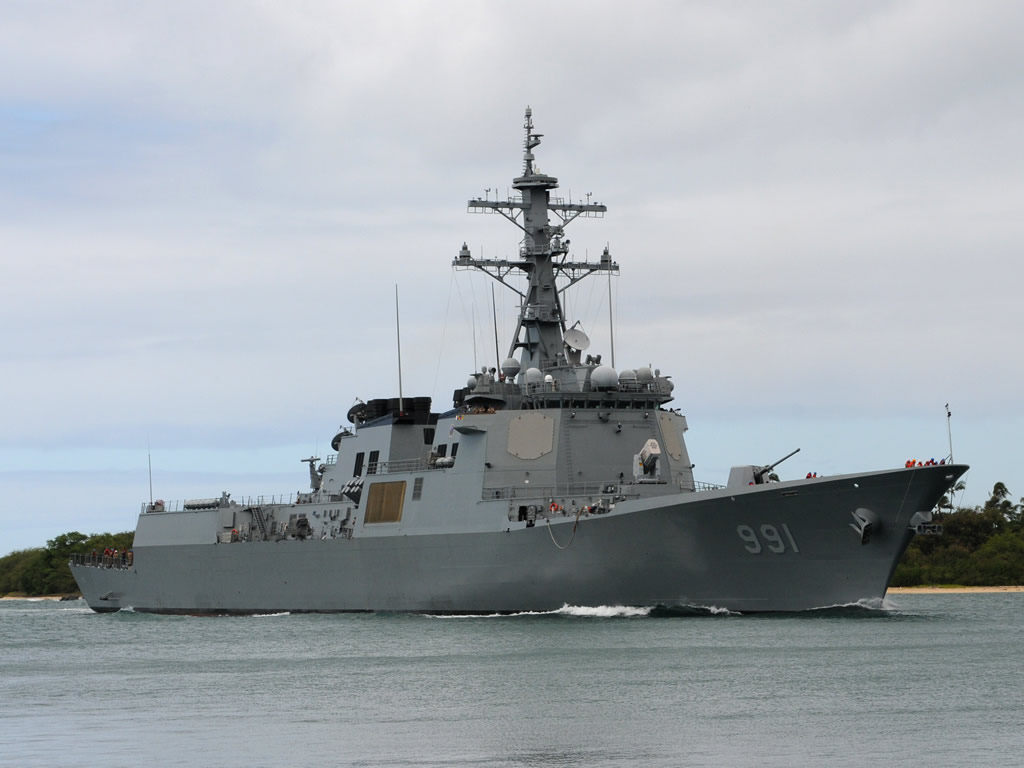
South Korea continues to modernize its forces, and take steps toward full sovereign control of its defenses. PAC-2 GEM+ missiles were ordered in 2008 to be operational in 2010 and fully in place by 2012. South Korea doesn’t appear to be aiming as high as Japan, with its license-produced Patriot PAC-3s and long-range naval SM-3 systems, but medium range SM-2 Block IIIA/B missiles fired from ROKN KDX-III destroyers do offer another limited option for the ROK’s coastal cities.
As countries like the UAE have been quick to recognize, turning a series of point defenses into a cohesive system that can respond in time requires long-range detection, and strong regional command-and-control systems. Now, a key contract has been signed, as South Korea prepares to field its Air and Missile Defense Cell (AMD-Cell) radars and command system.
Contracts and Key Events
Note that this article doesn’t cover every South Korean BMD purchase. It focuses on the core AMD-Cell command and control system, key radars, and overall assessments. Beyond that, it notes key milestones and decisions that may involve weapons within KAMD, like PATRIOT missiles, KDX-III destroyers, etc. Links to in-depth coverage of more specific systems are provided in the “Additional Readings” section.
2010 – 2017
(click to view full)
North Korea is believed to have deployed more than 600 short-range Scud missiles with a 320-500 km range, and around 200 Rodong missiles with a 1,300 km range.
January 2/18: Testing-Exports South Korean missile developers may bring their M-SAM air defense missile system for testing in the United Arab Emirates (UAE), after discussions between both countries were reported in South Korean press. The M-SAM is being developed as part of the Korea Air Missile Defense (KAMD) program—Seoul’s terminal-phase, lower-tier missile defense system that would shoot down incoming missiles from North Korea—and forms part of the wider “Kill Chain” pre-emptive system to deter the North before its missile attacks. For lower-altitude interceptions, US-built Patriot missiles and Korean-made medium-range surface-to-air missiles (M-SAM) will be used, while South Korea is also developing long-range surface-to-air missiles (L-SAM) for medium and high altitude interception. If selected the UAE, with its underpopulated desert areas and own expertise in testing Patriot missiles, could boost potential exports.
April 26/17: South Korea is looking to add two additional EL/M-2080 Green Pine early warning radars to the two currently operated by their armed forces. Capable of detecting ballistic missile threats within a range of 800 kms, the extra radars are being sought amid the recent round of rising tensions between Seoul—with their ally in Washington—and an increasingly belligerent North Korea. Deliveries of the Israeli-made radars are expected to be made by the end of the year. Meanwhile, the South Korean government has confirmed that parts of the US THAAD air defense system have been moved onto the site of its deployment in the south of the country and that the deployment is expected to be ready for full operation by the end of this year.
April 18/17: South Korea will decide next month if their M-SAM air-defense system will be declared operational. According to sources, testing and evaluations of the low-tier missile system have been completed and it now awaits a final process next month to determine its suitability for intended combat missions. Seoul had initially intended to have the system deployed in the early 2020s, but ongoing tensions with North Korea caused the government to push the deployment between 2018 and 2019. Employing hit-to-kill technology, the system will intercept incoming hostile ballistic missiles at altitudes of around 20 kilometers.
May 27/14: Thinking THAAD through. The US government is considering exo-atmospheric THAAD interceptors as an option to protect American forces in South Korea, and has conducted a site survey in South Korea. The issue is that South Korea is developing its own national KAMD missile defense system, and continues to reiterate that it won’t be part of a joint system with the USA and Japan. Which means that interoperability with systems like THAAD is a potential issue.
The Americans are thinking in geo-political terms, as a visible response to North Korea, and there’s also that standard underlying “of course they want to do it our way and buy THAAD” flavor. Very American. The thought that perhaps South Korea is happy with its Green Pine radars, frequently says that terminal defense is all it can use, and would rather deploy its own Cheolmae 4-H missile developed in conjunction with Russia, never enters the picture. On the other hand, the Americans might reply that their own forces would rather have THAAD’s protection, that more than 2 long-range radars might be a good idea against an enemy whose war plan includes in-depth terrorist attacks, and that a shared set of PATRIOT PAC-3 and THAAD systems could create a basis for independent command and control systems that can still cooperate. Sources: Wall St. Journal, “Washington Considers Missile-Defense System in South Korea”.
May 26/14: KAMD. Marcin Andrzej Piotrowski looks at past and current regional tensions are preventing South Korea from fully participating in an integrated missile defense network with Japan and the US. The tensions have also prompted Seoul to modernize its defense industry, and to collaborate with Russia and Israel instead. It also has a good summary of KAMD’s current state and plans, though it fails to pay much attention to KM-SAM program efforts with Russia:
“Since 2006, Seoul has been working on low-altitude defence, the Korea Air and Missile Defence (KAMD), which would initially cost $3 billion. This is currently based on the Israeli C3I Citron Tree system and two Green Pine early warning radars. Since 2009, KAMD has included eight strategic location batteries with 48 launchers and 192 PAC-2 GEM-T missiles. Negotiations about the delivery of an additional 112 PAC-2 missiles from the U.S. are ongoing (at a cost of $404 million). Between 2008 and 2012, ROK Navy also received three modern KDX-III Sejong-class destroyers with Aegis systems and SM-2 missiles…. In the context of the growing threat, ROK has decided to augment KAMD further between 2016 and 2020, with American PAC-3 missile interceptors ($1.3 billion). Seoul is planning another three Sejong-class destroyers with SM-6 missiles, more advanced than the SM-2s. It is possible that Seoul will decide to buy more capable missile defence systems, such as THAADs, SM-3s, Arrows, or even S-400s. Due to the scale of the rocket threat, the large area of Seoul and the costs of interceptors, procurement of the Israeli Iron Dome system is much less likely. However, ROK is planning to buy 10 RPS-42 TASRS Israeli radars ($191 million) in the near future, for detecting drones and cruise missiles at very low altitude.”
Sources: ISN, “South Korea’s Air and Missile Defence: Below the Threat Level”.
April 28/14: PATRIOT. South Korea’s defense establishment formally confirms their intent to upgrade existing PATRIOT systems to PAC-3/Config-3 status (q.v. March 12/14). The budget is WON 1.3 – 1.4 trillion (about $1.25 billion), and they aim to deploy the system between 2016 – 2020. Sources: The Korea Herald, “Seoul to upgrade missile defense”.
PATRIOT upgrade OK
July 26/13: KAMD. South Korea is investing in deterrence and ISR capabilities that will complement its KAMD system, and plans to devote $63 billion of its $192.6 billion 2014 – 2018 budget period for KAMD and deterrent systems.
“The activation of a new Air and Missile Defense Cell (AMD-Cell) was planned for this month, after few months delay. This command and control center will support the entire KAMD enterprise. The AMD-Cell will integrate early warning and target tracks from multiple sources, including US Early Warning Satellites (DSP), SPY-1 naval radars deployed on the KDX-III AEGIS destroyers and the new, land-based Green Pine delivered by israel.”
Deterrent systems include their own ballistic missiles and mediu-long range cruise missiles, and the new budget also contemplates high-altitudes, long-endurance RQ-4B Global Hawk Block 30 jet-powered UAVs. These systems aren’t enough to seriously threaten China yet, but once deployed, they will create a full defense and kill chain that completely outclasses North Korea.
Even all of this equipment won’t stop the DPRK from destroying Seoul if the tense cease-fire reverts to full conflict. What it will do is make South Korean retaliation very thinkable if North Korea decides to shell populated areas, blow up a number of Cabinet members in a terrorist attack, sink South Korean ships, etc. as it has done in the past. An enemy that is comprehensively outclassed loses at least some of its escalation dominance, no matter how aggressive they may be. Sources: Defense Update, “Seoul to Invest US$63 Billion in Strategic Deterrence, Missile Defense”.
June 11-12/13: Naval. The Yonhap news agency quotes “a senior government official,” who says that its KDX-III destroyers will have their SM-2 missiles supplemented by SM-6 purchases as of 2016, as part of KAMD. The SM-6 will complement the ROK’s existing SM-2s. By 2016, they’ll be usable as terminal point defense against ballistic missiles, while also providing long-range air defense against enemy fighters, cruise missiles, etc. If the 2016 delivery date is fixed, it implies a 2014 order for SM-6 missiles. It also implies a future system upgrade for the ships, from a standard Aegis combat system to Aegis BMD 5.0.
On land, South Korea is looking to upgrade its PATRIOTs to the latest PAC-3/Config-3 standard. The question is how compatible that system will be with the USA’s missile defense systems. A working group has been set up with the USA, and findings are expected in early 2014. South Korea hopes to have KAMD v1.0 fully ready by 2020. Sources: Yonhap, “S. Korea to deploy new surface-to-air missiles for Aegis destroyers” | Global Post, “S. Korea aims to establish missile destruction system by 2020”.
Naval BMD OKed
Dec 23/12: Issues. Korea and the USA are talking about integrating AMD-Cell in Osan with the U.S. Forces Korea’s PATRIOTs. The problem is that they need to create a firewall that would insulate that joint system from other US BMD assets outside South Korea. Which is to say, in Japan.
Korea was invaded by Japan during WW2, and Japanese atrocities left a lot of hard feelings. South Korean governments have faced firestorms of criticism when proposals have been made to share intelligence with Japan, even if that intelligence concerns North Korean missile launches. North Korea’s networks of sympathizers in South Korea are happy to stir up those hard feelings up whenever it’s convenient, of course. Sources: SLD, “Defending South Korea: The Challenge of North Korean Missiles.
Dec 5/12: Green Pine deployment. South Korea’s Green Pine radars are almost ready to deploy:
“South Korea brought in two Israeli-made “Green Pine” radars this year, one of them in August and the other last month, and has since been conducting tests to ensure they have no defects.
“Acceptance testing of the Green Pine radar No. 1 comes to an end today with a final assessment of 24-hour continuous operation,” the source said. “It will be deployed immediately after the acceptance testing and will be in service when North Korea launches its long-range rocket.”
Testing of the second radar will be completed by mid-December and deployed thereafter, the source said.”
Sources: Yonhap, “S. Korea to deploy newly introduced radar ahead of N. Korea rocket launch”.
Green Pine radars deployed
Oct 28/12: PATRIOT. A joint study by the Korea Institute for Defense Analyses and the US Missile Defense Agency concludes that the PATRIOT PAC-2 system has an interception success rate of below 40% against ballistic missiles. South Korea’s government looked at that, then concluded that they need to buy PAC-3 batteries, in order to push their odds above 70% for covered areas.
The PAC-3 systems appear to be a priority, with deliveries to begin in 2014. To achieve that, a DSCA export request will need to be issued in the very near future. As PAC-3 systems arrive, South Korea reportedly plans to divert their billion-dollar buy of German PAC-2 batteries to defend against aircraft and cruise missiles. ROK’s Yonhap News Agency, S. Korea moves to upgrade Patriot defense system” | Chosun Ilbo, “PAC-2 Missiles Flunk Intercept Test”.
Oct 26/12: Made in Korea. Despite American urgings, South Korea sees America’s system as unsuitable for their needs. American systems tend to focus on midcourse intercepts, but the Koreans see hundreds of missiles just 5-10 minutes flight from their territory, and prefer terminal intercept capabilities. They also aren’t about to give up their own research and capabilities in this critical area, given their doubts about US resolve, but it’s best not mention this to your ally:
“The MD system that the United States envisions is a multi-layered defense system, which is fundamentally different from the Korean type of missile defense system that is oriented to low-layer defense,” a defense ministry official told reporters on condition of anonymity. “We cannot but build a low-layer defense system under operational situations on the Korean Peninsula. Therefore, building the KAMD (Korean Air and Missile Defense) means never participating in U.S. efforts to build a multi-layer defense system,” the official said.”
It’s the “never” that tells you there’s more at work here than just operational considerations. Sources: Yonhap, “Defense ministry denies possibility of S. Korea joining U.S. missile defense”.
April 10/10: KAMD. South Korea is sticking to its course and deploying an indigenous missile defense system, with initial deployment scheduled for July 2010.
“South Korea, which decided not to join the U.S.-led global missile defense system, has gradually been building an independent, low-tier missile shield called the Korea Air and Missile Defense System (KAMD) since 2006 by acquiring Patriot missiles and long-range early warning radars.
The KAMD involves early warning radars, ship-to-air and land-based missile defense systems, arming Seoul with the ability to track and shoot down the North’s low-flying, short- and medium-range missiles, with help of U.S. early warning satellites.”
Sources: Yonhap, “S. Korea to deploy indigenous missile defense system in July”.
2009

(click to view larger)
Sept 23/09: Israel Aerospace Industries announces a $280 million pair of contracts with South Korea, one of which covers the Oren Yarok (EL/M-2080 Block B “Green Pine”) radar. South Korea will join Israel and India as customers for the system. Globes adds that IAI’s usual contract policies involve a down payment of 25-35%, suggesting that it will record $70-98 million revenue from these contracts in its consolidated financial report for 2009.
Reports as early as Sept 17/09 had indicated that the Israeli radar had won the AMD-Cell competition against Raytheon and Thales, and that a contract was imminent. Earlier discussions had revolved around figures of about $215 million for 2 Green Pine radar systems, and current reports offer a figure of $200 million for an undisclosed number of systems. The low number of TA-50 and F/A-50 fighter orders at this early stage of their development, and the EL/M-2032 fighter radar’s low R&D needs given its mature state, make those figures plausible in the absence of a detailed breakout between the 2 contracts. Ha’aretz adds that:
“South Korea is discussing with the IAI the possibility of purchasing the Arrow missile defense system [link DID’s]. Israel is making contacts with other countries on this issue as well, with Turkey among those that have expressed interest. Nonetheless, chances are slim that a foreign country will purchase the Arrow before a joint Israeli-American missile defense development occurs.”
Ha’aretz is referring to 2 trends. One is America’s government using blocking tactics or pressure, in order to stymie Israeli sales to mutual allies in international competitions. If the equipment might be said to contain any American or American-derived technologies, the sale can be blocked outright, or simply made untenable by dithering over permissions. Otherwise, diplomatic pressure and sales of advanced American equipment to Israel become the lever. South Korea’s E-X AWACS competition, India’s MMRCA fighter competition, and Turkey’s tank competition have all featured as recent examples. The other trend is an evolving jockeying between Boeing’s GBI and Arrow, Raytheon’s SM-3 (which Israel is reportedly considering), and Lockheed Martin’s THAAD missile for significant long-term roles in land-based missile defense. IAI release | Korea Times | Ha’aretz newspaper | Globes business | Agence France Presse | Flight International.
2 Green Pine radars
May 19/09: Competition. The Korea Times reports that 3 foreign bidders have submitted contract proposals for South Korea’s AMD-Cell program: Israel’s Elta, Raytheon of the United States, and Thales Nederland.
IAI Elta’s Green Pine radar has already been discussed below. Thales Nederland manufactures a number of advanced active array naval radars, some of which are capable of ballistic missile tracking; SMART-L is probably the best known, and South Korea already uses it on their Dokdo class amphibious assault ships. Raytheon’s products include a number of missile defense radars, including the AN/TPY-2 used as part of the USA’s THAAD theater defense system.
South Korea’s DAPA defense procurement agency plans to select the finalist by the end of the year after reviewing each firm’s contract proposal, and finishing price negotiations.
Feb 15/09: Competition. The Korea Times reports that South Korea’s Defense Acquisition Program Administration (DAPA) is likely to select Israel’s EL/M-2080 Green Pine radar systems, buying 2 radar sets by 2010 in a WON 300 billion/ $215 million deal. Green Pine radars are an integral component of Israel’s own national missiles defense system, where they are used in conjunction with Patriot PAC-2 GEM+ missiles and Boeing/IAI’s longer-range Arrow-2 interceptors. They may also become part of India’s emerging ABM system.
Green Pine radars have a claimed detection range of 500 km/ 300 miles, which can be extended to 800 km/ 480 miles in the most modern versions. Just one of those “Super Pine” radars cold cover all of North Korea from a position well behind the armistice’s front lines.
The ballistic missile early warning radars are part of the ROK’s planned Air and Missile Defense-Cell (AMD-Cell), a missile defense command-and-control center that will play a key role in monitoring, tracking and intercepting incoming cruise and ballistic missiles from North Korea. AMD-Cell will reportedly be interoperable with US Forces Korea’s own theater missile defense system.
An anonymous source told the paper that the USA’s Forward-Based X-Band Radar-Transportable (FBX-T) was denied due to export restrictions, which the French M3R radar failed to meet all requirements. Overall:
“The DAPA concluded negotiations with foreign bidders over the selection of the early-warning radar systems last week and believes the Israeli radar is the most suitable for the country’s theater missile shield in terms of price and capabilities.”
Israel and South Korea have had limited defense ties over the years, but those ties appear to be growing. South Korea has begun buying Israeli UAVs, and Israel is considering South Korea’s T-50 jets as its future advanced flight trainers. See also: Korea Herald | Ha’aretz, Israel.
Additional Readings
* IAI – ELM-2080 Green Pine Radar system
* Radar Basics – Green Pine Radar
* Army Technology – Arrow 2 Theatre Ballistic Missile Defence System, Israel. Technically, an IAI/Boeing collaboration. Includes information regarding the Green Pine.
* Wikipedia – Arrow (missile). Includes a section covering the EL/M-2080.
* IEEE Digital Library (Oct 15-18/96) – EL/M 2080 ATBM early warning and fire control radar system. “This paper describes the system concept and some of the hardware design…”
Related Systems
* DID – Korea’s KDX-III AEGIS Destroyers. Naval component of KAMD national ballistic missile defense, which will use SM-6 missiles for terminal point defense.
* DID – Timely Defenders: Keeping Patriots in Shape. South Korea bought PAC-2 systems from Germany, and will be buying new missiles and upgrading the ground systems to reach PAC-3/Config-3 status.
* Defense Update (Dec 17/11) – Cheongung – a New MR-SAM for the South Korean Multi-Tier Defense System. Medium-range M-SAM system and Cheolmae-2/ Cheongung missile, developed in conjunction with Russia’s Almaz-Antey. May develop ABM capabilities with a larger Cheolmae 4-H missile, which would benefit from Russian S-400 technologies.
News & Views
* Missile Defense Review (Sept 3/14) – Patch up Asian BMD.
* ISN (May 26/14) – South Korea’s Air and Missile Defence: Below the Threat Level.
* Yonhap (May 26/14) – Acquiring SM-3 missiles not an option for S. Korea: defense ministry.
* Yonhap (Oct 15/13) – S. Korea seeks multi-layered missile defense against North.
* The Diplomat (July 26/13) – South Korea Goes All In On Missile Defense.
* RUSI (March 12/13) – South Korea’s Emergent Missile Defence Capabilities.
* SLD (Dec 23/12) – Defending South Korea: The Challenge of North Korean Missiles. More specifically, of integrating AMD-cell with US Forces Korea’s PATRIOTs.
* DID (Dec 1/08) – Raytheon Begins SAM-X/Patriot Missile Work in South Korea. Eventually led to sales of ground systems, which were combined with ex-German PAC-2 missiles.