


(click to view full)
SM-3 Standard missiles have been the backbone of the US Navy’s ballistic missile defense plans for many years now, and are beginning to see service in the navies of allies like Japan. Their test successes and long range against aerial threats have spawned a land-based version, which end up being even more important to the USA’s allies.
In July 2008 the US Missile Defense Agency began considering a land-based variant of the SM-3, largely due to specific requests from Israel. Israel currently fields the medium range Arrow-2 land-based ABM (Anti-Ballistic Missile) system, and eventually elected to pursue the Arrow-3 instead of SM-3s. Once the prospect had been raised, however, the US government decided that basing SM-3 missiles on land was a really good idea. The European Phased Adaptive Approach to missile defense is being built around this concept, and other regions could see similar deployments.
EPAA & The SM-3 Option
(click to view full)
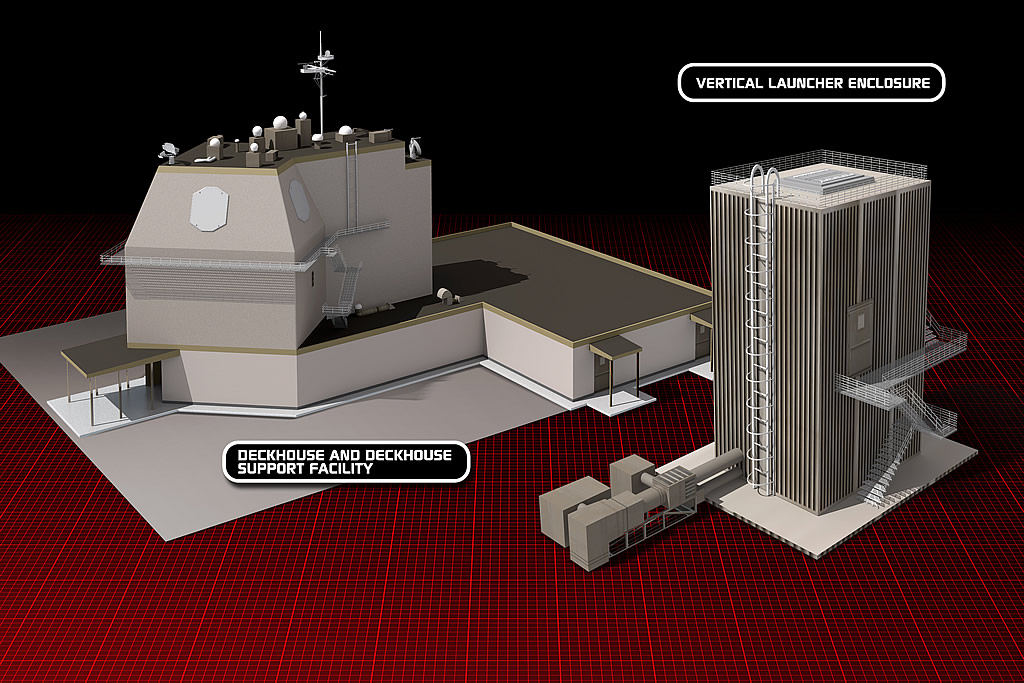
The European Phased Adaptive Approach aims to use a combination of naval and land-based missile defense systems, which hope to share a common architecture and missile set. The core physical component is a “deckhouse” enclosure, containing the command and control center and a BMD-enhanced SPY-1(D) radar that’s similar to those aboard US Navy destroyers and cruisers. The software will be taken from the Aegis combat system on US Navy ships, beginning with version 5.0.1 and upgrading over time. A connected vertical launching system building will contain 24 SM-3 missiles, which will become more advanced as newer variants are fielded.
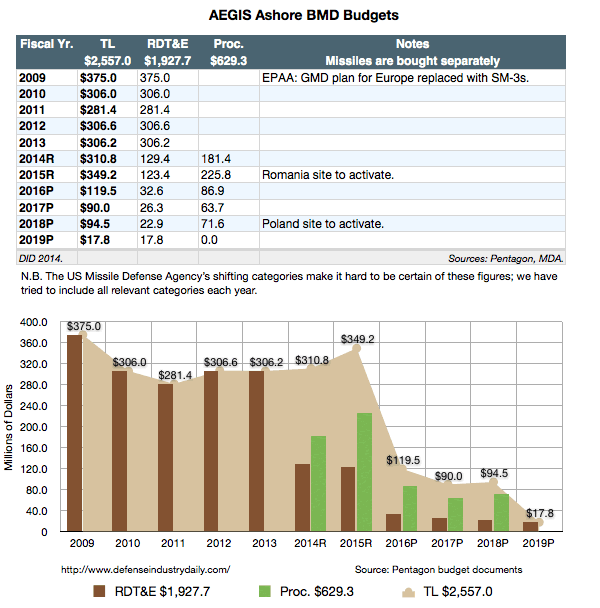
The USA is building 3 Aegis Ashore sites: one test site in Barking Sands, Hawaii, USA, and sites in Deveselu Air Base, Romania and Redzikowo, Poland. The GAO estimates that building these sites and bringing them to operational status will cost the USA about $2.3 billion. Our own tracking includes R&D into land-based SM-3 options, and tracks obviously related categories in MDA’s shifting budget lines.
The European Phased Adaptive Approach
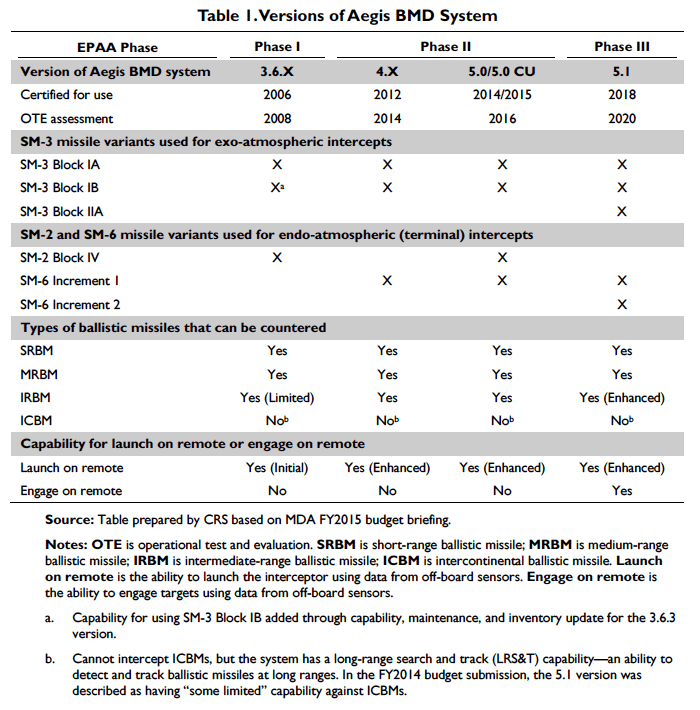
The European Phased Adaptive Approach (EPAA) currently envisions 4 phases:
EPAA Phase 1, 2011-2015
In 2011, the US Navy expected to have naval SM-3 Block 1A missiles and ships fully in place, on more BMD-capable ships than the 2 Atlantic Fleet destroyers available in 2009, to pair with land-based AN/TPY-2 radars that are also used in the THAAD system. Another 4 destroyers are being forward-deployed to Rota, Spain in FY 2014-2015. Unfortunately, naval SM-3 Block 1 missiles cannot cover the Czech Republic at all, and can offer only limited coverage for Poland.
The Obama administration bowed to Russian pressure and picked the THAAD system’s AN/TPY-2 radar as the system’s ground accompaniment, to limit the distance they could see into Russian airspace. The Russians simply saw weakness, and kept up the pressure, but couldn’t make any more headway. Turkey agreed to host the AN/TPY-2 radar near Diyarbakir in SE Turkey, though they added conditions that the data must not be shared with Israel.
This will be the only EPAA option until 2015, which is beyond the Obama administration’s current term of office. During that interim period, THAAD continues to receive upgrades. At sea, AEGIS BMD system 4.x is being rolled out beyond USS Lake Erie [CG 70], offering some capability improvements on board ship, and laying an open architecture foundation for future upgrades.
In parallel, NATO has fielded an initial version Active Layered Theatre Ballistic Missile Defence (ALTBMD) command and control architecture. They declared an “interim” BMD capability in May 2012, after a successful multinational test.
ALTBMD will also have European components to draw upon, including the national early-warning system under development by France. In August 2012, Poland announced that it was pursuing its own national BMD system, which may mirror many of France’s components. France (11 systems) and Italy (6 systems) can also contribute with their land-based SAMP/T Mamba and its Aster-30 missile, which is designed to address threats in the SRBM (<1,000 km) class.
On the naval front, the Netherlands is upgrading its 4 top-tier air defense frigates with ballistic missile tracking capability, and its ships are compatible with SM-3 missiles if they decide to purchase some. Elsewhere, Aster-30s are already found on advanced air defense destroyers: the Franco-Italian Horizon Class, and Britain’s Type 45 Daring Class. The naval system hasn’t been tested against ballistic missiles yet, but the systems could all be upgraded to do so.
EPAA Phase 2, 2015-2018

SAMP/T launch
(click to view full)
If progress continues per plan, 2015 would see advances on 2 fronts.
One front involves improved SM-3 Block 1B missiles, which will expand the range of coverage for American ships. Serious orders for the Block 1B missile began in 2011, but technical issues have delayed full production. That delay means that US Navy ships based in Europe will be competing with other priorities in Asia and around the USA, as they seek to host the new missiles. A slower phase-in that extends to 2018 now looks most likely.
The other element was to be a land-based “Aegis Ashore” site at Deveselu Air Base, Romania, hosting SM-3 missiles instead of Boeing’s longer-range, fixed-location GMD system. Aegis Ashore designs appear to have shifted from an easily-deployable configuration, toward high-investment fixed sites that are similar to the GMD program they replaced. The Romanian deployment would use SM-3 Block 1B missiles from an emplaced Mk.41 VLS launcher, and be controlled by a SPY-1D radar and AEGIS BMD 5.0.1 combat system. An interim setup was formally commissioned in October 2014.
If successfully deployed, this is a defense against short and medium range missiles (SRBMs & MRBMs), with some capability against intermediate range missiles in the 1,850-3,500 mile class (IRBMs). On the other hand, the location of these defenses still leaves central Europe mostly unprotected.
During Phase 2, NATO’s Active Layered Theatre Ballistic Missile Defence (ALTBMD) command and control network will be operational at an initial level. France, Italy, and possibly Poland will have armed land-based BMD systems of their own deployed, and it’s likely that ALTBMD compatible BMD-capable ships will be fielded. The Netherlands is already preparing its vessels for missile tracking and SM-3 hosting, and the Aster-30/ PAAMS combination is fielded on British, French, and Italian ships.
EPAA Phase 3, 2018-
(click to view full)
Around 2018, America expects to deploy the longer-range, 21″ diameter SM-3 Block II missile, on ships and (if deployments have been accepted) on shore. The US MDA would add Redzikowo, Poland to its list of land-based sites, defending Northern Europe with SM-3 Block 1B & Block IIA missiles, controlled by an AEGIS BMD 5.1 combat system.
This system would be intended to kill SRBM, MRBM, and IRBM threats, with some capabilities against full intercontinental range missiles (ICBMs). Gen. Cartwright has stated that just 3 SM-3 Block II locations would be able to cover all of Europe, but that missile is an earlier-stage R&D effort, with all the expected implications for dates and certainty of capabilities.
EPAA Phase 4, 2020+
Effectively cancelled.
The USA was going deploy a new Next-Generation Aegis Missile (SM-3 Block IIB) design, to improve performance and begin to field a credible anti-ICBM capability. Technical issues became a serious problem, once experts concluded that the initial sites picked for EPAA aren’t all that helpful for defending the USA. A liquid-fuel booster could be used to boost interceptor speeds, but that isn’t safe to use on ships. Even though the best place to defend the USA against an ICBM launched from Iran is from the middle of the North Sea. Now throw in a planned development schedule defined by a wild-guess political promise, rather than solid information. The whole thing was a mess, and in March 2013, it was “restructured” into into an R&D program by the Pentagon.
Aegis Ashore

(click to view full)
Making these things happen requires a number of additional steps. AN/TPY-2 radars will provide initial services during Phase 1, and will continue to play a supplemental role thereafter in both EPAA and NATO’s ALTBMD.
Beyond Phase 1, the USA has shifted to a larger and more permanent basing structure, which removes some of the benefits of switching away from GMD. The US Missile Defense Agency is building an “Aegis Ashore” test complex near Moorestown, NJ, and another at its missile defense testing center at Barking Sands, Kauai, Hawaii. The Hawaiian complex is hosting a land-based Mark 41 launcher, a 4-story building with a SPY-1 radar, and three 125-foot tall test towers.
Poland is being considered for Aegis Ashore deployment in 2018, but the country is beginning to diversify its options. The September 2011 agreement with the USA is still in force, but Poland is determined to have its own missile defense infrastructure, and may choose to place their bets on a parallel NATO/ European system. Their other option would likely involve American PATRIOT and/or THAAD systems.
Beyond Europe
Aegis Ashore may spread beyond Europe. In the Pacific, Japan is already deploying SM-3s at sea, and may find land-based counterparts useful. Its neighbor South Korea shares Japan’s worries about North Korea’s evil and semi-stable regime; the ROK intends to load shorter range SM-6 missiles on its AEGIS destroyers, is buying and deploying Patriot PAC-2 GEM+ missiles, and has contracted with Israel for “Green Pine” air and missile defense radars. Its cruiser-size KDX-III AEGIS destroyers could be modified for a ballistic missile defense role, but land-based SM-3s linked to air and naval systems offer an option that doesn’t require naval upgrades.
The other country that has been linked to land-based SM-3s had a more complicated set of choices, and possible rationales. See Appendix A’s coverage of Israeli deliberations, which ended with a decision to deploy their own Arrow technology instead.
The Missiles

(click to view full)
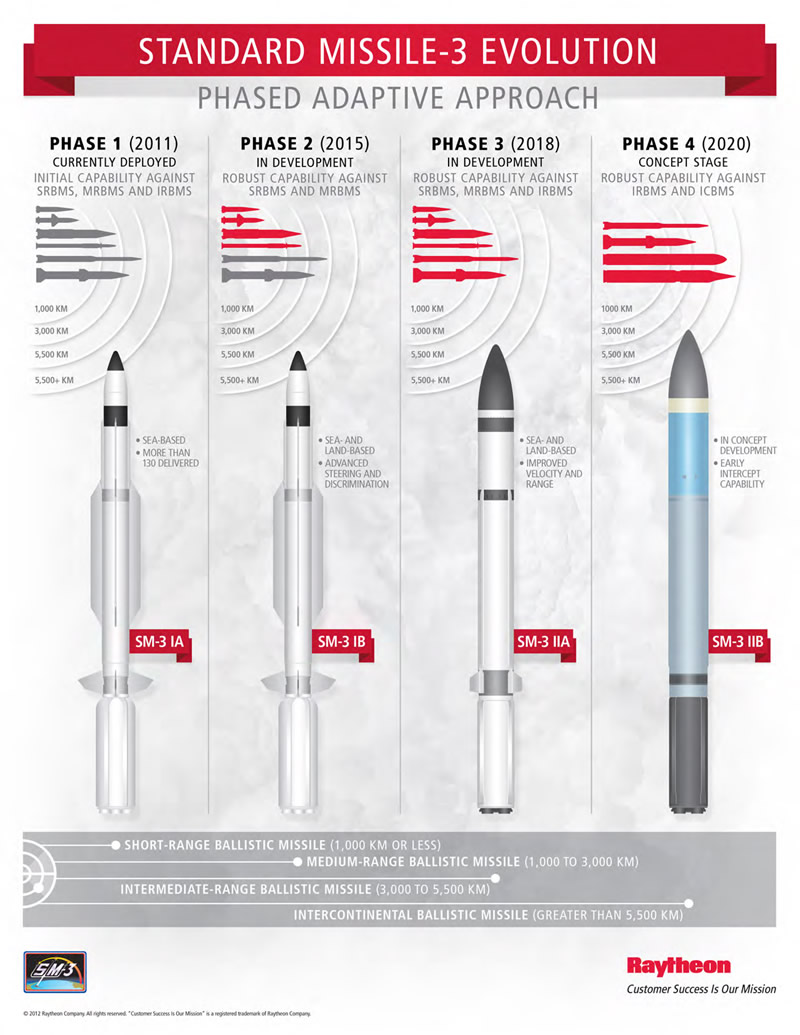
With a maximum range of about 300 miles/ 500 km, the Standard Missile 3 Block I (SM-3) has just 1/5th to 1/6th the reported reach of GMD’s Ground Based Interceptors, but a longer reach than current mobile land options like THAAD. SM-3 has 4 stages. The booster motor and initial stage launch the missile, and take it out of the atmosphere. Once it goes “exo-atmospheric,” the 3rd stage is used to boost the missile higher, and also corrects its course by referencing GPS/ INS locations. The final stage is the LEAP kill vehicle, which uses infrared sensors to pick out the target, then guides itself in to ram it. That target is expected to be an enemy ballistic missile, but America’s shoot-down of its own ailing satellite in 2008 showed that the same technology can be used against any low earth orbit object.
The introduction of Raytheon’s SM-3 Block II variant will widen the missile’s diameter from 13.5″ to 21″, greatly extending its range and speed. That means better performance against longer range missiles that move faster, and offer different trajectories. Block II weapons will add the ability to handle longer-range, higher-flying IRBM (Intermediate Range Ballistic Missiles, usually 3,000-5,000 km range), and even offer some hope against global-strike threats like ICBM (Inter Continental Ballistic Missile) warheads. SM-3 Block IIA is currently expected to debut around 2015, but testing and other requirements mean it won’t be part of EPAA until 2018 or later.
Contracts & Key Events
[youtube:v=ae5VmVwfWmk]
Because of the intertwined nature of the EPAA system, many contracts will be covered elsewhere. The AN/TPY-2 radar has its own article, as does the THAAD theater air defense system the TPY-2s were originally developed for. Standard Missile family contracts also have their own FOCUS article, as does the ubiquitous Mk.41 vertical launching system that will be part of the Aegis Ashore complex.
Unless a contract of these types specifically notes dedicated assets for EPAA/Aegis Ashore, or is directly germane to key program technologies, they will not be covered here.
FYs 2015 – 2021
NSF Devesulu opens.
September 6/21: Services Lockheed Martin won a $12.6 million deal to exercise options for Aegis design agent field engineering services. Services include test and evaluation, engineering change development, ordnance/ship alterations, modernization engineering, logistics and technical support, ordnance alterations kit development, integration and test support, AN/SPY-1 series radar antenna refurbishment and Coast Guard deep-water program design agent field engineering support. The services are in support of Aegis-equipped CGs and DDGs, allied Aegis-equipped ships, and Coast Guard Aegis-configured ships. Work will take place in Virginia, California and Florida. Estimated completion will be by September 2022.
August 23/21: No Funding For Alternative In Japan Local media revealed that Japan’s defense ministry is unlikely to seek funding in the fiscal 2022 budget to build the alternative for the abandoned Aegis Ashore missile defense system. A government official was quoted as saying that “such budget requests will likely be impossible over the next few years.” Japan’s goal was to install those land-based systems on warships instead. But questions remain over the cost of designing and operating those ships.
May 31/21: Japan Documents obtained by Asahi Shimbun revealed that Japan’s Aegis Ashore alternative sea-based proposal is likely to cost $9 billion in the long run. The undisclosed figures are for the repair and maintenance of equipment plus testing of the missile system.
May 28/21: Engineering And Security Support Lockheed Martin Overseas won a $30.6 million contract modification, which increases the total cumulative contract value by $30,612,010 from $99,037,697 to $129,649,707. Under this modification, the contractor will provide Poland AAEA engineering and security support, AAEA test and site updates, risk mitigation support, and continued completion effort for the Aegis Ashore Poland site. Aegis Ashore in Poland uses a defensive system almost identical to that used on US Navy Aegis-capable guided-missile destroyers and cruisers at sea. The system is designed to detect, track, engage and destroy ballistic missiles in flight. The complex at Redzikowo will consist of a fire-control radar “deckhouse” with an associated Aegis command, control and communications suite. Separately, it will house several launch modules containing Standard Missile-3 (SM-3) interceptors. Work will take place in New Jersey and Poland. Estimated completion date is June 30, 2023.
April 30/21: Japanese Design Japan is exploring the use of a multihull design for the two vessels that are to be equipped with the Aegis missile defense system that replaces the Aegis Ashore program. Japan’s Hibiki Class ocean surveillance ships uses the small-waterplane-area twin hull (SWATH) design. Such a configuration offers stability in rough seas. According to the news report, a civilian company will be contracted to develop a potential design.
February 18/21: 126 Days A Year The Asahi has disclosed that the two new Aegis warships that Japan plans to build as the alternative to land-base Aegis Ashore sites are only able to be on station to defend the country for up to 126 days a year. The land-based solution is capable of being operational for 365 days a year. A report by the Ministry of Defense stated that the ship would require three months of maintenance each year. The crew would need refresher training after that before they can be declared ready for duty.
August 25/20: Japan Lockheed Martin Rotary and Mission Systems won an $18.8 million contract modification under previously awarded Aegis Combat Weapon System development contract HQ0276-10-C-0001. Under this modification, the contractor will continue performing engineering design support and analysis of alternative services necessary for continuation of planning efforts and risk reduction efforts required to support the Aegis Ashore Japan analysis of alternatives and Foreign Military Sales. Japanese Defense Minister Taro Kono had cancelled plans to build two Aegis Ashore sites, citing cost and concerns that falling booster stages from the interceptor missiles could drop on residents. Japan, however, has reportedly not cancelled the $1 billion contract for the defense system’s radars, built by Lockheed Martin. Work will take place in Moorestown, New Jersey. Estimated completion date is December 31, 2020.
August 21/20: First Ever Intercept The US Missile Defense Agency (MDA) is on course to conduct the first ever intercept of a intercontinental ballistic missile (ICBM) target using a SM-3 Block IIA interceptor this year. Vice Adm. Jon A. Hill, director of MDA, says this will be executed under Flight Test Maritime 44 (FTM-44). It will be conducted in a “defense of Hawaii” scenario, with a ship and the SM-3 Block IIA, Hill added. Hill was speaking at a August 18 webinar sponsored by the Heritage Foundation, he said his agency is evaluating the feasibility of using the Aegis Combat System together with the SM-3 Block IIA interceptor as a layer in the missile defense of the US homeland.
July 7/20: Aegis Floating Ashore The Japanese government is said to be considering a suggestion to put the Aegis Ashore system on a floating platform out at sea. However, the idea is met with skepticism by some as the floating base is vulnerable to tsunami and from torpedo attacks. Another suggestion was to have two more Aegis-equipped destroyers added to the fleet but the challenge is finding enough personnel to man those warships. One solution proposed was to have Ground Self-Defense Force personnel deployed on board the ships. But having more Aegis warships will not allow Japan to deploy them around the clock as the ships cannot operate effectively during bad weather. Japan announced on June 15 to suspend the Aegis Ashore program as it cannot guarantee that the SM-3’s Mk72 booster can safely drop inside the base in Yamaguchi Prefecture.
June 17/20: Suspended in Japan Japan abruptly suspended plans to deploy its US-developed Aegis Ashore missile defense system on Monday, citing technical issues and mounting costs. “In view of the cost and time for the deployment, we will halt the process,” Defense Minister Taro Kono said to reporters. The system uses the Lockheed Martin Aegis Weapon System and the Raytheon Standard Missile for tracking and defending against incoming threats. Japan intended to deploy it to counter threats from North Korean missiles, but increasing problems raised the $2.15 billion estimated cost to over $4 billion, including purchase cost and an expected 30-year use.
May 20/20: Aegis Ashore Lockheed Martin Rotary and Mission Systems won a $22.3 million Aegis Combat Weapon System development contract, which covers multiple Aegis Weapon System baselines and platforms. Under this modification, the contractor will continue performing engineering design support services necessary for continuation of planning efforts and risk reduction efforts required to maintain initial operational capability schedule to support the Aegis Ashore Japan Foreign Military Sales main case. The work will take place in Moorestown, New Jersey, with an expected completion date of July 31, 2020. Funds from the government of Japan in the amount of $22,300,000 are being obligated at the time of award.
May 18/20: Akita Canceled The Japanese Ministry of Defense announced that plans to go ahead with the deployment of a land-based ballistic missile defense installation in Akita prefecture would be canceled. Akita prefecture had been identified as a site for the deployment of one of two Aegis Ashore installations that Japan is procuring to better defend against ballistic missile threats from North Korea. The decision to revisit the plan to deploy the system in Akita comes after months of sustained opposition from local politicians and constituents. The envisaged site was the Japanese Ground Self-Defense Force training area in Akita’s Araya district. Initial reports that the Japanese government had started reconsidering Akita as a deployment area came in December 2019.
May 5/20: AN/USQ-82(V) DRS Laurel Technology won a $11.8 million modification to exercise options for procurement of AN/USQ-82(V) hardware in support of DDG-51 (guided missile destroyer) class new construction, DDG-51 class modernization, and Aegis Ashore Japan. Aegis Ashore is the land-based variant of the Navy’s Aegis Weapons System. The AN/USQ-82(V) Program is a control system network. Its purpose is to transfer mission critical data to and from users associated with combat, navigation, aviation, power, propulsion, steering, alarms indicating and damage control systems. Work will take place in Johnstown, Pennsylvania. Estimate completion will be by August 2021.
August 19/19: Modernization The US Navy contracted Lockheed Martin with a $80 million modification for AEGIS Modernization (AMOD) production requirements. The deal covers the production, test and delivery of multi-mission signal processor equipment sets; electronic equipment fluid cooler; AEGIS Weapon System AMOD Upgrade equipment; Kill Assessment System 5.1 equipment; AEGIS spares; Australia Combat Systems Engineering Development Site; and AEGIS Ashore Japan Sites equipment. The upgrade is for the US Navy as well as the governments of Japan and Australia under the Foreign Military Sale program. The Aegis Combat System is an integrated naval weapons system using radar and computer technology to track and guide weapons in destroying enemy targets. The project was started by the US Navy in 1964 to defend ships from missile threats, and with constant upgrades is now a feature on over 100 US and NATO ships, as well as those of Australia, Norway and South Korea. It is also an integral part of NATO’s European missile defense system. Work under the modification is expected to be complete by November 2023.
August 12/19: Romanian Repair Finished The Aegis Ashore Ballistic Missile Defence site in Romania has completed its upgrade, NATO announced. The work was completed on August 9 and the THAAD battery that had been temporarily deployed there will be relocated. The update is part of the United States European Phased Adaptive Approach to ballistic missile defense, which was announced in September 2009. A release by Nato said that the update, which has been taking place across the Aegis Ballistic Missile Defense system fleet, did not provide any offensive capability to the Aegis Ashore missile defense system. Aegis Ashore is the land-based variant of the Navy’s Aegis Weapons System and the centerpiece of Phases II and III of the European Phased Adaptive Approach.
July 23/19: Saudi Arabia Lockheed Martin won a firm-fixed price modification worth $1.5 billion for the procurement of Terminal High Altitude Area Defense (THAAD) Interceptor support items in support of the Foreign Military Sales case to the Kingdom of Saudi Arabia. The contract award came a day after the US House of Representatives voted to block $8.1 billion in Arms Sales to Saudi Arabia and other Arab states, but without the majority needed to prevent President Donald Trump from vetoing the move. The THAAD is designed to hit-to-kill intercept both short- and medium-range ballistic missiles in terminal or descent phase. It is interoperable with Raytheon’s Patriot missile defense system, already fielded by Saudi Arabia. Work will take place in Texas, Arkansas, and Alabama. Period of performance is from July 19, 2019 through July 31, 2023.
June 7/19: Flawed Data in Japan The Japanese defense ministry plans to deploy a radar-equipped Aegis Ashore unit in the Ground Self-Defense Force’s Araya training area in Akita, the capital of the prefecture. However, officials found several mistakes in the survey documents that supported the need to deploy missile interceptors in Akita, local news reported Thursday. The defense ministry said on May 27 that 19 other candidate sites were “unfit” for Aegis Ashore deployment, Jiji Press reported. The government survey in question included errors for terrain data on nine other areas that provided comparisons to the designated site. The US State Department approved the Aegis Ashore systems purchase to Japan in January. Total cost of the system is estimated at more than $2 billion.
April 30/19: Poland and Romania The US Navy tapped Lockheed Martin, Rotary and Mission Systems with a $9.1 million contract modification for the AEGIS Ashore Support and Ship Integration and engineering of the AEGIS Weapon System as well as on-site support in Romania an Poland. The modification also includes technical data package and test package/procedure development, technical documentation, feasibility studies, configuration management support, lifecycle and system engineering, environmental qualification testing, topside analysis, Ballistic Missile Defense engineering, combat system alignment and integration of Advanced Naval Weapon Systems on DDG 51 Class ships. Just recently it was reported that the Aegis Ashore in Romania was undergoing updates. During the updates the USA will temporarily deploy the Terminal High Altitude Area Defense (THAAD) system to Deveselu in Romania. The Polish AEGIS Ashore system has been hit with delays due to construction issues at Redzikowo military base that are unrelated to the system’s performance. It won’t be operational until 2020. Work under the current contract modification will take place in Deveselu and Redzikowo as well as various sites within the US. Scheduled completion date is in September this year.
March 4/19: Japan The US Missile Defense Agency awarded Lockheed Martin Rotary and Mission Systems Division a $10 million contract modification for engineering and design support services for the Aegis Ashore (AA) Japan Foreign Military Sales (FMS) Technical Assistance Case. The modification prepares for the AA Japan Main Case. The Aegis Ashore is a land-based component of the Aegis Ballistic Missile Defense System, that provides missile defense against short to intermediate-range ballistic missiles. On December 19, 2017, the Cabinet of Japan approved a plan to purchase two Aegis Ashore systems equipped with the Gallium Nitride AESA radar to increase the country’s self-defense capability against North Korea, using SM-3 Block IIA missiles. Work under the modification will take place in New Jersey, and is expected to be completed by October 31 this year.
January 14/19: Engineering and Security support The Missile Defense Agency contracted Lockheed Martin with a $23 million sole-source, fixed-price incentive and cost-plus modification to provide Poland Aegis Ashore Engineering Agent (AAEA) engineering and security support. The modification includes AAEA test and site updates, risk mitigation support, and continued completion effort for the Aegis Ashore Poland site. Aegis Ashore is the land-based component of the Aegis ballistic missile defense system developed originally for deployment at sea aboard specially equipped U.S. Navy Arleigh Burke-class guided missile destroyers. Work is expected to be completed by December 2020.
December 14/18: Test The US DoD’s Aegis Ashore missile defense system achieves another milestone. During a recently held test the system successfully identified and tracked an intermediate-range ballistic test missile and intercepted it with a SM-3 Block IIA missile. The test was conducted somewhere over the Pacific with the interceptor launched from the Missile Defense Agency’s (MDA) Pacific Missile Range Facility at Kauai, Hawaii. “It was of great significance to the future of multi-domain missile defense operations and supports a critical initial production acquisition milestone for the SM-3 Block IIA missile program,” MDA Director Lieutenant General Sam Greaves told Reuters. The MDA has three Aegis Ashore systems in total. One station in Romania which, operational since 2016; and another in Poland, which is expected to be operational in 2020. The SM-3 Block IIA is the co-operative US-Japanese program. It adds the larger diameter, a more maneuverable “high-divert” kill vehicle, plus another sensor / discrimination upgrade to help deal with harder targets, countermeasures, and decoys.
December 20/17: FMS-Cabinet Approval The Japanese cabinet has approved a procurement plan for two Aegis Ashore batteries, to be tasked with intercepting potential ballistic missiles over its airspace. Initial funding for the project will be ring-fenced in the next defense budget beginning in April, but no decision has been made on the radar, or the overall cost, or schedule, of the deployment, according to the MoD. The batteries—without missiles—are expected to cost $2 billion, with SM-3 Block IIA interceptor missiles costing approximately $30 million each. The inclusion of the US’s new Spy-6 radar—due to be in operation on US vessels by 2022—also needs to be negotiated, but is likely to prove a costly proposition for Japan as outlays on new equipment squeeze its military budget.
December 12/17: Funding Request-FMS Japan has requested funding to lay the groundwork for its acquisition of the land-based Aegis Ashore missile defense system. $6.4 million has been requested in fiscal 2018’s budget to cover site surveys and deployment planning for the system, which will see two batteries deployed in Akita and Yamaguchi Prefectures. Prime Minister Shinzo Abe’s government plans to endorse the so-called Aegis Ashore deployment on Dec. 19, a government source said, as the country aims to bolster its defense capability against North Korea’s growing nuclear and missile threat. At present, Japan’s ballistic missile defense is handled by destroyers equipped with the Aegis combat system and Standard Missile-3 interceptors, for stopping missiles in outer space, and a ground-based Patriot Advanced Capability-3 system that can counter attacks in the lower spheres.
October 20/17: The Japanese government is considering the inclusion of SM-6 interceptors—in conjunction with the anti-ballistic missile SM-3 Block IIA interceptor—at its proposed ground-based Aegis Ashore installations, giving the systems the capacity to counter cruise missiles. While a shorter-range will limit the SM-6’s coverage, Tokyo is deeming it a necessary procurement to counter the threat of Chinese bombers like the H-6, which can carry cruise missiles loaded with nuclear warheads that have a range of more than 1,500 kilometers. These aircraft are frequently sighted in the skies around Japan and current anti-air missiles in Japanese stocks are not designed to intercept cruise missiles until they are very close. While Aegis Ashore won’t be online until at least 2023, SM-6s will be deployed on Japan’s Aegis warships from next year.
May 15/17: The Japanese government has completed its study into the possible procurement of the land-based Aegis Ashore system, concluding that developing a new missile defense layer with the system is more cost-effective than purchasing the Terminal High Altitude Area Defense (THAAD) system. At present, Tokyo operates a two-tier missile defense system with the first being SM-3 interceptors onboard Aegis-equipped destroyers, while the surviving missiles will then face a Patriot battery firing Patriot Advanced Capability-3 (PAC-3) surface-to-air guided missiles. Discussions on the procurement are expected to last into the summer and will likely take several years to implement. It is expected that two fixed Aegis Ashore sites equipped with the SM-3 Block 2A missile would be sufficient to cover the country, at a cost of $705 million.
May 16/16: The Aegis Ashore Missile Defense System (AAMDS) in Romania was declared as operationally certified. A ceremony on May 12 marked the occasion with the facility covering an area that protects allied countries in Southern and Central Europe, significantly reducing the risk of potential attacks with ballistic missiles from outside the Euro-Atlantic space. Construction of a second Aegis Ashore site in Poland has recently commenced as part of the final phase of NATO’s European Phased Adaptive Approach (EPAA).
February 12/16: The US Army has awarded AMEC a $182.7 million contract with option to support the Aegis Ashore missile defense system in Poland. The contract comes as part of Phase III of the European Phased Adaptive Approach (EPAA) program, which aims to boost land based missile defense systems for NATO allies against ballistic missile threats. The Polish installations will be placed to protect nations in northern Europe and follows the installation of an interceptor site in Romania during Phase II. The deployment of the Aegis systems will act as part of NATO’s forward deterrence policy in Europe in ally nations that border Russia.
December 22/15: Raytheon has been awarded a $2.35 billion contract to deliver 52 SM-3 Block IB missiles. The contract finalizes a preliminary one for 44 missiles valued at $541 million. The addition of 8 further missiles comes as the US military is increasing its stocks of SM-3s in the wake of increased missile threats, and orders by foreign allies of its weapons systems.
December 10/15: Raytheon has been awarded a not-to-exceed $543,337,650 undefinitized contract action modification to a previously awarded contract to manufacture, assemble, test, and deliver 17 Standard Missile-3 Block IIA missiles. The deal, initially set at $87 million, has now been extended to $543.3 million. The news comes after the US Navy and Missile Defense Agency (MDA) announced the second successful flight test on Tuesday. The SM-3 is the only ballistic missile killer to have the capability to be launched from both land and sea, and is being jointly funded and developed by US Navy and Japanese Maritime Self-Defense Forces. Future development of the program will see the interceptor be tested for the European missile defense system and hopeful deployment in Poland by 2018.
Oct 10/14: Romania. NATO formally inaugurates Naval Support Facility Devesulu, the new Aegis Ashore facility in Romania. Capt. William Garren becomes the site’s 1st commander, and construction continues on site. It’s scheduled to become fully operational in 2015. Stars and Stripes, “Navy to commission missile defense base in Romania” | Romnaia TV, “Vin americanii! SUA preia vineri baza de la Deveselu” [picture is wrong] | Iran’s PressTV, “US will commission missile base in Europe amid tensions with Russia” | Russia Today, “US commissions ‘crucial’ NATO missile shield facility in Romania”.
NSF Devesulu, RO opens
FY 2014
GAO & CRS reports cite software issues, spectrum frequency conflict in Poland, question operating cost estimates and cost-sharing; Initial Turkish deployment was very ragged; 1st launch from AA facility; DDGs deploying; SM-3 Block IIA passes CDR.
[youtube:v=3LPdmxnBkIU]
click for video
June 2/14: DDG Deployment. USS Ross [DDG-71, uses BMD 3.6.1] steams out of Norfolk to its new base in Rota, Spain, where it will join USS Donald Cook [DDG-71, uses BMD 4.0.2] as part of EPAA efforts. Sources: WVEC Norfolk, “Photos: 2nd Navy destroyer leaves Norfolk for Spain”.
May 22/14: SAMP/T. France and Italy carry out a test of their own at the French DGA’s Biscarosse test range, with SAMP/T Mamba systems from each country firing an Aster-30 missile and destroying a target drone. The larger story is the successful interconnection of their systems, within a broader test campaign that also involved French air force Crotale SHORADS batteries, French Army man-portable Mistral VSHORADS, and a French E-3F AWACS plane, all connected to the French 3D Defense Management Center (CMD3D) and control centers at Lyon and at Mont de Marsan.
France is building a national air defense and anti-missile system, which needs to inter-operate with NATO. Italy is another natural partner for missile defense, as they’re also using Aster-30 missiles on land in SAMP/T Mamba systems, and using them at sea in Franco-Italian Horizon Project frigates. Sources: French DGA, “Vidéo : reussite d’un double tir SAMP/T franco-italien” | defense-aerospace, “Surface-to-Air Campaign at Biscarosse: “Barrois” Squadron from Saint Dizier Fires First Mamba, Demos Interoperability”.
May 20/14: AA CTV-01. The 1st SM-3 launch from an Aegis Ashore facility takes place at the Pacific Missile Range Facility test site in Kauai, Hawaii. It’s a live SM-3 Block IB launch, but not a live intercept, since they’re only using a simulated target. The main goal is ensuring that all systems work when they’re transferred to land. Sources: US MDA, “Standard Missile Completes First Test Launch from Aegis Ashore Test Site” | Lockheed Martin, “Aegis Ashore Achieves Major Test Milestone for Worldwide Ballistic Missile Defense System” | Raytheon, “Aegis Ashore Launches Standard Missile-3 for First Time”.
1st Aegis Ashore launch
April 11/14: GAO Report. The Pentagon has been reluctant to develop a life-cycle cost estimate for BMD in Europe, on the dubious grounds that it isn’t a separate program. that’s why GAO-14-314 concerns itself with EPAA’s costs and implementation issues.
PATRIOT and AN/TPY-2 deployments have already shown weaknesses. The Turkish PATRIOT batteries faced roadblocks involving deployment when they arrived in December 2011. Other issues included training to different NATO engagement procedures, information-sharing uncertainties, soldiers deployed to cold mountaintops in tents that couldn’t handle the conditions, and poor local roads that could be dangerous. Build-out of longer-term infrastructure won’t even begin until mid-2014. The TPY-2 radar deployments to Turkey (2011) and CENTCOM (2013), meanwhile, still can’t share information and work together, because that hasn’t been worked out.
For Aegis Ashore, previous reports (q.v. April 26/13) have mentioned the AN/SPY-1D radar’s conflicts with local civil frequency usage. That’s largely worked out now in Romania, but not in Poland. Indeed, the Poles are about to issue commercial licenses for key radar frequencies, which would complicate things even more. It doesn’t get easier to handle all of this when US Strategic Command, European Command, MDA, and the Navy all claim roles in each deployment.
On the cost side, the US Navy will take over maintenance and operation of both European Aegis Ashore sites in 2018, but they haven’t developed a joint 25-year O&M estimate. There are also gaps concerning other BMD elements. The Army is estimating $61 million to support the Turkish TPY-2 radar, and $1.2 billion over 20 years. This assumes contractor support throughout, but different arrangements might be better and cheaper. A full analysis is expected in FY 2015. THAAD batteries have an estimated O&M cost of $6.5 billion over 20 years, but that $325 million per year involves basing in the USA. Costs for basing in Europe are expected to be higher. How much higher? We don’t know, because the US MDA and US Army can’t agree on how to do the analysis.
April 9/14: Speed up? Vice Adm. James Syring of the US Missile Defense Agency responds to speculation by saying that they could speed up the deployment of Poland’s Aegis Ashore installation in response to Russia’s invasion of Crimea, but:
“We’d need some additional funds in the budget, and we’d need to move up the development of the [SM-3 Block] IIA,”
The first part of the statement is true. Given the likely cost of the SM-3 Block 1B missiles, and known costs for the facility, it will take somewhere between $400 – 500 million to fully pay for an operational site. The second part of Syring’s statement, however, is wishful thinking. Unless development is being slow-walked and funds are the primary bottleneck, extra funds have a very limited effect in moving up a project’s development. The SM-3 Block IIA isn’t the type of project that will get much benefit. Sources: Defense News, “US May Accelerate Deployment of Missile Defense System in Poland”.
April 8/14: CRS Report. The Congressional Research Service updates their backgrounder covering the Aegis Ballistic Missile Defense system, which includes the EPAA. They confirm DID’s charts regarding these areas, though CRS doesn’t divide general naval BMD from the land-based European implementation.
They do have some pointed questions for Europe, however, proposing a calculation of relative American vs. European total contributions to European missile defense, and asking “Why should European countries not pay a greater share of the cost of the EPAA, since the primary purpose of the EPAA is to defend Europe against theater-range missiles?” That’s a different attitude.
Meanwhile, the FY 2015 budget cuts 132 SM-3 missiles from the FY 2014 budget’s 2015-2018 buys, and it will also change the composition and makeup of the naval BMD fleet via slower upgrades, and the mothballing of 4 BMD cruisers. Congress will want to know what effect that will have on overall capabilities, but asking the military will be pointless.
April 1/14: GAO Report. GAO-14-351 focuses on acquisition goals and reporting for missile defense in general. Most of the key findings for EPAA have already been covered recently, but the program is concerned about flight test delays and cancelations affecting Aegis Ashore, while adding that a 17 month delay in the modernized Aegis system is at a problematic point:
“Discovery of software defects continues to outpace the program’s ability to fix them; fixes may have to be implemented after software is delivered.”
March 25/14: AA Poland. Lockheed Martin Mission Systems and Training, Moorestown, NJ receives a $93 million contract, exercising options for the core radar and equipment in Poland’s Aegis Ashore Missile Defense System (AAMDS), and providing multi-year procurement funding for Aegis Weapon System (AWS) MK 7 equipment sets.
All funds are committed immediately, using FY 2014 budgets and FY 2013 shipbuilding budgets. Work will be performed in Moorestown, NJ (85.5%), Clearwater, FL (13.1%), and Akron, OH (1.4%), and is expected to be complete by September 2021. US NAVSEA in Washington, DC manages the contract (N00024-14-C-5114).
March 21/14: AA Poland. Raytheon IDS in Sudbury, MA receives a $45 million modification for 1 AN/SPY-1D(V) Transmitter Group and select Missile Fire Control System MK 99 equipment, which will become part of the Aegis Ashore Missile Defense System in Poland.
Work will be performed in Andover, MA (78.3%); Sudbury, MA (19.3%); Canada (1%); Moorestown, NJ (0.9%); and Norfolk, VA (0.5%), and is expected to be completed by March 2016. All funds are committed immediately, using FY14 funds. US NAVSEA in Washington, DC manages the contract (N00024-13-C-5115).
March 14/14: GAO report. The GAO releases GAO-14-248R, regarding the USA’s EPAA plans for defending Europe from ballistic missiles. The bottom line? There are a lot of moving parts, they’re being developed in parallel, and some of them aren’t moving as fast as others. Which means the system as a whole is going to be a bit behind. The MDA isn’t interested in acknowledging that, but the GAO makes a strong case by citing all the promised capabilities that are being removed from the beginning of each phase.
Phase 1, 2011. A TPY-2 radar is deployed in Turkey, but C2BMC systems still haven’t tested scenarios where they’re managing more than 1 TPY-2 radar, and GAO says that “Key capabilities for Phase 1 will not be fully available until 2015.”
Phase 2, 2015. The biggest issue is C2BMC S8.2 software, which has been delayed until 2017. It was supposed to improve the integration of incoming missile tracks for Phase 2, and provide a Lock-On After Launch firing capability for AEGIS BMD systems. Without it, radars like the TPY-2 will perform below their planned potential, and so will the missiles. Especially since the Romanian site’s Aegis Ashore system will only be an interim version, which will also wait until 2017 before it has all of the initially promised capabilities. On the mobile front, THAAD’s ability to distinguish incoming warheads in debris fields won’t reach desired capability until 2017, either.
Phase 3, 2018. The 2-year delay of full Phase 2 Aegis Ashore capability leads one to wonder if AEGIS BMD 5.1 will really be ready for 2018 deployment. The same might be said of the SM-3 Block 2A missile, even though MDA says it’s on track. Meanwhile, C2BMC is the biggest issue again. S8.4 is meant to let AEGIS BMD systems intercept incoming missiles without using their own radars, thanks to faster integrated tracks, more precise tracking, and resilience in more “complex” conditions. It won’t arrive until 2020 or later, forcing the MDA to deploy an S8.2.x build instead. That lateness will affect THAAD as well as Aegis Ashore, and THAAD’s own upgrades will happen in a timeframe that means any issues found in testing will delay them until after Phase 3 has begun.
Dec 27/13: Aegis multiyear. Lockheed Martin Mission Systems and Training in Moorestown, NJ receives a multi-year $574.5 million firm-fixed-price contract for Aegis MK 7 equipment sets. All confirmed orders will be used in destroyer production and refits (DDG 117 – 123), but there’s 1 option that can be used for Poland’s Aegis Ashore complex, along with associated engineering services. Lockheed Martin confirms that the core of all sets will be Aegis Baseline 9, which includes missile defense features.
$308.4 million in FY 2013 shipbuilding funds is committed immediately, to enable advance buys in bulk. Work will be performed in Moorestown, NJ (85.5%); Clearwater, FL (13.1%); and Akron, OH (1.4%), and is expected to be complete by September 2021. As one would expect, this is a sole source contract under 10 U.SC 2304(c)(1). US NAVSEA in Washington Navy Yard, Washington, DC manages the contract (N00024-14-C-5114). See also Lockheed Martin, Jan 7/14 release.
Oct 31/13: SM-3-IIA. Raytheon and Mitsubishi Heavy Industries have completed the SM-3 Block IIA’s Critical Design Review (CDR), and the USA and Japan have agreed on workshare arrangements that allocate development responsibility between each country. SM-3-IIA is the key new piece in EPAA Phase 3, and the successful CDR keeps it on track for flight test in 2015.
Raytheon made the announcement at the 2013 AIAA Multinational Ballistic Missile Defense Conference in Warsaw, Poland. Sources: Raytheon, “New, Larger Standard Missile-3 Moves From Design to Testing” | Raytheon, Oct 31/13 release.
Oct 28/13: AA Romania. American, Romanian and NATO officials break ground on the Aegis Ashore facility at Devsulu AB, based on the September 2011 accord between the United States and Romania.
Romania’s SC Glacial PROD SRL has already done $3.3 million in site-activation work, including temporary offices, container housing units, a warehouse, and a vehicle inspection area. US Navy, “US, Romania begin work on Aegis Ashore missile defense complex”.
FY 2013
SM-3 Block IIB canceled; European multi-system test; GAO Report; MBDA’s Aster-30 SAMP/T and USA’s GBI advance in parallel.
[youtube:v=07XKqvIKrCk]
click for video
July 18/13: AA Romania. KBR announces a $134 million Aegis Ashore build-out contract from the U.S. Army Corps of Engineers’ Europe District. The 269-acre site on Romania’s Deveselu Air Base will include a 4-story radar deckhouse structure relocated from New Jersey, security fencing, plus facilities and infrastructure including roads, support buildings, communications, security and utilities.
April 26/13: GAO Report. The GAO looks at the Missile Defense Agency’s full array of programs in report #GAO-13-342, “Missile Defense: Opportunity To Refocus On Strengthening Acquisition Management.” With respect to EPAA/ Aegis Ashore, the report reiterates concerns from the GAO’s March 30/12 and April 20/12 reports (q.v.): unstable cost baselines, concurrent testing & development, and questions about the ability to use the SPY-1’s radar frequencies without creating spectrum interference problems for the host nations.
The program office sees its greatest risks as (1) integration testing in Hawaii and New Jersey, (2) potential shipping or transportation delays, and (3) construction delays for the operational and test facilities. The disconnect stems from a fundamental disagreement about the project’s level of risk. With the program citing similarity to sea-based Aegis BMD as a reason for low risk. If the GAO’s concerns re: spectrum issues come true, however, the similarity will drop quickly. An analysis for Romania is due in 2013, but Poland will present its own independent situation. Meanwhile, knowledge gained from flight tests that begin in 2014 can’t be used to guide construction. Under a new plan, even Poland’s 2018 site will be ordering advance construction components in January 2014.
The GAO estimates the cost to develop and build the Polish facility at $746 million, from R&D to operational status. As such, the MDA reported costs of all 3 Aegis Ashore facilities is $2.3 billion. The GAO wonders about the US MDA’s portfolio balance, given R&D needs for multiple missiles, plus full build out of Aegis Ashore and full production of the SM-3 Block IB, plus operation, support, and testing for the iffy GMD system. The GAO recommends Analysis of Alternatives studies as one way to help manage that portfolio.
April 18/13: Poland. US State Department official Frank Rose (Deputy Assistant Secretary, Bureau of Arms Control, Verification and Compliance) speaks to the Polish National Defense University in Warsaw about Aegis Ashore. Poland is looking to build a national missile defense architecture, so Rose stresses the important of interoperability with NATO’s Active Layered Theater Ballistic Missile Defense (ALTBMD) command-and-control system (q.v. May 21/12). He adds that:
“The Ballistic Missile Defense Agreement between the U.S. and Poland entered into force in September of 2011. This agreement places a land-based interceptor site, similar to Phase 2, in Redzikowo, and includes the SM-3 Block IIA interceptor. This EPAA Phase 3 site is on schedule and on budget for deployment in the 2018 timeframe. The interceptor site here in Poland will be key to the EPAA. Not only will it protect Poland itself, but when combined with the rest of the EPAA assets, Phase 3 will be able to protect all of NATO Europe against ballistic missile threats from the Middle East.”
March 15/13: Following North Korea’s 3rd nuclear test attempt, the new US Secretary of Defense announces that the USA will add 14 more ground-based interceptors at Fort Greely, AK and Vandenberg AFB, CA, boosting the total number from 30 back to the 44 planned by the previous administration. At the same time, they’re re conducting Environmental Impact Studies for a potential additional GBI site in the United States.
They’re paying for this by “restructuring” the SM-3 Block 2B Next Generation Aegis Missile program, whose 2020 deployment date was never realistic (vid. April 20/12 GAO report). It’s effectively canceled.
Japan will continue to collaborate with the USA on the SM-3 Block 2A program, and they’ll get a 2nd AN/TPY-2 radar on their territory. Pentagon AFPS | Full Speech Transcript | Boeing | CS Monitor re: Russian angle.
No EPAA Phase 4
March 6/13: SAMP/T. MBDA’s SAMP/T system is operated by a joint French & Italian crew, and successfully intercepts a 300 km (short range) tactical ballistic missile target. Eurosam describes it as:
“…the first SAMP/T firing test in a NATO environment, close to what would be an operational use… [within] the alliance ALTBMD programme…. DGA sensors did provide the firing units and the command levels long-range detection data on A L16 radio network. DGA MI, in Bruz, acted as a L16 [Link-16] national C2, interfacing in L16 both with NATO BMDOC [in Ramstein, Germany], via L16 JREAP and with SAMP/T.”
The SAMP/T system is now widely deployed in France & Italy, with 15 land-based units equipped, alongside naval use of its Aster-30 missile from the countries’ Horizon Class frigates. We won’t be covering it here beyond this initial milestone, but it will be part of NATO’s missile defenses going forward. France’s DGA [in French] | Eurosam.
Feb 11/13: GAO Report. GAO-13-382R: “Standard Missile-3 Block IIB Analysis of Alternatives” throws cold water on the idea that the SM-3 Block 2B can defend the USA from bases in Poland or Romania. The geometry isn’t very good, and success may require a boost-phase intercept. Those are very tricky, and have limited range, because you have to hit the enemy missile within a very short time/ distance.
Some members of the military think it’s possible, at an initial estimated budget of $130 million extra. The problem is the tradeoffs. Liquid propellants can boost speed, but are unsafe on Navy ships due to the fire risks. On the other hand, the middle of the North Sea offers much better missile intercept geometries. Maybe Block 2B shouldn’t be land-based at all, but then why replace Block 2A in such an expensive way? MDA still needs to set the future missile’s performance requirements and limits. Where should the tradeoffs be made?
This brings us to the GAO’s point about the MDA developing the SM-3 Block IIB under a framework that dispenses with a good chunk of the usual paperwork, including an Analysis of Alternatives. On reflection, this is more than a bureaucratic point driven by “records show that programs doing the paperwork usually fare better.” One of the EPAA’s key underlying assumptions is now in question, and the proposed solution must now be in question as well. Is the best solution for land-based European missile defense still SM-3 Block IIB? What are the tradeoffs vs. using a system like the NRC’s recommended GMD-I from the USA (vid. September 2012 entry), and making Block 2B a ship-deployed missile? Does Block 2B even make sense now? Without good answers regarding capability, options, and maintainability, how does the MDA decide – or pick the right winning combination among the Block 2B competitors? A full AoA could improve those answers, and hence the odds of a smart pick.
Dec 21/12: Radar components. Raytheon IDS in Sudbury, MA receives $19.7 million for firm-fixed-price delivery order for radar components: Stabile Master Oscillator ordnance alteration kits, Radio Frequency Coherent Combiner ordnance alteration kits and associated spares, and material and installation services in support of the modernization effort on Navy ships and Aegis ashore units. This contract includes options which could bring the contract’s cumulative value to $22.9 million.
Work will be conducted in Norfolk, VA (63%); Andover, MA (27%); and Burlington, MA (10%), and is expected to be complete by June 2015. $19.7 million will be obligated at time of award. The Naval Sea Systems Command, Washington, D.C., is the contracting activity (N00024-11-G-5116, #0020).
Dec 21/12: AA Romania. Lockheed Martin Mission Systems and Sensors in Moorestown, NJ receives a $57.3 million contract modification for an Aegis Weapon System in support of DDG 116 and the purchase of material assemblies to support Aegis Ashore Missile Defense System Host Nation #1, Romania.
Work will be performed in Moorestown, NJ (85%), Clearwater, FL (14%), and Akron, OH (1%), and is expected to be complete by January 2017. All contract funds in the amount of $57,336,086 are committed immediately. The Naval Sea Systems Command, Washington DC manages the contract (N00024-09-C-5110).
Dec 20/12: Trainer SDD. Lockheed Martin Mission Systems and Sensors (MS2), Moorestown, NJ receives a $20.7 million cost-plus-fixed-fee, firm-fixed-price contract for the Aegis Ashore Team Trainer. This trainer will be designed to meet the Aegis Ashore Missile Defense System (AAMDS) individual watch station and watch team training, qualification and certification requirements. This contract will also fund information assurance requirements for the trainer, an information assurance training course, an instructor operator training course, and travel associated with the trainer’s development.
$4.7 million are committed immediately. Work will be performed in Moorestown, NJ and is expected to be complete in October 2014. This contract was not competitively procured, pursuant to FAR 6.302-1 by the US Naval Air Warfare Center Training Systems Division in Orlando, FL (N61340-13-C-0007).
Dec 10/12: AA Romania. Lockheed Martin Mission Systems and Sensors (MS2) in Moorestown, NJ receives a $45.9 million a contract modification for Aegis Ashore Engineering Agent engineering support and skid integration for “host nation” (which would be Romania) though “this is not a Foreign Military Sales [FMS] acquisition.” If the US military is buying it, it isn’t an FMS, even if they’re preparing to base it at a foreign location. This award raises the total contract’s value to date from $209.9 million to $255.8 million.
Work will be performed in Moorestown, NJ through Dec 31/15, and $7.8 million FY 2013 Research, Development, Test and Evaluation funds will get things going. The US Missile Defense Agency in Dahlgren, VA manages this contract (HQ0276-10-C-0003, PO 0044).
Nov 5/12: Networking. Boeing in Huntington Beach, CA receives a $16.7 million firm-fixed-price and time-and-material contract for gigabit ethernet data multiplex systems. They’ll be used in the DDG modernization program, new ship construction, and Aegis Ashore Systems. This contract includes options which could bring its cumulative value to $30 million.
Work will be performed in Camarillo, CA (57%), Smithfield, PA (33%), and Huntington Beach, CA (10%), and is expected to be complete by May 2015. $475,975 will expire by the end of the current fiscal year, on Sept 30/12. This contract was procured on a limited competition basis via the FBO.gov and Navy Electronic Commerce Online websites, with 2 proposals solicited and 2 offers received. The Naval Surface Warfare Center Dahlgren Division, Dahlgren, VA manages this contract (N00178-13-C-2000).
Oct 2/12: C2 Integration. ALTBMD. NATO’s NCI announces that “Ensemble Test 2” has been successful, using NATO’s Combined Federated Battle Lab Network (CFBLNet) as a test bench. Participants included 12 laboratories from 5 Nations across 2 continents, and the systems included:
* An Italian AN/TPS-77 transportable long range radar, built by Lockheed Martin
* French and Italian land-based SAMP/T systems, using MBDA’s Aster-30 missile
* Italy’s Horizon Class high-end air defense frigate, which uses the PAAMS combat system and Aster-30 missile
* US, Dutch and German PATRIOT missile defence systems
* A Dutch ADCF (De Zeven Provincien Class) high-end air defense frigate
* A German SAM Operations Centre from Germany,
* An American Aegis Ballistic Missile Defence System
* The USA’s C2BMC (Command and Control, Battle Management, and Communications) system
* The AN/TPY-2 radar that accompanies THAASD, and is part of EPAA
* The USA’s huge Shared Early Warning System (SEW) radars
* NATO’s Air Command and Control System (ACCS), the Air Command and Control Information Services (AirC2IS), CRC System Interface (CSI), and Interim Command and Control (ICC) system.
Firing missiles is the easy part. Having different command and control systems work together, which is required for any sort of coordinated defense, is difficult. Ensemble Test 3 is scheduled for May-June 2013. NATO NCIA.
FY 2012
NATO declares interim defensive capability; EPAA won’t really defend USA; SM-3 Block IIs may not meet EPAA schedule; Costs keep rising; Poland independent, but not out.
[youtube:v=I-NwNTT6Fao]
click for video
Sept 25/12: AA Romania. Raytheon Integrated Defense Systems in Sudbury, MA a $43.6 million contract modification “for the production and integration of an Aegis Weapon System (AWS) and Missile Fire Control System in support of DDG 116, and an AWS in support of Aegis Ashore Missile Defense System Host Nation #1” (HN-1, i.e. Romania). Raytheon makes the AN/SPY-1 radar transmitters and MK99 FCS illuminators.
Work will be performed in Andover, MA (80%), Sudbury, MA (15%), and Portsmouth, RI (5%), and is expected to be complete by September 2017. US Naval Sea Systems Command in Washington DC manages the contract (N00024-09-C-5111).
Sept 14/12: AA Romania. Lockheed Martin Mission Systems & Sensors in Moorestown, NJ receives an $18.5 million contract modification for the production and integration of an Aegis weapon system in support of DDG 116, and the purchase of material assemblies to support Aegis ashore missile defense system Host Nation 1 (Romania).
Work will be performed in Moorestown, NJ (85%); Clearwater, FL (14%); and Akron, OH (1%); and is expected to complete by January 2017. US Naval Sea Systems Command in Washington DC manages the contract (N00024-09-C-5110).
September 2012: NRC report. The US National Research Council publishes “Making Sense of Ballistic Missile Defense: An Assessment of Concepts and Systems for U.S. Boost-Phase Missile Defense in Comparison to Other Alternatives.” The report staff have deeply impressive backgrounds related to missile defense, and their main conclusion is that very fundamental reasons of geography and physics make boost-phase defense systems a waste of time.
This includes AEGIS BMD systems. The report explains very clearly that the window for stopping a warhead before it has enough energy to hit “defended” areas makes it difficult to impossible to position a ship in a place that allows even future SM-3 Block II missiles to hit their target.
It also states that EPAA Phase IV is not likely to be an effective way to defend the United States, and recommends that the USA make changes to its own GMD system and radar set. They’re not advocating the dismantling of EPAA, just saying that the USA should have a system in which EPAA is about Europe’s defense, and the USA has a system that doesn’t depend on it.
Aug 30/12: AA Kauai. Lockheed Martin Mission Systems and Sensors in Moorestown, NJ gets an $8.3 million contract ceiling increase, to provide Aegis Ashore Engineering Agent (AAEA) long-lead-time materials for the complex being built at the Pacific Missile Range Facility (PMRF) in Hawaii. This brings the total contract value from $200.1 to $209.3 million.
Work will be performed in Moorestown, NJ through April 30/13, and $5 million in FY 2012 Research, Development, Test and Evaluation funds will be used as initial funding. The US Missile Defense Agency (MDA) in Dahlgren, VA manages the contract (HQ0276-10-C-0003, PO 0038).
Aug 10/12: CRS Report. The US Congressional Research Service issues its latest update of “Navy Aegis Ballistic Missile Defense (BMD) Program: Background and Issues for Congress” [PDF]. Key issues highlighted or examined by Mr. O’Rourke include the cost of forward-deploying 4 destroyers to Spain, the FY 2013 budget’s proposal to slow the 2013-2020 ramp-up rate for BMD ships, the potential for European contributions to naval BMD, the inability to simulate China’s DF-21 ship-killing ballistic missile, SM-3 Block IIB risks, and concurrency and technical risk in the AEGIS BMD program generally.
With respect to the Spanish deployment (vid. Feb 16/12 entry), Rota can accommodate all of the new personnel, but infrastructure upgrades will be required. In total, the Navy estimated that it would incur approximately $166 million in up-front military construction, personnel, and maintenance costs; a small annual increase in operations and maintenance; and personnel costs of approximately $179 million – though really, you have to pay them wherever they are.
Aug 6/12: Poland fixing its “mistake”. Polish President Bronislaw Komorowski states that Poland is prepared to create its own anti-aircraft and missile defense system as part of a NATO shield, at a cost of $3-6 billion. With respect to the USA’s defensive plan, which Poland hasn’t rejected yet:
“Our mistake was that by accepting the American offer of a shield we failed to take into account the political risk associated with a change of president. We paid a high political price. We do not want to make the same mistake again.”
The missile and air defense system proposed by the Polish president would target all short and some medium range missiles, just like the initial 2 stages of the EPAA. The system would be part of NATO’s broader air defense systems, as well as the emerging NATO ALTBMD Missile Defense shield. Germany and France are specifically mentioned as potential partners, and MBDA’s naval PAAMS system and Aster-30 missiles have already been converted to a land equivalent of their own. Their SAMP/T is the logical competitor if Poland wants to buy a non-American system. Its weakness is that it wouldn’t be able to grow into a counter against IRBM or ICBM missiles, but that could make it a very good complement to an American system that did. Relations with Israel are close, but David’s Sling is a joint development with Raytheon, and past American behavior has been to use its weapon export rules against potential competitors. Read “Alone, If Necessary: The Shield of Poland” for full coverage of Poland’s WISLA and NAREW air defense competitions.
June 27/12: FTM-18 test. USS Lake Erie [CG-70] with its AEGIS BMD 4.0.1 system successfully launches an SM-3 block IB missile to hit a separating ballistic missile target. This is the same configuration that will be used for the land-based Phase 2 of the USA’s European missile defense plan, and represents an important success for the SM-3 block IB after the FTM-16 failure. This firing makes the AEGIS & SM-3 combination 23/28 in intercept tests so far (82.1%), vs. 31/40 (77.5%) for all other missile defense system intercept tests. US MDA | Lockheed Martin | Raytheon.
June 7/12: AA Romania. Lockheed Martin Mission Systems and Sensors (MS2) in Moorestown, NJ gets a contract ceiling increase of $9.8 million, increasing the total contract value to $197.4 million from $187.6 million. Under this modification, they’ll provide Aegis Ashore Engineering Agent Phase 2B support for the Host Nation 1 (Romania) skids and skids accessories.
Work will be performed in Moorestown, NJ, and Akron, OH through Oct 31/13. $6.9 million in FY 2012 Research, Development, Test and Evaluation funds will be used as incremental funding. The US Missile Defense Agency in Dahlgren, VA manages this contract (HQ0276-10-C-0003, PO 0032).
June 4/12: Aegis Ashore. URS Group, Inc. in San Antonio, TX wins a $129.5 million firm-fixed-price task order to build the Aegis Ashore test complexes in Moorestown, NJ and the Pacific Missile Range Facility at Barking Sands, Kauai, HI.
In Moorestown, they’ll build a radar deckhouse and support building, and do related work to test the government-furnished, government-installed MK41 missile launchers. The Pacific Missile Range facility involves full site construction of a radar deckhouse, support building, launch pad, electrical power, potable water, sewer connection, synthetic natural gas system, and communications systems, in addition to testing their success in integrating government-furnished, government-installed MK41 missile launchers. The task order also contains 1 unexercised option, which, if exercised, would increase cumulative task order value to $130 million.
Work will be performed in Kauai, HI (72%), and Moorestown, NJ (28%), and is expected to be complete by November 2013. Three proposals were received for this task order by the Naval Facilities Engineering Command in Pearl Harbor, Hawaii (N62742-09-D-1174, HC02). See also Aug 24/10 entry.
May 21/12: NATO ALTBMD. NATO leaders declared that the Alliance now has an interim ballistic missile defence capability, via a basic ALTBMD command and control system capability which has been tested and installed at Headquarters Allied Air Command in Ramstein, Germany.
At present, ALTBMD is just a C2 network. NATO members need to provide sensors and interceptors to connect to the system. Full Operational Capability isn’t expected until the end of the current decade, or the early 2020s. NATO.
ALTBMD interim capability
April 20/12: GAO report. The US GAO releases report #GAO-12-486, “Opportunity Exists to Strengthen Acquisitions by Reducing Concurrency.” The implications for missile defense belie the bland title:
“To meet the presidential 2002 direction to initially rapidly field and update missile defense capabilities as well as the 2009 announcement to deploy missile defenses in Europe, MDA has undertaken and continues to undertake highly concurrent acquisitions. Concurrency is broadly defined as the overlap between technology development and product development or between product development and production. While some concurrency is understandable, committing to product development before requirements are understood and technologies mature or committing to production and fielding before development is complete is a high-risk strategy that often results in performance shortfalls, unexpected cost increases, schedule delays, and test problems. It can also create pressure to keep producing to avoid work stoppages… During 2011, the Ground-based Midcourse Defense, the Aegis Standard Missile 3 Block IB, and the Terminal High Altitude Area Defense experienced significant ill effects from concurrency.
…Aegis Ashore began product development and set the acquisition baseline before completing the [Preliminary Design Review]. This sequencing increased technical risks and the possibility of cost growth… The program has initiated procurement of components for the installation and plans to start fabricating two enclosures called deckhouses – one for operational use at the Romanian Aegis Ashore installation and one for testing at the Pacific Missile Range Facility – in fiscal year 2012, but does not plan to conduct the first intercept test… until fiscal year 2014. Further, the program plans to build the operational deckhouse first, meaning any design modification identified through system testing… will need to be made on an existing deckhouse and equipment. As we have previously reported, such modifications on an existing fabrication may be costly.”
March 30/12: GAO Report. The US GAO tables its “Assessments of Selected Weapon Programs” for 2012. For Aegis Ashore, RDT&E costs have increased from $835.1 million in April 2010 to $1,418.6 million as of October 2011. The reconstitutable deckhouse design for the sites had not been included in its baseline, and the addition of hardware for a 3rd site in Poland also had to be paid for.
GAO sees concurrency risks from the program’s decision to begin system development before the preliminary design review, and from its plan to buy operational components before testing is done. the Navy defends their practice by saying that all of these systems are in advanced testing or deployed on Navy ships already. The program’s last milestone was a Critical Design Review in December 2011, and flight tests aren’t expected to begin before Q2 2014. The 1st “deckhouse” with radar, missiles, etc, is expected to be ready in December 2015, and the 2nd by December 2018. GAO:
“The SPY-1 radar requires modifications for its use on land and other changes may be necessary due to host nation radar frequency issues… In addition, the maturity of SM-3 Block IB may be overstated because some of its component technologies have not been flight tested or have experienced failures in testing. The multimission signal processor also faces development challenges, and the Defense Contract Management Agency has identified its schedule as high risk. We have previously reported that a significant percentage of its software still needs to be integrated.”
March 30/12: SAR. The Pentagon’s Selected Acquisitions Report ending Dec 31/11 includes elements of EPAA:
“Ballistic Missile Defense System (BMDS) – Program costs decreased $3,596.4 million (-3.1%) from $122,362.6 million to $118,766.2 million, due primarily to a reduction in the Theater High Altitude Area Defense (THAAD) missile production rate (-$1,247.2 million), the elimination of seven AN/TPY-2 radars (from 18 to 11) (-$1,237.2 million), and the placement of the Sea Based X-band (SBX) radar in limited test and contingency operation status (-$666.3 million). There were additional decreases for the reduction of three THAAD batteries (from 9 to 6) (-$540.8 million), reductions in Special Programs funding (-$408.2 million), a reduction of Aegis Standard Missile-3 Block IB missiles in FY 2013 (-$298.1 million), cancellation of the Airborne Infrared Program (-$239.3 million), and reductions in the Directed Energy Program (-$194.2 million). These decreases were partially offset by the application of revised escalation indices (+$684.8 million), increases to the Israeli Cooperative Program for FY 2011-2012 (+$217.8 million), increased construction estimates for Romania and Poland Aegis Ashore sites (+$213.0 million) [emphasis DID’s], and increases for Iron Dome in FY 2011 (+$205.0 million).”
Program costs
March 29/12: AA Romania. BAE U.S. Combat Systems in Minneapolis, MN receives a $23 million contract modification for MK 41 Vertical Launching System mechanical modules and related equipment and services for DDG 116 and Aegis Ashore, Host Nation One (Romania). Contract modification efforts includes requirements to procure MK41 VLS mechanical systems, production of support material, interim support parts, and equipment in support of DDG51-class new construction, and Aegis Ashore Missile Defense Systems requirements.
Work will be performed in Aberdeen, SD (43%); Farmingdale, NY (19%); Aiken, SC (15%); Fort Totten, ND (10%); York, PA (7%); Minneapolis, MN (5%); and Louisville, KY (1%). Work is expected to complete by September 2015. US Naval Sea Systems Command in Washington, DC manages the contract (N00024-11-C-5301).
March 28/12: Beyond Europe? Hurriyet Daily News reports that EPAA could soon have other regional counterparts:
“The US seeks to expand its missile systems to Asia and the Middle East by building regional shields against ballistic missiles, similar to the NATO shield already in Europe. A senior Pentagon official says the Obama administration will hold talks with South Korea, Japan, Australia and Gulf Cooperation Council countries.”
Feb 23/12: AA Romania. Raytheon Integrated Defense Systems in Sudbury, MA receives a $106.5 million modification to previously awarded contract for the production of an AN/SPY-1D-V radar transmitter group for Aegis Ashore Missile Defense System Host Nation 1 (Romania), as well as 2 AN/SPY-1D-Vs and a MK 99 Mod 14 targeting illuminator to equip the future DDG 116 destroyer.
Work will be performed in Andover, MA (80%); Sudbury, MA (15%); and Portsmouth, RI (5%), and is expected to be complete by September 2017. US Naval Sea Systems Command in Washington, DC manages the contracts (N00024-09-C-5111).
Feb 18/12: Turkey(s). During meetings with NATO chief Anders Fogh Rasmussen, Turkish Foreign Minister Ahmet Davutoglu states the TPY-2 radar based at Diyarbakir (vid. Sept 3/11) must not have any of its data sets shared beyond NATO, with a specific reference to Israel. The radar is positioned in a way that makes it easy to see into Iran, for early detection of ballistic missile launches. Voice of America | UPI.
Feb 16/12: Phase 2 ships. The US Navy announces the 4 Arleigh Burke Class guided-missile destroyers which will be forward deployed to Rota, Spain in FY 2014 and 2015. See also DoD Buzz.
“The four include three from Norfolk, Va; USS Ross, USS Donald Cook, and USS Porter, and one from Mayport, Fla., USS Carney. The ships are in support of President Obama’s European Phased Adaptive Approach to enhance the security of the European region… Ross and Donald Cook will arrive in fiscal 2014 and Carney and Porter in fiscal 2015.”
Nov 1/11: Radars. The US Missile Defense Agency (MDA) awards Raytheon IDS of Woburn, MA a maximum $307.6 million indefinite-delivery/ indefinite-quantity (IDIQ) contract. Under this new contract, Raytheon will maintain software required to operate “the X-band family of radars,” and perform and Ballistic Missile Defense System test planning, execution and analysis. Discussions with Raytheon personnel confirmed that the funding applies to the XBR radar on the SBX naval platform, as well as their AN/TPY-2 radars (THAAD, EPAA, deployed in Israel & Japan), and a “Ground Based Radar Prototype” that they’re working on as a technology demonstrator.
Work will be performed in Woburn, MA from Nov 1/11 through Oct 31/13, and the MDA’s FY 2012 research, development, test and evaluation funds will be used to fund initial orders. The MDA at Redstone Arsenal, AL manages the contract (HQ0147-12-D-0005).
FY 2010 – 2011
Europe grapples with BMD; Czechs out, Turkey in; Aegis Ashore shifts the plan and the costs; Progress report.

Sept 15/11: Progress report. The White House offers an update on progress made so far on its European missile defense plans. By Phase:
Phase 1: “In March of this year the USS Monterey [CG-61] was the first in a sustained rotation of ships to deploy to the Mediterranean Sea in support of EPAA. Phase One also calls for deploying a land-based early warning radar, which Turkey recently agreed to host as part of the NATO missile defense plan.”
Phase 2: “This week, on September 13, the United States and Romania signed the U.S.-Romanian Ballistic Missile Defense Agreement. Once ratified, it will allow the United States to build, maintain, and operate the land-based BMD site [and SM-3 deployment] in Romania.”
Phase 3: “Poland agreed to host the [SM-3] interceptor site in October 2009, and today, with the Polish ratification process complete, this agreement has entered into force.”
Russia: “As an initial step, NATO and Russia completed a joint ballistic missile threat assessment and agreed that the [NATO-Russia Council] would resume theater missile defense cooperation. The United States and Russia also continue to discuss missile defense cooperation through a number of high-level working groups at the State and Defense Departments.”
Sept 9/11: Aegis Ashore. The US Missile Defense Agency in Dahlgren, VA awards a $115.5 million sole source cost-plus-award-fee/ cost-plus-fixed-fee contract modification to Lockheed Martin MS2 in Moorestown, NJ, for continued Aegis Ashore Combat System adaptation efforts, site planning, transportation planning, technology initiatives and studies. This award of contract line item number (CLIN) 0001, and increase in the amounts for CLINs 0011 (material) and 0012 (travel), increases the total contract value to date from $61.2 million to $176.7 million.
Work will be performed in Moorestown, NJ, through Sept 30/12. FY 2011 research, development, test and evaluation funds will be used to incrementally fund this effort (HQ0276-10-C-0003, PO 0019).
Sept 2/11: Turkey in. Turkey has agreed to emplace an AN/TPY-2 early warning radar, facing Iran and linked to US Navy systems via Cooperative Engagement Capability. Turkish reports place it near Diyarbakir in SE Turkey, which also hosts Patriot missile batteries. Col. David Lapan tells Stars & Stripes that the agreement has some further required approvals to clear, but “The hope is to have it deployed by the end of this year.” Zaman Dis Haberler [in Turkish] | Missile Defense Advocacy Alliance | Stars & Stripes | Russia’s RIA Novosti.
Turkey
Aug 23/11: Phase 3. Raytheon Missile Systems Co. in Tucson, AZ receives a $9.8 million sole-source, cost-plus-award-fee contract modification. The CLIN 0008 option, “Future Upgrades and Engineering Support,” will help the Missile Defense Agency execute technical analysis for the Aegis BMD 5.1/SM-3 Block IIA combination, which is critical to PAA Phase 3. Exercising CLIN 0008 increases the total contract value from $276.7 – $286.5 million.
Work will be performed in Tucson, AZ through Sept 30/16, and will be incrementally funded by FY 2011 research, development, test, and evaluation funds. Though the SM-3 Block IIA is a cooperative program with Japan, this is not a foreign military sales acquisition. The US MDA in Dahlgren, VA manages the contract (HQ0276-10-C-0005, PO 0015).
July 6/11: DSB Report. In an open letter, the US Defense Science Board aims to dispel impressions that they recommended against the SM-3, which by its nature is a mid-course or terminal phase interceptor:
“The DSB concluded that the Missile Defense Agency is on the right track in developing European Phased Adapted Approach (EPAA) options, including continued evolution of the SM-3 family of missiles… The DSB also examined the potential in the EPAA context for EI [Early Intercept] in regional defense against short-range missiles before threat payloads could be deployed, and concluded that this was not a viable option because of technical constraints… The fact that this form of EI is not viable in shorter-range regional applications does not imply that either SM-3 family interceptors or the EPAA concept are flawed… MDA is on the right track in pursuing this capability for national missile defense, and examining the potential application in regional defense as a function of the range of threat missiles.”
June 23/11: CRS Report. The US Congressional Research Service releases the latest update of “Navy Aegis Ballistic Missile Defense (BMD) Program: Background and Issues for Congress” [PDF]. Key excerpts:
“Some observers are concerned – particularly in light of the EPAA – that demands from U.S. regional military commanders for BMD-capable Aegis ships are growing faster than the number of BMD-capable Aegis ships. They are also concerned that demands from U.S. regional military commanders for… BMD operations could strain the Navy’s ability to provide regional military commanders with Aegis ships for performing non-BMD missions… MDA states that SM-3 Block IAs have a unit procurement cost of about $9 million to $10 million, that SM-3 Block IBs have an estimated unit procurement cost of about $12 million to $15 million, and that SM-3 Block IIAs have an estimated unit procurement cost of about $20 million to $24 million.”
June 15/11: Czech Republic. The Czech Republic formally abandons its proposed role in the U.S. “Phased Adaptive Approach” to missile defense. Defense Minister Alexander Vondra told visiting Deputy Defense Secretary William Lynn that his country no longer wanted to participate in the American system, but would continue working within NATO on potential European defenses. Stars & Stripes.
Czech out
April 15/11: Testing. Flight Test Standard Missile-15 (FTM-15) begins to test the European Phased Adaptive Approach architecture, firing an SM-3 Block 1A missile against an intermediate-range (officially, 1,864 – 3,418 miles) target, based on AN/TPY-2 ground-based radar data, before the USS O’Kane (DDG 77, equipped with AEGIS BMD 3.6.1) could pick the target up using its own radar. Initial indications are that all components performed as designed, and the missile recorded the 21st successful AEGIS BMD intercept in 25 tries.
The target missile was launched from the Reagan Test Site, located on Kwajalein Atoll in the Republic of the Marshall Islands, approximately 2,300 miles SW of Hawaii. The AN/TPY-2 radar, which is also used as part of the THAAD missile system, was located on Wake Island, and crewed by Soldiers from the 94th Army Air and Missile Defense Command. It detected and tracked the missile, then sent trajectory information to the 613th Air and Space Operations Center’s C2BMC(Command, Control, Battle Management, and Communications) system at Hickam Air Force Base, HI. That was relayed to USS O’Kane, sailing to the west of Hawaii, which launched the SM-3-1A missile about 11 minutes after target take-off. O’Kane’s own AN/SPY-1 radar eventually picked up the incoming missile itself, and controlled the missile until impact.
As an important sidebar, the 2 demonstration Space Tracking and Surveillance Satellites (STSS), launched by MDA in 2009, successfully acquired the target missile, providing stereo “birth to death” tracking of the target missile.
FTM-15 was less dramatic than the 2008 satellite kill using an SM-3, but it’s equally significant. The successful full integration of ground and naval defenses, remote launch, and supplementary satellite track confirmed that EPAA Phase I, which has already deployed, works. It did so even though launch on remote track was supposed to wait for AEGIS BMD 5.1, and IRBMs were supposed to wait for SM-3 Block II. Instead, the test also combined to extend the current system’s proven capabilities, while validating the difficult connections that make a missile defense system more than the sum of its parts, and proving out an important early warning element (STSS) in the system. US MDA | Lockheed Martin | Raytheon | Lexington Institute.
April 3-18/11: The Russian Question, Take 2. Russia’s NATO envoy Dmitry Rogozin describes the issue of NATO-Russian missile defense cooperation as “a complicated matter, but it is not hopeless.” Nonetheless, differences run very deep. Russian Foreign Minister Sergei Lavrov roiled the waters recently when he said that:
“We insist on only one thing: that we’re an equal part of [a joint missile defense arrangement]. In practical terms, that means our office will sit, for example, in Brussels and agrees on a red-button push to start an anti-missile, regardless of whether it starts from Poland, Russia or the U.K.”
It’s not 100% clear if he meant veto power over launches, though it certainly sounds that way. In response, Sen. Mark Kirk [R-IL] sent a letter to President Obama, co-signed by 38 Republican senators. Excerpt:
“In our view, any agreement that would allow Russia to influence the defense of the United States or our allies, to say nothing of a “red button” or veto, would constitute a failure of leadership… ask for your written assurances that your Administration will not provide Russia with any access to sensitive U.S. data, including early warning, detection, tracking, targeting, and telemetry data, sensors or common operational picture data, or American hit-to-kill missile defense technology…”
They’re not likely to get those things, but it’s a warning shot that any agreement along these lines would face a Senate backlash, and become a 2012 election issue. NATO Secretary-General Anders Fogh Rasmussen also poured cold water on the concept, saying “We are thinking about two systems – one NATO’s and one Russian – that will cooperate and exchange information to make us more secure.” Bloomberg re: Lavrov | Agence France Presse | right-wing Heritage Foundation | Russia’s ITAR-TASS | Moscow Times re: NATO | The Telegraph (UK) | Voice of Russia re: Rogozin | AEI’s Weekly Standard (incl. full text of Senators’ letter).
March 24/11: GAO Report. The US GAO issues report #GAO-11-372: “Missile Defense: Actions Needed to Improve Transparency and Accountability.” Key excerpts:
“In 2010, MDA was able to meet or exceed its delivery goals for several MDA activities, such as missile defense upgrades to Aegis ships… MDA finalized a new process in which detailed baselines were set for several missile defense systems… [but] GAO found its unit and life-cycle cost baselines had unexplained inconsistencies… DOD has not fully implemented a management process that synchronizes European missile defense acquisition activities and ensures transparency and accountability. Without key management and oversight processes, there is a limited basis for oversight, and there is a risk that key components will start production before demonstrating system performance… GAO makes 10 recommendations for MDA to strengthen its resource, schedule and test baselines, facilitate baseline reviews, and further improve transparency and accountability. GAO is also making a recommendation to improve MDA’s ability to carry out its test plan. In response, DOD fully concurred with 7 recommendations. It partially concurred with 3…”
Feb 7/11: Turkey. With Turkey seen to be demurring on proposals to host one or more American AN/TPY-2 radars, as part of a European missile defense shield, US Senators Jon Kyl [R-AZ], James Risch [R-ID], Mark Kirk [R-IL] and James Inhofe [R-OK] have sent a joint letter to Secretary of Defense Robert Gates, asking him to consider Georgia as one of several potential alternate hosts.
Georgia’s Deputy Foreign Minister David Dzhalagania says the country has not formulated a concrete position, but thinks the proposal is interesting. The very thing that makes it interesting to Georgia – a major US asset that America would feel compelled to protect if hostilities begin again with Russia – is also the potential down-side to its placement in that country. On the other hand, a radar there would be very well positioned to monitor Iran. Civil Georgia | Georgia’s The Messenger | Russia’s RIA Novosti.
Dec 27/10: AA Kauai. Lockheed Martin Mission Systems and Sensors in Moorestown, NJ receives a $65.6 million contract modification for production of the Aegis Weapon System, tooling, test equipment, and associated technical services for the Aegis Ashore test site at the Pacific Missile Range Facility in Kauai, Hawaii.
Work will be performed in Moorestown, NJ (87%), and Clearwater, FL (13%), and is expected to be complete by October 2014. US Naval Sea Systems Command in Washington, DC manages the contract (N00024-09-C-5110).
Nov 3/10: AA Kauai. Black & Veatch Special Projects Corp. in Overland Park, KS receives a $6.5 million for firm-fixed price Task Order under an indefinite-delivery/ indefinite-quantity contract for architect-engineer services in support of the Aegis Ashore Missile Defense Test Complex at the Pacific Missile Range Facility in Barking Sands, Kauai, Hawaii. They’ll prepare plans, specifications, cost estimates for design-bid-build requests for proposal contract documents, and other related services for FY 2011.
Work will be performed in Barking Sands, Hawaii, and is expected to be complete by June 2011. One proposal was received for this task order by NAVFAC Hawaii in Pearl Harbor, HI (W912GB-09-D-0062, SR02).
Aug 24/10: AA Kauai. Lockheed Martin Mission Systems and Sensors (LM MS2) in Moorestown, NJ, is being awarded a sole-source, not-to-exceed $69.8 million cost-plus-fixed-fee letter contract to serve as the “Aegis Ashore” Engineering Agent. In accordance with the AA Program of Record. Contract finalization is expected to be complete by Nov 19/10. The work will be performed in Moorestown, NJ, and the performance period is from August 2010 through April 2011.
This project is part of a $278 million program to increase missile testing on Kauai. LM MS2 will provide the engineering and necessary material to support the design of the Aegis Ashore Missile Defense Test Complex; the deployment sites; the integration of the Aegis Ashore Missile Defense System (AAMDS) into the removable deckhouse; the installation, test and checkout of the AAMDS at these sites; and initial site maintenance and logistics support during site transfer to the lead service. This unfinalized contract will allow LM MS2 to assist in the development of the Aegis Ashore Combat System (AACS) requirements, to include supporting program planning, element capability specification, and concept of operations development. LM MS2 will begin the AACS adaptation, design efforts associated with the configuration of the AAMDS in the removable structure, and designing the enclosures for transport.
LM MS2 will begin those activities associated with validation and verification of the deckhouse requirements and will facilitate system requirements review in September 2010, and system design review in January 2011. FY 2010 Research, Development, Test and Evaluation funds will be utilized to obligate $10.1 million for this effort. The Missile Defense Agency manages this contract (HQ0276-10-C-0003). See also Honolulu Star-Advertiser.
April 1/10: SAR. The Pentagon releases its April 2010 Selected Acquisitions Report, covering major program changes up to December 2009:
“Ballistic Missile Defense System (BMDS) – Program costs decreased $10,068.9 million (-9.7%) from $102,912.4 million to $92,843.5 million, due primarily to the following: cancellation of the Kinetic Energy Interceptor and Multiple Kill Vehicle Program (-$5,304.2 million); cancellation of the Airborne Laser Program (-$2,634.7 million); elimination of the Space Tracking and Surveillance System follow-on constellation (-$1,972.0 million); transition of the sensor content to procurement (-$1,223.7 million); general infrastructure reductions (-$1,216.7 million); revised estimates for special classified programs (-$1,155.4 million); application of revised escalation indices (-$1,169.1 million); reduced Ground-Based Interceptor inventory due to the change of European site architecture (-$88.0 million); and infrastructure reductions (-$1,216.7 million). These decreases were partially offset by the change in European architecture to Aegis Ashore (+$2,493.5 million) [emphasis DID’s] and the consolidation of targets and revised Integrated Master Test Plan (+$1,646.4 million). In addition, procurement costs of $9,520.3 million, which were previously excluded from the SAR due to its pre-Milestone B Research, Development, Test, and Evaluation (RDT&E)-only status pursuant to section 2432 of title 10, United States Code, were added as an adjustment to the program in accordance with Congressional direction. RDT&E and Military Construction (MILCON) costs of $14,340.1 million were also added as adjustments to reflect the addition of two years to this program, which is considered Future Years Defense Program (FYDP) limited and has been allowed to add two years of cost to the program with each biennial budget. These adjustments are not considered to represent cost growth.”
Program costs
Dec 7/09: Europe BMD. Aviation Week notes several undercurrents involved in discussions around Europe’s missile defense.
One is “consequences of intercept,” which are certainly less than the consequences of a missile strike, but could well fall outside the launching country. Another is the compressed time frames, which means authority will reside in the commander – who will that be, and where will that commander be based?
A 3rd question is how the proposed SM-3 phases mesh with European NATO plans, including NATO’s Active Layered Theater Ballistic Missile Defense (ALTBMD) program command and control hub, and proposed land-based radars. Which are going to be an issue all their own, since the system requires them, and the American TPY-2s may not be the only players. Finally, there’s the question of whether European navies will join the program, which would further blue the question of whether this is an American system with NATO ancillaries, or a NATO system with American assets.
Nov 17/09: Early intercept. Northrop Grumman announces a 3-month $4.7 million task order from the US Missile Defense Agency, under an indefinite-delivery/ indefinite-quantity Joint National Integration Center Research and Development Contract. Under the Sept 29/09 task order, the firm will help the MDA integrate and demonstrate an early-intercept capability using existing SM-3 and GBI missiles. This kind of capability is especially relevant for forward-based SM-3s.
The Early Intercept effort aims to address renewed focus by the U.S. Department of Defense on dealing with large raids and countermeasures. Early Intercept will demonstrate an integrated architecture of early warning sensors, including space, airborne, land and sea; regional fire control and battle manager systems; and secure communications. This integrated architecture will enable current systems to engage threats earlier in the battle space to improve protection against large raids and facilitate “shoot-look-shoot” opportunities.
Northrop Grumman will begin by assessing existing sensor and battle management systems’ ability to support missile interception in the difficult boost phase, including technology developed for programs like the now-canceled Kinetic Energy Interceptor and battle management projects. The firm will plan demonstration experiments, leading toward the design and development of an experimental, plug-and-play architecture for battle management, command and control.
FY 2008 – 2009
Israeli interest in land-based SM-3; EPAA plan unveiled.

(click to view full)
Sept 17/09: Plan B – EPAA. The Obama administration announces revised plans for its European missile defense architecture. Instead of positioning Boeing’s Ground-Based Interceptors, which could intercept even the longest-range ballistic missiles, they choose an architecture based around the SM-3.
According to Secretary of Defense Robert M. Gates and Vice-Chairman of the Joint Chiefs of Staff, Gen. James Cartwright, the new plan begins with the current deployment of Patriot PAC-3 point defense systems in Europe, which may be adjusted. Those adjustments will bear watching, as early indicators of seriousness.
* In 2011, the US Navy is expected to have naval SM-3 Block 1A missiles and ships fully in place, on an expanded fleet of BMD-capable ships versus the 2 Atlantic Fleet destroyers available today. Unfortunately, naval SM-3 Block 1 missiles cannot cover the Czech Republic at all, and can offer only limited coverage for Poland. This will be the only option until 2015, which is beyond the Obama administration’s current term of office.
* 2015 would see progress on 2 fronts. One is SM-3 Block 1B missiles, and an improved AEGIS BMD system that will expand the range of coverage for American ships. The other would be land-based SM-3s in an easily-deployable configuration, based in Europe, instead of the longer-range Boeing Ground Based Interceptors. Political support for that land-based deployment is likely to become a political flash point, again.
* The final iteration would take place in 2018 or so, with deployment of the much larger SM-3 Block II missile, on ships and (if deployments have been accepted) on shore. Gen. Cartwright stated that no more than 3 SM-3 Block II locations would be able to cover all of Europe, but cautions that it’s an earlier-stage R&D effort, with all the expected implications for dates and certainty of capabilities.
Cartwright and Gates also added several additional considerations that affected their decision. One was Russian concerns about having large X-band BMD radars that could peer deeply into Russia. By using shorter-range, directional TPY-2 radars deployed in the Caucasus, Iranian aggression can also be hedged without covering Russia so deeply – something that allies like Poland may not necessarily see as a plus. The other, more significant Russian concern was that the GBI missile was powerful enough to be fitted with a nuclear warhead, and become an offensive MRBM with very low warning time. American denials did little to dissuade the Russians, since one must plan on the basis of capabilities rather than intent. That concept becomes technically ridiculous with an SM-3, removing that issue from the table.
Another issue for the USA was cost and flexibility. Gen. Cartwright cited a cost-per-missile of $3.3 million for a Patriot PAC-3, about $9 million for THAAD v1, $9.5-10 million for SM-3 Block I, about $13-15 million estimated for SM-3 Block II… and $70 million for the GBI interceptors. In a global environment that was seeing rapid growth of medium-range offensive missiles, that cost disparity had implications for strategic flexibility, as well as budgets. According to Gates and Cartwright, the GBI deployment was really designed to deal with 3-5 incoming intercontinental missiles, rather than larger salvos of medium-range missiles that are now possible. GBI is also silo-based and so immobile, as opposed to mobile ships and redeployable land-based SM-3s. The question is whether the USA will actually increase its planned buys of SM-3 in response, something that Information Dissemination’s report suggests hasn’t really been thought through yet. The US Navy’s next 5-year budget plan will tell the tale.
With that cost and architecture change comes a 3rd consideration: greater capacity for allied burden-sharing. Several other nations deploy and will deploy AEGIS ships that could be upgraded to SM-3 BMD capability, including Japan (Kongo class, being upgraded), South Korea (KDX-III), Spain and Australia (F100), plus the non-AEGIS F124 frigates fielded by Germany and the Netherlands. The SM-3 missile has already been exported, and could easily be exported more widely. Gen. Cartwright cited the potential for development of a common architecture linking land and naval systems, which would be deployed in Europe, Asia, Israel, and elsewhere. The architecture is being developed to incorporate non-American systems, and Israel’s IAI/Boeing Arrow was specifically cited. Gates added that talks along these lines had begun with Arab Gulf states, who are already developing their own missile defense preparations based on regional command and control systems, Patriot missiles, and possibly THAAD and MBDA’s comparable Aster-30 SAMP/Ts.
Meanwhile, THAAD missiles are still scheduled to deploy to Europe in 2009, as part of operational testing, and the system is still planned for roll-out as the Army’s area-defense weapon. The USA is also still interested in adding 2-stage capability to its GMD/GBI interceptors in Alaska and California, in order to improve their speed and increase their range. The big winner in these changes, however, is unquestionably Raytheon’s SM-3. Pentagon: Gates/ Cartwright press conference | Pentagon: DoD/ Czech MoD press conference | Aviation Week | Aviation Week Ares | Defense Tech called it early | Information Dissemination | Lexington Institute.
Switch to EPAA
August 18/09: Onto land. In a presentation at the 2009 Space and Missile Defense Conference & Exhibition in Huntsville, AL, Raytheon announces that it is developing a land-based system SM-3 system that would work with THAAD’s Raytheon-made AN/TPY-2 long range radar, and could be ready as early as 2013.
The presentation states that this solution could provide Israel a near-term solution to counter ballistic missiles from Iran, given the deployment of TPY-2 radars in Israel by the US government. It is also reportedly under consideration for use in Europe as the missile component of planned deployments in Poland and the Czech Republic.
It’s no accident that this comes just as Boeing announces a “mobile GMD” proposal for Europe by 2015, and Lockheed Martin has gone farther by submitting a modified THAAD proposal to the US Missile Defense Agency for consideration in the 2011 budget. Lockheed Martin has already invested privately funded R&D into a 21″ wide THAAD variant that would nearly double the Army interceptor missile’s range. Current SM-3s are 13.5″ in diameter, current THAADs are 14.5″, and the proposed SM-3 Block II being developed in partnership with Japan will also be 21″ in diameter. It would appear that a competition for the forward-deployed theater defense role may be brewing. Arutz Sheva | Reuters | Aviation Week re: shifts in doctrine | Aviation Week re: THAAD | Jerusalem Post re: Boeing’s “mobile GBI”.
April 27/09: Study. Japan’s Yomiuri Shimbun reports that the US Missile Defense Agency (MDA) has started studying a new missile defense system capable of launching the Standard Missile-3 from the ground.
Aug 4/09: Study. Colin Clark of DOD Buzz publishes a short video interview with Raytheon VP of advanced missile defense and directed energy Mike Booen. The interview took place at the 2009 Paris Air Show, and the topic is the $50 million FY 2010 US military budget request to study land-based SM-3 deployment.
July 17/08: Israel. Aviation Week reports that the US Missile Defense Agency is considering a land-based variant of the SM-3 Standard missile, at Israel’s request:
“SM-3 prime contractor Raytheon is examining a range of options — including a moveable, but not highly mobile, system that could fill Israel’s needs. Very few modifications would be needed for the missile and some tweaks would be required in the command and control system. The system would employ the same vertical launch modules, in an eight-pack configuration, used in the Aegis ship-based system.”
Appendix A: EPAA – The Rationale for The Switch

(click to view full)
When it was first announced in 2009, land-based deployment of SM-3 missiles was seen as a political move. That’s partly true. The proposed GBI missile is so powerful that it could be fitted with a nuclear warhead, and become a serviceable MRBM itself. This made Russia very uneasy. Then, too, a massive American investment in fixed site deployments, in countries that could cave in to pressure and ask the USA to leave later on, was both politically and financially problematic.
There’s also a valid military rationale in the European theater for replacing the longer-range Ground-Based Midcourse Defense system used in the USA itself, with the shorter-range and seemingly less-capable SM-3. The bottom line is more missiles, in semi-mobile locations. SM-3 missiles cost about 80% less than GMD’s GBI missiles, and the ground-based infrastructure of adapted Mk.41 vertical launchers and mobile radars is also less expensive than GMD’s full multi-silo complex and fixed radar. Now throw in the ability to move those assets once they’re built, and to quickly bulk up defenses using similar systems deployed at sea. That’s very useful against an enemy who is building a lot of MRBM/IRBM missiles, and could easily use a mass rush offense to overwhelm limited numbers of GBI interceptors – possibly coupled with terrorist operations against their fixed GMD launch complexes.
All of the rationales regarding mobile options vs. fixed sites evaporated when the US MDA switched to the Aegis Ashore configuration, which shares all of the same drawbacks inherent to fixed GMD deployments. The cost benefits remain intact, however, and so does the rationale for deploying more missiles in theater.
Meanwhile, the switch had political costs. Countries like Poland and the Czech Republic are out of range for naval SM-3 Block 1 coverage, and would require too many THAAD batteries on land. That had prompted the push for GBI missiles, and those governments had held firm in the face of domestic political controversy. The USA’s revised plans dealt them a political setback, and delayed meaningful local missile defenses until around 2015 or later. The shift was somewhat jarring, and the Czech Republic subsequently dropped out of US missile defense plans. In 2012, Poland followed with a declaration that it would deploy its own parallel system.
Israel’s Possible Rationales

(click to view full)
Statements from Raytheon indicated that Israel was already doing research into a land-based SM-3, despite its existing Patriot PAC-2 GEM+ and Arrow-2 architecture. In the end, however, Israel maintained of its focus on an improved “Arrow-3” interceptor, and America agreed to support that program in the FY 2010 budget. Those developments leave dim odds for land-based SM-3s in Israel.
The question is why they were interested in the first place. Several possibilities exist that might justify an Israeli desire to retain an active Arrow missile fleet, and still deploy the SM-3s.
One is the naval defense option. While Israel has apparently decided on a different direction, its proposed LCS-I frigates would have possessed the ability to fire SM-3 missiles, and their proposed MEKO derivatives might still have that if they’re equipped with strike-length Mk. 41 VLS launchers. The Arrow missile has not been integrated with the Mk.41 VLS, and the program has not described navalization plans.
The 2nd possible justification for an Israeli SM-3 buy revolves around and command-and-control developments. Like the LCS-I, any new Israeli frigates firing an SM-3 would need to link to an anti-ballistic capable radar for guidance. Israel already fields ABM-capable land radars like its “Green Pine” system, and the USA has reportedly moved manned AN/TPY-2 THAAD radars into Israel as additional insurance against a Second Holocaust perpetrated by Iran. Linkage of a naval missile’s guidance to those kinds of land platforms would involve many of the same modifications required by a fully land-launched and controlled SM-3, and statements by America’s General Cartwright say that the USA’s land-based anti-missile command and control systems that will work with land-based SM-3s, are also being developed to include the Arrow.
The 3rd possible justification is range. The SM-3 boasts a range about 5x longer than the Arrow-2, at 300 miles vs. 50-60 miles. A tripartite system of SM-3, Arrow-2, and Patriot missiles would effectively offer the 3 layered tiers required by a country of Israel’s size: national defense/ first line of defense, defense of key regions/ second shot, and defense of specific sites/ final attempt.
Fourth, deployment would coincide with a growing shift in the USA to focus on “ascent-phase intercept” of medium (MRBM) and intermediate-range (IRBM) missiles. If the launchers are deployed close enough to the firing missile, interceptions become possible sometime between the boost and mid-course phases during entry into space, right before the target missile can begin deploying decoys. The Middle East’s compressed distances are a threat, due to low warning times and the resulting hair-triggers. They might also be an opportunity.
Finally, the SM-3 is an active production item for the USA and Japan, which leverages the infrastructure created by a large-scale, full-rate production set of programs. This means that SM-3s can be produced far faster than additional Arrow missiles. If developments in Iran are leading Israel to conclude that it needs to deploy many more theater-range defensive missiles within a short period of time, the THAAD and Arrow programs are unlikely to be able to handle that request due to the stage they’re at, and the industrial framework around them. That would leave the SM-3 as Israel’s only realistic rapid plus-up option.
In the end, as noted above, Israel decided to improve its Arrow system and create the Arrow-3, with funding assistance from the USA. The country clearly considers ballistic missile defense to be a strategic technology capability, has yet to purchase ships that would make naval SM-3 deployment possible, and have already spent the money to integrate the Arrow system with Israel’s air defense architecture. The SM-3’s land-based progress will happen elsewhere.
Additional Readings
Background: EPAA Systems
* US MDA – Aegis Ashore.
* US MDA – Aegis Ballistic Missile Defense: Future Capabilities.
* DID FOCUS – Raytheon’s Standard Missile Naval Defense Family.
* NATO – Ballistic missile defence.
* DID – Alone, If Necessary: The Shield of Poland. Poland will be fielding a national air and missile defense system as a complement to EPAA – and also as insurance against its failure.
Official Reports
* US National Research Council – Making Sense of Ballistic Missile Defense: An Assessment of Concepts and Systems for U.S. Boost-Phase Missile Defense in Comparison to Other Alternatives. Tremendous in-depth look at US missile defense, from September 2012.
* US GAO (April 11/14, #GAO-14-314) Ballistic Missile Defense: Actions Needed to Address Implementation Issues and Estimate Long-Term Costs for European Capabilities.
* US Congressional Research Service (#RL33745) – Navy Aegis Ballistic Missile Defense (BMD) Program: Background and Issues for Congress [PDF]. Last update April 8/14.
* US GAO (April 1/14, #GAO-14-351) – Missile Defense: Mixed Progress in Achieving Acquisition Goals and Improving Accountability.
* US GAO (Apr 26/13, #GAO-13-432) – Opportunity to Refocus on Strengthening Acquisition Management. Notes a civil wireless spectrum issue with EPAA’s radars.
* US GAO (Feb 11/13, #GAO-13-382R) – Standard Missile-3 Block IIB Analysis of Alternatives. Argues why they should do one. They cancel it instead.
* US GAO (April 20/12, #GAO-12-486) – “Opportunity Exists to Strengthen Acquisitions by Reducing Concurrency.
* US GAO (March 24/11, #GAO-11-372) – Missile Defense: Actions Needed to Improve Transparency and Accountability. Includes EPAA.
News & Views
* Breaking Defense (Oct 17/13) – Why Russia Keeps Moving The Football On European Missile Defense: Politics. “Ironically, moving the technology further away from Russian borders could increase the potential for its successful use against Russian missiles. So, whether or not Russian technical concerns could ever really be assuaged must be questioned.”
* Commentary Magazine (December 2009) – The Missile Defense Betrayal. The revised European missile defense plan was not universally well-received on the political front, with many conservatives sharply critical. Commentary Magazine’s article includes coverage of the political dynamics at work in Poland and the Czech Republic.
* Lexington Institute (Nov 5/09) – Aegis Ashore: The Navy’s New Missile Defense Mantra.