

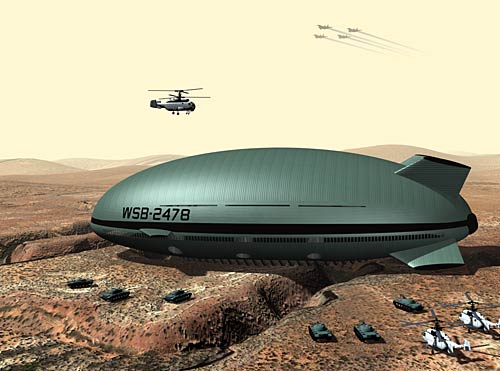
(click to view full)
DID’s in-depth article covering DARPA’s project for the 1-2 million pound (500-1,000 ton) WALRUS Hybrid Ultra-Large Aircraft (HULA) blimp-aircraft remains perennially popular. There’s something about a 1,000 foot long blimp-like aircraft that can lift a full battalion and ship them 8,000 miles in a week, without requiring landing strips or in-depth infrastructure, that appeals to the imagination. DARPA expects to pick a winning design in September 2006, and award a $100 million contract for a prototype airship. The LA Times reports that if WALRUS works out, the total contract could be worth up to $11 billion over 30 years.
Two firms won the $3 million preliminary design contracts: Lockheed’s fabled “Skunkworks,” producers of “impossible” aircraft like the U-2 Dragon Lady and SR-71 Blackbird – and a small California firm called Aeros made up of Russian emigres. A recent LA Times story profiles Worldwide Aeros, noting their confidence (“In reality we don’t feel Lockheed is our technical competitor… There is only one solution, and we have that one solution.”), quality of proposal (“seemed outstanding,” said one evaluator), revenues ($10 million expected this year from selling ad blimps), and company origins. CEO Igor Pasternak and colleagues began designing mammoth airships in Russia as a way to transport heavy cargo to Siberia’s remote oil fields, and future plans for their design also extend to “cruise ships in the sky.” They aren’t the only ones who can imagine extensive civilian spin-offs from this technology; of course, notes Pasternak, “it can totally change how you conduct warfare.”