

In 2005, the Canadian Department of National Defence awarded a 22-year, $1.77-billion (USD $1.5 billion) contract to an “Allied Wings” team lead by Kelowna Flightcraft Ltd. of Kelowna, British Columbia, who beat out a competing group led by Bombardier’s military training division in Mirabel, Quebec. The long-term contract will provide primary flight training training and support services to the Canadian Forces and international allies. These services will be provided out of the “Canada Wings Aviation Training Centre” in the Southport Aerospace Centre near Portage la Prairie, Manitoba.
This is not the first time the Canadian government has chosen a public/private approach to aviation training. Bombardier was already managing the Contracted Flying Training and Support (CFTS) program, and the public-private NATO Flying Training in Canada (NFTC) program has been running since 1997. In some ways, however, the new “Allied Wings” contract was a logical next step aimed at solidifying Canada’s traditional advantages, as Canada attempts to make itself an international center of excellence for foreign military aviator training:
* NATO Flying Training in Canada
* Primary Training: Competition for CFTS [updated]
* The Big Picture: International Flight Training in Canada [updated]
* Contracts & Key Events [NEW]
* Additional Readings & Sources [updated]
NATO Flying Training in Canada

Vectorsite describes the NFTC program:
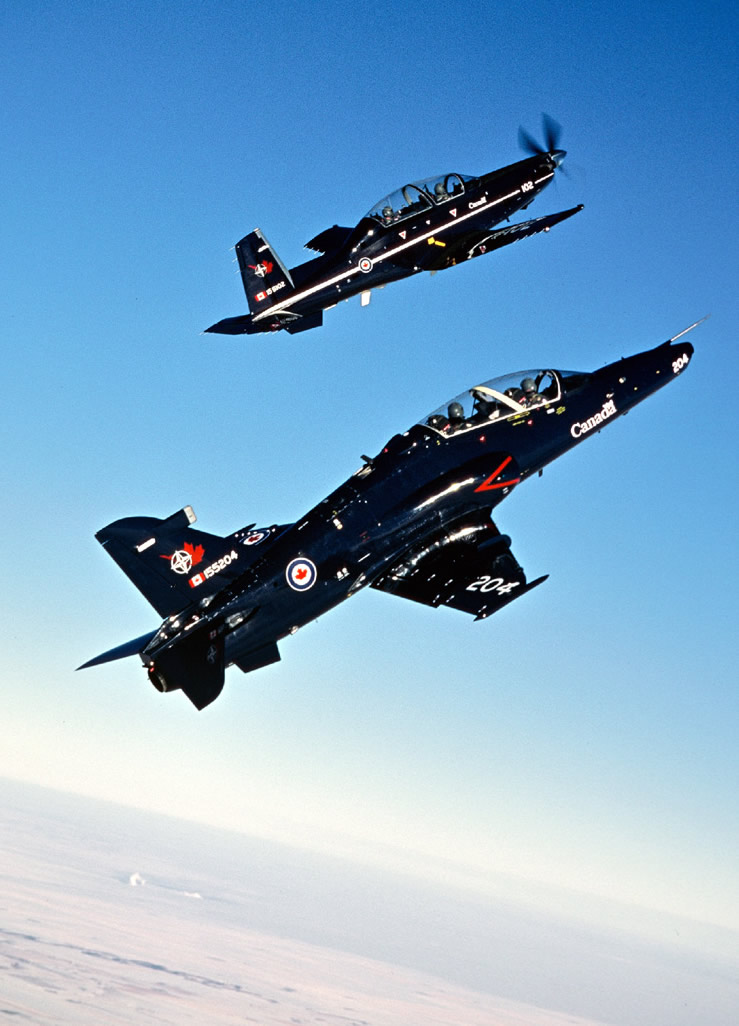
In a particularly intriguing deal, in 1997 the Hawk was selected for use in a Canadian “training for hire” scheme. The “NATO Flying Training in Canada (NFTC)” program is a joint venture of the Canadian government and Bombardier Aerospace Corporation, and offers its services to friendly governments on a contract basis. 18 “Hawk 115” trainers were initially ordered for NFTC, with an additional three trainers ordered in 2000 when Singapore signed up for the program. These Hawks are painted in a striking dark blue color scheme, with tail insignia consisting of a red Canadian maple leaf overlapped by a NATO four-pointed star. BAe has signed an extended contract to provide repair and overhaul support for these aircraft. NFTC will also operate 24 turboprop tandem seat Raytheon T-6A-1 Harvard II trainers for introductory flight instruction.
In other words, this is intermediate combat training and advanced jet training. NFTC training is run out of the airbases of 15 Wing Moose Jaw in Saskatchewan, and 4 Wing Cold Lake in Alberta.
Primary Training: Competition for CFTS
(click to view full)
Where NATO Flying Training in Canada handles more advanced training, the Contracted Flying Training System handles primary training for single-engine planes, multi-engine planes, and helicopters.
The winning Allied Wings consortium includes Kelowna Flightcraft Ltd., Canadian Helicopters Ltd., Canadian Base Operators, and ground-based training/simulator specialists Atlantis Systems International Inc. Their CFTS operation will provide primary training services, and is also be based on Canada’s wide-open prairies, in Portage La Prairie, Manitoba.
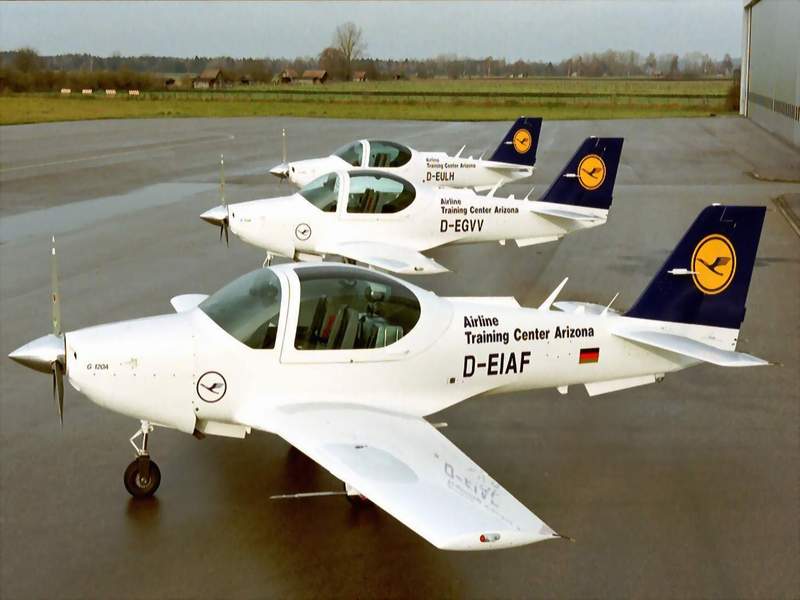
Under the terms of the Canada Wings Aviation Training Centre contract, Allied Wings will provide 9 Grob G120A aircraft for primary flying training, and 7 Raytheon (Beechcraft) King Air C-90Bs for multi-engine flying training. It will also convert 7 Bell 206 Jet Rangers and de-militarize 9 Bell 412 Griffon (Twin Huey) helicopters from the Canadian Forces inventory for helicopter flying training. Other items for which Allied Wings is responsible include new simulators, meteorological services, air traffic control, emergency response, airfield aviation services, and plane and simulator maintenance. Allied Wings itself will conduct primary training, but will provide only ground school instructors, courseware, flight services and the aircraft for multi-engine and rotary (helicopter) training. The Canadian Forces will supply flying instructors for those courses.
As Canadian Air Force Lt. Col. Randy Palmer put it to Training & Simulation Journal:
“The type of training will involve a lot more advanced training than we’ve been able to do in the past, particularly dealing with instrument flight training and crew resource management (and) working with larger, more complex aircraft.”
New capabilities will include simulators for multi-engine and helicopter instruction, as well as new hangars, fuel tank farms. It will also include a new 80,000-square-foot training complex, with three large full-flight simulator bays, classrooms, student lounges, a presentation hall and briefing rooms. The complex also will be wired for interactive training, as interactive learning aids, computer-based courses, and even distance learning are also very much a part of the new CFTS operation. The Portage La Prairie facility will offer 36 different courses, including primary flying training, multi-engine training, helicopter training, and refresher courses.
These changes will create a transitional period, but initial training was expected to begin early in 2006, with full operational capability expected in 2 years.
Allied Wings official Chris Lewis told Training & Simulation Journal that the center expects to instruct about 113 primary flying training students per year, about 40 multi-engine training students, and 60-75 rotary wing (helicopter) training students. The CFTS program will use only about 65% of its training capacity to provide instruction to Canadian pilots, however, and the Canadian government explicitly emphasized the importance of working together with its contract winner to market the program internationally.
Allied Wings Laurence Esterhuizen, a marketing official with Allied Wings, put it succinctly in his discussions with Training & Simulation Journal:
“DND’s thrust in all of this training is to market Canada as a center of excellence for flying training… NFTC is a major linchpin in that. But the missing ingredient was really a marketable primary multi-engine and helicopter training component. Obviously, now they will have that.”
The Big Picture: International Flight Training in Canada
training at Goose Bay
(click to view full)
Bombardier had lobbied hard for continuation of its CFTS primary training contract, even to the extent of submitting objections and requesting a new competition when it became clear that Allied Wings was likely to win. With the formal contract announcement, however, David Jurkowski, Bombardier Military Aviation Training’s VP of Government Relations and Business Development, told Training & Simulation Journal that Bombardier has no plans to challenge the contract award. The company laid off 30 employees, along with another 148 workers associated with subcontractors.
Bombardier is still in charge of NFTC jet training under the joint venture terms, however, and is in the process of providing its CF-18 advanced distributed combat training system to the Royal Canadian Air Force.
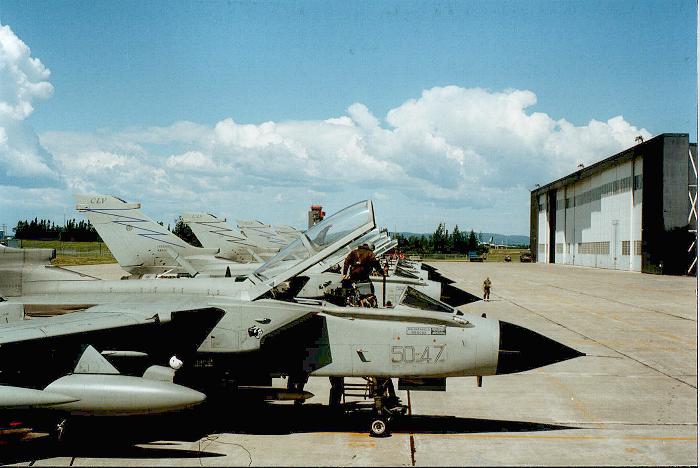
Nor is this all Canada has to offer. On Canada’s northeast coast, the Liberal Party also announced a pre-election promise in 2005 to spend $25 million on buying and installing electronic flight equipment at Canadian Forces Bay Goose Bay, which had been a key center for NATO low-level flight & electronic warfare training. Many of Canada’s NATO allies have scaled back training in light of shrinking military budgets, but it was hoped that recent price drops and a pledge of an additional $5 million to market the base abroad, and promised to keep foreign military training alive at CFB Goose Bay for at least 5 years after expiration of the NATO training agreement in March 2006.
Their Conservative Party opponents noted that the Liberal plan involved no commitment of Canadian forces, and proposed to station a 600-person rapid response battalion in Labrador, plus a squadron of unmanned surveillance aircraft, in order to augment these improvements at CFB Goose Bay. Whichever party wins, Goose Bay can be expected to remain among Canada’s available air training assets for at least the next five years [DID: The Conservatives won, and Goose Bay has].
Abundant space, in a vast country. A long history of providing foreign pilot training. A multicultural society. Advanced technology and training, including simulation strength (CAE remains headquartered in Canada). Canada has a lot going for it on this front, and may be putting all of the pieces of the puzzle together at last. The question is, how many other countries will be buying in the coming years?
Contracts & Key Events
(click to view full)
Feb 18/11: BAE Systems announces a GBP 8.3 billion (USD $13.5M, CAD $13.3M) contract from Bombardier to continue supporting NATO Flying Training in Canada’s CT-155/Hawk Mk.115 trainer jets. BAE Senior VP Training Solutions and Support Martin Rushton adds that NFTC’s Hawk fleet “has one of the highest aircraft flying hour totals in the Hawk trainer aircraft world… with the fleet exceeded 75,000 flying hours in the last ten years.”
Aug 12/08: Award for Professionalism – nice job, Dave. From DND:
“On 12 August 2008, Mr Dave Barney was the Air Traffic Controller (ATC) responsible for the inner runway at the Canada Wings Aviation Training Centre, 3 Canadian Forces Flying Training School in Southport Manitoba.
Although responsible for operations on the inner runway, Mr Barney observed a C90B King Air aircraft conducting a circling approach for a full stop landing on the outer runway. As the King Air turned inbound on an abbreviated final, approximately one mile away, he observed that the aircraft did not have its landing gear down. He quickly advised the outer runway controller and the aircraft was advised to “check the gear.” It should be noted that, unlike at military airports, Southport ATC does not normally make the “check the gear” call. The aircraft subsequently initiated an overshoot at approximately 300 feet while in descent.
Mr Barney is commended for his high level of situational awareness, rapid reaction and outstanding professional vigilance. His actions resolved a situation that possessed high potential for a serious accident to occur. His timely vigilance occurred during a stressful period of extended ATC operations in support of high intensity flying training operations.
Mr Barney demonstrated beyond doubt that his notable professional ethos makes him very deserving of this For Professionalism award.”
Dec 3/07: BAE Systems announces that the 22-plane Hawk fleet based at the NATO Flying Training in Canada has reached 50,000 flying hours in only 7 years, traiining over 330 students along the way. An NFTC Hawk also holds the record for the highest usage of an individual aircraft in one year at 653 hours.
Nov 18/05: The Canadian Dept. of National Defence announces the 22-year, $1.77-billion (then USD $1.5 billion) contract to an “Allied Wings” team lead by Kelowna Flightcraft Ltd. of Kelowna, British Columbia, who beat out a competing group led by Bombardier’s military training division in Mirabel, Quebec.
The long-term contract will provide flying training and support services to the Canadian Forces and international allies out of the “Canada Wings Aviation Training Centre” in the Southport Aerospace Centre near Portage la Prairie, Manitoba.
Additional Readings & Sources
* Canadian Dept. of National Defence – International Training Program – History
* Canada Wings Aviation Training Center. See also video presentation.
* NATO Flying Training in Canada (NFTC) Official Site. See also DND FAQ and sites for 15 Wing Moose Jaw and 4 Wing Cold Lake
* Bombardier – Military Training.
* Training & Simulation Journal (June/July 2005) – Consortium to modernize Canadian pilot training with advanced simulators
* Vectorsite – The Bae Hawk
* Canada DND – CT-155 Hawk
* Canada DND – CT-156 Harvard II
* Raytheon (Beechcraft) King Air C90B
* CBC (Nov 25/05) – Goose Bay Promises Not Enough: Tories