

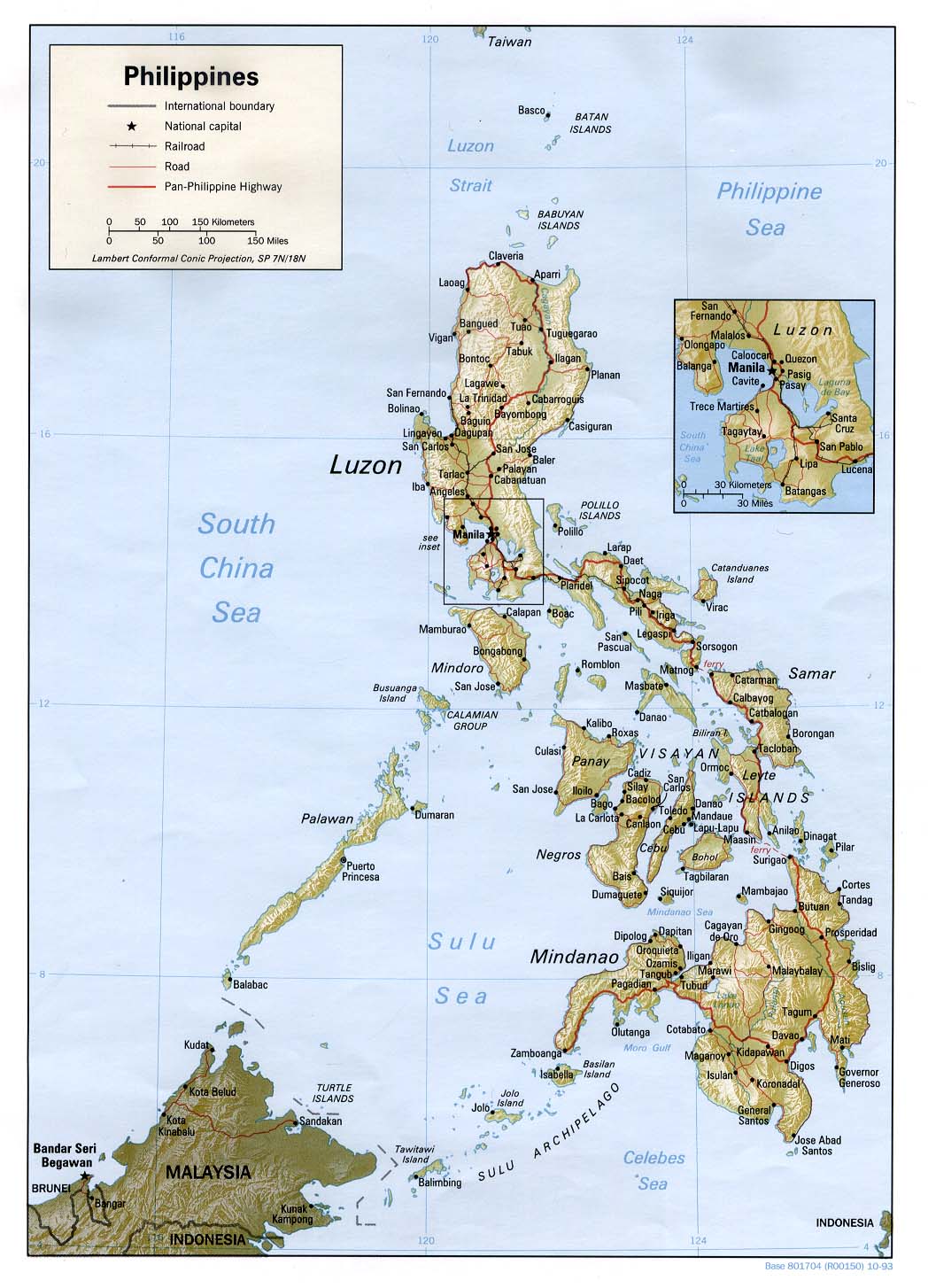
(click to view full)
On June 8/07, DID covered some construction support for US SOCOM’s operations in the Philippines, and pointed out that these kinds of contracts fit into a larger doctrine. They also fit into a larger set of efforts against an Islamist group known as Abu Sayyaf, which has been responsible for a number of terrorist acts in the Philippines, cooperates with other terrorist groups in the region like Jemaah Islamiyah, and was part of the 1995 effort to execute Operation Bojinka involving the assassination of the Pope during his visit to the country, the highjacking and destruction of 11-12 jumbo jets, and an attack on CIA Headquarters in Langley, VA by crashing a plane into it. Khalid Sheikh Mohammed never was the type to think small, as subsequent events would once again demonstrate.
The security situation in the Philippines has been serious at times, but the process of fighting this battle has involved a somewhat cooperative and functioning government – and hence a different approach to the conflict. In addition to SOCOM’s efforts, the US Embassy in Manilla’s details recent activities that include payouts of $10 million in rewards to Philippine citizens, the posting of additional reward offers, road-building in Cotabato on Mindanao, a joint US Navy/Philippine Navy operation to provide cataract surgery to locals in Zamboanga, et. al. Recent news includes a DSCA request for a large shipment of tactical radios, and delivery of 10 out of 20 modernized UH-1H Huey helicopters to the Philippines’ armed forces…
(click to view full)
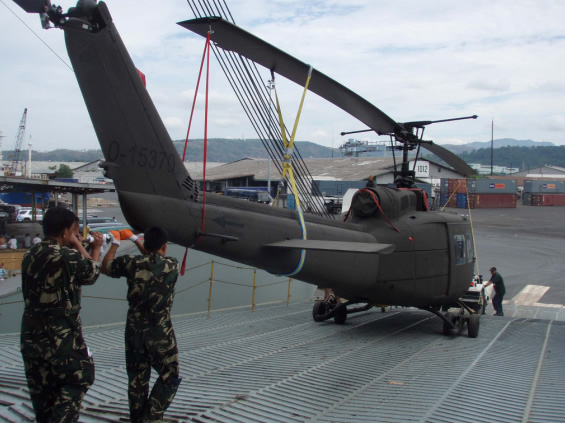
June 9/07: U.S. Ambassador Kristie A. Kenney will turn over to President Gloria Macapagal-Arroyo 10 UH-1H Huey helicopters, refurbished through the U.S. Foreign Military Financing program at $1.1 million per helicopter. The aircraft are part of 20 helicopters designated for the Philippines by President George Bush; 10 additional helicopters will be delivered later in 2007. They were refurbished in the United States through the U.S. Foreign Military Financing program at a cost of $22 million.
The intent is that these Hueys “will be used by the Philippine Air Force (PAF) to supplement its modernization program and will increase PAF’s capabilities to combat terrorism and provide humanitarian assistance during natural disasters.” As opposed to, say, VIP flights.
Upon the helicopters’ arrival in May at Subic Bay (pictured above), they were transferred to the Clark Economic Zone where PAF specialists conducted the routine maintenance and flight checks required for all aircraft, and painted the helicopters in the PAF color scheme. The ceremony was held at Villamor Air Base in Manila. US Embassy release.
(click to view larger)
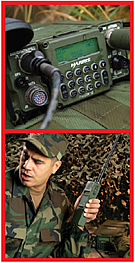
June 5/07: The US DSCA announces [PDF format] the Philippines request for Harris Corp’s High Frequency/Very High Frequency (VHF) radio systems, which include 6,356 Advanced Tactical VHF Handheld radio systems, 2,019 20-Watt High Frequency Man Pack radio systems, ancillary equipment, spare and repairs parts, support equipment, personnel training and training equipment, publications, U.S. Government and contractor engineering and logistics services and other related elements of program support. Harris’ popular Falcon II radios, in use by militaries around the world, include the RF-5800 series which are VHF-only products. The total value, if all options are exercised, could be as high as $96 million.
The prime contractor is Harris Corporation of Rochester, New York. There are no known offset agreements proposed in connection with this potential sale, and the number of U.S. Government personnel and contractor representatives required in-country to support the program will be determined in joint negotiations as the program proceeds through the development and equipment installation phases. DSCA adds:
“This proposed sale will assist the Philippines in fulfilling its strategic commitments to the U.S. by assisting its efforts to destabilize transnational terrorists’ strongholds within its borders; and by improving communications ability and internal command and control while operating in the country’s mountain ranges.”
Many of Abu Sayyaf’s strongholds and bases are in the Philippines’ mountainous areas, where forests and inhospitable terrain can make military action – and successful communication – difficult. These characteristics also make it easy to run illegal logging operations as a source of income for the group.