

(click to view larger)
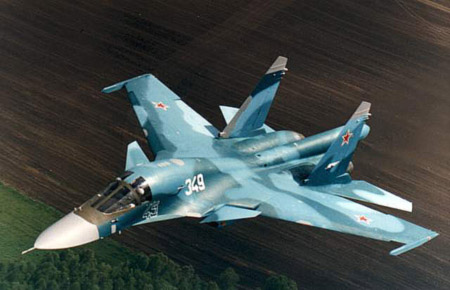
Sukhoi’s SU-27 Flanker fighter has become one of Russia’s great export successes. It’s also a design success. Its basic airframe applied lessons from all of America’s “teen series fighters,” producing a 4+ generation aircraft that remains the yardstick by which other fighters are measured. What’s even more impressive is that the base design has been so flexible, allowing further refinements and modifications that include SU-30 and SU-35 upgrades, versions that add canard foreplanes (SU-30MKA/I/M), and even carrier-launched capability (SU-33).
Then there’s the SU-32/34 “Fullback.” It was envisaged as a Flanker family successor to the F-111 analogue SU-24 “Fencer,” which was very highly regarded in Chechnya as a battlefield support aircraft. Its closest western comparison is the F-15E Strike Eagle, but the Russian design has evolved since its initial drafts in 1986.
Russia’s SU-34 Program
(click to view full)
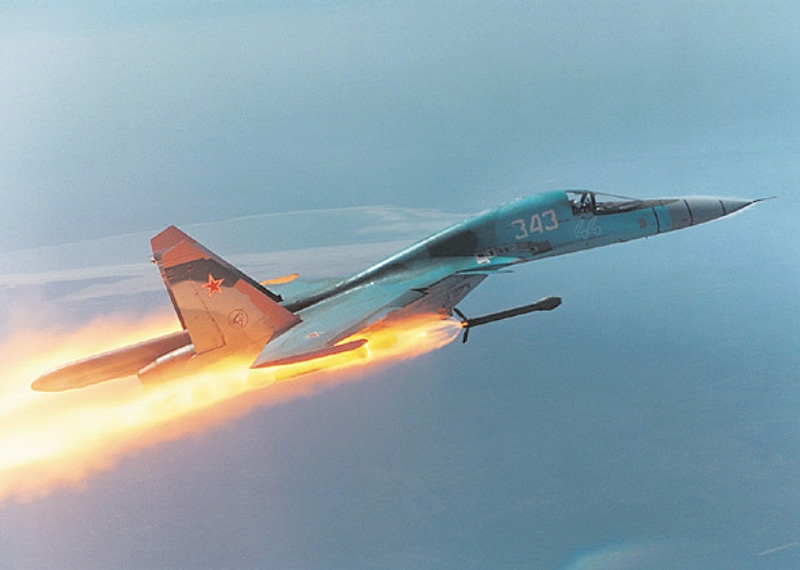
The collapse of Russia’s arms industry in the 1990s really hurt the SU-34’s development, but it has recovered. A development journey that began with the aircraft’s maiden flight in 1990, as the T10V/SU-27IB, ended in with 2010 deliveries and fielding under a 5-year production contract, followed by a 2012 full rate production order.
RIA Novosti put the plane’s mission simply: “The Su-34 is meant to deliver a sufficiently large ordnance load to a predetermined area, hit the target accurately and take evasive action against pursuing enemy planes.” Other reports have gone further, stating that the plane is also meant to be able to handle enemy fighters in aerial combat. Given its base platform characteristics, it would likely match up well in the air against many of America’s “teen series” aircraft.
In December 2006, Sukhoi announced a target of 18 SU-34s produced by 2010, and in March 2006, defense minister Sergei Ivanov placed the longer-term schedule at 58 aircraft purchased by 2015. Production has taken a bit longer than that, and that order for 18 ended up capped at 5, but Russia remains serious about the platform. Eventual demand levels of 120-200 aircraft have been floated, in order to replace Russia’s 300 existing SU-24s. More recent reports have featured numbers at the low end of this range, but orders have been placed for up to 138 (8 dev, 5 in 2006, 32 in 2008, 92 in 2012).
The determining factor for final SU-34 numbers is likely to be the SU-34’s priority amidst Russia’s rearmament program. So far, that program has been well-fueled by Russian hydrocarbon exports and Central Asian distribution hammerlocks, amidst a global scenario of rising hydrocarbon demand. Discoveries of shale oil and gas may upset those economic arrangements, and force the VVS to prioritize, but the SU-34 program’s critical power projection role and submitted orders ensure its future place.
To date, Russia remains the plane’s only customer. A jamming variant of the SU-32/34 has reportedly been discussed in the Indian and Russian trade press, using an L175V / KS418 high power jamming pod that’s supposedly under development. There are also reports of export interest from Vietnam, and the plane has been exhibited in China.
The SU-32MF/-34 “Fullback” fighter-bomber
(click to view full)
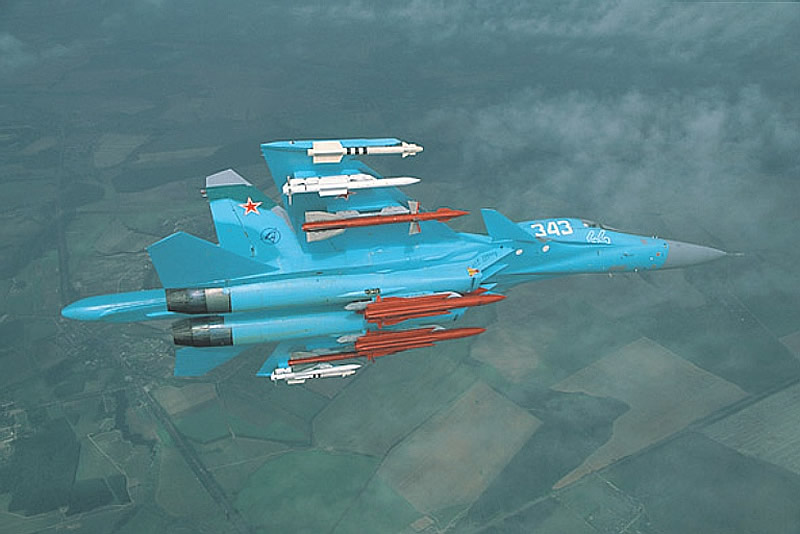
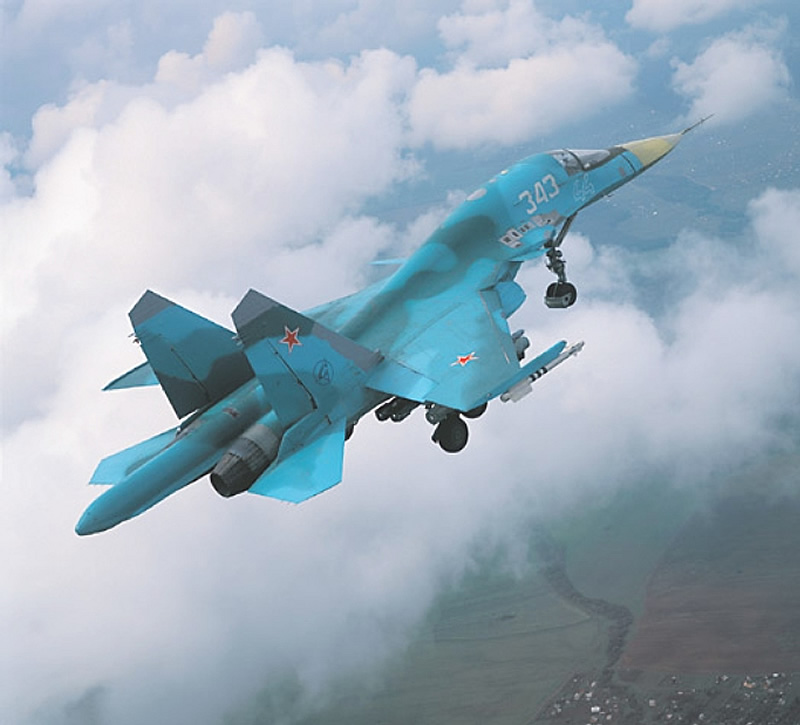
The SU-34 is also referred to as the “SU-32” by Sukhoi, and Sukhoi’s web site has long used the 2 designations interchangeably. Other sources use SU-32 to refer to a dedicated naval strike variant, but recent company references seem to be distinguishing SU-32s by reserving that designation for exports. DID will be using “SU-34” throughout, until and unless clear differences emerge. The SU-34’s key characteristics reportedly include:
* Side-by-side cockpit configuration of 2 K-36DM ejector seats, with a small aisle in between, and even a toilet of sorts for long missions. The ejector seats can be activated at any speed and altitude, even when the plane is on the ground.
* A 17mm armored cockpit, like the SU-25 Frogfoot ground-attack jet.
* 45.1 tonne maximum takeoff weight.
* 8 tonne ordnance load. Air Force Technology adds that this is distributed on 10 hardpoints, which can accommodate precision-guided weapons, as well as R-73/AA-11 Archer and R-77/AA-12 ‘AMRAAMSKI’ missiles. An internal 30mm GSh-301 gun with 180 rounds out its weapon array.
* AL-31FM1 turbofan engines built by the Moscow-based Salyut Company generate a thrust of up to 13.5 metric tons (over 29,000 pounds) and have a 1,000-hour service life in between repairs. Subsequent reports indicate that more powerful AL-41 engines may be fitted in future.
* Maximum speed stated as Mach 1.8 at altitude. Believed to be supersonic capable at sea level, but that’s often an academic statistic – most planes can’t sustain it without emptying their fuel tanks.
* 3,000 km range with standard drop tanks, extensible to “over 4,000 km” with the help of additional drop tanks. This makes deployment to locations like Tajikistan much easier, because intermediate airfields in Russia can easily be closed by bad weather. The SU-34 can also refuel in mid-air. Note, however, that typical “ground hugging” attack flight profiles will shorten their range considerably – Air Force Technology lists it as just 600 km on internal fuel, or 1,150 km with external fuel tanks.
* Can fly in TERCOM (Terrain Contour Matching) mode for low-level flight, and relies on software to execute a number of other difficult maneuvers. The front horizontal empennage behind the cockpit is designed to help it handle the air pockets found in high speed flight at low altitudes.
* Leninets B004 phased array multimode X-band radar, which interleaves terrain-following radar and other modes. The US B-1B’s stealth bomber’s AN/APQ-164 phased array radar uses a similar approach, and the Leninets radar’s performance is claimed to be of 200-250 km against large surface targets, with ground mapping capability to 75-150 km, and GMTI(Ground Moving Target Indicator) moving target tracking to 30 km. Detection performance against fighter sized aerial targets is claimed to be 90 km. Those are reasonable figures, but the AESA radars on modern American fighters will outclass it.
Other reports add additional details, and can be found in the “Additional Readings” section below.
Contracts & Key Events
2014-2017
(click to view full)
March 12/17: Russia will commence a modernization program for the Su-34 in 2018 after it was announced that 16 more of the fighter-bombers will be delivered to Russia’s air force later this year. Moscow also announced that they intend to swap out the Granit cruise missiles aboard the Project 949A Antey nuclear-powered cruise missile submarines with the latest Kalibr cruise missile. At present, Russia has eight operational Antey submarines with each possessing a displacement of 24,000 tonnes and armed with 24 Granit cruise missile launchers and six torpedo tubes.
August 18/16: If Russian media sources are to be believed, the Royal Moroccan Air Force could potentially be moving away from Western made aircraft in favor of the Su-34. Sources claim a deal between Rabat and Moscow is in the cards for a number of the bomber’s export versions as well as the Amur-class 1650 diesel electric submarine. Morocco has been undergoing modernization in all of its military branches, often with US help, in order to curb Islamist militants. However this latest deal may have more to do with its frosty neighbor Algeria, who has been buying Russian hardware for some time now.
August 17/16: Russia has used an air base in Iran to launch bombing missions in Syria for the first time. Tuesday saw the first Tu-22M3 and Su-34 aircraft leave Hamadan air base to attack anti-Assad militants in Aleppo, Idlib and Deir al Zour provinces. The move highlights not only a deepening of Moscow’s involvement in the Syrian Civil War, but also its growing defense ties with Iran, who also has their oar in the conflict by sending technical, military and financial expertise to president Assad as well as Shia militias in both Syria and Iraq.
August 3/16: Sukhoi Su-34 bombers are to be fitted with new radio surveillance gear that will allow them to spot and destroy enemy headquarters, communications and drone control centers. Dubbed UKR-RT, the system is a scaled-down version of the M-410 radio reconnaissance system that is installed in the Tu-214R. Many foreign military specialists regard the Tu-214R as a unique information gathering platform able to spot targets hundreds of kilometers away.
April 13/16: Talks have reportedly been started between the governments of Jordan and Russia over Jordan’s potential purchase of a small number of Su-32s. Interest in the export version of the Su-34 bomber as well as other Russian made military hardware has increased following Moscow’s military intervention in Syria. Until late, military and technical cooperation between the two have been fairly small, with contracts last year amounting to a refurbishment deal of two Il-76MF transport aircraft and the supply of components for the assembly of RPG-32 grenade launchers. However, a sale of any number of Su-32s would point to a potential reorientation from Jordan, who until now have happily been purchasing American weaponry with American money.
July 7/15: The Su-24 has become the latest Russian Air Force model to be grounded, with flights suspended following a deadly crash in the Eastern Khabarovsk region on Monday. This follows news that the MiG-29 fighter and Tu-95 heavy bomber fleets have also been grounded, also following recent crashes.
Oct 15/14: Delivery. Sukhoi’s Novosibirsk aviation plant hands another batch of Su-34 fighter-bombers to the Ministry of Defense. The aircraft plant is operating at full capacity, and is currently expected to do so until 2020. Sources: Sukhoi, “Sukhoi handed over a batch of Su-34 frontline bombers to the Ministry of Defense”.
June 10/14: Delivery. Sukhoi begins delivering planes from the full rate production order (q.v. March 1/12). These first 3 jets are reportedly headed to Baltimor military airdrome in Voronezh. Sources: Sukhoi, “New batch of Su-34 front-line bombers was transferred to the Russian Air Force” | IHS Jane’s Defense Weekly, “Russia begins receiving Su-34s from third production contract” | Air & Cosmos, “Sukhoi livre un premier lot de Su-34 de série à l’armée de l’air russe”.
2012-2013
Full SU-34 production order; Deliveries; User conference; Crashes ground legacy SU-24 fleet for a while.
(click to view full)
Dec 16/13: Sukhoi finishes delivering the 32 Su-34s ordered under Russia’s 2008 Low Rate Production contract, and holds an official ceremony to mark the occasion. The line will continue producing fighters under the 2012 Full Rate Production contract for 92 planes. Sources, Sukhoi, Dec 16/13 release.
LRIP order delivered
Oct 23/13: Delivery. Another delivery ceremony for SU-34s at the V.P. Chkalov Novosibirsk aircraft plant (NAZ). Sukhoi offers no meaningful details. Sources: Sukhoi Oct 23/13 release.
Oct 12/13: Delivery. A RIA Novosti report says that 29 SU-34s have been delivered to date, that the 2013 target of 14 fighters is on schedule, and that another 16 are slated for delivery in 2014. The official total for present orders is 124. That math works, if the 8 development aircraft and 2006 order for 18 are both excluded. Source: RIA Novosti, “Russian Air Force to Receive 30 New Fighter-Bombers by 2015”.
Aug 19/13: Sub-contractors. Sukhoi signs a sub-contract for 184 IFF transponders (RUB 1.5 billion/ $47 million) with the Ukrainian firm Radiopribor. Sources: RIA Novosti, “Sukhoi Signs $47M Transponder Deal for Su-34” | ZSE Radiopribor, via Ukroboronprom.
July 9/13: Delivery. Another 3 SU-34s are delivered to the VVS, and Sukhoi says that manufacturing is ramping up at the Novosibirsk aircraft plant. Source: Sukhoi release.
May 6/13: Delivery. Sukhoi has a handover ceremony for the 1st in “a batch” of Su-34s to be delivered in 2013 to the Russian Air Force under the State Defense Order for the year. The January 2013 deliveries would have corresponded to earlier orders. Sources: Sukhoi release.
April 2013: Conference. A conference is held at Vorozneh’s “Baltimore” air base about SU-34 operations, attended by the VVS’s 1st Air Force and Air Defense Command, combat units operating the Su-34, UAC and Sukhoi representatives, and top managers and representatives from the manufacturing supply chain.
Sukhoi says that the time period between failures on the ground and in the air met specifications. Even so, a protocol was signed at the end of the conference, providing for the adoption of specific measures to improve SU-34 performance, ergonomics, serviceability, reliability, and durability. Sources: Sukhoi May 6/13 release.
Jan 25/13: Delivery. Another 5 SU-34s are delivered to the Russian air force. They’ll join 5 planes that already fly from Voronezh, in southwest Russia. Sources: RIA Novosti, “Sukhoi Delivers 5 Su-34 Bombers to Russian Air Force” | Sukhoi release.
Nov 12/12: China. Sukhoi announces that it will present its Su-35S fighter, Superjet 100 short-haul airliner, and “Su-32 (Su-34 export version)” at Airshow China 2012 in Zhuhai.
China is still license-producing SU-type aircraft, and Sukhoi continues to supply spare parts for its aircraft in China. Having said that, China’s “indigenous” J-11 copies have been a bone of contention, and a Chinese offer to buy a small number of SU-33 naval fighters was rejected as a transparent ploy to repeat the same theft. China is currently developing its “J-15” naval fighter without help, and similar concerns can be expected to plague potential sales of SU-32 or SU-35 fighters. Sources: Sukhoi release.
Oct 25/12: VVS modernization. Russian Military Reform relays and translates a VPK article about Russian air force procurement plans. The article offers a figure of “129 Su-34 fighter-bombers to be delivered by 2020, with an option for at least another 18.”
Oct 26/12: Vietnam. Phun.vn cites a report from the mysterious site “Periscope 2,” wherein it’s suggested that Vietnam plans to replace its fleet of 50 or so aged SU-22 strike aircraft with SU-34s, and that export approval will be given immediately, once it’s requested. The report also suggests that Saab JAS-39 Gripens will replace the VPAF’s even older fleet of 150 or so MiG-21s, that L-159s may replace existing L-39 trainers alongside Vietnam’s reported Yak-130 options, and that Vietnam may be interested in C295-AEW planes. Read “Vietnam’s Russian Restocking” for a more detailed take.
March 1/12: 92 Ordered. Russia signs a follow-on contract with Sukhoi for 92 SU-34s for delivery by 2020, making this plane the production centerpiece of the VVS’ current rearmament effort. So far, Sukhoi holding’s Novosibirsk Aircraft Production Association (NAPO) has delivered 10 of the 2008 contract’s 32 SU-34s.
Depending on how one reads Russian releases and reports, this could bring the SU-34 order history to 150 (8 development + 18 in 2006-2010 + 32 in 2008 + 92 in 2012). Russia’s lack of transparency also raises the possibility that orders to date are just 100: 8 development planes plus a series of contracts that raised the base from 18 to 92. DID asked Sukhoi for clarification, but has received none.
The current contract was given a strong push by the recent series of SU-24 “Fencer” crashes, and by the swing-wing fighter’s costly, maintenance intensive upkeep. As Sukhoi puts it: “Implementation of the program will allow soon largely replacing Su-24 front bombers currently in service.” Sources: Sukhoi release | Interfax, “Sukhoi to sell 92 Su-34 frontline bombers to Russian Air Force – Defense Ministry” | RIA Novosti, “Russian Defense Ministry to Buy 92 Su-34 Fighters”.
Russia: 92
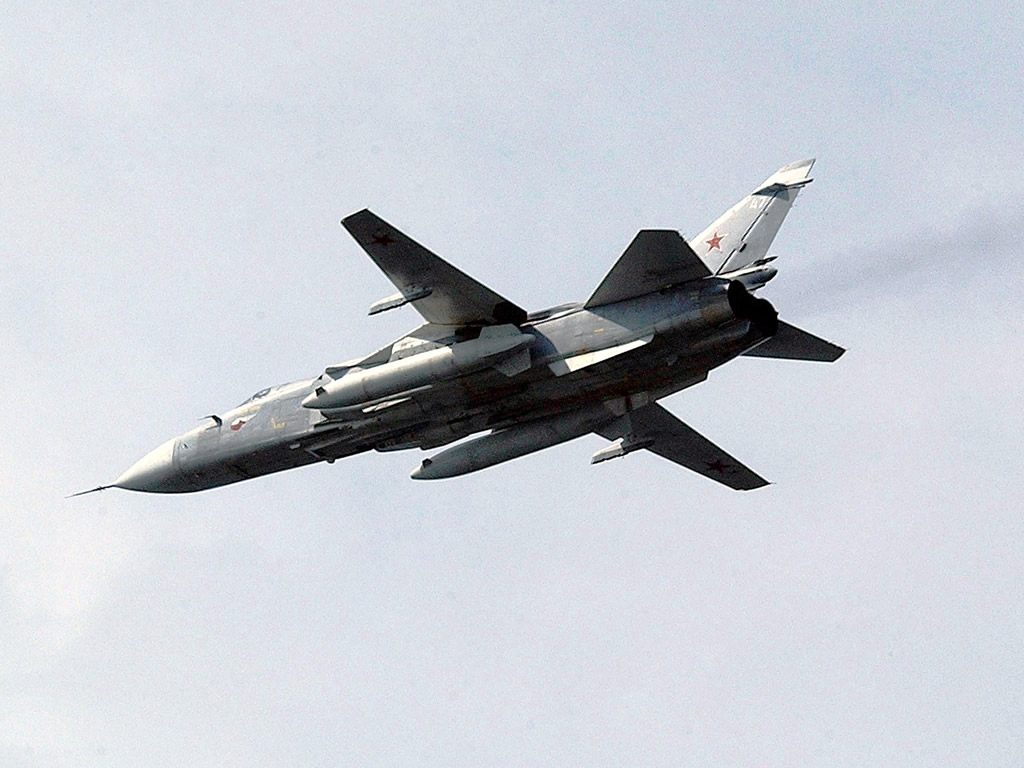
Feb 28/12: SU-24s. Russia has partially resumed SU-24 flights, following the Urals crash. CIHAN.
Feb 14/12: SU-24 Fencer flights suspended. Russia suspends all SU-24 flights indefinitely, after a SU-24 crashes in the woods of the Urals’ Kurgan region during a routine flight. Both pilots ejected safely. The Feb 13/12 crash is the 3rd SU-24 crash in the last 4 months, and a full investigation is underway to establish the cause. Sources: RIA Novosti, “Russia Grounds Su-24 Bomber Fleet after Urals Crash”.
Fencer crash, fleet grounded
2010 – 2011
SU-34 deliveries behind, but continuing; Long-range flight tests; SU-24 crashes become a problem.
(click to view full)
Dec 29/12: SU-24 Fencer crash. An Su-24 crashes as it attempts to land at the Marinovka air base in the Volgograd region, south of Moscow. The aircraft was on a routine training mission, and both pilots ejected and survived. The plane, on the other hand, catches fire and burns.
Each crash adds to the urgency of the SU-34 program. Sources: AP, “Russian military jet crashes, both crew survive”.
Fencer crash
Dec 12/11: 2 delivered. Sukhoi announces that the Russian SU-34 fleet continues to grow. They’re behind the original production plans, but:
“…four serial [production] Su-34 frontline bombers went up in the sky from the runway airport of the Novosibirsk Aircraft Production Association (NAPO) and off to the place of their deployment at the air base in Voronezh. Two more aircraft will arrive there in the next few days. The aircraft delivery is carried out in the framework of the five-year state contract signed in 2008 to supply 32 Su-34 frontline bombers to the Russian Defense Ministry.”
Oct 20/11: SU-24 Fencer crash. An Su-24 crashes at the Ukrainka military airfield in Russia’s Far East Amur region. It was flying in from the Central Russian city of Voronezh for planned maintenance work, but reportedly ran off the landing strip and caught fire after the landing gear collapsed. Sources: RIA Novosti, “Two killed in Su-24 fighter-bomber crash in Russia’s Far East”.
Fencer Crash
Sept 19/11: Russian media report that Russian Commander of the Air Forces Colonel General Aleksandr Zelin has given then go-ahead for SU-34 mass production, following successful tests. Russia Today:
“Earlier, General Zelin said the Air Forces planned to buy a total of 120 Su-34s, which will be formed into five squadrons with 24 aircraft deployed in each one. The aircraft are to be produced by the Novosibirsk branch of the Sukhoi Corporation.”
Full-rate production
Dec 28/10: 4 delivered. The Russian Air Force receives 4 new Su-34 fighter-bombers at the VVS’s Lipetsk Combat Training Center. Sources: Sukhoi release.
July 20/10: Testing. A Sukhoi release confirms that Su-34s used in the East-2010 military exercises used aerial refueling on their non-stop flight from the European part of Russia to the Far East, but makes it clear that this was more than just a ferry flight. The fighter-bombers carried out attacks as part of their routine. Sukhoi Director General Mikhail Pogosyan added that “…it is planned to increase the operational capability of the aircraft by adding new aerial munitions.”
June 23/10: Testing. RIA Novosti reports that a wing of SU-34s successfully accomplished a non-stop 6,000 km ferry flight from Lipetsk south of Moscow, to the Khabarovsk region in the Russian Far East. Even with a full load of wing tanks on a one-way trip, that’s a huge step up from the turbojet-powered SU-24M Fencer/ “Chemodahn*”, whose ferry range with wing tanks is listed as 3,055 Km.
The SU-34’s initial reports suggested a 4,000 km range with full drop tanks, which would match the F-15E Strike Eagle’s published ferry range. A 6,000 km ferry range is so far beyond that goal, and beyond similar aircraft, to make one wonder if aerial refueling was involved. That would still make it a non-stop trip, of course, and hence a “true” (but incomplete) report.
March 16/10: VVS Modernization. In “The future of the Russian Air Force: 10 years on“, RIA Novosti military commentator Ilya Kramnik discusses planned buys and pending recapitalization of the Russian Air Force over the next decade:
“According to various media reports, the Ministry wants to buy at least 1,500 aircraft, including 350 new warplanes, by 2020. The fleet would include 70% new equipment at that point, said Air Force Commander-in-Chief Colonel General Alexander Zelin… The Defense Ministry has now signed contracts for the purchase of 32 Su-34 Fullback advanced fighter-bombers to be delivered by 2013, 48 Su-35 Flanker-E fighters by 2015, 12 Su-27SM Flanker-B Mod. 1 fighters by 2011, 4 Su-30M2 Flanker-C planes by 2011 and 12 Su-25UBM Frogfoot combat trainers. This year, the Defense Ministry intends to sign a contract for the delivery of 26 MiG-29K Fulcrum-D fighters by 2015. Additional contracts for the delivery of at least 80 Su-34s and 24-48 Su-35s are expected to be signed. In all, the Russian Air Force is to receive 240-260 new aircraft of these types. It is hard to say much about the specifications of another 100-110 aircraft, due to be manufactured primarily after 2015. They will probably include 25-30 MiG-35 fighters, another 12-16 Su-30 combat trainers for Su-35 squadrons and 40-60 Sukhoi T-50 PAK FA (Advanced Frontline Aviation Aircraft System) fifth-generation fighters…”
2008 – 2009
Full production starts; Contract for 32 more SU-34s; Last SU-24M4 upgrade delivered; Broader VVS procurement plans.
(click to view full)
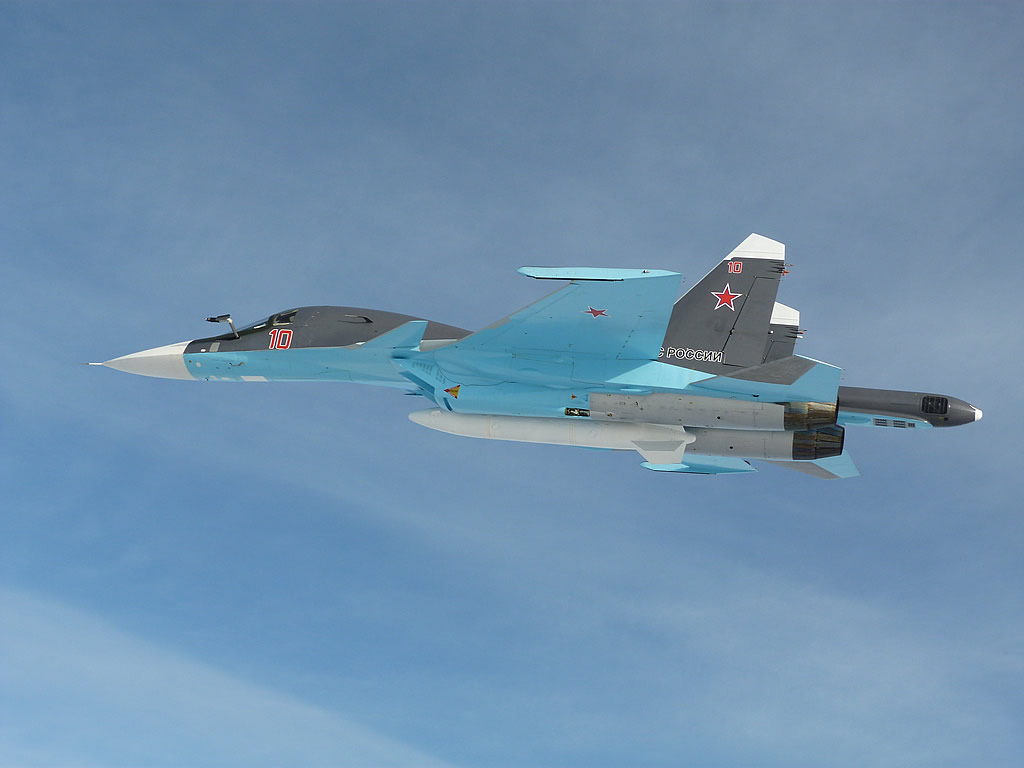
Dec 21/09: 2 delivered. The V.P.Chkalov Novosibirsk Aircraft Production Association (NAPO) officially delivers 2 Su-34s produced under the framework of the new manufacturing contract to the Russian Air Force. The planes have already arrived to the Russian AF Lipetsk Center for Combat Use and Flight Training.
In accordance with the 5-year state contract with the Ministry of Defense signed in 2008, NAPO will produce 32 Su-34 fighter-bombers till 2013. Sources: Sukhoi release.
Dec 10/09: SU-24. NAPO hands over the final batch of modernized Su-24M2 “Fencer” aircraft to the Russian Air Force, fulfilling its obligations under 3-year state contract, and shifting focus toward SU-34 production. Sukhoi release.
June 5/09: 32 more 34s. Jane’s Defense Review reports that Russia has placed a 5-year contract for SU-34 fighter/bombers. Subsequent quotes by Prime Minister Vladimir Putin place the contract at 32 jets for about RUB 40 billion (about $1.3 billion).
Subsequent Sukhoi releases place the contract date in 2008.
Low-rate production contract: 32
April 24/08: VVS modernization. Moscow News Weekly carries an analysis of the SU-34 and its acquisition plans by Ilya Kramnik of RIA Novosti:
“The Su-34 will replace the Su-24M aircraft (about 400 planes), the Su-24MR surveillance aircraft (over 100 planes), and the MiG-25RB aircraft (about 70). Russia will have to produce between 550 and 600 Su-34s to replace these obsolete aircraft within 10-15 years. However, the Defense Ministry plans to buy only about 58 [SU-34s] by 2015, and a total of 300 by 2022.
Many experts say that if the Su-24 and MiG-25RB aircraft are scrapped by 2020, Russia will be left without fighter-bombers and surveillance aircraft. Others argue that this number will be enough for the Air Force’s new concept.
The concept is focused not so much on the combat characteristics of the Su-34, as on its long range, the ability to refuel in the air (including by other Su-34 aircraft with additional fuel tanks under their wings), and its comfortable cabin… Units armed with such aircraft can be used in the so-called pendulum operations, when an Air Force unit bombs a terrorist base in Central Asia today, delivers a strike at a missile base in Europe the next day, and three days later flies to the Indian Ocean to support a combined group of the Northern, Pacific and Black Sea fleets, with flights from a base in Russia.
…This is not a new concept. Elite units of top-class aircraft manned by superbly trained crews formed the core of the German air force during World War II, and Japan’s Imperial Navy had a similar concept. However, such elite units can be quickly weeded out by swarms of ordinary aircraft in a global war of attrition, such as World War II. From this viewpoint, Russia’s new concept looks vulnerable, but then this country has the nuclear triad for a global war.”
Jan 9/08: Industrial. Sukhoi announces that Russia has started “full-scale production” of the Su-34 Fullback fighter bomber, and a company spokesman said that up to 20 fighters could now be assembled simultaneously at the Novosibirsk Aviation Production Association (NAPO). He did not specify how many would be built each year, and it’s likely that the announcement really means that the industrial infrastructure is ready.
This RIA Novosti report places the price of the plane at $36 million, but real clarity on that front is unlikely until the aircraft wins an export competition. RIA Novosti report | Kommersant report.
2005 – 2007
Contract for 18 SU-34s; Initial deliveries; Phase 2 tests; Don’t drink & courier – it delays the program.
(click to view full)
Dec 25/07: SU-24. Merry Christmas from NAPO. RIA Novosti reports that the firm has completed the delivery of 4 upgraded swing-wing Su-24M2 Fencer tactical bombers from the Chkalov plant in Novosibirsk to an Air Force regiment based in Russia’s Far East. Another 6 Su-24s are currently being modernized at the same plant, and another 2 modernized aircraft were deployed earlier in December with the Lipetsk pilot combat training center in central Russia.
The Su-24M2 is adds an improved cockpit with multi-function displays, helmet-mounted sights, a new SVP-24 mission computer, and new software that improves navigational accuracy and unguided weapon delivery. The SU-34 is still the VVS’ desired successor, but the pace and success of these modernizations may affect SU-34 Fullback deployment plans, and urgency. Sources: RIA Novosti, “Russian Air Force receives 4 modernized tactical bombers”
Dec 18/07: RIA Sibir relays a notice that NAPO will obtain 43 high-performance processing centers for EUR 50 million, in order to help modernize aircraft production.
NAPO makes Su-34 fighter-bombers, overhauls and upgrades Su-24M fighter-bombers, carries out preparations for the manufacture of Russian regional aircraft Sukhoi Superjet-100, and “participates in the program of Sukhoi Holding on the development of a 5th generation fighter.” Source: RIA Sibir.
Dec 27/06: Production update. A Sukhoi release adds clarity to the SU-34’s production schedule:
“The Sukhoi Aircraft Holding Company, in conjunction with the Russian Air Force, has started the second phase of the official tests of the Su-34 attack aircraft.
The three-year phase will include tests of the aircraft armed with new kinds of armament that the domestic defense industry is offering to further enhance the capabilities of the new aircraft. The first phase of the official tests was successfully completed in October [2006]. As a result Sukhoi has received go ahead to launch series production of the Su-34s at the Novosibirsk Aircraft Production Association (NAPO) and start deliveries of the new aircraft to the Air Force.
The first Su-34s have been handed over to the Russian Air Force this month [December 2006]. By 2010, under a three-year government contract, will build and supply the Russian Air Force with 18 Su-34s. Later, plans to manufacture 8 to 10 Su-34 aircraft a year.”
Subsequent events derail this contract, ending production at 5 planes. Sources: Sukhoi, “Second phase of the Su-34’s official tests has started” | Air & Cosmos, “Sukhoi livre un premier lot de Su-34 de serie a l’armee de l’air russe”.
Russia: 18 (5 produced)
Oct 10/06: Pravda’s tabloid version Fun Reports runs an amusing story that explains a multi-month delay to the program. The saga reportedly began when the Ulianovskoe Designing Bureau of Device Construction received an order from Novosibirsk aviation workers, who needed a control assembly part. The part took 3 months to make, and 2 designers were supposed to deliver the EUR 30,000 shipment to Novosibirsk, in Siberia.
When his colleague fell ill, Pavel Pahomov was sent on the train from Volgograd [DID: once named “Stalingrad”] to Ulan-Ude all alone, with an ordinary looking cardboard box designed to hide the contents. Unfortunately, Pahomov accepted drinks from his comrades on the train. After a missed train in Ufa, a high-speed taxi ride, and more than 24 celebratory hours, he returned to his seat and found the box missing. Pavel called the Russian Federal Security service, and claimed he had been set up American spies. It turned out that a train stewardess decided to clean up, and threw the box of “refuse” (with a false bottom) in the furnace. Yuriy Butov, the director’s assistant for supplying Chkalov’s Aviation Factory in Novosibirsk :
“Without this part the bombardment aircraft SU-34’s serial production cannot be launched. And we have a pending order for 24 planes. That is one billion Euros! Now the Designing Bureau is desperately trying to construct the part but they need another two months to complete it. We are facing serious financial losses.”
Pavel Pahomov’s visit to Siberia may wind up being a bit longer than he had intended. Sources: Pravda, “Russian engineer guzzles away secret Su-34 part”
Don’t Drink & Courier!
Sept 1/06: RIA Novosti reports that Army General Vladimir Mikhailov, commander of the Russian Air Force, has said that they would receive the first batch of Sukhoi Su-34 Fullback fighter-bombers by late 2006. Sources: RIA Novosti, “Russian Air Force to receive unique bomber soon”
1986 – 2004
From program start to the initial development batch. Hey, what’s 18 years between friends?
(click to view larger)
2004: Dev batch. Chkalov Aircraft Production Association in Novosibirsk, which produces the planes, had produced a development batch of 8 Su-32 aeroplanes. Source.
Development batch produced
June 2003: The plane successfully completes the first stage of Russian government testing. Source
1997: Sidelined. GlobalSecurity: “The [SU-34’s] development was decelerated [for Sukhoi] to concentrate itself in the development of the Indian Su-30 and the Su-27 acquired by China.”
June 1995: The aircraft is renamed the Su-32 according to Sukhoi, and the aeroplane is shown abroad at the 1995 Le Bourget air show in Paris. Eventually, even Sukhoi will start referring to it as the “SU-34” again. Source
Dec 18/93: The first pre-production T-10V is built and makes its first flight, piloted by the design bureau’s test pilots I.V. Votintsev and Ye.G. Revunov. [Source] This plane reportedly adopts “the Su-35 wing with additional stations, enlarged internal fuel tanks, enlarged spine and lengthened tail stinger, the production reinforced centre section design, and the representative production configuration of the tandem dual wheel main undercarriage” [Source].
April 13/90: The T10V-1’s test aircraft’s first flight is performed by the design bureau’s test pilot A.A. Ivanov. Source
1st flight
1989-90: The first prototype T10V-1 is built on the platform of the production Su-27UB. Source
May 1988: CDR. the plane’s conceptual design is presented for critical design review. In addition to the conventional Su-27UB-style cockpit configuration, with the pilots seated one behind the other, an alternative option of a “side by side” pilot-seating arrangement is discussed – and later adopted. The cockpit overhead space created behind the side-by-side seats allows the pilot to stand up, with the crew boarding the plane using an inbuilt ladder through the bay in the nosewheel landing gear unit and the service hatch in the back wall of the cockpit. Source
June 19/86: Work to produce a two-seat fighter-bomber version of the SU-27 officially begins, initiated by a decree of the government. The Sukhoi Design Bureau assigns the new plane the manufacturer’s designation T-10V. Source
Additional Readings
For the curious, the Russian TV show video features SU-24M2s, MiG-29SMTs, SU-27 family, and the SU-34 as the prime focus. The refueling aircraft for that aerial sequence is an IL-78.
* Sukhoi – SU-32. The firm has also referred to the aircraft as “Su-34” in its releases.
* Sukhoi – Su-32 Historical background
* Air Force Technology – Su-34 (Su 27IB) Flanker Fighter Bomber Aircraft, Russia
* Australian Air Power – Sukhoi Su-32/Su-34 Fullback: Russia’s New Heavy Strike Fighter “In comparing the basic Su-32/34 airframe against Western types, the design with 12.1 tonnes (26.7 klb) of internal fuel sits in between the Boeing F-15E and F-111 in combat radius and weapon payload capabilities. It will provide at lower gross weights lower agility than the F-15E, but higher agility than the F-111. Its top end supersonic performance is inferior to both US types…”
* GlobalSecurity – Su-34 (Su-27IB)
* Air Force Technology – Su-24M Fencer Front-Line Bomber, Russia. The SU-24’s swing-wing predecessor, which has some similarities to the American F-111. Also called “Chemodahn” by Russian crews. The word means “suitcase,” and refers to the aircraft’s boxy shape and slab sides.
Broader Context
* DID – Russia’s Military Spending Jumping – But Can Its Industry? Restarting an entire defense industry is hard.
* Russian Military Reform, via WayBack (Oct 25/12) – Russian air force procurement plans. Gives a figure of “129 Su-34 fighter-bombers to be delivered by 2020, with an option for at least another 18.”
* RIA Novosti, via WayBack (Jan 9/07) – Russian defense industry still faces problems. Points out, inter alia, that: “The management of the Novosibirsk Aircraft Plant had promised to supply six, rather than two, Su-34 bombers in late 2006.” Other items in the report are also highly relevant to the larger rearmament picture, including production difficulties, paper factories, and insolvency levels within the industry.