

(click to view full)
Britain’s practice of “contracting for availability” for key equipment, rather than paying for spare parts and maintenance hours, may be its most significant defense procurement reform. In a world where older air, sea, and ground vehicle fleets are growing maintenance demands beyond countries’ available budgets, it’s an approach whose success could have global significance.
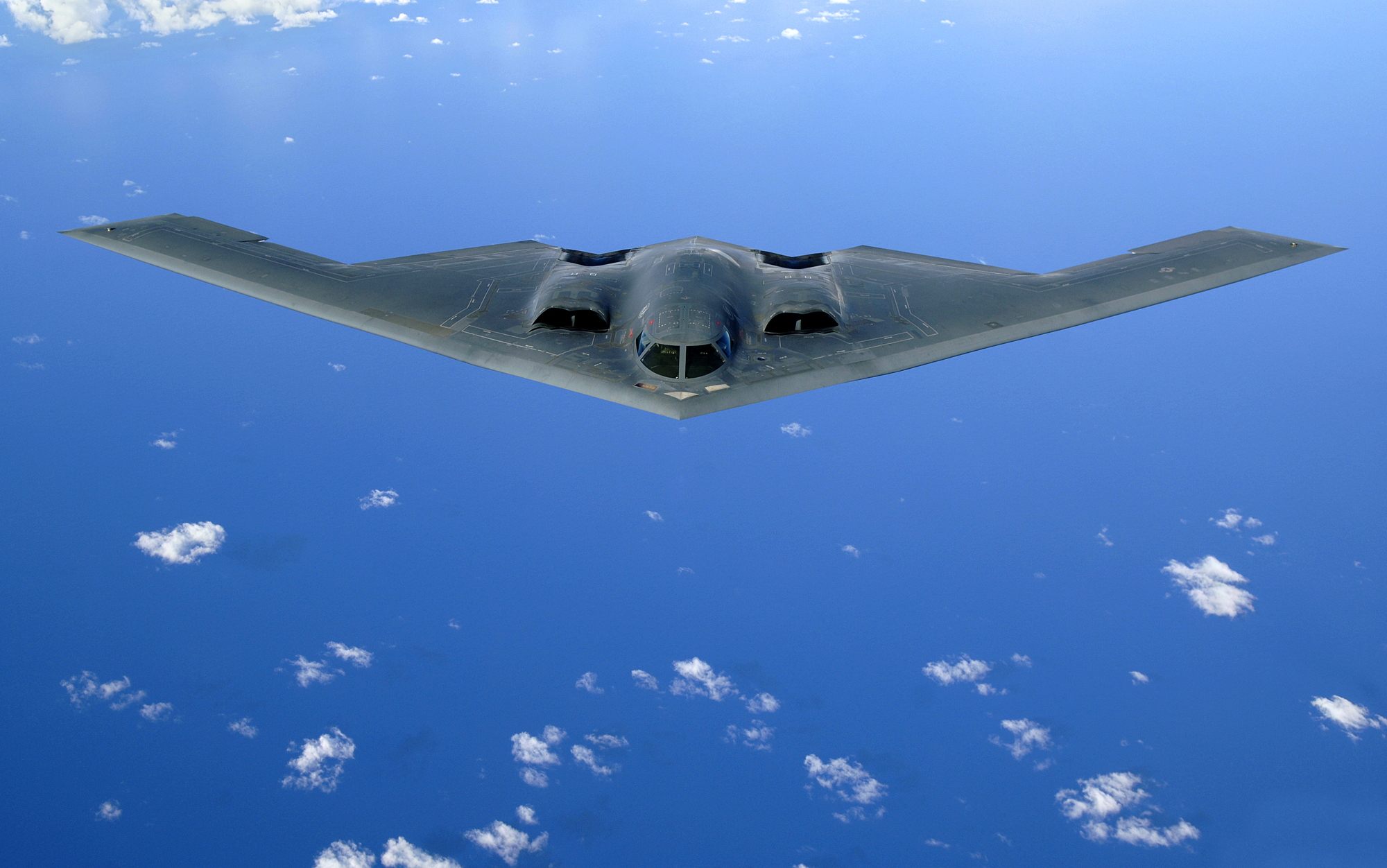
Across the pond, the USA is significantly behind in this area. Fortunately, they have not ignored the model entirely. Recent changes to the contracts covering their B-2 Spirit stealth bomber fleet demonstrate that some progress is being made, via a $9+ billion commitment from 1999-2014, and 2 parallel development programs that are changing key sub-systems.
FAST, Revised

(click to view full)
In the UK the approach of starting at a smaller level, then expanding the scope once performance is proven and trust built, has become standard procedure. That pattern appears to be the case here as well. In January 2007, the U.S. Air Force’s Oklahoma City Air Logistics Center and Northrop Grumman came to a 1-year, $200 million agreement that changed the B-2A’s 1999 FAST maintenance contract.
Under the revised terms, original aircraft manufacturer Northrop Grumman will provide maintenance and sustainment support for the nation’s fleet of 21 B-2 stealth bombers via 3 delivery orders: Contract Depot Maintenance (CDM), Consolidated Delivery Order (CDO), and Integrated Contractor Support (ICS). What’s different is that under the new “contracting for availability” performance-based logistics approach, Northrop Grumman will be measured by its ability to meet specified combat readiness requirements for the B-2 fleet, rather than being given money for specific tasks, spare parts, or maintenance on a specified schedule. All of that now becomes the contractor’s responsibility.
The specified readiness rate was not published, but it may represent a challenge for the contractor. Introduced from 1993-2000, America’s B-2 fleet has historically had availability rates below 50% for a number of reasons. In practice, what this meant was that even with moderate usage, an average of only 6-10 stealth bombers were actually available for missions at any given time.
As was the case with Britain’s Tornados, the effort to change the B-2 bomber’s maintenance framework is happening slowly. In 2002, the Total Systems Support Partnership (TSSP) was inaugurated between Northrop Grumman and the USAF; Air Force personnel worked closely with Northrop Grumman, in order to simplify the processes used to identify and deliver consumable spare parts to the B-2 fleet, resulting in improved combat readiness at a reduced cost. The USAF’s Materials and Manufacturing Directorate also played an important role.
The success of the TSSP program led to the B-2 program’s selection as part of a 2005 PBL pilot program conducted in 2005, and the new 1-year contract indicated a cautious but growing sense of trust and understanding between Northrop Grumman and the Air force in this area.

(click to view full)
Countries like Britain have made these availability-based contracts long-term or even “through-life-of-platform” affairs, in order to remove any incentives to skimp on work (like upgrades) whose benefits or problems may not show up for several years. The B-2 program is not there yet; it is still part of a learning curve and set of test programs designed to help the American DoD understand and successfully apply this new contracting approach.
The B-2A stealth bomber may prove to be a good choice for this purpose. Britain’s experience indicates that combining maintenance and upgrades within an availability-based framework offers significant benefits, and the USAF certainly has plans to upgrade its B-2 fleet over the coming years. Like the Tornados, the B-2’s readiness record to date also shows room for improvement.
As such, the 2007 contract’s 1-year duration made the B-2 maintenance and sustainment contract an excellent bellwether for the success and adoption of availability-based contracting within the US military. So far, continuation and extension have been the rule.
The pressures driving such reform attempts certainly aren’t going away. Gary Roehrig, director of Performance-Based-Logistics for Northrop Grumman’s B-2 program, cited the fact that Air Force operations and maintenance budgets are continually under pressure as one of the factors influencing the new approach. This was certainly the case in Britain as well, where reformers like Nigel Bairsto found that they only had enough budget to keep half the Tornado interceptor/strike fleet flying under conventional maintenance contracting approaches. Under the new ATTAC framework, that’s no longer a problem. Better yet, the monies are locked in to future budgets as a fixed contractual expenditure, rather than a discretionary item.
One suspects that kind of arrangement suits the US Air force just fine.
Affiliated Efforts: RMP & EHF

(click to view full)
While FAST handles maintenance and upgrades for the fleet, there are also associated sub-programs to produce those upgrades. The 2 programs deserving of special note are the B-2 Radar Modernization Program, and the B-2 Extremely High Frequency (EHF) Satellite Communications program.
The RMP cost about $1 billion, and was triggered by a negligent Federal Communications Commission decision to auction off the slice of spectrum used by the bomber’s previous radar. As the Pentagon’s testers put it [PDF]:
“The B-2 RMP features an Active Electronically Scanned Array [AESA] radar operating on a new frequency. The RMP replaces the B-2 legacy radar antenna and transmitter and changes radar operating frequency to avoid conflicts with other radio frequency spectrum users. The RMP does not add additional capabilities to the B-2 radar beyond those in the legacy system. Mode Set 1 consists of conventional mission and weapons delivery capabilities. Mode Set 2 incorporates nuclear mission capabilities and enables the B-2 to conduct both nuclear and conventional missions in a GPS-degraded/ denied environment.”
The RMP program finished in 2012.

(click to view full)
The B-2 EHF SATCOM program, in contrast, is about a significant capability upgrade. The goal is 100x improvements in satellite communications bandwidth, used by the stealth bomber to send and receive data securely. Of course, achieving that boost requires more than just aircraft upgrades. Northrop Grumman confirmed to DID that the new antenna will work with the new AEHF hardened broadband satellites, each of which offers 10-12 times the capacity and 6 times the data rate transfer speed of current Milstar II satellites. The program is proceeding in 3 phases. Like the B-2 RMP, system development is conducted in parallel, but installation falls under B-2 FAST.
Increment 1 didn’t actually change data speeds, just put the high speed data handling infrastructure in place. The first “kit” of EHF Increment 1 hardware included:
* A new integrated processing unit (IPU) developed by Lockheed Martin Systems Integration in Owego, NY. It will replace up to 12 stand-alone avionics computers;
* A new disk drive unit developed by Honeywell Defense and Space Electronic Systems in Plymouth, MN for transfer of EHF data onto and off of the B-2;
* A network of fiber optic cable that will support the high speed data transfers within the aircraft;
* New software was developed, integrated and tested by Northrop Grumman employees working at the Air Force’s Weapon Systems Support Center in Tinker AFB, OK.
B-2 EHF Increment 2 will install a new communications terminal, and the AESA antenna. This will offer AEHF satellite compatibility, creating a significant boost to maximum bandwidth.
Increment 3 will fully integrate the B-2 into the U.S. Department of Defense’s Global Information Grid network and its associated applications, so it can take full advantage of its new capacity.
Contracts and Key Events
2020 – Today
February 3/25: Moog Military Aircraft won a $13 million contract for B-2 flight control actuators. This deal provides for the remanufacturing of the B-2 flight control actuators. The B-2 Spirit, also known as the Stealth Bomber, is a US military aircraft designed for long-range strategic missions. It’s a revolutionary bomber with several key characteristics:Work will be performed at Elma, New York, and is expected to be completed by November 27, 2027. The Air Force Sustainment Center, Tinker Air Force Base, Oklahoma, is the contracting activity.
May 6/24: Northrop Grumman won a $7 billion deal for B-2 modernization and sustainment. This contract provides for B-2 enhancements, sustainment, logistics elements including sustaining engineering, software maintenance, and support equipment. Also included is programmed depot maintenance of the fleet and other interim contractor support. Work will be performed at Palmdale, California; with performance at other locations, namely Whiteman Air Force Base, Missouri; Tinker AFB, Oklahoma; Wright Patterson AFB, Ohio; Edwards AFB, California; and Hill AFB, Utah, and is expected to be completed by May 3, 2029. The Air Force Life Cycle Management Center, B-2 Division Contracting, Wright-Patterson AFB, Ohio, is the contracting activity.
May 3/24: Thomas Instrument won a $43.7 million deal for overhaul of the B-2 weapons bay door power drive unit. This contract provides for the overhaul of five units per year for five years. Work will be performed in Brookshire, Texas, and is expected to be completed by April 30, 2029. This contract was a competitive acquisition, and four offers were received. The Air Force Sustainment Center, Tinker Air Force Base, Oklahoma, is the contracting activity.
April 23/24: Lockheed Martin won an $88.3 million Captains of Industry contract for the overhaul of B-2 digital receiver and legacy defense message system. This contract provides for overhaul, management, and material lay-in. Work will be performed at Owego, New York, and is expected to be completed by April 16, 2034. This contract was a sole source acquisition. No funds are being obligated at time of award. The Air Force Sustainment Center, Tinker Air Force Base, Oklahoma, is the contracting activity.
July 12/22: Dropped By RATS A B-2 stealth bomber recently tested dropping a production unit of the B61-12 Joint Test Assembly using the Radar Aided Targeting System (RATS). The capstone test was carried out at the Tonopah Test Range on June 14. The 72d Test and Evaluation Squadron also took the opportunity to test the RATS Application Tool. The software allows pilots in the cockpit to verify that the RATS is operating correctly prior to weapon release.
November 10/21: GPS Rush The Pentagon is in a rush to buy GPS chips from GlobalFoundries. The reason for this is, that the plant that fabricates them will soon stop producing those components, Bloomberg reports. An initial $885 million in orders would be placed by December 15 and the rest by March next year. The Fab 10 facility has been sold to a new owner who will not be making those components anymore. These chips are need by the B-2 bomber and the Small Diameter Bomb II.
September 21/21: Antenna Electronics Unit Ball Aerospace won a $9.7 million contract of the B-2 Antenna Electronics Unit. The B-2 is a low-observable, strategic, long-range, heavy bomber capable of penetrating sophisticated and dense air-defense shields. Work will take place in Colorado. Expected completion date September 16, 2026.
September 17/21: Return From Iceland Three US Air Force B-2 Spirit stealth bombers returned to Whiteman Air Force Base in Missouri after a deployment to Keflavik Air Base, Iceland, that included a dozen multinational missions over the past month. The bombers, from the 509th Bomb Wing, left Iceland on Saturday, the Air Force announced.
September 1/21: Cartridge EaglePicher Technologies won a $12 million deal for the BBU-63/B Impulse Cartridge for the B-2 bomber. The B-2 is a low-observable, strategic, long-range, heavy bomber capable of penetrating sophisticated and dense air-defense shields. Work will take place in Missouri. Estimated completion date is September 30, 2026.
May 29/20: Repair Ophir Corp. won an $11.3 million contract for repair of the B-2 pilot alert assembly and laser energy monitor. The B-2 Spirit is a low-observable, strategic, long-range, heavy bomber capable of penetrating sophisticated and dense air-defense shields. It is capable of all-altitude attack missions up to 50,000ft, with a range of more than 6,000nm unrefueled and over 10,000nm with one refueling, giving it the ability to fly to any point in the world within hours. The cockpit accommodates two crew members. It is equipped with a color, nine-tube, electronic flight instrumentation system (EFIS), which displays flight, engine and sensor data and avionics systems and weapons status. Work will take place in Littleton, Colorado. Expected completion date is May 25, 2025.
March 11/20: Europe B-2 stealth bombers deployed to Portugal for training and integration into the European theater of operations, the US European Command on Monday confirmed. According to Eucom, a US Air Force task force including B-2 strategic bombers and KC-10 refueling planes left the United States and arrived on Monday at Lajes Field in Portugal’s Azores Islands. First flown 30 years ago, the B-2 Spirit offers stealth technology designed for penetrating dense anti-aircraft defenses which can deploy both conventional and thermonuclear weapons, including up to 80 500-pound class Global Positioning System-guided bombs, or 16 2,400-pound B83 nuclear bombs.
2018
September 6/18: Repair and Overhaul The US Air Force needs to overhaul the digital countermeasure receivers installed on the B-2 Spirit bombers. Lockheed Martin will be responsible to repair and modernize a number of those receivers under this $47.5 million firm-fixed-price requirements contract. The B-2 is a low-observable, strategic, long-range, heavy bomber capable of penetrating sophisticated and dense air-defence shields. The plane is equipped with a radar warning receiver, a defensive aids system and the Lockheed Martin AN/APR-50 defensive management system (DMS). The system, in conjunction with the radar warning receiver, detects electronic threats encountered by the B-2 and provides situational awareness to its air crew. Work will be performed at Lockheed’s facility in Oswego, New York and is expected to be completed by August, 2023
July 11/18: Defense upgrade The Air Force is upgrading the defenses of its B-2 Spirit bombers. The firm-fixed price delivery order is valued at $28.6 million and allows for a defense management system overhaul by Lockheed Martin. The Defensive Management System is a technology designed to help the B-2 recognize and elude enemy air defenses, by using various antennas, receivers and display processors to detect signals or “signatures” emitting from ground-based anti-aircraft weapons. The upgraded DMS technology ensures that the air crew knows where the threats are in real time in order to avoid flying into striking range. Built by Northrop Grumman, the B-2 Spirit costs about $2.2 billion per aircraft. It can reach altitudes of 50,000-feet and carry 40,000-pounds of payload. First produced in 1989, the stealth bomber was engineered to deliver weapons behind enemy lines and evade Soviet air defenses. Work will be performed in Owego, New York, and is expected to be completed by July, 2020.
2015
September 16/15: The Air Force has, however, struck a deal with Northrop Grumman to improve maintenance arrangements for the B-2 Spirit stealth bomber. The contract modification will see the company overhaul the aircraft every nine years rather than the previous seven, in addition to reducing the time taken to complete these overhauls, reportedly saving over $900 million over the fleet’s lifespan. The contracting for availability arrangement with Northrop Grumman dates back to January 2007, with a revision to the $2.7 billion Flexible Acquisition and Sustainment Team (FAST) program contract, originally signed in 1999, which shifted the contract to more performance-based terms.
June 1/15: Northrop Grumman has completed a Critical Design Review for new weapons management software for the B-2 Spirit bomber, as part of the Air Force’s Flexible Strike Phase I program.
FY 2010 – 2012

(click to view full)
Sept 28/12: EHF LRIP. Northrop Grumman receives a $108 million Low Rate Initial Production contract for EHF Increment 1 hardware and software. NGC.
Sept 24/12: RMP. Northrop Grumman announces that all RMP radar installations have been finished ahead of schedule. The average return time was 3 days early, and many were performed as part of the planes’ programmed depot maintenance (PDM).
The team used aggressive buys of long lead-time items, alongside a Life of Type buy approach that bought all the spare parts expected for the life of the planes. The main sub-contractor was Raytheon Space & Airborne Systems in El Segundo, CA, who provided the AESA radar antenna, power supply, and modified receiver/exciter. NGC.
RMP done
April 4/12: EHF. A B-2 Spirit stealth bomber completes an 18.5-hour sortie from Edwards AFB, CA over the North Pole, in order to validate EHF Increment 1’s new flight management software and computer upgrade.
The mission was led by the Combined Test Force team at Edwards Air Force Base, CA, and was the culmination of over 2 years of detailed planning and coordination between Northrop Grumman, the Air Force and multiple suppliers to verify hardware, software and process requirements. EHF-1 is now ready to enter low-rate initial production. NGC.
May 12/11: Raytheon Company of El Segundo, CA receives a $25.2 million firm fixed price contract for 7 remanufactured B-2 aircraft antenna parts. At this point, $0 has been obligated. Work will be performed in El Segundo, CA, and will be managed by the USAF’S 448 Supply Chain Management Wing/PKBC at Tinker AFB, OK (FA8119-11-C-0006). Asked about this contract, Raytheon representatives said that:
“I have received confirmation that this is not related to the spectrum allocation [DID: US FCC boneheads sold the spectrum slice, which forced a $1 billion radar refit for the fleet]. This is a separate contract that calls for radar repair and sustainment. Additional details will be forthcoming upon approval from the U.S. Air Force.”
May 9/11: EHF-2. Northrop Grumman Corp. in Palmdale, CA announces a $372 million contract to begin designing the B-2A stealth bomber’s EHF Increment 2 antenna system, designed to offer 100x improvements in satellite communications bandwidth. Of course, doing that requires more than just aircraft upgrades; Northrop Grumman confirmed to DID that the new antenna will work with the new AEHF hardened broadband satellites, and also confirmed that the effort falls under the B-2 FAST contract.
B-2 EHF Increment 1 involves enhancements to the aircraft’s processing and communications infrastructure. Increment 2 will install a new communications terminal, and the AESA antenna. Increment 3 will fully integrate the B-2 into the U.S. Department of Defense’s Global Information Grid.
Under terms of this Increment 2 design contract, Northrop Grumman will complete the preliminary design of the AESA antenna system, demonstrate technology readiness levels, and prove its functionality using hardware prototypes. The required engineering design, manufacturing, assembly, integration and test activities will take place at company facilities in Palmdale, El Segundo and Redondo Beach, CA; Dayton, OH, and Tinker Air Force Base, OK.
EHF Increment 2 SDD
Oct 13/10: EHF. Northrop Grumman announces that it has begun flight testing Increment 1 of the U.S. Air Force’s B-2 extremely high frequency (EHF) satellite communications program, using the B-2A test aircraft stationed at Edwards Air Force Base, CA.
April 13/10: RMP. Northrop Grumman announces that it has successfully completed the system development and demonstration (SDD) phase of the billion-dollar B-2 Radar Modernization Program (RMP). Installation of the new radar in the first group of B-2s was completed Nov 30/09 at Whiteman AFB. Final spares were delivered March 22/10.
A Northrop Grumman-led team is currently producing the radar units authorized under RMP’s low rate initial production phase (LRIP), which began in December 2008; and the full rate production phase, which began in November 2009. Installation of the LRIP radar units is expected to begin in mid 2010, with completion of all B-2 RMP radar installations expected to be complete in 2012.
The B-2 radar modernization program replaces the aircraft’s original radar system with one that incorporates technology improvements that have occurred since the B-2 was originally designed in the early 1980s. One of the improvements involves not using the slice of spectrum that the US Federal Communications commission mistakenly sold.
RMP SDD done
Jan 26/10: The B-2A bomber “Spirit of Pennsylvania” lifts off from Northrop Grumman’s Air Force Plant 42, on a return flight to Whiteman AFB. It’s just the latest B-2 to complete its 7-year programmed depot maintenance (PDM) in Palmdale, CA. The process includes a complete restoration of the bomber’s composite airframe to a “like-new” condition, plus inspections, service and flight testing of all of the aircraft’s major mechanical and electrical systems. To date, every B-2 has completed at least one PDM cycle. NGC.
March 17/10: EHF. Northrop Grumman technicians at Edwards AFB, CA have begun installing the first set of hardware for the B-2 stealth bomber’s B-2 extremely high frequency (EHF) satellite communications program. Increment 1 doesn’t actually change those speeds yet, just puts in place the high speed data handling infrastructure. Ground testing of the EHF Increment 1 hardware is planned early in 2010, and installation will hapopen under FAST. NGC.
Oct 16/09: RMP OK. The acting assistant Secretary of the Air Force for Acquisition authorizes Northrop Grumman to begin making the balance of B-2 RMP radar units needed to outfit the entire fleet. They will be produced as the final installment of the $468 million RMP contract, awarded by the Air Force in December 2000. Source.
FY 1999 – 2009

(click to view full)
Aug 26/09: Northrop Grumman Systems Corporation in Palmdale, CA received a $3.44 billion ceiling increase contract to support the B-2 weapon system. The FAST contract ican runs until 2014, and covers all aspects of B-2 fleet maintenance and upgrades. Northrop Grumman representatives placed the contract’s new lifetime ceiling at $9.54 billion, though the government is not obliged to spend all the funds.
The 702 AESG/SYK at Wright-Patterson AFB, OH manages this contract (F33657-99-D-0028). See also NGC release.
Availability: FASTer
Jan 30/09: FAST. The USAF awards Northrop Grumman in Palmdale, CA $35.2 million dollars under the B-2 Flexible Acquisition and Sustainment Team (FAST) Contract, for performance based support and CY 2009 Contract Depot Maintenance. At this time the entire amount has been obligated. The 448 SCMG/PKBF at Tinker AFB, Oklahoma manages this contract (F33657-99-D-0028).
This CY 2009 order for Contract Depot Maintenance (CDM) is added because this segment is no longer using a Performance Based Logistics approach. The reason, says Northrop Grumman, involves parts from other companies that are no longer available. The government chose to remove the PBL metrics from the 2009 CDM contract to allow Northrop Grumman to focus on the things they could control directly. For the CDM orders, Northrop Grumman will work with the government under the announced $35 million deal, in order to address the parts issues through other contracts with other suppliers.
For 2009, the other 2 delivery order types related to B-2A maintenance will remain under the full performance-based contract begun in 2007: Consolidated Delivery Order work, and Integrated Contractor Support work. In these areas, Northrop Grumman has flexibility to decide on the types and quantities of hardware sustaining engineering, supply chain management, software maintenance, programmed depot maintenance, etc. that are needed to meet the USAF’s B-2 combat readiness requirements.
January 2008: Northrop Grumman confirms to DID that the 2007 maintenance contract was renewed for 2008, on similar terms.
Dec 29/08: RMP. Following successful initial operational test and evaluation flight tests, USAF officials award a $468 million production contract to Northrop Grumman for the B-2 stealth bomber radar modernization program.
This award follows an initial award in 2000, and a $388 million system development contract in November 2004. Overall program costs are about a billion dollars.
Northrop Grumman Integrated Systems in Palmdale, CA, is the B-2 RMP prime contractor and has significant subcontracting efforts with Raytheon Space and Airborne Systems in El Segundo, CA; Lockheed Martin Systems Integration in Owego, NY; and BAE Systems in Greenlawn, NY. USAF.
RMP continued
Jan 11/07: An NGC release describes the shift to a more heavily performance-based contract, as described above: “Northrop Grumman Awarded $200 Million Contract to Implement More Efficient Way to Support B-2 Bomber: Performance-Based Logistics offers Air Force, taxpayers more ‘bang’ for the maintenance buck.”
Sept 17/99: Northrop Grumman Corp. in Pico Rivera, CA received a $2.7 billion indefinite-delivery/ indefinite-quantity contract to provide for the Flexible Acquisition and Sustainment Team (FAST) program in support of the B-2 aircraft from Sept 17/99 through Sept 16/05, with 3 add-on 3-year options for a possible total of 15 years (Sept 16/14).
This program will provide the continuing support necessary to fulfill the mission, conduct operations, and endure the combat capabilities of the B-2 aircraft. The solicitation was issued on March 31/99, and negotiations were completed on Aug 23/99. The Aeronautical Systems Center at Wright-Patterson AFB, OH is managing this contract (F33657-99-D-0028).
FAST contract
Additional Readings
* DID FOCUS Article – Britain’s Future Contracting for Availability Approach.
* USAF – B-2 Spirit
* Northrop Grumman: B-2 Spirit Bomber
* DID (June 18/07) – Upgrading Big Stealth: B-2 Improvements Continue
* DID (Jan 2/07) – Britain Hammers Out Through-Life Support Framework for Tornado Fleet
* DID (July 13/06) – UK MoD Issues Report on Through-Life Equipment Management