
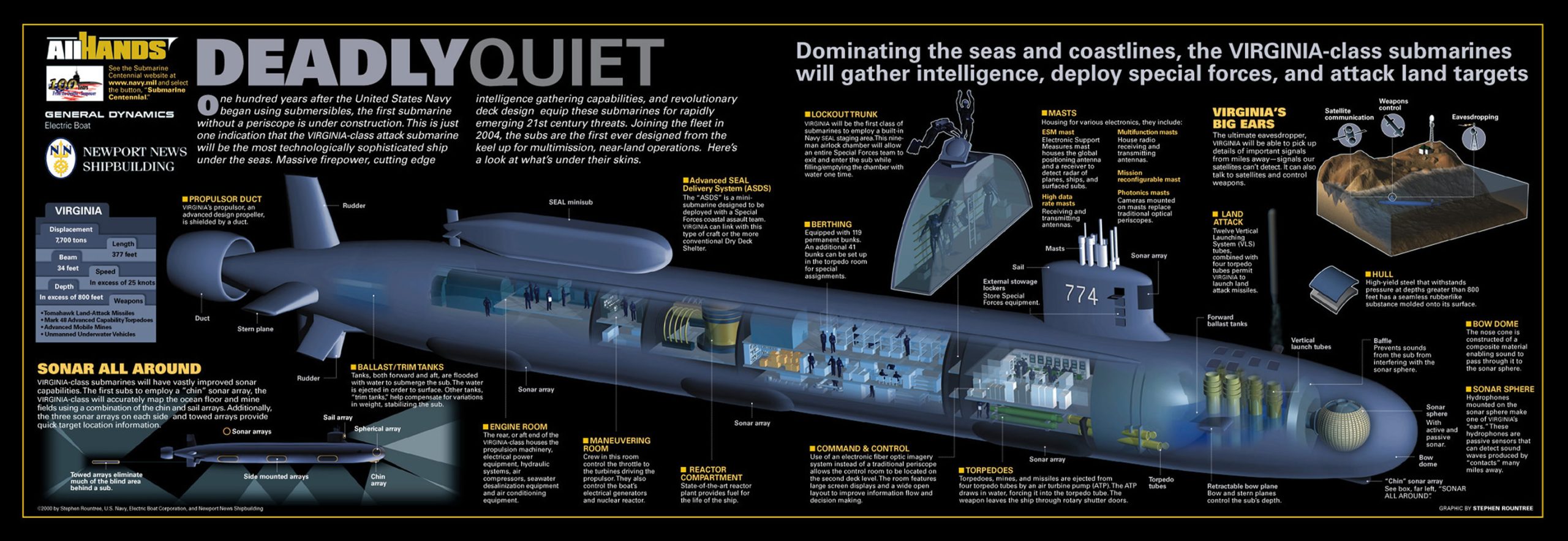

(click for SuperSize)
“GDEB Receives $148M as Virginia Class Lead Yard” described changes to the Virginia Class submarine’s design that are expected to reach 20% of the $200 million savings goal by the time orders for the versatile sea attack/ land attack/ special forces submarines rise to 2 per year, in 2012.
The bow changes cover the FY 2009-2013 ships, referred to as Block III. SSN 774 Virginia – SSN 777 North Carolina are Block I, and SSNs 778-783 will be Block II. Block III begins with the 11th ship of class, SSN 784. Long lead time component orders began May 22/08, and the submarine is expected to be ready for delivery around 2015. A fuller explanation of Block III’s extensive bow changes, and an accompanying graphic, may be found below – along with contract updates that include additional improvements and sonar development.
The Virginia Class Program: “2 for 4 in 12”

(click to view full)
The SSN-774 Virginia Class submarine was introduced in the 1990s as a Clinton-era reform that was intended to take some of the SSN-21 Seawolf Class’ key design and technology advances, and place them in a smaller, less heavily-armed, and less expensive platform. The resulting submarine would have learned some of the Seawolf program’s negative procurement lessons, while performing capably in land attack, naval attack, special forces, and shallow water roles. In the end, the Seawolf Class became a technology demonstrator program that was canceled at 3 ships, and the Virginia Class became the naval successor to America’s famed SSN-688 Los Angeles Class.
The Virginia Class program was supposed to reach 2 submarines per year by 2002, removing it from the unusual joint construction approach between General Dynamics Electric Boat and Northrop Grumman Shipbuilding – but that goal has been pushed back to 2012 in progressive planning budgets.
In FY 2005 dollars, SSN-21 submarines cost between $3.1-3.5 billion each. According to Congressional Research Service report #RL32418, and the Navy is working toward a goal of shaving FY05$ 400 million from the cost of each Virginia Class boat, and buying 2 boats in FY2012 for combined cost of $4.0 billion in FY 2005 dollars – a goal referred to as “2 for 4 in 12”. In real dollars subject to inflation, that means about $2.6 billion per sub in 2012, and $2.7 billion in 2013. The Navy believes that moving from the current joint construction arrangement will shave FY05$ 200 million from the cost of each submarine, leaving another FY05$ 200 million (about $220 million) to be saved through ship design and related changes.
Block III: The Changes

(click to view full)
The most obvious change is the switch from 12 vertical launch tubes, to 12 missiles in 2 tubes that use technology from the Ohio Class special forces/ strike SSGN program. The Virginia’s hull has a smaller cross-section than the converted ballistic missile SSGNs, so the “6-shooters” will be shorter and a bit wider. Nevertheless, they will share a great deal of common technology, allowing innovations on either platform to be incorporated into the other submarine class during major maintenance milestones. Net savings are about $8 million to program baseline costs.
The other big change you can see in the above diagram is switching from an air-backed sonar sphere to a water-backed Large Aperture Bow (LAB) array. Eliminating the hundreds of SUBSAFE penetrations that help maintain required pressure in the air-backed sonar sphere will save approximately $11 million per hull, and begins with the FY 2012 boats (SSNs 787-788).
The LAB Array has 2 primary components: the passive array, which will provide improved performance, and a medium-frequency active array. It utilizes transducers from the SSN-21 Seawolf Class that are that are designed to last the life of the hull. This is rather par for the course, as the Virginia Class’ was created in the 1990s to incorporate key elements of the $4 billion Seawolf Class submarine technologies into a cheaper boat.
The SUBSAFE eliminations, plus the life-of-the-hull transducers, will help to reduce the submarines’ life cycle costs as well by removing moving parts that require maintenance, eliminating possible points of failure and repair, and removing the need for transducer replacements in drydock.
The bow redesign is not limited to these changes, however, and includes 25 associated redesign efforts. These are estimated to reduce construction costs by another $20 million per hull beginning with the FY 2012 submarine.
With the $19 million ($11 + 8) from the LAB array and Vertical Payload, and the $20 million from the associated changes, General Dynamics is $39 million toward the $200 million baseline costs goal of “2 for 4 in 12”. While the changes themselves will begin with the FY 2009 ship, the savings are targeted at FY 2012 because of the learning curve required as part of the switch. Recent discussions concerning an earlier shift to 2 submarines per year would result in faster production of the Block III submarines, but would be unlikely to make a huge difference to that learning curve.
Contracts and Key Events

September 9/24: Sargent Aerospace & Defense won a $15 million contract for the procurement of 104 linear direct valves used on the Virginia-class submarines. This is a stand-alone contract with no options. All work will be performed in Tucson, Arizona, and is expected to be completed by June 2039. Naval Supply Systems Command Weapon Systems Support, Mechanicsburg, Pennsylvania, is the contracting activity.
July 1/24: RIX Industries won a $31 million for a firm-fixed-price, undefinitized contract action for the procurement of 25 Virginia-class high pressure air compressors. All work will be performed in Benicia, California, and is expected to be completed by July 2030. Naval Supply Systems Command Weapon Systems Support, Mechanicsburg, Pennsylvania, is the contracting activity.
June 19/24: Progeny Systems won an $11.9 million modification to exercise options to provide engineering and technical support including modernizing Virginia Class Block I/II submarines to include the common weapon launcher. Work will be performed in Manassas, Virginia, and is expected to be completed by July 2026. Naval Sea Systems Command, Washington, DC, is the contracting activity.
February 27/24: General Dynamics won a $151 million modification for long lead time material associated with the Virginia Class submarines SSN 814, SSN 815, SSN 816, and SSN 817. Work will be performed in Sunnyvale, California; Minneapolis, Minnesota; Spring Grove, Illinois; York, Pennsylvania; Annapolis, Maryland; Bethlehem, Pennsylvania Windsor Locks, Connecticut; Cleveland, Ohio; and other locations, and is expected to be completed by September 2035. Naval Sea Systems Command, Washington, DC, is the contracting activity.
January 24/24: General Dynamics won a $96.4 million modification for Long Lead Time Material associated with the Virginia Class submarines SSN 812 and SSN 813. Work will take place in Colorado, California, Pennsylvania, Illinois, New York, New Jersey and other locations within the US as well as the United Kingdom.
October 27/22: Virginia Class General Dynamics won a $122.8 million contract modification for lead yard support and development studies and design efforts related to Virginia Class submarines. This contract modification includes options which, if exercised, would bring the cumulative value of the modification to $164,071,626. Work will take place in the continental US. Expected completion will be by August 2025.
October 5/22:Lead Yard Support General Dynamics won a $533 million deal for Lead Yard Support and Development Studies and Design efforts related to Virginia-class submarines. The deal includes options which, if exercised, would bring the cumulative value of the modification to $813,720,300. The Virginia-Class new attack submarine is an advanced stealth multimission nuclear-powered submarine for deep ocean anti-submarine warfare and littoral (shallow water) operations. Work will take place in Connecticut and Virginia. Expected completion will be by October 2023.
May 20/22: Strategic Weapon Support System General Dynamics Electric Boat won a $313.9 million modification for additional United Kingdom (UK) Strategic Weapon Support System kit manufacturing, and submarine industrial base development and expansion, as part of the Integrated Enterprise Plan supporting Columbia-class ballistic missile submarines and the nuclear shipbuilding enterprise (Virginia-class and Ford-class). The industrial base development work is for the furtherance of the Fiscal 2022 National Defense Authorization Act (Public Law 117-81) which authorized, and the Department of Defense Appropriations Act, 2022 (Public Law 117-103) which appropriated, additional funds for submarine industrial base development and expansion to ensure second- and third-tier contractors are able to meet increased production requirements. Work will take place in Rhode Island and Virginia. Estimated completion will be by September 2029.
March 16/22: Montana The US Navy took delivery of the newest Virginia-class fast-attack submarine Montana (SSN 794) on Monday. Montana (SSN 794) completed sea trials last month. It is the third of the 10-ship group of Virginia-class submarines known as Block IV. Virginia-class submarines displace 7,835 tons, with a hull length of 377 feet and a diameter of 34 feet. They are capable of speeds in excess of 25 knots and can dive to a depth greater than 800 feet, while carrying Mark 48 advanced capability torpedoes and Tomahawk cruise missiles.
February 15/22: Lead Yard Support General Dynamics won an $18.8 million contract modification for lead yard support and development studies and design efforts related to Virginia-class submarines.The Virginia-class attack submarine is an advanced stealth multimission nuclear-powered submarine for deep ocean anti-submarine warfare and littoral, or shallow water, operations. Work will take place in Arizona, California and Pennsylvania. Expected completion will be by November 2024.
February 2/22: Phase 3 General Dynamics won a $20 million contract modification to support Virginia and Columbia Class efforts detailed design (Phase 3) efforts. The Virginia Class is a class of nuclear-powered attack submarines for deep ocean anti-submarine warfare and littoral (shallow water) operations. The Columbia Class is an upcoming class of nuclear subs. Work will take place in Connecticut. Expected completion will be by September 2024.
January 20/22: CWL General Dynamics Electric Boat won an $11.5 million contract modification to support the Virginia Class Common Weapon Launcher (CWL) technology insertion advanced processor build efforts for all variants. The Virginia Class submarine is the Navy’s latest fast-attack submarine and is capable of targeting, controlling, and launching MK 48 torpedoes and Tomahawk land-attack missiles (TLAMs). Work will take place in Connecticut. Estimated completion will be by September 20, 2022.
January 4/22: Support And Design Efforts General Dynamics Electric Boat won a $30.9 million deal for lead yard support and development studies and design efforts related to Virginia Class submarines. The Virginia Class attack submarine is the US Navy’s newest undersea warfare platform. The Virginia Class has several innovations that significantly enhance its warfighting capabilities, including in littoral operations. Virginia class SSNs have a fly-by-wire ship control system that provides improved shallow-water ship handling. Work will take place in Connecticut. Expected completion will be by November 2024.
November 9/21: Lead Yard Support General Dynamics Electric Boat won a $66.6 million contract action modification for lead yard support and development studies and design efforts related to Virginia class submarines. Virginia class subs are a class of nuclear-powered attack submarines. Work will take place in North Carolina, Florida and Maryland. Estimated completion will be by November 2024.
October 19/21: Lead Yard Support General Dynamics won a $269 million contract for lead yard support and development studies and design efforts related to Virginia Class submarines. The Virginia Class new attack submarine is an advanced stealth multimission nuclear-powered submarine for deep ocean anti-submarine warfare and shallow water operations. Work will take place in North Carolina and Virginia. Estimated completion date is October 16, 2022.
October 11/21: Lead Yard Support General Dynamics won a $482.1 million contract modification for lead yard support and development studies and design efforts related to Virginia Class submarines. The Virginia Class new attack submarine is an advanced stealth multimission nuclear-powered submarine for deep ocean anti-submarine warfare and littoral operations. Work will take place in Connecticut, Virginia and Rhode Island. Estimated completion will be by October 2022.
October 4/21: Propulsors Rolls Royce won a $9.3 million deal for Virginia Class submarine propulsors. The deal shall provide a maximum of seven Virginia Class propulsor rotor assemblies, scoop bar sets, and associated engineering support services. The Virginia Class attack submarine is the US Navy’s newest undersea warfare platform and incorporates the latest in stealth, intelligence gathering and weapons systems technology. Work will take place in Mississippi and Massachusetts. Expected completion will be by May 2025.
June 7/21: Propulsors BAE Systems won an $18.7 million delivery order for Virginia Class submarine propulsors. This delivery order does not include options. The Virginia Class new attack submarine is an advanced stealth multimission nuclear-powered submarine for deep ocean anti-submarine warfare and littoral operations. Work will take place in Kentucky. Expected completion date is in April 2025.
March 23/21: Virginia Payload Module General Dynamics Electric Boat Corp. won a $2.4 million contract modification to exercise an option for the construction of one Block V Virginia Class submarine with Virginia Payload Module. Electric Boat Corp. will continue to subcontract with Huntington Ingalls Industries – Newport News Shipbuilding. The Virginia-class is a nuclear-powered cruise missile fast-attack submarines (NSSN New SSN), currently in service in the United States Navy. Designed by General Dynamics’s Electric Boat (EB) and Huntington Ingalls Industries. The US Navy has been procuring Virginia (SSN-774) class nuclear-powered attack submarines (SSNs) since FY1998, and a total of 34 have been procured through FY2021 (FY Fiscal Year). Since FY2011, Virginia-class boats have been procured at a rate of two per year. Contract work will occur in Virginia, Rhode Island, California, Connecticut, Maryland, Arizona, Pennsylvania and other areas within and outside the US through February 2030.
March 11/21: Montana Huntington Ingalls Industries announced that the Virginia Class submarine Montana was launched into the James River at the company’s Newport News Shipbuilding division. The 7,800-ton submarine, which had been in a floating dry dock since being transferred from a construction facility in October, was submerged and moved by tugboats to the shipyard’s submarine pier, for final outfitting, testing and crew certification, it says in a news release. Through the teaming agreement with General Dynamics Electric Boat approximately 10,000 shipbuilders, as well as suppliers from all 50 states, have participated in Montana’s construction since the work began in 2015. Montana is approximately 92% complete and scheduled to be delivered to the US Navy in late 2021.
November 17/20: Development Studies General Dynamics won a $23.1 million deal for additional fiscal 2021 development studies, design efforts and material for Virginia Class submarines. The contract modification provides additional development studies and design efforts related to Virginia Class submarine design and design improvements. The contractor will continue development studies, design efforts and procurement of material required to fully evaluate new technologies for Virginia Class submarines. The Virginia Class attack submarine is an advanced stealth multimission nuclear-powered submarine for deep ocean anti-submarine warfare and littoral (shallow water) operations. The US Navy awarded several modification contracts to General Dynamics Electric Boat over the years in support of the Virginia-Class attack submarine programme.
October 20/20: Design Efforts General Dynamics won a $25.1 million contract modification for additional fiscal 2021 development studies and design efforts for Virginia Class submarines. The Virginia Class new attack submarine is an advanced stealth multimission nuclear-powered submarine for deep ocean anti-submarine warfare and littoral (shallow water) operations. The Virginia-Class submarines are being built by a partnership between Huntington Ingalls Industries’ Newport News Shipbuilding division and General Dynamics Electric Boat. General Dynamics Electric Boat built the first of the class,Virginia (SSN 774), and Northrop Grumman Newport News the second,Texas (SSN 775). Work will take place in North Carolina. Estimated completion will be in September 2021.
April 21/20: Vermont General Dynamics Electric Boat announced that it has delivered the nuclear-powered attack submarine Vermont to the Navy. The Vermont is the 19th submarine of the Virginia Class, which displace 7,835 tons, with a hull length of 377 feet and a diameter of 34 feet, and can carry eight masts, including a snorkel mast and high-data-rate satellite communication masts as well as a radar mast. The submarine is valued at $3 billion. “I am pleased to report that the Vermont has received some of the highest quality ratings in the history of the Virginia program. We wish Vermont and her crew a long and distinguished career in defense of our nation“, said Kevin Graney, President, General Dynamics Electric Boat, in a press release. Back in December the Navy awarded Electric Boat $22.2 billion for delivery of nine Virginia-class subs, and in January Lockheed Martin received $19.3 million to deliver masts for the boats.
March 18/20: Design Efforts General Dynamics Electric won a $13.1 million deal for additional fiscal 2020 development studies and design efforts for Virginia Class Submarines. The Virginia Class new attack submarine is an advanced stealth multimission nuclear-powered submarine for deep ocean anti-submarine warfare and littoral (shallow water) operations. The Electric Boat division of General Dynamics, Connecticut, is the lead design authority for the Virginia Class. General Dynamics Electric Boat has built the first of the class – Virginia (SSN 774), and Northrop Grumman Newport News the second – Texas (SSN 775). Work will take place in McLeansville, North Carolina and will be complete by September 2020.
February 10/20: Phase III Electric Boat Corp. won a $7.6 million contract action to perform Phase III of the Virginia Class Main Propulsion Machinery control systems effort. The Virginia Class is a nuclear-powered fast-attack submarine built for anti-sub and anti-surface operations. It is armed with torpedoes, Tomahawk Cruise missiles and is capable of mine-laying operations. It can also deliver special forces teams as it has the ability to operate in shallow or littoral waters. It is the US Navy’s newest undersea warfare platform and incorporates the latest in stealth, intelligence gathering and weapons systems technology. Work will take place in Sunnyvale, California and is scheduled to be finished by March 2021.
January 17/20: Block V Lockheed Martin won a $19.4 million contract modification to exercise options for the procurement of eight multi-function modular masts for new-construction Virginia Class submarine Block V hulls. Virginia Class subs are designed for a broad spectrum of open-ocean and littoral missions, including anti-submarine warfare and intelligence gathering operations. The Block V submarines include some significant upgrades and changes when compared to the Virginia-class submarines already built. Work will take place in New Hampshire and New York. Estimated completion date is in September 2023.
December 27/19: USS Arizona And USS Oklahoma The US Navy announced that the next two Virginia Class submarines, which are also the first two of Block V of the class will be named for the sailors who during the Pearl Harbor attack. The USS Arizona and USS Oklahoma, currently referred to as SSN-802 and SSN-803, will be named for the USS Arizona and USS Oklahoma that were sunk in the December 7, 1941, attack and the roughly 1,600 sailors who died on them, the Navy said on Tuesday. The decision brings the names back into active-duty service more than 75 years after the two vessels were in use. The new Arizona and Oklahoma will be the first two in Block V of the Virginia-class submarine program, which have been named about a month after the Navy awarded a $22.2 billion contract to General Dynamics Electric Boat for first nine vessels of the block.
December 4/19: Block V General Dynamics won a $22.2 modification for construction of nine Virginia Class submarines, eight with Virginia Payload Module (VPM), from fiscal 2019 to fiscal 2023. The contract modification includes spare material and an option for one additional submarine with VPM. The deal is for the construction of the fifth block of Virginia Class submarines by General Dynamics Electric Boat and major subcontractor Huntington Ingalls Industries’ Newport News Shipbuilding division, inclusive of design support and all efforts necessary to test and deliver each submarine. The Block V submarines built from 2019 onward will have an additional Virginia Payload Module. mid-body section, increasing their overall length. The VPM will add four more VPTs of the same diameter and greater height, located on the centerline, carrying up to seven Tomahawk missiles apiece, that would replace some of the capabilities lost when the SSGN conversion Ohio Class subs are retired from the fleet. Work under the modification will take place in Virginia, Rhode Island, Connecticut, California, Pennsylvania and Maryland. Work is scheduled to be complete by August 2029.
November 7/19: New Deal Ahead The US Navy is reportedly preparing to sign a contract for nine Virginia Class Attack submarines. Eight of them will include an 84-foot section that boosts the boat’s strike missile capacity. Bloomberg reports that the Navy has reached an agreement with General Dynamics. The contract will also include an option for a 10th boat if needed. The news comes after the Virginia Class program has seen creeping delays and slipping profits in recent years caused by labor issues and a strained submarine industrial supply base. “We have reached a multiyear” agreement “and are working to announce a contract” by December 31, Navy spokesman Captain Danny Hernandez said in a statement. It “will achieve significant savings, will include important lethality enhancements,” and “provide critical stability to the industrial base. Further information will be available upon contract award,” he said.
October 31/19: USS Delaware Huntington Ingalls Industries announced that it delivered the fast-attack submarine, the ninth Virginia Class vessel it has built, to the US Navy ahead of its commissioning next year. The nuclear-powered vessel completed sea trials earlier this month, and is the Navy’s 18th Virginia Class submarine, the company announced. The commissioning of the USS Delaware is scheduled for April 4, 2020, in Wilmington, Del. Delivery to the Navy was made on Friday. The submarine will be the seventh Navy vessel to carry the state’s name. The purchase of at 20 more Virginia Class vessels, replacing the Los Angeles Class, is planned through 2043. They are designed for open-ocean and littoral missions, anti-submarine warfare, anti-surface ship warfare, strike warfare, special operation forces support, intelligence, surveillance, and reconnaissance, irregular warfare and mine warfare missions.
October 14/19: Lead Yard Support Electric Boat Corp. won a 434.4 million deal for lead yard support and development studies and design efforts regarding the Virginia Class submarines. The Virginia Class replaces Los Angeles Class submarines as they retire. The Virginia Class has several innovations that significantly enhance its warfighting capabilities, including in littoral operations. Virginia Class SSNs have a fly-by-wire ship control system that provides improved shallow-water ship handling. The class has special features to support SOF, including a reconfigurable torpedo room which can accommodate a large number of SOF and all their equipment for prolonged deployments and future off-board payloads. The class also has a large lock-in/lock-out chamber for divers. In Virginia Class SSNs, traditional periscopes have been supplanted by two photonics masts that host visible and infrared digital cameras atop telescoping arms. Work under the contract will take place in Connecticut, Virginia and Rhode Island. Estimated completion will be by September 2020. The contract provides lead yard support for Virginia class submarines that will maintain, update and support the Virginia class design and related drawings and data for each Virginia class submarine, including technology insertion, throughout its construction and post-shakedown availability period. The contractor will also provide all engineering and related lead yard support necessary for direct maintenance and support of Virginia class ship specifications.
August 12/19: Planning, Material Procurement and Repair General Dynamics won a $15.2 million delivery order for the Virginia Class USS Washington or SSN 787. The order includes planning, material procurement and repair work. The nuclear-powered fast attack submarine is built by Huntington Ingalls and General Dynamic’s Electric Boat Division. Virginia Class submarines operate in the world’s littoral and deep waters while conducting anti-submarine warfare, anti-surface ship warfare, strike warfare, special operation forces support, and intelligence, surveillance and reconnaissance. General Dynamics will perform work in Groton, Connecticut. Work is estimated to be finished by December this year.
August 9/19: Special Support Oceaneering International won a $34.3 million firm-fixed-price contract for the Virginia Class submarine sail racetracks, payload tube loading platforms and multiple all-up-round canister special support equipment ladder kits with shipping crates. The Virginia Class new attack submarine is an advanced stealth multimission nuclear-powered submarine for deep ocean anti-submarine warfare and littoral (shallow water) operations. The lead ship, Virginia was laid down in September 1999, launched in August 2003 and commissioned in October 2004. It underwent a three-year operational evaluation before operational deployment. Oceaneering will perform work under the support contract in Chesapeake, Virginia. Estimated completion date is in August 2024.
June 25/19: Modular Mast for Block V The Navy tapped Lockheed Martin to build elements of the Virginia Class submarines. The firm-fixed-price, cost contract is valued at $16.3 million and has the company build multifunction modular masts for the submarines’ Block V hull, which can be extended by sections, depending on the requirements of the vessels’ strike capabilities. The Virginia Class of nuclear powered fast attack submarines is the US Navy’s latest undersea warfare platform. Block V subs incorporate the Virginia Payload Module (VPM), an added section of the ship, which will extend the hull by 84 feet and boost its strike capabilities. Virginia Class submarines with Block V armaments are capable of carrying Tomahawk cruise missiles. The VPM will increase the number of torpedoes and Tomahawk missiles the Virginia class can carry. 70 percent of the work will take place in Nashua, new Hampshire, and 30 percent in Syracuse, New York. Scheduled completion date is in June next year.
April 11/19: ETCU The Navy awarded $33.4 million to Raytheon to supply the Naval Warfare Center in Philadelphia with up to 28 electronic throttle control units (ETCU) and auxiliary components in support of the Virginia Class program. The deal has Raytheon provide replacement ETCU hardware, which is currently obsolete and can no longer be efficiently supported. The Virginia Class are attack submarines. The Navy’s newest undersea warfare platform is designed to seek and destroy enemy subs as well as surface ships. Virginia Class boats can carry up to 24 torpedoes and Tomahawk cruise missiles. They can be deployed for a wide range of operations including anti-submarine warfare, anti-surface ship warfare, strike warfare, special operations forces support, intelligence, surveillance and reconnaissance, irregular warfare, and mine warfare missions. According to the DoD, the proposed contract includes the hardware fabrication for new construction platforms and all back-fit systems to mitigate parts obsolescence, update and maintain the ETCU technical data package, and design verification testing on limited production units for quality assurance. Work is scheduled to be completed by April 2024.
March 20/19: Long Lead Time Material The US Navy awarded General Dynamics a $2 billion contract modification to provide additional materials required to build the Virginia Class submarines from fiscal 2019 through fiscal 2023. The deal includes additional Long Lead Time Material and Economic Ordering Quantity items for SSN-802 to SSN-811 underwater vessels. The SSNs 802 -811 Virginia Class submarine hull numbers have not been named yet. The Virginia Class is the Navy’s newest undersea warfare platform. Attack submarines are designed to seek and destroy enemy submarines and surface ships, project power ashore with Tomahawk cruise missiles and Special Operation Forces, carry out Intelligence, Surveillance, and Reconnaissance (ISR) missions, support battle group operations, and engage in mine warfare. The modification falls under a previously awarded sole-source contract. General Dynamics is the lead contractor of the Virginia Class submarine program. In February 2017, General Dynamics won an initial $126.5 million contract by the US Navy for long lead time material for the first two Block V Virginia Class submarines, SSN-802 and SSN-803. The Block V submarines built from 2019 onward will have an additional Virginia Payload Module (VPM) mid-body section, increasing their overall length. Work under the contract modification will take place within the USA.
February 27/19: Universal Modular Mast The US Navy awarded L-3 KEO a $19.3 million contract modification for the production of the Universal Modular Mast, which serves as a lifting mechanism for the Virginia class mast payloads. The Universal Modular Mast is standard equipment for above-water sensors on U.S. and international submarines. It is a non-hull penetrating mast for Navy Virginia-class fast-attack submarines and Ohio-class guided missile submarines that can host five different sensor configurations: the photonics mast, the multi-function mast, the integrated electronic mast, the high-data-rate-mast, and the photonics mast variant. The Virginia class or SSN-774 class are nuclear powered fast attack submarines. The submarines form the Navy’s new undersea warfare platform designed to seek and destroy enemy submarines and surface ships as well as project power ashore. Work under the contract will take place in Italy as well as Massachusetts and is scheduled to be finished by August 2021.
April 02/18: Post-delivery work General Dynamics Electric Boat Corp, is being contracted for the provision of post-delivery work on the USS Colorado (SSN 788). The awarded contract is valued at over $14 million. The USS Colorado is the 15th Virginia Class submarine delivered to the US Navy. She was delivered on September 21, 2017 and was commissioned on March 17, 2018. The SSN 788 is part of a 5-year, $17 billion deal to strengthen the USA’s nuclear submarine fleet. The SSN 788 belongs to Block III submarines that took a big step forward by replacing the 12 vertical launch tubes with a more flexible “6-shooter” approach, and swapping a water-backed, horseshoe-shaped LAB sonar array for the existing air-backed spherical array. Electric Boat Corp. will perform planning and execution efforts, including long lead time material procurement, in preparation to accomplish the maintenance, repair, alterations, testing, and other work on USS Colorado. Work will be performed in Groton, Connecticut and is expected to be completed by September 2018.
Jan 5/09: Goodrich in Charlotte, NC received a $49 million contract from Northrop Grumman Shipbuilding to provide composite components for the next 8 Virginia Class nuclear fast attack submarines referred to as Block III.
Goodrich’s Engineered Polymer Products team in Jacksonville, FL is building components to support the construction of 1 ship per year in 2009 and 2010, rising to 2 ships per year from 2011 through 2013. The components include the bow dome, and sonar and weapons equipment.
Dec 22/08: The US Navy signals its a href=”/Early-Xmas-Big-Virginia-Contracts-for-GDEB-NGC-05218/”>approval of the Virginia Class’ progress, and of the new Block III design, with a $14.011 billion contract to fund 8 Virginia Class block III submarines. Work on these boats will run until 2019.
Dec 12/08: General Dynamics Electric Boat Corp. in Groton, CT received a $16.8 million cost-plus-fixed-fee material order to fund the Block III Common Weapon Launcher (CWL) design, and includes the total scope associated with the vendor portion of the inboard electronics design as well as the scope required for in-house (Electric Boat) tasks. The CWL will sit in the Block III bow’s “six shooter” holes, and is so named because that space can be used to launch a wide variety of items besides UGM-109 Tomahawk cruise missiles; aerial UAVs and underwater UUVs are the most obvious.
GDEB services will include engineering support, Engineering Development Model (EDM) hardware, continued development of the CWL for use with SSN 784 VPT, development of interface documents, and defining changes to support interfaces to the Weapon Control and Payload Tube Control Panels. Work will be performed in Manassas, VA, and is expected to be complete by 2013. This contract was not competitively procured by the supervisor of Shipbuilding Conversion and Repair in Groton CT (N00024-09-C-2101).
Dec 12/08: Lockheed Martin Maritime Systems and Sensors in Manassas, VA received a $38.3 million modification to previously awarded contract (N00024-04-C-6207) for engineering services in support of the Acoustic – Rapid Commercial off The Shelf (A-RCI) program. The 550,000 additional engineering services hours will be used on TacLAN tasking related to Special Operations support, and to complete the new “BSY-2 Wrap Around Antenna (WAA),” which is listed as being a Virginia Class sonar.
DID requested clarification, and got it. BSY-2 is a Seawolf class system only. WAA is the Wide Aperture Array, and on the SSN-774 Virginia Class it evolved to the L-WAA (Lightweight Wide Aperture Array). The Virginia Class Block III bow has been redesigned to save money beginning with SSN 784; it will use the Large Aperture Bow (LAB) Array.
It turns out that the DefenseLINK release should read “technology insertions for the USS Jimmy Carter’s [SSN 23 Seawolf Class] BSY-2 WAA, and USS North Carolina [SSN 777 Virginia Class] LWAA TI-08 integration.” The exact work involved is technology insertion, integration, and modernization on USS Jimmy Carter and USS North Carolina, as well as the completion of the existing TI-08 effort and the Virginia Class Block III TI-10 Large Aperture Bow (LAB) Array effort for SSN 784.
Work will be performed in Manassas, VA (90%) and Syracuse, NY (10%) and is expected to be complete by June 2009. This contract was not competitively procured by US Naval Sea Systems Command.
Nov 5/08: The Virginia Class nuclear fast attack submarine Program Office Virginia Class Sub Program Wins Acquisition Awardreceives the 2008 David Packard Excellence in Acquisition Award during a ceremony at Fort Belvoir, VA. This marks the third time (1996, 1998, 2008) that the Virginia Class Program Office has earned the award. The Virginia Class Program was recognized for excelling in 4 specific areas: reducing life-cycle costs; making the acquisition system more efficient, responsive, and timely; integrating defense with the commercial base and practices; and promoting continuous improvement of the acquisition process.