


(click to view full)
L-3 Communications Link Simulation and Training (L-3 Link) division recently announced a $43.7 million contract from the U.S. Navy to serve as prime contractor on the C-9 Contractor Logistics Support (CLS) program. In conjunction with their partners Goodrich Corporation Aviation Technical Services division, Pacific Gas Turbine Center, and Patriot Aviation Services, they will be responsible for overall program management encompassing aircraft depot support, engine depot support, and site support for 24 C-9 aircraft. There are also a pair of C-9 aircraft operated by NASA to support reduced gravity studies (aka. “Vomit Comets”). Should the U.S. Navy exercise 4 additional one-year contract options, the potential contract value of the C-9 CLS program could grow to approximately $230 million.
Work will take place at 6 U.S. Navy, U.S. Marine Corps and U.S. Air Force installations: Naval Air Station (NAS) Whidbey Island, WA; NAS Oceana, VA; NAS Atlanta, GA; NAS Willow Grove, PA; Marine Corps Air Station Cherry Point, NC; and Scott Air Force Base, IL.
(click to view full)
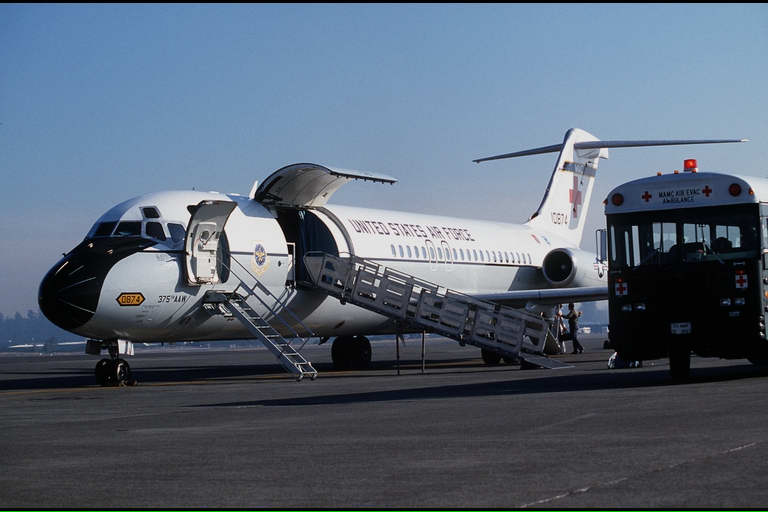
The C-9s are military variants of the Super 30 stretched DC-9 short-haul passenger jet, and were built from the mid-1960s through the mid-1990s. The C-9A Nightingales that once performed aeromedical evacuation have been retired, which caused some trepidation at first but led to a new way of approaching the problem; now this “90% approach” is being credited with reducing casualties. The remaining C-9s serve as VIP transports and cargo aircraft, but age is catching up with them. Their Pratt and Whitney JT8-D-9 engines are noisy and inefficient by modern standards, their airframes have many flight-hours on them, and even with some avionics upgrades their older cockpit layout and equipment remain a drawback. Some C-9s are being replaced by 737-derived C-40s, but despite calls to retire the fleet by 2010 there are no plans to fully fund a replacement by modern C-40 A/B/C transports. L-3 also has the CLS contract for the C-40A fleet, and their specialty in aircraft support is a quiet but significant contributor to L-3’s bottom line.