


(click to view full)
The GPS-guided M982 Excalibur artillery shell is not an anti-tank round, unlike the SMArt 155 shells Australia bought in October 2007. Excalibur’s accuracy brings its own capabilities, however, including precise counter-fire at enemy artillery and mortars located via projectile-tracking radars. Its shells can also target a particular building near troops under fire, providing a much faster, cheaper, and more reliable alternative to close air support fighters with precision-guided bombs. Both of these capabilities are important on the front-lines, where Australian troops are engaged.
DID readers will recall Australia’s LAND 17 artillery replacement contract, currently underway, aimed at purchasing a new set of towed and mobile 155mm howitzers capable of firing shells like SMArt 155 and the M982 Excalibur. In the mean time, however, a secondary solution is available – and Australia appears to have submitted a modified request…
Excalibur’s PFECS
(click to view full)
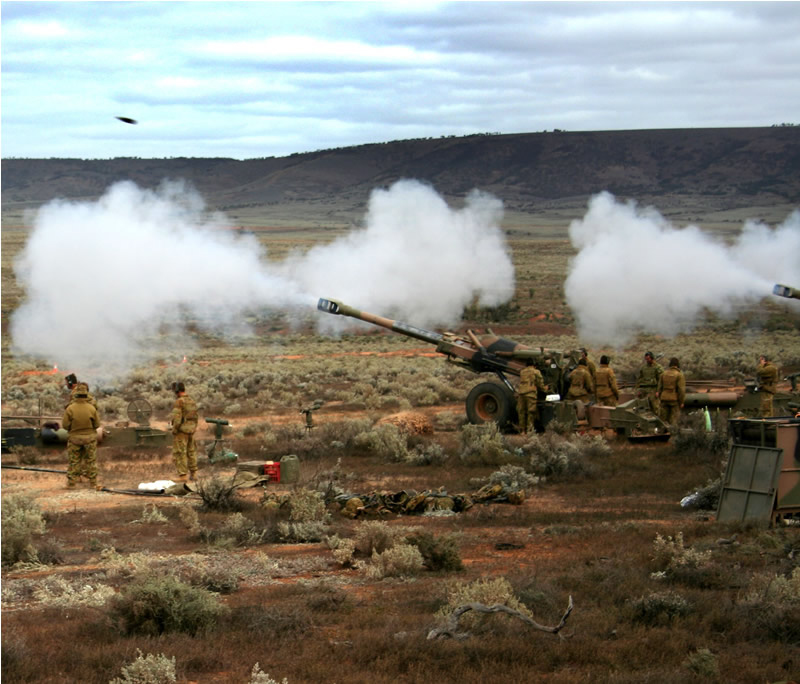
The immediate integration solution for Australia’s M198 howitzers is called the Portable Excalibur Fire Control System (PFECS). According to Raytheon, 3 levels of integration are fielded or in development. All can be integrated on any howitzer and with components from the potential host country, using appropriate communications, command and control, GPS, fire control and other howitzer digitization equipment.
Determining Excalibur’s compatibility with each 155 gun requires analysis of gun characteristics and test firings, but Raytheon said that a brief look at the world’s 155 howitzers had not identified any insurmountable road block to Excalibur compatibility. Fire control integration onto platforms is “a fairly simple prospect,” and the accompanying PEFCS module is slightly bigger than a brief case.
Contracts and Key Events
June 2/08: An $85.3 million contract for Excalibur shells will supply the US Army and Marines – and also begins sales to Australia. See “$85.3M Order As Excalibur Production Accelerated.”
April 21/08: This appears to be a revised request. The US DSCA announces [PDF] Australia’s formal request for 2,400 Modular Artillery Charge Systems (MACS, propellant), 250 GPS-guided XM982 Block Ia-1 Excalibur Unitary Projectiles with base bleed units that extend the shell’s range to around 40km/24 miles, 43 Portable Excalibur Fire Control Systems (PEFCS), 43 AN/PRC-119 Single Channel Ground and Airborne Radio System (SINCGARS) w/o GPS, plus training ammunition, containers, support equipment, spare and repair parts, publications and technical data, maintenance, personnel training and training equipment, U.S. Government and contractor representatives’ engineering and technical support services, and other related elements of logistics support.
The estimated cost is $58 million, up from $40 million. Note also the rise from 28 – 43 PFECS, and the addition of 43 SINCGARS radio systems since Oct 1/07. There are no known offset agreements proposed in connection with this potential sale. The principal contractors will be:
* Raytheon Missile Systems in Tucson, AZ (Excalibur)
* ITT in Roanoke, VA (SINCGARS)
* General Dynamics ATP in Camden, AK (MACS)
Oct 1/07: The US Defense Security Cooperation Agency announces [PDF format] Australia’s formal request for 2,400 Modular Artillery Charge Systems (MACS), 250 M982 Block 1a-2 GPS-guided Excalibur 155mm shells with base bleed units, 28 Portable Excalibur Fire Control Systems (PEFCS) that allow the shells to be fired from guns like Australia’s towed M198s that don’t have the system pre-integrated, training ammunition, containers, support equipment, spare and repair parts, publications and technical data, maintenance, personnel training and training equipment, U.S. Government and contractor representatives, engineering and technical support services, and other related elements of logistics support. The estimated cost is $40 million.
The prime contractors will be Raytheon Missile Systems Corporation in Tucson, AZ for Excalibur, and General Dynamics Armament and Technical Products in Camden, AK for MACS. Implementation of this sale will not require the assignment of any additional U. S. Government personnel in-country.