

(click to view full)
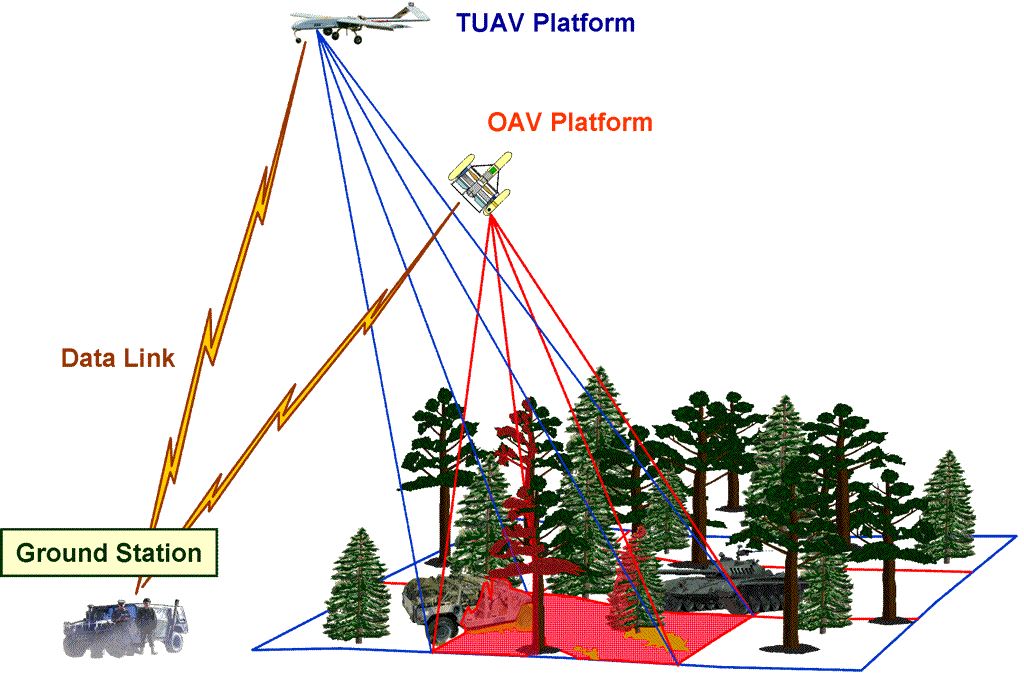
Harris Corporation received a $6.6 million research and development contract from the U.S. Army Communications-Electronics Command (CECOM) to develop and demonstrate the Jigsaw Laser Radar (LADAR) 3D-imaging test-bed system for use on a DP-5X Helicopter UAV.
Laser Radar (LADAR or LIDAR) is similar to millimeter wave radar, but uses lasers to scan and processes the signal echoed from targets, in order to create a 3-D virtual picture of the area. Due to its capability to scan large areas with very high precision, and its ability to gradually build a detailed picture of the area under surveillance, LADAR sensors are usually employed on loitering systems which can look at the target from different angles and match them to templates stored in its onboard processors. As the technology progressed, people also realized that they could use the ladar to look through cover such as trees, towers and camouflage.
With conventional, two-dimensional imaging, it is possible to see only through the holes in a tree covering, for example. But because it produces images from multiple angles and collates them into a single 3-D picture, the LADAR essentially sees around the trees. This is the purpose of the Jigsaw program.
Key elements of the Jigsaw system include a small, rugged laser with a highly sensitive detector, provided by MIT/LL; complex, 3-D image registration, provided by Sarnoff; a sophisticated 3-D image processor from MIT/LL and Harris; and a powerful, 3-D visualization and user interface from Harris.
The ability to reliably identify targets – tanks and other vehicles – hidden under foliage and camouflage was successfully demonstrated by Harris and MIT-Lincoln Laboratories during an earlier Defense Advanced Research Projects Agency (DARPA)-sponsored proof-of-concept Jigsaw study. This demonstration was followed by the recently completed initiative to design a smaller, lighter, autonomous, yet better-performing test bed system suitable for use on a medium-sized UAV like DARPA’s DP-5X UAV project, which is part of the Army’s $120+ billion Future Combat Systems program.
During this latest phase of the DARPA-sponsored effort, Harris is providing systems integration services in cooperation with LADAR sensor developer MIT-LL and DP-5X platform developer Dragonfly Pictures Incorporated. In addition, the U.S. Army Research Development & Engineering Command (RDECOM), Communications-Electronics Research Development and Engineering Center (CERDEC), Night Vision & Electronic Sensors Directorate (NVESD) is providing test range services and UH-1 helicopter support for early flight testing; Sarnoff Corporation is providing sophisticated 3D-image registration algorithms; and L3Com/Wescam is providing a small, high-performance turret. This phase includes full implementation of a UAV version of Jigsaw, followed by experimentation and demonstrations, and concludes with in-depth analysis of data collected with the airborne test bed during flight campaigns using the UH-1 helicopter and DP-5X UAV helicopter.
Other potential applications for LADAR include robotic vision, navigation for autonomous vehicles, manufacturing quality control, industrial security, and topography.
Additional Readings and Sources
* Harris Corp. News Release (June 2/05) – Harris Corporation Team Awarded $6.6 Million Airborne Laser Radar Research and Development Contract
* Defense Update – Laser radar (LADAR) based Guidance Systems
* oe Magazine (April 2003) – LADAR Puts the Puzzle Together. A good discussion of Jigsaw’s concept, potential and challenges from Robert Hauge, Jigsaw program manager for the Information Exploitation Office at DARPA.
* Photonics Technology World (Feb. 2003) – Ladar Images in Three Dimensions