


(click to view full)
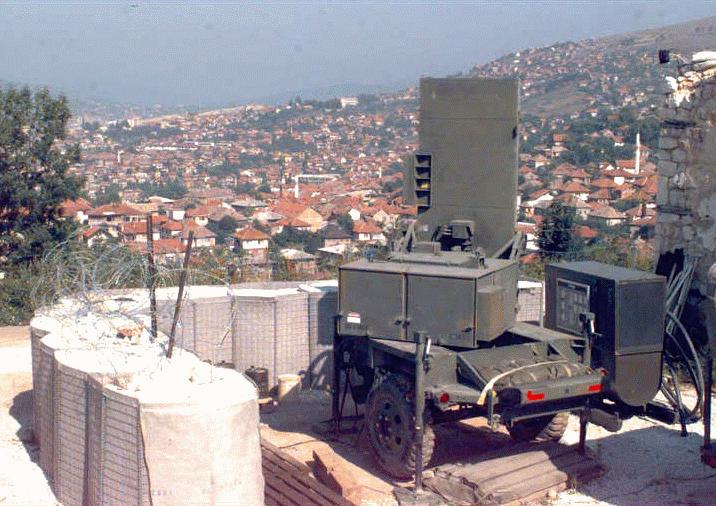
Firefinder radars track the path of incoming shells, rockets, mortars, etc., and calculate the point they were fired from. Raytheon’s TPQ-36 radar is specifically designed to counter medium range enemy weapon systems out to a range of 24 kilometers, while the TPQ-37 can locate longer-range systems, and even surface launched missiles, out to 50 kilometers. Michael Yon, embedded with 1-24 (“Deuce Four”) in Mosul, offered a first hand description of counter-battery radars’ effect on enemy tactics in 2005.
Better radar technologies offer a number of potential advantages for this role, including wider fields of view and less maintenance. Not to mention fewer disruptive, time-sucking false positives for deployed troops. In September 2006, Lockheed Martin began a contract to deliver their “Enhanced AN/TPQ-36” (EQ-36) radars. Despite the close official name and designation, this was a wholly new radar system, from a different company. Orders have begun to accumulate, along with deployments – and, finally, a less confusing designation change to AN/TPQ-53.
The TPQ-53 Counterfire Radar System

(click to view full)
The TPQ-53 includes a number of operational improvements, including 360 degree coverage capability instead of the TPQ-36’s current 90 degrees, and dramatic reductions in false alarm rates. A successful program would replace many of the TPQ-36 radars currently in service.
In 2002, the US Army began a research project called the Multi-Mission Radar Advance Technology Objective. The goal was similar to the US Marine Corps’ G/ATOR: a single mobile radar system able to perform Air Defense Surveillance, Air Defense Fire Control, Counter Target Acquisition (artillery tracing) and Air Traffic Service missions. Unlike the Marines, the Army didn’t proceed from there toward a full development project. Instead, they incorporated some of the technologies and learning from MMRATO into a competition that would begin by fielding radars to solve the CTA problem.
Both the truck-mounted AN/TPQ-53, and the smaller Humvee-mounted TPQ-50 LCMR (Lightweight Counter Mortar Radar) trace back to that effort, and the TPQ-53 also grew out of lessons learned from the previous generation TPQ-36/37 Firefinder radar series. The base radar technology is more advanced, and software and hardware were modernized. Mechanically, the radar got more robust gears, a rotating platform, an automated leveling system for faster and more reliable emplacement, and an improved air cooled system to improve reliability and keep costs down. The Army expects these changes to save millions of dollars over the radars’ lifetimes.
An AN/TPQ-53 radar system is actually made up of 2 vehicles. One FMTV truck is the Mission Essential Group, containing the radar antenna and the power generator. The second FMTV truck carries the Sustainment Group, with a climate controlled operations shelter and backup power generator.
The TPQ-53 is IFPC (Indirect Fire Protection Capability) compatible in countering rocket, artillery, and mortar attacks, and the Army is thinking of adding software upgrades to allow it to track larger targets, and perform air defense surveillance against UAVs, helicopters, and enemy aircraft.
The system’s operations center allows the radar to link back to Army command systems like AFATDS and FAADC2. Linkages to ground-based Counter Rocket Artillery and Mortar (C-RAM) command systems, which can also connect to fire control radars and defensive weapons like the Phalanx Centurion, provide a complete defensive solution for protected bases. If the radar’s functions expand to include broader air defense, those command system linkages will become even more important.
Automation and built-in test sensors means that only 4 soldiers can operate the system, with an emplacement time of 5 minutes and a displacement time of just 2 minutes. This compares to 3 HMMWVs and 6 people for the previous TPQ-36v8 system; or 2 FMTV trucks, 2 HMMWVs, and 13 people for the TPQ-37v8.
A built-in encrypted wireless radio can reach up to 1 km away, allowing operators to disperse and make themselves more difficult targets. Soldiers can use a pair of ruggedized Linux laptop computers to handle operations from anywhere in range, or work from the climate-controlled shelter vehicle.
EQ-36/ TPQ-53: Program and Industrial Team
(click to view full)
The initial Quick Reaction Capability (QRC) contract for 5 radars was issued in January 2007. In spring 2007, the prototype completed successful counterfire target acquisition testing in both 90- and 360-degree modes at the U.S. Army’s Yuma Proving Grounds in Yuma, AZ. In summer 2007, the system completed successful air surveillance testing at White Sands Missile Range in White Sands, NM. A prototype was unveiled in October 2007, and the 1st system was delivered to the Army in summer 2009. By late 2010, the first EQ-36 systems were deployed in Iraq & Afghanistan.
An August 2011 option raised the EQ-36’s QRC order total to 36 systems (4 + 12 + 17 + 3), though some official documents place the number at 38. Another 65 AN/TPY-53 radars were ordered later, following the Milestone C update decision that launched low-rate initial production.
Over the longer term, the potential exists for $1.6+ billion in orders, covering all QRC units + 136 radars in the program of record. The Full Rate Production decision is scheduled for Q4 FY 2014.
Industrial team members for the EQ-36 program include Lockheed Martin Maritime Systems and Sensors (MS2):
* Lockheed Martin MS2 in Syracuse, NY (Program lead, antenna array, digital module assemblies);
* Lockheed Martin MS2 in Moorestown, NJ, facility (transmit/receive modules);
* Lockheed Martin Simulation, Training and Support, in Orlando, FL (TPQ-53 training system and curriculum);
* Burtek, Inc. in Chesterfield, MI (operations shelter and stationary platform);
* Syracuse Research Corp. in Syracuse, NY (digital signal processor);
* Tobyhanna Army Depot in Tobyhanna, PA (maintenance support).
Contracts and Key Events
The radar is an American product, with the USA as its founding and largest customer. As such, timelines and divisions use American fiscal years, which end on September 30th.
FY 2020
May 4/20: Purchase And Repair Honeywell International won a $11 million contract for the purchase and repair of one spare part supporting the AN/TPQ-50 Counterfire Target Acquisition Radar System. The AN/TPQ-50 is a US Army Program of Record that provides early warning for indirect fire and counterfire target acquisition support. The system has proven to be exceptionally effective at providing early warning and location of rocket and mortar threats facing the warfighter. The AN/TPQ-50 is part of the LCMR family of radars that SRC produces for counterfire missions. Work will take place in Florida. Estimated completion date is April 29, 2025.
FY 2018
13 more for USA under MYP; Singapore’s export request.

(click to view full)
October 10/18: Configuration Lockheed Martin is being tapped to introduce a full rate production configuration to the new AN/TPQ-53 (Q-53) radar. The US Army is awarding Lockheed with a contract modification that sees for the insertion of Gallium Nitride into the Q-53. The Q-53 is a mobile, maneuverable, fully supportable and easily maintained counterfire target acquisition radar. Compared to currently deployed systems, the new, battle-tested Q-53 offers enhanced performance, including greater mobility, increased reliability and supportability, a lower life-cycle cost, reduced crew size, and the ability to track targets in a full-spectrum environment, a vital capability on today’s battlefield. According to the press release, the transition to GaN will provide the Q-53 with additional power for capabilities including long-range counterfire target acquisition. GaN has the added benefit of increasing system reliability and reducing lifecycle ownership costs. Work will be performed at Lockheed’s factories in New York, New Jersey and Florida.
FY 2014 – 2017
June 7/17: The US State Department has cleared the sale of Lockheed Martin’s AN/TPQ-53 counter-battery radar to Saudi Arabia. Valued at at estimated cost of $662 million, the deal marks the first export order of the radar outside of the US. Included in the deal are 26 AN/TPQ-53(V) Radar Systems to include Solid State Phased Array Radar with KN-4083 Selective Availability Anti-Spoofing Module (SAASM) enhanced Land/Sea Inertial Navigation System (INS) and automatic leveling system, as well as various equipment, training and materials. Riyadh reportedly intends to use these radars to support its border security requirements and modernise its armed forces with a more current capability to locate and counter the source of incoming ballistic artillery, rockets, and mortars.
April 25/17: Lockheed Martin has won a $1.6 billion contract to continue manufacturing the AN/TP-Q-53 counterfire radar for the US Army. The Q-53 Active Electronically Scanned Array (AESA) radar will eventually replace older systems like the Q-36 and Q-37, and is capable of detecting incoming indirect fire like rockets and mortars, allowing response time for troops to reach cover, but they can also detect the location of the launch site. This allows counter battery fire to triangulate and respond with fire of their own. Lockheed Martin remains the only supplier of such systems to the Army.
April 2/17: The US Army has awarded Lockheed Martin a $1.5 billion contract to produce and deploy the AN/TPQ-53 Counterfire Target Acquisition Radar System. Developed as a replacement for existing AN/TPQ-36 and AN/TPQ-37 Firefinder radar systems, the new radar is designed to detect, classify, track and determine the location of enemy artillery assets such as mortars, cannons and rockets. The service claims that once in place, the radars will provide increased mobility, reliability and performance.
June 29/16: Lockheed Martin’s AN/TPQ-53 counter-battery radar has proven that it can be used to detect unmanned aerial vehicles alongside its usual task of detecting incoming artillery and rocket fire. The company announced the success following testing carried out by the US Army as part of its Maneuver and Fires Integration Experiment (MFIX) at Fort Sill, Oklahoma. Conducted annually, the MFIX exercise brings together military, industry and academia to assess solutions to future warfighting needs in a live environment.
February 9/16: Testing of the Q-53 Counterfire Target Acquisition Radar System in June 2015 has shown the radar is having difficulty detecting volley-fired mortars. While the second initial operational test and evaluation (IOT&E) found the system effective against single-fired rockets, artillery, and mortar munitions, it was unable to handle the detection of more than one munition fired at the same time, according to Michael Gilmore’s annual Operational Test & Evaluation report. The radar also struggled to identify the difference between a mortar, a rocket, and artillery. The Army, however, has stated that the radars have been working well in operational environments, and plans are to increase performance in high clutter environments with development and integration of software upgrades in 2019, with more testing planned for 240 mm and 122 mm munitions not assessed in previous tests.
April 7/14: Support. Lockheed Martin in Liverpool, NY receives a $9.1 million contract modification for interim contractor ssupport of the AN/TPQ-53 radar fleet.
All funds are committed immediately, using FY 2012 Army budgets. Work will continue until Sept 30/14, and will be performed in Liverpool, NY. US Army Contracting Command in Aberdeen, MD manages the comntract (W15P7T-06-C-T004 P00092).
March 28/14: +14. Lockheed Martin in Liverpool, NY receives a $145.9 million contract modification for another 13 AN/TPQ-53 radar systems, along with 13 corresponding sets of on-board spares. This is the 4th installment under the March 13/12 multi-year contract, and brings orders to $751 million: 65 systems over 4 phases.
All funds are committed immediately, using FY14 US Army budgets. Work will be performed in Liverpool, NY, with an estimated completion date of Nov 30/16. US Army Contracting Command in Aberdeen, MD manages the contract (W15P7T-12-C-C015, PO 0022).
Oct 8/13: Singapore. The US DSCA announces Singapore’s export request for up to 6 AN/TPQ-53(V) Counterfire Target Acquisition Radar Systems (CTARS) with 120 degree sector scan capability, along with generators, power units, a simulator, a live fire exercise (!), tool and test equipment, spare and repair parts, repair & return services, software support, support equipment, publications and technical documentation, communication support equipment, personnel training, and other forms of US Government and contractor support. The estimated cost is up to $179 million.
Singapore would be the radar’s 1st export customer. Their forces do deploy abroad, where CTARS capability will be very useful. At home, the city-state’s small size also makes them inherently vulnerable if problems in neighboring countries should allow local terrorists to acquire ballistic rockets.
The principal contractor will be Lockheed Martin in Syracuse, NY. If a sale is negotiated, they’ll need Government and contractor representatives in Singapore for 6 weeks to support equipment deprocessing/fielding, systems checkout and new equipment training. Source: US DSCA, Oct 8/13.
DSCA: Singapore
FY 2012 – 2013
Multi-year contract; Milestone C approval; Initial fielding; Future competition?
[youtube:v=5Rsw9Cl3zzw]
(click to view video)
June 27/13: +19. Lockheed Martin Corp. in Liverpool, NY receives a $206.9 million firm-fixed-price contract modification to procure AN/TPQ-53 Radar Systems and corresponding spare parts, using a combination of FY 2012 and 2012 funds. Lockheed Martin sets the number at 19 radar systems, and this order brings the cumulative total face value of this contract is $605.1 million over the low-rate initial production contract, with 52 systems ordered over 3 phases.
Work will be performed in Syracuse, NY. US Army Contracting Command at Aberdeen Proving Ground, MD manages this contract (W15P7T-12-C-C015, PO 0010). Sources: Pentagon, Lockheed Martin Aug 26/13 release.
March 12/13: Support. Lockheed Martin Corp. in Liverpool, NY receives a $12 million cost-plus-fixed-fee contract modification, to provide interim contractor support for the AN/TPQ-53 radar system.
Work will be performed in Liverpool, NY until the end of FY 2013 on Sept 30/13. One bid was solicited, with 1 bid received (W15P7T-06-C-T004).
Dec 19/12 – Jan 17/13: future competition for FRP? PM Radars issues a Sources Sought request to determine whether reintroducing competition for Full Rate Production (FRP) may be possible in FY 2014. In other words, this is not an RFP to displace incumbent Lockheed Martin just yet, but it’s the homework that might create the option to do so.
The Army anticipates an FRP contract in Q4 FY 2014, as a single award, firm fixed price (FFP) contract comprised of a base year, with multiple separately priced options and range quantities. Spares, new equipment training, and technical manuals will also be acquired on a FFP basis. This would lead to the acquisition of about 70 systems over 4 years. Key factors in the source selection process include a Live Ammunition System Demonstration (LASD) planned for the first half of FY 2014. Data witnessed by the Army Test and Evaluation Command (ATEC) will not be an adequate substitute to participating in the live demo.
The submission date for this information request, originally set to Jan 14, 2013, is later postponed to Feb. 12. The FRP RFP itself is planned for release in Q4 FY 2013, with an award in Q3 FY 2014. FBO: W15P7T-13-R-C113.
Jan 2013: DOTE report. In its FY2012 report, the Director, Operational Test & Evaluation notes reliability improvements, with less frequent system aborts than the 2011 system demonstration’s 1 per 30 hours. Some of these original issues were attributed to user documentation and training, which slated for further improvement.
Even so, the results show a fallback from vast improvements after initial configuration changes, to a final configuration figure of 1 abort every 75 hours during limited testing. Initial Operational Test & Evaluation is scheduled for fall 2013, and the radars will need a big jump to hit required reliability levels of 1 abort every 257 hours.
A Limited User Test (LUT) took place in the fall of 2012, but that’s in FY 2013, and so it isn’t covered in the 2012 annual report.
Oct 17/12: Add other functions? The US Army announces that it has begun fielding the AN/TPQ-53, and the Humvee-mounted AN/TPQ-50 Lightweight Counter Mortar Radar, to protect forward-deployed forces. They also discuss a number of the AN/TPQ-53 system’s features, and reveal that the Army is considering software upgrades that would add general air surveillance radar capabilities against helicopters, UAVs, cruise missiles, and aircraft. Note that the radar’s antenna is heavily derived from the 2002 MMR ATO radar project, which already contemplated air volume search as a mission.
One indication that the Army is serious is that they’re moving the program from PEO IEWS Product Manager Radars, to PEO Missiles and Space. That will organize air defense radars under the same organizational umbrella as the counter-fire radars. US Army.
April 20/12: +21. Lockheed Martin issues a release citing $391 million in US Army contracts for 33 TPQ-53 systems.
Asked for clarification, the firm explains that the US Army has exercised its 2nd option under the contract since the March 13/12 announcement, adding another $225 million for another 21 systems (W15P7T-12-C-C015).
April 2/12: Lockheed Martin MS2 Radar Systems in Liverpool, NY receives a $23.3 million cost-plus-fixed-fee contract, for services “in support of the EQ-36 radar” through April 30/13.
Work will be performed in Liverpool, NY. The original bid was solicited through the Internet, with 3 bids received by U.S. Army Contracting Command in Fort Monmouth, NJ (W15P7T-06-C-T004).
March 13/12: Multi-year contract. Lockheed Martin Mission System and Sensors in Liverpool, NY receives a $166 million firm-fixed-price contract for 12 “enhanced AN/TPQ-36” (now called AN/TPQ-53) radar systems, including spares, testing, and training materials.
This means that Lockheed Martin will be the producer for the EQ-36 program of record, which could rise to 136 systems. It’s also the 1st installment of a larger $881 million contract, which could end up buying up to 51 low-rate production systems, plus Limited User Test (LUT) and Initial Operational Test and Evaluation (IOT&E) services.
Work will be performed in Liverpool, NY, with an estimated completion date of Feb 28/17. The bid was solicited through the Internet, with 1 bid received. The US Army Contracting Command at Fort Monmouth, NJ manages the contract (W15P7T-12-C-C015). See also US Army PEO IEW&S, Aug 15/11 entry | Lockheed Martin.
Multi-year contract
February 2012: Despite the issues noted in the DOT&E report, the TPQ-53 radar receives Milestone C clearance, allowing it to go ahead to Low-Rate Initial Production. Source.
Milestone C
Jan 17/12: Test reports. The Pentagon releases the FY 2011 Annual Report from its Office of the Director, Operational Test & Evaluation (DOT&E). The “Enhanced AN/TPQ-36 (EQ-36) Radar System” is included. The Army conducted 3 Live Ammunition System Demonstration (LASD) radar test events at Yuma Proving Ground, Arizona, in October 2010, January 2011, and June 2011. Unfortunately, the DOT&E office reports that the systems had problems with reliability and accuracy:
“Based on radar testing at Yuma Proving Ground and Army reporting from theater to date, radar reliability remains poor and is well below system requirements… one system abort every 30 hours [instead of 1 per] 185 hours… provided accurate locations of most rocket, artillery, and mortars systems… [but] has difficulty detecting certain types of rockets and artillery rounds. Using updated software, the QRC AN/TPQ-53 radar demonstrated improvements in reducing the rate of misclassifying aircraft as threat projectiles in the 90-degree and 360-degree modes… June 2011 testing, the QRC AN/TPQ-53 radar decreased the rate of [false positives, but]… misclassifying and false location reporting rates remain below the Program of Record requirement of one false report in 12 hours.”
FY 2008 – 2011
1st delivery. New name.

(click to view full)
September 2011: TPQ-53. The EQ-36 gets a formal designation change, to the less-confusing QRC(Quick Reaction Capability) AN/TPQ-53. The Army will select the Program of Record EQ-36 radar contractor some time in FY 2012, to produce up to 136 systems. Source: 2011 DOT&E report.
Designation change
Aug 15/11: Army Contracting Command (ACC) APG-C4ISR, in Aberdeen, MD announces that it intends to buy more EQ-36 radar systems, to begin Program of Record purchases instead of the Quick Reaction Capability buys to date.
The solicitation for Full Rate Production (FRP) was first posted on Feb 16/11 at an estimated value of $940 million. The response date has been postponed by 30 days to Sept 14/11, under “Best Value” consideration and Firm Fixed Price (FFP) pricing. A June 30/11 revision addressed inconsistencies on desired quantities that had built up since the presolicitation. The planned production schedule for this 5-year contract is currently set to 12 Low Rate Initial Production (LRIP) units in FY 2013, 23 LRIP units in FY 2015, and 32 Full-Rate Production (FRP) units in FY 2016, for a total of 67 systems (W15P7T-11-R-T201). FBO.gov, ASFI.
Aug 15/11: +3. A $91.5 million firm-fixed-price cost-plus-fixed-fee award modifies Lockheed Martin’s April 14/10 contract, raising it to 20 EQ-36 systems: 4 EQ-36 radar systems with armored Sustained Operation Group (SOG) and Mission Essential Group (MEG) equipment, and 16 EQ-36 systems with standard SOG and MEGs.
Work will be performed in Liverpool, NY, with an estimated completion date of July 30/12 (W15P7T-06-C-T004). By our records, this appears to raise the order total to 54 systems, though DOT&E figures place QRC buys at just 38 systems.
3 more systems
Oct 26/10: Deployment. Lockheed Martin announces that the U.S. Army has deployed the first AN/TPQ-36 (EQ-36) radars in Iraq and Afghanistan.
Deployment
June 21/10: Sub-contractors. Donaldson Company announces that the EQ-36 will use its patented StrataTube filtration technology to air-cool its electronics, without introducing dust and other contaminants. Current schedules have the final units for that initial 17-system June 2007 contract delivered by fall 2010.
Donaldson StrataTubes use inertial force to spin dust and other contaminants out of the air stream, but have no moving parts to wear out or break, and are maintenance-free. Custom designed EQ-36 Strata panels are included in the radar’s antenna and pedestal systems, and it joins other StrataTube using military devices like the M1 Abrams tank and H-60 family of helicopters.
April 14/10: +17. Lockheed Martin Corp. in Syracuse, NY receives a sole-source $108.5 million firm-fixed-price contract for 17 enhanced AN/TPQ-36 (EQ-36) radar systems, plus associated sustained operational group and mission essential group (MEG) non-recurring engineering and MEG installation. Work is to be performed in Syracuse, NY, with an estimated completion date of Oct 8/10. The US CECOM Acquisition Center in Fort Monmouth, NJ manages the contract (W15P7T-06-C-T004).
This award is made under an unfinalized contract, and commits 49% of the estimated final value. Lockheed Martin has confirmed to DID that this is a new radar order, which would make 34 radars ordered so far.
17 more Radars
July 2/09: 1st delivery. Lockheed Martin delivers the first EQ-36 Radar System to the U.S. Army on time, following successful live-fire performance testing against indirect fire from mortars, artillery and rockets this spring at the Army’s Yuma Proving Ground in Arizona. The effort also included engineering, contractor and government acceptance testing.
To accelerate the fielding of the EQ-36 radar, the U.S. Army in June 2008 exercised contract options with Lockheed Martin for 12 additional systems, which will include enhanced performance capabilities. With production for both orders now running in parallel, and the 12-radar order accelerated, all 17 of the EQ-36 systems are expected to be delivered by fall 2010. Lockheed Martin.
1st delivery
April 29/09: Lockheed Martin Maritime Systems & Sensors in Liverpool, NY receives a $20.7 million firm-fixed-price contract that buys spares for the 12 initial production Enhanced AN/TPQ-36 Radar Systems.
Work is to be performed in Liverpool, NY, with an estimated completion date of Aug 31/10. One sole source was bid solicited from the radar’s manufacturer and one bid was received by the CECOM Acquisition Center in Fort Monmouth, NJ (W15P7T-06-C-T004).
FY 2006 – 2008
SDD; CDR.

(click to view full)
July 29/08: +12. Lockheed Martin Maritime Systems and Support in Syracuse, NY receives an $84.3 million firm-fixed-price contract to accelerate the production and delivery of the 12 Enhanced AN/TPQ-36 Firefinder Initial Production Radar Systems (EQ-36), which were listed as options within the initial development contract. Those options were reportedly exercised in June 2008.
Work will be performed in Syracuse, NY, and is expected to be complete by Oct 25/10. There was one bid solicited on March 23/08, and 1 bid was received by the CECOM Acquisition Center in Fort Monmouth, NJ activity (W15-P7T-06-C-T004)
March 2008: EQ-36 program successfully completes its Critical Design Review. Source.
CDR
Nov-Dec 2007: Testing. A prototype EQ-36 radar built by industry partner SRC is tested against mortars and rockets at Yuma Proving Ground, AZ. During the tests, the EQ-36 prototype successfully located the firing positions of both rocket and mortar launchers. Lockheed Martin says that live fire testing was conducted over a 7 day period without a single false alarm.
October 2007: EQ-36 program successfully completes its Preliminary Design Review. Lockheed Martin.
Oct 9/07: Lockheed Martin unveils an EQ-36 prototype.
Rollout & PDR
Sept 27/06: Development + 5. Lockheed Martin’s contract win of up to $120 million, issued by the Army’s Program Executive Officer-Intelligence, Electronic Warfare and Sensors (PEO-IEW and S).
The original release says that the company is directed to provide the Army with 5 Enhanced AN/TPQ-36 radars, within 36 months (W15P7T-06-C-T004). Subsequent conversations with Lockheed Martin reveal that this stage included just 4. The firm uses key technology from the MMR ATO program, especially the antenna/ emitter. Lockheed Martin release.
SDD
2002: MMR ATO. Contract to Syracuse Research Corp. (SRC) for a “Multi-Mission Radar, Advanced Technology Objective”. The radar is designed to perform C-RAM/ Firefinder, Air volume search, Short Range Air Defense (SHORAD), and Air Traffic Control functions.
For this demonstration project, Lockheed Martin is a sub-contractor. The radar turns out to be a TPQ-53 precursor. Later, the roles flip to make SRC a Lockheed sub-contractor, with responsibility for the radar’s core Digital Signal Processor.
Additional Readings
* Lockheed Martin – TPQ-53 Radar System. Formerly called the EQ-36, or Enhanced AN/TPQ-36 Counterfire Target Acquisition Radar. Still referred to that way in some contracts.
Competitors and predecessors include…
* Raytheon – AN/TPQ-36 Firefinder Weapon Locating System. See also ThalesRaytheon page.
* Global Security – AN/TPQ-36 Firefinder Radar
* Raytheon – AN/TPQ-37 Firefinder Weapon Locating System. See also ThalesRaytheon pages for the TPQ-37.
* Global Security – AN/TPQ-37 Firefinder Artillery Locating Radar
* DID – US Marines to Get G/ATOR AESA Ground Radars. G/ATOR’s scope matches MMRATO’s, but its evolution is a reverse image of the TPQ-53’s. It begins with air defense, and will add counterfire in Increment II. By Increment IV, it will have all of MMRATO’s envisioned capabilities, including Air Traffic Control.
* DoD Inspector General, via WayBack (Oct. 2001) – Firefinder audit report [PDF]. Older Firefinder radars were known as AN/TPQ-36, AN/TPQ-37 and AN/TPQ-47.r Artillery Locating Radar
* DID – US Marines to Get G/ATOR AESA Ground Radars. G/ATOR’s scope matches MMRATO’s, but its evolution is a reverse image of the TPQ-53’s. It begins with air defense, and will add counterfire in Increment II. By Increment IV, it will have all of MMRATO’s envisioned capabilities, including Air Traffic Control.
* DoD Inspector General, via WayBack (Oct. 2001) – Firefinder audit report [PDF]. Older Firefinder radars were known as AN/TPQ-36, AN/TPQ-37 and AN/TPQ-47.