


(click to view full)
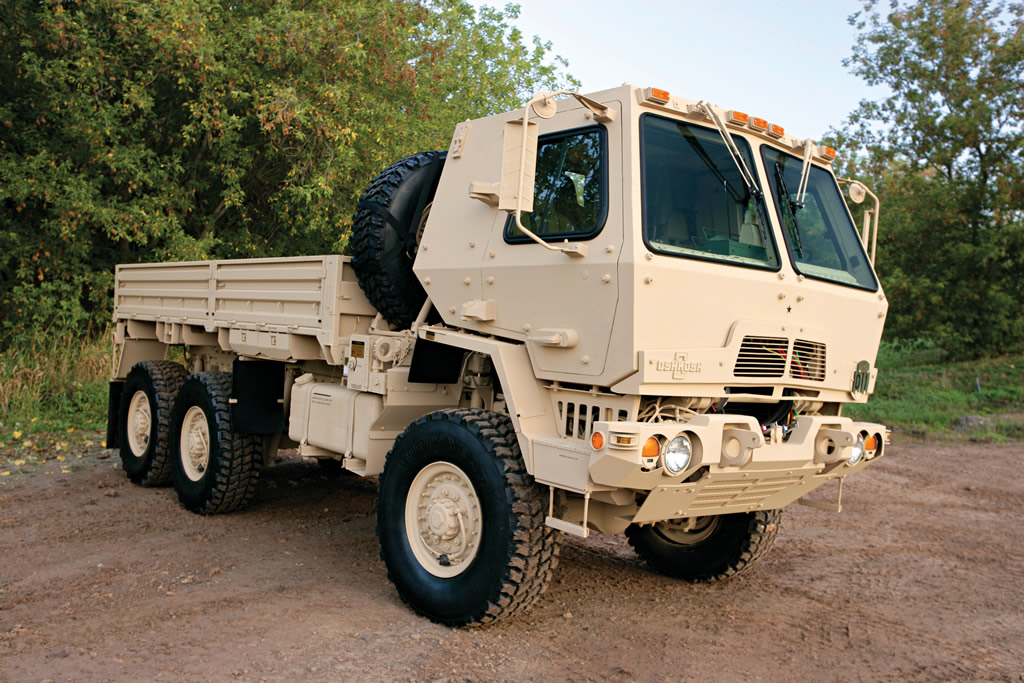
The 14 variants in the Family of Medium Tactical Vehicles (FMTV) form the core of the USA’s new state-of-the-art medium military transport truck fleet. Which in turn forms the core of the “mature logistics capability” seen in the Iraqi theater and elsewhere. FMTV trucks are all automatic transmission, and range from 2.5-ton cargo and van models to 5-ton cargo, tractor, van, wrecker, tanker, specialty, and dump-truck models in various 4×4 and 6×6 configurations. Some models also have attached trailers that increase their carrying capacity. Even so, the use of common engines, transmissions, drivelines, power trains, tires, cabs, etc. create over 80% parts commonality between FMTV models. Where possible, commercial components are used for added savings.
There have been 3 main phases of the FMTV program, including the last “SO23” open competition in 2003. All told, more than 50,000 FMTV trucks in various models have been delivered to the US Army. A bridging order to BAE continued production in Sealy, TX from 2008 through 2010, but the 4th phase re-compete saw a new firm begin FMTV production – alongside heavy truck production for the Army (FHTV) and Marines (LVSR), and medium trucks for the US Marine Corps (MTVR).
FMTV Program & Production

(click to view full)
Under the new contract, Oshkosh Corp. has been awarded a competitive, 5-year requirements contract to build up to 12,415 trucks and 10,926 trailers, and provide associated support and engineering services. The total estimated contract value at award was $3.023 billion.
BAE Systems subsidiary Stewart & Stevenson won the initial FMTV competition to begin producing these trucks, and has retained the manufacturing contract through previous rebuy competitions, a merger with Armor Holdings, and Armor Holding’s absorption into BAE. The current FMTV rebuy program is a 5-year requirements contract award for up to 23,000 vehicles and trailers, as well as support services and engineering. The addition of support services is significant, and can amount to a notable portion of the contract’s full value over time.
Subsequent reports indicate that for this re-buy program, BAE Systems submitted a bid 20% lower than the current FMTV price, despite a supply chain for FMTV that is 60% directed source (i.e. sub-contractors and parts specified by the government). Oshkosh’s bid was reportedly 33% below the current FMTV price.
In addition to their role as the backbone of the US Army’s truck fleet, FMTV trucks serve as the base for key weapons systems like the future MEADS air-defense system and the new HIMARS air-portable multiple rocket launchers, and as the base for some blast-resistant vehicles like BAE’s Caiman. These designs are excluded from the FMTV re-buy.
Even without these specialty variants, FMTV production has ramped up sharply over the last few years. Initial rates of production were approximately 2,400 trucks per year, but that rate has now accelerated to 7,200 (about 32/day) and was expected to reach over 8,000 per year (about 42/day) at BAE’s plant in Sealy, TX during FY 2009.
Heavy use in theater and casualties of chance or battle have contributed somewhat to this production ramp-up, but other factors also play a major role. One is the desire to grow the US Army by over 60,000 soldiers. The importance of logistics means that more soldiers will need more trucks, especially as the regular army focuses on assuming more of the sustainment role that has traditionally been assigned to the National Guard and Reserves. Meanwhile, those military reserve forces are driving 30 and even 40 year old trucks that are reaching the end of any useful life cycle, and must be replaced quickly.
These factors mean that the FMTV’s production pace is unlikely to abate much, creating high hurdles for Oshkosh to meet. Fortunately, intellectual property rights are not an issue, as the government owns the blueprints. On the other hand, even “build-to-print” contracts usually end up accommodating contractor-specific systems and improvements. FMTV design had been frozen at the A1P2 version prior to this recompete, in order to ensure a level playing field, but a successful award opens the door to a new development and enhancement schedule. That was part of initial and ongoing discussions with the US Army, as Oshkosh prepared to ramp up its own FMTV production. So far, the transition is going well.
Budgets and production orders under this new contract include:
* FY 2010: $1.438 billion ($5.5M RDT&E, $1.344 billion procurement for 8,637).
* FY 2011 request: $1.438 billion ($3.7M RDT&E, $1.435 billion procurement for 4,652).
* FY 2012 request: $ 448 million ($4.0M RDT&E, $ 432.9M procurement for 2,390, $11.1M supplemental funding for 32 more to make 2,442).
Contracts and Key Events
(click to view full)
The current FMTV rebuy program is a 5-year firm-fixed-price requirements contract award that was originally intended for up to 23,000 vehicles and trailers, as well as support services and engineering. It has now surpassed those totals. Unless otherwise noted, US Army TACOM Life Cycle Management Command in Warren, MI, manages the contracts, and Oshkosh Corp. in Oshkosh, WI is the contractor. Bids for the original contract were solicited on the World Wide Web, with 3 bids received.
FY 2015-2018
February 12/18: Contract Award The US Army awarded Wednesday, February 7, a $476 million contract to Oshkosh to build the latest A2 variant of the Family of Medium Tactical Vehicles (FMTV). Production will be completed by February 2022, with work locations to be determined with each order. The Army and Oshkosh Defense will now finalize the FMTV A2 designs, conduct required testing, and then launch into production. New vehicles should begin rolling off the production line in 2020. First introduced in 1991, the years has seen multiple vendors produce, upgrade, and improve more than 75,000 FMTVs. Over this period, the Army has also pursued several improvements to its Family of Medium Tactical Vehicles, most recently with the competitively awarded “A1P2” version in 2008. For the A2, the Army asked vendors to propose a series of changes to the truck’s design, known as Engineering Change Proposals, along with a plan to take the updated design and begin producing new trucks. Those new trucks will feature a higher capacity chassis to carry enhanced protection, a higher output alternator to simplify the electrical system and feed the growing demand for power, support enhanced vehicle diagnostics, increase engine power and performance, and introduce key safety features like electronic stability control.
January 18/17: Israel’s Defense Ministry has contracted Oshkosh Defense to provide 200 FMTV tactical trucks. Valued at $200 million, the deal comes after vigorous field testing by Israel of six trucks to ensure the firm’s Family of Medium Tactical Vehicles (FMTV) meets Israeli requirements. It’s expected that this order will be added too, as Tel Aviv begins the replacement of the nearly 60-year old tactical trucks currently used by its logistics branch.
September 24/15: Oshkosh Defense has been handed a $47 million modification to add an additional 184 medium tactical vehicles to a $4.7 billion Foreign Military Sales order in 2009, with the new vehicles headed for Iraq. The vehicles are scheduled for delivery by February 2017.
FY 2012
April 13/12: A $60.1 million firm-fixed-price contract modification for FMTVs. Work will be performed in Oshkosh, WI, with an estimated completion date of Sept 30/14 (W56HZV-09-D-0159).
April 2/12: A $294.7 million firm-fixed-price contract for FMTV support services. Oshkosh, on the other hand, says the contract will buy “more than 2,500” FMTV trucks and trailers for the U.S. Army, and adds that the US Army has now ordered “more than 29,000” FMTV trucks and trailers from them. From a program standpoint, that would be on top of previous orders to Armor Holdings and its eventual buyer, BAE Systems.
Work will be performed in Oshkosh, WI, with an estimated completion date of Sept 30/14 (W56HAV-09-D-0159). See also Oshkosh release.
March 30/12: The Pentagon’s Selected Acquisitions Report ending Dec 31/11 includes FMTV, and isn’t good news for Oshkosh:
“Program costs decreased $1,965.7 million (-10.5%) from $18,731.4 million to $16,765.7 million, due primarily to a quantity decrease of 7,463 trucks from 87,839 to 80,376 trucks (-$1,266.1 million) and associated schedule, engineering, and estimating allocations* (-$504.1 million). The quantity decrease also lowered estimates for non-recurring engineering, specifically, program management, non-recurring testing, and in-house and contractor engineering costs (-$135.2 million). There were additional decreases for unit cost savings from Engineering Change Proposal (ECP) definitization (-$146.8 million). These decreases were partially offset by the application of revised escalation indices (+$80.4 million).”
Feb 23/12: Oshkosh Defense unveils its “FMTV Enhanced Protection & Mobility Demonstrator” (EPMD) at AUSA Winter. The prototype vehicle utilizes the same Oshkosh TAK-4 independent suspension system that equips USMC trucks, and which is retrofitting many Army MRAPs. That change will improve mobility, while a custom-fitted Oshkosh Underbody Improvement Kit (UIK) improves protection against land mines.
These changes are important on a business level, because Oshkosh was depending on sales of upgrades and improved versions, in order to offset its unprofitable base bid (vid. Jan 9/12). Now the question becomes whether the US Army will bite.
Feb 3/12: Proxy battle win. Oshkosh’s 8-K/A filing says that all 13 of the corporation’s nominated Board members were elected, and all 6 of the Icahn Group’s nominees were defeated.
Icahn came close to getting a seat on the Board for his group, and that 13th seat had to wait for the full count, but overall, it’s a pretty stinging rebuff. The company nominee with the fewest share votes was Harvey N. Medvin, at 40,619,097; 5 of his 12 colleagues received over 79 million share votes. The Icahn nominee with the most share votes was Samuel Merksamer, at 39,016,262; 3 of his 5 colleagues received less than 15.5 million share votes, and those 3 were the only nominees to have more “withheld” votes than affirmative votes.
Jan 17/12: A $17.1 million firm-fixed-price contract modification to buy FMTV air conditioning install kits. Work will be performed in Oshkosh, WI, with an estimated completion date of Oct 31/13 (W56HZV-09-D-0159).
Jan 17/12: Oshkosh touts endorsements of its Board of Directors slate from independent proxy advisory firms Glass Lewis & Co. (Glass Lewis) and Egan-Jones Proxy Services (Egan-Jones). Voting is Jan 27/12.
Jan 9/12: Proxy battle – I choose you, Pikachu! The proxy skirmish with Icahn turns into a war – and the FMTV contract is a prominent feature. Icahn’s SEC DFAN14A materials express concern about the coming FHTV re-bid, and identify Oshkosh’s FMTV win strategy as 1 of 2 devastating strategic mistakes (the 2006 JLG acquisition being the other) that have consumed management’s attention and driven down profitability, even as other business segments have floundered and need focus:
“We believe that the FMTV represents the single largest problem with the future of this company… We believe this unprofitable contract represents management’s unrealistic attitude and poor planning, as well as the board’s lack of oversight on a product that represents over half of segment revenue.”
Oshkosh management’s filing points to the JLG acquisition as key to its M-ATV MRAP win, cites growing market share in defense, and asks for shareholders to wait for its markets to pick up. It directly attacks Icahn’s Board candidates as, in effect, a bunch of dependent puppets with little relevant experience in its key segments of defense or construction, and poor records with other companies. Management adds that Mr. Icahn has tried to circumvent Wisconsin’s business combination statute for shareholder protection, alleges that he had offered no substantive ideas to Oshkosh management when asked (though his DFAN14A has clear positions), and states that he refused to discuss his analysis behind the Navistar merger recommendation. In its 8-K filing, however, Oshkosh management make a concession, by pledging to “report profit on its Family of Medium Tactical Vehicles contract for the first quarter of fiscal 2012.”
The facts of the matter do make it appear that the Army played its FMTV hand well, and Oshkosh chose a strategy that failed at every point. As BAE surmised at the time, given the value of Army-specified sub-contracts, Oshkosh’s bid could not be profitable, and has not been. Worse, the Army chose not to be interested in enhancements, which would have restored some profit for Oshkosh; they also front-loaded FMTV purchases, before price-escalation clauses in the contract could kick in. Though this acquisition approach drove down short-term costs, in the long term, it could actually backfire on the Army by destroying 2 key suppliers. With BAE’s Sealy, TX truck plant largely emptied of work and staff, an analysis from the Lexington Institute sounds a cautionary note for the US Army, and wonders if its procurement victory will prove as pyrrhic as Oshkosh’s:
“[Oshkosh] finds itself in this predicament because it made some ill-timed acquisitions at the top of the sub-prime real estate boom (most notable lift-maker JLG), and then sought to compensate for its error by bidding very aggressively on Army truck contracts… workers would not be the only victims of the [proposed Navistar merger]… [A commercial suppliers strategy] ignores the loss of control implied for the Army customer. When you are by far the biggest source of demand for a company’s products, then you can pretty much dictate the terms of the relationship. When you are only one of many customers, you have less influence… The fact that submerging Oshkosh into the Navistar culture will give the Army fewer competitive options in the future is fine with [Icahn]; that’s how you get pricing power.”
It all comes to a head on Jan 27/12. See: Oshkosh 8-K | Oshkosh management’s SEC DEFA14A filing (see esp. pp. 38-44) | Icahn Group DFAN14A arguments | The Street | Reuters | Lexington Institute analysis.
Jan 5/12: A $27.3 million firm-fixed-price contract modification for more FMTVs. Work will be performed in Oshkosh, WI, with an estimated completion date of June 30/13. The original bid was solicited through the Internet, with 3 bids received by US Army Contracting Command in Warren, MI (W56HZV-09-D-0159).
Jan 5/12: A $7.6 million firm-fixed-price contract modification to support FMTVs. Work will be performed in Oshkosh, WI, with an estimated completion date of Oct 13/13. The original bid was solicited through the Internet, with 3 bids received by US Army Contracting Command in Warren, MI (W58HZV-09-D-0159).
Dec 6/11: Navistar/Oshkosh merger? Billionaire Carl Icahn owns 10% of Navistar, and 9.51% of Oshkosh, so his comments that the 2 companies should merge draws a lot of attention. He tells CNBC:
“I definitely think it would be a good merger. I think there would be a lot of synergy. I own stock in both and I think shareholders of both companies would benefit.”
Both Boards of Directors are maneuvering defensively around Icahn. Navistar agreed to put its Board up for election each year, but agreed not to propose his own slate of directors at the annual meeting. Things are a bit more open at Oshkosh, where Icahn is proposing Board slates, and has been increasingly critical of existing management.
Nov 10/11: A $19.1 million firm-fixed-price contract for 129 FMTVs; 11 armor B-Kits; 20 FMTVs; and 20 FMTV “High Mobility Artillery Rocket System B-Kits; with install for United Arab Emirates.” Work will be performed in Oshkosh, WI, with an estimated completion date of June 30/13 (W56HZV-09-D-0159).
The wording above is somewhat unclear, but Oshkosh has now confirmed that the UAE order is just 20 trailers and armoring B-kits. The UAE has an active HIMARS program, which began with their September 2006 DSCA request. As a Feb 3/09 announcement from BAE suggested, the UAE had already bought its FMTV chassis.
FY 2011
Sept 29/11: A $30 million firm-fixed-price contract modification for 452 FMTV family trucks, and 86 up-armoring B-kits. Work will be performed in Oshkosh, WI, with an estimated completion date of June 30/13 (W56HZV-09-D-0159).
According to DID’s records, based on announced contracts, this brings the total number of FMTV trucks ordered under this new contract to 23,665, plus 2,806 trailers, and 127 up-armoring B-kits, at a cost of about $3.69 billion.
Aug 1/11: A $904.2 million firm-fixed-price contract modification to procure 6,963 FMTV truck variants. Work will be performed in Oshkosh, WI, with an estimated completion date of June 30/13 (W56HZV-09-D-0159). See also Oshkosh release.
Aug 1/11: James Hasik’s new research service offers a timely memorandum, asking how much money Oshkosh is losing on its FMTV contract: “Just how much money is Oshkosh losing on the FMTV contract? And should the customer care?.”
That has long been suspected, as over 60% of the FMTV truck’s cost is fixed-price, mandatory “directed source” items from subcontractors, and Oshkosh’s bid was reportedly 33% below the SO23 contract’s FMTV price. Using information from past orders, such as those listed here, he gets average current contract costs of $181,000 per truck and $71,000 per trailer, which seems to match up with order totals so far. Further estimates involving relative truck production rates, relative value, and announced margin rates for the defense division:
“…give us estimates of -21% as the FMTV margin in Q2 2011, -15% as the FMVT [sic] margin in Q3 2011… with some slightly different assumptions, I got margins of -10% and -6%.1 As the FMTV contract will account for at least $150 million of Oshkosh Defense’s business over the next five years, taking losses can’t be shrugged off… as Charlie Szews has taken personal control at Defense, the problem has clearly been recognized. And indeed, if the overall margin is improving with increasing volume, then they’re not losing money on every truck. It’s not as though the value of the bill of material exceeds the sale price. There’s a positive contribution margin, so there’s hope that things might work out… Today, we have the beginnings of ex post measures – actual, if inferred, performance on the contract. Losing 15 percent on a $295 million gig means that you’re spending $347 million to get that 295; in short, that’s a $52 million quarterly loss. Yet quite apart from the commercial business, Defense is still grossing about a billion dollars quarterly, and the bonanza of the M-ATV work is almost at an end. So that bid on the FMTV contract, which now seems to have been hazardous, should still not prove fatal. Oshkosh may yet turn it around, but even if it doesn’t, only Oshkosh’s shareholders will suffer.”
While Hasik’s concern is focused on whether the contract would endanger Oshkosh as a company, there’s also an industrial base issue, wherein a supplier bids below cost, in order to drive a competitor out of business and secure a monopoly or near monopoly position with respect to American production facilities. That’s precisely the situation in the Boeing/Airbus tanker competition, which will also cost taxpayers above and beyond the bid price. It’s likely that as the defense business contracts under spending cuts, we’ll see more of this behavior. It isn’t clear that the US DoD has thought about this issue, and determined the best guidelines for responding.
July 25/11: A $30.5 million firm-fixed-price contract for 185 FMTV trucks and 1 armor B-kit. Work will be performed in Oshkosh, WI, with an estimated completion date of April 3/13 (W56HZV-09-D-0159).
June 14/11: A $7 million firm-fixed-price contract for 44 FMTVs. The contract runs until March 31/12 (W56HZV-09-D-0159).
April 20/11: A $71.8 million firm-fixed-price contract for 417 FMTVs of different types. Work will be performed in Oshkosh, WI, with an estimated completion date of March 31/12 (W56HZV-09-D-0159).
April 15/11: The Pentagon’s Selected Acquisitions Report ending Dec 30/10 includes FMTV program changes – but they cost adjustments are downward:
“Family of Medium Tactical Vehicles (FMTV) – Program costs decreased $1,895.2 million (-9.2 percent) from $20,626.6 million to $18,731.4 million, due primarily to reductions in costs resulting from the award of a new competitive re-buy contract (-$2,308.6 million), acceleration of the procurement buy profile (-$328.9 million), and a change in the model mix (-$230.4 million). There are additional decreases for fielding and non-recurring costs (-$236.7 million) and other support (-$149.1 million) due to early completion of the program. These decreases are partially offset by a quantity increase of 4,654 trucks from 83,185 to 87,839 trucks (+$786.5 million) and associated schedule, engineering, and estimating allocations* (+$588.8 million).”
* Note: Quantity changes are estimated based on the original SAR baseline cost-quantity relationship. Cost changes since the original baseline are separately categorized as schedule, engineering, or estimating “allocations.” The total impact of a quantity change is the identified “quantity” change plus all associated “allocations.”
Feb 28/11: A $25.2 million firm-fixed-price contract for 315 FMTV medium trucks, 3 B-Kits, and program support. Work will be performed in Oshkosh, WI, with an estimated completion date of March 31/12 (W56HZV-09-D-0159).
According to DID’s records, based on announced contracts, this brings the total number of FMTV trucks ordered under this new contract to 15,604.
Feb 14/11: The Pentagon issues its FY 2012 budget request, even as the new 112th Congress is forced to debate a FY 2011 budget, in order to repair the failure of the 111th Congress to pass one. The FY 2010-2011 requests were around $1.4 billion, but FY 2012’s request drops sharpy to $448 million for a total of 2,442 more FMTV trucks).
Dec 3/10: A $413.2 million firm-fixed-price contract for 1,800 family of medium tactical vehicles for the US Army National Guard. Work will be performed in Oshkosh, WI with an estimated completion date of March 12/13 (W56HZV-09-D-0159).
Dec 3/10: A $100.1 million firm-fixed-price contract for 1,800 family of medium tactical vehicles for the US Army National Guard. Work will be performed in Oshkosh, WI with an estimated completion date of March 12/13 (W56HZV-09-D-0159). DID is investigating the discrepancy in these figures.
Nov 19/10: As final deliveries from BAE Systems continue, and initial deliveries from Oshkosh begin, the U.S. Army is busy testing the new FMTV trucks at Aberdeen Proving Ground, MD, and Yuma Proving Ground, AZ. Lt. Col. Shane Fullmer, the Army’s product manager for medium tactical vehicles:
“Testing is going very well. The process involves 20,000 miles of reliability and durability testing – plus performance testing which is everything from [performance on] slopes to speed, endurance and payload capability… Given what we’ve seen to date, we are in good shape to easily meet our reliability requirements.”
The trucks are also subject to live fire blast testing, and performance testing including fording, hill grade/ payload tests, pull capability for tractors, etc. Testing is expected to conclude in the spring of 2011. US Army.
Nov 19/10: A $797.9 million firm-fixed-price contract for 4,773 FMTV trucks – though the Oshkosh release says that 590 trailers are part of that total, meaning truck orders are just 4,183. Work will be performed in Oshkosh, WI, with an estimated completion date of March 31/12. Oshkosh is more exact: deliveries are scheduled to begin in September 2011, and finish in August 2012. (W56HZV-09-D-0159).
Based on announced contracts listed in this article, the current rebuy program has issued $2.1 billion in contracts so far, to buy 13,239 trucks, 1,156 trailers, and 37 armoring b-Kits.
FY 2010
Sept 10/10: A $260.1 million firm-fixed-price contract for the production of 2,060 FMTVs. Work is to be performed in Oshkosh, WI with an estimated completion date of March 31/12. (W56HZV-09-D-0159). Oshkosh release
Sept 3/10: A $20.5 million firm-fixed-price contract for 122 FMTV vehicles by March 31/12, with work to be performed at Oshkosh, WI (W56HZV-09-D-0159).
Aug 16/10: A $201.5 million firm-fixed-price contract for 1,288 FMTV trucks. Work is to be performed in Oshkosh, WI, with an estimated completion date of March 31/12 (W56HZV-09-D-0159).
July 2/10: A $105.6 million firm-fixed-price contract for 621 FMTV trucks, and 43 trailers. Work will be performed in Oshkosh, WI, with an estimated completion date of March 31/12 (W56HZV-09-D-0159).
July 2/10: A $30.9 million firm-fixed-price contract for 167 FMTV trucks, 37 armor b-kits, and 119 trailers. Work will be performed in Oshkosh, WI, with an estimated completion date of March 31/12 (W56HZV-09-D-0159).
May 27/10: Oshkosh Defense ships its first FMTV trucks and trailers to the U.S. Army, including a Long-Term Armor Strategy (LTAS)-compliant cab. The 2 trucks represent 2 different FMTV variants and their trailers, and were shipped ahead of schedule. The original timeline had Oshkosh Defense beginning to deliver full production units in October 2010. Oshkosh Defense.
May 10/10: Oshkosh Corp. in Oshkosh, WI receives a $410.1 million firm-fixed-price contract for 2,230 FMTV family trucks, and 404 trailers, for deliveries scheduled between March and December 2011. To date, Oshkosh Corporation has received orders valued at more than $690 million under the new FMTV contract, and the company will begin supplying initial trucks to the Army this month for performance and durability testing. Production deliveries will begin in October 2010, and the contract’s formal completion date is March 31/12. (W56HZV-09-D-0159).
As part of its efforts, Oshkosh Corporation has also broken ground on a new 150,000-square-foot, state-of-the-art electrocoat (E-coat) facility in Oshkosh, WI, to support the FMTV program, and possibly other programs. The E-coat facility will help ensure corrosion protection, one of the FMTV fleet’s key attributes in order to meet its demanding time-of-service requirements; competitor BAE Systems had an operational E-coat facility of its own in Sealy, TX, but that may now be closed. Start-up of Oshkosh’s facility will begin in late summer 2010, and the firm is also moving into a new building in Warren, MI for FMTV System Technical Support (STS) work. The firm expects to hire up to 190 new employees. See also Oshkosh Defense release.
April 27/10: The Oshkosh award may end up complicating life for the M142 HIMARS rocket launcher program, fielded by the US Army and Marines, and by several foreign militaries. The Army has 2 more years of buying HIMARS, but there’s a 14-month lag from contract award to delivery. The Army planned to procure its last 44 BAE chassis for the HIMARS system in FY 2011 under its bridging contract, but BAE is expected to discontinue FMTV production during the period of time it would take to build the chassis.
Col. Dave Rice, program manager for precision fires, rocket and missile systems, added that BAE’s Increased Crew Protection (ICP) cab for the HIMARS is a proprietary design. The Army will “have to see if the cab changes are militarily significant,” and then decide what to do. Gannett’s Army Times.
April 23/10: A bnet columnist criticizes Michigan for awarding Oshkosh a tax break, in order to do what it had to do anyway:
“As part of the contract, Oshkosh Defense agreed to establish a technical center in Michigan that will eventually employ up to 200 people. The office will be located on the site of the closed Detroit Arsenal Tank Plant. The Army office that manages vehicle acquisition is located in the area, so it makes sense for Oshkosh to have people nearby.
And there’s the rub. The state gave Oshkosh a $6.4 million tax credit to help build the facility. This is part of a “renaissance zone” program to revitalize older, existing industrial sites. Oshkosh won’t pay taxes until 2011 at the earliest and then it might well be at a reduced rate.
The question is: Does Oshkosh need the help? The company would have needed an office, anyway, to manage both the MRAP-ATV and the FMTV contracts. So it appears that Michigan is essentially paying some of Oshkosh’s costs. Considering that the state is running a $1 billion budget deficit (after $1 billion in spending cuts), it’s hard to justify giving Oshkosh tax breaks to do something it was already planning to do.”

Feb 12/10: Oshkosh keeps the award. US Department of Defense:
“The Department of the Army announced today that it has re-evaluated the contract award decision for its Family of Medium Tactical Vehicles (FMTV) originally made on Aug. 26, 2009. This change was based on Government Accountability Office’s (GAO) recommendations. Accordingly, Oshkosh Corp. has been awarded a competitive, five-year requirements contract for production of up to 12,415 trucks, 10,926 trailers, and associated support and engineering services. The total estimated contract value at award was $3.023 billion… From Dec. 21, 2009, to Jan. 22, 2010, the Army re-evaluated the proposals in accordance with the GAO’s recommendation. Subsequently, there was an Office of the Secretary of Defense peer review affirming the Army’s reevaluation process.”
Oshkosh celebrated the award in a corporate release, while BAE Systems was forced to notify its investors:
“…the Group will include in its 2009 accounts an impairment of goodwill and other intangible assets amounting to [GBP] 592 million relating to the Armor Holdings Inc. transaction and specifically the FMTV product line.”
The news is a major blow to BAE Systems’ $4.53 billion acquisition of Armor Holdings. With its core FMTV business about to end, MRAP production finished, and the M-ATV competition lost to Oshkosh, much now rides on the JLTV competition. At the same time, BAE Systems’ UK facilities recently announced potential job losses in its submarine business, and a minor trimming of its Nimrod-related workforce.
Dec 14/09: Congress’ Government Accountability Office issues its decision, recommending that the Army reevaluate the offerors’ capability evaluation factor, and make a new selection decision. GAO managing associate general Michael Golden said that:
“Our review of the record led us to conclude that the Army’s evaluation was flawed with regard to the evaluation of Oshkosh’s proposal under the capability evaluation factor, and the evaluation of Navistar’s past performance… We also denied a number of Navistar’s and BAE’s challenges to the award to Oshkosh, including challenges to the evaluation of Oshkosh’s price.”
By statute, the Army now has 60 days to inform the GAO of its response to the GAO’s recommendations. BAE Systems welcomes the decision, while looking forward “to reviewing the full GAO report and its recommendations so we can fully consider the implications for our business and our options…” Oshkosh Corporation Chairman and CEO Robert G. Bohn said in their corporate release that challenges to the evaluation of the Oshkosh Corporation price had been denied, adding that:
“It is important to realize that today’s decision did not recommend proposal revisions nor did it recommend termination of our contract… We believe that when these narrow issues are reconsidered, the Army’s decision to award Oshkosh Corporation the FMTV contract will be maintained.”
See: Redacted GAO decision [PDF] | Navistar release | Oshkosh release | The Hill.
Nov 19/09: Oshkosh discusses its efforts to secure tax breaks from the city of Oshkosh, as it plans to expand its manufacturing facilities by adding a new 150,000-square-foot electrocoat (E-coat) painting facility for FMTV production. The company plans to break ground on the new E-coat facility in December 2009, with start up beginning late summer 2010. Oshkosh | The Northwestern.
The financing package would have the city provide up to $5 million in tax incremental financing (TIF), while the state would provide $35 million in tax credits and other assistance for the plant. The TIF district is pending approval by the Oshkosh Common Council. BAE Systems promptly weighs in, of course:
“BAE Systems has two electrostatic E-Coat stations at our Sealy, Texas facility, one for large parts and one for small parts. As outlined on p. 41 of the redacted second supplemental protest document, the Army’s FMTV re-buy solicitation provided that: “An offeror that currently has existing facilities that can be utilized, or modified to build FMTV vehicles may be determined to be less risky than an offeror that has to acquire facilities to produce vehicles on the contract.” E-Coat is a requirement to build FMTV and is at the heart of its corrosion protection. Parts must be completely immersed in electrophoretic paint emulsion, at which point an electrical charge is run through both and then the parts are drained entirely.
As we read of our competitor seeking taxpayer assistance to build a new E-coat facility – in a very short time frame – to meet the requirements of the FMTV contract, we find it totally inconsistent with the source selection criteria to believe that BAE Systems, with two E-coat facilities in current operation, is considered equal in risk with a company that doesn’t have this essential capability and is looking for the taxpayers to pay for it.”
Nov 18/09: BAE Systems holds a teleconference to discuss their protest, and the recent GAO hearings. A GAO decision is expected by Dec 14/09, which is the 100th day, in conformance with GAO rules.
One clarification up front is that FMTV variants used as part of other weapons system, such as HIMARS rocket launchers, SLAMRAAM air defense systems, MEADS air defense systems, and the FMTV Low-Velocity Airdrop version used by airborne forces, were all removed from the re-buy competition in February 2009. Program managers for those systems will apparently make those decisions, but BAE does have some unique intellectual property in those vehicles’ current designs. If lack of production orders causes BAE to shutter their Sealy, TX facility, the firm would have to begin production of those variants elsewhere at added cost; alternatively, any competitor selected instead would have to replicate and test the vehicles’ mission-specific design features, either at its own expense or at the government’s. The derivative Caiman MRAP was never part of the FMTV re-buy, and remains BAE’s intellectual property.
In response to questions from DID regarding the applicability of Oshkosh’s rapidly fielded and produced M-ATV MRAP as a risk-evaluation precedent, BAE representatives made several points. The core of those points was that M-ATV was an internally-held design, whereas FMTV is a government-held TDP (technical documentation), which does not include all of the know-how needed to build the vehicle, and has a much longer and more involved process for changes. In conjunction with a production schedule that resembles M-ATV’s aggressiveness, and the production of only 1 FMTV prototype from Oshkosh to date, BAE believes this represents added risk.
BAE Systems also believes there’s a question around the FMTV A1 LTAS-compliant (Long Term Armoring Strategy) cab design, which is currently BAE’s design. Competitors must re-design that cab, and replicate and test the A1P2 cab’s level of protection, which is just being fielded now. An Aug 13/09 Oshkosh release says that Oshkosh has done this design work at its own expense, but the release does not mention testing; BAE’s protest includes their observation that a design which requires testing and verification adds production and design risk.
Finally, with respect to reports from sources like the Lexington Institute (vid. Nov 4/09 entry), BAE representatives confirmed that Oshkosh’s $3 billion total evaluated price bid underbid the current FMTV price in the neighborhood of 30%, but add that BAE’s re-buy bid price was lower, too. The government, “for whatever reason,” published Oshkosh’s contract bid on their web site, down to variant level pricing. BAE systems knows the trucks very well, and fully 60% of the trucks’ value is directed source, which means the winning contractor must use those suppliers. BAE representatives do not believe that Oshkosh’s prices are realistic, and display similar skepticism regarding some of the elements of Oshkosh’s insourcing claims.
Oshkosh Defense was contacted regarding BAE claims, but chose not to respond.
Nov 18/09: The Greater Houston Partnership business advocacy umbrella organization releases the results of their study, which claims that the region would lose 3,400 direct jobs and 6,766 indirect jobs if Oshkosh retains the contract, with other effect spreading beyond to the state of Texas. The Partnership is joining other Sealy FMTV Task Force members in calling on the Army to put the contract out for a re-bid – in effect, a do-over. PR Newswire release.
Nov 17/09: BAE Systems releases a redacted version of its protest to the public, following agreement from the GAO and even Oshkosh. Its core allegation is that the buy was not best value, but became a solely price-based competition that disregarded risk factors. The protest also cites other past GAO cases that it believes to be analogous. Redacted FMTV Protest [PDF, 6.5 MB].
Nov 9-10/09: The GAO holds hearings regarding the FMTV protest. GAO hearings usually held when there are conflicting factual issues, and the dispute cannot be resolved merely from submissions. This is longer than usual for such hearings, but reports indicate that an array of Army witnesses were called.
Nov 4/09: Loren Thompson of The Lexington Institute predicts that the GAO will overturn the Army’s decision:
“Let’s revisit what happened in that competition, and ask whether a protest seems warranted…[The Army] made the award after concluding that incumbent BAE Systems and Oshkosh were essentially equal in all non-cost selection criteria, but that Oshkosh offered a more attractive price… On price, the Army accepted a bid from Oshkosh that is 30% below the price BAE Systems is currently charging for the vehicle – even though Oshkosh, with no direct experience in manufacturing the product, must turn out a vehicle with the same performance specifications and features, using many of the same suppliers. When challengers to an established producer offer such huge price reductions to win a contract, it is standard procedure to conduct a rigorous analysis of how realistic the challenger’s price is. Yet there is little evidence the Army made any such effort… leveling of non-cost factors… allowed… a “best value” award solely on the basis of price. But unlike BAE, Oshkosh did not have all production facilities or tooling in place; its workforce was not experienced in building FMTV trucks; it did not have established relationships with all suppliers; and it did not have a validated design for the required armored cab in the vehicle. So to say the rivals represented equivalent risk is simply not believable – especially given the very aggressive price targets Oshkosh’s bid required it to meet. GAO will see this award for what it was, and act accordingly.”
See: Issue Brief | Subsequent elaboration.
Oct 16/09: BAE Systems files another supplemental protest to the GAO:
“…after finding additional concerns with the source selection process during the U.S. Army’s Family of Medium Tactical Vehicles (FMTV) rebuy competition… BAE Systems is increasingly convinced the service’s source selection evaluation was flawed and that the Army did not follow its own stated objective to conduct a best-value FMTV competition based on a clear-cut set of criteria… BAE Systems is requesting that a redacted version of the supplemental protest be made available publicly. In order for release of a redacted supplemental protest, all parties involved in the matter must agree to its release.”
FY 2009

Sept 11/09: BAE Systems files a supplemental protest.
Sept 4/09: Both BAE Systems and Navistar Defense file GAO protests (file# 401865.2, 401865.1) regarding the FMTV award to Oshkosh. BAE:
“BAE Systems has filed a protest with the U.S. Government Accountability Office (GAO), asking the agency to review the decision by the U.S. Army to award a contract to a competitor for the Family of Medium Tactical Vehicles (FMTV) rebuy program. After a detailed analysis of the information provided by the Army, before and during the formal competition debrief, the Company believes that the Army did not properly evaluate the proposals, consistent with the Government’s stated requirements, and the Army failed accurately to assess the various risks associated with the different proposals.”
The GAO protests will put the FMTV re-buy contract on hold until a decision is rendered. A decision is expected by Dec 14/09.
Aug 26/09: Oshkosh wins the FMTV production re-compete, and an initial $280.9 million order for 2,568 trucks and trailers, plus OY 01 data, additional care and storage, component first article test, first production vehicle inspection test, production verification test, live test family medium tactical vehicles winch, armor B-kits, and federal retail tax. Work is to be performed in Oshkosh, WI, with initial test vehicle deliveries are planned for mid-2010, followed by production vehicle deliveries later in that year. With an estimated completion date of April 30/10 for this order. Bids were solicited on the World Wide Web with 3 bids received by TACOM LCMC Warren, AMSCC-TAC-ATB in Warren, MI (W56HZV-09-D-0159).
Wisconsin Governor Jim Doyle is quoted as saying that the total contract could be worth up to $2.6 billion and create 2,000 production jobs in the state. That’s definitely conservative, with other analysts placing the value closer to $4.5 billion, plus maintenance. Through the state’s Enterprise Zone program, Wisconsin will provide up to $35 million in tax credits over the next 12 years to support the project. In response to the win, Oshkosh CEO Robert Bohn reportedly said that “We’ve been known for a long, long time as a manufacturer that delivers on time and I think that helped us.” While it certainly didn’t hurt, BAE Systems had its own strong delivery record, including the top ranking among MRAP vehicle suppliers. It is very likely that the key differentiators lay elsewhere; tellingly, Oshkosh would not comment on pricing.
Over the past 17 years, Armor Holdings/BAE Systems has delivered more than 56,000 FMTV trucks and trailers, which have maintained a 94% average operational readiness rate in both Iraq and Afghanistan. BAE’s financial planning assumed FMTV-related sales and maintenance activities of about $2 billion in each of 2009 and 2010, dropping to less than $1 billion per year from 2011 onward. BAE announced that it “will continue to fulfill these commitments and consider its options as it carefully reviews the Army’s latest decision.” Translation: a protest is possible. Its absence would be surprising in the current climate, given the contract’s potential value.
FMTV bridge buys and maintenance efforts will continue using BAE Systems on Sealy, TX over 2009 and 2010, per the existing bridge-buy contract and partnership with Red River Army Depot. During this period, Oshkosh will make preparations, discuss final design details with the US Army, and ramp up production.
The long-term earnings hit, and implicit questions regarding the current value of its $4.5 billion Armor Holdings acquisition in 2007, sent BAE’s stock sliding. With MRAP production ended, MRAP-ATV going to Oshkosh, and its FMTV mainstay removed, BAE Systems’ American land vehicle strategy has taken a series of body blows that make the future JLTV competition even more important to the firm. Oshkosh stock has gone in a different direction, in the wake of a sole-source award to continue producing the US Army’s FHTV heavy trucks, its status as the ongoing manufacturer of the US Marines’ medium (MTVR) and heavy (LVSR) truck fleets, and a recent multi-billion win in the blast-resistant M-ATV competition that will also make them a contender for the larger JLTV Hummer replacement buy. See: Oshkosh Defense | BAE Systems | Milwaukee Business Journal | Bloomberg | UK’s Financial Times | Reuters.
May 27/09: BAE Systems submits its bid for the FMTV re-compete. Their corporate release touts over 17 years of experience, during which their 2,700 person facility in Sealy, TX has manufactured more than 53,000 FMTV trucks and trailers in 21 variants.
BAE is touting the strength of its workforce and its embedded knowledge that goes beyond the blueprints, and into production processes, efficiency, and proven flexibility. The delivery record for FMTV and its derivative Caimin MRAP vehicles has been excellent; indeed, Caimin was the #1 MRAP vehicle in its ratio of on-time to promised deliveries. Then, too, there is the specialized infrastructure like BAE’s Sealy e-coat facility, and privately developed off-blueprint additions like “miles to go on this tank” indicators and other enhancements.
May 27/09: Oshkosh submits its bid for the FMTV A1P2 re-buy contract. Their main competitor is a Sealy, TX incumbent with a formidable performance record of its own. In that situation, Oshkosh’s required priorities are twofold: (1) Avoid anything that might tip the scales against them, even slightly. That means driving perceived performance risk as close to zero as possible, and creating a net zero for political risks; and (2) produce a proposal that offers credible improvements in price and/or performance, against a very strong competitor.
In discussions with DID, the firm outlined the core of its case. Assuming a level playing field, the key criteria for this contract are price and past performance. Oshkosh believes they have a very credible, fact-based price derived from their own experiences building about 10,000 MTVR medium trucks for the Marines, and the fact that almost 90% of FMTV suppliers are already Oshkosh suppliers.
In terms of past performance risk, they pointed to the fact that their integrated production line has conducted simultaneous production of 10 models, totaling 29 variants – a record that matches well with the FMTV re-buy’s high mix/ low individual volume schedule. Oshkosh also touts its performance in the area of engineering and logistics support, which has become an integral aspect of the FMTV program. Their work with MTVR and the Army’s FHTV heavy truck family gives them a very wide field support network, and the firm cites its fast delivery and fielding of up-armored heavy trucks after the Army confirmed its LTAS armoring strategy. They’re building on that record with their FMTV related risk-reduction investments, which include an internally-financed design for an LTAS-compatible FMTV cab.
If Oshkosh wins, production would mostly take place on the firm’s existing campus in Oshkosh, WI, with some sub-contracting to current subcontractors. That kind of concentration generally improves price and efficiency numbers, but lowers political leverage. The other potential political strike is the “industry consolidation” card, which notes the risks of placing all medium and heavy truck production (Army’s FMTV & FHTV, USMC’s MTVR & LVSR) with one supplier and, for the most part, one campus. Oshkosh’s response is to cite the number and range of large firms involved in the MRAP and JLTV programs, and to state their belief that there has been a fundamental industry change over the past few years. Oshkosh Defense release.
Additional Readings
* Global Security – FMTV