
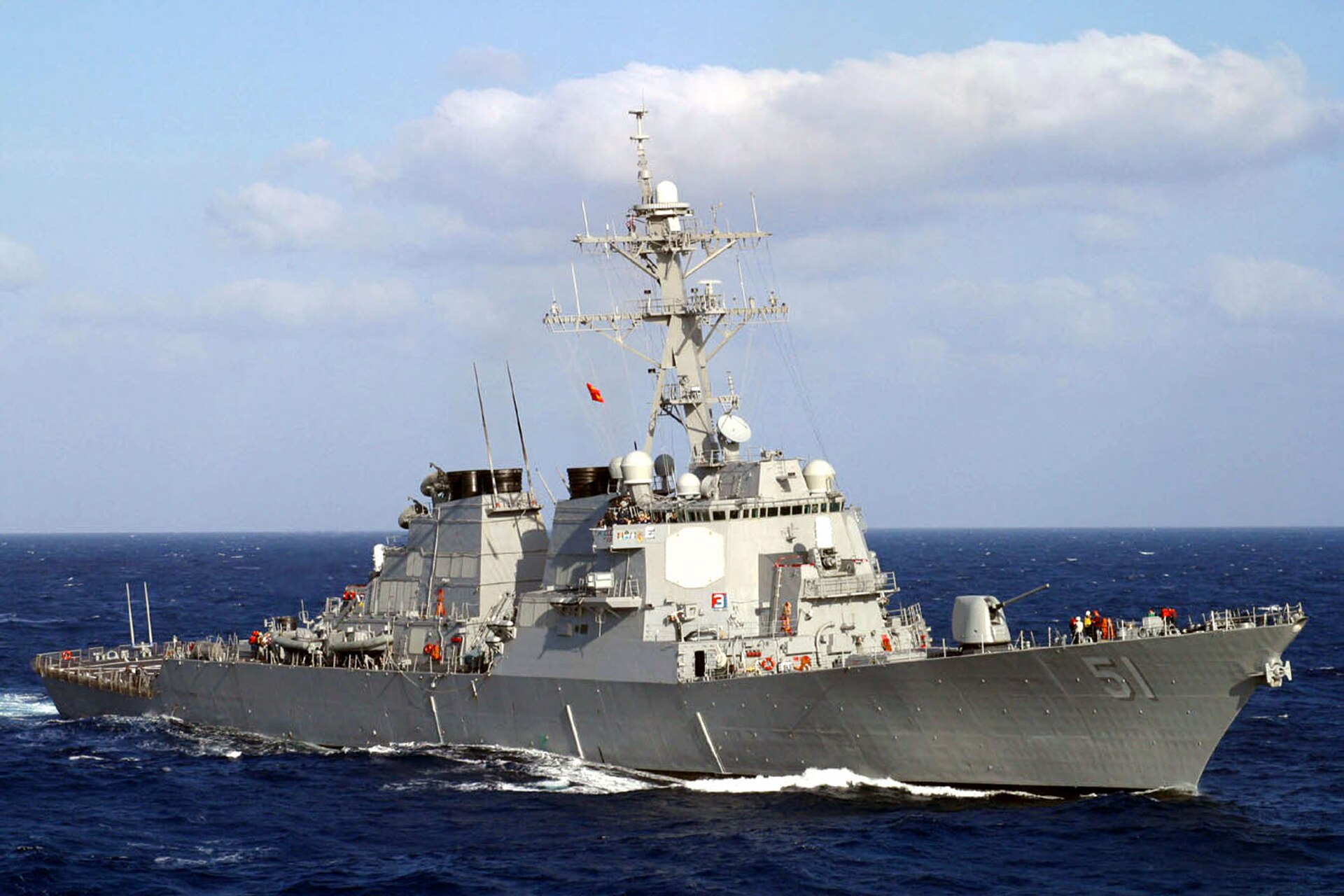

(click to view full)
In April 2009 Bath and Ingalls agreed to the Navy’s surface combatant plans, thus heralding a significant restructuring within the American naval shipbuilding community. Under the agreements, the USA would end production at 3 Graf Spee sized DDG-1000 Zumwalt Class “destroyers,” but shift all production from the Congressionally-mandated joint arrangements to General Dynamics Bath Iron Works in Maine, which had already made program-related investments in advanced shipbuilding technologies.
Northrop Grumman (now Huntington Ingalls Industries) would retain its DDG-1000 deckhouse work, but their main exchange was additional orders for DDG-51 Arleigh Burke Class destroyers. Their Ingalls yard in Pascagoula, Mississippi would continue building the DDG-51 destroyers, beginning with 2 ordered in FY 2010-2011.
The US Navy’s Revised DDG-51 Plan

(click to view full)
With the DDG-1000 Zumwalt Class ended at 3 ships, the DDG-51 Arleigh Burke Class ships will become more important to the future navy. The Navy’s FY 2011 budget also terminated the planned CG (X) cruiser program as unaffordable. Instead, the US Navy would field an updated DDG-51 Flight III version, starting in FY 2016.
That date has been pushed back, owing to technical issues with the Flight III ships. Under the current plan, the DDG-51 Flight IIA Restart version would remain in production from FY 2010-2017, buying 13 ships in total (DDG 113 – 125) under a multi-year buy program. Huntington Ingalls Industries ships ordered to date are both named after Congressional Medal of Honor recipients, and include:
* DDG 113 John Finn
* DDG 114 Ralph Johnson
Both Bath Iron Works and HII will continue to build ships of class, but lead yard status for the “DDG-51 restart” ships shifted to Northrop Grumman (now HII) during the restructuring. GD Bath Iron Works is currently contracted to build DDG 115 Rafael Peralta and & DDG 116 Thomas Hudner, as the DDG-51 follow-yard.
Beyond the Flight IIAs, US Navy plans once called for buying an undetermined number of DDG-51 Flight IIIs from FY 2016 through at least FY 2022, and perhaps until FY 2031. The follow-on DDG-51 Flight IIIs are expected to carry a smaller version of the new Air and Missile Defense Radar (AMDR-S) dual-band active array that was slated for the canceled CG (X), along with the upgraded power and cooling systems required to support it. Other enhancements will be fleshed out as detailed design work on the Flight III commences, reportedly in FY 2012-2013. Unfortunately, there have been early reports that integration of the AMDR radar could prove to be a problem. The new radar will need to have a power draw that the ship can handle, cooling needs that the ship’s design can meet, and a size that can fit within the ship’s available space, all without changing the destroyer’s balance and stability. That is, to put it mildly, a challenge. So, too, are growing cost estimates that are edging the DDG-51 Flight III toward the price of larger and more advanced DDG-1000 Zumwalt Class ships.
Flight III buys now appear set to start no earlier than FY 2018, if indeed they start at all. Current plans do call for an interim step, however, as part of the proposed 2012-2017 multi-year buy.
Under the current multi-year proposal, 1 of 2 FY 2016 ships (DDG 123), and both FY 2017 ships (DDG 124-125), will “incorporate Flight III capability,” but not the new radars themselves. The addition of the AMDR-S radar and other associated systems would be funded as an engineering change proposal (ECP), so it doesn’t look like it’s affecting multi-year pricing. Otherwise, the Navy wouldn’t be able to show enough savings [1] to justify a multi-year buy under US laws. The Flight III ECP won’t be awarded until the Flight III Milestone Decision Authority approves the configuration, and the greatest risk would be changes that involve significant retrofits of DDG 123-125, beyond adding the AMDR radar. Those kinds of changes are always much more expensive than installing systems during ship construction.
Contracts & Key Events
Article coverage essentially terminated in FY 2013, as the USA moved to a multi-year block-buy from both shipyards to finance remaining Flight IIA destroyers, and the initial Flight III ships.
One thing to notice while reading these is that ship construction contracts do not include important equipment like guns, radar, combat systems, missile launchers, etc. Those are bought independently as “Government Furnished Equipment,” though ship construction contracts do pay to have that equipment installed in the ships. Many of those contracts are not publicly announced, or not broken out specifically by ship. As such, any ancillary contracts covered here are suggestive and informative, not comprehensive. Indeed, those “ancillary” contracts make up the largest portion of the ship’s total cost.
FY 2013 – 2025
May 9/25: Rolls-Royce Marine North America won a $23.5 million firm-fixed-price, indefinite-delivery/indefinite-quantity contract for highly specialized design agent engineering and technical services for the LCS, Freedom variant, machinery plant control and monitoring system, and control area network and monitoring ships control system, DDG-51 class machinery control system, and LSD 41/49 propulsion logic management units. Work will be performed in Walpole, Massachusetts (80%); Mayport, Florida (6%); Norfolk, Virginia (4%); San Diego, California (4%); and various locations outside and across the continental US, each less than 1% (6%). Work will be completed by May 2030. Fiscal 2024 other procurement (Navy) funds in the amount of $149,183 will be obligated for the minimum guarantee. The Naval Surface Warfare Center Philadelphia Division, Philadelphia, Pennsylvania, is the contracting activity.
November 7/24: The US Navy has announced a life service extension for 12 Arleigh Burke-class (DDG 51) guided-missile destroyers beyond their expected 35-year operability. Ships selected involve Flight I systems commissioned between 1991 and 1997, which incorporate older designs and components, particularly in their primary anti-submarine warfare helicopter support capabilities.
July 11/24: The US Navy has accepted the 72nd Arleigh Burke-class destroyer from Bath Iron Works as part of a deal awarded in 2013. The USS John Basilone is a Flight IIA guided missile destroyer incorporating an advanced mine countermeasure solution, helicopter hangars, blast-hardened bulkheads, and additional electronic and networked systems. A keel-laying ceremony for the ship was held in 2020, followed by its christening two years later.
June 17/24: General Dynamics won a $202 million deal for DDG 51 Class Planning Yard. Work will take place in Bath, Maine, and is expected to be completed by July 31, 2029. Naval Sea Systems Command, Washington, DC is the contracting activity.
May 28/24: Green Expert Technology won a $13 million cost-plus-fixed fee task order for cybersecurity support for Arleigh Burke-class integrated bridge control systems. This task order includes options which, if exercised, would bring the cumulative value of this task order to $67,669,637. Work will be performed in Haddonfield, New Jersey (81%); and Philadelphia, Pennsylvania (19%), and is expected to be completed by May 2025. The Naval Surface Warfare Center Philadelphia Division, Philadelphia, Pennsylvania, is the contracting activity.
March 26/24: Life Cycle Engineering was awarded a $50 million cost-plus-fixed-fee contract for an indefinite-delivery/indefinite-quantity contract for the DDG 1000 Class Integrated Power System (IPS); the DDG 51 Class Flight III and New Construction IPS; the Advanced Missile Defense Radar Support Power Conversion Module IPS; and the DDG (X) Land Based Test Site IPS. Work will be assigned according to individual task orders and is expected to be completed by December 2029.
August 22/22: DDG-120 Pacific Shipyards International won a $17.2 million contract modification for the accomplishment of post shakedown availability (PSA). The PSA is for one Arleigh Burke Class guided missile destroyer (DDG 120). The USS Carl M. Levin is the 70th destroyer overall for the class. Work will take place in Hawaii. Expected. Completion will be by September 2023. The Naval Sea Systems Command, Washington, DC, is the contracting activity.
August 15/22: Lead Yard Support Bath Iron Works won a $35.4 million contract modification for lead yard support effort for the DDG-51 Class Guided Missile Destroyer program. Work will take place in Maine. Estimated completion will be in June 2023. The Naval Sea Systems Command, Washington, DC, is the contracting activity.
June 9/22: Lead Yard Support Bath Iron Works won a $54.6 million contract modification to exercise options for accomplishment of lead yard support for the DDG 51 class guided missile destroyer program. The DDG 51 class guided missile destroyers are warships that provide multi-mission offensive and defensive capabilities. The majority of work will take place in Maine. Estimated completion will be by June 2023.
May 10/22: Machinery Control System Lockheed Martin won a $14.5 million contract modification to exercise options for Machinery Control System production shipsets in support of both the DDG 51 modernization program and the DDG 51 new construction program. Work will be performed in Orlando, Florida, and is expected to be completed by June 202. The Naval Sea Systems Command, Washington DC, is the contracting activity.
April 19/22: Follow Yard Services Huntington Ingalls won a 41.7 million contract modification to exercise options for accomplishment of follow yard services for the DDG 51 Class destroyer program. The DDG 51 class guided missile destroyers are warships that provide multi-mission offensive and defensive capabilities. Destroyers can operate independently or as part of Carrier Strike Groups, Surface Action Groups, and Expeditionary Strike Groups. Work under the modification will take place in Mississippi, Washington DC and Maine. Estimated completion will be by April 2023.
February 4/22: PEO Serco won a $22 million contract action in support of the Program Executive Office (PEO) “SHIPS” PMS 400D mission to design, build, outfit and test all DDG 51 guided-missile destroyer-class ships, increasing the design performance capability of the DDG 51 class ships. The Arleigh Burke (DDG 51) class guided missile destroyers provide a wide range of warfighting capabilities in multi-threat air, surface and subsurface environments. The US Navy currently has seven new DDG 51 Flight III destroyers under construction, Work will take place in Washington DC. Estimated completion date is September 8, 2022.
January 26/22: Modernization General Dynamics won a $47.7 million deal for a dry-docking selected restricted availability in support of the USS Curtis Wilbur (DDG-54) to accomplish maintenance, repair, and modernization of the ship prior to the its next deployment. The USS Curtis Wilbur is the 4th Arleigh Burke Class missile destroyer. The Arleigh Burke class of guided missile destroyers is the USN’s first class of destroyers built around the Aegis Combat System and the SPY-1D multi-function phased array radar. Work will take place in California. Estimated completion will be by September 2023.
January 14/22: DDG 125 Huntington Ingalls Industries’ (HII) Ingalls Shipbuilding division achieved the Aegis light-off milestone on the US Navy’s first Flight III Arleigh Burke Class guided missile destroyer Jack H. Lucas (DDG 125). The Flight III upgrade incorporates a number of design modifications that collectively provide significantly enhanced capability. Aegis light-off is an important milestone for integrating and activating all of the new electric plant equipment and combat systems.
November 16/21: Industrial Base Efforts Huntington Ingalls won a $20 million cost modification for shipbuilding supplier industrial base efforts in support of the DDG 51 class destroyer program. The multimission warship features the AEGIS combat system, the Vertical Launching System, two embarked SH-60 helicopters along with advanced anti-aircraft missiles and land-attack missiles. Work will take place in Mississippi and is expected to be finished by April 2029.
August 31/21: Builder’s Trials According to Huntington Ingalls Industries’ (HII) Ingalls Shipbuilding division, the US Navy’s guided missile destroyer Frank E. Petersen Jr. (DDG 121) completed builder’s trials. The Arleigh Burke Class destroyer spent three days in the Gulf of Mexico testing the ship’s combat system, which included firing a missile.
July 21/21: AMOD Raytheon Missiles and Defense won a $35.7 million deal for the procurement of AEGIS modernization (AMOD) kits for Navy DDG 51 Class destroyers and for the government of Japan under the Foreign Military Sales program. The Navy’s Aegis Modernization program provides updated technology and systems for CG 47 Class Aegis guided missile cruisers and DDG 51 Class Aegis guided missile destroyers. The DDG 51 Arleigh Burke destroyers provide multi-mission offensive and defensive capabilities. They can operate independently or as part of carrier strike groups, surface action groups, amphibious ready groups, and underway replenishment groups. Work will take place in Massachusetts, Virginia and Burlington. Estimated completion will be by July 2024.
July 13/21: Not Enough Orders? Shipyards could suffer if the US Navy does not order additional Arleigh Burke Class destroyers, Deputy Defense Secretary Kathleen Hicks was told this week. Hicks visited Bath Iron Works in Maine, a General Dynamics subsidiary founded in 1884 whose primary customer is the US Navy, and the Naval Sea Systems Command’s Portsmouth, Naval Shipyard, to discuss a decrease in orders for Navy destroyers, the Pentagon said.
January 15/21: HELIOS The US Navy has moved one step closer towards integrating the High Energy Laser with Integrated Optical-dazzler and Surveillance (HELIOS) laser weapon system on an Arleigh Burke destroyer by taking delivery of the first system. A recent demonstration by Lockheed Martin and the Navy showed that the laser power achieved was in excess of the 60 kW requirement. Lockheed Martin completed the Critical Design Review and Navy Factory Qualification Test milestones in 2020, demonstrating the value of system engineering rigor and proven Aegis system integration and test processes on the way to delivering operationally effective and suitable laser weapon system that meets the Navy’s mission requirements.
December 14/20: Aegis Combat System Raytheon won a $38.8 million contract modification for the production of two Fire Control System MK 99 ship sets and the associated technical engineering services in support of the Aegis Combat System on DDG-51 class ships. The DDG 51 Class are the Arleigh Burke class destroyers in service with the US Navy. They are multi-mission warships with offensive and defensive capability in multi-threat air, surface, and subsurface environments. The USS Arleigh Burke (DDG 51), the first ship and namesake of the class, was commissioned on July 4, 1991. Since then 62 more ships have been commissioned. The MK-99 Fire Control System (FCS) is a major component of the AEGIS Combat System, a centralized, automated, command-and-control and weapons control system that was designed as a total weapon system, from detection to kill. It controls the loading and arming of the selected weapon, launches the weapon, and provides terminal guidance for AAW missiles. FCS controls the continuous wave illuminating radar, providing a very high probability of kill. Work will take place in Massachusetts, Virginia, Rhode Island and California. Estimated completion is in August 2024.
November 5/20: Malabar Exercise According to a statement by the US Pacific Fleet, the US participant in the Malabar exercise this year hosted by Indian Navy is the Arleigh Burke Class guided missile destroyer USS John S. MacCain. The Malabar exercise is a quadrilateral naval exercise involving the United States, Japan , Australia, and India as permanent partners. The exercise began in 1992 to advance planning, integration and employment of advanced warfare tactics between participating nations and this year will feature the return of the Royal Australian Navy, according to Navy officials. According to officials, the exercise will include a variety of tactical training, including specific interactions designed to strengthen interoperability between Royal Australian Navy, Indian Navy, Japan Maritime Self-Defense Force and US maritime forces.
October 30/20: Engineering Change DRS Systems won a $10.5 million contract modification for an engineering change to the Energy Magazine Prototype design for the DDG51 Class destroyer program. This award is for an engineering change proposal of the Energy Storage Module that will provide capability to supply power to a directed energy load and includes design, build and testing for a total of two prototype units. The Arleigh Burke (DDG 51) Class guided missile destroyers provide a wide range of warfighting capabilities in multi-threat air, surface and subsurface environments. Arleigh Burke class destroyers are equipped with the Navy’s Aegis Weapon System, the world’s foremost integrated naval weapon system. When integrated with the Aegis Combat System, the Cooperative Engagement Capability (CEC) will permit groups of ships and aircraft to link their radars to provide a composite picture of the battle space, effectively increasing the theater space. The capability is designed to provide the Navy with a 21st century fighting edge. Work under the current modification will take place in Wisconsin and is expected to be finished by June 2022.
October 22/20: Live Fire Test The first live fire test of the MK 57 Vertical Launching System on the first-in-class USS Zumwalt, using a Standard Missile-2, was executed successfully on the Naval Air Weapons Center Weapons Division Sea Test Range, Point Mugu, earlier this month. The Zumwalt, delivered to the Navy in April, successfully showed off its ability to detect, track and engage an anti-ship cruise missile with an SM-2, the US Navy announced this week. The test also assessed the ship’s ability to hold up against the shock and vibration of weapon firing, along with any hazards and degradations resulting from the live firing, the Navy said. At 610 feet long and 80 feet wide, which is 100 feet longer and 13 feet wider than the Arleigh Burke Class destroyer, Zumwalt has the space to conduct a wide array of surface, undersea and aviation missions, the Navy has said.
October 14/20:USS Stout Sets Record The US Navy destroyer USS Stout returned to Naval Station Norfolk, Virginia after a record 215 days at sea. A lack of safety, because of the COVID-19 pandemic, in frequent port calls prompted its seven-month deployment in the US 2nd, 5th and 6th Fleet areas of operation. Before arriving in Norfolk, the ship took on fuel and supplies in Rota, Spain, setting the record before crossing the Atlantic Ocean. Navy ships are staying at sea longer and avoiding port calls to help prevent personnel from on-shore exposure to the virus. On September 26, the ship reached 208 consecutive days at sea, exceeding the Navy’s known record held by USS Dwight D. Eisenhower and USS San Jacinto, both of which also reduced port calls because of the pandemic. The USS Stout, an Arleigh Burke Class destroyer, carries Tomahawk missiles, Aegis radar and surface-to-air missiles, antisubmarine rockets, Harpoon missile launchers and a crew of 277.
October 7/20: Engineering Change Proposal Huntington Ingalls won a $9.5 million deal for Engineering Change Proposal 51-2006, replacement of the distributed integrated power node centers with Mark C. Pope ADV 180 on Arleigh Burke Class guided missile destroyer DDG 121. The Arleigh Burke Class of Guided Missile destroyers a class of destroyer built around the Aegis Combat System and the SPY-1D multifunction passive electronically scanned array radar. Work will take place in Mississippi and is expected to be finished by April 2022. This effort encompasses all of the manpower, support services, material, peripheral impacts and associated technical data and documentation required to prepare for and accomplish Engineer Change Proposal 51-2006.
September 30/20: Ross In The Baltic Sea The guided-missile destroyer USS Ross completed training exercises in the Baltic Sea with a ship of Poland’s navy, the US Sixth Fleet announced. The USS Ross, based at Rota, Spain, and the frigate ORP Gen. Kazmierz Pulaski conducted a series of maneuvers, air and surface tactics and data link exercises. The Arleigh Burke Class destroyer had conducted similar exercises with ships of NATO partners during this summer, including training with the Lithuanian and Latvian navies. Three weeks before the exercises with the Polish ship, the USS Ross joined British and Norwegian counterparts for maritime exercises led by the British Navy above the Arctic Circle in the Barents Sea.
September 22/20: Surface Ship Sonar Domes Goodrich won a $64.2 million contract for the manufacture of surface ship sonar domes to support ship classes DDG-51, CG-47, and FFG-7 antisubmarine warfare requirements. DDG-51 or Arleigh Burke Class is a class of destroyer built around the Aegis Combat system. CG-47 or Ticonderoga Class were the first surface combatant ships equipped with the Aegis Weapons System. FFG-7 is a class of guided missile frigates. Work will take place in Florida. Expected completion date is in September, 2025. If all options are exercised, work will continue through September 2027.
August 17/20: USS Preble BAE Systems won a $103.6 million contract to prepare for and accomplish repair and alteration requirements for USS Preble (DDG 88) Chief of Naval Operations scheduled depot maintenance period. This contract includes options, which, if exercised, would bring the cumulative value of this contract to $117,754,630. The purpose is to maintain, modernize, and repair the USS Preble. The USS Preble will receive comprehensive modernization for DDG 51 Class ships to ensure a mission relevant service life. This is a “long-term” availability and was solicited on a coast-wide (West Coast) basis without limiting the place of performance to the vessel’s homeport. BAE Systems will provide the facilities and human resources capable of completing, coordinating, and integrating multiple areas of ship maintenance, repair, and modernization for USS Preble. Work will take place in San Diego, California. Expected completion will be by February 2022.
July 8/20: USS McCampbell Vigor Marine LLC won a $133.4 million deal to prepare for and accomplish repair and alteration requirements for USS McCampbell (DDG 85) chief of naval operations scheduled depot maintenance availability. USS McCampbell will receive comprehensive modernization for DDG 51 class ships to ensure a mission relevant service life. These improvements will include hull, mechanical and electrical technology insertion; as well as provide critical warfighting improvements, such as upgraded machinery control system, integrated bridge and navigation system (to include physical throttles); advanced galley upgrade; wireless communications and digital video surveillance system upgrade; upgrade to a fiber optic local area network backbone; AEGIS baseline 9 upgrade (that includes updated guns weapons system); enhanced Vertical Launching System; multi-mission signal processor; and Ballistic Missile Defense 5.0 upgrade. USS McCampbell (DDG-85) is an Arleigh Burke-class destroyer in the United States Navy. This ship is the 35th destroyer of her class. USS McCampbell was the 20th ship of this class to be built by Bath Iron Works at Bath, Maine, and construction began on 16 July 1999. She was launched and christened on 2 July 2000. On 17 August 2002, the commissioning ceremony was held at Pier 30 in San Francisco, California. The Arleigh Burke Class guided-missile destroyer is en route to Portland, Oregon, where it will undergo midlife modernization. Following routine maintenance and system upgrades, McCampbell will proceed to Naval Station Everett, Washington, where it will be homeported. Work will take place in Portland, Oregon. Estimated completion will be by November 2021.
July 1/20: Construction Huntington Ingalls won a $936 million contract modification to exercise the fiscal 2020 option for the construction of a USS Arleigh Burke DDG-51 Class ship (DDG 135). This modification also includes options for engineering change proposals, design budgeting requirements and post-delivery availabilities on the fiscal 2020 option ship. The DDG 51 Arleigh Burke Class is a multi-mission warship. It features an advanced anti-submarine warfare system, the AEGIS combat system, the Vertical Launching System, Lockheed’s LMT two embarked SH-60 helicopters along with advanced anti-aircraft missiles and land-attack missiles. Impressively, the warship offers protection against a wide range of threats, including ballistic missiles. Work will take place in Mississippi, Pennsylvania and other locations. Estimated completion date will be by June 2027.
June 30/20: Supplier Base Efforts Bath Iron Works (BIW) won a $132 million deal to fund capital expenditure projects for shipbuilder and supplier industrial base efforts in support of the USS Arleigh Burke DDG-51 class destroyer program. The deal will fund shipbuilder and supplier base efforts to address supply chain fragility and to ensure future readiness for the fleet. The Arleigh Burkes are the primary type of ship produced by BIW, a subsidiary of global aerospace and defense company General Dynamics. BIW provides planning yard services for all Arleigh Burke Class and Zumwalt Class destroyers including engineering, design, material kitting, logistics, planning and execution. The shipyard announced the contract modification as the company’s largest union, Local S6, continues to strike over disagreements about the proposed contract between BIW and the union. The union has decried to the company’s plans to continue hiring subcontractors and make changes to seniority privileges. Work will take place in Bath, Maine. Estimated completion will be by June 2028.
June 24/20: USS Nitze In Venezuela The USS Nitze sailed into contested waters off the coast of Venezuela Tuesday in what the Navy describes as a “freedom of navigation operation” contesting “an excessive maritime claim” by Venezuela. The Arleigh Burke Class guided missile destroyer conducted the operation outside of Venezuela’s 12-nautical-mile territorial jurisdiction, an area the Maduro regime claims control over. “The US Navy routinely conducts freedom of navigation operations around the world to preserve the maritime navigation and access rights guaranteed to all nations and vital to the global mobility of US forces,” said the Navy’s press release on the operation.
June 10/20: LYS Bath Iron Works won a $42.7 million contract modification to exercise options for the accomplishment of lead yard class services for the DDG 51 Class destroyer program. DDG 51 Arleigh Burke destroyers are warships that provide multi-mission offensive and defensive capabilities. Destroyers can operate independently or as part of carrier strike groups, surface action groups, amphibious ready groups, and underway replenishment groups. This option exercise is for lead yard services (LYS) for the DDG 51 Class destroyer program. LYS provides necessary engineering, technical, material procurement and production support; configuration; class flight and baseline upgrades and new technology support; data and logistics management; lessons learned analysis; acceptance trials; post-delivery test and trials; post shakedown availability support; reliability and maintainability; system safety program support; material and fleet turnover support; shipyard engineering team; turnkey; crew indoctrination, design tool/design standardization, detail design development, and other technical and engineering analyses for the purpose of supporting DDG 51 Class ship construction and test and trials. In addition, DDG 51 Class LYS may provide design, engineering, procurement and manufacturing/production services to support design feasibility studies and analyses that modify DDG 51 Class destroyers for Foreign Military Sales (FMS) programs sponsored by the Department of the Navy and the Department of Defense. Work will take place in Maine and other locations. estimated completion date is in June 2021.
June 9/20: Taiwan Strait The Navy destroyer USS Russell completed a transit of the Taiwan Strait, the waterway between China and Taiwan, on Thursday and Friday, officials said. The Arleigh Burke Class guided missile destroyer made the voyage days after China’s newest aircraft carrier, Shangdong, left the area and sailed northward for sea trials in the Yellow Sea. “The ship’s transit through the Taiwan Strait demonstrates the US commitment to a free and open Indo-Pacific. The US Navy will continue to fly, sail and operate anywhere international law allows,” Cmdr. Reann Mommsen, US 7th Fleet spokesperson told USNI.
May 22/20: Modernization Boeing again won a $13.2 million modification to exercise options in support of the AN/USQ-82(V) program for DDG-51 class new construction, DDG-51 Class modernization, operations and maintenance, research and development and Foreign Military Sales (FMS). AN/USQ-82(V) program is a control system network. Its purpose is to transfer mission critical data to and from users associated with combat, navigation, aviation, power, propulsion, steering, damage control systems and alarms and indicating. DDG 51 Arleigh Burke destroyers are warships that provide multi-mission offensive and defensive capabilities. Destroyers can operate independently or as part of carrier strike groups, surface action groups, amphibious ready groups, and underway replenishment groups. Work will take place in Huntington Beach, California. Estimated completion will by May 2021.
May 19/20: AN/USQ-82(V) Boeing won a $13.2 million deal for the AN/USQ-82(V) Program in support of DDG-51 Class new construction, DDG-51 Class modernization and Foreign Military Sales cases. The AN/USQ-82(V) delivers data networking to enable critical and real-time control system communications throughout the Arleigh Burke Class destroyer. The AN/USQ-82(V) family of shipboard networking systems consists of the Data Multiplex System (DMS), the Fiber Optic Data Multiplex System (FODMS), and Gigabit Ethernet Data Multiplex System (GEDMS). It transfers inputs and outputs for the Burke-class destroyer’s machinery control systems, damage-control system, steering control system, Aegis combat system, navigation displays, and interior communications alarms and indicators. The contract combines purchased for the Navy and the governments of Japan and Australia. Work will take place in Smithfield, Pennsylvania and is expected to be finished by August 2021.
May 5/20: New Construction Ship Program Northrop Grumman Systems won a $27.4 million contract modification to exercise options to procure integrated bridge and navigation systems for the DDG-51 (guided missile destroyer) New Construction Ship Program and DDG-51 Midlife Modernization Program with physical throttles kits and engineering services. The Arleigh Burke (DDG 51) Class guided missile destroyers provide a wide range of warfighting capabilities in multi-threat air, surface and subsurface environments. These ships respond to Low Intensity Conflict/Coastal and Littoral Offshore Warfare (LIC/CALOW) scenarios as well as open-ocean conflict independently or as units of Carrier Strike Groups (CSG), Surface Action Groups (SAG), and Expeditionary Strike Groups (ESG). Work will take place in Charlottesville, Virginia. The integrated bridge and navigation system is a hull, mechanical and electrical upgrade. It is part of the comprehensive plan to modernize the DDG-51 class to ensure the ships remain combat relevant and affordable throughout their life. Estimated completion will be by August, 2021.
April 22/20: Main Reduction Gear Shipsets Timken Gears and Services won a $76.2 million contract modification to exercise options for main reduction gear shipsets for DDG-51 or Arleigh Burke Class guided-missile destroyers. The DDG 51 Arleigh Burke Class is a multi-mission warship. It features an advanced anti-submarine warfare system, the AEGIS combat system, the Vertical Launching System, two embarked SH-60 helicopters along with advanced anti-aircraft missiles and land-attack missiles. The main reduction gears transmit the power from two main propulsion gas turbines to the propulsion shaft. Each DDG 51 Class destroyer has two gear assemblies, one for each propulsion shaft. The DDG 51-Class guided-missile destroyer is a multi-mission surface combatant with 67 delivered ships, and 21 more are currently under contract. Work will take place in Missouri, California, Pennsylvania, Massachusetts, Delaware and Wisconsin. Work is expected to be finished by November 2023.
April 17/20: FYS Huntington Ingalls won a $23.4 million modification to exercise options for accomplishment of follow yard class services (FYS) for the DDG-51 class destroyer program. The DDG-51 Arleigh Burke Class is a multimission warship. It features an advanced antiSubmarine warfare system, the AEGIS combat system, the vertical launching system, two embarked SH-60 helicopters along with advanced anti-aircraft missiles and land attack missiles. Huntington Ingalls’ business segment, Ingalls, has in-depth experience in manufacturing amphibious assault and expeditionary ships for the US Navy. Being the US Navy’s primary surface combatant, the Aegis-equipped Arleigh Burke Class destroyers enjoy solid demand, indicating the possibility of increased revenue recognition for the company in the coming days. Work will take place in Mississippi, Washington DC and Maine. Estimated completion will be by April 2021.
March 18/20: South Africa Visit The USS Carney conducted a scheduled port visit in Cape Town, South Africa, while patrolling European and African waters with the US 6th Fleet. The Arleigh Burke Class destroyer, stationed in Rota, Spain, made the weekend visit on March 15 at the invitation of Lana Marks, US ambassador to South Africa. Marks attended a brief ceremony aboard the ship. “This visit of the USS Carney to Cape Town is a symbol of the United States’ commitment to encouraging commerce with Africa, protecting sea routes for the benefit of all countries, and promoting trade with South Africa,” she said, “and this visit is just the beginning of even stronger and ever more amazing relations between our two militaries and our two countries.” The ship traveled to South Africa from the Seychelles, in the Indian Ocean, and will continue westward.
March 17/20: HELIOS Lockheed Martin and the US Navy are set to integrate the High Energy Laser with Integrated Optical-dazzler and Surveillance (HELIOS) system onto an Arleigh Burke destroyer in 2021. The move comes after the laser system underwent the US Navy’s Critical Design Review (CDR). Set to undergo system integration in Moorestown, New Jersey this year, the HELIOS system will then be tested at the Wallops Island Navy land-based test site. This is expected to significantly reduce program risk prior to its delivery to a shipyard for integration into an Arleigh Burke destroyer. HELIOS will become an integrated component of the destroyer’s Aegis combat system.
December 27/19: Budget Cuts? The DoD plans to cut the construction of more than 40 percent of its planned Flight III Arleigh Burke Destroyers in fiscal years 2021 through 2025, DefenseNews reports. According to a Memo from the White House Office of Management. The proposal would cut five of the 12 DDGs planned through the future years defense program. This would reportedly cut $9.4 billion of the total shipbuilding budget. The memo also outlined plans to accelerate the decommissioning cruisers, cutting the total number of Ticonderoga Class cruisers in the fleet down to nine by 2025, from a planned 13 in last year’s budget. The Pentagon’s plan would actually shrink the size of the fleet from today’s fleet of 293 ships to 287 ships.
December 9/19: Planning Yard Services General Dynamics won a $145.8 million cost-plus-award-fee modification to exercise an option for Destroyer Designated Guided or Guided Missile Destroyer Planning Yard Services. The modification exercise is for the continuation of integrated planning yard services for Arleigh Burke Class ships. DDG 51 Arleigh Burke destroyers are warships that provide multi-mission offensive and defensive capabilities. Destroyers can operate independently or as part of carrier strike groups, surface action groups, amphibious ready groups, and underway replenishment groups. Work will take place in Bath, Maine, and is expected to be finished by January 2021.
November 28/19: Ship Integration Lockheed Martin won a $17.6 million contract modification to exercise options for ship integration and test of the AEGIS Weapon System (AWS) for AWS Baselines through Advanced Capability Build (ACB) 12. The deal provides for AEGIS shipboard integration engineering, AEGIS test team support, AEGIS modernization team engineering support, ballistic missile defense test team support, and AWS element assessments. The contract will cover the AWS ship integration and test efforts for five new construction DDG 51 Class ships, the major modernization of five DDG 51 Class ships, and the major modernization of six CG 47 Class ships. It will additionally cover the integrated combat system modifications and upgrades for all current ships with all AWS baselines up to and including ACB 12. The AWS is a centralized, automated, command-and-control and weapons control system that was designed as a total weapon system, from detection to kill. DDG 51 Arleigh Burke destroyers are warships that provide multi-mission offensive and defensive capabilities. Destroyers can operate independently or as part of carrier strike groups, surface action groups, amphibious ready groups, and underway replenishment groups. Work will take place in Virginia, Washington, Mississippi, Maine and New Jersey. Work is expected to be finished by November 2021.
September 24/19: Simplified Driver Traveling Wave Tubes Communications & Power Industries won a $20.5 million contract for the procurement of evaluations, repairs, rebuilds, and production of the Simplified Driver Traveling Wave Tubes (SDR TWTs). According to the Department of Defense, Communications & Power Industries is the only known source, which has the capability to evaluate, produce, repair, and rebuild the SDR TWT within the required schedule. SDR TWTs are microwave tubes installed in the AN/SPY-1D(V) Radar System on board the DDG 51 Class AEGIS destroyers, AEGIS Ashore, and Foreign Military Sales DDG ships. The SPY-1 radar is a key component of the Aegis Weapon System, the heart of the Aegis Combat System. Arleigh Burke destroyers are warships that provide multi-mission offensive and defensive capabilities. Destroyers can operate independently or as part of carrier strike groups, surface action groups, amphibious ready groups, and underway replenishment groups. The ships use the Aegis Combat System and the SPY-1D multifunction radar array. The procurement is in support of Navy new ship construction, AEGIS Ashore, Navy ship sustainment, and FMS cases. Work will take place in Palo Alto, California. Estimated completion will be in June 2025.
September 19/19: EDSRA BAE Systems San Diego Ship Repair won two contracts with a combined worth of $170.7 million for the execution of two Arleigh Burke Class Destroyers extended dry-docking selected restricted availability (EDSRA). The first contract is for the USS Decatur or DDG 73 and is valued at $86.1 million. The second contract is worth $84.6 million and is for the USS Stethem or DDG 63. The availabilities will include a combination of maintenance, modernization and repair. Both are Chief of Naval Operations scheduled EDSRA. The purpose is to maintain, modernize and repair the destroyers. Both deals are “long-term” availabilities and were solicited on a coast-wide (West-Coast) basis without limiting the place of performance to the vessel’s homeport. BAE will provide the facilities and human resources capable of completing, coordinating, and integrating multiple areas of ship maintenance, repair and modernization for USS Decatur. Work under both contracts will take place in San Diego, California. Estimated completion will be in October next year.
September 9/19: USS Michael Murphy Pacific Shipyards International won a $32.1 million deal for upgrades of the USS Michael Murphy or DDG 112. According to the DoD, Pacific Shipyards International is to execute the fiscal 2020 selected restricted availability of the Michael Murphy, which includes a combination of maintenance, modernization and repair. The Arleigh Burke Class ship, commissioned in 2012 and named after a Hawaii-based Navy SEAL member who died in Afghanistan and posthumously received the Congressional Medal of Honor, will undergo unspecified maintenance, modernization and repair. The ship participated in UNITAS, a two-week multinational maritime exercise, with 11 other nations. The vessel rescued five stranded Peruvian mariners off the coast of Ecuador, who had gone without food for five days and water for three days. It also aided the US Coast Guard contain a speedboat found to be carrying 2,100 pounds of cocaine, leading to the arrest of three alleged smugglers. Work under the new contract will take place in Pearl Harbor, Hawaii and estimated completion will be in April 2020.
June 11/19: Lead Yard Services The US Navy contracted Bath Iron Works with a $61.7 million modification in support of the DDG 51 Class destroyers. The deal is for lead years services, which is a broad category encompassing necessary engineering support and configuration, baseline upgrades and new technology support, data and logistics management, analysis, acceptance trials, post-delivery test and trials and other elements of supporting construction of DDG 51 Class destroyers. DDG 51 Arleigh Burke destroyers are warships that provide multi-mission offensive and defensive capabilities. Destroyers can operate independently or as part of carrier strike groups, surface action groups, amphibious ready groups, and underway replenishment groups. The ships use the Aegis Combat System and the SPY-1D multifunction radar array. The ships were designed to use Tomahawk and other surface-to-air missiles and engage in antisubmarine warfare. Majority of the work under the contract modification will take place in Maine and is scheduled to be completed by June next year-
May 31/19: Main Reduction Gear The Navy awarded Timken Gears and Services a $147.4 million contract modification for Main Reduction Gear shipsets for Arleigh Burke guided missile destroyers. The gear is designed to transfer power from a pair of main gas turbine engines to propulsion shafts of the vessels. Each of the Arleigh Burke ships has one gear assembly for each of the two propulsion shafts. In 2016 Timken has been awarded a $1.04 billion contract for main reduction gears for the Arleigh Burke destroyers. The destroyers are equipped with the Aegis combat system which integrates the ship’s sensors and weapons systems to engage anti-ship missile threats. Timken will perform work within the US and is expected to complete work by November 2022.
May 17/19: AN/USQ-82(V) Techincal Services Boeing won a $13.4 million contract modification support of the AN/USQ-82(V) family of systems consisting of the Data Multiplex System, Fiber Optic Data Multiplex System, and Gigabit Ethernet Data Multiplex System (GEDMS). The modification provides for design agent and technical services. Boeing will provide advanced and highly specialized technical engineering to assist with system sustainment, cybersecurity enhancement, configuration management, development, qualification and integration of systems, testing and technical support to manufacturing and repair vendors. Essentially, GEDMS is a Government Furnished Equipment build-to-print system, where no commercially adequate products satisfy the design requirements. AN/USQ-82(V) systems are installed and deployed on US Navy DDG 51-class destroyers, in the Aegis Ashore ballistic missile defense systems, on ships of three countries under Foreign Military Sales cases, in different Navy and FMS land-based test sites, and are also being installed on new-construction LHA 8 and new FMS Japan and Korean DDGs. The GEDMS network transfers inputs and outputs for the Burke-class destroyer’s machinery control systems, damage control system, steering control system, Aegis combat system, navigation displays, and interior communications alarms and indicators. Boeing will perform work within the US and scheduled completion date is in March next year.
April 22/19: USS Paul Ignatius PSA BAE Systems won a $23.9 million contract modification for post-shakedown-availability (PSA) of the Arleigh Burke Class destroyer USS Paul Ignatius. The post-shakedown-availability is accomplished within a period of approximately 16 weeks between the time of ship custody transfer to the Navy and the shipbuilding and conversion obligation work limiting date. The PSA comprises all of the manpower, support services, material, non-standard equipment and associated technical data and documentation required to prepare for and accomplish the PSA. Work will include correction of government responsible trial card deficiencies, new work identified between custody transfer and the time of PSA, and incorporation of engineering changes not incorporated during the construction period, which are not otherwise the building yard’s responsibility under the ship construction contract. Huntington Ingalls delivered the USS Paul Ignatius to the US Navy during a ceremony on February 25. It is the 67th ship in its class and and is scheduled to sail away from the shipyard in June. BAE Systems will perform work in Jacksonville, Florida, and the expected completion date is in May 2020.
April 18/19: Follow Yard Class Services The Navy awarded Huntington Ingalls a $28.4 million contract modification in support of Follow Yard Class services for the Arleigh Burke (DDG-51) Class destroyer program. The deal provides liaison and technical support, engineering, design, and configuration management, systems engineering team, turnkey, special studies, baseline management, and crew indoctrination and orientation. Arleigh Burke Class destroyers are highly capable, multi-mission ships and can conduct a variety of operations, from peacetime presence and crisis management to sea control and power projection, all in support of the United States’ military strategy. The guided missile destroyers are capable of simultaneously fighting air, surface and subsurface battles. The ship contains myriad offensive and defensive weapons designed to support maritime defense needs well into the 21st century. Ingall’s has delivered 31 Arleigh Burke ships to the Navy. Work under the modification will take place within the US and is scheduled to be finished by April next year.
April 10/19: Modernization Program DRS Laurel Technologies won a $53.7 million supply contract in support of the guided-missile destroyer (DDG) modernization program. The deal includes cost reimbursable services for the repair station console (RSC). According to the DoD, the RSC installation is accomplished in whole or in phases that minimize interruption in ship operating schedules while maximizing the capacity of type Commander and Naval Sea System Command agencies to upgrade and modernize hull, mechanical as well as electrical and electronic systems. DRS Laurel will deliver supplies to various Navy bases, shipyards, repair and contractor facilities. The DDG program commenced with the USS Arleigh Burke (DDG 51) in mid-2010, to provide comprehensive mid-life upgrades that will ensure Arleigh Burke class ships maintain mission relevance. With an expected life of 35 years or more, the sustained maintenance and modernization of these ships is crucial to their continued role as an essential component of surface warfare. The Navy modernization program provides a full spectrum of technical support encompassing all phases of the alteration/installation process. DRS Laurel Technologies will perform in Virginia and various other places and expects to be finished by April 2024.
April 1/19: TR-343 Sonar Transducers shipsets The Naval Surface Warfare Center awarded Ultra Electronics Ocean Systems $46.8 million to support new construction of Arleigh Burke Class Destroyers. The deal has Ultra Electronics provide TR-343 Sonar Transducers shipsets, which is part of the AN/SQS-53 hull mounted sonar array assembly. The AN/SQS-53 is a component of AN/SQQ-89(V) acoustic sonar weapons system – a fully integrated surface ship undersea warfare combat system with the capability to search, detect, classify, localize, and attack submarine targets. The AN/SQS-53 is a computer-controlled surface-ship sonar that has active and passive operating capabilities providing precise information for ASW weapons control and guidance. It is a large bulb-like structure built into the bows below the water line of US Navy Arleigh Burke Class Destroyers, Ticonderoga Class Cruisers, and Japanese Navy Kongo Class destroyers. The contract has Ultra Electronics provide fabrication, assembly, inspection, test and delivery of TR-343 sonar transducer shipsets in Braintree, Massachusetts. Work is scheduled to be complete by March 2024.
March 8/19: Yard Services and Tech-Assist The Naval Sea System Command awarded Bath Iron Works (BIW) a $10.9 million contract modification for Arleigh Burke (DDG-51) class lead yard services, including engineering and technical assistance for new-construction DDG-51 class ships. The USS Arleigh Burke is a guided missile destroyer designed to be able to fulfill a land strike role with Tomahawk missiles, antiaircraft warfare role with powerful Aegis radar and surface-to-air missiles, antisubmarine warfare (ASW), with towed sonar array, anti-submarine rockets, and ASW helicopter, and anti surface warfare with a Harpoon missile launcher. The modification provides for continued lead yard services for the DDG 51 Class Destroyer Program. Lead yard services include liaison for follow ship construction, general class services, class design contractor services, class change design services for follow ships, and ship trials and post-shakedown availability support. Work will take place in Maine and other locations and is expected to conclude in July this year.
February 21/19: Black Sea mission The US destroyer Donald Cook re-entered the Black Sea on Tuesday to conduct exercises with the Ukraine and other allies. It is the ship’s second visit to the Black Sea this year and comes amid escalating tensions and violence between Russian-backed separatists and Ukrainian forces. The USS Donald Cook or DDG-75 is an Alreigh Burke-class guided missile destroyer. The Arleigh Burke-class destroyer made a port stop last month in Batumi, Georgia, and conducted an exercise with two of that country’s coast guard vessels while the Russian navy watched. The destroyer’s last visit to the Black Sea was in late January. The ship will augment maritime security, help to ensure regional stability and boost the readiness and capability of its Black Sea partners through a multi-national exercise.
February 7/19:Advanced Planning Services The Navy contracted Q.E.D. Systems with a $11.5 cost modification for third party advanced planning services in support of Navy service combatant ship classes CG 47 and DD G51. Work includes Chief of Naval Operations Availabilities, Continuous Maintenance Availabilities (CMAVs), inactivation CMAVs, sustainment availabilities, modernization and re-commissioning availabilities as well as continuous maintenance and emergent maintenance windows of opportunity. The CG 47 or USS Ticonderoga is a guided missile cruiser and was the first combatant ship to feature the Aegis combat system. This allows the ship to track and engage multiple targets much more effectively than any ship previously. However, the Ticonderoga-class cruisers were becoming too expensive to continue building, and were too difficult to upgrade: In came the DDG 51 or USS Arleigh Burke. The Arleigh Burke uses a slightly downgraded version of the Aegis combat system, which allows for launching, tracking, and evading missiles simultaneously. Work under the modification will take place in Virginia, California and Washington and is scheduled to be completed by February next year.
February 6/19: Planning Yard Services The Navy contracted General Dynamics Bath Iron Works a $126.2 million contract for DDG 51 class integrated planning yard services. The DDG 51 Arleigh Burke-class guided missile destroyers are warships that provide multi-mission offensive and defensive capabilities. The ships were designed to fulfill the strategic land strike role with Tomahawk missiles, antiaircraft warfare role with powerful Aegis radar and surface-to-air missiles, antisubmarine warfare and antisurface warfare. Planning yard services include design, material kitting, logistics, planning and execution. The majority of the Planning Yard services work will be performed in Maine. Bath Iron Works, a subsidiary of General Dynamics, also currently manages post-delivery maintenance and modernization activities for DDG 1000-class ships and LCS-class ships.
January 23/19: USS Cook joins drills under Russian observation The US Destroyer USS Donald Cook docked in Western Georgia in order to join drills under the observation of Russian Vessels in the Black Sea. The USS Donald Cook or DDG-75 is an Arleigh Burke-Class destroyer that was launched in 1997. The Arleigh Burke class of guided missile destroyer is the US Navy’s first class of destroyer built around the Aegis Combat System and the the SPY-1D multifunction passive electronically scanned array radar. The USS Donald Cook includes strike and defense capabilities with missiles guns, cannons and torpedoes. The destroyer arrived Monday in Batumi for a scheduled port visit ahead of the exercises with NATO allies. Russia’s Black Sea Fleet has been monitoring the Cook since it entered the Black Sea. Just two months ago Russia seized three Ukrainian vessels in the black Sea claiming the ships illegally crossed the Russian border on the sea. A criminal case was opened.
December 27/12: BIW builds DDG 132 Bath Iron Works is being contracted to start production on the US Navy’s fifth DDG 51 Flight III destroyer. The awarded contract modification is priced at $910 million and exercises the FY2019 option for construction of DDG 132. Included in the contract are engineering proposals, design budgeting requirements and some post-delivery availabilities. Work will be performed at BIW’s shipyard in Bath, Maine and at several other locations including Cincinnati, Ohio; Atlanta, Georgia; York, Pennsylvania; Coatesville, Pennsylvania; Falls Church, Virginia; South Portland, Maine; Walpole, Massachusetts; Erie, Pennsylvania and Charlottesville, Virginia. DDG 132 is expected to launch in May 2026.
November 14/18: USS Michael Monsoor The Navy’s second Zumwalt-class destroyer is currently sailing towards California. The USS Michael Monsoor is making its way towards Coronado where it will be commissioned on January 26, 2019. Bath Iron Works started the ship’s construction in May 2013 with builder’s trials held in December 2017 and January 2018. During the acceptance trials held in February this year the USS Monsoor suffered an engine casualty which required the replacement of its two Rolls Royce MT30 maritime gas turbines. Like the Zumwalt, the Monsoor features a stealthy shape, electric-drive propulsion, new radar and sonar, and powerful guns and missiles. It’s fitted with 80 vertical launch cells for Tomahawk cruise missiles, ESSMs, and Raytheon’s Standard Missiles. Other armament includes a 155mm Advanced Gun System and a MQ-8C Fire Scout. The third ship in the class, USS Lyndon B. Johnson (DDG-1002), is set to be delivered in 2020. Combined, the Navy has spent about $23 billion on research, development and acquisition of the three-ship class.
November 1/18: Combat Systems for Korea South Korea is equipping three of its guided missile destroyers with a new Aegis combat system. The foreign military sales contract between Lockheed Martin and South Korea is priced at $365.7 million. Lockheed Martin will provide the Republic of Korea Navy with development and integration of the weapon system in its Baseline K2 configuration. The Aegis Combat System manages all combat essential elements on Arleigh-Burke and Ticonderoga-class ships and ensures that the missile launching element, the computer programs, the radar and the displays are fully integrated to work together. The contract covers services such as combat system installation, including staging and integrated logistics support required for the installation; program management, system engineering and computer program development; ship integration and testing; technical manuals and planned maintenance system documentation. Work will be performed at multiple national and international locations, including Moorestown, New Jersey and Ulsan, South Korea. Work on all three vessels is expected to be completed by July 2026.
October 30/10: USS O’Kane HII is being contracted to repair one of the Navy’s Arleigh-Burke class destroyers. The firm-fixed-price contract is priced at $44.8 million and covers a combination of maintenance, modernization and repair work on the USS O’Kane. Upgrades to the vessel will revolve around reducing the ship’s workload requirements and increasing war-fighting capabilities while reducing total ownership cost to the Navy. Those improvements will include massive overhauls to combat systems, as well as hull, mechanical and electrical upgrades. This contract also includes options could raise the contract value to $51.5 million. DDG-77 will be overhauled at HII’s shipyard in San Diego, California and is expected to be back at sea by January 2020.
October 26/18: IBNS Northrop Grumman is being tapped to support the Navy’s ongoing DDG-51 New Construction Ship and DDG-51 Midlife Modernization programs. The company will provide the service with common Integrated Bridge and Navigation Systems (IBNS) at a cost of $18.1 million. The IBNS is a hull, mechanical and electrical upgrade and part of the comprehensive plan to modernize the DDG-51 class to ensure the ships remain combat relevant and affordable throughout their life. The systems to be installed include radar systems, navigation software, ship control software, chart servers, network interface boxes, flat panel displays, global positioning systems, and ship control display systems. Back fit installation of the IBNS systems by the Navy will be conducted at the home ports of the vessels during their modernization windows. This contract also includes a number of options which, if exercises, would raise the total value to $163.9 million. Work will be performed at Northrop Grumman’s facility in Charlottesville, Virginia.
October 1/18: Plus 4 The Navy is ordering four more Arleigh-Burke class destroyers from Bath Iron Works. The awarded multiyear contract has a value of $3.9 billion and provides for the construction of one ship per year through FY2022. The DDG-51 Arleigh Burke Class ships will form the backbone of the future US Navy. The vessels can operate independently or as part of groups and offer multi-mission offensive and defensive capabilities. This contract also includes options for engineering change proposals, financial requirements and availabilities that, if exercised, would bring the face value of the order to $4 billion. Work will be performed at Bath Iron Works’ shipyard in Bath, Maine and at several other locations including Cincinnati, Ohio and South Portland, Maine. The new warships are expected to launch by June 2028.
August 17/18: Electrical power General Dynamics Bath Iron Works is being tapped to replace the centralized 400-Hz power distribution system of three Arleigh Burke-class destroyers. The contract modification has a value of $9.5 million and provides for material and labor needed to add new integrated power node centers on the USS John Basilone (DDG 122), the USS Harvey C. Barnum Jr. (DDG 124) and on the USS Gallagher (DDG 127). The current centralized 400-Hz power-distribution system, consists of two air-cooled solid state frequency converters. The new integrated power node center combines power transfer, frequency conversion, voltage transformation, power conditioning, and fault protection into one cabinet. Electrical power is at the heart of any modern warship. On destroyers for example they allow the Mk41 VLS to perform its job. For each launcher there are 400-Hz and 60-Hz power distribution units to supply power to the launcher electronics. Work will be performed at the company’s shipyard in Bath, Maine, and is expected to be completed by November 2022.
June 05/18: USS Cole The Navy is contracting BAE Systems Norfolk Ship Repair to conduct some work on one of its vessels. The $36 million contract provides for a combination of maintenance, modernization and repair on the DDG 67 designated ship. BAE will provide the facilities and human resources capable of completing, coordinating and integrating multiple areas of ship maintenance, repair and modernization. DDG 67, or USS Cole is an Arleigh-Burke class destroyer. On October 12, 2000, suicide terrorists exploded a small boat alongside the USS Cole as it was refueling in the Yemeni port of Aden. The blast ripped a 40-foot-wide hole near the waterline of the Cole, killing 17 American sailors and injuring many more. An extensive FBI investigation of the incident ultimately determined that members of the Al-Qaeda terrorist network planned and carried out the bombing. This contract includes options which, if exercised, would bring the cumulative value of this contract to $96 million. Work will be performed in Norfolk, Virginia, and is expected to be completed by July 2019.
May 31/18: Gear up The Navy is contracting Philadelphia Gear Corp. in support of its future DDG-51 class guided missile destroyers. The $70.8 million contract modification enables the company to exercise options for two shipsets of Main Reduction Gears (MRGs). The MRGs is the set of gears that transmit the power from two main propulsion gas turbines to the propulsion shaft. Each DDG-51 class destroyer has two gear sets, one for each propulsion shaft. The destroyers are powered by four GE LM 2500 gas turbines, each rated at 33,600hp with a power turbine speed of 3,600rpm, driving two shafts, with controllable pitch propellers. The MRGs to be purchased under this procurement are for installation in DDG-128 and DDG-129. Work will be performed at various locations, including Santa Fe Springs, California and St. Augustine, Florida, and is scheduled for completion by November 2020.
May 10/18: More power for the Burke The Rotary and Mission Systems branch of Lockheed Martin is being tapped to provide services in support of the DDG-51 New Construction Ship program. The contract is valued at over $11 million and sees for the production of common Machinery Control Systems (MCS). The MCS provides control and monitoring capability of the ship’s auxiliary, damage control, electrical, and propulsion systems. As part of its electrical capability, MCS interfaces with the ship’s power generation and electrical distribution system. The US Navy’s DDG-51 Arleigh Burke Class destroyers are the backbone of America’s present and future fleet. With the DDG-1000 Zumwalt Class order ended at 3 ships, the DDG-51 Arleigh Burke Class ships will become more important to the future Navy. The award brings the total cumulative face value to $194.3 million. Work will be mainly performed in Baltimore, Maryland and expected to be completed by May 2019.
February 14/18: Repairs—USS Chafee The US Navy awarded BAE Systems Friday, February 9, a $22.7 million contract to conduct repairs onboard USS Chafee. Under the terms of the agreement, the Arleigh Burke-class guided missile destroyer will have its military and technical capabilities improved and upgraded, with a particular focus on the main engine intake and uptake compartment structural repairs, along with topside preservation. Work will take place at Pearl Harbor, Hawaii, running until September 2018.
January 10/18: AEGIS Modernization—USS Stout Lockheed Martin received Friday a $10.1 million contract modification from the Pentagon to exercise an option to procure, assemble, integrate, and test AEGIS Ballistic Missile Defense (BMD) 4.0.2 equipment for the Arleigh Burke-class guided missile destroyer, USS Stout (DDG 55). The modification could provide additional funds to Lockheed Martin depending on how well the company performs on the contract, and the money comes from fiscal year 2018 defense-wide procurement funding and will not expire at the end of the current fiscal year. Work will take place at Moorestown, New Jersey and Clearwater, Florida, with a scheduled completion time of April 2019.
January 9/18: Modernization—USS Oscar Austin BAE Systems announced January 3, the receipt of a 12-month work order for the extensive modernization of the US Navy’s Arleigh Burke-class guided missile destroyer USS Oscar Austin (DDG 79). The agreement includes options that if exercised, would bring the cumulative value of the deal to $117.1 million. During the dry-docking, the vessel will receive an upgrade to its Aegis Combat System as well as alterations and miscellaneous repairs that will affect nearly every onboard space. Work will commence this February and wrap up in February 2019. The Oscar Austin is the second guided missile destroyer to undergo the extensive repair and upgrade work. BAE Systems’ shipyard in Jacksonville, Florida, is currently working on the first destroyer to undergo the DMP modernization, the USS Roosevelt (DDG 80). The company’s San Diego shipyard recently was awarded the first West Coast destroyer DMP contract for work on board the USS Howard (DDG 83).
December 29/17: Support-Maintenance-Repair BAE Systems was awarded Tuesday, three US Navy contracts totalling $101 million in support of two of the service’s Arleigh Burke-class destroyers and an Avenger-class mine countermeasures ship. The Arleigh Burkes—USS Howard and USS Oscar Austin—will receive maintenance, repair, and servicing work, with work on the USS Howard to occur in San Diego, Calif., while work on the USS Oscar Austin will be performed in Norfolk, Va. Work is scheduled to finish in May 2019 and February 2019 respectively. Meanwhile, USS Champion MCM-4 is scheduled for dry-docking at its homeport in San Diego, Calif., with the contract covering the planning and execution of depot-level maintenance, alterations, and modifications that will update and improve the ship’s military and technical capabilities. Work will be completed on the vessel by August 2018.
December 20/17: Contract-Repairs The Pentagon has awarded Huntington Ingalls a $63 million modified contract for emergency repair and restoration on the US Navy’s USS Fitzgerald. Under the terms of the agreement, Huntington will provide for the initial collision ripout phase of an availability which will include a combination of maintenance, modernization, and collision repair on the Arleigh Burke-class guided missile destroyer—which suffered severe damage following a collision with a cargo ship in June, claiming the lives of seven US sailors. Work on the contract will occur in Pascagoula, Miss., and is expected to be completed by September 2018.
December 14/17: Engineering Technical Services The US Navy has awarded Bath Iron Works a $23.9 modified contract to provide engineering and technical services on Arleigh Burke-class guided missile destroyers. US Navy shipbuilding and conversion funds from fiscal years 2012, 2013, 2014 and 2016 totaling more than $22.5 million has been obligated to the Maine-based firm and will not expire at the end of the current fiscal year. The agreement is also a cost-reimbursement contract that potentially could provide Bath Iron Works with an award fee, based upon a later evaluation by the Pentagon. Work on the contract will mostly be split between Brunswick, Maine, and Bath, Maine, with some taking place in Washington, DC, and Pascagoula, Miss., and is expected to be completed by June 2018.
December 6/17: Contract Modification-Radar Raytheon has been selected by the US Navy to deliver AN/SPY-1 Radar for the unnamed Arleigh Burke-class DDG-127 US Navy destroyer. Valued at an estimated $48.6 million, the deal falls under an undefinitized contract action that modifies the terms of a previous award contract, with US Navy fiscal 2016 shipbuilding and conversion funds of $22.6 million obligated to Raytheon at the time of the award, and will not expire at the end of the current fiscal year. Work will take place primarily at Andover, Mass., with a scheduled completion date of January 2020.
November 21/17: Delivery The US Navy has accepted delivery of the future USS Ralph Johnson (DG 114), an Arleigh Burke-class future guided-missile destroyer, following the successful completion of sea and in-port trials in September. Manufactured by shipbuilder Huntington Ingalls Industries, the vessel’s namesake Pfc. Ralph H. Johnson, received the Medal of Honor for his actions during Operation Rock in the Vietnam War, 1968. Johnson jumped on top of a tossed grenade to spare his fellow Marines from the blast. The heroic action took Johnson’s life but saved the lives of his brothers in arms and undoubtedly prevented the enemy from penetrating his sector of the perimeter. The new vessel is the 64th Arleigh Burke class destroyer and the third of the DDG 51 Flight IIA restart ships to be delivered. It was built at Hungtinton’s Pascagoula shipyard, where future destroyers Paul Ignatius (DDG 117), Delbert D. Black (DDG 119), Frank E. Petersen, Jr. (DDG 121) and Lenah H. Sutcliffe Higbee (DDG 123) are currently in various stages of production. Huntington is also under contract for the future USS Jack H. Lucas (DDG 125)—which will be the first Flight III ship.
October 17/17: Following the withdrawal of Arleigh Burke-class destroyers USS John S. McCain and Fitzgerald from service, the US Navy has issued the unscheduled deployment of the guided-missile cruiser USS Monterey to the 5th and 6th Fleet areas. This will allow the USS O’Kane—originally scheduled for deployment with the 5th and 6th Fleet around Europe and the Middle East—to instead be deployed to the 7th Fleet operating in the west Pacific, where it will take over ballistic missile defense (BMD) duties left by the untimely departure of both the McCain and Fitzgerald, which suffered catastrophic damage in separate incidents during the summer. The McCain and Fitzgerald collisions have spotlighted issues in the Navy’s 7th Fleet, based out of Japan, as the collisions bring to the fore leadership failures and diminishing training standards, based on Congressional testimony alluding to naval crews being overworked and spread thin. Two top officers on the McCain—which collided with a much lager cargo vessel near Singapore in August—have since lost their posts “due to a loss of confidence,” and have been reassigned.
September 27/17: Lockheed Martin has received a $15.5 million contract modification to conduct repair work on the damaged USS Fitzgerald. The contract marks the beginning of the repair work required on the Arleigh Burke-class destroyer following its June 17 collision with a civilian cargo vessel that killed seven US sailors. Under the agreement, Lockheed will provide delivery, installation and testing of one SPY-1D radar array, water cooling systems for the radar system and power cables. Work will be performed in Moorestown, NJ, Clearwater, Fla. and Oswego, NY with an expected completion date of October 2019. The AN/SPY-1D phased array radar is the primary component of the AEGIS Weapons System mounted on Ticonderoga-class cruisers and Arleigh Burke-class destroyers.
September 14/17: The US Navy has successfully tested the AN/SPY-6(V) Air and Missile Defense Radar developed by Raytheon. The event took place off the west coast of Hawaii on Sept. 7, involving a short-range ballistic missile target and a number of air-to-surface cruise missile targets. During the test, he radar successfully searched for, detected and maintained track on all targets throughout their trajectories, and the Navy said that preliminary data from the test showed the system met its primary objectives against a complex short-range ballistic missile and multiple air-to-surface cruise missile simultaneous targets. they will be equipped on US Navy DDG 51 Flight III destroyers.
July 31/17: Huntington Ingalls announced that its latest Arleigh Burke-class destroyer, Ralph Johnson (DDG 114), has successfully completed its builder’s sea trials in the Gulf of Mexico. During the trails, the vessel underwent basic testing of its main propulsion, controls, and other ships systems in the Gulf out of Pascagoula, Miss. It is expected to be home-ported at Naval Station Everett, Wash, following its commissioning later this year. So far, Huntington has delivered 29 Arleigh Burke’s to the US Navy and have four additional vessels—Paul Ignatius (DDG 117), Delbert D. Black (DDG 119), Frank E. Petersen Jr. (DDG 121) and Lenah H. Sutcliffe Higbee (DDG 123)—currently under construction.
July 18/17: The first Arleigh Burke-class guided-missile destroyer to be commissioned in five years has been named the USS John Finn, during a ceremony at Joint Base Pearl Harbor-Hickam in Hawaii. Named after US Navy sailor Chief John Finn, Finn had been awarded the Medal of Honor for heroism during the attack on Pearl Habor, and at the time of his death in 2010, was the oldest living recipient of the award. In preparation for the vessel’s commissioning, acting Secretary of the Navy Sean Stackly said that Finn “distinguished himself through heroic service to his fellow Sailors and our nation. I know the men and women who make up the crew of USS John Finn will carry his legacy forward with the same selfless service he distinguished more than 75 years ago.”
May 4/17: Raytheon has received  a $327.1 million US Navy contract for the low-rate production of the Air and Missile Defense Radar system. Known as the AMDR or AN/SPY-6(V) , the order calls for the procurement of three initial systems, including the equipment and engineering systems needed to produce, and will be mounted on Flight III Arleigh Burke-class guided missile destroyers. The Air and Missile Defense Radar is part of the ship’s AEGIS system, and is 30 times more sensitive than the search radars on the Flight II Arleigh Burkes. Work is expected to be completed by October 2020.
February 23/17: Huntington Ingalls Industries has marked a production milestone for the USS Frank E. Petersen during a keel authentication ceremony. The company was contracted by the Navy in March 2016 to produce the Arleigh Burke-class Flight IIA guided missile destroyer which is named after Frank Emmanuel Petersen Jr., who served as the USMC’s first African-American pilot and general officer. During the ceremony, Petersen’s window, Dr. Alicia Petersen said, “He wasn’t a man who wanted a lot of praise or recognition; however, if he could see this great ship being built for other young men and young women to see and look up to, he would be very proud.”
July 22/15: The Chief of Naval Operation Adm. Jonathan Greenert wants to buy ten Arleigh Burke-class destroyers (DDGS) to the tune of two a year, according to his Navigation Plan announced this week. This will bring the total number to be procured by 2020 to seventy-two. The Plan also calls for the procurement of the Navy’s Small Surface Combatant frigates by 2019, as well as investment in deterrent and attack submarines. The latter would involve boosting the fleet of Virginia-class boats to twenty-two within five years, in addition to the maintenance of the Ohio-class ballistic missile boats, with a replacement eyed for 2031.
April 15/15: The future Flight III Arleigh-Burke Class destroyers are making good progress, with an order scheduled for 2019. The Navy recently told Congress that the program would take the shape of a ten-ship multi-year procurement contract.
Nov 4/13: DDG 113. HII officially lays the keel for DDG 113 John Finn. She’s the 1st ship of the DDG 51 program restart, and will become the 29th Arleigh Burke Class ship built by HII. Sources: US NAVSEA, “Keel Laid for Future USS John Finn”.
Sept 12/13: DDG 114. The Navy marked the start of fabrication for DDG 114, the future USS Ralph Johnson. Keel laying won’t take place until Q3 2014. Sources: US NAVSEA, “Future USS Ralph Johnson starts fabrication”.
FY 2012

(click to view full)
June 7/12: Lead vs. Follow Yard. Huntington Ingalls Industries, Inc. in Pascagoula, MS receives a $17.3 million cost-plus-award-fee/ cost-plus-fixed-fee contract with performance incentives, for DDG 51 class follow yard services. The firm explained that they remain the follow-yard behind General Dynamics’ Bath Iron Works for previous Arleigh Burke Class destroyers in the US Fleet (DDGs 51-112).
As the follow yard, they offer many of the same services as the lead yard, when required. That includes engineering, technical, material procurement and production support; configuration; class flight upgrades and new technology support; data and logistics management; lessons learned analysis; acceptance trials; post delivery test and trials; post shakedown availability support; reliability and maintainability; system safety program support; material and fleet turnover support; shipyard engineering teams; crew training, design tool/ design standardization, detail design development, and other technical and engineering analyses for the purpose of supporting DDG 51 class ship construction and test and trials.
In addition, DDG 51 class follow-yard services may provide design, engineering, procurement and manufacturing/ production services to support design feasibility studies and analyses that modify DDG 51 class destroyers for Foreign Military Sales programs. Japan’s Kongou Class, and South Korea’s KDX-III destroyers, are both examples of that phenomenon.
Work on this contract will be performed in Pascagoula, MS (98%), and Washington, DC (2%), and is expected to be complete by February 2013. This contract was not competitively procured by US Naval Sea Systems Command in Washington, DC, as these relationships were set a long time ago (N00024-12-C-2312).
Feb 15/12: Naming. The US Navy names DDG 113-115.
DDG 113: John Finn, who retired as a lieutenant, received the Medal of Honor from Adm. Chester Nimitz for displaying “magnificent courage in the face of almost certain death” during the Japanese attack on military installations in Hawaii during Pearl Harbor.
DDG 114: Marine Corps Pfc. Ralph Henry Johnson was posthumously awarded the Medal of Honor for shouting a warning to his fellow Marines and hurling himself on an explosive device, saving the life of one Marine and preventing the enemy from penetrating his sector of the patrol’s perimeter during the Vietnam War.
Nov 16/11: Jane’s Navy International is reporting that DDG-51 flight III destroyers with the new AMDR radar and hybrid propulsion drives could cost $3-4 billion each.
If that’s true, it’s about the same cost as a DDG-1000 Zumwalt Class ship, in return for less performance, more vulnerability, and less future upgrade space. AMDR isn’t a final design yet, so it’s still worthwhile to ask what it could cost to give the Flight IIIs’ radar and combat systems ballistic missile defense capabilities – R&D for the function doesn’t go away when it’s rolled into a separate program. Indeed, if the Flight III cost estimate is true, it raises the question of why that would be a worthwhile use of funds, and re-opens the issue of whether continuing DDG-1000 production and upgrades might make more sense. DoD Buzz.
FY 2011
Sept 26/11: The US Navy releases the totals for the June 15/11 contract: $783.6 million in shipbuilding costs for DDG 113. Note that this is just the shipbuilder’s share. It excludes key items like radars, electronics, weapons, and other “government-furnished equipment.” For the recent DDG 1001/1002 contract, Bath Iron Works’ shipbuilding costs were a bit more than $2 billion for 2 ships, each of which is expected to cost a bit less than $3 billion when all is said and done. The actual cost of DDG 113/114 would work out to around $2 billion each at a similar ratio. Equipment for an Arleigh Burke Flight IIA ship has a long production history, is less sophisticated in some ways than DDG 1000’s, and does not include extras from other shipbuilders – like the Zumwalt’s composite deckhouse from HII. As such, DDG 113’s furnished equipment is very likely to be less expensive in absolute terms. The question is, would it be more than 30% less expensive, which is required in order to be lower relative to shipbuilding costs?
The Navy also announces a $697.6 million fixed-price-incentive contract for DDG 114 construction. For DDG 114 construction, significant amounts of work will be performed in Pascagoula, MS; Cincinnati, OH; Walpole, MA; York, PA; Charlottesville, VA; Erie, PA; and Burns Harbor, IN; and is expected to be complete by July 2018. Contract funds will not expire at the end of the current fiscal year. This contract was procured via a limited competition between Huntington Ingalls and Bath Iron Works, run by US Naval Sea Systems Command in Washington, DC (N00024-11-C-2305). See also HII.
August 17/11: Lockheed Martin Mission Systems and Sensors, Moorestown, NJ, is awarded a $6,986,478 option exercise modification to previously awarded contract (N00024-03-C-5115) for management and engineering services to maintain and modify the design of DDG 51-class combat system compartments and topside arrangements. Required services include program management and operation support, quality assurance, configuration management, ship design integration, fleet lifecycle engineering support, installation support, firmware maintenance, combat system test and evaluation, Navy-furnished material support, special studies, and future-ship integration studies.
Work will be performed in Moorestown, N.J. (37%); Bath, ME (25%); Pascagoula, MO (22%); San Diego, Calif. (6%); Washington, DC (5%); Norfolk, VA (3M); Port Hueneme, CA (1%); and Syracuse, NY (1%). Work is expected to be completed by September 2012. Contract funds will not expire at the end of the current fiscal year. The Naval Sea Systems Command, Washington Navy Yard, DC, is the contracting activity.
June 15/11: Huntington Ingalls, Inc. in Pascagoula, MS receives a fixed-price-incentive contract for DDG 113 construction, engineering change proposals, and design budgeting – in other words, the main ship contract. The US Navy just won’t tell anyone what the cost is. They’ll only say that “significant work” will be performed in Pascagoula, MS; Cincinnati, OH; Walpole, MA; Burns Harbor, IN; York, PA; and Charlottesville, VA. Work is expected to be complete by July 2017. This contract was not competitively procured by US Naval Sea Systems Command in Washington, DC (N00024-11-C-2309). And yet:
“As this award represents the first DDG 51 class ship to be awarded for the continuation of the DDG 51 class program, and there is a competitive solicitation for [3] additional DDG 51 class ships, the contract award amount and percentages of work to be performed in each location for DDG 113 are considered source selection information (see 41 U.S.C. 2101, et seq., FAR 2.101 and FAR 3.104) and will not be made public at this time.”
We’ve seen a similar pattern recently in the Littoral Combat Ship program, and the net effect is to obscure the program’s major costs from public view. Depending on how long the Navy decides to define the program as competitively solicited, and it has been built in 2 shipyards for a long time now, this could obscure costs for many years. All for a critical component of the American fleet. See also H.I.I. release.
June 15/11: Defense News reports that Saudi Arabia may be shifting their focus away from a fully armed variant of the Littoral Combat Ship, carrying the smaller AN/SPY-1F radar and AEGIS combat system. In its place, they received May 2011 briefings concerning full DDG-51 Arleigh Burke Class destroyers displacing about 3 times the tonnage, with ballistic missile defense capability upgrades. The cost trade-off would be about 4-6 modified LCS ships, in exchange for about 2 DDG-51 Flight IIA BMD ships.
The unspoken threat here is, of course, Iran’s nuclear and ballistic missile programs. The unspoken concern is the security of a top-level defense technology, which is critical to defending the USA and its allies, in Saudi hands.
To date, the DDG-51 Arleigh Burke class has never been exported per se, though their AEGIS combat system and accompanying AN/SPY-1D radars have. Japan is the only foreign country with full AEGIS BMD systems, on board their natively produced Kongo Class destroyers. Spanish F100 frigates have participated in US missile defense tests, and are eligible for the full BMD upgrade; Australia’s forthcoming Hobart Class “destroyers” are a close derivative. South Korea’s large KDX-III destroyers could be upgraded to add BMD capabilities, but the smaller SPY-1F radars on Norway’s Fridjhof Nansen Class frigates don’t have that same upgrade path available.
Another possible option for Saudi Arabia would be used US Navy DDG-51 Flight I ships, upgraded with AEGIS BMD. That would allow the Saudis to field more ships for the same money, if an agreement was reached. The costs would lie in questions about hull life and length of service, and the Flight Is’ lack of a helicopter hangar. Helicopters have been shown to be essential defenses against speedboat threats, of the kind that Iran fields in the Persian/Arabian Gulf. Defense News | Information Dissemination.
June 12/11: Looking ahead, Aviation Week reports that DDG-51 Flight III may be hitting design growth problems. Power, cooling, and weight distribution have always been seen as the most likely stumbling blocks to fitting next-generation radars like AMDR on the DDG-51 hull, and:
“As the possible requirements and expectations continue to grow for the proposed DDG-51 Arleigh Burke-class Flight III destroyers, so is the concern among defense analysts and contractors that the U.S. Navy may once again be trying to pack too much into one ship… And yet it is the need to field [AMDR] that is driving some of the additional requirements for the Flight IIIs… “Sometimes we get caught up in the glamour of the high technology,” Huntington Ingalls Industries CEO Mike Petters says. “The radars get bounced around. They get changed. Their missions get changed. The technology changes. The challenge is if you let the radars drive the ships, you might not get any ships built.”
June 3/11: BAE Systems Land & Armaments, LP in Minneapolis, MN wins a $54.6 million firm-fixed-price sole-source contract for MK 41 Vertical Launching System mechanical modules and related equipment and services. This contract includes options which, if exercised, would bring its cumulative value to $55.5 million.
A June 22/11 BAE release reveals that the equipment will be installed in HII’s DDG 113 & 114, and Bath Iron Works’ DDG-115. Each ship will receive 2 sets, for a total of 6. Production on the missile launchers will begin in June 2011 and run through 2013, though the contract runs to September 2015. Work will be performed in Aberdeen, SD (45%); Aiken, SC (25%); York, PA (20%); Louisville, KY (5%); and Fridley, MN (5%). Work is expected to be complete by September 2015 (N00024-11-C-5301).
June 2/11: Northrop Grumman spinoff Huntington Ingalls Industries in Pascagoula, MS receives a $25.3 million not-to-exceed contract modification for DDG 113 long lead time materials, which must be bought early to keep the ship on schedule.
Work will be performed in Cincinnati, OH (60%), and Pascagoula, MS (40%), and is expected to be complete by June 2011 (N00024-10-C-2308).
Feb 25/11: Lockheed Martin Mission Systems and Sensors in Moorestown, NJ receives a $26.7 million contract modification, exercising an option for DDG 114’s Aegis weapon system, including a multi-mission signal processor, and associated special tooling and special test equipment.
Work will be performed in Moorestown, NJ (87%), and Clearwater, FL (13%), and is expected to be complete by November 2013. US Naval Sea Systems Command in Washington, DC manages the contract.
Dec 20/10: Raytheon Co. in Sudbury, MA receives a $45.3 million firm-fixed-price contract modification, exercising options for the production of 2 AN/SPY-1Dv transmitter groups and 2 MK 99 Mod 8 fire control systems, for installation on DDG 114 (Northrop Grumman) and DDG 115 (GD). See also May 3/10.
Work will be performed in Andover, MA (88%), and Sudbury, MA (12%), and is expected to be complete by April 2013. US Naval Sea Systems Command in Washington Navy Yard, DC manages the contract (N00024-09-C-5111).
Oct 14/10: Lockheed Martin Mission Systems and Sensors in Moorestown, NJ received a $97 million contract modification t finalize production of the DDG 113 Aegis weapon system (including a multi-mission signal processor [MMSP]); plus an additional MMSP for the Surface Combat System Center on Wallops Island, VA; DDG 114-115 advanced procurement efforts; and associated technical services. Note that DDG 115 is being built by General Dynamics Bath Iron Works.
Work will be performed in Moorestown, NJ (87%), and Clearwater, FL (13%), and is expected to be complete by October 2014 (N00024-09-C-5110).
FY 2010
Sept 29/10: BAE Systems in Louisville, KY receives a $7.8 million cost-plus-fixed-fee contract for engineering services and supplies to convert and upgrade one 5-inch/ 127mm MK 45 MOD 4 gun mount for the future guided missile destroyer DDG 113.
Work will be performed in Louisville, KY (80%), and Minneapolis, MN (20%), and is expected to be complete by February 2013. $282,340 will expire at the end of the current fiscal year, on Sept 30/10. The contract was not competitively procured by the Naval Surface Warfare Center’s Port Hueneme Division in Port Hueneme, CA (N00024-07-G-5438).
Aug 23/10: Raytheon Integrated Defense Systems in Sudbury, MA received a $46.9 million firm-fixed-price contract modification, finalizing a deal to produce an AN/SPY-1D-V radar transmitter group, MK 99 Mod 8 fire control system, and other engineering services in support of DDG 113’s Aegis weapons systems ship set.
Work will be performed in Andover, MA (88%), and Sudbury, MA (12%), and is expected to be complete by February 2014. The Naval Sea Systems Command in Washington Navy Yard, DC manages these contracts (N00024-09-C-5111).
June 21/10: Philadelphia Gear Corp. announces an $80 million contract to provide main reduction gears for 3 new Arleigh Burke Class destroyers (DDG 113, 114, and 115). Options for additional ships could bring the contract’s eventual total to more than $425 million.
Philadelphia Gear has supplied supplied gears, sprockets and transmissions for US Navy ships since the First World War, and the firm now specializes in the design and manufacture of Main Reduction Gears (MRGs) for front line combat and support vessels. Main reduction gears are used to turn the very fast rotational speed of an engine, such as a DDG-51 type destroyers’ LM2500 turbines, into efficient slower speed rotation of the ships’ propellers. The entire assembly weighs over 100,000 pounds, is rated at at 51,550 shp, and uses a reduction ratio of 21.3746 to 1.
Note that this contract will supply both Northrop Grumman (DDG 113/114) and Bath Iron Works (DDG 115). Earlier this year, Philadelphia Gear announced plans to move its West Coast operations from Lynwood, CA to a renovated facility in Santa Fe Springs, near Los Angeles. The new 120,000 square foot facility is slated to open in Q3 2010, and will house all assembly and test, plus more than 80% of the manufacturing work for the US Navy’s DDG program. Philadelphia Gear Corp. | FedBizOpps solicitation, which explains the exact structure of these main reduction gears.
May 3/10: “Government-Furnished Equipment” remains a substantial share of any warship’s cost. Lockheed Martin Mission Systems and Sensors in Moorestown, NJ receives a $91.3 million firm-fixed-price not-to-exceed modification to a previously awarded contract for advance procurement of the consolidated bill of material and associated labor to support beryllium oxide resistors, phase shifters, surface mount work center production and engineering services support of production of the DDG 114 and 115’s Aegis weapon system.
Aegis refers to both the SPY-1 radars that equip these ships, and the combat system that integrates the ship’s radar and weapons into a single coordinated defensive system. It is so integral to this and related ship classes that they are frequently described in common parlance as “Aegis destroyers/ cruisers/ frigates.”
Work will be performed in Moorestown, NJ (85%), and Clearwater, FL (15%), and is expected to be complete by December 2011. The Naval Sea Systems Command in Washington Navy Yard, D.C. manages these contracts (N00024-09-C-5110).
April 22/10: Northrop Grumman Shipbuilding, Inc. in Pascagoula, MS receives an $114 million modification to a previously awarded contract (N00024-10-C-2308), exercising an option for long lead time materials. This includes propulsion gas turbines, generators, controllable pitch propeller, and other components to support construction of DDG 114, the firm’s 30th DDG-51 destroyer.
Work will performed in Cincinnati, OH (32%); Walpole, MA (30%); Charlottesville, VA (11%); Erie, PA (7%); Anaheim, CA (7%); Warminster, PA (2%); and various locations (11%). The effort is anticipated to start immediately, with a base period of performance ending 37 months after contract award. The Naval Sea Systems Command in Washington Navy Yard, DC manages the contracts. See also Northrop Grumman release.
Dec 2/09: Northrop Grumman Shipbuilding, Inc. in Pascagoula, MS receives a not-to-exceed $170.7 million letter contract for DDG 113 long lead time materials under the DDG 51 Arleigh Burke Class destroyer program. Funds will be used to buy things like propulsion gas turbines, generators, air conditioning systems, controllable pitch propeller and other components, so they’ll be ready in time when construction of DDG 113 begins.
Work is expected to be performed in Massachusetts, Pennsylvania, Ohio, Alabama, Indiana, Louisiana., Mississippi, New York, Texas, Virginia and Washington, to be completed by January 2013. This contract was not competitively procured by The Naval Sea Systems Command in Washington Navy Yard, DC, since Northrop Grumman had already been picked to build the ship (N00024-10-C-2308).
The formal award of the DDG 113’s main construction contract is expected in 2010. See also Northrop Grumman release.
FY 2009

April 7/09: Rep. Gene Taylor [D-MS, Seapower subcommittee chair] announces that the Pentagon has reached agreements with General Dynamics’ Bath Iron Works in Maine, and with Northrop Grumman’s Ingalls Shipyard in Mississippi. Read “Bath, Ingalls Agree to Navy’s Surface Combatant Plans” for details of the arrangements.
April 6/09: US Secretary of Defense Robert M. Gates announces his recommendations for the FY 2010 defense budget:
“…in this request, we will include funds to complete the buy of two navy destroyers in FY10. These plans depend on being able to work out contracts to allow the Navy to efficiently build all three DDG-1000 class ships at Bath Iron Works in Maine and to smoothly restart the DDG-51 Aegis Destroyer program at Northrop Grumman’s Ingalls shipyard in Mississippi. Even if these arrangements work out, the DDG-1000 program would end with the third ship and the DDG-51 would continue to be built in both yards.
If our efforts with industry are unsuccessful, the department will likely build only a single prototype DDG-1000 at Bath and then review our options for restarting production of the DDG-51.”
Additional Readings
* US Congressional Research Service (Feb 26/10 update) – Navy DDG-51 and DDG-1000 Destroyer Programs: Background and Issues for Congress
* DID – AMDR Competition: The USA’s Next Dual-Band Radar
* DID – US Destroyers Get a HED: More Power to Them! Hybrid-Electric drive modifications might solve the class’ power problems.
* DII – Serious Dollars for AEGIS Ballistic Missile Defense Modifications (BMD)
* USNI Proceedings Magazine (May 2008) – Where Are the Ballistic-Missile-Defense Cruisers?. The DDG-51s, which would have been called cruisers in a previous age, are becoming that answer. Is that a good response? it could cost to give the Flight IIIs’ radar and combat systems ballistic missile defense capabilities – R&D for the function doesn’t go away when it’s rolled into a separate program. Indeed, if the Flight III cost estimate is true, it raises the question of why that would be a worthwhile use of funds, and re-opens the issue of whether continuing DDG-1000 production and upgrades might make more sense. DoD Buzz.
Additional Readings
* US Congressional Research Service (Feb 26/10 update) – Navy DDG-51 and DDG-1000 Destroyer Programs: Background and Issues for Congress
* DID – AMDR Competition: The USA’s Next Dual-Band Radar
* DID – US Destroyers Get a HED: More Power to Them! Hybrid-Electric drive modifications might solve the class’ power problems.
* DII – Serious Dollars for AEGIS Ballistic Missile Defense Modifications (BMD)
* USNI Proceedings Magazine (May 2008) – Where Are the Ballistic-Missile-Defense Cruisers?. The DDG-51s, which would have been called cruisers in a previous age, are becoming that answer. Is that a good response?
* Naval Technnology – Arleigh Burke Class destroyers
FOOTNOTES
fn1. The FY 2013 budget’s multi-year buy proposal estimates total savings of $1.538 billion, or 8.7% savings over buying the 9 ships with annual contracts. Current destroyers have a hardware cost of $250-350 million each for their Aegis radars and weapons systems, of which “major hardware” is an overwhelming percentage. Even if we use the low-end estimate for current systems, and assume no cost for retrofitting, 3 x $250 million would cut the projected total savings in half, dropping the proposed multi-year buy below the 5% savings threshold. [return]