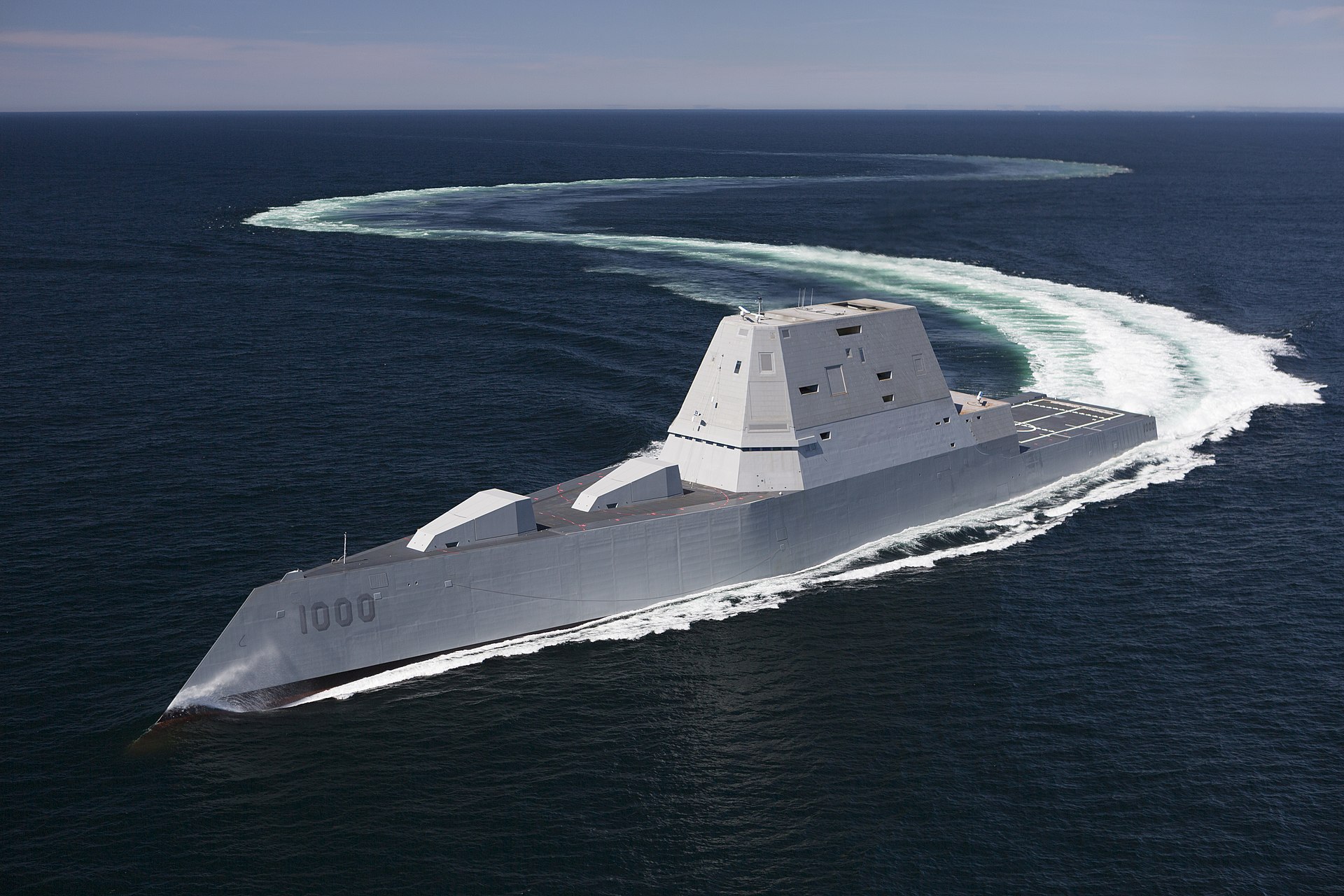
Dead Aim, Or Dead End? The USA’s DDG-1000 Zumwalt Class Program
Related Stories: Americas - USA, BAE, Boeing, Budgets, Coastal & Littoral, Contracts - Awards, Design Innovations, Electronics - General, FOCUS Articles, General Dynamics, Issues - Political, Lobbying, Lockheed Martin, New Systems Tech, Surface Ships - Combat, T&C - IBM, Transformation

DID’s FOCUS articles offer in-depth, updated looks at significant military programs of record. The prime missions of the new DDG-1000 Zumwalt Class destroyer are to provide naval gunfire support and next-generation air defense in near-shore areas where other large ships hesitate to tread, possibly even as the anchor for an action group of stealthy Littoral Combat Ships and submarines. The estimated 14,500t (cruiser sized) Zumwalt Class will be fully multi-role, however, with undersea warfare, anti-ship, and long-range surface attack roles.
That makes the DDG-1000 suitable or another role – as a “hidden ace card,” using its overall stealth to create uncertainty for enemy forces. At over $3 billion per ship for construction alone, however, the program faced significant obstacles if it wanted to avoid fulfilling formerSecretary of the Navy Donald Winter’s fears for the fleet.
DID’s FOCUS Article for the DDG-1000 program covers the new ships’ capabilities and technologies, key controversies, associated contracts and costs, and related background resources. From the outset, DID has noted that the Zumwalt Class might face the same fate as the ultra-sophisticated, ultra-expensive SSN-21 Seawolf Class submarines. That appears to have come true, with news of the program’s cancellation at 3 ships. Or will it be 2?
The latest news involves FY 2010 budget outcomes, and more released funds to develop the Zumwalt’s LRLAP 155mm long-range guided shells…
- Zumwalt Class: Program and Participants (i.e. “Continue reading…”)
- DDG-1000 Key Technologies and Features
- DDG-1000 Issues and Controversies
- Zumwalt Class: Contracts and Key Events
- FY 2009 [updated]
- FY 2008
- FY 2007
- FY 2006
- FY 2005
- FY 1998 through 2004
- Additional Readings & Sources
Zumwalt Class: Program and Participants
Since 1998, in constant FY 2009 dollars, program R&D costs rose from an initial baseline of $2.2 billion to $9.52 billion (+333.7%), hardly surprising given the number of very new technologies involved, and the 2 program restarts along the way. Procurement costs have dropped as ship numbers dropped from 32 to 7, but on a per-ship basis they went from $1.05 billion to $2.58 billion based on the Pentagon’s Selected Acquisition Reports.
The Navy’s actual per-ship cost projections currently stand at $3.15 billion, though that figure is disputed by Congressional Budget Office reports, which place it at $5.1 billion. The Navy claims that the CBO’s estimate doesn’t consider shipyard improvements that change the build process, a more mature detailed design that has been built several thousand times by computer (a capability developed as a “lesson learned” from the Arleigh Burke program); and the roughly $500 million per ship that is being contracted for on a firm-fixed-price basis. On the other hand, the CBO has been right, and the Navy wrong, when estimating other recent shipbuilding programs.
Some program history follows.
Northrop Grumman Ship Systems’ Ingalls shipyard led the “DD 21 Gold Team” through Phase I (System Concept Design) and Phase II (Initial Systems Design) from 1995-2001, until the program was suspended on May 7/01 pending that Quadrennial Defense Review and other key studies.
In November 2001, the DD 21 Program was restructured as the DD (X) Program. The Navy was directed to conduct a Spiral Development Review (SDR), to revalidate some requirements; and to assess the merits of achieving various levels of capability across a family of ships, including a Littoral Combatant Ship (LCS) and the next-generation CG (X) cruiser. The Request For Proposal for Phase III was issued Nov 30/01.
The Gold Team won on April 29/02, but the contract was delayed until the US Government Accountability Office denied General Dynamics’ protest On Aug 19/02. At that point, a firm winner could be declared. The winning “National Team” was led by Northrop Grumman, and included Raytheon IDS as the prime mission systems equipment integrator for all electronic and combat systems. Other major subcontractors included Lockheed Martin, BAE Systems, and Boeing. It even incorporated “Blue team” leader General Dynamics Bath Iron Works as a subcontractor for design and test activities.
By mid-spring 2005, however, a new DDI contract was signed. The Navy designated 4 Prime Contractors, to be coordinated through a Navy-Industry DDG-1000 Collaboration Center run by Raytheon. The current Prime Contractors are:
- Northrop Grumman Ingalls (ship design & build)
- General Dynamics Bath Iron works (ship design & build)
- Raytheon (mission systems integration which includes sensors, combat systems, electronics, and the PVLS)
- BAE Systems (AGS gun system)
On Nov 23/05, the Undersecretary of Defense for Acquisition signed the “destroyer acquisition memorandum,” approving the DDG 1000 program to proceed with Milestone B, and commencing detail design and construction of the first ships. On April 7/06, the program got its second name change from DD-21 and then DD (X), to its official and formal designation as the DDG-1000 Zumwalt Class.
As construction begins, Congressional resolutions have dissolved the US Navy’s original “winner take all” shipbuilding approach; the first 2 DDG-1000 destroyers will now be built at Northrop Grumman’s Ingalls yard in Pascagoula, MS; and at General Dynamics’ Bath Iron Works in Bath, Maine. This is expected to add up to $300 million to the cost of each ship, but was expected to help to keep the USA’s industrial base options open for future efforts like CG (X) et. al.
Strong arguments can be made for both the Navy’s original option and Congress’ mandated approach… and have been. Under the Navy’s proposed new “Dual Lead Ships Strategy,” the USN planned to benchmark these lead ships from each shipyard against each other, and revisit its options around FY 2009. That became a moot point when the program was truncated at 3 ships, a development that would ironically lead the program back to its original single-builder strategy if it sticks.
DDG-1000 Key Technologies and Features
The Zumwalt class is currently in the final stages of the system design & development phase. During this “detail design” phase, all of the various sub-systems are integrated, a production design is finalized, and construction/ engineering issues are worked out. When finished, the class is projected at 14,500t, almost 3 times the displacement of some frigates. In other eras, it would have been called a cruiser or even a battlecruiser. A follow-on CG (X) cruiser is also contemplated, and the issues faced by the DDG-1000 Program are having a significant influence on whether and how it comes to fruition.
Several of the Zumwalt class’ sub-systems represent entirely new technologies, as seen in the graphics above and below. Some of the key innovations include:
All-aspect Stealth. To achieve survivability in littoral regions close to shore, DDG-1000 ships will be reliant on their ability to see their surroundings and counter threats, while being difficult to detect. To achieve that stealth, the destroyer’s “tumblehome” inward-sloping hull, shaping, composite superstructure, and other stealth measures are meant to reduce radar, infared, and other signatures. Even the ship’s internal lighting system represents advances in this area. The goal is a 50-fold radar cross section reduction as compared to current DDG-51 Arleigh Burke Class destroyers.
Dual-Band Radar. For detection and self-defense, the DDG-1000 will rely on a new approach called the Dual-Band Radar. Designed to perform multiple functions including horizon search and fire control, the DBR takes the next step in radar integration. Raytheon’s X-Band SPY-3 radar provides air and surface detection/tracking, and supports fire control. Its use of active array radar technology makes it far more survivable against saturation missile attacks, since it can track and guide against tens of incoming missiles simultaneously. The passive phased array SPY-1D radars that equips American AEGIS destroyers and cruisers can track up to 200 targets, but are limited to terminal guidance against just 3-4 at any one time. Active array radars also feature superior reliability, and recent experiments suggest that they could also be used for very high-power electronic jamming, and high-bandwidth secure communications. The SPY-3 will ultimately be integrated with Lockheed’s active array S-Band volume search radar.
Collectively the SPY-3 and Lockheed’s S-band search array will comprise the Dual Band Radar (DBR) system, allowing the destroyer to benefit from the best capabilities of both X-band’s outstanding medium to high altitude performance, and the S-band VSR’s performance in clutter, in order to create a single combat picture. The goal was a threefold improvement over existing AEGIS ships like the DDG-51 destroyers and CG-47 cruisers. Raytheon is the prime contractor for mission systems, which includes radar and sensors and also includes the…
Total Ship Computing Environment. Rather than doing this piecemeal on a per system basis, the idea is to have an integrated but open architecture approach from the very beginning. This creates a single IT framework, makes it easier to integrate commercial-off-the-shelf (COTS) hardware and software, and makes wider interoperability easier. It also allows the Navy and the prime contractors to use more conventional commercial acquisition approaches/ partnerships to support and upgrade the technology. TSCE is currently at Release 5/6, and coding for Release 6 is underway.
TSCE will be about 8 million lines of code, but it actually connects with about 20 million lines of code reused from other programs (AEGIS, SPQ-89, NAVSSI), plus the secured commercial operating systems, databases, and middleware that underpin the entire infrastructure. TSCE’s functionality is being developed as services, with set interfaces to the underlying commercial software and proprietary code. This allows changes to take place on both ends with minimal disruption of each service. The advances made by TSCE will in turn be reused in the new CVN-78 carriers and CV-X cruisers because of its services framework, design for reuse, and open architecture.
IBM is partnered with prime contractor Raytheon for this component; other key subcontractors include Lockheed Martin.
PVLS Missile Launchers. Some additional survivability will come from automated firefighting systems, and even from the ship’s missile launchers. Zumwalt Class destroyers will distribute 80 missile cells in 20 reinforced launchers along the edges of the ship, rather than putting them in one central cluster that can be directly targeted by the most modern missiles. The Mk 57 Peripheral Vertical Launching System (PVLS) will have larger cells than the current Mk 41 VLS, allowing them to carry larger missiles than the current Mk41 VLS, or multi-pack smaller missiles within. The system is also designed to release and direct the energy from a magazine explosion away from the ship, and avoid situations in which the detonation of a round in one cell spreads to other cells. Raytheon is the prime contractor, with BAE Systems as a subcontractor.
Advanced Gun System. The supposed rationale for the DDG-1000 centers around naval gunfire support for troops ashore. While US battleships with 9 massive 16-inch guns have performed extremely well in this role to date, the DDG-1000 intends to rely on a pair of BAE Systems’ rapid fire 155mm guns, firing advanced Long Range Land Attack Projectile (LRLAP) GPS-guided shells that give the AGS a greatly-extended range of 83-100 miles. See DID articles covering the AGS, and the LRLAP projectile. If enough power can be generated by the ship, future ships might even include an electro-magnetic rail gun.
All-Electric Power. Another challenge the Zumwalt Class will face is power. Ship electronics continue to require more and more power, and this class is also envisioned as an all-electric ship wherein even gun turrets and other mechanical systems will be electrical, and having separate systems for propulsion and power will no longer be necessary. The use of electric drive also eliminates the need for drive shaft and reduction gears, which brings benefits in ship space, acoustic signature reduction to enemy submarines, and less interference with the ship’s listening devices. Not to mention better fuel efficiency, and the potential to accommodate new electronics, more powerful radars, or even energy weapons and rail guns. The DDG-1000’s expected electrical output is 78 MW, compared to 7.5 MW for the current DDG-51 Arleigh Burke Class.
The exact choice of engine systems remains somewhat controversial. The concept was originally for an integrated power system (IPS) based on in-hull permanent magnet synchronous motors (PMMs), with Advanced Induction Motors (AIM) as a possible backup solution. The design was shifted to the AIM system in February 2005 in order to meet scheduled milestones; PMM technical issues were subsequently fixed, but the program has moved on. The downside is that AIM technology has a heavier motor, requires more space, requires a “separate controller” to be developed to meet noise requirements, and produces one-third the amount of voltage. On the other hand, these very differences will force time and cost penalties from design and construction changes if the program wishes to “design AIM out”.
The AIM system is made by Alstom, which makes electric-drive motors for cruise ships. CAE will supply the integrated platform management system. A Rolls-Royce MT30 36MW gas turbine has powered the IPS Engineering Development Model in Philadelphia, and has now been ordered for production ships; the firm delivered the first turbine set in February 2005. The MT30 has 80% commonality with the Rolls-Royce Trent 800 aero engine used on the Boeing 777, and Rolls-Royce states that it is the most powerful marine gas turbine in the world.
DRS Technologies Power Technology unit had received development contracts for the PMM motors, electric drive and control system for the IPS, but the ship design has moved in other directions and it it would be almost impossible to incorporate them now without significant redesign efforts. The firm does retain involvement in the ship’s “Integrated Fight-through Power” modules and load centers that take converted electrical power, condition it to get it to the right voltages, and distribute it to 8 redundant zones. If you lose power on the port side of the ship, for instance, you can cross-connect it to the starboard side et. al.
DDG-1000 Issues and Controversies
The Zumwalt Class will incorporate a number of new technologies and capabilities that will make it a very formidable combatant – but it has also had its share of controversies that have included questions concerning its stealth, weapon choices, at-sea stability, cost growth, and the Navy’s future force mix.
Stealth. While the DDG 1000 is designed as a low-emissions ship across a number of wavelengths, it is 50% larger than the already large Arleigh Burke Class destroyers – very nearly the same displacement as the WW2 German ‘pocket battleship’ Graf Spee. On the high seas, it’s a very big ocean; but the Navy wants to take them into the shallow-water littoral zone, where a number of alternative technologies (including swarms of small-medium UAVs with electro-optical equipment) can be used to find a ship. Once the ship fires its weapons, methods for detecting the ship expand further via options like acoustic sensors. Stealth will still make the ship harder to target and engage, but unlike the Iowa Class battleships, a DDG-1000 will not be able to ignore an Exocet missile strike to its hull.
The Navy believes it can still produce a stealthy enough ship, with enough stand-off range to avoid some threats and buy reaction time against others. Naval personnel add that they testing the platform to ensure that these goals are met. Some observers are less certain. They also wonder whether a serious, realistic ‘hunt the Graf Spee’ test using a properly equipped opposing force cleared to use innovative approaches is thinkable, especially after the Navy has invested its prestige and several billion dollars to build a capital ship. Without such tests, of course, the only way to find out for sure is the hard way, in battle.
Weapons. One of the issues that did a lot of damage to the program in its late stages was the revelation that its radar system would not be suited to ballistic missile defense roles, and that modifications to make the radar powerful enough would be problematic. This lack of flexibility proved costly, since cheaper DDG-51 destroyers can be made fully ABM capable using known technologies, while the DDG-1000’s SPY-3 radar and combat system would require the same sort of research program the AEGIS ships went through in order to add that capability. The Navy also began to contend that the DDG-1000 would not be able to use Standard family missiles (SM-2, SM-3, SM-6) at all, a charge that has been vehemently and persuasively disputed by Raytheon and others. Raytheon also disputes the charge that its SPY-3 radar would be less suited to the BMD role once software additions were made, contending that its performance would be superior to current ships.
The other weapons-related issue was the 155mm Advanced Gun System. It will be capable of rapid, long range, accurate fire that far out-ranges even a battleship gun. War is also about intimidation, however; otherwise, the inaccurate, slow, but loud and intimidating musket would never have replaced the faster, longer-range, more accurate, but less intimidating crossbow as the infantry’s standard missile weapon. A 155mm shell doesn’t have quite the psychological impact of a 16-inch, volkswagen-size battleship round, and rapid fire to create that effect risks exhausting the DDG 1000’s limited ammunition supply very quickly.
Reactivating the battleships has been considered, and still has supporters in Congress. Can the killing effect of GPS-guided shells hitting targets marked by landing forces provide enough suppression and decapitation to make up the difference? Or is the AGS the wrong concept for naval fire support?
Ship shape. Tumblehome hull designs that slope outward to the waterline have had a less-than-stellar naval history. The design offers important stealth benefits, but some experts believe that the ship could capsize in a following sea at the wrong speed, if a wave at an appropriate wavelength hits it at an appropriate angle. That would be… expensive, on many levels. Then again, so is a missile in your hull. Experiments are being run in simulated conditions up to hurricane-level and with scale models up to 1/4 scale, in order to determine safety. The Navy believes the design to be safe across an array of conditions whose breadth matches current ships.
As a new design type, however, the Zumwalt Class can never have the certainty of designs that are known and proven over the immense array of conditions encountered by thousands of ships sailing over many decades. New capability comes with risk, but if it proves out, the USA will have expertise in stealthy ship design and construction that puts it well ahead of other countries. Are the experts who believe the design to be unsafe rigid traditionalists of the same species that dismissed the aircraft carrier when it was new? Or are they offering a prescient warning? DID’s “Defense News: Will DDG-1000 Destroyers Be Unstable?” discusses this issue in more detail.
Cost Growth. In the end, this is the biggest issue faced by the DDG-1000 program. Originally slated to cost under $1 billion per ship, the program has grown to the point that 2005 GAO estimates placed likely average construction costs at $3.2 billion per ship, with ship life cycle costs at about double that of the DDG-51 Arleigh Burk Class ($4 Billion vs. $2.1 billion). Further cost increases are possible based on technical project risks, with some estimates climbing as high as $5 billion.
At that cost level, even the US Navy will find itself priced out of the water, unable to maintain enough ships to serve in the envisaged role. That cost profile also leads one to ask whether the Navy would really send something that expensive into harm’s way in dangerous shallow waters near an enemy coast, knowing that they’re gambling with a $3+ billion asset whose cost makes it an extremely attractive enemy target.
Force Structure. The original plan called for 32 DD (X) ships. That has now shrunk to 8, and a number of projections place the likely number of ships actually built at 2-5. Reagan’s 600-ship Navy is now projected to shrink to just 313 ships in official plans, and even this may not be achievable; a 2005 Pentagon study stated that the Navy was likely to be up to 40% short on expected funding toward their 375 ship goal, based on reasonably-expected funding profiles.
Even an 8-ship class certainly isn’t going to succeed in replacing 62 DDG-51 AEGIS destroyers – but something will have to do so beyond 2030, or the Navy’s planned force is likely to become ineffective at all levels as the intended “high-low” mix fails on both ends. DID has already discussed the light armament profile being built into US Navy versions of the Littoral Combat Ship, and their corresponding and compounding lack of weapon flexibility. As Vice-Admiral Mustin (ret.) and Vice-Admiral Katz (ret.) put it in a 2003 USNI Proceedings article:
“Because the Navy has invested heavily in land-attack capabilities such as the Advanced Gun System and land-attack missiles in DD (X), there is no requirement for [the Littoral Combat Ship] to have this capability. Similarly, LCS does not require an antiair capability beyond self-defense because DD (X) and CG (X) will provide area air defense. Thus, if either DD (X) or CG (X) does not occur in the numbers required and on time, the Navy will face two options: leave LCS as is, and accept the risk inherent in employment of this ship in a threat environment beyond what it can handle (which is what it did with the FFG-7); or “grow” LCS to give it the necessary capabilities that originally were intended to reside off board in DD (X) and CG (X). Neither option is acceptable.”

The SSN-21 Seawolf Class remain the best fast attack submarines in the world, with capabilities – and costs – that no other sub can match. That cost eventually led to program cancellation after 3 boats, and replacement by an SSN-774 Virginia Class that integrated many of their key technologies and design approaches at only 60-70% of Seawolf’s cost. In effect, the Seawolf Class became a set of 3 technology demonstrators.
If the Zumwalt Class cannot overcome these controversies with cost-effective performance, DID warned that it could end up sharing Seawolf’s fate. With the 2008 suspension of construction at 2-3 ships, that appears to be exactly what has happened.
Zumwalt Class: Contracts and Key Events
Note that frequent references to “Mission Systems Equipment” can cover a wide range of items: Dual Band Radar, external communications suite, Total Ship Computing Environment set, MK 57 Vertical Launching System, AN/SQQ-90 Integrated Undersea Warfare Combat System, Electro-Optical/Infrared suite, IFF integrated sensor suite; and the Zumwalt ship control hardware, including an integrated bridge, navigation, EO surveillance, and engineering control system components.
Unless otherwise noted, contracts are issued by the USA’s Naval Sea Systems Command in Washington, DC.
Nov 5/09: BAE Systems Land & Armaments LP’s U.S. Combat Systems in Minneapolis, MN receives an $11.9 million modification to a previously awarded contract (N00024-05-C-5117), exercising an option for continuing design and development of the Long Range Land Attack Projectile (LRLAP), which is fired from the ship’s 155mm guns.
Work will be preformed in Orlando, FL (75%), and Minneapolis, MN (25%), and is expected to be complete by September 2010.
Oct 28/09: President Obama signs the FY 2010 defense budget into law. That budget provides the full requested amount of $1,084.2 million to finish the 3rd ship, but the reconciled bill stripped out the $539.1 million in RDT&E funding the Pentagon had requested. White House | House-
Senate Conference Report summary [PDF] & tables [PDF].
Oct 21/09: General Dynamics Bath Iron Works Corp in Bath, ME received a $79.5 million modification to a previously awarded contract (N00024-06-C-2303). It exercises an option for additional class services associated with the detail design and construction of the DDG 1000 Zumwalt class destroyer.
Bath Iron Works will provide technical and industrial engineering in the interpretation and application of the detailed design to support construction and the maintenance of a safe and operable ship design. Work will be performed in Bath, ME and is expected to be complete by November 2010.
FY 2009
Sept 10/09: Raytheon Integrated Defense Systems in Tewksbury, MA received a $22.5 million modification to previously awarded contract (N00024-05-C-5346) for continuing Mission Systems Equipment (MSE) software development and additional design verification for the Zumwalt Class Destroyer Program. Work will be performed in Moorestown, NJ (64%), Tewksbury MA (20%), Baltimore, MD (10%) and Dahlgren, VA (6%), and is expected to be complete by March 2012.
Timely software development has been flagged as a potential issue by recent GAO reports (q.v. March 31/09 entry).
Aug 19/09: Small business qualifier Temeku Technologies, Inc. in Herndon, VA received a $7.95 million firm-fixed-price contract for DDG 1000’s Flight Deck Lights (FDL) System, mounted on and near the flight deck and hangar face as next-generation visual landing aids for helicopters.
Work will be performed in Herndon, VA (60%); Bologna, Italy (30%); and Point Mugu, CA (10%) and is expected to be complete in April 2011. This contract was competitively procured via electronic request for proposal, with 3 offers received by the Naval Air Warfare Center Aircraft Division in Lakehurst, NJ (N68335-09-C-0425).
Aug 17/09: Ganett’s Navy Times updates the current status of major DDG-1000 sub-systems in “DDG 1000 project quietly logs successes.”
In production: Ship hull, Northrop Grumman’s composite upper-level deckhouse; Raytheon’s Advanced Vertical Launch System; Integrated Power system including RR MT-30 engine; Automatic fire suppression system.
Finished development: Tumblehome hull form; BAE’s 155mm AGS gun, Lockheed Martin’s LRLAP GPS-guided long-range shell; Infrared suppression engine exhaust and heat suppression system, incl. 4 major at-sea tests; Crew multi-skill training plan.
Still in development: Dual-Band Radar (Raytheon’s X-band SPY-3 Multi-Function Radar, Lockheed Martin’s S-band SPY-4 Volume Search Radar), Raytheon’s Total Ship Computing Environment, 3-D CAD models.
The first 2 X-band SPY-3 arrays are being assembled, and “minor” manufacturing issues have been resolved, following completion of at-sea testing in Spring 2009. The DBR has also been installed at the Wallops Island test facility, where aircraft detection tests are ongoing and will continue into the fall. Below-deck components of the S-band SPY-4, are in full-rate production, and 6 arrays are under contract. Of the 3-D CAD models, 90 of 94 are completely released and locked down, and the remaining 4 are expected by September 2009.
July 2009: The 155mm AGS fires a LRLAP to its threshold range of 63 miles/ 101 km during a White Sands, NM test. DDG-1000 program manager Capt. James Syring is quoted as saying that further tweaking of the rocket motor’s chemistry should push the shell’s range over 70 miles. Source.
July 23/09: LaBarge, Inc. announces a $6.1 million contract from BAE Systems to continue producing electronic assemblies for the Advanced Gun Systems that will be installed on both ordered Zumwalt class destroyers. The Company expects this latest award will continue production on the AGS program at its Huntsville, Ark., facility through December 2009.
July 20/09: Raytheon Integrated Defense Systems in Tewksbury, MA received a $60 million cost-plus-incentive-fee modification to a previously awarded contract (N00024-05-C-5346), exercising an option for Mission System Equipment (MSE) Class Services for the Zumwalt Class Destroyer Program.
Work will be performed at Raytheon facilities (85%) in San Diego, CA; Marlboro, MA; Sudbury, MA; Tewksbury, MA; Towson, MD; and Portsmouth, RI; at Lockheed Martin facilities (12%) in Moorestown, NJ and Akron, OH; and at BAE’s facility in Minneapolis, MN (3%), and is expected to be complete by March 2013.
June 19/09: Converteam, Inc. in Pittsburgh, PA received a $23 million modification to a previously awarded contract (N00024-09-C-4203). They will provide a DDG 1000 Baseline Tactical High Voltage Power Subsystem (HVPS) for use in the Navy’s integrated power system land based test site. These components will meet the same specification established by the DDG 1000 shipyards for lead ship installation. Work will be performed in Pittsburgh, PA, and is expected to be complete by March 2011.
The HVPS distributes electrical power from the ship’s turbine-generators to the ship’s propulsion and electronic equipment. It includes an advanced induction motor, motor drive, harmonic filters and resistors for dynamic braking and neutral grounding.
May 4/09: Gannett’s Navy Times interviewed US Chief of Naval Operations Adm. Gary Roughead 3 times during March and April 2009, and publishes excerpts. With respect to the DDG-1000, Roughhead sees the new design as somethng they can only learn from if it’s deployed and used, and he’s especially interested in the real-world, full-scale performance of its radically different hull form. Beyond that:
“I’d like to see how it goes. And if it really is a breakthrough technology, can it be scaled up and can it be scaled down? Because if you start getting into nuclear power and bigger radars [for CG (X)], can the DDG hull form take it? My sense is, it can. But if it can’t and you have to scale up, does it scale?
....There’s no question we will employ those ships once they’re delivered. Deploy them and employ. I see them in the deployment rotation because, quite frankly, it will be important to operate those ships in different environments, get them up in the high latitudes. What happens when that hull form starts to ice up? What’s the effect of that? If people are talking about having to be up in the Arctic areas, it’s a good thing to know. How well are they sustained logistically at great distances? We’ve got to get them out. Get them deployed.”
April 23/09: Raytheon Integrated Defense Systems in Tewksbury, MA received a $217 million cost plus fixed fee modification to a previously awarded contract (N00024-05-C-5346) for 2 Volume Search Radars (VSR). Work will be performed in Moorestown, NJ (95%) and Sudbury, MA (5%), and is to be complete by March 2013.
These S-band naval radars will be used as part of the Dual-Band Radar (DBR) systems mounted on one of the new Zumwalt Class destroyers, and on the inaugural CVN-21 carrier USS Gerald R. Ford [CVN 78]. See “The US Navy’s Dual-Band Radars” for full coverage.
April 13/09: Defense News reports details of the agreement between the US Navy and its 2 shipyards for major surface combatants.
The deal reportedly includes a provision for Northrop Grumman’s shipyard in Avondale, LA to continue building LPD-17 San Antonio Class amphibious transport docks. Unfortunately, that shipyard has displayed severe and consistent quality problems building the first 2 ships of class.
Under the agreement, the FY 2010 budget would fund the second half of the 3rd Zumwalt Class ship [DDG 1002], and the Arleigh Burke Class DDG 113, with full ballistic missile defense capabilities instaled at the outset. That a departure, because all previous BMD ships in the US Navy have been refits of existing vessels. DDG 113 will be built by Northrop Grumman at Ingalls in Mississippi. That would be the first DDG-51 destroyer ordered since 2002, and it would be followed by orders for similar ships in FY 2011: DDG 114 (Northrop) and DDG 115 (Bath Iron Works).
April 7/09: Raytheon announces a successful initial “lightoff” test of the Dual Band Radar, which includes the X-band AN/SPY-3 Multi-Function Radar and S-band Volume Search Radar. Both radiated at high power during lightoff at the Navy’s Engineering Test Center in Wallops Island, VA. Following this successful lightoff test, the radar suite will begin an extended period of operational performance testing.
April 7/09: Rep. Gene Taylor [D-MS, Seapower subcommittee chair] announces that the Pentagon has reached agreements with General Dynamics’ Bath Iron Works in Maine, and with Northrop Grumman’s Ingalls Shipyard in Mississippi. Read “Bath, Ingalls Agree to Navy’s Surface Combatant Plans” for details of the arrangements.
April 6/09: US Secretary of Defense Robert M. Gates announces his recommendations for the FY 2010 defense budget:
”...in this request, we will include funds to complete the buy of two navy destroyers in FY10. These plans depend on being able to work out contracts to allow the Navy to efficiently build all three DDG-1000 class ships at Bath Iron Works in Maine and to smoothly restart the DDG-51 Aegis Destroyer program at Northrop Grumman’s Ingalls shipyard in Mississippi. Even if these arrangements work out, the DDG-1000 program would end with the third ship and the DDG-51 would continue to be built in both yards.
If our efforts with industry are unsuccessful, the department will likely build only a single prototype DDG-1000 at Bath and then review our options for restarting production of the DDG-51.”
April 1/09: The Mississippi Press reports that Raytheon Company is footing the bill for the recently created www.ZumwaltFacts.info:
“Spokeswoman Carolyn Beaudry initially denied Tuesday any corporate involvement in the Zumwalt campaign. She later called back to say that others within the company had since told her Raytheon is supporting “a lot of public efforts, including ZumwaltFacts.info,” to provide third-party advocacy.”
This is not unusual for corporations or other organizations when lobbying government; indeed, a recent Washington Times article by USN Adm. James Lyons (ret.) lamented the retreat of America’s shipbuilding industry from its previous public advocacy role. Non-disclosure of such involvement is less customary, though the Times report could also describe a simple mistake that was quickly corrected. When the funding is meant to be covert, the technical term is an “astroturf” (artificial grassroots) campaign.
March 31/09: The US GAO audit office delivers its 7th annual “Defense Acquisitions: Assessments of Selected Weapon Programs report. It rates 4/12 critical technologies in the DDG-1000 program as fully mature (demonstrated in a sea environment), and 6/12 as approaching maturity, but 5 of the 6 will not demonstrate full maturity until after they’re installed on the ship. Lockheed Martin’s S-band volume search radar, and the Total Ship Computing Environment, are rated as immature. The report adds:
“Land-based tests of the volume search radar prototype originally planned for before ship construction will not be completed until June 2009 – over 2 years later. Software development for the total ship computing environment has proved challenging; the Navy certified the most recent software release before it met about half of its requirements….”
“The integrated power system will not be tested with the control system until 2011 – nearly 3 years later than planned. The Navy will buy a power system intended for the third ship and use it in land- based tests…. Land-based tests of the volume search radar prototype will not be completed until June 2009 – over 2 years later than planned…. The Navy will not demonstrate a fully capable radar at its required power output until testing of the first production unit in 2011…. installation [of the volume search radar) will occur in April 2013 – after the Navy has taken custody of the ship. The Navy initially planned to develop and demonstrate all software functionality of the total ship computing environment (phased over six releases and one spiral) over 1 year before ship light-off…. However, the contractor delivered release 4 without incorporating all software system requirements and deferred work to release 5, primarily due to issues with the command and control component. Problems discovered in this release, coupled with the deferred work, may be a sign of larger issues….”
March 17/09: ZumwaltFacts.Info publishes an “admirals’ letter to Secretary of Defense Robert M. Gates from USN Adm. Henry H. Mauz (ret.); USN Rear Adm. Philip A. Dur (ret.); and Phil Depoy, Director of the US Naval Postgraduate School’s Systems Engineering Institute. Zumwalt Facts is 3rd party site chaired by USMC Col. James G. Zumwalt, Esq. (ret.). Full letter [PDF format].
March 11/09: BAE Systems in Minneapolis, MN rceives a $23.5 million modification to a previously awarded contract (N00024-05-C-5117), in order to continue development of the 155mm Long Range Land Attack Projectile (LRLAP), which will be fored from the ship class’ Advanced Gun System. Work will be preformed in Orlando, FL (75%) and Minneapolis, MN (25%), and is expected to be completed by September 2010.
See also the May 27/05; April 4/07; June 11/07; and Dec 23/08 LRLAP awards, whose total adds up to $807.4 million.
March 6/09: Raytheon IDS in Tewksbury, MA received a $57 million cost-plus-incentive-fee modification to a previously awarded contract (N00024-05-C-5346). These funds will buy selected Zumwalt Class mission system equipment which will be checked out and integrated at Wallops Island, VA, for the program’s Test and Evaluation Master Plan (TEMP) aboard the US Navy Self Defense Test Ship (SDTS). The SDTS is a best described as a barge that can mount and use installed radars and weapons for tests. See also the related Dec 15/08 and Dec 5/08 awards.
Work will be performed in Tewksbury, MA (40%); Andover, MA (40%), Wallops Island, VA (10%) and Portsmouth, RI (10%), and is to be completed by March 2011. Contract funds in the amount of $27.5 million will expire at the end of the current fiscal year.
Feb 12/09: Northrop Grumman Ship Systems in Pascagoula, MS received a $9 million modification to a previously awarded contract for systems engineering, design and technical services. The contract will support the detail design and construction of the DDG 1000 Zumwalt Class Destroyers.
Northrop Grumman is currently expected to design and build DDG-1001, the Michael Monsoor. Work will be performed in Pascagoula, MS, and is expected to be completed by December 2009 (N00024-06-C-2304).
Feb 4/09: Rep. Gene Taylor [D-MS-4] chairs the US House Armed Services Committee’s Seapower and Expeditionary Forces subcommittee. He is a vocal critic of the US Navy’s current shipbuilding strategy, while remaining one of Congress’ strongest advocates for a larger shipbuilding budget and a larger Navy. His statement on the future of US Navy shipbuilding reiterates his support for more DDG-51 type destroyers, and says:
“For far too many years I have watched as the size of the Navy fleet has decreased…. In particular, the failure of the [Littoral Combat Ship] program to deliver on the promise of an affordable, capable, and reconfigurable warship only puts the exclamation point on a Bush administration’s strategy that was neither well envisioned nor properly executed. As for the DDG 1000, we will not know the true cost of that program for a number of years but significant cost growth on that vessel will require diverting funding from other new construction projects to pay the over-run….”
Feb 4/09: “The Navy’s New Battleship Budget Plan” at the naval policy discussion site Information Dissemination addresses the proposed DDG-1000 program approach in an op-ed:
“Of all the different ships in the Navy’s FY10 shipbuilding budget, there are actually only 3 mature ship designs [out of 11 ship types].... This reflects the inability of naval leadership to set requirements. This reflects a long standing policy where accountability has not been a priority. This reflects an industry without enough oversight. This reflects weak political leadership willing to ignore deception and deceit. Let me explain that last point.
....John Young was absolutely right to force the Navy to go through a requirements study process, but the rest of the memo should be raising serious questions in Congress. The very intent of the memo, which comes from the top acquisition official in the Department of Defense, is a signed specific instruction to the Navy to intentionally ‘pad’ the budget of the DDG-1000 program with money from a completely new program…. in its first year of construction the DDG-1000 could now potentially go over budget by several hundred million dollars and still not trigger a breach of Nunn-McCurdy…. With the leak of this memo, all of our Congressmen and Senators must now intentionally look the other way, with both eyes shut and index fingers jammed into their ears, and ignore that the top DoD financial officer is intentionally padding the books to circumvent the law.”
Feb 2/09: Raytheon announces that the first production equipment has been delivered for the U.S. Navy’s DDG 1000 Zumwalt-class destroyer – a Cooperative Engagement Capability (CEC) planar array antenna assembly.
Jan 26/09: Pentagon undersecretary for acquisition, technology and logistics John Young’s “DDG 1000 Program Way Ahead” memo sets out alternatives for the program, and touches off controversy.
The reduction from 7 ships to 3 will spread the same R&D funds over fewer ships, raising their accounting cost per ship but not their actual purchase cost. So far, actual program costs and timelines remain on track, but under America’s Nunn-McCurdy procurement laws, the accounting cost change forces the Pentagon to meet 4 tests or cancel the program: (1) the weapon is essential for national security; (2) the new unit costs are reasonable; (3) management structure can control future growth; and (4) that no substitutes exist that provide equal or greater military capability at less cost.
Meeting tests 1 and 4 will be difficult, and the fact that the Navy has never really done a direct comparison of the DDG-1000 Zumwalt class vs. the existing DDG-51 Arleigh Burke Class in key areas makes the problem worse (see Oct 12/08 “Heritage Foundation: Questions to Ask re: DDG-51 vs. DDG-1000” for more). Young’s memo offers the option of adding a “Future Surface Combatant” class to the DDG-1000 program, increasing the number of ships technically in the program without specifying what type they would be. It appears to be an effort to buy time for a year, while the Navy looks at the actual cost of fielding new-build DDG-51 ships with the radar modifications, software modifications, and power upgrades required to serve in a ballistic defense role. This, too, is something that is not currently known. Information Dissemination explains the accounting | Defense News re: FSC | Defense News: Young on DDG-1000 options and relative ship costs.
Jan 12/08: Defense News reports that a deal may be in the works to build both DDG-1000 Zumwalt and DDG-1001 Michael Monsoor, in exchange for having more of the Arleigh Burke Class destroyers that Congress is expected to ask for built at Northrop Grumman’s Ingalls shipyard in Pascagoula, MS. The Pascagoula shipyard was scheduled to begin fabrication of DDG 1001 in fall 2009.
The move would reportedly leverage Bath Iron Works’ investments toward DDG-1000 production, and keep Pascagoula more focused, given the diverse ship classes (DDG-51, LPD-17, LHD-8) it is already building in Mississippi.
Dec 23/08: BAE Systems in Minneapolis, MN receives a $23 million modification, exercising an option under a previously awarded contract, for common services related to the Advanced Gun System (AGS).
Work will be performed in Cordova, AL (32%), Minneapolis, MN (25%), Louisville, KY (23%) and Burlington, VT (20%) and is expected to be complete by September 2010 (N00024-05-C-5117).
Dec 22/08: Bloomberg News reports that an Oct 31/08 budget memo from Deputy Defense Secretary Gordon England approved shifting away as much as $940 million from the P-8A Poseidon maritime patrol aircraft program, in order to complete payment for the 3rd DDG-1000 destroyer that Congress partially funded in FY 2009. The Navy proposed getting 2 P-8A aircraft instead of 6 during the initial production phases.
Meanwhile, the US Navy faces significant challenges keeping the existing fleet of P-3C Orion maritime patrol aircraft in the air. Almost 1/4 of this aging fleet has been grounded due to safety concerns, and the Navy is forced to retire some aircraft every year. Even though they are in greater demand over key sea lanes, and in overland surveillance roles on the front lines. Early introduction of the P-8A has been touted as critical to maintaining these capabilities, without creating both near-term and long-term shortfalls.
The proposed FY 2010 ship plan also reportedly includes the purchase of 2 more DDG-51 Arleigh Burke Class destroyers.
Dec 15/08: Raytheon Integrated Defense Systems in Tewksbury, MA received $10.1 million modification to a previously awarded contract. They will furnish the test assets and infrastructure material required, in to support the integration, testing, and facilitation of DDG-1000 Mission Systems Equipment. See also Dec 5/08 entry for more background.
Work will be performed in Burlington, MA (75%) and Tewksbury, MA (25%), and is expected to be complete by September 2009 (N00024-05-C-5346).
Dec 9/08: Raytheon announces that its integrated undersea warfare combat system for the Zumwalt Class has received its official U.S. Navy nomenclature: AN/SQQ-90.
The SQQ-90 includes the ship’s hull-mounted mid-frequency sonar (AN/SQS-60), the hull-mounted high-frequency sonar (AN/SQS-61), and the multi-function towed array sonar and handling system (AN/SQR-20). These systems are fully integrated with the MH-60R helicopter’s combat system, and improved automation and information management allows the SQQ-90 to be operated by 1/3 the crew of current AN/SQQ-89v15 anti-submarine systems used on DDG-51 and CG-47 AEGIS destroyers and cruisers.
Dec 5/08: Raytheon Integrated Defense Systems in Tewksbury, MA received a $9 million modification to a previously awarded contract (N00024-05-C-5346) for one time engineering efforts. The purpose of this effort is to initiate the non-recurring engineering work required to make the selected Mission System Equipment (Dual Band Radar SPY-3 Array and REX; MK57 Vertical Launch System Electronics Module Controller Unit; Canister Electronic Units, and Total Ship Computing Environment) compatible with the Navy’s remote controlled Self Defense Test Ship (SDTS). The SDTS test will include the first missile firing with this advanced Mission System, against a difficult target set.
Raytheon will update selected Zumwalt Class Destroyer Mission Systems Equipment (MSE) for initial integration efforts at Wallops Island, VA, and follow-on installation on board the SDTS, in support of the Zumwalt TEMP (test and evaluation master plan). Work will be performed in Portsmouth RI (55%), Tewksbury, MA (25%), and Andover, MA (20%) and is expected to be complete by August 2009. All contract funds will expire at the end of the current fiscal year.
Dec 2/08: Raytheon announces a successful production readiness review of the mission systems equipment (MSE) for the DDG-1000 program. This comprehensive review was the culmination of more than 90 separate design and production reviews, and afterward the Zumwalt program completed a total ship system production readiness review – the final formal review before ship construction begins.
The Zumwalt Class MSE includes the following major subsystems: the Total Ship Computing Environment; Dual Band Radar; the external communications suite; MK 57 Vertical Launching System; AN/SQQ-90 Integrated Undersea Warfare Combat System; the Electro-Optical/Infrared suite; the Identification Friend or Foe integrated sensor suite; and the Zumwalt ship control hardware, including an integrated bridge, navigation, EO surveillance, and engineering control system components.
Dec 1/08: General Dynamics Bath Iron Works Corp in Bath, Maine received a $45.8 million modification to a previously awarded contract (N00024-06-C-2303). It exercises an option for services associated with the detail design and construction of the DDG 1000 Zumwalt Class Destroyer, and modifies the contract issued on the Feb 15/08 for the first ship of class.
Work will include configuration management and maintenance of class design products; program management; configuration and data management; system and ship integration services; production engineering services; and ship system segment management. Work will be performed in Bath, ME, and is expected to be complete by November 2010. See also GD release.
Oct 29/08: At a Navy SEAL Warrior Fund Benefit Gala at the Waldorf-Astoria Hotel in New York City, Secretary of the Navy Donald C. Winter announced that DDG-1001 will be named USS Michael Monsoor after the Congressional Medal of Honor winner.
Petty Officer 2nd Class Michael Monsoor was a Navy SEAL who was posthumously awarded the Medal of Honor for his heroic actions in Ramadi, Iraq on Sept 29/06. Monsoor was asthmatic as a child, but his determination led him to conquer his condition and pass SEAL training. The 25 year-old machine gunner was providing security at a sniper lookout post with SEAL Team 3, when a fragmentation grenade hit his chest and bounced to the floor. Monsoor was near the only exit, and was the only one who could have escaped. Instead, he threw himself on the grenade before it exploded, and died half an hour later. Though some of his SEAL brethren and their Iraqi allies were wounded, all survived because of his sacrifice. USN release | USN coverage of award ceremony | Official USN Medal of Honor page for Michael Monsoor.
Oct 7/08: The right-wing Heritage Foundation publishes its in-depth paper concerning the DDG-1000 vs. DDG-51 debate: “Changing Course on Navy Shipbuilding: Questions Congress Should Ask Before Funding.”
The report can be characterized as leaning toward further DDG-1000 ships, but it offers key questions to ask rather than recommendations. This is more than just a rhetorical device. The answers to those questions could tip the debate either way, and the report points to discrepancies between recent and past Navy statements that need clarification. It also offers research evidence that disputes some recent statements, with an especial focus on the Zumwalt Class’ air defense and anti-submarine capabilities.
FY 2008
Sept 24/08: The House and Senate Armed Services Committees have reconciled their versions of the FY 2009 defense budget. The reconciled budget provides $2.5 billion for the 3rd Zumwalt Class ship, “without prejudice to any potential future Department of Defense decision to truncate the DDG-1000 class acquisition program in favor of a return to DDG-51 class destroyers.”
House Seapower subcommittee chair Gene Taylor [D-MS] continues to doubt the Navy’s ability to build DDG-1002 for $2.5 billion, a sum that is about half the amount predicted in some CBO reports. He cites the language noted above as a satisfactory compromise, because it allows the Secretary of the Navy to divert the $2.5 billion into more Arleigh Burke Class destroyers if problems continue. MarineLog | Gannett’s Navy Times.
Sept 22/08: Defense News caries a story offering Northrop Grumman’s replies to its own Sept 15/08 publication, which quoted inside sources alleging concerns inside Northrop and the US Navy regarding construction problems involving the ship’s composite superstructure, or deckhouse. The Zumwalt Class uses composites rather than metal, because it improves radar stealth. All composite superstructures will be made by Northrop Grumman in its Gulfport, MS facility, even the structures that will fit on top of ships built by General Dynamics’ Bath Iron Works.
While Defense News’ unnamed sources stand by their assertions, Northrop Grumman replied that the deckhouse design meets all technical and load requirements, that the Navy remains closely involved in all aspects of the process, that over 6,000 test articles fabricated from 2001 onward have surfaced and addressed the risks. Fabrication was supposed to begin in Q4 2008, but Northrop Grumman says they are on track to start fabrication in February 2009.
Sept 17/08: The US Senate passed its FY 2009 defense budget proposal by a vote of 88-8. The bill includes $2.6 billion for a 3rd DDG-1000 destroyer. In contrast, the House bill allocates no funding at all for a 3rd ship. Brunswick Times Record report.
That difference will have to be settled in “reconciliation” conferences, in order to produce a final FY 2009 defense bill. Will the House give up on some of its priorities, or will the Senate have to drop this item?
Aug 31/08: The Los Angeles Times interviews CNO Adm. Gary Roughead, and includes the following quotes in its report:
“I started looking at the DDG-1000. It has a lot of technology, but it cannot perform broader, integrated air and missile defense…. Submarines can get very close [due to design compromises], and it does not have the ability to take on that threat…. And I look at the world and I see proliferation of missiles, I see proliferation of submarines. And that is what we have to deal with.”
With respect to a 3rd destroyer, the LA Times report writes:
“But he was less enthusiastic about building a third ship. The Navy agreed to the additional vessel because money was already in the current budget proposal, he said. “It will be another ship with which to demonstrate the technologies,” he said. “But it still will lack the capabilities that I think will be in increased demand in the future.” “
Aug 15/08: Gannett’s Navy Times reports that the US Navy has changed course, and now plans to ask Congress for the funds to build a 3rd DDG-1000 destroyer.
The question is whether Congress is inclined to give them those funds. The Senate’s FY 2009 defense bill includes $2.6 billion for this purpose, but the House bill had $0, and Seapower subcommittee leaders Taylor [D-MS] and Bartlett [R-MD] appear to have other shipbuilding priorities. The Navy’s reported compromise apparently involves ordering parts for the DDG-51 class, in order to make a production restart feasible. In a letter to Collins, Deputy Defense Secretary Gordon England reportedly wrote that:
“This plan will provide stability of the industrial base and continue the development of advanced surface ship technologies such as radar systems, stealth, magnetic and acoustic quieting, and automated damage control….”
If these reports are true, the US Navy and Department of Defense appear to be betting that House Armed Services Committee Chair Ike Skelton [D-MO] and company will be inclined to give in during reconciliation negotiations, and forgo their proposed funding for projects that matter to key Democrats like Taylor, in order to boost key Zumwalt Class advocates like Sen. Susan Collins [R-ME].
July 31/08: The US House Armed Services Seapower and Expeditionary Forces subcommittee holds in-depth hearings regarding the DDG-1000 and DDG-51 programs. Ranking minority member, Roscoe Bartlett [R-MD]
“When the Ranking Member and I first called for this hearing, the purpose was to ensure that all of the facts associated with the capabilities and procurement costs of the DDG 1000 and the capabilities and procurement costs of the DDG 51 were discussed…. Predictably, this [subsequent program termination] announcement from the Navy has generated a firestorm here on Capitol Hill…. So, we still need a hearing to clear the air on mission capabilities and costs of the two destroyer programs….
This subcommittee was, and is, concerned with cost estimates for the DDG 1000. But let me be very clear – this subcommittee did not recommend canceling the DDG 1000 as we have been accused in the press. What this subcommittee recommended, and the full House adopted in May of this year, was a pause to the third DDG 1000 while the development of technologies and true costs of construction became known on the first two ships…. We have two panels of experts today to walk us thorough all these issues….”
See: Rep. Bartlett opening statement | Video of Navy Panel 1 and Analysts Panel 2 [Windows Media] | P1: Allison Stiller – USN Deputy Assistant Secretary, Ship Programs | Vice Admiral Barry McCullough – USN || P2: Ron O’Rourke – Congressional Research Service re: shpbuilding options | Dr. Eric Labs, Congressional Budget Office | Paul Francis, US GAO. All testimonies are PDF format.
July 23/08: Dead in the Water. Widespread reports indicate that the Navy is canceling the DDG-1000 program, capping construction at the 2 ships already ordered.
Reports indicate that the service will keep the DDG-51 Arleigh Burke Class production line open instead, producing either more Flight IIA ships, or inaugurating a Flight III that incorporates some technologies from the DDG-1000 program and/or an active array radars like Lockheed Martin’s S4R. The most reasonable estimates suggest that the trade-off would amount to about 11 DDG-51 destroyers instead of 5 Zumwalt Class light cruisers. The key assumptions behind that figure are twofold. The first assumption involves full funding for the actual cost of the first 2 DDG-1000 ships as an extraneous item, rather than having additional DDG-51s used as bill payers if the CBO’s estimate turns out to be correct again and the Navy is wrong again. Absent that assumption, the trade-off becomes about 9 DG-51s and 2 DDG-1000s vs. 7 DDG-1000s. The second assumption is that any modifications made don’t change the costs for the future DDG-51 destroyers by more than $100 million per ship.
Raytheon’s SPY-3 active array radar, dual-band radar fusion technologies, and open-architecture combat system appear to be the biggest technology losers from this decision, unless elements are incorporated into other ships. General Dynamics’ Bath Iron Works is the obvious contractor loser, unless an equivalent number of DDG-1000 destroyers replaces Zumwalt Class orders at a man-hours ratio of 2.0-2.2 DDG-51s for each DDG-1000 destroyer not purchased from Bath Iron Works. Lockheed Martin’s AEGIS naval combat system is the likely technology winner, via the removal of a key challenger. Sen. Collins [R-ME] confirms it | House Armed Services Committee applauds the decision | Virginia Pilot | Reuters | WIRED’s Danger Room | Navy Times | Maine’s Morning Journal | Wall St. Journal | Associated Press | National Journal’s Congress Daily | NY Times.
The excellent naval blog Information Dissemination includes a full analysis of the decision in “DDG-1000 review”, including this quotes from a May 2008 letter from Adm. Roughead to Sen. Kennedy [D-MA]:
“Since we are phasing out production of the DDG 51 class, there would be start-up costs associated with returning this line to production. As a result, the estimated end cost to competitively procure a lead DDG-51 (Flight IIa – essentially a repeat of the final ships currently undergoing construction) in Fiscal Year (FY) 2009 assuming a truncation of the DDG 1000 class after the two lead ships would be either $2.2B for a single ship or $3.5B for two lead ships (built at competing production yards). This estimate is based on a Profit Related to Offer (PRO) acquisition strategy. The average cost of subsequent DDG 51 Flight IIa class ships would be about $1.8B (FY09) per ship….
While there are cost savings associated with the DDG 1000’s smaller crew, they are largely offset by higher estimated maintenance costs for this significantly more complex ship. Clearly the relative value of the DDG 1000 resides in the combat system (Dual-Band Radar, Volume Search Radar, ASW Suite, etc) that provide this ship with superior warfighting capability in the littoral. However, the DDG 51 can provide Ballistic Missile Defense capability against short and medium range ballistic missiles and area Anti-Air Warfare capability (required in an anti-access environment) where the DDG 1000 currently does not. Upgrading the DDG 1000 combat system with this capability would incur additional cost. The DDG 51 class also possesses better capability in active open ocean anti-Submarine Warfare than does the DDG 1000. On balance, the procurement cost of a single DDG 51 is significantly less than that of a DDG 1000, and the life-cycle costs of the two classes are similar. “
The Congressional Budget Office’s Eric Labs, who has been proven right on several cost estimates for modern shipbuilding programs, estimates construction costs of the first 2 DDG-1000 destroyers ar $5.1 billion each, with costs expected to decline to an average of $4.14 billion over the next 5 ships.
July 15/08: Gannett’s Navy Times reports that the DDG-1000 program’s odds of surviving beyond the first 2 ships appear to be fading. The Senate Armed Services committee included funding for a 3rd ship in its FY 2009 budget, but the House Armed Services committee did not. See March 14/08 entry for an indication of the prevailing opinion among HASC leaders. The 3rd ship’s fate will be decided in “reconciliation”, as the House and Senate hammer out a single agreed-upon budget for submission.
Meanwhile, work continues on the US military’s 2010 Program Objective Memorandum that lists multi-year goals and numbers for key projects. Inputs from the services are due by the end of July 2008, and a strained shipbuilding budget could force choices between the DDG-1000 program and closing more than one active shipbuilding line. Chief of Naval Operations Adm. Gary Roughead, Secretary of Defense Gordon England, and Defense Assistant Secretary John Young will meet at the end of July to discuss the DDG-1000 program directly. Meanwhile, the GAO is preparing a report on the program’s status, and the House Seapower subcommittee under powerhouse Rep. Gene Taylor [D-MS] will hold July 31/08 hearings concerning the program. Any one of these events could end up determining the program’s future.
April 7/08: The Zumwalt class appears in the Pentagon’s Selected Acquisition Report to December 2007:
“Program costs decreased $7,135.4 million (-19.8 percent) from $36,022.1 million to $28,886.7 million, due primarily to a quantity decrease of 3 ships from 10 to 7 ships (-$8,495.0 million) and revised estimates for budget reductions and inflation impacts on future ships (-$275.8 million).
These decreases were partially offset by increases in fiscal 2009 to fully fund ships 5-7 (+$693.6 million), quantity allocations* for schedule, engineering, and estimating (+$603.7 million), additional funding for the Advanced Gun System Pallets and Sea Strike capabilities (+$308.3 million), and the application of revised escalation indices (+$291.0 million).
....Note: Quantity changes are estimated based on the original SAR baseline cost-quantity relationship. Cost changes since the original baseline are separately categorized as schedule, engineering, or estimating “allocations.” The total impact of a quantity change is the identified “quantity” change plus all associated “allocations.”
March 14/08: The US House Armed Services Seapower and Expeditionary Forces Subcommittee meets to hear testimony on the FY 2009 National Defense Authorization Budget Request for Navy Shipbuilding. The DDG-1000 comes under fire from both sides of the political aisle. Chairman Taylor [D-MS] notes that a:
”...cost overrun of only 10% for the first two ships, which would be excellent for a first in ship class, is still close to $700 million dollars. With all the new technologies that must work for this ship to sail, a cost overrun of 20% or even 30% is not out of the question.”
He relays a scenario he has heard from Navy personnel, and it is amplified by ranking minority Rep. Bartlett [R-MD], who lays that scenario out as a choice:
”...is it wise to buy destroyers that at best will cost $3 billion a copy, and more likely $5 billion a piece if the Congressional Budget Office is right, while we shut down stable, more affordable production lines, such as the DDG-51 line? How much risk are you buying down with only 7 DDG 1000s, at a cost of $21 – $35 billion, when you could likely have at least 14, upgraded DDG-51s for that same amount?”
Read: “US Navy’s 313-Ship Plan Under Fire in Congress” for more excerpts, and additional materials from the day’s testimony.
March 12/08: Raytheon announces the successful completion of key electronics system reviews, including the 6th major software review for the Zumwalt program, an applications preliminary design review for Release 5 of the TSCE (Total Ship Computing Environment) software, and a critical design review of the TSCE Release 5 infrastructure. The reviews reportedly verified that Raytheon and its teammates remain on schedule and on budget.
TSCE Release 5 adds 5 million delivered lines of code to the Zumwalt baseline, introducing surface warfare, integrated undersea warfare, information operations and general naval operations capabilities to the combat system. On the combat front, it also adds post-launch missile support for both RIM-162 Evolved Sea Sparrow Missile and Standard family missiles, and can use the full capabilities of the Mk110 57mm Close-in-Gun System and 155mm Advanced Gun System. On the operational front, TSCE R5 provides the framework to support the ship’s engineering control system.
As a point of comparison, TSCE R5 adds almost as many lines of code as Windows NT v3.1 possessed in total. Release 6 will have about 8.1 million lines, and all this is on top of about 20 million reused modules from other programs of record (AEGIS, SPQ-89 towed array programs, NAVSSI), plus all the code that makes up the commercial operating systems, database systems, middleware, et. al. used in the TSCE system. As a modern and familiar set of comparisons, Windows XP possesses about 40 million lines of code in total, and MacOS 10.4 possesses about 86 million.
Feb 15/08: Northrop Grumman Ship Systems in Pascagoula, MS received a $1.402 billion modification to previously awarded contract (N00024-06-C-2304). This contract will begin construction of the as-yet unnamed DDG-1001, as well as and construction of the DDG 1000 superstructure and hangar under a work share agreement with Bath Iron Works. Northrop Grumman Shipbuilding, a newly-formed company sector comprising the former Ship Systems and Newport News divisions, will build the composite deckhouse for all Zumwalt Class destroyers.
Work will be performed in Pascagoula, MS (34%); Gulfport, MS (12%); Pittsburgh, PA (7%); Burns Harbor, IN (4%); McLean, VA (4%); Walpole, MA (1%); Seattle, WA (1%) and various other locations (37%), and is expected to be completed by July 2014. Fabrication of the DDG 1000 Zumwalt’s deckhouse will start in Q4 2008, and construction of DDG 1001 is expected to begin in Q4 2009, with an expected delivery date of 2014. US Navy release | Northrop Grumman release.
Feb 15/08: General Dynamics Bath Iron Works, Inc. in Bath, ME received a $1.395 billion modification to previously awarded contract (N00024-06-C-2303). The effort includes construction of the DDG 1000 destroyer USS Zumwalt, and construction of DDG 1001’s mid-forebody under a work share agreement with Northrop Grumman Ship Systems (NGSS).
Work will be performed in Bath, ME (83%); Pittsburgh, PA (5%); Milwaukee, WI (4%); and various other locations (8%), and is expected to be complete by June 2013. The Zumwalt is currently scheduled to be delivered to the US Navy in 2014. US Navy release | GD release.
Dec 17/07: Raytheon announces a successful critical design review of the DDG-1000’s electro- optical/infrared (EO/IR) system, resulting in approval to advance the design into the production phase. The design review took place at Raytheon’s Maritime Mission Center in Portsmouth, RI, and participants included representatives from Raytheon, NAVSEA, the Naval Surface Warfare Center, Johns Hopkins Applied Physics Laboratory, and Lockheed Martin MS2 in Akron, Ohio. All review objectives were successfully met.
The Zumwalt class’ EO/IR suite combines 5 individual sets of hardware and embedded software from Lockheed Martin, with the Raytheon-developed Total Ship Computing Environment as resident core software. That core software allows the sensors to be used as one or, when necessary, as 5 individual sensors with 5 different missions – including guidance for the ship’s self-defense gunnery. The system can be operated manually, and also delivers 360-degree, 24-hour situational awareness for the ship via features like automated mine-like object detection, and detection and tracking algorithms that discern targets in day and night, as well as high and low contrast environments. During final integration, Raytheon will complete the entire EO/IR “sensor-to-glass” thread – from target detection to workstation display.
EO/IR systems are becoming popular on modern warships, for two reasons. One is that they improve the ship’s capabilities against unconventional threats like fast boats, and also improve its ability to work in surveillance mode when patrolling near ports, energy infrastructure, and key waterways. The other reason is that modern ships feature more and more stealthy designs, which can be ruined if the ship must emit large amounts of radiation at all times via radar scans.
Dec 13/07: Raytheon announces that the DDG-1000’s MK 57 PVLS sub-program, which enhances ship survivability as well as holding current and future missiles within an open architecture firing system, has been recognized by the Department of Defense and the National Defense Industrial Association (NDIA) as a 2006 Top 5 DoD program award winner for excellence in systems engineering. Members from Raytheon’s joint government-industry team were presented with the award during NDIA’s 10th Annual Systems Engineering Conference in San Diego, CA.
Nov 9/07: Bath Iron Works, Inc. in Bath, ME received a $142 million cost-reimbursement modification to previously awarded contract (N00024-06-C-2303) for DDG 1000 Zumwalt Class Destroyer additional long lead material and pre-production planning to support detail design and construction.
Work will be performed in Bath, Maine (23%); Parsippany, NJ (18%); Pittsburgh, PA (12%); Sanford, ME (3%); Newtown Square, PA (3%); Brunswick, GA (2%); Paterson, NJ (2%); York, PA (2%); Baltimore, MD (2%); Erie, PA (2%); Iron Mountain, MI (2%) and various other locations of 1% or less each (total 29%), and is expected to be complete by January 2008.
Nov 9/07: Northrop Grumman Ship Systems (NGSS) in Pascagoula, MS received a $90 million cost-reimbursement modification to previously awarded contract (N00024-06-C-2304) for DDG 1000 Zumwalt Class Destroyer additional long lead material and pre-production planning to support detail design and construction.
Work will be performed in Pittsburgh, PA (42%); Pascagoula, MS (11%); Parsippany, NJ (7%); Dallas, TX (7%); Walpole, MA (5%); Erie, PA (5%); York, PA (4%); Herndon, VA (4%), Hampton, NH (3%) and various other locations of 2% or less (total 12%), and is expected to be complete by January 2008.
Nov 5/07: BAE Systems announces an $8 million contract from Raytheon Company for the first 2 shipsets of MK57 Vertical Launching System (VLS) for the U.S. Navy’s DDG 1000 Zumwalt destroyers, which begins the transition from design to production. Work will be performed at BAE Systems facilities in Minneapolis, Minnesota; Cordova, Alabama; and Aberdeen, South Dakota.
The MK57 VLS is being developed under a collaborative partnership between Raytheon Integrated Defense Systems and BAE Systems. The contract covers the continuation of design, integration, requirements verification, and the initial purchase of materials for the first 2 ship sets; it has the potential to increase up to $64 million, depending on future DDG-1000 production. Work on this contract award begins immediately and continues until January 2012.
Nov 5/07: General Dynamics Advanced Information Systems in Fairfax, VA received a maximum $83 million cost-plus-award-fee, fixed-price incentive/ firm-fixed-price hybrid, indefinite-delivery/ indefinite-quantity contracts for the Phase II development, qualification, production, and support of the Common Enterprise Display System (CEDS) Display Consoles. The CEDS is a family of displays that will be implemented across platform systems on Navy surface ships, submarines, and aircraft, providing a common interface to the Platform Open Architecture Computing Environment. Remote displays will be used in conjunction with display consoles.
Work will be performed in Fairfax, VA (69.34%); Fremont, CA (8.52%); Washington, DC (7.64%); Tallman, NY (4.90%); Smithfield, PA (4.65%); Scottsdale, AZ (4.34%); Virginia Beach, VA (.41%); Huntsville, AL (.19%); Arlington, VA (.01%), and is expected to be complete by November 2008. The contract was competitively procured via full and open competition and was solicited through the Navy Electronic Commerce Online and Federal Business Opportunities websites, with 2 offers received (N00024-07-D-5222)
Nov 5/07: DRS C3 Systems, LLC in Gaithersburg, MD received a maximum $62.6 million cost-plus-award-fee, fixed-price incentive/ firm-fixed-price hybrid, indefinite-delivery/ indefinite-quantity contracts for the Phase II development, qualification, production, and support of the Common Enterprise Display System (CEDS) Display Consoles. The CEDS is a family of displays that will be implemented across platform systems on Navy surface ships, submarines, and aircraft, providing a common interface to the Platform Open Architecture Computing Environment. Remote displays will be used in conjunction with display consoles.
Work will be performed in Duluth, GA (45%); Gaithersburg, MD (20%); Dahlgren, VA (20%); Johnstown, PA (10%); and Chesapeake, VA (5%), and is expected to be complete by November 2008. This contract was competitively procured and advertised via the Navy Electronic Commerce Online and Federal Business Opportunities websites, with 2 offers received (N00024-07-D-5223).
Oct 30/07: Raytheon announces a successful preliminary design review for the “Release 5” of the Total Ship Computing Environment Infrastructure (TSCEI), which comprises six releases of software and more than 5 million lines of code. TSCEI provides computer support for Zumwalt ship control, maintenance, logistics, training and other deployment functions. This level of integration and automation is far ahead of other warships, and is a primary driver for the DDG 1000’s 60% personnel reduction.
Oct 1/07: Raytheon announces a milestone in advancing the final development of the company’s Dual Band Radar (DBR) for the Zumwalt Class destroyers. Raytheon IDS led the government-industry team in the successful installation of the Lockheed Martin Volume Search Radar (VSR) array at the Surface Warfare Engineering Facility at the Naval Base Ventura County, Port Hueneme, CA. After extensive testing, Raytheon will now integrate the VSR with the SPY-3 X-band Multi-Function Radar to form the DBR.
Another 5 months of extensive testing is set to begin, representing a critical step in testing the maturity of the technology prior to advancing to full system production. Raytheon’s X-band, SPY-3 has successfully completed extensive land- based and at-sea tests over the last 2 years. Raytheon release.
FY 2007
Sept 25/07: Jane’s Naval Intelligence reports being told by the US Navy that the first DDG 1000 Zumwalt-class destroyer will be produced by General Dynamics’ Bath Iron Works (BIW) Maine shipyard instead of Northrop Grumman Ship Systems’ (NGSS) Ingalls shipyard. This announcement confirms rumors noted in the July 17/07 entry.
Sept 21/07: Raytheon Integrated Defense Systems in Tewksbury, Mass. received a $994.3 million cost-type modification to previously awarded contract (N00024-05-C-5346), covering key mission system equipment (MSE) production and engineering support services for the first 2 ships of class. The MSE includes the total ship computing environment infrastructure; acoustic sensor suite element – including the bow array sensor suite; dual band radar; electro-optic/infrared sensor; ship control system; identification of friend or foe; common array power and cooling systems; electronic module enclosures; and Mark 57 vertical launcher system. Raytheon is the mission systems integrator for the Zumwalt Class ships.
Work will be performed in Moorestown, N.J. (21%); Portsmouth, R.I. (20%); Andover, Mass. (18%); Tewksbury, Mass. (17%); Marlborough, Mass.; St. Petersburg, Fla.; Ft. Wayne, Ind. (17%); and Sudbury, Mass. (7%), and is expected to be complete by December 2012. The MSE is being procured for the program executive office for ships [PMS-500].
Aug 23/07: Raytheon announces a successful design review of the Zumwalt Class’ integrated acoustic sensor suite. IASS is a modular, open architecture combat system designed to provide the ship with a complete undersea warfare picture. It integrates the ship’s acoustic undersea warfare systems and subsystems, including the dual frequency bow array sonar, towed array sonar, towed torpedo countermeasures, expendable bathythermograph, data sensor, acoustic decoy launcher, underwater communications, and associated software.
The design review – which also determined that predefined space and weight allocations on board a Zumwalt Class ship are adequate to house the components of the acoustic sensor suite – took place at the Raytheon IDS Maritime Mission Center, Portsmouth, R.I. Participants included representatives from Raytheon, Naval Sea Systems Command, the Naval Undersea Warfare Center and the Naval Surface Warfare Center, as well as Lockheed Martin and other subcontractors. Raytheon’s OpenAIR™ business model also leveraged the help of small businesses including Argon ST, Applied Acoustic Concepts, and Adaptive Methods.
With this success, the U.S. Navy has given Raytheon Integrated Defense Systems (IDS) approval to advance the acoustic sensor suite’s design into production. Raytheon release.

July 24/07: In a statement before the US House Armed Services Subcommittee on Seapower and Expeditionary Forces, Congressional Budget Office representatives testify that [PDF format]:
“The service’s 2008 budget suggests that the Navy expects the first two ships to cost $3.0 billion each and the following five to cost an average of $2.0 billion apiece – meaning that the entire class would have an average cost of $2.3 billion per ship.18 CBO, by contrast, estimates that the first two DDG-1000s would cost $4.8 billion apiece and the next five would cost an average of $3.5 billion each. The average per-ship cost of the class would be $3.9 billion.”
They go on to explain the Navy’s objections to their estimate, as well as their reasons for setting those objections aside. Summary:
“The Navy has stated that if the Congress authorized and bought two additional DDG-51s in 2008 – which would be the 63rd and 64th ships of their class – those destroyers would cost a total of $3.0 billion to $3.1 billion, or $1.5 billion to $1.6 billion apiece (in 2008 dollars). At the same time, the Navy’s 2008 budget submission to the Congress estimates the cost of building the seventh DDG-1000 in 2013 at about $2.1 billion (in 2013 dollars). Deflated to 2008 dollars (using the inflation index for shipbuilding that the Navy provided to CBO), that estimate equals about $1.6 billion – or the same as for an additional DDG-51, which would have the benefit of substantial efficiencies and lessons learned from the 62 models built previously. The lightship displacement of the DDG-1000 is about 5,000 tons greater than that of the DDG-51s under construction today. In effect, the Navy’s estimates imply that those 5,000 extra tons, as well as the 10 new technologies to be incorporated into the DDG-1000 class, will be free.”
July 17/07: Defense News reports that U.S. Navy and industry officials are discussing a plan to shift construction of the first DDG 1000 destroyer from Northrop Grumman’s Ingalls shipyard to the General Dynamics yard at Bath, ME. Bath Iron works has begun construction of the last Arleigh Burke Class destroyer (DDG 112), and has no work after it is delivered in 2011. Northrop Grumman Ingalls, meanwhile, is building its own Arleigh Burke ships, an LPD 17 San Antonio class ship, and the Coast Guard’s National Security Cutters.
Navy officials reportedly insist that the proposed shift does not reflect dissatisfaction with Northrop Grumman, which has been stung by public criticism of its work on LPD 17 amphibious ships and the Coast Guard’s Deepwater program. Perhaps, and perhaps not. What is certain is that building the second Zumwalt Class destroyer allows Ingalls to gain lessons learned from the first ship, and may also provide a break from the criticism of problems with its own first-in-class ships (LPD 17 amphibious assault ship, LHA 6 LHA-R mini-carrier, National Security Cutter). As long as they are awarded one of the 2 ships to build, the timing will make little difference to them.
If the Navy and the two shipyards agree on a lead ship swap, Secretary of the Navy Winter will make the final decision, which is not expected before July 23/07.
June 11/07: AGS into production. BAE Systems, Armament Systems Division in Minneapolis, MN received a not-to-exceed ceiling $276 million cost-plus-incentive-fee modification to previously awarded contract (N00024-05-C-5117), for the design, development and construction of the advanced gun system (AGS) in support of the DDG 1000 Program. Work will be performed in Cordova, AL (32%), Minneapolis, MN (25%), Louisville, KY (23%) and Burlington, VT (20%), and is expected to be complete by February 2014. Full DID coverage.
June 11/07: Bath Iron Works Inc. in Bath, ME received a $197.1 million cost-reimbursement type modification to previously awarded contract (N00024-06-C-2303) for DDG 1000 Zumwalt Class Destroyer long lead material, and pre-production planning to support detail design and construction.
Work will be performed in Bath, Maine (44%), Parsippany, NJ (16%), Pittsburgh, PA (10%), Iron Mountain, MI (5%), Erie, PA (4%), Kingsford, MI (4%), Mississauga, Ontario, Canada (4%), York, PA (3%), Kent, WA (3%), Indianapolis, IN (3%), Hudson, ME (2%), and Newton Square, PA (2%).
June 11/07: Northrop Grumman Ship Systems (NGSS) in Pascagoula, MS received a $10 million cost-plus-award-fee modification under previously awarded contract (N00024-06-C-2304) for procurement of DDG 1000 research, development, test and technical services.
Work will be performed in Pascagoula, MS (45.09%); Herndon, VA (26.66%); Annapolis, MD (6.53%); Aberdeen, MD (4%); West Bethesda, MD (3.75%); Linthicum, MD (2.68%); San Antonio, TX (3.76%); Washington, DC (2.32%); Reston, VA (2%); Arlington, VA (1.20%); Pt. Mugu, CA (1.01%); Newport News, VA (0.75%); and Tacoma, WA (0.25%), and is expected to be complete by December 2007.
June 5/07: Northrop Grumman Ship Systems in Pascagoula, MS received a $191.1 million cost-reimbursement type modification to previously-awarded contract (N00024-06-C-2304). It covers DDG 1000 Zumwalt Class Destroyer long lead material such as steel plates, pipe, cable and other major equipment. It also covers production planning labor, integrated logistics support, and systems integration engineering to support detail design and construction.
Work will be performed in Pascagoula, MS (47%), Pittsburgh, PA (30%), Parsippany, NJ (12%), Indianapolis, IN (5%), Erie, PA (4%), and Iron Mountain, MI (2%), and is expected to be completed by November 2007. Northrop Grumman release.
May 15/07: US Joint Forces Staff College JAWS Masters Thesis by Col. Shawn Welch, USARNG, is published: Joint and Interdependent Requirements: A Case Study in Solving the Naval Surface Fire Support Capabilities Gap [PDF format]. Wins National Defense University 2007 Award for best thesis. Persuasively argue that current capabilities are insufficient, casts doubt on the DDG-1000 Class as an adequate solution, and makes a case that faulty assumptions have helped to create this problem. Includes a number of interesting anecdotes, as well as analysis.
April 24/07: BAE Systems – Armament Systems Division in Minneapolis, MN received a $108.9 million cost-plus-award-fee modification to previously awarded contract (N00024-05-C-5117) for completion of design, development and integration of the Advanced Gun System (AGS), in support of the DDG 1000 Zumwalt Class program. Work will be performed in Minneapolis, MN (76%); Burlington, VT (19%); and Baltimore, MD (5%), and is expected to be complete by September 2009. This award modifies a $376 million RDT&E contract announced on May 27/05.
See full DID coverage, which includes coverage of Germany’s attempt to field a similar naval capability via its MONARC system.
April 6/07: Northrop Grumman Ship Systems in Pascagoula, MS received a $7.5 million cost-plus-award-fee modification to previously awarded contract N00024-06-C-2304, for DDG 1000 research, development, test and technical services.
Work will be performed in Pascagoula, MS (75.53%); Herndon, VA (9.77%); Aberdeen, MD (3.33%) Annapolis, MD (2.93%); San Antonio, TX (2.00%); El Segundo, CA (1.99%) Pt. Mugu, CA (1.28%); Linthicum, MD (0.69%); West Bethesda, MD (0.67%); Washington, DC (0.57%); Reston, VA (0.51%); Arlington, VA (0.40%); and Newport News, VA (0.33%), and is expected to be completed by September 2007. All contract funds will expire at the end of the current fiscal year.
April 2/07: Defense News runs an article that openly questions the DDG-1000 design’s stability at sea:
“At least eight current and former officers, naval engineers and architects and naval analysts interviewed for this article expressed concerns about the ship’s stability. Ken Brower, a civilian naval architect with decades of naval experience was even more blunt: “It will capsize in a following sea at the wrong speed if a wave at an appropriate wavelength hits it at an appropriate angle”....”
Rigid traditionalism of the same species that dismissed the aircraft carrier? Prescient early warning of a catastrophe? Or something else? Read DID’s report.
March 21/07: Rolls Royce Naval Marine, Inc. received a $76.6 million firm fixed price contract for DDG-1000 main turbine generator sets (N00024-07-C-4014). No specifics yet, but see DID’s coverage of the MT30 engine in the technology section, above. Work will be performed in Walpole, MA and is expected to be complete by September 2009. The contract was competitively procured and advertised on the Internet, with 2 offers received. GE Marine would have been the other offeror.
March 20/07: Bath Iron Works Inc.received a $12.6 million cost-plus-award-fee modification under previously awarded contract N00024-06-C-2303, for DDG 1000 research, development, test and technical services.
Work will be performed in Bath, ME (39.08%), Brunswick, GA (19.70%), West Bethesda, MD (12.22%) Groton, CT (9.55%), Arlington, VA (6.10%), Elk Grove, VA (4.33%), Herndon, VA (3.79%), Annapolis, MD (2.73%), Pt. Mugu, CA (1.72%), Montgomeryville, PA (0.50%), Washington D.C. (0.25%), and San Antonio, Texas (0.03%), and is expected to be complete by January 2008. Contract funds in the amount of $3.6 million will expire at the end of the current fiscal year.
March 7/07: DRS Power Technology Inc in Fitchburg, MA received a $19.7 million cost-plus-fixed-fee contract for Integrated Power Systems research, and development of a Permanent Magnet Motor (PMM) System Land Based Test Site and Next Generation Design.
DRS’ PMM was taken out of the DDG 1000 design to keep it on schedule, and a proven but heavier and less productive AIM system was installed instead. continuing research could add new options to future Zumwalt class destroyers – or more likely, to successor ships like the CG (X). See full DID coverage.
Feb 12/07: Raytheon Integrated Defense Systems and BAE Systems announce completion of a restrained test firing of a Standard Missile-2 Block IV MK72 rocket booster on the new MK57 PVLS missile launcher. The test at White Sands Missile Range, NM demonstrated the system’s ability to safely withstand a static burn of an MK72 rocket motor in the new launcher. See Raytheon release.
Feb 12/07: Raytheon Integrated Defense Systems in Tewksbury, MA received a not-to-exceed $305.7 million cost-type modification to previously awarded contract (N00024-05-C-5346) for DDG 1000 Mission System Equipment (MSE) and engineering support services. Work will be performed in Tewksbury, MA (47%); Portsmouth, RI (28%); and Moorestown, NJ (25%), and is expected to be complete by September 2007.
This is part of the DDG 1000 Ship Systems Detailed Design and Integration effort, and the hardware involved includes: Total Ship’s Computing Environment Infrastructure; Acoustic Sensor Suite Element – including the Bow Array Sensor Suite; Dual Band Radar; Electro-Optic/ Infrared Sensor; Ship Control System; Identification of Friend or Foe; Common Array Power and Cooling Systems; Electronic Module Enclosures; and the Mark 57 PVLS Vertical Launcher System.
Feb 6/07: General Atomics in San Diego, CA, who is also well known for designing power distribution systems used by the US Navy on its aircraft carriers, receives a $10.7 million cost-plus-fixed-fee contract to research and develop Integrated Power Systems (IPS).
A spokesman for the Space and Naval Warfare Systems Center in Charleston, SC said that the contract is not specifically geared to any platform already under construction like the DDG 1000. Instead, technologies developed and lessons learned under this R&D contract will be integrated into future IPS systems generally. DID coverage.
Jan 29/07: Northrop Grumman Ship Systems in Pascagoula, MS received a $268.1 million cost-plus-award-fee/ cost-plus-fixed-fee modification under previously awarded contract (N00024-06-C-2304) to exercise an option to complete the detail design of the Zumwalt Class Destroyer. The total value of the detail design effort is $307.5 million (see Aug 31/06 entry).
The contract funds further DDG 1000 detail design and procurement of vendor-furnished information and long-lead materials, and runs through 2013. Work will be performed at Northrop Grumman Ship System’s Pascagoula, MS; Gulfport, MS; and Washington DC facilities. See also Northrop Grumman release.
Jan 29/07: Bath Iron Works Inc. in Bath, ME received a $257.5 million cost-plus-award-fee/cost-plus-fixed-fee modification under previously awarded contract (N00024-06-C-2303) to exercise an option to complete Zumwalt Class Destroyer detail design. The total value of the detail design effort is $337.4 million – $79.9 million for advanced zone detail design was awarded as part of the basic contract (see Aug 8/06 entry).
Jan 19/07: Skyler Technologies Group subsidiary RSL Fiber Systems, LLC in Salem, New Jersey announces a contract from Northrop Grumman Ship Systems in Pascagoula, MS to supply the Advanced Lighting System (ALS) for the U.S. Navy’s DDG-1000 Zumwalt Class. Their Advanced Lighting System offers significant benefits to stealth, durability, and maintainability, and has already been installed in several new US Navy ships.
In a conversation with DID, RSL Fiber systems estimated a total contract value is in excess of $12.5 Million for the six (6) DDG 1000 class ships planned. The estimated contract value for the two (2) DDG 1000 class ships already approved by Congress is in excess of $4.9 Million, and includes engineering support services and the supply of remote source lighting systems and related hardware. See our article “DDG-1000 ‘Destroyers’ to get ALS Lighting System” for more coverage of ALS details, advantages, and resources.
Nov 7/06: Raytheon announces the delivery of a complete set of specifications, design documents, source code and user guides for the DDG-1000 Total Ship Computing Environment Infrastructure (TSCEI) Release 4.1, which will be made available to other US Navy open architecture programs via the PEO IWS SHARE (Software-Hardware Asset-Reuse Enterprise) repository. The TSCE is a robust, enterprise-network computing system on which all DDG-1000 application software programs run. IBM blade servers are the Zumwalt class’ hardware medium.
Under the Navy’s DDG-1000 Detail Design and Integration contract awarded in 2005, Raytheon IDS serves as the prime mission systems equipment integrator for all electronic and combat systems. See Raytheon release.
Oct 24/06: Raytheon reports successful on-schedule integration of Lockheed Martin’s engineering development model S-Band array with receiver, exciter, and signal/data processing equipment for the Volume Search Radar (VSR) portion of the DDG-1000 destroyer’s Dual Band Radar (DBR). Raytheon had already developed and tested the X-band component of the DBR, known as the AN/SPY-3. Now the challenge is to integrate them together.
Oct 17/06: President George W. Bush signs the FY 2007 defense appropriations bill into law as Public Law 109-364. The final bill authorizes the buildout of 2 DDG-1000 ships, to be incrementally funded. It is silent re: future years or future ships, imposing no limits.
FY 2006
Aug 31/06: Raytheon issues a release reporting the successful completion of two significant events for the DDG-1000 Zumwalt Class Destroyer Program: the third Quarterly Technical Assessment (QTA) and the Detail Design and Integration (DDI) Integrated Baseline Review (IBR), both of which were conducted at the DDG 1000 Collaboration Center in Washington, DC.
The QTA reviewed and assessed the following major design and development categories: System Integration, Ship Detail Design, Mission System Equipment Development, Mission System Design and System Software Development. Participants included representatives from the U.S. Navy PEO Ships/PMS 500, PEO IWS, Naval Surface Warfare Dahlgren Division and the DDG-1000 industry teammates including Raytheon, Northrop Grumman Ship Systems, Lockheed Martin, BAE Systems and General Dynamics/Bath Iron Works.
The program’s DDI IBR involved the US Navy assessing the program scope, resources, Integrated Master Schedule and Earned Value Management processes. This key milestone was also successfully completed, and concluded with the Navy’s approval of the $2.7 billion Program Management Baseline. Firms involved in this stage included Raytheon, Lockheed Martin, BAE Systems, General Dynamics/ Bath Iron Works, Northrop Grumman Defense Missions Systems, Boeing and L-3 Communications.
Aug 31/06: Northrop Grumman Ship Systems (NGSS), Pascagoula, MS is being awarded a $95.9 million cost-plus-award-fee/ cost-plus-fixed-fee contract for DDG-1000 Zumwalt Class destroyer detail design, maintenance of the DDG-1000 integrated data environment (IDE), and procurement of vendor furnished information (VFI) and long lead material (LLM) to support detail design. Work will be performed in Pascagoula, MS and is expected to be complete by September 2007. The contract was not competitively procured by the Naval Sea Systems Command in Washington, DC (N00024-06-C-2304).
The total value of this detail design effort is $307.5 million, with $39.4 million funded at contract award for advanced zone detail design. The remaining detail design efforts are included in a priced option valued at $268.1 million. The IDE maintenance effort will be fully funded at contract award in the amount of $11.5 million, and Northrop Grumman will be awarded a Not-to-Exceed (NTE) line item for vendor furnished information and long-lead materials valued at $45 million. The maximum amount for which the Government is liable under that NTE is $22.5 million, prior to further definitization.
Aug 8/06: General Dynamics subsidiary Bath Iron Works Inc. (BIW) in Bath, Maine recently received a $115.8 million cost-plus-award-fee/ cost-plus-fixed-fee contract for DDG-1000 Zumwalt Class Destroyer detailed design, and procurement of vendor furnished information (VFI) in support of the detailed design. Work will be performed in Bath, ME and is expected to be complete by December 2008. Per the previous contract announcement, this contract was not competitively procured by the Naval Sea Systems Command in Washington DC (N00024-06-C-2303).
The total value of the detail design effort is actually $336.3 million. This initial award consists of $78.5 million funded at contract award, plus a not-to-exceed (NTE) line item for procurement of “vendor-furnished information” valued at $37.3 million, for a total of $115.8 million. Note that the maximum amount for which the government is liable under the NTE line item prior to definitization is $18.6 million, so the $115.8 million total may not be reached. The remaining detail design efforts are included in a priced option valued at $257.7 million.
May 25/06: Raytheon announces that the U.S. Navy’s first shipboard active phased array multifunction radar, Raytheon’s AN/SPY-3, has successfully participated in a series of at-sea tests, including the first time the radar has acquired and tracked a live controlled aircraft while at sea. Raytheon release.
May 1/06: Reader Justin Hughes notifies us that under a motion approved by the US House Force Projection Subcommittee, the DDG-1000 program would be capped at 2 ships as a technology demonstrator for the forthcoming CG (X) cruiser program. This is all part of the US FY 2007 defense budget process, and does not represent a final decision, but could be influential. Chairman Bartlett [R-MD] did acknowledge that the CG (X) cruiser are slated to incorporate a new type of radar that “might not be ready for use for a decade.” See Defense News article. There’s also an interesting but completely unofficial discussion here re: what might be done with those funds – see esp. the information re: the DDG-51 Arleigh Burke Class upgrades.
This tip would prove prophetic.
April 13/06: Bath Iron Works in Bath, ME receives a $42.8 million cost-plus-award-fee modification to previously awarded contract (N00024-05-C-2310) for the continuation of DD(X) transition design efforts and initial detail design and long lead material procurement for DD (X) ship construction.
This effort is for transitional and detail design for DD (X), such that work can be accomplished prior to the award of a detail design completion contract in order to minimize impact on the ship industrial base. Work will be performed in Bath, ME and is expected to be complete by June 2006.
April 12/06: DID’s “The Lion in Winter: Government, Industry, and US Naval Shipbuilding Challenges” reproduces a speech by Secretary of the Navy Donald Winter. In many ways, the DDG-1000 class is a poster-child example of the shipbuilding dynamics he discusses. This has implications for overall US naval policy, and also for the program’s future.
March 2/06: Northrop Grumman Ship Systems in Pascagoula, MS received a $42.8 million cost-plus-award-fee, level of effort modification to previously awarded contract (N00024-05-C-2311) for continuation of DD (X) transition design efforts, initial detail design and long lead material procurement for DD (X) ship construction.
Work will be performed in Pascagoula, MS and is expected to be complete by June 2006.
Nov 23/05: DD (X) Gets Go-Ahead Through Milestone B Review. See DID coverage, and Navy Times article.
Nov 11/05: DD (X) Destroyer Program Has Its Defense Acquisition Board Review. Inside Defense goes over some of the issues and considerations.
FY 2005

Sept 30/05: Bath Iron Works, Bath, ME (N00024-05-C-2310) and Northrop Grumman Ship Systems in Pascagoula, ME (N00024-05-C-2311) each receive a not-to-exceed ceiling price $53.4 million (with a limitation of $26.7 million) cost-plus-award-fee, level of effort letter contract for the Phase IV DD (X) program transition design effort. They will provide vendor furnished information for key equipment, completion of system diagrams and maintenance of the DD (X) integrated data environment for design.
Work will be performed in Bath, ME and Pascagoula, MS and is expected to be complete by January 2006 (N00024-05-C-2311).
Sept 30/05: , is being awarded a not-to-exceed ceiling price $53,400,000 (with a limitation of $26,700,000) cost-plus-award-fee, level of effort letter contract for the Phase IV DD(X) program transition design effort. The contract will provide efforts to obtain vendor furnished information for key equipment, completion of system diagrams and maintenance of the DD(X) integrated data environment. Work will be performed in Bath, Maine, and is expected to be completed by March 2006. Contract funds will not expire at the end of the current fiscal year. The contract was not competitively procured. The Naval Sea Systems Command, Washington, D.C., is the contracting activity (N00024-05-C-2310).
Sept 14/05: The DD (X) Program’s Flag-Level Critical Design Review (CDR) is completed for the overall system design, marking the end of Phase III and a process advertised as being “on schedule and within 1% of stated budget.” See the release for more details, which include important information about the program.
Note that this effort included an unusually thorough approach of CDRs for each of 10 Engineering Deveopment Models, representing a judgment that they have achieved enough have achieved both technical maturity and cost insight. The 10 EDMs were:
- Wave-Piercing Tumblehome Hull
- Infrared Mockups
- Composite Deckhouse and Apertures
- Dual Band Radar (DBR)
- Integrated Power System
- Total Ship Computing Environment (TSCE)
- Integrated Undersea Warfare System (IUSW)
- Peripheral Vertical Launching System (PVLS)
- Advanced Gun System (AGS)
- Autonomic Fire Suppression System (AFSS)
Aug 4/05: Raytheon Integrated Defense Systems has selected IBM to supply core computing and storage equipment for the DD (X) multi-mission destroyer. The equipment will form the backbone of the Total Ship Computing Environment (TSCE), based on an Open Architecture approach that makes it easier to integrate commercial-off-the-shelf (COTS) hardware and software and makes wider interoperability easier.
The selection of IBM followed a competition in which Raytheon solicited proposals from leading computer suppliers, noting the complex requirements of the TSCE and the challenges of operating electronic equipment in the harsh environment aboard a surface combatant. IBM will work with Raytheon to complete detailed specifications and supply COTS equipment to Prime contractor Northrop Grumman for the first DD(X) ship delivery.
August 2/05: The MK57 Vertical Launching System (VLS) Engineering Development Model (EDM) successfully passes Factory Acceptance Testing two weeks ahead of schedule. The testing was designed to prove that the MK 57 PVLS system has a sound open architecture, capable of receiving and processing missile select and launch commands within the mission timelines. See release. Back on June 23/05, another release noted a Maximum Credible Detonation Event (MCDE) test at the Aberdeen Test Center. That test was designed to confirm that that weapons stored in a PVLS module will not detonate during a worst case scenario in an module next to it.
July 26/05: DID’s “DD (X) Program Passes Review, But Opposition & Reports Cloud Future (Updated)” Notes political opposition from various circles. Also notes recent Congressional testimony from the CBO and GAO discussed cost estimates that have risen from $1 billion to $3.2 billion average per ship, ship life cycle costs likely to be about double that of the DDG 51 Arleigh Burk Class ($4 Billion vs. $2.1 billion), possible further cost increases, and technical project risks that still remain.
July 19/05: US GAO submits a briefing to Congress: “Progress and Challenges Facing the DD (X) Surface Combatant Program.” The Congressional Budget Office also submits a briefing: “The Navy’s DD (X) Destroyer Program” [PDF format].
July 19/05: Lockheed Martin announces a 5-year, $120 million cost-plus-award-fee contract from BAE Systems for further development and test of the Long-Range Land Attack Projectile (LRLAP) for the Advanced Gun System (AGS). The new contract calls for additional development and tests in 2006-2008 and support to AGS qualification testing in 2009-2010. More than 100 projectiles will be delivered and tested under this contract, and full-rate production is expected to begin in 2011. Corporate release | DID article.
July 18/05: The National Team announces that they have successfully completed the Initial Critical Design Review for the DD (X) overall system design, allowing the program to pass on toward the Flag level review in September 2005 and enter detail design. This was a DD (X) Phase III program event that addressed the total system’s design maturity, and overall progress made to date on DD (X) engineering-development models of hardware and software components that have already been built, tested and reviewed by the National Team and the Navy. Examples include the integrated deckhouse and apertures, total ship computing environment, dual-band radar system, integrated under-sea warfare system, MK 57 advanced vertical launching system, automated gun system and wave-piercing tumblehome hull.
July 5/05: DID’s “DD (X) Program: Developments & Alternatives.” Notes ongoing Congressional discussions re: cost caps, despite Congressional action that had hiked the price per ship. Also notes the lobbying effort underway to reactivate Iowa Class battleships instead.
June 14/05: GAO Delivers DD (X) Program Interim Report. Among other things, it says that technology development for the U.S. Navy’s advanced DD (X) destroyer is still lagging despite progress in a number of areas.
June 1/05: The DD (X) National Team announces the successful completion of Underwater Explosion testing on the ship’s Quarter Scale Model. The tests were done to determine the unique destroyer hull form’s reaction to underwater explosions. Explosive charges were placed at predetermined distances from the model, and the intensity of the charges was stepped up as the test series progressed. The release reports that the new design’s wave-piercing bow, tumblehome cross section, step deck area and rising stern responded as envisioned. See release.
May 27/05: AGS RDT&E contract. BAE acquisition United Defense LP’s Armament Systems Division in Minneapolis, MN received a not to exceed ceiling $376 million cost-plus-award-fee contract for continuation of design, development and test of the 155mm Advanced Gun System (AGS), in support of the DD (X) Destroyer program. The contract includes the fully automated gun, magazine and Long Range Land Attack Projectile (LRLAP).
Work on this contract will be performed in Minneapolis, MN (55%) and Orlando, FL (45%), and is expected to be complete by September 2010. The contract was not competitively procured by the Naval Sea Systems Command in Washington, DV (N00024-05-C-5117).
May 23/05: $3 billion contract for DD (X). A consortium led by Raytheon Co. Integrated Defense Systems (IDS) in Tewksbury, MA received a cost-plus award-fee letter contract with a not-to-exceed ceiling of $3 billion for DD (X) ship system integration and detail design. Raytheon and its partners will develop systems for the new destroyers that improve on existing technology, including radar, sonar, the ships’ computing network and external communications network and missile launchers. The consortium will also be integrating the systems to make sure they work together.
Work will be performed by Raytheon IDS in Tewksbury, MA; Lockheed Martin Maritime Systems and Sensors in Moorestown, NJ; BAE acquisition United Defense LP in Minneapolis, MN; Northrop Grumman Mission Systems in King George, VA; and Ball Aerospace & Technology Corp. in Westminster, CO; and is expected to be complete by December 2009. This contract was not competitively procured. The Naval Sea Systems Command, Washington, D.C. issued the contract (N00024-05-C-5346).
April 18/05: Senate Hearing On DD (X) Procurement Strategies. The legislature doesn’t like the “winner take all” approach, and wants the funding spread around. The Navy disagrees, citing additional costs of up to $300 million per ship. DID covers the issue.
March 31/05: Software Release 2 of DD (X) Total Ship Computing Environment (TSCE) receives formal certification from the Navy, after successfully meeting all entrance and exit criteria. Two successful demonstrations of Software Release 2 at the U.S. Navy’s Open Architecture Test Facility (OATF) in Dahlgren, VA demonstrated that the open-architected TSCE is easily portable between different computing platforms, can be reconfigured quickly without having to write new code, and delivers the functionality essential for DD(X) to perform its multiple missions.
The first large-scale implementation of the US Navy’s Open Architecture (OA) strategy, the TSCE integrates all shipboard warfighting and peacetime operations into a single, common enterprise computing environment. This approach gives the Navy increased ability to use standardized software and commercial-off-the-shelf (COTS) hardware across a family of ships. See release.
March 9/05: Northrop Grumman Ships Systems in Pascagoula, MiS received a $10 million cost-plus-fee modification to previously awarded contract (N00024-02-C-2302) to refine the DD (X) Program Life Cycle Cost Estimate deliverable. This effort modifies Contract Data Requirements List A.20 with additional requirements in order to provide greater detail into the DD (X) Program Life Cycle Cost Estimate.
Work will be performed in Tewksbury, MA (35%); Pascagoula, MS (23%); Bath, Maine (18%); Minneapolis, MN (7%); Moorestown, NJ (4%); Farmington, UT (4%); King George, VA (4%); Chantilly, VA (3%); and Alexandria, VA (2%), and is expected to be complete by March 2005.
Jan 14/05: DD (X) AN/SPY-3 Multi-Function Radar Passes Milestone B Criteria Tests. The Engineering Development Model (EDM) for the AN/SPY-3 X-Band Multi Function Radar has successfully completed the Milestone B test event at the Navy’s Wallops Island, VA test range. The test served to assess radar performance with regard to environmental, detection, and tracking performance.
FY 1998 through FY 2004
April 14/04: $78 million to Northrop Grumman under DD (X).
April 29/02: Northrop Grumman Ship Systems (NGSS) division Ingalls Shipbuilding Inc. in Pascagoula, MS wins the down-select, and a $2.879 billion cost-plus-award-fee contract for DD (X) Design Agent activities. These include the design, build and test of engineering development models (EDMs) for major subsystems and components for the DD (X) destroyer.
Work will be performed in Pascagoula, MS and Bath, ME (38%); Portsmouth, RI (16%); Minneapolis, MN (13%); Tewksbury, MA (9%); Reading, MA (4%); Andover, MA (4%); Newport News, VA (3%); Fullerton, CA (2%); Fort Wayne, IN (2%); Bethesda, MD (2%); Anaheim, CA (2%); Cincinnati, OH (2%); Hudson, MA (2%); and Philadelphia, PA (1%) and is to be complete by September 2005.
This contract is incrementally funded; funding in the amount of $273.2 million has been comitted with this award (N00024-02-C-2302). It was competitively procured via publication in the Commerce Business Daily and the solicitation was posted to the Navy Electronic Commerce Online (NECO) Internet web page, with 2 offers received.
See also US assistant secretary of the Navy for research, development and acquisition John Young, Jr’s briefing regarding the downselect:
“The award will be made to Ingalls Shipbuilding, Incorporated, the Gold Team lead. Their proposal was selected due to its overall management and technical approach, coupled with superior engineering development models and exceptional specified performance features of the proposed design. The superior EDMs and features included an innovative peripheral vertical launch system, dual-band radar suite, two-helicopter spot flight deck, and stern boat-launching system.
The contract was competitively awarded based on best value…. The source selection process was the first of a kind for a Navy shipbuilding program and will be the model for future Navy acquisitions…. BIW will continue to be involved in the design of the ship and development of the EDMs, to ensure that both shipbuilders can product DD(X) and can compete for the detailed design and construction of the lead ship in fiscal year 2005.”
Dec 21/01: US under secretary of defense for acquisition, technology and logistics Pete Aldridge announces that the DD-21 program has been terminated, ollowing the Quadrennial Defense Review. It will be replaced by a program called DD (X). Pentagon transcript.
Oct 25/01: $60.2 million to the DD-21 Alliance (N00024-98-9-2300).
June 14/01: A not-to-exceed $124.3 million firm-fixed-price advance agreement modification for the extension of the DD 21 Phase II period of performance.
Work will be performed by the “Blue Team” (42%) led by Bath Iron Works in Bath, Maine and Lockheed Martin Government Electronic Systems in Moorestown, N.J.; the “Gold Team” (42%) led by Ingalls Shipbuilding in Pascagoula, MS, with Raytheon Systems Co. in Falls Church, VA; and United Defense Limited Partnership (UDLP) in Minneapolis, MN (16%). Work is expected to be complete by September 2001 (N00024-98-9-2300, modification 0037)
May 31/01: $7.1 million to the DD-21 Alliance (N00024-98-9-2300).
May 29/01: $6.7 million to the DD-21 Alliance (N00024-98-9-2300).
May 17/01: $7.1 million to the DD-21 Alliance (N00024-98-9-2300).
May 1/01: $5.4 million to the DD-21 Alliance (N00024-98-9-2300).
April 2/01: $29 million to the DD-21 Alliance (N00024-98-9-2300).
Jan 9/01: $12 million to the DD-21 Alliance (N00024-98-9-2300).
Jan 9/01: 7 million to the DD-21 Alliance (N00024-98-9-2300).
Nov 2/2000: $10.6 million to the DD-21 Alliance (N00024-98-9-2300).
May 1/2000: $16 million to the DD-21 Alliance (N00024-98-9-2300).
Nov 23/99: A $238 million contract modification to the DD-21 Alliance for the DD-21 Phase II effort, which includes the development of 2 competitive DD-21 initial systems designs with accompanying DD 21 virtual prototypes.
Work will be performed in Bath, Maine (21%); Moorestown, NJ (21%); Pascagoula, MS (21%); Falls Church, VA (21%); and Minneapolis, MN (16%), and is expected to be complete by January 2001 (N00024-98-9-2300).
Feb 17/99: $12 million to the DD-21 Alliance (N00024-98-9-2300).
Aug 18/98: The DD-21 Alliance, comprised of Bath Iron Works Corp. in Bath, Maine, and Ingalls Shipbuilding in Pascagoula, MS received is being awarded a $16.5 million agreement modification to a previously awarded contract (N00024-98-9-2300) for the Phase I development of DD-21 design concepts. Bath Iron Works Corp. has been selected by the DD-21 Alliance to lead the alliance and execute the Phase I agreement, which provides for the establishment of 2 competing teams who will perform requirements analyses and trade studies, and develop 2 competitive DD-21 system concept designs. Each team will implement total ship systems engineering and cost as an independent variable principles in order to achieve significant reductions in ship procurement costs, operation and support costs, and manning levels over current Navy combatants. This agreement has a potential cumulative value of $68.5 million.
Work will be performed in Moorestown, NJ (30%), Pascagoula, MS (25%), Falls Church, VA (25%), and Bath, Maine (20%), and is expected to be complete in October 1999. The Naval Sea Systems Command in Arlington, VA is managing the contract.
- US Navy PEO Ships – DDG 1000
- Naval Technology – Zumwalt DD (X) Class – Multimission Destroyer: Advanced Technology Surface Combatants, USA
- DID Spotlight – The US Navy’s Dual Band Radars
- Lockheed Martin – S-band Advanced Radar
- Maritime Business Strategies, LLC – ZumwaltFacts.Info – A 3rd party site chaired by Col. James G. Zumwalt, Esq. (USMC Ret.). It is supported by external donors, which include Raytheon.
- DDG-1000 National Team Site. Still in early stages; see also the DD (X) National team site, which covers the period up until September 2005 very well (BOTH sites are no longer operational).
Official Reports
- US Congressional Budget Office (#RL32109, updated Sept 11/08) – Navy DDG-1000 and DDG-51 Destroyer Programs: Background, Oversight Issues, and Options for Congress
- US House Armed Services Subcommittee on Seapower and Expeditionary Forces (July 24/07) – Congressional Budget Office, Statement of J. Michael Gilmore, Assistant Director for National Security and Eric J. Labs, Senior Analyst: The Navy’s 2008 Shipbuilding Plan and Key Ship Programs [PDF format]
- US Government Accountability Office (GAO-06-279R, Dec 13/05) – Issues Related to Navy Battleships. Just looks at the various issues and options around reactivating Iowa Class battleships, and states the various positions, without doing a lot of in-depth analysis.
- Pentagon Office of Force Transformation’ (2005) – Alternative Fleet Architecture Design study [PDF format]. Note esp. their estimates re: the lack of realism in US Navy funding, and hence ship-building, projections. The US Congressional Research Service also tabled an April 2007 research report discussing this and other Navy force structure studies.
- US Government Accountability Office (GAO-05-924T, July 28/05) – Defense Acquisitions: Progress and Challenges Facing the DD (X) Surface Combatant Program [PDF format]. Paul L. Francis, GAO director of acquisition and sourcing management, in testimony before the House Committee on Armed Services, Subcommittee on Projection Forces.
- US Government Accountability Office Briefing (GAO-05-924T, July 19/05) – Defense Acquisitions: Progress and Challenges Facing the DD (X) Surface Combatant Program. Paul L. Francis, GAO director of acquisition and sourcing management, in testimony before the House Committee on Armed Services, Subcommittee on Projection Forces. Includes GAO cost estimates.
- US Congressional Budget Office (Doc #6561, July 19/05) – The Navy’s DD (X) Destroyer Program [PDf format]. Statement of Assistant Director for National Security J. Michael Gilmore before the House Committee on Armed Services, Subcommittee on Projection Forces. It’s worth looking at their methodology for calculating program costs, and the conclusions they’ve come to.
- Defense Tech (June 28/05) – The Navy’s FCS. Covers the DD (X) program vs. the approach of reactivating battleships, with a number of links.
- US Congressional Research Service (June 24/05) – Navy DD (X) and CG (X) Programs: Background and Issues for Congress
- US Government Accountability Office (GAO-05-752R, June 14/05) – Progress of the DD (X) Destroyer Program. Report to the Senate Committee on Armed Services, Subcommittee on Seapower; and the House Committee on Armed Services, Subcommittee on Projection Forces. Discusses the state of various key technologies in the program.
Other Readings
- DID – USA: A 21st Century Maritime Posture for an Uncertain Future. Guest article by the Heritage Foundation.
- Ganett’s Navy Times (Aug 17/09) – DDG 1000 project quietly logs successes. Updates current progress on major systems.
- Heritage Foundation (Oct 7/08) – Changing Course on Navy Shipbuilding: Questions Congress Should Ask Before Funding. Looks at the issue of DDG-1000 vs. DDG-51 designs.
- US Naval Institute, Proceedings Magazine (Aug 2007) – The Navy and Its DDG-1000 – Heading Wrong. By Captain Robert H. Smith, U.S. Navy (Retired). Requires free registration to read, and one can also find an excerpt in the Information Dissemination milblog’s Aug 7/07 entry: “14,500 Tons of Littoral Cruising, Invisible, Survivable, Multi-Mission Capable, NSFS, Sea Striking, Deep Reach Firepower.”
- US Joint Forces Staff College (May 15/07) – JAWS Masters Thesis by Col. Shawn Welch, USARNG: Joint and Interdependent Requirements: A Case Study in Solving the Naval Surface Fire Support Capabilities Gap. National Defense University 2007 Award for best thesis; persuasively argue that current capabilities are insufficient, casts doubt on the DDG-1000 Class as a solution, and makes a case that faulty assumptions have helped to create this problem. Includes a number of interesting anecdotes, as well as analysis:
“The history of NSFS, current national strategy, joint and service specific doctrine, current and alternative capabilities associated with providing NSFS are evaluated against current attempts to bridge NSFS gaps with naval aviation and missiles alone. This study will demonstrate a credible case for re-examining major caliber guns and the ships that mount them as part of the NSFS solution set. This thesis identifies five [5] courses of action to meet the NSFS requirements to defeat a future near-peer competitor in the littorals in a timely and affordable manner.”
- Popular Science (November 2006) – The Invisible Warship. Of course, the moment it begins performing naval gunfire support, triangulating its location with acoustic senors becomes very possible. Missile firings present smaller but similar issues.
- Sea Power magazine (September 2006) – Integrated Fight Through Power Provides Electrical Redundancies
- DID (April /06) – The Lion in Winter: Government, Industry, and US Naval Shipbuilding Challenges. Lays out, and discusses, Secretary of the Navy Winter’s speech concerning the state of the Navy and its future. Money quote: “The greater the capabilities, generally, the higher the costs – which means that the Navy can afford to buy fewer platforms. But that too drives up the cost per ship. Both factors – greater capability and lower numbers of ships – are pushing the cost of shipbuilding to prohibitive levels.”
- LA Times (Nov 24/05) – Building of Navy Destroyers is OKd. Good coverage of the political hurdles remaining.
- South Mississippi Sun-Herald (Nov 22/05) – The Pentagon’s Dilemma. Interesting larger context. Looks at the effect rising personnel costs are having on the defense budget and procurement programs.
- Sea Power magazine (September 2002) – A Cornerstone Force Of Proven Strength. Discusses the SC 21 family vision of surface combatant ships that share key design principles (LCS, DD-X, CG-X). Offers a good sketch of the hopes and the concept that underpins current US Navy thinking – but pay special attention to the “Numbers Are Critical” section.
- Navy League 2002 SEA-AIR-SPACE Exposition (March 26/02) – Speech by Assistant Secretary of the Navy (Research, Development, and Acquisition) Mr. John J. Young, Jr. In the speech, he explains at some length why he chose to keep the DD (X) program alive… and also, why and how he restructured it.
The idea is to have an integrated but open architecture approach from the very beginning, using systems that maximize present and future interoperability and minimize technical “lock in” to a single-vendor solution. This creates a single IT framework, makes it easier to integrate commercial-off-the-shelf (COTS) hardware and software, and makes wider interoperability easier. It also allows the Navy and the prime contractors to use more conventional commercial acquisition approaches/ partnerships to support and upgrade the technology. Open Architecture is a concept that has spread across the Navy’s existing and future fleet, via upgrade programs and new ship construction that insist on it. See these interviews and presentations for more.
- Lockheed Martin Insights Magazine (Fourth Quarter 2006) – “A Conversation with Dr. Delores M. Etter” [PDF format]. Discusses the concept and benefits of open architecture for dealing with “the other half” of ship construction and maintenance, and offers some examples. Dr. Delores M. Etter is the Assistant Secretary of the U.S. Navy for Research, Development and Acquisition.
- Defense AT&L (Sept-Oct 2006) – Ensuring the Navy’s Present and Future Technological Edge [PDF format]. Interview with Delores Etter.
The Derivative (?) CG-X Program
- US Congressional Research Service (#RL34179, Sept 20/07) – Navy CG (X) Cruiser Program: Background, Oversight Issues, and Options for Congress
- Gannett’s Navy Times (July 26/07) – 25,000-ton cruiser under consideration
- US Congressional Research Service (#RS22559, June 13/07) – Navy CG (X) Cruiser Design Options: Background and Oversight Issues for Congress
- US Congressional Research Service (#RL33946, April 2/07) Navy Nuclear-Powered Surface Ships: Background, Issues, and Options for Congress. Some Congressional representatives like Roscoe Bartlett [R-MD] and Gene Taylor [D-MS] of the Seapower & Expeditionary Forces Committee are pressing for this class to be nuclear-powered, arguing both cost benefits and strategic security benefits if oil prices continue to rise.
- Gannett’s Navy Times (Nov 13/06) – New committee chair wants more ships, nuclear power