


Trimaran LCS Design
(click to enlarge)
Exploit simplicity, numbers, the pace of technology development in electronics and robotics, and fast reconfiguration. That was the US Navy’s idea for the low-end backbone of its future surface combatant fleet. Inspired by successful experiments like Denmark’s Standard Flex ships, the US Navy’s $35+ billion “Littoral Combat Ship” program was intended to create a new generation of affordable surface combatants that could operate in dangerous shallow and near-shore environments, while remaining affordable and capable throughout their lifetimes.
It hasn’t worked that way. In practice, the Navy hasn’t been able to reconcile what they wanted with the capabilities needed to perform primary naval missions, or with what could be delivered for the sums available. The LCS program has changed its fundamental acquisition plan 4 times since 2005, and canceled contracts with both competing teams during this period, without escaping any of its fundamental issues. Now, the program looks set to end early. This public-access FOCUS article offer a wealth of research material, alongside looks at the LCS program’s designs, industry teams procurement plans, military controversies, budgets and contracts.
LCS: Concept & Needs

(click to view full)
Ultimately, the US Navy is trying to replace 56 vessels: 30 FFG-7 Oliver Hazard Perry Class frigates, 14 MCM Avenger Class mine countermeasures vessels, and 12 MHC-51 Osprey Class coastal mine hunters.
The LCS requirement has been identified as part of a broader surface combatant force transformation strategy, which recognizes that many future threats are spawning in regions with shallow seas, where the ability to operate near-shore and even in rivers will be vital for mission success.
That requires the ability to counter growing “asymmetric” threats like coastal mines, quiet diesel submarines, global piracy, and terrorists on small fast attack boats. It also requires intelligence gathering and scouting, some ground combat support capabilities, and the ability to act as a local command node, sharing tactical information with other Navy aircraft, ships, submarines, and joint units.
At the same time, however, the US Navy needs ships that can act as low-end fillers in other traditional fleet roles, and operate in the presence of missile-armed enemy vessels and/or aerial threats.
Given the diversity of possible missions in the shallow-water and near-shore littoral zones, and the potential threats from forces on land, any ship designed for these tasks must be both versatile and stealthy. History also suggests that they need to be able to take a punch. Meanwhile, the reality of ships that are expected to remain in service for over 30 years gives rise to a need for electronic longevity. As the saga of the USA’s cost-effective but short-lived FFG-7 frigates proved, “future-proofing” and upgradeability for key systems, electronics, and weapons will be critical if these small surface combatants are to remain useful throughout their mechanical lives.
While a ship’s hull and design makes a number of its performance parameters difficult to change, the Americans believed they may have a solution that lets them upgrade sensors and key systems. Denmark’s Standard Flex 300 corvettes pioneered a revolutionary approach of swappable mission modules, based on ISO containers. In contrast to the traditional approach, which is to cram a wide-ranging set of bolted-in compromise equipment into fixed installations, “flex ships” can radically changes the ships’ capabilities, by swapping in a full breadth of equipment focused on a particular need.
Swappable modules also give the Navy new options over time. One option is technology-based, via spiral development that focuses on rapid insertions of new equipment. This creates a long series of slight improvements in the mission modules, and hence the ship’s capabilities. Over time, the cumulative effect can be very significant. The 2nd benefit is cost-related, since upgrades require far less work and cost to install when mission technologies evolve. The 3rd benefit is risk-related. The ability to do low-cost, spiral upgrades encourages frequent “refreshes” that remain within the existing state of the art, rather than periodic upgrade programs that must stretch what’s possible, in order to handle expected developments over the next 25 years.
LCS: Designs & Teams

There are currently 2 different LCS designs being produced and procured as part of the competition.
LCS-1 Freedom Class Monohull
Team Lockheed Martin’s LCS-1 Freedom Class offers a proven high-speed semi-planing monohull, based on Fincantieri designs that have set trans-Atlantic speed records. The design will use the firm’s COMBATSS-21 combat system as the fighting electronic heart of the ship, has shock-hardened the engine systems, and uses a combination of a steel hull and aluminum superstructure. USS Freedom has faced persistent reports of weight and stability issues, however, which required additional bolt-on buoyancy fittings at its stern.

(click to view full)
The ships have a smaller flight deck than the Independence Class at 5,200 square feet, but a larger 4,680 square foot helicopter hangar. The Freedom Class’ LCS mission bay is the biggest difference – it’s under half the size, at 6,500 square feet. On the other hand, its RAM missile launcher is the 21-round Mk.49, and if the ships need weapon upgrades, export designs stemming from the Freedom Class mount full strike-length Mk.41 vertical launch cells. These can handle any vertically-launched system in the fleet, including SM-3 anti-ballistic missile interceptors, and Tomahawk long-range precision attack missiles.
Lockheed’s core team includes various Lockheed divisions, plus naval architects Gibbs & Cox of Arlington, VA; shipbuilder Bollinger Shipyards of Lockport, LA; and shipbuilder Marinette Marine of Marinette, WI. Niche providers and related partnerships include:
* Angle Incorporated
* Argon ST (threat detection systems)
* Blohm + Voss
* Data Links Solutions
* DRS Technologies
* EADS (TRS-3D radar)
* Fairbanks Morse (Colt-Pielstick PA6B-STC diesel engines)
* Fincantieri (diesel generators)
* Izar (now Navantia)
* L-3 Communications
* MAAG Gear AG
* MacTaggart Scott
* Raytheon
* Rolls Royce (MT30 gas turbines, shaftlines, bearings, software, Kamewa waterjets)
* Sensytech
* Sperry
* Terma
* Unidynamics
* United Defense, now BAE Systems
LCS-2 Independence Class Trimaran

(click to view full)
The LCS-2 Independence Class offers a futuristic but practical high-speed trimaran, based on Austal designs and experience with vessels like the US Marines’ Westpac Express high-speed transport, and the Army and Navy’s TSV/HSV ships. It offers an especially large flight deck (7,300 square feet) and internal mission volume (15,200 square feet mission bay) for its size, with a 3,500 square foot helicopter hangar. The hull is aluminum, but the trimaran design offers additional stability options, and may help the ship survive side hits.
The Independence Class will carry a General Dynamics designed combat system, and standard LCS weapon fittings. The RAM defensive missile launcher sacrifices some size, but the 11-round SeaRAM is a self-contained unit with its own radar. If the LCS should require a full suite of naval weapons in future, export designs based on the this class tout “tactical-length” vertical launch cells that are limited to shorter weapons like RIM-162 ESSM and SM-2 air defense missiles, and VL-ASROC anti-submarine missiles.

The initial teaming arrangement was led by General Dynamics Bath Iron Works shipbuilder as prime integrator, with Austal of Mobile, AL (a subsidiary of Austal Ships of Australia) as the main design partner and ship-building site. That alliance was broken by the requirements of the 2010 RFP, which demanded a 2nd builder for the designs that was unaffiliated with the first.
Austal is now the sole prime contractor for the LCS-2 Independence Class design. GD subsidiaries remain heavily involved, including General Dynamics Armament and Technical Products Division in Burlington, VT; General Dynamics Electric Boat Division in Groton, CT; General Dynamics Advanced Information Systems in Fairfax, VA; and General Dynamics Canada in Ottawa, Ontario. Other key participants include:
* Boeing in Seattle, WA
* BAE Systems in Rockville, MD
* L3 Communications Marine Systems in Leesburg, VA
* Northrop Grumman Electronic Systems in Baltimore, MD
* Maritime Applied Physics Corporation in Baltimore, MD
* GE (LM 2500 gas turbines)
* MTU (8000 Series diesel engines)
* Saab (AN/SPS-77v1 Sea Giraffe AMB radar)
* Wartsila (water jets)
LCS = Standard Equipment + Mission Packages…
(click to view full)
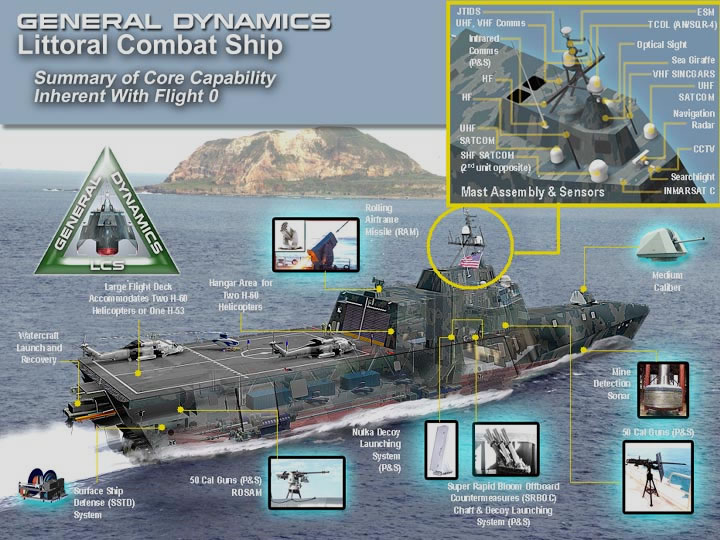
At 115 – 127 meters in length and 2,800 – 3,100 tons of displacement, the USA’s competing LCS ship designs are almost the size of Britain’s Type 23 frigates. They might well be classified as frigates, were it not for their shallow water design and employment. For whatever reason, high speed has also been identified as an important ship characteristic. As such, both the GD/Austal trimaran and Lockheed’s racing-derived monohull offer potential top speeds of 40-50 knots over short distances.
No matter which mission modules are loaded, the ship will carry a BAE Systems Mk.110 57mm naval gun with a firing rate of up to 220 rounds/minute, and Mk.295 ammunition that works against aerial, surface or ground threats. The ship will also carry .50 caliber (12.7mm) machine guns, plus defensive systems including automated chaff/flare dispensers and a launcher for Raytheon’s RIM-116 RAM Rolling Airframe Missile. RAM is designed to handle anti-ship missiles, aircraft, UAVs, helicopters, and even small boats, but its range of just 9 km/ 5 nm will only protect its own ship. Unlike larger missiles such as the RIM-162 ESSM, RAM systems cannot perform fleet defense.

LCS ships will also rely on their onboard MH-60 helicopters and/or MQ-8B Fire Scout helicopter UAVs, plus other robotic vehicles including a variety of Unmanned Underwater Vessels (UUV) and Unmanned Surface Vessels (USV). The terms have changed over time, but the US Navy has downgraded the term “mission modules” to mean individual components plus their support equipment. Integrated packages of weapons, sensors, robotic vehicles, and manned platforms that can be switched in and out depending on the ship’s mission are now called “mission packages.” They include all task-related mission modules, onboard aircraft, and their corresponding crew detachments.
The ships’ first and most important mission package is not officially listed. It consists of a small but very cross-trained crew. LCSs were intended to operate with a core crew of 40 (now 50) sailors, plus a mission module detachment of 15 and an aviation detachment of 25. Each ship has a Blue crew and a Gold crew, which will shift to 3 crews over time that can deploy in 4-month rotations.
There are concerns that this is a design weakness, leaving the LCS crew at the edge of its capabilities to just run the ship, with insufficient on-board maintenance capabilities, and too little left over for contingencies such as boarding and search, damage control, illnesses, etc. USS Freedom’s addition of 10 more bunks before her 1st Asian deployment indicates that the US Navy may be about to concede this point, but even with 50, performance wasn’t great.
Beyond the human element, the LCS program will initially draw upon packages for Mine Warfare (MCM: 24 planned), Anti-submarine Warfare (ASW: 16 planned) and Surface Warfare (SUW: 24 planned). The LCS Mission Modules Program Office (PMS 420) packages a variety of technologies to these ends, many of which are produced by other program offices and delivered as elements of a particular mission module. Costs per module have gone down over time, but that hasn’t been from any genius in planning and fielding. Rather, it results from a high program failure rate of individual components, and their replacement in the program by less expensive items:

The following DID articles offer in-depth coverage of current and proposed Mission Packages:
* It’s All in the Package: the Littoral Combat Ship’s Mission Modules. Covers the full set of mission packages.
* LCS & MH-60S Mine Counter-Measures Continue Development. MCM is the most complex module, and receives a dedicated article.
LCS: Controversies & Cautions

(click to view full)
The cost and size of LCS ships are now comparable to other countries’ high-end naval frigates. As the US Navy’s primary low-end vessels in the future fleet, they will be expected to perform many of the same roles. The cargo hold’s size has created some challenges in fitting all of the required equipment into the mission modules, without compromising high-end performance at the modules’ particular tasks. Even so, LCS ships can be expected to perform the mine countermeasures role very well, and the frigates’ traditional anti-submarine role reasonably well, thanks to their helicopters, array of robots, and rapidly upgradeable systems.
Other traditional roles for frigate-sized vessels are more controversial. The biggest controversy surrounds the ships’ one severe inflexibility: their weapons fit.
Present LCS designs don’t even carry torpedo tubes, or vertical-launch systems (VLS) that could accommodate present and future attack and/or defensive missiles. Even with the Surface Warfare module installed, LCS ships will carry a very light armament set for a major naval vessel: a 57-mm Mk 110 naval gun system; RIM-116 SeaRAM short range defensive missiles; 30mm cannons that would replace very short range Griffin missile launchers if installed; 12.7mm machine guns; plus any missiles or 70mm rockets carried by its accompanying helicopters (up to 2 H-60 slots or up to 4 MQ-8B Fire Scout UAV slots).
That armament is closer to a support vessel than a naval surface combatant, and larger high-speed support designs like the JHSV would offer far more mission module space for reconfigurable specialty support ships. Naval analyst Raymond Pritchett has pithily described the current compromise as:
“…3000 ton speedboat chasers with the endurance of a Swedish corvette, the weapon payload of a German logistics ship, and the cargo hold of a small North Korean arms smuggler.”

(click to view full)
The LCS weapons array also compares unfavorably with comparable-sized frigates that can perform the full array of anti-submarine, fleet air defense, and naval combat roles. The new Franco-Italian FREMM Class, or even Britain’s much older Type 23/Duke Class, outclass it considerably as multi-role ships. So do smaller corvettes like Israel’s US-built, $260 million Sa’ar 5 Eilat Class, and Sweden’s ultra-stealthy Visby Class. Even the tiny Danish Flyvefisken Class, whose swappable “flex ship” modules helped pave the way for the LCS idea, has a Mk 48 vertical launch system that can handle medium-range air defense missiles, and mounts launchers for Harpoon anti-ship missiles.
LCS’ lack of weaponry may not matter against small boats like the “Boghammers,” fielded by the Iranians during their late-1980s guerrilla warfare at sea against the US Navy in the Persian Gulf. Unfortunately, many nations field 90’+ Fast Attack Craft equipped with anti-ship missiles. Despite being 1/3 the LCS’ length and 1/5 of its displacement or less, their employment would create a threat that could attack an LCS from beyond its range of reasonable retaliation, with weapons that the LCS’ may not be able to stop or survive.
It’s telling that brochures for the International LCS versions offered by each team feature a major radar capability boost via the small SPY-1F AEGIS system or other radar upgrade, and are armed with torpedo tubes, anti-ship missiles and vertical-launch system (VLS) cells.

(click to view full)
Meanwhile, survivability has become an issue on 3 fronts. One is the slim margins created by a very small crew, leaving little margin for tasks like damage control if automated systems are damaged or fail. The other issues involve questions of shock/survivability testing, and of aluminum structures. The original concept for LCS was a ship whose damage resistance could save the crew, but not the ship, in the event if a significant strike. That was upgraded slightly to potentially saving the crew and the ship, but not continuing to fight while doing so. As the Exocet missile strikes on the HMS Sheffield (sank) and USS Stark (survived, barely) proved, even steel warships designed to keep fighting after a strike may find it challenging to meet their design specifications. Navy revelations that the LCS ships would not meet even Level I standards, let alone the OPNAVINST 9070.1 Level II standard of the frigates they’ll replace, has caused some consternation.
So, too, has the use of aluminum in ships exposed to hostile fire. The LCS-1 Freedom Class uses an aluminum superstructure, while the LCS-2 Independence Class is primarily an aluminum design. While both ships have had to certify to the same fire-proofing standards asked of other ships, aluminum conducts heat very well, and melts or deforms easily. If the ancillary fire-fighting systems, resistant coatings, etc. fail, or cannot handle a given situation at sea, structural integrity problems and secondary fires could become fatal concerns very quickly.
The emerging scenario in the USA is a cost for the base ships that continues to hover around $400-500 million each, plus weapons, electronics, and mission modules that bring the price per fully-equipped ship to $450-600 million, even under the proposed new fixed-price contract. That’s no longer a cheap $220 million corvette class price tag. Instead, it’s a price tag that places the USA’s LCS at the mid-to-upper end of the international market for full multi-role frigate designs. Even as overall American procurement trends make LCS ships the most common form of US naval power.
In that environment, unfavorable comparisons are inevitable. A versatile surveillance and special forces insertion ship whose flexibility doesn’t extend to the light armament that’s its weakest point, and isn’t able to deal with anything beyond token naval or air opposition, won’t meet expectations. Worse, it could cause the collapse of the Navy’s envisaged “high-low” force structure if the DDG-1000 destroyers and CG (X) cruisers are priced out of the water, and built in small numbers.
That domino has already fallen, as DDG-1000/ DD (X), production has been capped at just 3 ships, and CG (X) was canceled entirely in the FY 2011 budget. As Vice-Admiral Mustin (ret.) and Vice-Admiral Katz (ret.) put it in a 2003 USNI Proceedings article:
“Because the Navy has invested heavily in land-attack capabilities such as the Advanced Gun System and land-attack missiles in DD (X), there is no requirement for [the Littoral Combat Ship] to have this capability. Similarly, LCS does not require an antiair capability beyond self-defense because DD (X) and CG (X) will provide area air defense. Thus, if either DD (X) or CG (X) does not occur in the numbers required and on time, the Navy will face two options: leave LCS as is, and accept the risk inherent in employment of this ship in a threat environment beyond what it can handle (which is what it did with the FFG-7); or “grow” LCS to give it the necessary capabilities that originally were intended to reside off board in DD (X) and CG (X). Neither option is acceptable.”
Especially if the low end has grown to a cost level that makes it equivalent to other countries’ major surface combatants, while falling short on key capabilities that will be required in the absence of higher-end ships.
The LCS Program

In 2009, the CBO estimated LCS shipbuilding costs at around $30.2 billion, with a fleet average of 1.2 mission modules per ship (TL. 66) bought separately at about $100 million per module. As of 2012, the split had changed a bit, but the overall total was around $39 billion. This contrasts with the original hope of $22 billion total costs for 55 ships and 165 mission modules, at $400 million per ship ($220M construction + (3 x $60M) mission module options).
The US Navy’s current shipbuilding plan envisions building 32 littoral combat ships and 64 mission modules until about 2040. Technically, only 45 LCS ships would count toward Navy fleet totals. Because these ships are assumed to have a service life of 25 years, the 10 or fewer ships bought from 2036 – 2040 would be replacements for the original ships of class. Even so, that number of LCS ships is likely to make up 20% of the Navy or more. The US Navy has already sagged to under 300 ships, and unless major changes in course lie ahead for its budget or its chosen designs, the total number of ships will sink farther.
Acquisition Structure
In July 2011, the Navy created PEO LCS to oversee the program, headed by Rear Adm. James A. Murdoch. Ship construction supervision was removed from PEO Ships, while mission module supervision was removed from PEO Littoral and Mine Warfare (PEO LMW), which was dissolved. It wasn’t the first big change in the program – and may not be the last.
It’s normal for programs to change elements like numbers ordered, but not to change the entire buy strategy. The Littoral Combat Ship program has shifted its entire buy strategy several times during its short lifetime – a sorry sequence of orders, budgets not spent, contract cancellations, etc. documented in Appendix A.
The last buy strategy has lasted long enough for a multi-ship contract. After buying 4 ships and taking bids under their 2009 revised strategy, the US Navy went to Congress and asked for permission to accept both 10-ship bids, buying 20 ships for a total advertised price that was about the same as the estimates for the 15 ships they had wanted. The GAO and CBO both have doubts about those estimates, in part because the Navy is still changing the designs; but the contracts were issued at the end of December 2010. Each contractor would get 1 initial ship order, then 9 more options, with the ship purchases spread across FY 2010-2011 (1 per year for each contractor); then FY 2012-2015 inclusive (2 per year for each contractor). Cost overruns will be shared 50/50 between the government and contractor, up to a set cost cap.
Budgets


By the end of FY 2013, the program is expected to be at about a quarter of total procurement, in units ordered and dollars spent.
LCS: Ship Roster
Team Lockheed, Freedom Class
* LCS 1, USS Freedom. Commissioned Nov 8/08.
* LCS 3, USS Fort Worth. Commissioned Sept 22/12.
* LCS 5, Milwaukee
* LCS 7, Detroit
* LCS 9, Little Rock
* LCS 11, Sioux City
* LCS 13, Wichita
* LCS 15, Billings
Team Austal, Independence Class
* LCS 2, USS Independence. Commissioned Jan 16/10.
* LCS 4, USS Coronado. Commissioned April 5/14.
* LCS 6, Jackson
* LCS 8, Montgomery
* LCS 10, Gabrielle Giffords
* LCS 12, Omaha
* LCS 14, Machester
* LCS 16, Tulsa
LCS: Export Potential

(click to view full)
Once one steps beyond small patrol craft, growing capabilities have made frigate-sized vessels the most common naval export around the globe. With many nations confronting challenges in the world’s littorals, which include the globe’s most important shipping choke points, one would expect some interest in the Littoral Combat Ship beyond the USA. A Dec 11/06 Austal release claimed 26 potential buyers worldwide for the ship and its companion equipment, “with two near-term contenders and four others that have expressed active interest.”
There are 2 interesting aspects to LCS export bids. One is their equipment, which is radically different from the US Navy’s set.
Lockheed Martin’s international Multi-Mission Combat Ship (MMCS) version, which attracted some interest from Israel before cost issues intervened, has a variety of configurations from OPV/corvette to large frigate size. Upgraded radars range from CEAFAR active-array radars on smaller ships, to the option of Lockheed’s SPY-1F for the largest variant. Fixed weapons include torpedo tubes and 8 Harpoon missiles, though some exhibit models have used 12 Kongsberg NSMs. Concept diagrams also show between 4-48 VLS cells, some of which are full strike-length size.
General Dynamics’ trimaran adds an upgraded radar (SPY-1F in diagrams), torpedo tubes, and 16 tactical-length vertical launch (VLS) cells.Among other payloads, those cells could hold VL-ASROC anti-submarine missiles to extend anti-submarine reach, or quad-packed RIM-162 ESSM anti-air missiles for area air defense. Exhibited models have also displayed up to 16 NSM anti-ship missiles.

(click to view full)
The other aspect worth noting is the Littoral Combat Ship’s failure to close any export sales over 7+ years. At present, both LCS designs have received preliminary export inquiries, but Israel and Thailand are the only cases where it has gone farther than that.
Israel did step up in July 2008, and confirmed its request for an LCS-I based on Team Lockheed’s design. Israel’s variant was very different from LCS 1 Freedom, however; it featured a fixed set of weaponry rather than full mission module spaces, and its proposed SPY-1 AEGIS or MF-STAR radar and weapons array and made it far more capable in critical roles like air defense and ship to ship warfare. As noted above, similar changes have been a common theme among international LCS offerings, but an estimated ship cost of over $700 million eventually pushed Israel to rethink its plans. That country is now pursuing cheaper options based on Blohm + Voss’ MEKO family of corvettes and frigates, or South Korean designs. The Freedom Class also lost the Thai competition.
Saudi Arabia has reportedly expressed interest in a fixed armament version of the General Dynamics/Austal design. That interest was reiterated in 2010, but they’re also evaluating Lockheed Martin’s design for the Arabian/Persian Gulf fleet. In 2011, it emerged that the Saudis might skip an LCS buy altogether, in exchange for a much more heavily-armed, versatile, and expensive option: the USA’s DDG-51 Arleigh Burke Class multi-role destroyers, with ballistic missile defense capability.
Meanwhile, designs like the German MEKO family, the multi-role Franco-Italian FREMM, the modular-construction Dutch Sigma class, and even refurbished 1980s-era NATO frigates continue to find buyers around the world.
LCS: Ship Contracts & Key Events
This section covers the core LCS program. Mission Packages are discussed in-depth in “It’s All in the Package: the Littoral Combat Ship’s Mission Modules“; and the complex mine countermeasures package gets its own in-depth treatment in “LCS & MH-60S Mine Counter-Measures Continue Development“.
Unless otherwise noted, all contracts are issued by the USA’s Naval Sea Systems Command in Washington, DC.
FY 2016 – 2024
![USS Coronado [LCS 4] & USNS Millinocket [JHSV 3]](https://www.defenseindustrydaily.com/wp-content/uploads/2023/11/SHIP_LCS-4_JHSV-3_RIMPAC_2014_Austal_lg.jpg)
June 25/24: Austal USA, Mobile won a $47 million cost-plus-fixed-fee, firm-fixed-price, and cost-only modification for Littoral Combat Ships class design support, and integrated data and product model environment support. Work will be performed in Mobile, Alabama and Pittsfield, Massachusetts and is expected to be completed by June 2025. Fiscal 2019 shipbuilding and conversion (Navy) funding in the amount of will be obligated at time of award. The Naval Sea Systems Command, Washington, DC, is the contracting activity.
May 28/24: Lockheed Martin won a $22.7 million modification to exercise an option for industrial post-delivery availability support for the Freedom-variant Littoral Combat Ship USS Cleveland (LCS 31). Work will be performed in Marinette, Wisconsin, and is expected to be completed by March 2025. Naval Sea Systems Command, Washington, DC, is the contracting activity.
May 20/24: Austal won an $8 million deal to provide advance planning, material procurement, and accomplishment of work for emergent availabilities in support of the littoral combat ship USS Kingsville (LCS 36). This effort is to develop and provide planning, engineering support, planning and logistics technical documentation, funds and man-hour expenditure data, projected costs, cost estimates, material and labor for the accomplishment of post-delivery work items during emergent availabilities and to accomplish all testing required. Work will take place in National City, California, and is expected to be completed by December 31, 2025.
March 4/24: Huntington-Ingalls won an $80 million cost-plus-award-fee modification to exercise options for the accomplishment of the planning yard services for the Littoral Combat Ship in-service ships. Work is expected to be completed by April 2025. The Naval Sea Systems Command, Washington, DC, is the contracting activity.
February 14/24: Austal USA has completed its acceptance trials of the US Navy’s future USS Kingsville littoral combat ship (LCS 36) in the Gulf of Mexico. The event included a series of tests to evaluate the vessel’s equipment and capabilities according to the US Department of Defense’s shipbuilding and compliance standards. The trials were facilitated in partnership with the US Navy Board of Inspection and Survey.
September 6/22: LCS 34 Austal USA won a $11.4 million contract modification to exercise an option for littoral combat ship (LCS) industrial post-delivery availability support for USS Augusta (LCS 34). The LCS main purpose is to take up operations such as patrolling, port visits, anti-piracy, and partnership-building exercises to free up high-end surface combatants for increased combat availability. Work will take place in Alabama and Massachusetts. Expected completion will be by September 2023.
June 24/22: IDPME Austal USA won a $45.2 million to exercise an option for Littoral Combat Ships (LCS) Class Design Support and Integrated Data and Product Model Environment (IDPME) support. The littoral combat ship is a new family of surface ships for the US Navy. The LCS is a fast, highly manoeuvrable, networked surface combat ship, which is a specialized variant of the family of US future surface combat ships. Work will take place in Alabama and Massachusetts. Expected completion will be by June 2023.
April 27/22: In-Service Ships Huntington Ingalls Industries won a $20.2 million contract modification to exercise options for the accomplishment of the planning yard services for the Littoral Combat Ship (LCS) in-service ships. Work will take place in Virginia, Mississippi, California and Jacksonville. Expected completion will be by April 2023.
March 11/22: Industrial Post-Delivery Availability Austal won a $12.3 million contract modification to exercise an option for littoral combat ship (LCS) industrial post-delivery availability support for USS Santa Barbara (LCS 32). The USS Santa Barbara is the US Navy’s 16th Independence littoral combat ship (LCS) variant. The LCS programme will see the construction of the vessels in the Freedom-class and the Independence-class variants. Work will take place in Alabama and Massachusetts. Expected completion will be by December 2022.
October 6/21: Design Services Lockheed Martin won an $80 million contract modification to exercise options for littoral combat ship class design services and integrated data and product model environment support. According to the Defense Department, The US Navy plans to build a fleet of 33 literal combat ocean going warships that are also capable of operating in shallow coastal waters. Work will take place in New Jersey, Washington DC and Wisconsin. Estimated completion will be by October 2022.
August 26/21: Unmanned Mine Detection The US Navy announced, that it has finished a test of its first littoral combat ship-based unmanned mine detection system. The Unmanned Influence Sweep System designed for the LCS has a mine countermeasures unmanned surface vehicle, or MCM USV, and a towed minesweeping payload to sweep magnetic or acoustic mines, the Program Executive Office for Unmanned and Small Combatants.
May 5/21: Configuration Management Changes Lockheed Martin Rotary and Mission Systems won a $15.6 million contract modification for the implementation of configuration management changes on select Freedom-variant Littoral Combat Ships (LCS). The LCS new construction contract provides for the design, construction, integration, and testing of the Littoral Combat Ship, which operates with focused-mission packages that deploy manned and unmanned vehicles to execute a variety of missions, including anti-submarine warfare, surface warfare, and mine countermeasures. Work will take place in Marinette, Wisconsin. Estimated completion will be by May 2022.
April 23/21: USS Mobile The future USS Mobile, the US Navy’s next Independence-class littoral combat ship, will be commissioned on May 27, the Navy announced. The ceremony, restricted because of COVID-19 concerns but scheduled to be livestreamed, will be held in Mobile, Ala., where the ship was built by Austal USA. The vessel will be the 13th Independence variant in the Navy fleet. Littoral combat ships are fast, agile, focused-mission platforms designed for operation in near-shore environments but capable of open-ocean operation, Austral USA said.
April 2/21: Operation Inherent Resolve The USS Dwight. D Eisenhower Carrier Strike Group is participating in Operation Inherent Resolve with new airstrikes, the Navy said on Wednesday. Missiles were launched by Carrier Air Wing 3 against Islamic State positions in Iraq and Syria from the strike group’s position in the Eastern Mediterranean Sea, the Navy statement said. The air launches came after IS took responsibility for an attack this week at Palma, Mozambique. “Our Strike Group is ready and capable of providing direct, long-range combat operational air support from the Eastern Mediterranean Sea,” Rear Adm. Scott F. Robertson, commander of Carrier Strike Group 2, said in a statement.
December 13/18: LCS-13 PSA The US Navy’s 13th Littoral Combat Ship is receiving its last finishing touches. Lockheed Martin is being awarded with a $16 million cost-plus-award-fee order in support of the USS Wichita. The contract provides for engineering and management services during the ship’s post shakedown availability (PSA). The company will provide the Navy with 65.000 man-hours of work and is responsible for work specification, pre-fabrication and material procurement. The USS Wichita is a Freedom-class LCS, designed to conduct anti-surface warfare, anti-submarine warfare, anti-air warfare, mine warfare, electronic warfare, and special operations. The PSA is assigned to newly built, activated or converted ships upon completion of a shakedown cruise. Work performed is focused on correcting defects noted during the shakedown cruise and those remaining from Acceptance Trails. Work will be performed in Baltimore, Maryland; New York and Marinette, Wisconsin. The PSA is expected to be completed by February 2020.
November 20/18: Saudi contract Lockheed Martin is being awarded with a contract modification to continue work on Saudi Arabia’s new warships. The undefinitized contract action modification provides for long-lead-time material and detail design in support of the construction of four Multi-Mission Surface Combatant ships (MMSC). The order is valued at $282 million and includes Foreign Military Sales funding in the amount of $124 million. The MMSC is a derivative of the US Navy’s Freedom-class Littoral Combat Ship. Its mission capabilities include anti-surface warfare, anti-submarine warfare, anti-air warfare, mine warfare, electronic warfare, and special operations. Saudi Arabia’s new ships will be fitted with Mk-41 VLSs, Lockheed’s COMBATSS-21 Combat Management Systems, CIWS, a Mk-75 76mm OTO Melara Gun and several missile systems. Work will be performed at Lockheed’s locations in Marinette, Wisconsin; Baltimore, Maryland; Herndon, Virginia; Moorestown, New Jersey; Manassas, Virginia and San Diego, California. Performance of the contract is expected to be completed by October 2025.
September 28/18: LCS-18 PSA The US Navy’s next Littoral Combat Ship is getting its last finishing touches. Austal is receiving a cost-plus-award-fee order valued at $16.5 million. The contract provides for material and work during the USS Charleston’s post shakedown availability (PSA). LCS-18 is an Independence-class ship. The high speed trimaran offers an especially large flight deck and internal mission volume. The hull is aluminum, but the trimaran design offers additional stability options, and may help the ship survive side hits. The PSA is assigned to newly built, activated or converted ships upon completion of a shakedown cruise. Work performed is focused on correcting defects noted during the shakedown cruise and those remaining from Acceptance Trails. Work will be performed at shipyards in Mobile, Alabama and San Diego, California. Work is expected to be completed by August 2019.
September 20/18: Fleet grow by three The Navy is ordering one Freedom-class LCS from Lockheed Martin and two Independence-class LCSs from Austal. Both companies are being awarded with fixed-price-incentive firm target modifications to previously awarded contracts. The DoD press release however does not specify the value of those modifications because the price-tag is considered to be a ‘source selection sensitive information’ as stated under in 42 in US Code 2101 and Federal Acquisition Regulations 2.101 and 3.104. Austal received an initial $584.2 million contract (N00024-17 C-2301) for the construction of one LCS-2 on October 6, 2017. The ships to be built will be the 33rd, 34th and 35th littoral combat ships in the fleet, and will exceed the 32-ship requirement set by the Navy. Appropriators, however are slashing funds for the acquisition of necessary mission modules in the 2019 Defense Department funding bill, raising concerns about future program delays. Work will be performed at various locations, including – but not limited to – Mobile, Alabama; Cincinnati, Ohio; Marinette, Wisconsin and Monrovia, California, and is expected to be completed by September 2024.
September 14/18: MQ-8C qualifies Northrop Grumman’s MQ-8C Fire Scout qualifies for automated sea mine hunting operations. During the recently held US Navy Advanced Naval Technology Exercise, the unmanned helicopter successfully coordinated with a small robotic surface ship and unmanned submersible, by serving as a communications relay and situational awareness platform. The MQ-8C is an unmanned Bell 407 designed to operate from the Freedom and Independence class LCS, collect surveillance, conduct mine hunting and anti-submarine warfare missions. In the future the drone may be armed with the advanced precision kill weapon system (APKWS), a BAE Systems product that transforms unguided 2.75-inch rockets into a precision-guided round. The Fire Scout completed its initial operational test and evaluation on board the USS Coronado in July.
September 3/18: Engine change The USS Michael Monsoor is ready to sail again. Shipbuilder Bath Iron Works recently completed the replacement of one of the massive turbines needed to power the DDG-1001. The Navy decided to replace the unit after it noticed an unusual vibration during sea trials and discovered afterward that a foreign object had damaged some of the blades. The Zumwalt class destroyers are powered by two Rolls-Royce MT30 turbines, similar to those used on Boeing 777 passenger jets.
August 2/18: USS Tulsa enters PSA The US Navy’s next Littoral Combat Ship is currently entering its post-shakedown availability (PSA). Austal is being awarded a cost-plus-award-fee order with a value of $14.8 million. The company will provide engineering and management services in support of the USS Tulsa (LCS 16), including work specification development, prefabrication efforts and material procurement. The USS Tulsa is an LCS-2 Independence class vessel which is a futuristic but practical high-speed trimaran, based on Austal designs and experience with vessels like the US Marines’ Westpac Express high-speed transport. LCS 16 carries a General Dynamics designed combat system, and standard LCS weapon fittings. Work will be performed in Mobile, Alabama and San Diego, California. The PSA is expected to be completed by August 2019.
July 18/18: More orders Lockheed Martin is being awarded a modification in support of the Navy’s LCS program. The un-definitized contract action modification has a value of $450.7 million and provides for long-lead-time material and detail design in support of the construction of four Multi Mission Surface Combatant ships. Lockheed Martin MMSC (Multi-Mission Surface Combatant) is a derivative of the US Navy’s Freedom-class Littoral Combat Ship. The MMSC platform can be configured with a variety of sensors and weapons based on operational requirements of the naval customer. It also allows for interoperability with the US Navy and allied naval forces in joint operations. Its mission capabilities include anti-surface warfare, anti-submarine warfare, anti-air warfare, mine warfare, electronic warfare, and special operations. This modification brings the total cumulative face value to over $1 billion. The contract also includes a $225.3 million US foreign military sale to the Kingdom of Saudi Arabia. Work will be performed at multiple locations inside and outside the continental US. They include Crozet, Virginia; Milwaukee, Wisconsin; Baltimore, Maryland and the UK. Production is expected to be completed by October 2025.
June 20/18: Mission updates The Navy is contracting Advanced Acoustic Concepts LLC in support of the Navy’s Littoral Combat Ship (LCS) platform. The cost-plus-fixed-fee and cost-reimbursement modification is valued at $12.2 million and provides for software engineering services to support the LCS Mission Modules program. The Navy’s Littoral Combat Ship has been designed to counter a number of “asymmetric” threats like coastal mines, quiet diesel submarines, global piracy, and terrorists on small fast attack boats. Instead of designing a single platform that is able to take over those tasks the Navy opted for developing a ship that can be adapted to specific mission requirements by integrating swappable mission modules. Therefore, the LCS program includes packages for Mine Warfare, Anti-submarine Warfare and Surface Warfare. The LCS Mission Modules Program Office packages a variety of technologies to these ends, many of which are produced by other program offices and delivered as elements of a particular mission module. Work will be performed in Hauppauge, New York; Columbia, Maryland and Lemont Furnace, Pennsylvania, and is expected to be completed by June 2019.
June 15/18: Sustained support Q.E.D Systems is being awarded a contract in support of the Navy’s Littoral Combat Ship (LCS) class. Valued at $15 million the cost-plus-incentive fee, cost-plus-fixed fee, cost-only contract allows for the procurement of long lead time material in support of the LCS class ships’ maintenance and sustainment availabilities. The $35 billion LCS program is the Navy’s idea for the low-end backbone of its future surface combatant fleet. At 115 – 127 meters in length and 2,800 – 3,100 tons of displacement the US LCS is almost the size of Britain’s Type 23 frigates. LCSs can be reconfigured with a variety of mission modules. In addition, the vessels are armed with a 57mm naval gun, .50 caliber machine guns, plus defensive systems including automated chaff/flare dispensers and a launcher for Raytheon’s RIM-116 RAM, which allows the ship to intercept anti-ship missiles, aircraft, UAVs, helicopters, and even small boats. This contract includes options which, if exercised, would bring the cumulative value of this contract to $237 million. Work will be performed in San Diego, California and Virginia Beach, Virginia, and is expected to be completed by June 2019.
March 20/18: Mission modules Northrop Grumman will deliver services in support of littoral combat ship (LCS) mission modules for the US Navy. Valued at $46.7 million, the contract modification was announced by the Pentagon last Wednesday, March 15, and tasks Northrop with providing engineering, technical and sustainment services for the Navy’s littoral combat ship mission modules—which are designed for naval operations against asymmetric threats and anti-access obstacles in littorals near the coastline. Work will take place Bethpage, New York, San Diego, California, and several other US locations with contract completion scheduled for March 2019.
February 5/18: USS Omaha-Commissioning The newest Independence-variant littoral combat ship (LCS), USS Omaha, was commissioned into service on Saturday, February 3, at the Broadway pier in San Diego. As the 11th LCS to enter the fleet and the sixth of the Independence-variant design to enter service, attendees at the ceremony include former Navy SEAL officer and Medal of Honor recipient Bob Kerrey—who also served in the US Senate and as governor of Nebraska—Warren Buffett’s daughter, Susie Buffett—who served as the vessel’s sponsor, as well as San Diego Mayor Kevin Faulconer. The LCS-class consists of the Freedom-variant, made by Lockheed Martin, and the Independence-variant, made by Austal USA.
January 24/18: USS Little Rock-“Littoraly” Stuck! The US Navy’s latest Freedom-class littoral combat ship (LCS), USS Little Rock, has found itself caught in the ice in Montreal, Canada. Recent cold fronts from the Arctic has caused record cold temperatures throughout December and January, with ice forming faster than normal in the Seaway. Little Rock, which was commissioned in Buffalo, New York on December 16, with significant snowfall already falling, and the plan was to then transit the Seaway to reach the Atlantic Ocean, before continuing on to Mayport, Florida. Now, its is likely the vessel will be stuck in Montreal until the ice thaws in March, with the crew to continue to focus on training, readiness and certifications.
November 9/17: The US Navy has awarded a $22.4 million contract to BAE Systems to exercise options for post-shakedown availabilities (PSA) for the USS Little Rock and USS Sioux City littoral combat ships (LCS). Work will be carried out onboard USS Little Rock LCS-9 and USS Sioux City LCS-11 Freedom-class littoral combat ships at BAE’s facility in Jacksonville, Fla., with completion scheduled for February 2019. PSA activities are usually carried out to correct deficiencies found during the shakedown cruise or to accomplish other authorised improvements.
October 09/17: Austral USA, the Mobile, Alabama-based subsidiary of the Australian shipbuilder has been awarded a $584.2 million modification to a previously awarded US Navy contract for the construction of a littoral combat ship (LCS). Under the terms of the deal, the firm will perform and oversee all necessary design, planning, construction and test and trials activities in support of delivery of the vessel to the Navy, with a scheduled completion date set for October 2023. Work will primarily take place at Mobile, Alabama, but also at several other east coast locations. The Navy expects to release a competitive solicitation(s) for additional LCS class ships in future years, and therefore the specific contract award amount for these ships is considered source selection sensitive information and for the time being, will not be made public.
September 28/17: Shipbuilder Fincantieri Marinette Marine has delivered the future USS Little Rock, a Freedom variant Littoral Combat Ship (LCS), to the US Navy. The Little Rock—completed last summer and is expected to be commissioned into service in December—is the Navy’s 11th LCS and the fifth Freedom variant delivered to and accepted by the service. Speaking on addition Freedom-class LCS vessels under construction, Fincantieri added that the future USS Sioux City will enter into trials soon, the future USS Wichita was christened and launched in September of last year and is conducting system testing in the Menominee River, and the future USS Billings was launched in July and is to begin trials next year.
September 04/17: Future Littoral Combat Ship USS Little Rock (LCS 9) has completed its acceptance trials, attaining the highest score of the five Freedom-class LCS vessels completed to date. During the five-day trial, it completed a full-power run along with all associated steering and maneuvering events and also surface and air self-defense detect-to-engage exercises, as well as demonstrating the performance of the ship’s propulsion plant, auxiliary systems and the ship’s handling. Manufacturers Lockheed Martin and Fincantieri Marinette Marine are now preparing Little Rock for delivery to the Navy in the coming weeks.
August 29/17: In a littoral combat ship (LCS) first, the US Navy successfully used a UAV to provide over-the-horizon targeting information and damage assessment for a missile that was launched from an LCS vessel. The ship in question, the Independence-class LCS USS Colorado, was participating in exercises off the coast of Guam when it fired a RGM-84D Harpoon Block 1C missile that successfully struck a surface target at significant distance beyond the ship’s visual range. During the exercise, a Northrop Grumman MQ-8B Fire Scout drone and a Lockheed Martin MH-60S Seahawk helicopter, both part of Coronado’s rotary-wing air detachment, provided targeting support for the Harpoon missile. The aircraft used radar, electro-optical systems and other sensors to locate the target, pass targeting information back to the ship via data link to refine the firing solution, monitor and assess the missile, and then carry out damage assessment on the target.
August 23/17: An industry team led by Lockheed Martin has successfully completed builder’s trials of the future Freedom-class Littoral Combat Ship USS Little Rock. Conducted on Lake Michigan, LCS 9 Little Rock went through a series of tests and evaluations of its primary systems and propulsion, including reaching flank speeds of over 40 knots. Four Freedom-class LCS vessels have been delivered to the Navy by Lockheed, with the Little Rock and eight others in various stages of production. They will serve alongside the larger Independence-class LCS produced by Austal USA.
July 6/17: The US Navy has christened its latest Freedom-class littoral combat ship the USS Billings during a ceremony in Marinette, Wis. Built by Lockheed Martin, Freedom-class LCS is the smaller of the two variants of the LCS, the other being the Independence-class constructed by Austral USA. It has a top speed of over 40 miles per hour and carries a variety of light guns, short-ranged missiles and anti-submarine torpedoes. Each LCS is outfitted with a single mission package made up of mission modules containing warfighting systems and support equipment.
May 25/17: The US Navy has awarded Raytheon a $14.7 million contract for maintenance and support of the AN/AQS-20 sonar mine detection system. Under the agreement, the company will work to improve the system’s performance and sustainability with work to include hardware and software upgrades, technology development, engineering and spare parts. Options available in the contract could bring the total value of the program to $77.1 million. The AN/AQS-20 towed mine hunting and identification array is deployed on the Littoral Combat Ship (LCS).
March 9/17: The US Navy completed the test-firing of a surface to surface missile module (SSMM) from littoral combat ship USS Detroit. This marks the first time that such a system was fired from an LCS platform as well as the first time such a platform utilized a vertical lift launch. By giving LCS vessels an SSMM package, the Navy will be able to engage the increasing threats posed from small boats by giving them an added lethality.
September 14/16: A US Navy announcement for an overhaul of the troubled Littoral Combat Ship program will include turning the first four ships into test vessels. The change comes after the naval branch announced an engineering stand-down for LCS crews following an August 29 engineering casualty on the USS Coronado. Under Thursday’s plan, the Freedom, Independence, Fort Worth and Coronado will become single-crewed testing ships that could be deployed as fleet assets on a limited basis, the Navy said.
December 4/15: Experts from navies, academia and industry met in Tokyo this week to discuss the unique challenges of operating in the littoral or coastal environment. The Littoral OP Tech East conference is the first of its kind to be held in Asia, and looks at fostering increased innovation and creation of solutions to both new and old problems. Speakers stressed the importance of the development of new war-fighting concepts and increased operational capabilities of fleets. The meeting comes at a time when the US navy and its allies are looking to incorporate wider capabilities for all ships in its fleets and the rolling out of the new Littoral Combat Ship (LCS) class warship throughout various theatres.
December 1/15: The US Navy has released the remaining $279 million funding to Lockheed Martin for the next freedom-variant Littoral Combat Ship. The funds will allow for the completion of the USS Cooperstown, the 29th LCS warship in service, and follows the $79 million granted by congress in March towards the construction. The announcement comes shortly after the commissioning of the USS Milwaukee last week.
November 24/15: The US Navy’s Littoral Combat Ship Class (LCS) program is picking up speed as two more of the ships were launched over the last few days. November 20 saw the USS Omaha enter the water in Mobile, Alabama and the USS Milwawkee was commissioned the following day by the Mayor of Milwawkee. There are now five LCS class ships operational and they are being completed at an average of four per year. It is hoped that by 2018, 38 of the ships will have undergone construction in only 13 years and will be operating in shallow and coastal waters throughout the world.
October 27/15: The Navy’s Littoral Combat Ships (LCS) will reportedly be equipped with over-the-horizon missiles for their next deployment, with the specific model not yet determined. With the Brookings Institution rightly pointing out that the LCS do not currently possess the power-projection capabilities recently demonstrated by Russia’s Caspian Sea fleet, the USN is likely looking to bolt-on additional muscle to the fleet following the cancellation of the Non-Line-of-Sight (NLOS) missile in April 2010. With the USS Coronado and USS Freedom scheduled for deployment next year, a Request for Proposals is expected by the end of this year.
October 21/15: The US State Department has approved the sale of up to four Littoral Combat Ship-based Multi Mission Surface Combatant Ships to Saudi Arabia, with these based on the Lockheed Martin Freedom-class LCS, as opposed to the Austal Independence-class. If lawmakers agree to the sale, a Foreign Military Sales contract can be drafted, with this likely to be signed early next year. The deal – potentially worth $11.25 billion – forms part of the Kingdom’s Eastern Fleet Modernization program.
October 20/15: The Navy has accepted delivery of the sixth Littoral Combat Ship (LCS 5), the future USS Milwaukee. The Freedom-class vessel is the third of eight to be manufactured by Lockheed Martin, with the ship now scheduled for commissioning on 21 November. The USS Milwaukee will be homeported in San Diego with the rest of the LCS fleet.
FY 2015
LCS 7 & 8 christened; New TRS-4D radar for Freedom Class after LCS 15.
September 17/15: The Saudis are reportedly set to choose Lockheed Martin’s Littoral Combat Ship for the country’s Arabian Gulf-based frigate modernisation program, with a deal thought to be announced by the end of the year. The company is one of two teams constructing LCS for the US Navy. The Saudis have previously requested the ability for their LCS vessels to launch Standard Missile-2 (SM-2) air defense missiles but are thought to have dropped previous plans to procure the Aegis combat system owing to cost.
August 27/15: Austal is enjoying the start of the sweet spot of its $3.5 LCS contract, showing record profits and anticipating additional efficiencies as it starts to knock out the remaining 9 LCS ships.
August 18/15: The Littoral Combat Ship USS Coronado (LCS-4) has successfully conducted live-fire testing using the ship’s surface warfare mission module, firing the ship’s Mark 46 30mm cannon and Mark 110 57 mm gun, hitting surface targets off the West Coast. The BAE Systems Mk 110 gun equips the Navy’s LCS fleet as standard, with the Mark 46 forming part of the surface warfare (SuW) module.
July 21/15: Lockheed Martin has launched the ninth Littoral Combat Ship (LCS), the Freedom-class USS Little Rock (LCS 9). Austal christened LCS 8 (the USS Montgomery) in November 2014, with LCS 9 the fifth of eight LCS timetabled for construction by Lockheed Martin. The ship will now undergo testing and equipment fitting before being delivered to the Navy later this year.
Sources: US Navy Moving Forward With LCS | USNI News.
July 9/15: Littoral Combat Ship 6 (USS Jackson) has completed acceptance trials with the US Navy in the Gulf of Mexico. LCS 6 is the third Independence-class to be built by Austal, which shares the construction of the LCS program with Lockheed Martin under a $3.5 billion ten-ship block buy awarded in December 2010. The company laid the keel for the fourteenth LCS (USS Manchester) in late June this year, having already delivered two Independence-class vessels.
July 1/15: Austal has laid the keel of the fourteenth Littoral Combat Ship in Alabama, with the future ship destined to become the USS Manchester. Austal shares the construction of the LCS program with Lockheed Martin under a $3.5 billion ten-ship block buy awarded in December 2010.
Feb 23/15: USS Omaha keel laid, sixth in Independence class.
Austal USA laid the keel for the USS Omaha (LCS 12), the latest and sixth littoral combat ship in the Independence class.
Secretary of Defense Chuck Hagel appears to have shied away from making any drastic dedision with the future of the LCS, by choosing to base 20 future Small Surface Combatants… based on “modified LCS hull designs.” The use of the plural form implies that there is no down-select to just one of the 2 LCS designs. By omission, mine warfare seems out, since modular requirements are maintained solely for capabilities against surface ships and submarines.
Predictably the SSCs will have to be both more survivable and better armed, since these points are among the weaknesses most often pointed out by LCS detractors. The list of goodies to achieve that:
* over-the-horizon surface-to-surface missiles
* air defense sensor and weapon upgrades
* 1 advanced electronic warfare system
* advanced decoys
* 1 towed array system for submarine detection and torpedo defense
* 2 25mm guns
* 1 armed helicopter equipped with Hellfire missiles and MK-54 torpedoes
* 1 unmanned FireScout helicopter for surveillance, reconnaissance, and targeting
The armed helicopter and rotorcraft are not new, and 25mm guns are not going to make much of a difference except against the smallest threats. The rest is getting SSCs closer to how LCS has been pitched to export prospects, and to what even smaller ships pack in foreign fleets. Beyond that, the Navy still has to pin down many specifics, discuss crew size, or explain how they will contain costs.
Nov 17/14: CSBA Paper. The non-partisan CSBA releases “Commanding the Seas: A Plan to Reinvigorate U.S. Navy Surface Warfare.” Their recommendations are wide ranging, including a major shift in US Navy weapons configurations toward higher capacity medium-range air defenses. That would take place in order to free up VLS cells for long-range offensive surface attack, anti-submarine, and air-denial weapons.
The paper believes that LCS ships should be forward based abroad, given their limited range and low ability to maintain themselves at sea. Their mission packages should also be disentangled from the LCS platform, creating “independent, stand-alone capability sets that could be carried on a wide range of ships in the National Fleet.” Beyond that, the SSC/ LCS could take advantage of LCS’ higher power generation to mount anti-aircraft rail guns and/or lasers, hosting RIM-162 ESSM air defense missiles, and distributing offensive attack capabilities via their VLS cells.
The paper recommends that the Navy pick 1 existing LCS design to convert to the SSC, adding a vertical launch system and retrofitting VLS to some of the Flight 0 ships as well. The problems come down to capability and cost. At minimum, an SSC derived from the LCS would need to carry the ASW mission package full-time, and incorporate longer-range missile capabilities via a vertical launch system. The reality is that the cost is inevitably higher than the $515 million for an LCS with the ASW package, but the Navy isn’t planning for any increase as it plans for 20 SSC ships. This is so even though the FFG-7 Oliver Hazard Perry Class, which was developed in the 1980s as a similar sort of budget frigate platform, would cost $774 million in adjusted modern dollars. Conclusion? The Navy won’t get 20 SSCs, which is one more reason to retrofit VLS cells on Flight 0 LCS ships. Sources: CSBA, “Commanding the Seas: A Plan to Reinvigorate U.S. Navy Surface Warfare” (incl. full PDF) | USNI, “CSBA Recommends New Course for U.S. Navy Surface Forces”.
Nov 8/14: LCS 8 christened. The US Navy christens the Independence Class LCS 8 Montgomery, in a ceremony at Austal USA’s Mobile, AL shipyard. The ship was launched in August 2014, and is making preparations for trials and delivery in late summer 2015. Austal adds that:
“Jackson (LCS 6) is preparing for sea trials in early 2015. Final assembly is well underway Austal USA’s Bay 5 on Gabrielle Giffords (LCS 10) and in Bay 4 on Omaha (LCS 12). Modules for Manchester (LCS 14) and Tulsa (LCS 16) are under construction in Austal USA’s Module Manufacturing Facility.”
Sources: Austal, “USS Montgomery (LCS 8) Christened: Second Independence-variant LCS christened this year”.
Oct 28/14: LCS-1 sensors. Airbus North America announces that Freedom Class ships will have a new and improved radar, beginning with LCS 17. Instead of the current TRS-3D, they’ll be equipped with the more powerful and flexible TRS-4D naval radar, a rotating version of the Active Electronically Scanned Array (AESA) fixed panel GaN radar that equips Germany’s forthcoming F125 Class expeditionary frigates.
AESA radars offers a 2x-3x range or resolution boost compared to PESA technologies, and GaN circuits offer further improvements to a radar’s power to performance ratio. Flexibility comes from programming that can segment and shift all of its individual T/R modules in order to steer beams, offer near-simultaneous modes, actively illuminate multiple targets, etc. What it doesn’t offer yet, is the Saab Sea Giraffe AMB’s ability to backtrack incoming artillery and rocket fire to its origin point.
There’s talk of moving to a single LCS radar, and maybe even a single combat system for the entire class. The TRS-3D was seen as being a step behind the LCS-2 Independence Class’ Sea Giraffe AMB, which can also backtrack incoming artillery to its origin point. The TRS-4D counters with superior overall performance, and strengthens EADS as a contender against the USMC’s TPS-80 G/ATOR, Saab’s Sea Giraffe 4A AESA, etc. It also improves Team Lockheed’s overall radar/ combat system position, which is already strong because of its interface commonalities with Aegis. Sources: Airbus North America, “New Radars Provided by Airbus Defense and Space, Inc., to Support Improved Survivability for the Freedom Variant Littoral Combat Ships”.
Oct 18/14: LCS 7 christened. The US Navy christens and side-launches trhe Freedom Class LCS 7 Detroit, in a ceremony at Marinette Marine Shipyard, WI. We’re trying to resist the temptation to make a crack about ceremonially burning down the mission module area, but we can’t resist. On the other hand, the city of Detroit hasn’t given up. A ship could do worse.
Detroit will continue to undergo outfitting and testing at Marinette until her expected delivery to the Navy in late 2015. Sources: US Navy, “Navy Christens, Launches Future USS Detroit” | LMCO, “Lockheed Martin-Led Team Launches Future USS Detroit”.
Oct 14/14: LCS-2 Support. Austal USA, LLC in Mobile, AL receives an $8.4 million cost-plus-fixed-fee contract modification to a previously awarded contract to exercise an option for Core LCS-2 Independence Class Services. They’ll assess engineering and production challenges, evaluate costs and schedule risks for engineering change proposals, and keep up class baseline documentation. All funds are committed immediately, using FY 2014 US Navy shipbuilding budgets.
Work will be performed in Mobile, AL (60%), and Pittsfield, MA (40%), and work is expected to be complete in October 2015 (N00024-11-C-2301).
Oct 12/14: 57mm gun. The US Navy has removed BAE’s Mk.110 57mm naval gun from their DDG-1000 Zumwalt Class ships. The reported reason was that the 30mm Mk.46 RWS did better against key target types like small boats than the Mk.110 or notional 76mm guns. That’s more than slightly surprising to some observers, who note that a 30mm cannon is only lethal within about a mile – but the Navy is saying that they were equally surprised. Program Manager Capt. Jim Downey is quoted saying that:
“They were significantly over-modeled on the lethality…. The results of the actual live test-fire data was that the round was not as effective as modeled…. it gets into the range of the threat – the approach of the threat, what the make-up of the threat is and how it would maneuver, how it would fire against our ship. There is a whole series of parameters that are very specific on what the threat is and how you take it out through a layer of defenses…. not what we expected to see.”
Downey categorically denies that the Mk.110’s 10+ ton weight difference was an issue, and also confirmed that his program’s findings haven’t been shared with other NAVSEA entities like PEO LCS, let alone the Coast Guard who uses the gun on some cutters. The Navy is working on creating those mechanisms, but they don’t exist yet. Defense News, “Experts Question US Navy’s Decision To Swap Out DDG 1000’s Secondary Gun”.
Oct 9/14: LCS 7. Lockheed Martin Corp. in Baltimore, MD receives a $10.9 million cost-plus-fixed-fee contract modification, exercising an option for LCS 7 Detroit’s post-delivery support. This is normal, and involves deferred design changes that have been identified during the construction period, before the post-delivery test and trials. $500,000 in (FY 2011?) US Navy shipbuilding budgets is committed immediately.
Work will be performed in Marinette, WI (57%); Hampton, VA (14%); Moorestown, NJ (11%); San Diego, CA (11%); and Washington, DC (7%), and is expected to be complete by October 2016 (N00024-11-C-2300).
Oct 9/14: LCS 8. Austal USA in Mobile, AL receives a $10.9 million cost-plus-fixed-fee contract modification, exercising an option for LCS 8 Montgomery’s post-delivery support. This is normal, and involves deferred design changes that have been identified during the construction period, before the post-delivery test and trials. $500,000 in FY 2011 US Navy shipbuilding budgets is committed immediately.
Work will be performed in Mobile, AL (70%); Pittsfield, MA (20%); and San Diego, CA (10%), and is expected to be complete by October 2016 (N00024-11-C-2301).
FY 2014
Orders for ships 17-20; Congress wimps out on oversight, but then USN wants to stop at 32 ships; USN finally wakes up to the importance of “combat” with the SSC frigate idea, but is it too late? BIW wins multi-year support contract for both types; LCS 5 & 6 launched; Mayport, FL to host 6 Freedom Class ships; Poor performance on LCS 1 deployment to Singapore; Naval Strike Missile test from LCS 4; Could rail guns and lasers save the day?; LCS lifecycle costs are high; Weight margins are a huge problem for LCS, and so is under-manning.

Sept 25/14: GAO on lead ships. The GAO issues a report saying that the Navy technically stayed within acquisition regulations in its acceptance of the 2 lead ships, thanks to cost-reimbursement contractual clauses. But extensive use of waivers to expedite LCS 1 and LCS 2 trials and acceptance, and for a variety of short-term concerns, led to a lot of additional time and money spent later on. That discussion may seem somewhat moot a decade after the initial contract awards, but consequences are felt to this day:
“Even as of August 2014, the combat management system continued to face significant limitations, which has restricted its use during fleet operations.”
Separately, the April 17 SAR report, obtained 2 months later through the Freedom of Information Act, shows the Initial Operational Test and Evaluation (IOT&E) for LCS 2 is now set for August 2015, followed by Initial Operational Capability (IOC) 1 month later. According to the Navy, that delay trickled down from delayed completion of the Mine Countermeasures Mission Package’s (MCM MP) own IOT&E. Despite all of the delays, the first 2 ships in the class still don’t look very capable. Sources: GAO-14-827, “Navy Complied with Regulations in Accepting Two Lead Ships, but Quality Problems Persisted after Delivery” | CRS, “Navy Littoral Combat Ship (LCS) Program: Background and Issues for Congress” [Aug 4/14 update, PDF] | SAR [PDF].
[youtube:v=cKLBqVIhG44]
Sept 23/14: Weapons. The US Navy confirms a successful live fire test of Kongsberg’s Naval Strike Missile from USS Coronado [LCS 4], via a launcher mounted on the flight deck.
NSM is a full-range, stealthy sub-sonic missile that delivers both anti-ship and land attack capability. Its presence would instantly turn the SuW module into something other than a joke, but the Navy is noncommittal about issuing a requirement that would lead to NSM integration with the existing LCS fleet. What is certain, is that a missile of this nature will be required as part of any SSC frigate derivatives. Sources: US Navy, “Navy Successfully Tests Norwegian Missile from LCS 4” | Kongsberg, “Successful test firing of KONGSBERG’S Naval Strike Missile from US Navy’s Littoral Combat Ship” | USNI, “Norwegian Missile Test On Littoral Combat Ship Successful.”
Sept 9/14: SSeCret. A classified briefing for the House Armed Services Committee about the findings of the small surface combatant task force is postponed at the last minute, with a new date yet to be rescheduled. A Navy spokesperson tells USNI that all they’re willing to talk about at this point is their thought process. The report itself was submitted internally on July 31, but the Navy does not want to talk about its content before budget negotiations with the Pentagon. If the past is any indication, the Navy will keep Congress in the dark as long as possible. Ronald O’Rourke notes in his CRS report, about the aborted 2009-10 downselect:
“…this was the third time in the history of the LCS program that the Navy presented Congress with an important choice about the future of the LCS program late in the congressional budget-review cycle, after Congress had completed its spring budget-review hearings and some of its committee markups.”
If the Navy wants ships in this category before the end of the decade, some sort of LCS 2.0 seems a much more realistic option rather than a brand new design – short of buying an off-the-shelf design abroad. So much for Secretary Hagel’s call that “all options are on the table” – and the core reason is the US Navy’s history of added costs and slow execution for ship designs that they haven’t fielded before. Source: USNI, “HASC Cancels LCS Replacement Briefing Over Lack of Information.”
Aug 22/14: Support. General Dynamics Bath Iron Works in Bath, ME receives an initial $9.8 million cost-plus-award-fee contract to provide planning yard services in support of both variants of in-service Littoral Combat Ships. Bath Iron Works will be the single planning yard, providing engineering, planning, ship configuration, material and logistics support to maintain and modernize both variants of the LCS class, managing the scheduling of all planned, continuous, and emergent maintenance, and associated maintenance periods that involve multiple private and public organizations. $6.2 million in FY 2014 US Navy O&M budgets are committed immediately, and options could bring the contract’s cumulative value to $100.4 million.
Work will be performed in Bath, ME and is expected to be complete by August 2015. This contract was competitively procured via FBO.gov with 3 offers received. US NAVSEA in Washington, DC manages the contract (N00024-14-C-4313).
Dual-class Planning Yard services
Aug 22/14: Support. CACI Technologies, Inc. in Chantilly, VA is being awarded a $25.1 million cost-plus-fixed-fee contract for professional support services in support of Program Executive Office LCS. Services include professional services in the areas of: program management and acquisition support, technical and engineering support, business and financial management support and logistics support. $15 million is committed immediately from various budgets, and this contract includes options which could bring its cumulative value to $44 million.
Work will be performed in Washington, DC (90%); Norfolk, VA (4%); San Diego, CA (2%); Panama City, FL (2%); Newport, RI (1%); and Monterey, CA (1%), and is expected to be complete by February 2015. This contract was not competitively procured pursuant to 10 U.S.C. 2304(c)(1) as implemented in FAR 6.302-1. US NAVSEA in Washington, DC manages the contract (N00024-14-C-6307).
Aug 7/14: Basing. Secretary of the Navy Ray Mabus announces that Naval Station Mayport, FL, will be receiving 6 Freedom Class Littoral Combat Ships: LCS 9 Little Rock, LCS 11 Sioux City, LCS 13 Wichita, LCS Billings, LCS 17 Indianapolis, and LCS 19. NS Mayport, which recently lost its frigates, will pick up about 900 Sailors and support personnel. Sources: Maritime Executive, “Six Navy LCS’ Find Homeport”.
July 31/14: LCS-1 Support. Rolls Royce Marine North America in Walpole, MA receives a $9 million firm-fixed-price repair order for the repair of 1 MT-30 gas turbine engine for the Littoral Combat Ship (LCS) Freedom variant, including re-assembly into the LCS configuration, and pass-off testing to validate performance. All funding is committed immediately, using FY 2014 US Navy O&M budgets.
Work will be performed in Bristol, UK and is expected to be complete by February 2016. The order was not competitively procured in accordance with 10 USC. 2304(c)(1), by US NAVSEA in Washington, DC (N00104-09-G-A755).

(click to view full)
July 30/14: GAO Report. The US GAO releases another LCS-related report, which looks at the program as a whole but has a greater emphasis on the class’ weight issues. Both initial ships have inadequate weight margins, and the LCS-2 Independence Class will stay that way even after the design is stabilized for LCS 6, with just 31.3 tons to spare (3,156.7 tons of 3,188.0 Naval Architectural Limit) instead of 50. The LCS-1 Freedom Class does better, with 67.3 tons to spare by LCS 5 (3,482.7 tons of 3,550.0 NAL). GAO recommends changes to contractor weight reporting, whose lack of centralized tracking has contributed to surprise weight problems.
Low margins are problematic, because they harden the 105-ton limit for mission packages, and limit or inflate the cost of weapon upgrades, extra crew, or other changes needed to make the ship relevant throughout its life. Accepting the penalty of going overweight, on the other hand, would hurt ship speed, handling, range, and service life. USS Freedom is itself overweight, and she illustrated this problem during the Singapore deployment. Her gas turbines had to remain switched off most of the time to conserve fuel, giving this “fast” ship such slow transit speeds that it was “hard for LCS to easily or efficiently get around the [7th fleet’s large Pacific] theater”.
To make matters worse, there’s already a call for extra weight. It will take another 10-20 tons, and a pervasive ship redesign, to address the under-crewed fatigue demonstrated during LCS 1’s Singapore deployment. That was present even though the crew recruited contractor technical representatives for routine ship tasks, during a peacetime operation. The Navy’s response is that they don’t intend to change the number of people on board, and they’re also compromising the ship’s mission capability in other ways:
“Navy weight estimates for increment 4 of the MCM mission package, however, do not reflect all the systems being acquired for that package. Space and weight constraints have required the Navy to modify how it intends to outfit increment 4 of the MCM mission package. Although the Navy plans to acquire all the systems planned for that increment, space and weight limitations will not allow LCS seaframes to carry all of these systems at one time. According to LCS program officials, MCM mission commanders will have either (1) the Unmanned Influence Sweep System and the unmanned surface vehicle that tows it, or (2) the minehunting Surface Mine Countermeasures Unmanned Undersea Vehicle—called Knifefish—available—but not both systems. As a result, LCS seaframes outfitted with the increment 4 MCM package may have decreased minesweeping or mine detection capability.”
The final argument has to do with the RFP to continue production after LCS 24. GAO recommends no approval for additional ships or even an RFP until both seaframes have deployed to “a forward overseas location” like Singapore (not scheduled for the Independence Class until 2017); completed rough water, ship shock, and total ship survivability testing; and completed initial operational test and evaluation of the SUW mission package on the Freedom variant and the MCM mission package on the Independence variant. The Navy, as usual, wants to keep production going regardless, setting continued production and savings now vs. the risk of major RFP amendments and delays, expensive refits later, or flawed ships on the front lines. Sources: GAO-14-749, “Littoral Combat Ship: Additional Testing and Improved Weight Management Needed Prior to Further Investments.”
July 26/14: Force structure. The US Navy has a problem. Its 11 remaining FFG-7 Oliver Hazard Perry Class frigates have largely been disarmed, but they’re still underway on missions more often than many other fleet ships. When the frigates are all retired by FY 2015, the US Navy will only have 8 LCS ships, with no real anti-submarine capability beyond a helicopter, and an unproven ability to sustain existing missions like longer-term counter-drug operations or carrier escort.
CSBA analyst Cmdr. Bryan Clark (ret.) sees the US Navy falling back on cargo vessels, the Mobile Landing Platform ship, and JHSV transport catamarans to pick up some of the slack. Even so, anti-submarine work will devolve to its high-end destroyer fleet, and recent issues with sustained operations during LCS-1 Freedom’s initial trials are not encouraging. Sources: Gannett’s Navy Times, “Retiring frigates may leave some missions unfilled”.
July 24/14: Weapons. The US Navy confirms that USS Coronado [LCS-4] is scheduled to test-launch Kongsberg’s stealthy, 13-foot Naval Strike Missile (NSM) at the Point Mugu, CA test range. NAVSEA says this isn’t about any specific requirement, it’s just a one-off event to test the Independence Class’ ability to handle more advanced weapons, and “provide insights into the weapon’s stated capabilities of increased range, survivability and lethality.”
It’s possible that NSM could fit into the LCS SuW mission module at some future date, with the LCS using UAVs etc. to close the kill chain at range. Amazingly, the US Navy is still wondering whether it should confine itself to weapons that work only within the ship’s unaided detection range, despite the fact that 500-ton Fast Attack Craft fielded by other countries carry full-range anti-ship missiles.
The Independence Class’ too-small weight margin may seem to be a problem for heavy weapons, but the “Surface Warfare” module is so vestigal that there’s plenty of weight margin in the mission package’s 105-ton weight limit. The anti-submarine module is also pretty basic, and it will be interesting to see if the class can handle an ASW/SuW fleet scout loadout.
On a related note, the NSM is a candidate to eventually replace the sea-skimming, radar-guided RGM-84 Harpoon missiles abord US Navy ships, and a full range anti-ship and surface attack missile will be critical to the USA’s Small Surface combatant frigate program (q.v. April 7-8/14). Since the Navy’s approach makes it hard for anything other than an adapted LCS to succeed, this test has significant long-term implications for the Independence Class. Sources: Gannett’s Navy Times, “LCS to conduct test of Norwegian missile”.
July 17/14: SAC Budget. The Senate Appropriations Committee approves a $489.6 billion base FY 2015 budget, plus $59.7 billion in supplemental funding. It includes the LCS, but they aren’t pleased in the shift from 4 ships to 3, and the planned extension of block-buy pricing into FY 2016. They also note the program cut to 32 and the untested performance of the mission modules:
“Given the testing concerns raised by GAO and the Department’s current strategic pause on the LCS program, the Committee finds it prudent to also slow the procurement of LCS mission modules. Therefore, the Committee recommends a total reduction of $71,314,000 to the fiscal year 2015 budget request for LCS mission modules and related components.”
See also DID, “FY15 US Defense Budget Finally Complete with War Funding”.

(click to view full)
July 8/14: GAO Report. After USS Freedom returned to San Diego from its mission in Asia, nearly every LCS stakeholder – including the operational commander of the ship in Singapore (Commander, Destroyer Squadron Seven) and each of the USS Freedom crews – produced lessons-learned summaries. Mostly, we’ve learned that the Freedom Class has some critical problems in real-world 7th Fleet operations, and that its operating costs will approach destroyers with 3x its tonnage.
Bluntly, the ship’s crew of 50 still couldn’t cope, even in peacetime, testing nothing of substance beyond RHIB boats, and with onboard defense contractor support reps drafted into jobs they weren’t supposed to be doing. Crews averaged 6 hours sleep while underway, instead of the Navy’s recommended 8.
The “good” news is that USS Freedom spent 58% of its time in port, vs. a 20% average for other fleet ships. Mechanical issues were part of that, with 55 total mission days lost that cut short 2 exercises and removed 2 planned operations. It might have been worse, but failure-prone medium-pressure air compressors were constantly monitored by sensors and replaced before they could fail.
On the costs front, the number of shore personnel to support the ship has more than tripled from 271 in the 2011 estimate to 862. An updated life-cycle cost estimate is expected in fall 2014, but GAO estimates place them at $79 million ($64M ships + $15M mission modules) per ship per year, vs. $24M for a minehunter, $54M for a frigate, and $88M for a DDG-51 Ballistic Missile Defense destroyer. Additional overseas deployment-related cost data is likely to raise LCS costs, but deployment schedules mean that we probably won’t have good data for both variants until well after 2017. Sources: GAO-14-447, “Deployment of USS Freedom Revealed Risks in Implementing Operational Concepts and Uncertain Costs” | USNI, “Document: GAO Report on USS Freedom Deployment”.
June 13/14: LCS 4. General Dynamics Bath Iron Works in Bath, ME receives $11.7 million cost-plus-award-fee modification to the previously awarded order to provide engineering and management efforts in support of USS Coronado’s [LCS 4] post-shakedown availability work, to fix the last set of things from INSURV testing. The ship was commissioned on April 5/14.
$5 million in FY 2014 ship conversion budgets is committed immediately. Work will be performed in San Diego, CA, and is expected to be complete by December 2014. The US Navy’s Supervisor of Shipbuilding, Conversion, and Repair in Bath, Maine manages the contract (N00024-13-G-2316, #0001).
May 12/14: MQ-8 MUT. USS Freedom [LCS 1] operates an MH-60R Seahawk helicopter and MQ-8B Fire Scout VTUAV together off the coast of San Diego, CA for VBSS (visit, board, search & seizure) exercises. Flying them together doesn’t seem like much, but operating safely in the same space as a manned helicopter is something that needs to be worked out very thoroughly before it can be used operationally.
June 13/14: LCS 4. General Dynamics Bath Iron Works in Bath, ME receives $11.7 million cost-plus-award-fee modification to the previously awarded order to provide engineering and management efforts in support of USS Coronado’s [LCS 4] post-shakedown availability work, to fix the last set of things from INSURV testing. The ship was commissioned on April 5/14.
$5 million in FY 2014 ship conversion budgets is committed immediately. Work will be performed in San Diego, CA, and is expected to be complete by December 2014. The US Navy’s Supervisor of Shipbuilding, Conversion, and Repair in Bath, Maine manages the contract (N00024-13-G-2316, #0001).
May 12/14: MQ-8 MUT. USS Freedom [LCS 1] operates an MH-60R Seahawk helicopter and MQ-8B Fire Scout VTUAV together off the coast of San Diego, CA for VBSS (visit, board, search & seizure) exercises. Flying them together doesn’t seem like much, but operating safely in the same space as a manned helicopter is something that needs to be worked out very thoroughly before it can be used operationally.
Fire Scouts can maintain longer surveillance over a target or area of interest, but these helicopter UAVs lack the total firepower and/or troop capacity of an MH-60R or MH-60S. Sources: NGC, “Northrop Grumman, US Navy Conduct Successful Simultaneous Manned, Unmanned Helicopter Flight Tests Aboard the Littoral Combat Ship”.
May 6/14: Cyber-security. US Fleet Cyber Command head Vice Admiral Jan Tighe says that the Navy is working to close the cyber-security gaps identified in the 2013 DOT&E report (q.v. Jan 28/14). The Navy has teams considering “what do they need to do to change, and/or replace” on Freedom Class (and presumably Independence Class) ships, in order to close gaps and create the communications systems needed to transmit critical data to the shore-based support facilities LCS ships are so dependent upon. Sources: Bloomberg, “Cyberdefenses for Littoral Combat Ship Getting Retooled”.
April 30/14: Politics. It looks like LCS support is well and truly slipping. The House Seapower subcommittee version of the FY 2015 defense spending bill would cut planned Navy buys from 3 ships to 2, plus advance procurement funding for 2 in FY 2016, while prioritizing submarines and aircraft carriers. Worse:
“A source familiar with the subcommittee’s deliberations noted there had been a “real effort to zero out the LCS request,” based on perceptions of a flawed program and the need to eliminate some spending.”
20+ ships into a program is a bit late for such realizations, but the reality of not enough money is beginning to force choices that Congress didn’t really have to face before. Sources: Defense News, “House markup cuts one LCS, supports 11 carriers” | Subcommittee markup [PDF] | Full committee NDAA.
April 22/14: Support. General Dynamics Bath Iron Works in Bath, ME receives an unfinalized $28.7 million contract for Littoral Combat Ship (LCS) class design services. This includes class baseline design services, class documentation services, class engineering studies and interim support services.
All funds are committed immediately, using FY 2013 shipbuilding and FY 2014 RDT&E budgets. Work will be performed in Bath, ME (54%); Pittsfield, MA (45%); and Mobile, AL (1%), and is expected to be complete by May 2015. US NAVSEA in Washington, DC manages the contract (N00024-09-C-2302).
April 17/14: SAR. The Pentagon finally releases its Dec 31/13 Selected Acquisitions Report, which includes LCS.
“Program costs decreased $11,332.1 million (-33.4%) from $33,955.5 million to $22,623.4 million, due primarily to a quantity decrease of 20 ships from 52 to 32. The Department of Defense has determined that no new contract negotiations beyond 32 Flight 0+ LCS ships will go forward. The Navy has been directed to complete a study to support the future procurement of “a capable and lethal small surface combatant.” The Navy has also been directed to submit “alternative proposals to procure a capable and lethal small surface combatant,” and the study should consider options for “a completely new design, existing ship designs (including LCS), and a modified LCS.” This SAR reflects the initial estimate of a 32-ship LCS program. The results of the study, to be completed in time to inform the FY 2016 President’s Budget, will determine the configuration of the ships (future flight of LCS or different small surface combatant) that will fulfill the small surface combatant requirement.”
Program cut cuts costs
April 9/14: SSCTF RFI. The US Navy issues a very non-specific Request for Information #N00024-14-R-2306, in the hopes that responses will inform its SSCTF (Small Surface Combatant Task Force). Basically, they’re looking at specifications and cost drivers for existing designs, but they don’t specify what range they’re looking in:
“The Navy is interested in the shipbuilding industry perspective on mature ship designs and concept designs that have the capability and lethality generally consistent with a small surface combatant. Systems and sub-system information will be the subject of the second RFI. The Navy is also interested in market information on system and sub-system level approaches to providing small surface combatant combat capabilities including hull, mechanical and electrical systems; weapon and sensor systems; command, control, communications, computers and intelligence networks; electronic warfare systems; signature reduction technologies; and mission module concepts for consideration in future small surface combatants including modified LCSs.”
Sources: FBO.gov, “Intent to Issue Requests for Information (RFI) for Market Information Pertinent to the Navy’s Future Small Surface Combatant”.
RFI for frigate replacement
April 9/14: Weapons. The US Navy confirms that they have picked the AGM-114L Hellfire Longbow radar-guided missile as the SUW Package’s initial missile. Lockheed Martin’s Hellfire wouldn’t have any more range than Raytheon’s Griffin (~3.5 nmi), but the radar seeker allows the ship’s radar to perform targeting, while allowing salvos of multiple fire-and-forget missiles against incoming swarms. In contrast, the Griffin’s laser designation must target one boat at a time, from a position that’s almost certain to have a more restricted field of view than the ship’s main radar.
Lockheed Martin says that the missile has had 3 successful test firings in vertical launch mode, and there are plans to test-fire the missile from LCS itself in 2014, using a new vertical launcher. Navy AGM-114L missiles would be drawn from existing US Army stocks, which will have shelf life expiry issues anyway. That’s one reason the Army intends to begin buying JAGM laser/radar guided Hellfire derivatives around FY 2017. Sources: DoD Buzz, “Navy Adds Hellfire Missiles to LCS” | USNI News, “Navy Axes Griffin Missile In Favor of Longbow Hellfire for LCS”.
April 7-8/14: Weapons. With the USA considering its options for 20 frigates, Finmeccanica is proposing the OTO Melara 76mm Super Rapid gun as an upgrade to existing and future LCS/ASSC ships. Already in service with 56 navies, the water-cooled gun can maintain high rates of fire, while extending naval gun range. Specialty options include GPS-guided Vulcano super long-range shells for naval fire support out to 22 nmi, or the optional STRALES system that adds a radar to the gun mount, and uses DART radar-guided shells for surface warfare and air defense. The bad news is that the US Navy isn’t sure that it will fit on the LCS-2 Independence Class’ narrow hull (q.v. CRS report, Feb 25/14).
Meanwhile, Kongsberg is presenting scale models of armed Littoral Combat Ships (LCS) at the Sea-Air-Space 2014 Exposition, fitted with their stealthy new Naval Strike Missile. The Freedom Class gets 12 NSMs in 2 recessed modules above the helicopter hangar, while the trimaran Independence Class ends up with 18 missiles in 2 recessed launchers just behind the bridge, and another in the hull behind the naval gun.
Those loadouts would make the ships formidable surface combatants. If they control multiple UAVs for surveillance and targeting, their strike role actually starts to look like an aircraft carrier with 1-launch aircraft, and this configuration wouldn’t require ship radar upgrades. That could even position them for the post-2019 Surface Warfare Module upgrade within the existing fleet. On the other hand, a real frigate-type ship will need other weapons, which means 8 or more Mk.41 vertical launch cells that can carry VL-ASROC anti-submarine rockets, longer range air defense missiles like quad-packed RIM-162 ESSMs, etc. Unless the air defense missiles have independent guidance, like MBDA’s Sea Ceptor or Raytheon’s future ESSM Block 2, a frigate-class radar and combat system will also be necessary. Sources: DoD Buzz, “Finmeccanica Proposes 76mm Gun for LCS” | Naval Recognition, “Sea-Air-Space 2014 Show Daily News – Kongsberg NSM”.
April 5/14: LCS 4. USS Coronado is commissioned at North Island Naval Air Station, in Coronado, CA next to San Diego. This ship is 6 months late, but shows quality improvements over LCS 2. Which you’d certainly hope would be the case, compared to a first-in-class ship. Sources: UT San Diego, “USS Coronado commissioned”.
LCS 4 commissioned
April 4/14: Manning. Breaking Defense published the results of an unreleased study re: LCS 1’s Singapore deployment:
“[LCS sailors] averaged about six hours of sleep per day, 255 below the Navy’s eight-hour standard, and key personnel such as engineers got even less. That’s in spite of
* extensive reliance on contractors both aboard and ashore, with a “rigid” schedule of monthly returns to Singapore that restricted how far from port the LCS could sail;
* the decision to increase Freedom‘s core crew by 25 percent, from 40 to 50 — the maximum the ship can accommodate without a “significant” redesign; and
* the 19-sailor “mission module” crew, who are supposed to operate LCS’s weapons, helicopters, and small boats, pitching in daily to help the core crew run the ship’s basic systems.
The core crew’s engineering department in particular told GAO they had no idea how they’d keep the ship going without help from the mission module’s engineers. But…. while the entire 19-sailor anti-surface module crew has skills useful in running the ship itself, the MCM crew has only four sailors who could help, and the ASW module only one. That means an LCS outfitted to hunt mines or subs would effectively be 15 to 18 sailors short – about 20 to 25 percent.”
The Navy says they’re testing engineering modifications and new approaches. But then, that’s what they’ve always said about this issue. Sources: Breaking Defense, “Sleepless In Singapore: LCS Is Undermanned & Overworked, Says GAO”.
Manning still a problem
April 2/14: Testing. Austal USA in Mobile, AL receives a $6.7 million contract modification to build a live fire test module in support of the Navy’s LCS-2 Independence variant LCS survivability testing program. It certainly took the Navy long enough to get this going.
All funds are committed immediately, using FY 2013 RDT&E budgets. Work will be performed in Mobile, AL, and is expected to be complete by March 2015. Fiscal 2013 research, development, test and evaluation funding in the amount of $6,726,406 will be obligated at the time of award and will expire at the end of the current fiscal year. The USN Supervisor of Shipbuilding Gulf Coast in Pascagoula, MS manages the contracts (N00024-11-C-2301). See also Austal, “Austal Awarded Contract For Survivability Testing On LCS”.
March 31/14: GAO Report. The US GAO tables its “Assessments of Selected Weapon Programs“. Which is actually a review for 2013, plus time to compile and publish. The LCS has 16/18 key technologies listed as mature, the 2 exceptions being LCS-1 mission bay overhead launch and retrieval system and the LCS-2 aluminum structure. Design changes include a stronger stern ramp for LCS-1 ships, and bridge wings and a 7m RHIB boat for LCS-2 ships. The report adds:
“LCS 1 completed a ten-month deployment to the western pacific in December 2013 where it operated out of Singapore. During this deployment it encountered two significant engineering issues that significantly curtailed its ability to get underway: the lubrication cooling system ruptured and the ship service diesel engine generator had reliability issues. In addition to these engineering issues, LCS 1 had a number of combat system and other material failures; including radar underperformance and the combat system unexpectedly rebooting during operations.”
March 4-11/14: FY15 Budget. The USAF and USN unveil their preliminary budget request briefings, and slowly release numbers over the next week. LCS procurement drops from 4 ships to 3 in FY15, but then it actually rises from 2 to 3 per year in FY16, FY17, and FY18, and overall budgets rise too. That would close out Hagel’s 32-ship limit. The Navy’s presentation also shows 2 LCS ships beyond that, however, in FY19. A note indicates that this is “Pending FY16 decision.”
The obvious resolution of the Navy presentation’s discrepant data would involve an initial advanced small surface combatant award. The Pentagon’s noises about “alternative proposals to procure a capable and lethal small surface combatant, consistent with the capabilities of a frigate” have dominated outside discussions ever since Hagel’s Feb 24/15 briefing. The extent of the required changes make it difficult to understand how they could move forward under current acquisition regulations, without creating a new program. On the other hand, detailed budget documents show a Navy that intends to continue LCS as a program beyond the 32 ships. Sources: USN, PB15 Press Briefing [PDF].
March 10/14: FY 2014. US NAVSEA in Washington, DC issues the FY14 orders for 4 Littoral Combat Ships. Ships 17-20 will cost a total of $1.383 billion:
Lockheed Martin in Baltimore, MD receives $698.9 million for LCS 17 & 19, including basic seaframe construction, selected ship systems integration and test, and some onboard systems like engines and radars that aren’t bought under independent contracts.
All funds are committed immediately, using Navy FY14 shipbuilding budgets. Work will be performed in Marinette, WI (56%), Walpole, MA (14%), Washington, DC (12%), Oldsmar, FL (4%), Beloit, WI (3%), Moorestown, NJ (2%), Minneapolis, MN (2%), and various locations of less than 1% each (7%), and is expected to be complete by June 2018 (N00024-11-C-2300).
Austal USA in Mobile, AL receives $683.7 million for LCS 18 & 20, including basic seaframe construction, selected ship systems integration and test, and some onboard systems like engines and radars that aren’t bought under independent contracts.
All funds are committed immediately, using Navy FY14 shipbuilding budgets. Work will be performed in Mobile, AL (51%), Pittsfield, MA (13%), Cincinnati, OH (4%), Baltimore, MD (2%), Burlington, VT (2%), New Orleans, LA (2%), and various locations of less than 2% each (26%), and is expected to be complete by June 2018 (N00024-11-C-2301).
FY15: 4 ships
March 10/14: LCS-FFG. Ever since Hagel’s late February announcement, his mention of a Small Surface Combatant/ frigate as a follow-on after LCS #32 has dominated discussion. Recall: “I’ve directed the Navy to consider a completely new design, existing ship designs, and a modified LCS.” His memo to Secretary of the Navy Ray Mabus specifies that “These assessments should consider survivability, performance, sustainment cost, materiel readiness, lethality and growth potential…”
CNO Adm. Greenert now says he will disband the LCS Council, which still seems to have work to do in terms of getting the ships ready to deploy and work with the fleet, in favor of a group that will study the Navy’s Small Surface Combatant options.
Early indications are that it won’t be much of a study. SecNav Mabus has already compared the task to successive flight/block modifications of previous ship classes, while continuing a strained relationship with the truth by dismissing license-built foreign designs as: “Well, number one, I don’t think any foreign design is up to our — our standards.” That’s patently ridiculous, and indicates either a lack of the most basic grasp of this field, or willful dishonesty. Breaking Defense is quite correct in adding that many off-the-shelf foreign designs would be far superior – though they miss Navantia’s serving 5,300t Nansen Class ASW frigate, which already comes with Lockheed’s SPY-1F radar and AEGIS combat system, and uses the Mk-41 VLS. Norway paid Navantia $480 million per ship (NOK 21 billion for 5, on June 23/00).
Loren Thompson of the Lexington Institute argues that the design has to be an LCS derivative for a different reason – the Navy doesn’t have a decade to hold the competition, design a new vessel, and get it produced. That kind of wait would push the future frigate’s funding right into the buzz-saw of SSBN-X and F-35B/C buys. Which is true.
On the other hand, neither LCS model has a fully-armed derivative in even detail design form, and both LCS contenders have potential issues that will require added testing if the ships’ size grows. Meanwhile, Northrop Grumman is proposing a frigate variant of the USCG’s Bertholf Class cutter. It would be interesting to compare development and certification times for a lengthened LCS with different weight distribution and new systems, vs. NGC’s model. Or vs. a close Nansen Class derivative built by Bath Iron Works. Sources: Breaking Defense, “LCS Lives! Mabus, Hamre Argue Littoral Combat Ship Will Survive Cuts” | Defense News, “CNO: Group Will Study New LCS Designs” | Forbes, “Navy Has Few Options If Littoral Combat Ship Falters”.
Feb 28/14: Support. US NAVSEA in Washington, DC exercises a pair of options to perform post-delivery planning, and implementation of deferred design changes, on the Freedom Class ship Milwaukee [LCS 5] and the Independence Class ship Jackson [LCS 6].
Lockheed Martin in Baltimore, MD receives $10.8 million for LCS 5. All funds are committed immediately, using USN FY10 shipbuilding budgets. Work will be performed in Marinette, WI (57%); Hampton, VA (14%); Moorestown, NJ (11%); San Diego, CA (11%); and Washington, DC (7%), and is expected to be complete by October 2015 (N00024-11-C-2300).
Austal USA in Mobile, A receives $7.1 million for LCS 6. All funds are committed immediately, using USN FY10 shipbuilding budgets. Work will be performed in Mobile, AL (70%); Pittsfield, MA (20%); and San Diego, CA (10%) and is expected to be complete by September 2015 (N00024-11-C-2301).
Feb 25/14: CRS Report. The US Congressional Research Service revises their Background and Issues for Congress report. While the report includes useful information about the program’s history, and details some of the current problems with both seaframes, its timing means that the basis for the Pentagon’s move to stop at 32 LCS ships is a focus. CRS raises the concern that the same ‘field first, analyze missions and design next, justify in retrospect’ philosophy may be applied to the follow-on frigate. Is a frigate the best option for meeting the described need? They do admit that:
“Countering improved Chinese maritime military forces will involve procuring ships (such as destroyers and attack submarines) that are oriented toward ballistic missile defense, anti-ship cruise missile defense, countering larger surface ships, and countering submarines that are operating far from shore as well as in littoral waters.48 The LCS is not optimized for most of these missions.”
The report’s pricing for mission packages is useful; according to an Aug 26/13 Navy document, the common equipment for all sets is $14.9 million, the MCM Package is $97.7 million (TL $112.6M), the “SUW” Package is $32.6 million (TL $47.4M), the future ASW Package is $20.9 million (TL $35.8M). Given that key mission packages like ASW aren’t even close to being fielded yet, and that some aspects like waterjet propulsion are ill-suited to the ASW mission, it’s hard to see the basis for saying:
“When assessed in terms of ability to perform the LCS program’s three primary missions [Mines, Small boats, and Submarines in shallow waters], the LCS fares well in terms of weaponry and other ship features in comparisons with frigate and corvette designs operated by other navies.”
Sources: US CRS, “Navy Littoral Combat Ship (LCS) Program: Background and Issues for Congress”.
Mission Module costs
Feb 24/14: Backing away? The announcement isn’t a surprise (q.v. Jan 6/14), but there’s less to Chuck Hagel’s FY 2015 pre-budget briefing on the LCS than meets the eye:
“Regarding the Navy’s Littoral Combat Ship, I am concerned that the Navy is relying too heavily on the LCS to achieve its long-term goals for ship numbers. Therefore, no new contract negotiations beyond 32 ships will go forward. With this decision, the LCS line will continue beyond our five-year budget plan with no interruptions.
The LCS was designed to perform certain missions – such as mine sweeping and anti-submarine warfare – in a relatively permissive environment. But we need to closely examine whether the LCS has the protection and firepower to survive against a more advanced military adversary and emerging new technologies, especially in the Asia Pacific. If we were to build out the LCS program to 52 ships, as previously planned, it would represent one-sixth of our future 300-ship Navy. Given continued fiscal constraints, we must direct shipbuilding resources toward platforms that can operate in every region and along the full spectrum of conflict.
Additionally, at my direction, the Navy will submit alternative proposals to procure a capable and lethal small surface combatant, consistent with the capabilities of a frigate. I’ve directed the Navy to consider a completely new design, existing ship designs, and a modified LCS. These proposals are due to me later this year in time to inform next year’s budget submission.”
Consideration of these questions is a decade overdue, but there’s only 1 takeaway here that really means anything: “the LCS line will continue beyond our five-year budget plan with no interruptions”. They haven’t actually terminated the program, and they can negotiate for up to 8 ships beyond the current block buy that ends in FY15, and follow-on comments from Secretary of the Navy Ray Mabus show that he overwhelmingly favors modifying LCS for the Small Surface Combatant. This is so despite likely issues with effective anti-submarine warfare due to waterjet noise, low damage tolerance, and comparative cost vs. proven frigates once upgrades to the radar, combat system, and weapons are added. Sources: US DoD, “Remarks By Secretary Of Defense Chuck Hagel FY 2015 Budget Preview Pentagon Press Briefing Room Monday, February 24, 2014” | Bloomberg, “Hagel Expands on Reservations’ About Littoral Combat Ship”.
Semi-commitment to stop at 32, follow-on “capable small surface combatant” proposed
Feb 21/14: Support. Lockheed Martin in Baltimore, MD receives a $23.6 million contract modification for LCS fleet support.
All funds are committed immediately, using Navy FY14 O&M dollars. Work will be performed in San Diego, CA and is expected to be complete by September 2014. The USN’s Southwest Regional Maintenance Center in San Diego, CA manages the contract (N00024-12-G-4329).
Jan 23/14: Sub-contractors. L-3 Corp. Systems West, Salt Lake City, Utah, is being awarded a $17.6 million indefinite-delivery, indefinite-quantity contract modification for supplies and services associated with Littoral Combat Ship configurations of the Hawklink Tactical Common Data Link (TCDL) Surface Terminal Equipment, and with Vortex Mini-TCDL Shipset components. While Hawklink is most closely associated with the MH-60R Seahawk helicopter, these supplies and services are in support of the Fire Scout MQ-8B/8C.
Funds will be committed as needed. Work will be performed in Salt Lake City, UT (90%), Point Mugu, CA (5%), and the Patuxent River Naval Air Station, MD, (5%), and is expected to be complete in December 2014. US Naval Air Systems Command, Patuxent River, Md., is the contracting activity (N00019-13-D-0001).
Jan 19/14: New deal? Defense News is reporting that the Navy and Pentagon have come to an uneasy compromise of sorts re: LCS. The program would be put on probation, but ship buys would continue to a total of 26-28, which would be until FY 2017 or so. Before any more ships could be bought, the ship would need to pass evaluation by the Pentagon’s independent DOT&E testing office, which has been critical of the ship.
This new proposal gives existing shipbuilders and supporters more time to prove that the ship can meet its base claims and specifications. It also gives them more time to lobby. A passed FY 2015 budget that stopped buys at 32 becomes hard to overturn, even though production would continue for several years, because the Navy would begin filling future budgets with other programs instead. An open-ended “we dare you to stop us later” agreement has a very different dynamic.
Note, too, that DOT&E’s mandate doesn’t include re-evaluating the ship concept, which is coming under more fire these days. All they can do is state whether the ship meets the Navy’s specifications and can perform its assigned missions, which is a different judgment than the one that Pentagon’s leadership was implicitly making. Sources: Defense News, “Navy, Pentagon battle over LCS future”.
Jan 13/14: Aviation Week looks at the LCS program, and reports that the crew size will rise to 50 core crew on both ships. That still wasn’t really enough during USS Freedom’s recent deployment (q.v. Nov 12/13). Beyond that, the article quotes Vice Adm. Thomas Copeman, commander of the Naval Surface Force and U.S. Pacific Naval Surface Force. Amazingly, the Navy has finally concluded that reducing crew sizes first, then hoping for technological innovation, is a bad approach.
Copeman adds that combat power is indeed one of LCS’ requirements, as he distinguishes between routine operations and combat operations. It may have “my complete attention,” but naval analyst Norman Polmar points out that the design process sacrificed the Navy’s flexibility regarding this defining characteristic of a warship. You can’t shoot attention at the enemy, though technological improvements may create new options in a decade or more (q.v. Jan 10/14). Polmar is also dismayed at the delays for mission modules that address long-standing naval challenges: “If the modules were something exotic, like nuclear lasers, I’d understand.” In fairness, they are trying to address standard challenges in non-standard ways.
We’ll add that combat options do exist for LCS, but retrofitting designed-out features is expensive. They’d need to cut into the decks to install a MK41 vertical launch system, then code and test major changes to the combat system so it could handle advanced weapons like the RIM-162 Evolved SeaSparrow. In practice, that means they’d either (a) stick to a narrow range of weapon improvements that are largely self-contained, and require minimal integration, at the possible cost of fleet commonality – vid. MBDA’s Sea Ceptor missile; (b) pick just one LCS class to have real combat capability, and make changes to it; or (c) spend more to implement radar and combat system commonality across both classes, as part of a full weapons upgrade. Sources: Aviation Week: NavWeek, “Skimming the Surface.”
Jan 6/14: To 32. A Pentagon memo from acting deputy defense secretary Christine Fox recommends that the LCS program slash total numbers by 20 ships, from 52 – 32. Looks like the Navy “won” the internal battle, which could have decided to terminate the program at just 24 (q.v. Sept 3/13). That would leave just 8 ships to be bought after the current multi-year buy contract ends in FY 2016, and options reportedly include speeding up production, or running a follow-on buy that might pick just 1 type.
Even at 32 ships, the program will have bought over 80% of its ships before the end of operational testing.
It’s important to note that this isn’t set in stone yet. The 2015 budget proposal will contain the final plan, but that document will be delayed to late February or March. Then it has to pass through Congress. Meanwhile, leaked copies of the Pentagon’s DOT&E test reports are expected to be critical of both LCS ship types, and of the Mine Counter-Measures package in particular. Sources: Bloomberg, “Pentagon Said to Order Cutting Littoral Ships by 20” | Bloomberg, “Navy Littoral Ship Reliability in Doubt, Tester Says” | ABC2 WBAY Wisconson, “Marinette Marine Monitors Pentagon Recommendations” | Alabama,com, “Navy will reportedly cut littoral combat ship order by 20” | U-T San Diego, “Navy’s littoral ships to be slashed?”.
Jan 16/14: The US Navy has come up with its own designation for the Sea Giraffe radar that equips LCS-2 Independence Class ships: AN/SPS-77(V)1. It’s adapted for US operations by Saab Defense and Security USA Sensor Systems in Syracuse, NY, who also handles installation, testing, and maintenance.
So far, the radar has been installed on 3 Independence Class ships, with 5 more radars in production. Sources: Saab, Jan 16/14 release.
Jan 10/14: LCS 1 & 3. Lockheed Martin in Baltimore, MD receives a maximum $13.2 million cost-plus award fee contracting modification, finalizing LCS 1 and 3 planning yard support efforts for Freedom Class LCS ships, esp. USS Freedom and USS Fort Worth. That means vendor training and crew familiarization; trainer support; availability advanced planning; long lead time material planning and procurement; material warehousing; logistics product updates; and class sustainment management.
One thing we’re noticing is that over the last couple of years, similar support contracts seem to cost more for the Freedom Class than they do for the Independence Class (q.v. Dec 23/13, March 15/13, Dec 20/12).
All funds are committed immediately, using FY 2014 O&M budgets. Work will be performed in Washington, DC, and is expected to be complete by September 2014. US NAVSEA in Washington, DC manages the contract (N00024-12-G-4329, 0017).
[youtube:v=gMfYUyrKRng]
Jan 10/14: LCS EM Weapons module? The current US Navy program manager for DDG 51 acquisition, Capt. Mark Vandroff, says that the service has begun to look at the requirements for a “DDG-51 Flight IV” destroyer, which wouldn’t begin service until the 2030s. Rail guns and lasers are part of the early conversation, and it isn’t just because they’re cool:
“Some of the thinking involves senior leaders talking about getting on the other side of the cost curve. Right now if someone shoots a missile at us, we shoot a missile back at them. The missile we shoot at them cost about as much, if not more, than the missile that got shot at us. They are burning money and we are burning money to defend ourselves…. The down side is this kind of technology does not exist today and even if it does, you have to look at what kind of maritime platform could you put it on and what that would look like. When that technology starts to get close to mature, then you will see the Navy start to figure out what it has to do in order to field that technology.”
This could be the opportunity LCS has been looking for. Converting DDG 51 ships to hybrid-electric drive would be a minimum requirement to host these weapons, but the redesign could become very expensive, and even that may not be enough. HII is touting their LPD-17 Flight II amphibious assault hull as a future air and missile defense cruiser platform,. It has enough power generation capacity, but that’s a $2.5+ billion proposition. Looking downscale, Littoral Combat Ships have plenty of onboard power, plus accessible free space for capacitors etc. Switching the 57mm forward gun for a railgun, and adding laser weapons for air and surface defense, would give an LCS with the “EM weapons” package unique Naval Fire Support and air-defense roles within the fleet. LCS-2 ships might even have enough room remaining to add other mission package capabilities. As Vandroff says, we’ll know more as the technology becomes mature. Sources: Military.com, “Future Destroyers Likely to Fire Lasers, Rail Guns”.
Dec 23/13: Support. US NAVSEA issues a pair of options for LCS core class services. Those include engineering and design services, as well as efforts to reduce LCS acquisition and lifecycle costs.
Lockheed Martin Corp. in Baltimore, MD receives a $23.3 million contract modification, with $12.1 million in FY 2013 shipbuilding funds committed immediately. Work will be performed in Moorestown, NJ (36%), Hampton, VA (30%), Washington, DC (23%), and Marinette, WI (11%), and is expected to be complete by December 2014 (N00024-11-C-2300).
Austal USA LLC in Mobile, AL receives a $14.1 million contract modification, with $4 million in FY 2013 shipbuilding and R&D funds committed immediately. Work will be performed in Mobile, AL (72%) and Pittsfield, MA (28%), and is expected to be complete by December 2014 (N00024-11-C-2301).
Dec 23/13: LCS 2 & 4. General Dynamics Bath Iron Works in Bath, ME receives a $7.7 million cost-plus-fixed-fee delivery order for LCS-2 and LCS-4 Planning Yard Services, as they prepare for in-service sustainment. These services will include: vendor training and crew familiarization; in-service engineering support; trainer support; availability advanced planning; long lead time material planning and procurement; material warehousing; logistics product updates; and class sustainment management.
$1 million is committed immediately, using FY 2014 O&M funds. Work will be performed in Bath, Maine, and is expected to be completed by Dec 21/14 (N00024-12-G-4330).
Dec 18/13: LCS 5 launch. Marinette Marine christens and launches LCS 5 Milwaukee from its Marinette, WI shipyard. This is the Lockheed Martin team’s 1st ship under the 2010 block buy. Unlike LCS 6, this one slides into the river in a traditional manner. Sources: USN, “Future USS Milwaukee (LCS 5) Christened and Launched, Marks Production Milestone” | Lockheed Martin, “Lockheed Martin-Led Team Launches Future USS Milwaukee”.
Dec 14/13: LCS 6 launch. Jackson is launched at Austal’s shipyard in Mobile, AL. This is Austal’s 1st ship under the 2010 block buy, and the 1st ship built in the shipyard’s new 59,000-square-foot Bay 5 assembly hall.
Launches have become more complex these days. Instead of just sliding down a ramp, the 1,600t assembly was lifted almost 3 feet in the air by Berard Transportation’s self-propelled modular transporters (SPMTs), and moved about 400 feet onto an adjacent moored deck barge. The barge was towed a half mile down river to BAE Systems’ Southeast Shipyard for transfer to BAE’s floating Drydock Alabama. Launch happens when Alabama submerges, floating Jackson free. The ship will undergo final outfitting and activation at Austal’s shipyard.
Dec 13/13: Demands, but no teeth. The House FY 2014 defense bill has some key provisions in Section 124 re: the LCS program, and the Senate is unlikely to mess with them. It doesn’t matter, since the there are no real penalties for non-compliance.
The bill demands a review from the Pentagon’s JROC saying that they’ve looked at existing and required capabilities; think the current capabilities development document remains valid given performance, and will produce an adequate ship; and confirm that capability production documents exist for each ship type, and will exist for each mission module before operational testing begins. The odds of the JROC saying “we were wrong to give our go-ahead, this is a complete mess, LCS fails” are basically zero.
Beyond that, the bill demands a report from the CNO, and also from the Pentagon’s far more skeptical Director of Operational Test and Evaluation, within 60 days of the FY 2014 defense budget becoming law. That report will looks at the LCS’ concept of operations, which the Navy admits is sketchy now. It will also look at the ships’ ability to meet the Navy’s core strategy; compare the combat capabilities of the mission modules against the FFG-7 frigate and Osprey Class minehunting ships LCS would replace; assess LCS’ expected survivability in combat, given threats in the near-shore environment; offer an overview of test progress and plans; and look at maintenance, manning and support issues for the class, with special attention paid to failures so far.
Fine. So, what if the reports aren’t produced, or the results are negative? The GAO Report (q.v. July 22/13) recommended dropping to minimum sustaining rate production for ships, and halting module buys. So, what did the House do? Nothing. They said that FY 2014 monies couldn’t be used to buy items for LCS 25-26, until the bill’s conditions were met. For reference, FY 2014 is about ships #17-20, and the entire multi-year contract ends at #24. Sources: House FY 2014 NDAA [PDF] | Breaking Defense, “Congress Targets Littoral Combat Ship Survivability In NDAA” | USNI News, “More Littoral Combat Ship Oversight Unlikely to Affect 2015 Block Buy”.
Dec 2/13: Support. Austal USA LLC in Mobile, AL receives an $8.3 million contract modification, exercising option for Independence Class core class services. They’ll assess engineering and production challenges, and evaluate the cost and schedule risks from new efforts to reduce LCS acquisition and lifecycle costs.
All funds are committed immediately from FY 2013 shipbuilding budgets. Work will be performed in Mobile, AL (60%), and Pittsfield, MA (40%), and is expected to be complete by November 2014 (N00024-11-C-2301).
Nov 20/13: Saudi Arabia. The Saudi Naval Expansion Program II will shape the Kingdom’s next set of buys, and discussions have ranged from American LCS frigates, to full-size DDG-51 Aegis destroyers capable of ballistic missile defense. They could turn to options like Spain’s Navantia (F100 family), if they wish to buy Aegis ships from a source other than the USA. The Saudis are also evaluating France’s new FREMM frigates, which could offer missile defense capabilities of their own, and share some commonalities with their existing Al-Riyadh Class.
October statements by Saudi intelligence chief Prince Bandar bin Sultan may have said that the kingdom was hoping to make a major shift away from the United States, but Lockheed Martin continues to pursue discussions. The Royal Saudi Navy’s core currently consists of French Al-Riyadh (Lafayette) and Al-Madinah Class frigates at the high end, and older US-built Badr Class corvettes and Al-Sadiq Class patrol boats at the low end. Sources: Reuters, “Lockheed sees more clarity on Saudi naval buy in next months” | UAE’s The National, “Challenges in the Middle East for US defence companies“.
Nov 16/13: LCS 1. USS Freedom leaves Singapore’s Changi Naval Base, which she had been using as a logistics and maintenance hub. Those kinds of bases are key to the LCS concept, because the crew design and load-out of the ship have most maintenance and almost all repairs performed in port, with very little capability on board ship. The Navy adds that:
“Prior to getting underway, Freedom accomplished repairs to the feedback cable in the port steerable waterjet which delayed her participation in exercise Cooperation Afloat Readiness and Training (CARAT) Brunei. All wajerjets are now functioning normally, and Freedom still expects to conduct a brief port visit in Brunei as part of the exercise.”
Since arriving in Singapore April 18, Freedom has participated in the International Maritime Defence Exhibition (IMDEX), 2 CARAT exercises with Malaysia and Singapore, and the multinational SECAT exercise. CARAT Brunei will undoubtedly be counted in future USN releases, even though the ship was actually prevented from taking substantive part. Sources: “USS Freedom (LCS 1) Gets Underway From Singapore For Final Time”.
Nov 12/13: Shock and Awwww. The Wall Street Journal reports that LCS 1’s maintenance problems in Singapore were a shock to Navy leadership:
“When Navy leaders were given an expedited assessment on the ship’s performance last week, they found the scope of those problems to be “a little stunning,” says Rear Adm. Tom Rowden, the Navy’s director of surface warfare.”…. In war games last year, the Freedom seemed to struggle with multiple tasks and appeared overwhelmed, says Petty Officer Manuel Navarro, a combat leader aboard the USS Sampson, a 500-foot destroyer that took part in the exercises. “From a combat perspective, from what I can see, they did horribly,” he says.”
The ships’ heavy dependence on pierside maintenance is a new concept for the Navy, and the key question is whether this is the sort of normal teething problem associated with that newness, or an illustration of a flawed concept that hasn’t been used for good reasons. The same question arises re: ship manning, which may not have been enough even with 10 extra core sailors on board.
As the Navy ponders these issues, pressure is growing to cut the LCS buy from the original plan of 55 to 32 or even 24 ships (q.v. Sept 3/13). That would probably be achieved by taking GAO’s advice, and dropping orders to the minimum sustainable level. A 32-ship program would still end very early, with last orders in 2022 or so. Sources: Wall Street Journal, “Navy Ship Plan Faces Pentagon Budget Cutters” | Newsmax, “Navy’s Problem-Plagued Ship of Future Facing Cutbacks”.
Nov 11/13: LCS 1. More problems, just before a planned naval exercise in Brunei. USS Freedom had issues with feedback in the portside steerable waterjet, which needed additional repairs. This comes shortly after the starboard steerable water-jet hydraulic system had been contaminated with seawater and required extra maintenance. Sources: Russia Today, “Glitch-ridden US advanced warship pier-side ahead of Singapore drills”.
LCS 1: CARAT Brunei
FY 2013
$1.38 billion for LCS 13-16; Program cut to 50 ships; Undersecretary Robert Work’s overview of the program is followed by 2 negative Navy reports, as capability controversies continue; GAO program report; DOT&E report on LCS issues; Keel laying for LCS 8 & 9; USS Freedom deploys to Singapore, with difficulties; New Freedom Class waterjets solve a problem – and add to one?; Export loss in Thailand.
[youtube:v=24wKIczkRZU]
click for video
Sept 3/13: Ship cuts? With over $50 billion in cuts coming, the Office of the Secretary of Defense’s ALT POM reportedly proposed to end LCS buys with the current contract, at just 24 ships. The Navy is pushing to buy at least 32.
On the other hand, OSD is reportedly insisting that the Navy place a top priority on fielding the mine countermeasures (MCM) module, in light of challenges around the Strait of Hormuz and elsewhere. One would think this would have been obvious years ago. Sources: Defenseworld, “U.S. To Limit Littoral Combat Ship Purchase”.
Aug 12/13: Support. Small business qualifier Manufacturing Techniques Inc. in Kilmarnock, VA receives a $32.7 million indefinite-delivery/ indefinite-quantity contract with cost-plus-fixed-fee completion and firm-fixed-price delivery orders. It’s a support contract involving battle management systems, Dragon Spear (SOCOM’s MC-130W aircraft), and Littoral Combat Ship programs. They’ll provide help with rapid prototype development, hardware fabrication, hardware and software for prototype or prototype pre-production units and kits.
Just $68,263 in FY 2012 funds are committed immediately. Work will be performed in Kilmarnock, VA, and is expected to be complete by August 2018. This was competitively procured via FBO.gov, with 2 offers received by the US Naval Surface Warfare Center Dahlgren Division in Dahlgren, VA (N00178-13-D-1022).
Aug 12/13: LCS 2. General Dynamics Bath Iron Works in Bath, ME receives a $9 million cost-plus-award-fee order to provide material and labor for USS Independence’s post-shakedown availability (LCS 2 PSA Phase 2). Efforts will include program management, production supervision, temporary protection services and transportation services.
$6.9 million in FY 2012 – 2013 funding is committed immediately, and $2.3 million in FY 2013 funding will expire by Sept 30/13. Work will be performed in San Diego, CA and is expected to be complete by December 2013. The Supervisor of Shipbuilding, Conversion, and Repair in Bath, ME manages the contract (N00024-13-G-2316).

2012-2019
(click to view full)
July 25/13: HASC Seapower hearing. The House Armed Services Committee’s Subcommittee on Seapower and Projection Forces holds hearings in the wake of the GAO’s report. It makes for interesting viewing in places but that’s mostly in the prepared statements. GAO explains that they aren’t advocating cancellation, but unless Congress steps in now, they’ll find themselves unable to exercise any influence on the program. The Navy repeats the party line that everyone loves the LCS, and all problems will be fine.
The real takeaway is that the basic format for Congressional hearings is broken and next to useless if a program is in trouble. At 3-5 minutes per member present, it’s impossible to ask more than 1 substantive question, or offer the kind of consistent questioning and follow-up required to even establish key facts. That’s a perfect environment for evasive or meaningless answers, secure in the knowledge that they can’t be examined in any depth. Which is exactly what happens. Watch for yourself. Sources: HASC Seapower, Acquisition and Development Challenges Associated with the Littoral Combat Ship (Video Part 1 and Part 2) | GAO Testimony Transcript.

July 22/13: GAO Report. The US GAO releases GAO-13-530, “Significant Investments in the Littoral Combat Ship Continue Amid Substantial Unknowns about Capabilities, Use, and Cost”. The entire report is a long chronicle of the Littoral Combat Ship program’s history of falling short and of unresolved issues, side-by-side with warnings concerning a program that will have bought 24 ships, started a second multi-year contract in FY 2016, and bought 31 mission packages before full operational testing is done.
That “could lead to the Navy risking taxpayer investments of over $40 billion in 2010 dollars in systems that may not provide the expected – and yet to be fully defined – militarily useful capability.” This timing also strips outside bodies of meaningful oversight and influence, while buying equal numbers of ships even if a specific type is better for certain missions. As the GAO notes:
“…the former Under Secretary of the Navy and others have posited that the Freedom variant may be better suited to the Middle East region and the SUW mission given its maneuverability [DID: the TERN UAV’s restriction to LCS-2 would change even that advantage], while the Independence variant may be better suited to the western Pacific region and the ASW and MCM missions given its longer range and larger helicopter deck.”
This is just a small slice of the issues with the LCS program. One issue that was accepted in the original LCS vision is its need to stay close to a deployed group when in medium to high threat environments. That restriction isn’t shared by similarly-expensive ships, and creates an added burden on task groups. Nor is this the only issue:
“…since LCS has only a self-defense anti-air warfare capability, it will require protection from a [DID: likely missile defense capable] cruiser or destroyer in more advanced anti-air warfare environments, which reduces the LCS’s ability to operate independently and occupies the time of more capable surface combatants that might be better employed elsewhere”…. [There are] classified concerns with the capability or planned capability and employment of the SUW, MCM, and ASW mission packages…. Elements of the LCS business case, including its cost, the time needed to develop and field the system, and its anticipated capabilities have degraded over time. There are also significant unknowns related to key LCS operations and support concepts that could affect the cost of the program and soundness of the business case…. Some of these questions, discussed in table 5, are likely to have impacts on the ongoing LCS acquisition, including what seaframe variant should be purchased and how the ships will actually be operated and supported… .At the Milestone B decision for the seaframe program, the Navy estimated O&S costs to account for 62% of the program’s life-cycle cost estimate, or $87 billion of $124 billion in total ownership costs through fiscal year 2057.[20] The Navy’s point estimate for the LCS seaframe program total life-cycle cost estimate was at the 10% confidence level, meaning that there is a 90% chance that the costs could be different – and likely higher based on the data – than the point estimate [the spread is between $108 – 170 billion in then-year dollars].”
They recommend that Congress appropriate LCS funding under the existing contract, but with conditions attached to complete LCS technical and design studies, assess changes, and offer an analysis of what they want to change for greater commonality, before the money is freed. GAO also recommends shifting to minimum sustaining production for mission modules (now) and ships (LCS 25-), until and unless the Navy has produced a new independent cost estimate and a new validated capabilities document, and received a full rate production decision. Sources: GAO-13-530, || See also detailed report coverage re: sub-systems for LCS mission packages and the Mine Counter-Measures package in particular.
GAO study cites multiple program issues, recommends program slowdown & conditions
July 11/13: The US Navy offers its latest update on the LCS program, via its official blog. There are a number of specific details re: the doings of LCS 1-3, but overall, it boils down to: “All is well. Really.” Sources: USN Navy Live, “LCS: Latest Update”.
July 20/13: LCS 1. USS Freedom limps back into port in Singapore after an overheated diesel generator took out propulsion during a helicopter VERTREP with USNS Ceasar Chavez [T-AKE 14]. The ship’s overall power stayed on, and the supply run was completed, but it had to pull out of planned Cooperation Afloat Readiness and Training (CARAT) exercises with the Singaporean Navy.
Exhaust leaks in the turbochargers on 2 generators will require turbocharger replacement, and the generators will require further troubleshooting in Singapore. The ship has had similar problems before on its trip – see March 19-29/13, May 21/13 entries. Just another successful deployment. Defense News | Reuters.
LCS 1: Shutdown off Singapore
July 19/13: LCS 2. General Dynamics Bath Iron Works in Bath, ME receives a sole-source $7.5 million cost-plus-award-fee contract modification, to provide engineering and management services in support of USS Independence’s post-shakedown availability. All funds are committed immediately, using FY 2013 RDT&E budgets; $602,083 will expire on Sept 30/13.
Work will be performed in Bath, ME (55%), and San Diego, CA (45%), and is expected to be complete by March 2014. The USN Supervisor of Shipbuilding, Conversion, and Repair in Bath, Maine manages the contract (N00024-09-G-2301, ER09).
June 27/13: LCS 9. The official keel-laying ceremony for the future USS Little Rock is held at Marinette Marine Corp. in Marinette, WI. Lockheed Martin.
June 26/13: LCS 8. The official keel-laying ceremony for the future USS Montgomery is held at Austal’s yard in Mobile, AL. Given modern ship-building methods, 36 of the 37 modules for the ship are already under construction. Austal.
June 6/13: Naming. The Secretary of the Navy names the next 2 LCS ships.
The Freedom Class LCS 15 Billings is named after the city in Montana. The Independence Class LCS 16 Tulsa is named after the city in Oklahoma. US DoD.
May 24/13: SAR. The Pentagon finally releases its Dec 31/12 Selected Acquisitions Report [PDF].
“Littoral Combat Ship (LCS) – Program costs decreased $3,485.0 million (-9.3%) from $37,440.5 million to $33,955.5 million, due primarily to the decision to purchase 3 fewer ships resulting in a quantity decrease from 53 to 50 ships (-$2,945.7 million) and associated schedule and estimating allocations (+$150.0 million). Additional decreases were attributable to the application of new outyear escalation indices ($-1,050.6 million), realignment of LCS in the 30-year shipbuilding plan in FY 2019 to FY 2034 (-$519.8 million), and adjustments to the seaframe requirements estimate in FY 2012 to FY 2018 (-$406.3 million). These decreases were partially offset by the application of revised escalation indices (+1,216.4 million) and pricing changes for trainer and battle spare requirements (+$90.6 million).”
So, let’s see if we have this straight. Cost escalation indices during the budgeting period add over $1.2 billion, which seems to be a common theme among many SAR reports this period. Then, as soon as we leave the budgeting period, something magically changes and the program will save over $1 billion due to the same indices. That seems preposterous, and doesn’t fit any trends we’re aware of, but we’re open to a convincing explanation. If someone out there has one, we’ll print it.
SAR – Fewer ships & implausible accounting
May 22/13: User Interfaces matter. Respected Navy blog Information Dissemination takes note of a FY 2014 markup in the budget, and explains why rationalization to a single radar and combat system will likely leave both Saab and GDC4S out in the cold. From “House FY14 Mark“:
“Saab North America has a problem. They supposedly have this really great radar…. the problem is the radar is tied to the combat system on the Austal variant of the LCS, and that combat system has a fatal flaw typical of software development in government. The UI is terrible…. The surface warfare community has a user interface into the combat system that is standard across the entire AEGIS line of warships. The Freedom class version has a combat system that uses a very similar interface…. Instead of making the combat system user interface look and feel like every other combat system in the fleet at the User Interface level, the LCS-2 combat system insists their user interface is better.
….AEGIS is government owned. These folks who complain about Lockheed Martin’s monopoly in the Navy on the combat system are given chance after chance to compete, but they fail every time because no matter how good the technology is under the covers – and sometimes it is really fantastic – they lose to Lockheed Martin because they refuse to imitate the user experience of AEGIS that every sailor in the Navy is comfortable with. As an IT guy who develops enterprise systems for government, I laugh when observing a classic mistake contractors do far too often, and all I can say is these companies get exactly what they deserve when they get nothing. It isn’t the Saab North American radar. That radar might be legitimately great, but it doesn’t matter at all. The real problem is the software folks who insist their way of doing user interfaces for the US Navy is better than the way everyone in the US Navy does it. That’s just stupid!”
User Interfaces matter!
May 21/13: LCS 1. More problems push the ship pierside again in Singapore, as ship’s force inspection reveals rust on 2 of the reduction gear casings. The suggestion is that the oil has formed emulsions and lost some of its lubricating quality, as a result of maintenance that wasn’t performed quickly enough after the late April reduction gear seawater cooler failure. Sources: Information Dissemination, “Camo Gray and Never Underway”.
LCS 1
May 7/13: USN Report. Bloomberg gets its hands on a March 9/12 confidential draft report prepared for CNO Adm. Greenert by Rear Adm. Samuel Perez. This document is separate from USN Commander of Surface Forces Vice-Adm. Copeman’s “Vision for a 2025 Surface Fleet”, which recommended a full set of weapon for LCS (q.v. March 18/13 entry). Perez’ report is broader, but his conclusions are similar: serious gaps between ship capabilities and the missions the Navy will need LCS to execute. Key areas of concern include:
Manning: “The minimal-manning level and subsequent fatigue result in significant operational and safety impacts, with notable degradation of crew readiness, performance levels and quality of life.” USS Freedom has since added 20 more berthings for its initial deployment, bringing total crew to 100 (40 core + 25 aviation + 15 mission package + 20).
Armament: Perez shares Copeman’s reservations about the LCS’ armament, and points out that Iran alone has 67 Fast Attack Craft that carry anti-ship missiles with a range of over 5 miles. Any one of them can strike LCS ships without direct retaliation, and deliver disabling hits.
CONOPS: He also cites the lack of a clear LCS concept of operations, and notes that getting all of the right people and equipment on station to swap a mission module can take several weeks, instead of the advertised 96 hours. As a result, the concept “no longer has the tactical utility envisioned by the original designers.”
Navigation: Finally, Perez points out that the Independence Class trimaran’s width “may be a navigational challenge in narrow waterways and tight harbors,” though Bloomberg’s account doesn’t quantify that in any way.
The disturbing thing about these reports isn’t their conclusions. It’s the fact that these conclusions have been obvious for years, and have been pointed out for years, while US Navy leadership pretended that everything was fine. That’s still the Navy’s M.O., and CNO Greenert dismissed questions by saying that “study is over a year old – we’ve done a lot since then”. Which doesn’t address what they’ve done to change the conclusions of the study. In a number of critical areas, the answer is “nothing” or “not much.” Perez Report Executive Summary [PDF] | Bloomberg | The Hill | Military.com | USNI, “Perez Report: Many in LCS Program Have Forgotten Key Fundamentals”.
Perez Report
May 2/13: New waterjets for LCS-1 class. LCS 5 Miwaukee will be the first Freedom Class ship to try out a set of 4 new waterjets. The technology was developed by Rolls-Royce Naval Marine in Walpole, MA, in collaboration with the Office of Naval Research (ONR) and the Naval Surface Warfare Center’s Carderock Division. The joint project under ONR’s Future Naval Capabilities program began in 2007, and the April delivery to Marinette Marine marked its successful completion. The waterjets will be made in the United States, with primary manufacturing at Rolls-Royce facilities in Walpole, MA and Pascagoula, MS.
The new 22MW Axial-Flow Waterjet Mk-1 can reportedly move nearly 500,00 gallons of seawater per minute, providing more thrust per unit than the current commercial waterjets. Researchers believe the smaller, more efficient waterjets will help the LCS avoid excessive maintenance costs and ship component damage associated with cavitation. On the other hand, Information Dissemination points out an issue:
“Waterjets are incredibly loud, as in they can be so loud that a ship with waterjets is probably going to significantly reduce the effectiveness of a bow sonar…. there is no bow mounted sonar [on LCS] and waterjets is why there never will be…. ONR is going to deliver super waterjets, which may increase the speed of LCS a knot or two, who knows. Here is the problem though – waterjets are still loud like a rock concert, and one of the primary missions of the LCS is to hunt littoral submarines.
When will this program start being about mission and stop being about features?”
Sources: USN, “New Waterjets Could Propel LCS to Greater Speeds” | Rolls Royce, Feb 21/12 release. | Information Dissemination, “More Speed!”
April 25/13: Support. CACI Technologies Inc. in Chantilly, VA receives a $20.1 million contract modification for professional support services in support of PEO LCS (Program Executive Office Littoral Combat Ships). They’ll help with program management and acquisition support, technical and engineering support, business and financial management support, and logistics support.
Work will be performed in Washington DC (89.9%); Norfolk, VA (4.2%); San Diego, CA (2.2%); Panama City, FL (1.8%); Newport, RI (1.3%); and Monterey, CA (0.6%), and is expected to be complete by October 2013. Just $362,308 are being committed immediately, and $181,334 will expire at the end of the current fiscal year, on Sept 30/13. US Naval Sea Systems Command in Washington, DC manages the contract (N00024-13-C-6322).
April 21/13: Thailand. Lockheed Martin’s MMCS Freedom Class derivative loses the competition, as the Royal Thai Navy picks South Korea’s Daewoo Shipbuilding and Marine Engineering. DSME won with their DW 3000H proposal, which builds on experience gained with ROKN projects like the FFX Incheon Class frigates. Bangkok Post.
Loss in Thailand
April 15/13: General Dynamics’ Bath Iron Works in Bath, ME receives a $12.6 million contract modification, exercising Independence Class Design Services for LCS 6 and following ships. Work includes baseline design services, class documentation services, class engineering studies, cost estimating support, LCS ship transition, and a liaison role for ship construction and post delivery.
Work will be performed in Bath, Maine (52%); Pittsfield, MA (47%); and Mobile, AL (1%), and is expected to be complete by June 2014. It’s completely funded by the FY 2012 Shipbuilding and Conversion budget (N00024-09-C-2302).
April 12/13: LCS 3. As Coronado was conducting a full-power demonstration and running at high speed when insulation on the starboard diesel exhaust first smoldered, then ignited. The fire was reportedly “extinguished immediately.” All fires at sea are serious, but this one was pretty minor. The question is whether it happens again during full-speed trials. KPBS.
Minor fire
April 12/13: Naming. 2 LCS ships are among the 7 named by Secretary of the Navy Ray Mabus, who actually stuck to class naming conventions this time instead of veering into political partisanship.
The Freedom Class LCS 13 Wichita is named in honor of Kansas’ largest city, while the Independence Class LCS 14 Manchester is named for one of New Hampshire’s industrial centers. Pentagon.
April 8/13: Arming LCS. Austal VP Craig Hooper says it’s quite possible to arm the LCS-2 Independence Class with effective anti-ship weapons and vertical launch cells, which isn’t exactly a surprise since that has been in Austal brochures:
“You want Harpoon? I can give you eight to 16. You want VLS, 75mm gun? OK we can do it…. but is that the right path? If we hand over all the available margin on LCS to legacy weapons… do we risk losing the opportunity to exploit the changes that are coming in the war at sea?”
As with all things, there is a balance point. It isn’t at all obvious why a quad Harpoon launcher topside, or a 76mm gun with the ability to launch long-range shells, or an 8-cell VLS, must precludes mission module space in a class that has a lot of it. USN Director of Surface Warfare Rear Admiral Thomas Rowden doesn’t see an armament problem at all, even in the current undergunned state, saying “I’m the keeper of the keys for requirements. And I am here to tell you that LCS meets the requirements.”
A more thoughtful response comes from Bryan McGrath at ID, who notes that the last US Navy surface ship built to fire anti-ship missiles was USS Porter [DDG 78], the last Arleigh Burke Flight I destroyer. Every Flight II/IIA destroyer all the way up to DDG 116 has omitted those launchers, and every FFG-7 Oliver Hazard Perry Class frigate in USN service has removed theirs. Meanwhile, fleets like China’s have invested heavily in anti-ship missiles that work at longer and longer ranges, and routinely mount them on ships as small as corvettes. As DDG-51 Flight I destroyers have to retire due to age, the disparity will just get worse, and LCS is a contributor to the “out-sticked” problem rather than a solution. Military.com | Information Dissemination.
April 5/13: Review? Military.com reports that US Navy leaders plan to discuss the LCS and its fit in the future fleet at the Navy League’s Sea Air Space Symposium on April 8th. Word is that they’re considering a program review.
April 1/13: LCS 3. Lockheed Martin Mission System and Training in Baltimore, MD receives a $17 million cost-plus-award-fee order for USS Fort Worth’s post-shakedown work, including renewed post-repair trials. The ship was commissioned on Sept 22/12. This is in addition to the $12.7 million contract for post-shakedown planning (q.v. Oct 25/12).
Work will be performed in San Diego, CA, and is expected to be complete by July 2013. The full amount is committed immediately, using FY 2006, 2012, and 2013 Shipbuilding and Conversion funding. The USN Supervisor of Shipbuilding, Conversion, and Repair in Bath, ME manages the contract (N00024-12-G-2317).
March 29/13: YGBKM. There’s a lot poor reporting out there on defense issues, and we don’t always call it out, but sometimes the standards are so poor that it’s necessary. Former ballet dancer Allison Barrie’s FOX News “reporting” on LCS’ Pacific arrival is in that category. Where to begin? MH-60 helicopters can’t carry heavyweight torpedoes, or key mine clearance equipment. The mine warfare module touted in the article isn’t ready, and the surface warfare mission module is only effective against motorboats. And what does “Should a battle erupt, Freedom can act as a hub to tie together sea, air and land assets” even mean?
The article paints a picture of a ship that can perform a number of specialized missions at a high level, right now – and almost none of it is true. A dash of skepticism and about 15 minutes of Google searching would have revealed the many and serious holes in this piece, especially given recent coverage in several major media outlets. Unfortunately, no-one at FOX seems to have put in the time or oversight. Falling below even the New York Times’ standards on defense issues should be a source of shame. FOX News | “Someone Help Allison Please“.
March 28/13: GAO Report. The US GAO tables its “Assessments of Selected Weapon Programs“. Which is actually a review for 2012, plus time to compile and publish. GAO designates 16/19 critical LCS technologies as mature, and the 3 omissions are either minor differences (Freedom Class retrieval system) or unsatisfiable any time soon. If a 30-year ABS certification somehow fails to satisfy the 20 year operational hull life requirement, the only solution seems to be “wait 20 years and ask us again in 2032.”
For the Freedom Class, GAO says that the cracking problem “occurred either in high stress areas or were due to poor workmanship.” They’ve been repaired. The ship has also had corrosion problems in the mission zone due to a poor stern door seal, and class design changes were made in response to both issues. They do seem to be finding quite a few issues in this design, but LCS 5 & 7 accomplished production readiness and integrated baseline reviews. LCS 5 is listed as 53% complete, and LCS 7 is listed as 37% complete.
Austal’s Independence Class, “will now [add] a corrosion protection system similar to [the Freedom Class] to mitigate the corrosion and will backfit it on existing hulls.” That’s an unusual item to casually omit from 1 LCS class, but whatever. LCS 4 has experienced construction delays to summer 2013, but the program office says that these issues are resolved now. LCS 6 & 8 accomplished production readiness and integrated baseline reviews: LCS 6 is listed as 49% complete, and LCS 8 is listed as 24% complete.
In October 2012, the Navy rescinded their requirement to conduct a Milestone C/ Low Rate Production LCS review. That means there will be 24 ships under contract before there’s a systematic review to support a production decision, in FY 2019.
March 19-29/13: LCS 1. USS Freedom has now had 3 power outages during the ship’s transit from Pearl Harbor, HI to Guam. This isn’t the 1st time, vid. April 23/12 entry.
On this trip, Aviation Week reports that the 10-12 minute March 16th outage may have been caused by water getting into an SSDG diesel generator’s exhaust system. March 20th saw an 11 minute outage that was also supposedly related to an SSDG problem, and March 21st was the 3rd outage. The ship eventually makes it to Guam on March 29th, and the crew was able to work through the issues themselves, but loss of power is a serious problem if it doesn’t happen at a convenient time. Aviation Week | Marianas Variety || US Navy | Guam PDN.
LCS 1 loses power
March 19/13: 30mm Mk46s. General Dynamics Land Systems Inc. in Woodbridge, VA receives a $25.7 million contract option for eight 30mm MK46 MOD 2 gun turrets, including associated spares and shore based parts. It covers 2 gun weapon systems for the LPD 17 class, and 6 more to equip LCS 5, 6, and 7. The guns are part of the “surface warfare” mission package.
Work will be performed in Woodbridge, VA (43%); Tallahassee, FL (20%); Lima, OH (14%); Westminster, MD (11%); Sterling Heights, MI (10%); Scranton, PA (2%), and is expected to be completed by November 2014. All funding is committed immediately (N00024-10-C-5438).
March 18/13: USN Memo – Up-gun LCS. USNI reports that USN Commander of Surface Forces Vice Adm. Tom Copeman has proposed changes to the Navy’s LCS strategy. In late 2012, he reportedly submitted the classified memo “Vision for the 2025 Surface Fleet,” which calls for an “up-gunned, multimission variant” of a single LCS class going forward. Some observers have interpreted this as halving the 55 ship LCS buy, but that doesn’t necessarily follow. It’s perfectly possible to buy the same number of ships, with just 1 go-forward design.
With respect to the multi-mission requirement, both LCS classes have been promoted abroad with proper weapon fit-outs and upgraded sensors. A number of radar fit-outs would be possible, but the ship designs would have 2 important differences. Lockheed Martin’s Freedom Class has less mission module space to give, but could host strike-length Mk.41 vertical launch cells that can launch Tomahawk cruise missiles and the largest SM-x family air and missile defense hardware. Austal’s Independence Class could retain much more mission module space after installing serious weapons, but would be restricted to tactical-length cells that would still be big enough for RIM-162 ESSM air defense missiles, and for VL-ASROC anti-submarine rockets.
There is some precedent. Undersecretary Bob Work’s draft assessment of the LCS program (vid Jan 29/13) explicitly cites the old Spruance Class destroyers. Later versions added a 61-cell VLS battery and 8 Harpoon anti-ship missiles, while subtracting a dedicated ASROC launcher and keeping its pair of 5-inch guns, 2 Mk15 Phalanx 20mm CIWS defenses, and RIM-7 Sea Sparrow air defense missiles. The likely radar and combat system changes would make LCS re-configuration more substantial, but even a tiny 8-cell VLS and provision for anti-ship missiles would significantly change the LCS’ tactical capabilities. USNI | Bloomberg | Defense News.
Copeman Report
March 15/13: Support. Lockheed Martin MS2 in Baltimore, MD received a $32.8 million contract modification for Freedom Class service efforts and special studies, analyses and reviews. “Lockheed Martin will assess engineering and production challenges and evaluate the cost and schedule risks from affordability efforts to reduce LCS acquisition and lifecycle costs.”
All funds will come from US Navy FY 2012 Shipbuilding and Conversion, and are committed immediately. Work will be performed in Hampton, VA (32%); Marinette, WI (27%); Moorestown, N.J. (22%), and Washington, DC (19%), and is expected to be complete by March 2014. US Naval Sea Systems Command in Washington, DC manages the contract (N00024-11-C-2300).
March 15/13: Support. Austal USA LLC in Mobile, AL received a $20 million contract modification for Independence Class service efforts and special studies, analyses and reviews. “Austal USA… will assess engineering and production challenges and evaluate the cost and schedule risks from affordability efforts to reduce LCS acquisition and lifecycle costs.”
All funds will come from US Navy FY 2012 Shipbuilding and Conversion, and are committed immediately. Work will be performed in Mobile, AL (72%) and Pittsfield, MA (28%), and is expected to complete by March 2014. US Naval Sea Systems Command in Washington, DC manages the contract (N00024-11-C-2301).
March 4/13: 2 Freedom Class. Lockheed Martin MS2 in Baltimore, MD receives $696.6 million to build 2 FY 2013 Littoral Combat Ships. Note that this doesn’t include the mission modules needed to make the ships useful, or weapons provided as government-furnished equipment.
Work will be performed in Marinette, WI (56%); Walpole, MA (14%); Washington, DC (12%); Oldsmar, FL (4%); Beloit, WI (3%); Moorestown, NJ (2%); Minneapolis, MI (2%) and various locations of less than 1% each totaling 7%, and is expected to be complete by July 2018 (N00024-11-C-2300). See also Lockheed Martin.
March 4/13: 2 Independence Class. Austal USA in Mobile, AL receives $681.7 million for 2 FY 2013 Littoral Combat Ships. Note that this doesn’t include the mission modules needed to make the ships useful, or weapons provided as government-furnished equipment.
Work will be performed in Mobile, AL (51%); Pittsfield, MA (13%); Cincinnati, Ohio (4%); Baltimore, MD (2%); Burlington, VT (2%); New Orleans, LA (2%) and various locations of less than 2% each totaling 26%. Work is expected to be complete by June 2018 (N00024-11-C-2301). See also GDLCS site.
4 LCS ships: 2 of each class
March 4/13: LCS 4. General Dynamics Bath Iron Works in Bath, ME receives a $12.3 million contract modification, exercising an option for post-delivery support of LCS 4, the Independence Class ship USS Coronado. Bath Iron Works will perform the planning and implementation of deferred design changes identified during the construction period, which are necessary to support Coronado’s sail-away and follow-on post-delivery test and trials.
Work will be performed in Mobile, AL (76%); Bath, ME (18%); and Pittsfield, MA (6%), and is expected to be complete by February 2014. The full amounts are committed immediately, using FY 2009 Shipbuilding and Conversion funds (N00024-09-C-2302).
March 1/13: Deployment. USS Freedom [LCS-1] leaves San Diego to deploy to Singapore and Southeast Asia for about 8 months. It’s the ship’s first regular deployment, though it has been sent on active missions in the Caribbean during its training and post-shakedown phases. USN All Hands, incl. video.
1st official operational deployment
Feb 8/13: LCS 2. General Dynamics Bath Iron Works in Bath, ME receives a $6.9 million cost-plus award fee contract modification. They’ll provide engineering, management, advance planning and design work to support post shakedown work on LCS 2, the first-of-class USS Independence. Efforts will include program management, advance planning, engineering, design, material kitting, liaison and scheduling (see also May 21/12’s $7 million entry).
Work will be performed in Bath, ME (90%) and Pittsfield, MA (10%), and is expected to be complete by April 2013. All funds are committed, using FY 2013 RDT&E funding. The US Navy’s Supervisor of Shipbuilding, Conversion, and Repair in Bath, ME manages this contract (N00024-09-G-2301).
Jan 30/13: Thai competition. IHS Jane’s reports that Thailand is talking about buying 3 Chinese Type 054 Jiangkai-II frigates from Hudong-Zhonghua Shipbuilding, plus technology transfer to enable maintenance, repair, and overhaul and to locally produce unspecified components under licence. Thailand already operates some Chinese-built ships, and its 2 Nareusan Class frigates boast the very unusual feature of having American & European systems and weapons on board.
They see the Chinese ships as an option that could fit their total $1 billion budget, but Lockheed Martin has confirmed that they’re competing, too, with a variant of the Freedom Class LCS. Further competition can be expected from European manufacturers like TKMS (MEKO), Damen Schelde (SIGMA), and possibly DCNS (Gowind); and South Korea (FFX Incheon Class) adds a new international option in this category.
Jan 29/13: Work in progress. Undersecretary of the Navy, Robert O. Work offers a working paper draft of an in-depth report entitled “The Littoral Combat Ship: How We Got Here, and Why”. It’s soon withdrawn from the US Naval War College Site, as he works to incorporate feedback into the final edit. It is accurately characterized as
“…the most thorough, honest, and detailed forensic outline of how LCS came pierside…. one-stop-shopping for anyone who would like to know the significant decision points in the process.”
Work is an LCS supporter. His outline is honest, but his conclusions are debatable. A fuller recounting and analysis is deserving of its own separate piece. DID awaits the final report, but offers this link to this interim document in the meantime. Commander Salamander naval blog | Scribd copy of the draft.
Undersec Report draft
Jan 22/13: Industrial. Austal announces a strategic partnership with Sembcorp Marine subsidiary Sembawang Shipyard Pte. Ltd., in Singapore. “Austal and Sembawang Shipyard will together provide rapid, high quality support specifically tailored to the US Navy’s fleet of Littoral Combat Ships (LCS) and Joint High Speed Vessels (JHSV), both of which are expected to operate in the region.”
True, though the first example will be a Lockheed Martin ship.
Jan 17/13: DOT&E testing. The Pentagon releases the FY 2012 Annual Report from its Office of the Director, Operational Test & Evaluation (DOT&E). The LCS is included, and so are its Mission Modules/ Pakages. It does not paint a hopeful picture, demonstrating very serious mission package deficiencies that could and should have been addressed years ago. With respect to the ships themselves:
Freedom Class: During sea trials following post-shakedown availability, the ship developed a shaft seal leak and took 6 weeks to repair, but was graded as fit for service during special INSURV trials in May 2012. LCS 3 has made some design changes, and isn’t reporting any of the serious hull cracks found on USS Freedom. Final design isn’t expected to sail until LCS 5 Milwaukee.
Independence Class: Getting a system to combat corrosion (see Aug 12/11 and earlier), and an Impressed Current Cathodic Protection system is planned for the water jet tunnels on LCS 4. The Navy also continues to work through problems associated with the Twin Boom Extensible Crane on LCS 2. Final design isn’t expected to sail until LCS 6 Jackson.
General: LCS has problems fighting while maneuvering. “Ship operations at high speeds cause vibrations that make accurate use of the 57 mm gun very difficult.” Overall, “LCS is not expected to be survivable in that it is not expected to maintain mission capability after taking a significant hit in a hostile combat environment.” Crewing levels continue to worsen this vulnerability, while impairing capability:
“Crew size can limit the mission capabilities of the ship. Core crew size provides little flexibility to support more than one operation at a time; unplanned manning losses and corrective maintenance further exacerbate the problem. The Navy is reviewing manning levels and installing 20 additional bunks in LCS 1 for flexibility during its deployment [DID: vid. July 2/12 entry], but is not changing the final manning levels.”
LCS has been given class-specific survivability designations, rather than using the Navy’s general Level 1, Level 2, etc. LCS LVL 1 is an orderly abandon ship. LCS LVL 2 allows the ship to limp out of the area, while operating communications and small caliber weapons. LCS LVL 3 includes some remaining mission capability. The USN will conduct Total Ship Survivability Trials on LCS 3 and 4, but won’t conduct shock trials until the final LCS 5 & 6 designs sail. DOT&E | WIRED.
DOT&E 2012 report
Jan 10/13: Program update. Rear Admiral Thomas Rowden offers an update covering the LCS program and its mission modules.
USS Freedom is preparing for her Asian deployment, and LCS 3 USS Fort Worth is preparing to undergo a Post Delivery Test and Trials period. USS Independence is testing the Mine Counter-Measure module, and LCS 4 Coronado is under construction and slated for summer 2013 delivery.
On the mission module front, they’re now referred to as “mission packages.” The vestigal Surface Warfare MP is scheduled for Initial Operating Capability (IOC) in FY 2014. USS Independence [LCS 2] has demonstrated successful launch and recovery of offboard vehicles for the Mine Counter Measures MP, which is also slated for IOC in 2014. The ASW MP is working on “[i]ntegration of the launch and recovery system into the hull, and won’t reach IOC until FY 2016. USN’s Navy Live blog.
Jan 10/13: PEO support. CACI Technologies Inc. in Chantilly, VA receives a $20.6 million cost-plus-fixed-fee contract to support PEO Littoral Combat Ships. All funds are committed immediately, but $4.4 million will expire at the end of the current fiscal year, on Sept 30/13.
Work will be performed in Washington ,DC (89.9%); Norfolk, VA (4.2%); San Diego, CA (2.2%); Panama City, FL (1.8%); Newport, RI (1.3%); and Monterey, CA (0.6%), and is expected to be complete by April 2013. This contract was not competitively procured, per the sole-source allowances in 10 U.S.C. 2304(c)(1), as implemented in FAR 6.302-1 (N00024-13-C-6322).
Dec 26/12: LCS 1 fixes. Aviation Week reports that the US Navy has made a number of fixes to problems identified in their May report (q.v. April 23/12 entry), after vehemently denying that accounts of those problems were true.
Fixes include augmentation of the ship’s anti-corrosion system, complete repainting of the main machinery room and piping that had not been previously painted, non-destructive testing of piping that was then reviewed by the the American Bureau of Shipping, and changes to weld procedures and Non-Destructive Testing procedures on LCS-3 and subsequent Freedom Class ships. Fixes to the RIX air compressors don’t appear to have been effective, based on “ship sources.” They may be replaced with Sauer products. Program officials also supposedly redesigned the Isotta Fraschini ship’s service diesel engines (SSDGs) that have been causing power problems – but subsequent events indicate that it hasn’t fixed the problems. Maybe Finmeccanica shouldn’t have been given such carte blanche by Lockheed Martin to specify its own products.
Dec 26/12: Support. General Dynamics Bath Iron Works in Bath, ME receives $13.5 million for planning yard services to support LCS-2 and LCS-4, the first Independence Class ships. Services will include: vendor training and crew familiarization; in-service engineering support; trainer support; availability maintenance advanced planning; long lead time material planning and procurement; material warehousing; logistics product updates; and the class sustainment management.
Work will be performed in Bath, ME, and is expected to be complete by September 2013. $9.4 million is committed immediately, and will expire at the end of the current fiscal year on Sept 30/13 (N00024-12-G-4330).
Dec 20/12: Support. Lockheed Martin MS2 in Baltimore, MD receives a $12.1 million contract modification, exercising an option for Freedom Class Littoral Combat Ship core class services. All contract funds are committed immediately.
Work will be performed in Moorestown, NJ (36%), Hampton, VA (30%), Washington, DC (23%), and Marinette, WI (11%), and is expected to be complete by December 2013 (N00024-11-C-2300).
Dec 20/12: Support. Austal USA LLC in Mobile, AL receives an $8.1 million contract modification, exercising an option for Littoral Combat Ship (LCS) core class services. They’ll assess engineering and production challenges, and evaluate the cost and schedule risks of affordability changes to reduce LCS acquisition and lifecycle costs. All contract funds are committed immediately.
Work will be performed in Mobile, AL (51%) and Pittsfield, MA (49%), and is expected to be complete by December 2013 (N00024-11-C-2301).
Oct 25/12: LCS 3. Lockheed Martin MS2 in Baltimore, MD receives a $12.7 million cost-plus-award-fee order to provide engineering and management services for advance planning and design to support of LCS-3 Forth Worth’s post-shakedown availability.
Work will be performed in San Diego, CA, and is expected to be complete by July 2013. The USN supervisor of shipbuilding, conversion, and repair in Bath, ME manages the contract (N00024-12-G-2317).
Oct 5/12: Controversy. USMC Lt. Col. John Sayen pens an LCS article for TIME’s Battleland that minces few words, while comparing LCS to specific foreign ship classes:
“The Navy’s new Littoral Combat Ship (LCS) is not only staggeringly overpriced and chronically unreliable but – even if it were to work perfectly – cannot match the combat power of similar sized foreign warships costing only a fraction as much…. About the only threat the LCS might handle is the “swarms” of Iranian machinegun and RPG-carrying speedboats in the Persian Gulf…. When asked why the LCS has sacrificed so much for speed, Navy spokesmen tend to become vague.”
The US Navy fires back in short order, saying that:
“…the LCS was never designed to protect other ships or to support troops ashore. That’s not its job. Its job is to protect the sea base and high value naval units from swarming boats, hunt down and sink diesel submarines, and clear mines in littoral waters.”
Some of their other shots miss, but they’re right about a few things. In terms of major points, shipbuilding is to naval vessel standards, not commercial standards as Sayen claimed, a change that cost the Navy a good chunk of money on initial ships. That argument ducks the issue of lower survivability standards, however, which are a legitimate point of debate. The Navy’s contention re: superiority to 1980s-era FFG-7 frigates that have had all major weapons removed in a bit disingenuous, and it would be useful to understand the basis for their claims of superiority over much smaller and cheaper 1990s-era Osprey Class minesweepers. TIME Battleland | USN’s Navy Live blog | Military.com.
Sept 28/12: Support. Lockheed Martin MS2 in Washington, DC receives an $8.5 million contract modification, finalizing the contract for Freedom Class FY 2013 engineering support services. Work includes technical library services, logistics and technical data and documentation, quality management services in preparing of test and inspection requirements, quality assurance inspection, collecting and analyzing test data, and otherwise working to standardize the class’ follow-on availability periods.
Work will be performed in San Diego, CA, and is expected to be complete by September 2013. All funds expire on Sept 30/12, at the end of FY 2012. The USN’s Southwest Regional Maintenance Center in San Diego, CA manages the contract (N00024-12-G-4329).
FY 2012
$1.4 billion for LCS 9-12; Freedom Class breakdowns & questions – but program looks “unstoppable”; Navy establishes LCS Council to get it ready for deployment to Singapore; LCS 10-12 named; LCS 4 launched; LCS 5 keel laid; 20 New berths for Freedom Class; Cost is #1 now.

(click to view full)
Sept 28/12: Support. Lockheed Martin MS2 in Washington, DC wins a $7.5 million modification, as part of finalizing the contract for Freedom Class FY 2013 engineering support services.
All funds expire on Sept 30/12, at the end of FY 2012. Work will be performed in San Diego, CA, and is expected to complete by September 2013. The USN’s Southwest Regional Maintenance Center in San Diego, CA manages the contract (N00024-12-G-4329).
Sept 28/12: Support. General Dynamics Bath Iron Works in Bath, ME receives a $7 million modification, finalizing the contract for LCS Independence Class FY 2013 engineering support services. Work includes technical library services, logistics and technical data and documentation, quality management services in preparing of test and inspection requirements, quality assurance inspection, collecting and analyzing test data, and otherwise working to standardize the class’ follow-on availability periods.
All funds expire on Sept 30/12, at the end of FY 2012. Work will be performed in San Diego, CA. The USN’s Southwest Regional Maintenance Center in San Diego, CA manages the contract (N00024-12-G-4330).
Sept 22/12: LCS 3. The Freedom Class ship USS Fort Worth is commissioned at the Port of Galveston, TX, and is officially placed in service. US Navy.
LCS 3 commissioned
Aug 22/12: LCS Council. The US Navy convenes an “LCS Council” of high-ranking officers, in order to ensure that the LCS is ready to deploy to Singapore in 2013, per its commitments, and that the USN is ready to support it properly. “Addressing the challenges identified by [preparatory USN] studies necessitates” this high-level group, in order to drive fixes in multiple places across the Navy.
It’s filled with brass: Vice Adm. Rick Hunt, director of the Navy Staff, as its chairman, and the following senior officers also on board: Vice Adm. Mark Skinner, Principal Military Deputy to the Assistant Secretary of the Navy for Research, Development and Acquisition; Vice Adm. Tom Copeman, commander, Naval Surface Forces; and Vice Adm. Kevin McCoy, commander, Naval Sea Systems Command. The Plan of Action and Milestones are due no later than Jan 31/13. USN Memo [PDF] | POGO.
Aug 16/12: “Directional instability”. POGO and Aviation Week find documents that detail problems keeping LCS 1 on a straight course. While ships do need some directional instability to maneuver well, but “a source close to the LCS program told POGO that the directional instability affected the crew’s ability to operate the Lockheed ship.”
Worse, the problem occurred just before the Navy went to Congress, asking for permission to buy both ship types. The documents show the Navy instructing people to either not talk about this problem, or minimize it. POGO.
June 1/12: LCS to Singapore. Defense Secretary Leon Panetta tells the 11th Annual Shangri-La Dialogue on security that “American littoral combat ships will be berthing in Singapore.” Army Gen. Martin E. Dempsey goes on to detail the specifics a couple of days later, saying that there will be 4 LCS ships committed to Singapore for 6-10 month rotations, and will make port calls throughout the region. Pentagon | Pentagon follow-on.
Singapore chosen for deployments
May 31/12: Support. General Dynamics Bath Iron Works in Bath, ME receives a $12.5 million cost-plus-fixed fee contract modification for LCS Independence Class design services. They’ll provide class baseline design services, class documentation services, class engineering studies, cost estimating support, LCS ship transition work, interim support services, and liaison for ship construction and post delivery with the class design agent for even-numbered ships from LCS 6 Jackson onward. This modification includes an option, which could bring its cumulative value of this modification to $25.1 million.
Work will be performed in Bath, ME (54%), Pittsfield, MA (45%), and Mobile, AL (1%). Work is expected to be complete by June 2014 (N00024-09-C-2302).
May 31/12: LCS 2. General Dynamics Bath Iron Works, Bath, ME receives a $7 million cost-plus-award-fee contract modification to provide engineering and management services for advance planning and design in support of LCS-2 USS Independence’s post-shakedown availability. Efforts will include program management, advance planning, engineering, design, material kitting, liaison, and scheduling.
Work will be performed in Bath, ME, and is expected to be complete by February 2013. This contract was not competitively procured by the USN’s Supervisor of Shipbuilding, Conversion, and Repair in Bath, ME (N00024-09-G-2301).
[youtube:v=K75oSSe1x18]
click for video
May 11/12: Push for GAO. House Armed Services Committee member Rep. Jackie Speier [D-CA] is leading a push to have the Congressional GAO audit office to review the LCS program. Rep. Duncan Hunter [R-CA] is also active in submitting LCS-related amendments that are critical of the Navy and its lack of disclosure. Speier says that:
“…serious flaws…. threaten the operational capabilities of the ship…. it’s disturbing that the Navy would accept a ship that fails to meet the basic requirements for a tugboat. The future of the fleet is corroding before our eyes.”
See: Maritime Executive | AOL Defense | The Hill.
April 23/12: POGO – cancel LCS-1 Class. The POGO NGO releases a series of Navy documents showing problems with the LCS-1 Freedom Class, which:
“…has been plagued by flawed designs and failed equipment since being commissioned, has at least 17 known cracks, and has repeatedly been beset by engine-related failures…. during those two outings: several vital components on the ship failed including, at some point in both trips, each of the four engines. In addition, there were shaft seal failures during the last trip,[22] which led to flooding. Additional new material… shows that the ship appears to have even more serious problems with critical ship-wide systems, including rampant corrosion and flooding….. The Navy has not been forthcoming with information about all of these problems.”
Aviation Week picks up on these allegations, and relates “extensive corrosion and manufacturing issues more recent and serious than anything the Pentagon or prime contractor Lockheed Martin has publicly acknowledged thus far,” including flaws in vital piping systems that are leaking. Their report is based on a guided tour of the ship in dry dock, as well as “sources intimately familiar with Freedom’s design, repairs and operations.” To make things worse, the ship has issues with underway speed. In moderate-severe Sea State 7 conditions, it’s no greater than 20 knots, with prohibitions against driving into head seas. Even in moderate Sea State 5 conditions, LCS 1 is restricted to 20 knots into head seas. POGO goes on to recommend that the USN adopt just 1 variant of the LCS, and further recommends canceling Lockheed Martin’s Freedom Class variant. POGO | Aviation Week | USNI Blog | Commander Salamander blog | U-T San Diego | POGO vs. the USN, side by side comparison.
Widespread issues with LCS 1
July 2/12: 20 more berths. Defense News reports that the Navy is acknowledging the obvious, and adding 20 more berths to USS Freedom. They’re not adding any more space, of course, but they will add 2 officer berths, 2 petty officer berths, and 16 enlisted berths. No decision has been made yet about USS Independence.
LCSs were intended to operate with a core crew of 40 sailors, plus a mission module detachment of 15 and an aviation detachment of 25. Each ship has a pair of 40-person crews (Blue and Gold), which will shift to 3 crews over time that can deploy in 4-month rotations. In order to use the additional berths, the manning plan also has to change.
Other LCS 1 Freedom Class upgrades will reportedly involve an Aqueous Film-Forming Foam system, improvements to stern ramp fender stanchions, removal of its retractable bitts; and more fire suppression sprinklers, tank level indicators, and pipe hangers. Those sorts of changes aren’t unusual for a ship at this stage.
May 22-24/12: Despite the PREINSURV report of May 7/12, The Special Trial takes place anyway with an overall good assessment. Because the Freedom was on the pier for repairs, its crew had spent too little time on it prior to the inspection, which explains some of the hiccups.
These repairs have addressed some problems like hull cracks (see April 11/11 entry) but other vexing issues remain unsolved since they have been spotted in 2008, such as water intrusion up the hawse pipe and through the aft stern doors. Navy Times.
May 7/12: A PRESINSURV report recommends not to proceed with a scheduled Special Trial, as they have found the crew unprepared with the inspection and unfamiliar with their ship. At least they had a positive attitude. It should be noted that a pre-inspection is supposed to find issues, in order to get all ducks in a row before the real deal. Gannett’s Navy Times | Information Dissemination has the verbatim memo.
April 8/12: Program unstoppable? The New York Times writes an article about the Littoral Combat Ship: “The Next War: Smaller Navy Ship Has a Rocky Past and Key Support.” The money paragraph:
“Analysts say an important factor driving the Navy and Congress is that the vessels the ships are meant to replace – frigates and minesweepers – are aging, and that there is little else in the pipeline. The combat ship is seen as too far along in production to be killed now. [Rep. Duncan Hunter, R-CA says] It’s one of those things that once the snowball goes down the hill, it just keeps rolling…. There’s no way I’m going to stop it.”
See: New York Times | DoD Buzz.
March 16/12: 4 x FY 2012 ships. The US Navy issues 2 major contracts for FY 2012 LCS ships. A $715 million contract modification to Lockheed Martin Corporation will build LCS 9 Little Rock and LCS 11 Sioux City at Marinette Marine Corporation in Marinette, WI. A $691.6 million contract modification to Austal USA will build LCS 10 Gabrielle Giffords and LCS 12 Omaha in Mobile, AL. Amounts are based on the competitive, LCS dual block buy contracts (vid. Dec 29/10), and factor in approved FY 2010-11 change orders to the designs. Note that these contracts cover just the base sea frames, and installation of separately-purchased “government furnished equipment” like weapons, etc. Mission modules in particular must be noted as an expensive “extra.”
At present, USS Freedom [LCS 1, Fr] is undergoing serious repairs at its homeport in San Diego, CA. USS Independence [LCS 2, In] is currently undergoing test and trials in Mayport, FL. Fort Worth [LCS 3, Fr] is under construction and planned to deliver in June 2012, and Coronado [LCS 4, In] is expected to deliver in early 2013. Milwaukee [LCS 5, Fr] and Jackson [LCS 6, In] are in the early stages of construction. Detroit [LCS 7, Fr] and Montgomery [LCS 8, In] are in pre-production stages. US Navy.
4 ships: 2 of each class
March 14/12: US NAVSEA issues a pair of contracts for a year of “special studies, analyses, review and Littoral Combat Ship (LCS) class services… [to] assess engineering and production challenges and evaluate the cost and schedule risks from affordability efforts to reduce LCS acquisition and lifecycle costs.” Work will last until March 2013.
The award disparity between the Freedom (Lockheed) and Independence (Austal) classes is interesting, and calls to mind the AvWeek report that suggested the need for a fundamental redesign (Jan 30/12). Maritime Memos’ Tim Colton wonders what the heck the government is thinking with the whole award. “…[T]hese are fixed-price contracts: the contractors should be doing everything they can to reduce costs and schedule at their own expense.” Which is true, but lifecycle costs are a bigger fraction, and are entirely the Navy’s problem unless there’s a contract to address them. Of course, not picking 40+ knot speeds as a key requirement would have done a lot to reduce operating costs and boost range – but it’s too late for the Navy to do that now.
Lockheed Martin Corp in Baltimore, MD receives a $33.6 million option (N00024-11-C-2300), with work to be performed in Hampton, VA (32%); Marinette, WI (27%); Moorestown, NJ (22%); and Washington, DC (19%).
Austal USA in Mobile, AL receives a $19.7 million option (N00024-11-C-2301), with work to be performed in Mobile, AL (72%) and Pittsfield, MA (28%).
March 1/12: LCS 1. Gannett’s Navy Times:
“Barely a month after leaving dockyard hands, the Freedom, first of the Navy’s new Littoral Combat Ships (LCS), is back [for a 6 week] dry dock in San Diego, this time to fix a broken shaft seal that caused minor flooding on board the ship [on Feb 1/12]… engineers from the Naval Sea Systems Command and Lockheed Martin… will pull the propeller shaft and examine the shaft and its seals to determine why and how the newly-installed seal broke. Repairs for the Freedom are covered under an Initial Support Plan contract with Lockheed-Martin…”
LCS 1 breakdown
Feb 15/12: LCS 11 & 12 named. US Secretary of the Navy Ray Mabus names the next 2 Littoral Combat Ships. He keeps politics out of this naming set, naming the Freedom Class ship LCS 11 Sioux City, and the Independence Class ship LCS 12 Omaha. US Navy | Washington Times.
Feb 10/12: LCS 10 named. US Secretary of the Navy Ray Mabus can’t seem to keep politics out of his ship names. He names LCS 10 after shot Congresswoman Gabrielle Giffords [D-AZ], even though the naming convention for LCS ships has been cities. He did the same for Rep. John Murtha [D-PA] in the San Antonio Class LPDs.
Mabus’ politicized ship naming choices have drawn fire, to the point of sponsored bills and amendments that would add congressional oversight to SecNav’s traditional prerogative. Traditionally, there has been some level of politics in the process, but it has generally involved choices that had acceptance on both sides of the aisle. The Giffords naming would qualify, but coming after Mabus’ other choices, it’s raising the heat rather than dissipating it. US DoD | Austal.
Jan 30/12: Freedom Class a lemon? Aviation Week reports that after being given copies of Aviation Week Intelligence Network (AWIN) briefings the findings of Navy and industry reports, the set of defense analysts it probed believe that the Freedom Class may need to be fundamentally redesigned.
“The analysts also call for an investigation into how the ship was accepted in such – in their view – questionable shape…”
Jan 27/12: PM removed. LCS program manager Capt. Jeffrey Riedel is reassigned out of the program by LCS Program Executive Officer Rear Adm. James Murdoch, pending an investigation into allegations of “improper conduct.” Edward Foster will serve as the acting program manager until the investigation is complete, but even if the allegations are proven false, the report says that Riedel won’t be returning. Gannett’s Navy Times.
LCS PM removed
Jan 14/12: LCS 4 launch. LCS 4 is christened Coronado, after the California city near San Diego. Note that she is not yet USS Coronado. US Navy.
Dec 19/11: Support. Lockheed Martin in Baltimore, MD receives an $11.9 million contract modification, exercising an option for core Littoral Combat Ship (LCS) class services until December 2012. They’ll assess engineering, and provide baseline and configuration management services during construction, post-delivery, test and trials for the Freedom Class.
Work will be performed in Hampton, VA (20%); Virginia Beach, VA (20%); Washington, DC (15%); Marinette, WI (13%); Moorestown, NJ (12%); Baltimore, MD (10%); Manassas, VA (7%); and Arlington, VA (3%). Naval Sea Systems Command, Washington, DC, is the contracting activity (N00024-11-C-2300).
Dec 19/11: Support. Austal USA in Mobile, AL receives an $11.9 million contract modification, exercising an option for core Littoral Combat Ship (LCS) class services until December 2012. They’ll assess engineering, and provide baseline and configuration management services during construction, post-delivery, test and trials for the Independence Class.
Work will be performed in Mobile, AL (30%); Pittsfield, MA (30%); Malvern, PA (20%); Newport News, VA (13%); and various locations of less than 2% each, totaling 7% (N00024-11-C-2301).
Dec 19/11: LCS 3. Lockheed Martin in Baltimore, MD receives a $15.2 million contract modification, exercising an option for LCS 3 (future USS Fort Worth) post-delivery support. Lockheed Martin will perform the planning and implementation of deferred design changes that have been identified during the construction period, and are deemed necessary to support Fort Worth’s sailaway and follow-on post delivery test and trials.
Work will be performed in Moorestown, NJ (39%); Marinette, Wis. (34%); Hampton, VA (18%); and Washington, DC (9%). Work is expected to be completed by December 2012. Contract funds will not expire at the end of the current fiscal year. The Naval Sea Systems Command, Washington, DC, is the contracting activity (N00024-09-C-2303).
Dec 16/11: Philippines deployment? Discussions continue re: deployment of LCS ships to Singapore (vid. Dec 4/10), and reports suggest that the Philippines is also involved in discussions with the USA. The moves are said to be part of a broader US strategy to “pivot” its military focus toward the Pacific, and away from Europe. Reuters.
Nov 7/11: New LCS Office. Inside the Navy reports [subscription] that PEO-LCS has created an office dedicated to introducing the new ships to the fleet. It will be responsible for coordinating logistics, training, mission package support and ship sustainment. That sort of thing has been done before elsewhere in the Navy and US Military Sealift Command, but it’s new to the LCS following the July 11/11 merger of the ship and mission module PEOs.
Nov 2/11: LCS 5 keel. Team Lockheed Martin holds the official keel-laying ceremony for LCS 5 Milwaukee, their 3rd Freedom Class ship. Lockheed Martin.
LCS induction office
Oct 24/11: LCS 3. Lockheed Martin announces that LCS 3 Fort Worth has passed builder’s trials, and returned to Marinette Marine on Lake Michigan to prepare for Navy acceptance trials.
Oct 20/11: Cost is #1. LCS PEO Rear Adm. James Murdoch tells reporters that cost is now the overriding priority for the program, which means avoiding any changes unless there’s no choice. The flip side is that all of the 2 classes’ current weaknesses end up more or less frozen as is.
The mission modules will continue to evolve. He says that the Navy is still trying to reduce the Independence Class’ [LCS-2] preparation time to employ some of its mine-clearing mission package, so it can meet the Navy requirement to clear a (classified) area in a (classified) amount of time of a (classified) number of mines. They’re also taking steps to replace the anti-submarine USVs with simpler towed sonar arrays, which can be run at speed. Aviation Week.
FY 2011
Program shifts to dual-buy; Program SAR to $37.48 billion; LCS 5-8 bought; PEO LCS created; USS Independence corrosion issues; USS Freedom cracking issues; LCS 5-9 named; Marinette opens new facility; Saudi interest?; Official reports.

(click for cutaway)
Sept 20/11: Sub-contractors. Saab and its American subsidiary Saab Sensis Corp. announce the official Sea Giraffe contract from General Dynamics Advanced Information Systems, who is the Independence Class’ platform system engineering agent. Saab’s Sea Giraffe has always been the planned radar for the LCS-2 Independence Class, and has been ordered for the first 2 ships; this just makes it official for all ships under the new contract.
The 3-D Sea Giraffe AMB is used for aerial scans, water surface scans, and weapon guidance. Land-based counterparts can even back-track incoming rockets and ballistic projectiles to their firing point, and Saab confirms reports that the naval radar can do so as well. Saab Sensis manages the US technical baseline for Sea Giraffe AMB. They will provide US based program management hardware and software adaptations, system integration, testing, and total life-cycle support to in support of the radars on Austal’s LCS design.
Sept 8/11: LCS 2. USS Independence [LCS-2] arrives in St. Petersburg, FL. The question is now how the Navy will use it. GAO reports contend that USS Freedom’s previous deployment may have set the whole program back, by removing the ship’s use as a test bed for LCS mission modules. DoD Buzz discusses what they think we know:
“We can presume the ship’s corrosion issues are resolved since it was given the green light to leave Naval Station Mayport, Fla., and that it’s seaworthy because it made the trip around the state, and that it’s handling flight operations now – the ship stood into Tampa Bay with an MH-60 helicopter on its flight deck…”
Aug 29/11: Exports? Aviation Week quotes Lockheed MS2 VP of littoral ship systems, Joe North, who says that over 21 countries have expressed interest in their LCS design. He’s the first to admit that interest does not always equate to a budget, and the article notes that Chinese frigate designs are becoming thinkable alternatives to buying a ship like the Freedom Class.
Aug 22/11: LCS 5 begins. Lockheed Martin announces the start of construction on LCS 5 Milwaukee, at Marinette Marine. The ship is due for delivery to the U.S. Navy in 2014, and is the 1st of 10 Freedom Class ships awarded to Lockheed Martin under the December 2010 Navy contract.
Meanwhile, LCS 3 Fort Worth remains on track for delivery in 2012.
Aug 5/11: Freedom Class changes. Aviation Week’s “U.S. Navy Studies And Improves LCS-1” describes the post-shakedown process, which includes design and procedure changes that are incorporated into the class. Previous hull cracking issues aren’t on USS Freedom’s PSA list, but magazine modifications and a mooring configuration change are.
Aug 2/11: Corrosion. Prospective Deputy SecDef Ashton Carter sends a written response to the bipartisan Senate letter of July 13/11. It says that USS Independence’s galvanic corrosion problem was a design flaw, which is being changed at a cost of $3.2 million, plus about $250,000 for each future ship of class. An Impressed Current Cathodic Protection System and “additional sacrificial protection design” will be applied to USS Independence during its Post Shakedown Availability, and on future ships of class prior to delivery. With respect to the damage:
“…the complex geometry of the water jet assemblies and tunnels made sufficient insulation of the aluminum hull from the steel water jet assembly difficult… corrosion on LCS 2 is concentrated in small areas in the water jet tunnels and water jet cone assemblies… transition area between the two.”
That doesn’t sound like “aggressive” corrosion, which raises questions. The original design approach apparently did include cathodic protection in the waterjets, alongside coatings and insulation, but it wasn’t enough, and some of the insulation wasn’t installed properly. The system was also designed to commercial principles, which emphasize regular repair of corrosion, but the Navy is looking for a more permanent fix.
With respect to the LCS program’s cost estimates, Carter says the Navy’s figures were based on actual offers received, so he decided that was the best program estimate to use. Full Carter letter [PDF] | Defense News. See also July 13/11, June 20-22/11, and June 17/11 entries.
Independence Class corrosion issue
Aug 1/11: LCS 6 begins. The Navy authorizes the first cutting of aluminum for the Independence Class ship LCS 6 Jackson at Austal’s Modular Manufacturing facility in Mobile, AL. US Navy.
July 27/11: Rep. Duncan D. Hunter [R-CA-52] and Rob Wittman [R-VA-1] ask the GAO to update its 2010 audit of the LCS program. Full Letter [PDF].
July 22/11: LCS 2. General Dynamics – Bath Iron Works in Bath, ME receives a $10 million cost-plus-award-fee contract modification to provide engineering and management services for advance planning and design in support of the post shakedown availability for USS Independence [LCS 2]. While Austal is the builder and contract owner, GD-BIW began the LCS competition as their bid partner, and would likely have served as the “2nd shipyard” for the trimaran design, if the Navy had pursued that requirement.
Work will be performed in Bath, ME (72%); Pittsfield, MA (20%); and Mobile, AL (8%). Work is expected to be completed by February 2013. The Supervisor of Shipbuilding, Conversion, and Repair in Bath, Maine manages this contract (N00024-09-G-2301).
July 15/11: LCS 9 named. Secretary of the Navy Ray Mabus announces that the next Freedom Class ship, LCS 9, will be named USS Little Rock, in honor of Arkansas’ capital city.
The previous USS Little Rock began life as a Cleveland Class light cruiser after World War II [CL-92], and was one of 6 to be converted to a Galveston Class guided missile cruiser later on [CLG/CG-4]. She was decommissioned in 1976, and now sits in Buffalo, NY as a museum ship. US Navy.
July 13/11: Corrosion. A bipartisan group of 7 U.S. Senators sends a formal letter to the Pentagon’s Ashton Carter, asking for explanations about LCS certifications that had been waived by the Navy. Waived items included survivability-related certifications, an area that’s a known weakness for the type. Senators Webb [D-VA, former Secretary of the Navy], Begich [D-AK], McCaskill [D-MO], McCain [R-AZ], Brown [R-MA], Coburn [R-OK], and Portman [R-OH] question:
* An April 7/11 Office of the Secretary of Defense certification to move the LCS to Milestone B, while waiving several requirements, with no explanation of why.
* The use of Navy acquisition cost estimates, instead of those from the Pentagon’s Cost Assessment and Program Evaluation (CAPE) group.
* A waiver of the need to certify program tradeoffs, granted late in the program
* How the LCS program “will ensure reliability and minimize major cost growth in operations and sustainment costs” in light of LCS-2’s corrosion issue; they also want detailed information about the problem, and a response to the Austal CEO’s public statement.
See: Full text of letter | Gannett’s Navy Times.
July 11/11: PEO LCS Created. The US Navy formally establishes Program Executive Office, Littoral Combat Ships (PEO LCS), during a ceremony at Washington Navy Yard, in order to oversee the program. Ship construction supervision is removed fro PEO Ships, while mission module supervision is removed from PEO Littoral and Mine Warfare (PEO LMW), which is dissolved.
Per predictions made in May, Rear Adm. James A. Murdoch is placed in charge of the office, which is designed to bring all elements of the troubled program together under one roof. US Navy | Information Dissemination (May 2011) was not enthusiastic.
July 5/11: US Navy:
“The littoral combat ship USS Freedom (LCS 1) is undergoing $1.8 million in maintenance while in dry dock at BAE Systems San Diego Ship Repair. Freedom is scheduled to undock September 19, 2011.”
The accompanying picture clearly shows the single helicopter hangar, as well as the 2 boxy stern bustles, aka. “water wings,” which added at a late stage to address the type’s reserve buoyancy issues.
June 20-22/11: Corrosion. June 20-22/11: After USS Independence corrosion reports hit Austal’s share price, a company release addresses the issue. It notes the complete lack of such problems on all of Austal’s commercial and military ships to date, and suggests that the US Navy may have failed to follow basic procedures. Note that Westpac Express is a leased vessel, maintained by Austal:
“…having built over 220 aluminum vessels for defence forces and commercial clients around the world… galvanic corrosion has not been a factor on any Austal built and fully maintained vessel, and our technical experts are eager to support any request to identify root causes… The Westpac Express… has shuttled U.S. Marines throughout the Pacific Basin continuously for ten years, with a 99.7% availability over that period.
Austal has a well-developed methodology for the management of galvanic corrosion, which it has deployed globally… If selected to provide post-delivery support for the Littoral Combat Ship (LCS) Class Services program, it is a straight forward process for Austal engineers… deploy temporary sacrificial anodes every time the vessel is moored, and ensure that high-voltage maintenance equipment is properly grounded before use aboard ship.”
Reports that the US Navy’s temporary fix involves installing a cathodic protection system aboard USS Independence do tend to suggest several major lapses: in specifications and acceptance (US Navy), by the Design Agent (Austal), and by the contract prime (GD Bath Iron works). Information Dissemination has a different take, and thinks there are grounds for believing that Austal’s JHSV ships, which may not have a cathodic protection system either, could also be at risk:
“In the case of LCS-2, the problem was apparently accelerated by stray currents in the hull from the electrical distribution system problems the ship has been having since it was turned over to the Navy. LCS-4 doesn’t have [a cathodic protection system] either, but apparently CPS is part of the lessons learned process and was included in the fixed-price contracts for Austal versions of the LCS beginning with LCS-6. LCS-2 will have the CPS installed at the next drydock period, while Austal has said a CPS will be added to LCS-4 before the ship is turned over to the Navy. The question everyone seems to be asking is whether the JHSV could suffer the same issue… I’d be curious to know if Westpac Express has a CPS installed, or some other form of prevention is used at all.”
See: Austal release | Alabama Press-Register | Information Dissemination | WIRED Danger Room.
June 17/11: Corrosion. The US Navy has told Congressional appropriations committees that “aggressive” corrosion was found in the propulsion areas of USS Independence, which rely on Wartsila waterjets. The ship has been given temporary repairs, but permanent repairs will require dry-docking and removal of the water-jet propulsion system. The strong Australian dollar has hurt Austal’s commercial exports, so this blow to its defense business has added impetus. Bloomberg | Alabama Press-Register | Sydney Morning Herald.
Corrosion in new ships isn’t unheard of, though it’s never a good sign. Norway’s Fridtjof Nansen Class AEGIS frigates had this problem, for instance. The Independence Class runs some risks that are specific to its all-aluminum construction, however, as key subsystems with different metals create risks of galvanic corrosion. Interestingly, the Project on Government Oversight (POGO) NGO notes that:
“The Senate Armed Services Committee’s markup of the FY 2012 National Defense Authorization Act, released today, gives the Pentagon $32.1 million to address “the DoD Corrosion Prevention and Control shortfall in funding requirements.” The Pentagon estimates that funding in this area yields an estimated 57:1 return on investment by reducing the costs for repairs and replacements of corroded systems and parts.”
June 16/11: WLD-1 launch testing. The US Navy Program Executive Office for Littoral and Mine Warfare (PEO LMW) announces the successful first time launch and recovery of the WLD-1 Remote Multi-Mission Vehicle (RMMV) semi-submerged USV from USS Independence [LCS 2], while underway near Panama, FL. The vehicle went through 5 successful cycles of deployment, towed operations and recovery, while also testing things like vehicle stability in the wake zone and remote operation.
In active use, the RMMV will tow the AN/AQS-20A sonar, and the entire Remote Minehunting System is scheduled for further testing in summer 2011 as part of the LCS MIW mine warfare module’s core AMCM system. This test matters to the LCS program for other reasons as well. The effectiveness of LCS rear launch and recovery systems has been a concern for both designs. US NAVSEA.
June 15/11: Saudi Arabia. Defense News reports that Saudi Arabia may be shifting their focus away from a fully armed variant of the Littoral Combat Ship, carrying the smaller AN/SPY-1F radar and AEGIS combat system. In its place, they received May 2011 briefings concerning DDG-51 Arleigh Burke Class destroyers displacing about 3 times the tonnage, with ballistic missile defense capability upgrades. The cost trade-off would be about 4-6 modified LCS ships, in exchange for about 2 DDG-51 Flight IIA BMD ships.
The unspoken threat here is, of course, Iran’s nuclear and ballistic missile programs. The unspoken concern is the security of a top-level defense technology, which is critical to defending the USA and its allies, in Saudi hands.
To date, the DDG-51 Arleigh Burke class has never been exported per se, though their AEGIS combat system and accompanying AN/SPY-1D radars have. Another possible option for Saudi Arabia would be used US Navy DDG-51 Flight I ships, upgraded with AEGIS BMD. That would allow the Saudis to field more ships for the same money, if an agreement was reached. The costs would lie in questions about hull life and length of service, and the Flight Is’ lack of a helicopter hangar. Helicopters have been shown to be essential defenses against speedboat threats, of the kind that Iran fields in the Persian/Arabian Gulf. Defense News | Information Dissemination.
June 4/11: LCS to Singapore. In a speech made at this year’s Shangri-La Dialogue, US Secretary of Defense Robert Gates disclosed US plans to deploy new littoral combat ships (LCS) to Singapore. US Navy ships routinely stop in Singapore, but these would be the first US Navy ships permanently deployed there. SecDef Gates speech transcript | East Asia Forum.
June 2/11: Sub-contractors. Taber Extrusions LLC announces contracts to supply extruded aluminum products for JHSV 3 Fortitude, and LCS 6 Jackson, from its facilities in Russellville, AR and Gulfport, MS. Some structural extrusions for both ships will also be manufactured by Taber and supplied to Austal through a contract with O’Neal Steel Corp.
Taber has an 8,600 ton extrusion press with a rectangular container and billet configuration. The firm says that compared with smaller presses and round containers, their tool gives superior metal flow patterns with much tighter tolerances for flatness, straightness and twist; and better assurance of critical thickness dimensions. The resulting wide multi-void extrusions are friction stir welded into panels, and tight tolerances improve productivity while reducing downstream scrap. When finished, they make up some of the ship’s decking, superstructure and bulkheads.
April 15/11: LCS SAR. The Pentagon’s Selected Acquisitions Report ending Dec 30/10 include the LCS program:
“Procurement and construction cost estimates for LCS have been incorporated into the SAR following approval of Milestone B (entry into Engineering and Manufacturing Development) on April 8, 2011. Previous reports were limited to development costs… Since the December 2009 SAR, development costs increased $1,080.4 million (+3.0 percent) from $36,358.4 million to $37,438.8 million, due primarily to fully funding the required planning and execution of the post-Milestone B program, to include the requirements for developmental/operational testing and live fire test and evaluation (+$822.0 million). There are also increases to complete shipboard trainers (+$189.3 million) and post delivery efforts for LCS-1 and LCS-2 (+$60.9 million).”
Costs rising
April 11/11: Cracking. DoD Buzz relays US Navy LCS program manager Capt. Jeff Riedel’s words, from a briefing at the US Navy League’s annual Sea, Air Space conference. He says it isn’t a design issue – or is it?:
“Both Lockheed and the Navy are going through their final review that should be available in the next couple of weeks… The design is adequate, how I build it is a different story… If I was able to weld it as it was designed to be welded, it wouldn’t have been an issue. The real issue was, getting access to that area to be able to do the weld… We modeled the superstructure and we found that we had areas that were high stress areas, so we would expect, potentially, a crack to occur in that high-stress area… So we instrumented the superstructure and we used that instrumentation to validate the model and in fact, we’re now using that to better the design… for LCS-3 and following we’ve gone back and changed the design so we can reduce those stress areas.”
Beginning with LCS-3, Riedel says that the spot on the ship where the crack occurred was made easier for welders to reach, allowing them to lay an extra thick weld.
March 25/11: LCS 6 & 8 named. US Secretary of the Navy Ray Mabus announces that the Freedom Class LCS 6 will be named the USS Jackson, after Mississippi’s state capitol, and LCS 8 will be named the USS Montgomery, after Alabama’s state capitol. US DoD
March 18/11: Freedom, cracked. US NAVSEA reveals that Team Lockheed’s LCS-1 Freedom has already experienced a 6-inch outside/ 3-inch inside horizontal hull crack, located below the waterline in the steel hull, during a heavy weather ocean trial. It leaked 5 gallons an hour, and originated in a weld seam between steel plates. The ship returned to port in San Diego at 8 knots, avoiding rough seas, and the crack was patched with a cofferdam by March 12/11. NAVSEA is reviewing the class’ design, construction drawings and welding procedures.
In response to questions, NAVSEA spokesman Christopher Johnson emailed Bloomberg to add that welding “defects” also showed up as smaller cracks in the welds of USS Freedom’s aluminum superstructure during 2010 sea trials. Changes apparently already have been made in the ship’s design to correct the superstructure stress.
Discussions with people who have been involved in shipbuilding produced a range of reactions, but the fact that the larger crack was found in the steel hull, not the aluminum superstructure, is significant. Aluminum is a tricky material for ships, precisely because of its tendency to crack. One sailor recalled being able to see daylight from inside a level 2 office in the USS Newport LST (now Mexico’s ARM Papaloapan), thanks to cracks at the welds in its aluminum superstructure. Steel is supposed to be less troublesome that way. The overall tenor was that cracks typically first appear near the areas that ‘want to move’ as the ship flexes, but are overly restrained from doing so. That is said to make cracks more of a design issue, and less of a welding issue, though poor welding or poor steel quality can cause problems. One question asked was about expansion joints, which allow the middle part of the ship that gets the most bending to be able to give up those forces in the rubber expansion joint. Many older frigates have an expansion joint at the middle of the ship, for instance, and if this was eliminated in the LCS design, that would more strongly suggest a design issue. Bloomberg (note that USS Independence, referenced as having better welds, is in fact Austal’s ship) | Defense News | Fort Worth Star Telegram | Milwaukee Journal-Sentinel Online.
LCS 1 cracks
March 18/11: LCS 5 & 7 named. US Secretary of the Navy Ray Mabus announces that the next 2 Freedom Class ships built by Lockheed Martin will be named the USS Milwaukee [LCS 5] and the USS Detroit [LCS 7]. LCS 3 Fort Worth is said to be about 85% complete at the moment, and on schedule for 2012 delivery. LCS 5 Milwaukee will begin construction in the summer of 2011, while LCS 7 Detroit isn’t expected to begin construction until May 2012.
The last ship named USS Detroit was a Sacramento Class fast support ship, T-AOE-4. It was decommissioned in 2005. The last ship named USS Milwaukee was T-AOR-2, a Wichita Class oiler that was decommissioned in 1994. US Navy | Alabama Press Register | Detroit Free Press | Australia’s Herald Sun (Victoria/ Melbourne) | Green Bay Press-Gazette | West Australia Business News.
March 17/11: 4 ships in FY 2011. The budget calls for 1 ship from each contractor. Note, however, that these awards don’t include the purchase of Government Furnished Equipment on board, or of the mission module needed to make the ships operational.
Lockheed Martin Corp. in Baltimore, MD receives a $376.6 million contract modification for 1 Freedom Class ship, LCS 7 Detroit. Work will be performed in Marinette, WI (56%); Walpole, MA (14%); Washington, DC (12%); Oldsmar, FL (4%); Beloit, WI (3%); Moorestown, NJ (2%); Minneapolis, MN (2%); and various locations of less than 1% each, totaling 7%. Work is expected to be complete by April 2016 (N00024-11-C-2300).
Marinette Marine Co.’s President, Richard McCreary, says the firm expects to recall all 110 laid off employees by the summer, and add about 40 employees per month in August & September 2011.
Austal USA in Mobile, AL receives a $368.6 million contract modification for 1 Independence Class ship, LCS 8. Work will be performed in Mobile, AL (51%); Pittsfield, MA (13%); Cincinnati, OH (4%); Baltimore, MD (2%); Burlington, VT (2%); New Orleans, LA (2%); and various locations of less than 2% each, totaling 26%. Work is expected to be complete by October 2015 (N00024-11-C-2301). See also Austal | Lockheed Martin | Aviation Week | defpro | Philadelphia Inquirer | Upper Michigan Source.
FY 2011 order: LCS-7 & LCS-8
March 15/11: Support. Contracts to the 2 shipbuilders for Littoral Combat Ship class services, funding efforts to “assess engineering and production challenges and evaluate the cost and schedule risks from affordability efforts to reduce LCS acquisition and lifecycle costs.”
Lockheed Martin Corp. in Baltimore, MD receives $34.1 million contract modification. Work will be performed in Hampton, VA (31%); Marinette, WI (25%); Washington, DC (24%); and Moorestown, NJ (20%); and is expected to be complete by March 2012 (N00024-11-C-2300).
Austal USA in Mobile, AL receives a $19.7 million contract modification. Work will be performed in Mobile, AL (83%), and Pittsfield, MA (17%); and is expected to be complete by March 2012 (N00024-11-C-2301).
March 8/11: Controversy. The Senate Armed Services Committee holds hearings regarding the Navy’s FY 2012 Navy budget and longer-term plan. SecNav Ray Mabus outlines the Navy’s view of the approved multi-year buy strategy.
“With an average cost of $440 million per ship, and with the cost reductions we have seen demonstrated on LCS 3 and 4, the Navy will save taxpayers approximately $1.9 billion in FY12-FY16. More importantly, the fact that prices were so dramatically reduced from the initial bids in 2009 will allow us to save an additional $1 billion – for a total of $2.9 billion – through the dual award of a ten-ship contract to each bidder.”
On the other hand, ranking member Sen. McCain continues to express concerns re: the LCS acquisition plan, though the multi-ship buy has been approved:
“As you probably know, I continue to think the Navy made a big mistake in going forward with a dual-source strategy on the LCS program. I believe that the true lifecycle costs of buying and sustaining both ships will be considerably more than what the Navy told us. I do not believe it is wise for Congress to authorize what amounts to a ‘bulk buy’ on a program without proving that its key aspects will work as intended and that its sustainability costs are reasonable. In the case of LCS, the Navy could not tell Congress what its plans are for the two different combat systems for the two designs; and, the combined capability of the mission packages with the sea-frames, which gives the ships combat power, remains unproven. I am concerned that the costs of operating and sustaining both variants will eventually require moving to a single combat system or going to a common propulsion and mechanical system. If that is where affordability concerns drive the Navy, why are we buying two versions of this ship?”
See: SASC Hearings record | Sen. Levin (chair) floor statement | Sen. McCain floor statement.
March 7/11: Industrial. Fincantieri subsidiary Marinette Marine Corporation breaks ground for a new panel-line fabrication building to support construction of the U.S. Navy’s Freedom-class LCS. It will use more automation, improve raw material storage, and cut the distance ship modules have to travel during construction. It’s part of a 5-year, $100 million modernization plan by the shipyard’s new parent company, and builds on 2009 improvements that included higher-capacity overhead cranes, plasma-cutting tables and pipe-bending machines.
In addition to this groundbreaking, Marinette Marine also marked the opening of its professional center and the completion of a project to expand its main indoor ship construction building. This expansion project nearly doubles the building’s size, creating enough space to house 2 complete LCS hulls and parts for 2 additional ships. The firm’s counterpart, Austal, has also been investing in major facility improvements at its Gulf Coast shipyard. Marinette Marine [PDF] | Lockheed Martin.
Feb 1/11: Sub-contractors. EADS North America announces a contract from Lockheed Martin to supply its TRS-3D radar for up to 10 Freedom Class Littoral Combat Ships through 2015. Under the terms of its contract, EADS North America will deliver the 1st radar unit to Lockheed Martin for installation in 2012.
Within the US armed forces, the TRS-3D also serves aboard the Coast Guard’s new frigate-sized National Security Cutters. Austal’s Independence Class trimarans use Saab’s Sea Giraffe AMB radar instead.
Jan 17/10: Sub-contractors. Fairbanks Morse announces a contract from Lockheed Martin for 2 of its 17,000 bhp Colt-Pielstick 16-cylinder PA6B STC diesel engines, to power the Freedom Class LCS 5 ordered in December 2010. The engines will be manufactured and tested at the company’s facility in Beloit, WI, in accordance with American Bureau of Shipping (ABS) Naval Vessel Rules.
Price is not disclosed. If the entire set of 10 ships is ordered, the firm would provide 20 diesel engines.
It may be presumed that Austal is busy working on contracts with its engine suppliers as well: GE (LM2500 turbines) and MTU (800 series diesel).
Jan 17/10: Sub-contractors. Rolls Royce Marine announces an immediate contract from Lockheed Martin for 2 more of its 36MW MT30 gas turbines, as part of a larger contract to equip up to 10 Freedom Class ships.
The MT30 is derived from the firm’s Trent engines that outfit large passenger jets. In the US Navy, the MT30 also serves on the forthcoming fleet of 3 DDG-1000 Zumwalt Class destroyers. Each LCS-1 Freedom Class ship takes 2 turbines, so the total order would be 20 if all 10 Freedom Class ships are ordered. Price is not disclosed, and the release adds that:
“In addition to gas turbines and waterjets, a significant range of Rolls-Royce equipment is specified in the Lockheed Martin design, including shaftlines, bearings and propulsion system software.”
They have not been trouble-free, however: see esp. Sept 29/10 entry.

(click to view full)
Dec 30/10: Dual Buy. Now that the provisional spending authority is approved along with the Navy’s revised dual-buy plan, the Navy issues 2010-2015 block buy contracts to Austal and to Lockheed Martin. The contract includes options for up to 9 additional vessels in the following 5 years, plus post delivery support, additional crew and shore support, special studies, class services, class standard equipment support, economic order quantity equipment. These contracts were competitively procured via the Federal Business Opportunities website, with 2 offers received.
Freedom class monohulls: Lockheed Martin Corp. in Baltimore, MD receives a fixed-price-incentive contract (vid. Dec 8/10 entry) for $491.6 million: $436.9 million for a Freedom class ship, and $54.7 million for technical data package, core class services, provisioned items orders, ordering, a not-to-exceed line item for non-recurring engineering, and data items. Contract funds will not expire at the end of the current fiscal year, except FY 2010 RDT&E funds.
Fincantieri’s Marinette Marine Corporation will build the ships, and naval architect Gibbs & Cox will provide engineering and design support. Work will be performed in Marinette, WI (56%); Walpole, MA (14%); Washington, DC (12%); Oldsmar, FL (4%); Beloit, WI (3%); Moorestown, NJ (2%); Minneapolis, MI (2%); and various locations of less than 1 percent (7%). Work is expected to be complete by August 2015.
If all 10 Freedom class ships are bought, the given cumulative value is $4.07 billion. If the Navy exercises options according to the previous procurement approach instead, and looks in 2012 for a 2nd source to build 5 more ships, the contract could rise to $4.571 billion, including selected ship systems equipment for a 2nd source builder and selected ship system integration and test for a 2nd source (N00024-11-C-2300).
Independence class trimarans: Austal USA, LLC in Mobile, AL receives a fixed-price-incentive contract (vid. Dec 8/10 entry) for $465.5 million: $432.1 million to build an Independence class LCS, plus $33.4 million for technical data package, core class services, provisioned items orders, ordering, a not-to-exceed line item for non-recurring engineering, and data items. Contract funds will not expire at the end of the current fiscal year, except FY 2010 RDT&E funds.
This brings Austal’s total order book to A$ 1.3 billion; the same shipyard is also building the US Navy’s JHSV fast-transport catamarans. Austal is beginning LCS-related preparation work beyond its investments to date, including a $140 million facility expansion and workforce development program over the next 12 months, which will more than double Austal’s workforce to 3,800 employees. Construction of the first LCS vessel will begin in early 2012, and it’s currently scheduled for delivery by June 2015. Work will be performed in Mobile, AL (50%); Pittsfield, MA (17%); Cincinnati, OH (3%); Baltimore, MD (2%); Burlington, VT (2%); New Orleans, LA (2%); and various locations of less than 2 percent each (24%).
If all 10 Independence class ships are bought, the given cumulative value is $3.786 billion. If the Navy exercises options according to the previous procurement approach instead, and looks in 2012 for a 2nd source to build 5 more ships, including selected ship systems equipment for a 2nd source and selected ship system integration and test for a 2nd source, the contract could rise to $4.386 billion (N00024-11-C-2301).
Note that these prices do not reflect the additional cost of Government Furnished Equipment, including all weapons, mission modules, etc. Those additional costs can be expected to be comfortably over $100 million per ship. See also US Navy | Austal | Lockheed Martin | Defense Tech.
Dual buy contract for up to 20 ships
Dec 22/10: Budgets. The US Senate passes H.R. 6523, the House’s Ike Skelton National Defense Authorization Act for Fiscal Year 2011. Having passed in identical form in both the House and Senate, it was introduced to the President to be signed on Dec 29/10. US Senate [PDF]. See also Aviation Week debate coverage | Sen. McCain’s [R-AZ] floor statement, against inclusion of the LCS.
Dec 21/10: Budgets. The US house of Representatives’ “lame duck” session of outgoing Congresspeople passes a new continuing resolution proposed by Senate Democrats to keep the government running through early 2011. The only arms-program-specific language in the legislation says that: “Subject to the availability of appropriations, the Secretary of the Navy may award a contract or contracts for up to 20 Littoral Combat Ships”.
On the other hand, the funding will not extend through the end of the fiscal year on Sept 30/11, as the incoming House and Senate will have full opportunity to pass their own budget. Gannett’s Navy Times.
Dec 14/10: GAO Report. The US Senate Armed Services Committee holds hearings regarding the proposed LCS program change. Reuters | See esp. the US GAO testimony: “Defense Acquisitions: Realizing Savings under Different Littoral Combat Ship Acquisition Strategies Depends on Successful Management of Risks,” which generally echoes their Dec 8/10 report.
Dec 13/10: Competition. Lockheed Martin and Austal extend their bid price offers to Dec 30/11, to allow extra time to finalize contracts at current prices. That’s necessary for 2 reasons. One is the funding uncertainty and turmoil created by continuing resolutions, as the 112th Congress tries to clean up the budgetless mess left by the last Congress. The other, related issue is that the latest LCS acquisition plan hasn’t been approved by Congress yet. Ranking Senate Armed Services Committee member Sen. John McCain [R-AZ] continues to oppose approval of that new acquisition plan, pending clarity on combat effectiveness and long-term costs. Green Bay Press Gazette.
Dec 10/10: CBO Report. The US Congressional Budget Office releases its report on the proposed program change: “Cost Implications of the Navy’s Plans for Acquiring Littoral Combat Ships” [PDF]. The CBO often has different cost estimates than the US Navy – and CBO’s higher estimates have a history of being right. In this case, however, they acknowledge that they’re handicapped by not seeing the shipyard bids.
They see the central issues as twofold. One is future operating and maintenance costs, which the GAO has also flagged as a serious issue. Maintaining 2 types is both a plus and a minus. That could really help the fleet if one design performs better, and right bow, data is limited. n the other hand, it also means additional spares, maintenance and training infrastructure, which may have to be duplicated on both coasts depending on deployment plans.
The other issue is the hardwired central combat systems, which are said to cost about $70 million per ship. They’re a topic of special attention in the report, as they’re different for the 2 ship designs. On the other hand, aligning them to allow common upgrades and maintenance would result in high retrofit costs down the road. Some estimates place the cost between $910 million – $1.8 billion. See also subsequent coverage of the combat system issue by Aviation Week | Gannett’s Navy Times.
Dec 8/10: GAO report on buy strategy. The US GAO releases its report – “Navy’s Proposed Dual Award Acquisition Strategy for the Littoral Combat Ship Program.” They still see the program as risky, and the risks are inherent in the design, concept, and execution, not the procurement strategy. The Navy doesn’t really understand operating and maintenance costs for the designs yet, which creates a big budget risk, though building both ships may hedge against the risks that one design turns out to be poor in this or other areas. Most significantly, the GAO points to a chronic and serious problem that has destroyed cost estimates for previous ship classes:
“In an effort to address technical issues on the first two ships, the Navy has implemented design changes for… LCS 3 and LCS 4… [that are] not yet complete. These changes are significant and have affected the configuration of several major ship systems including propulsion, communications, electrical, and navigation. In addition, launch, handling, and recovery systems for both designs are still being refined… contract modifications will need to be negotiated and priced. According to the Navy, it estimates funding requirements for these change orders to total 5 percent for all future follow-on ships produced… In addition, Navy officials stated that the seaframe solicitation includes a provision that agreed to design changes are “not to exceed” $12 million – a feature that Navy officials state will bound government cost risk due to design changes. Pending full identification and resolution of deficiencies affecting the lead ships, the Navy’s ability to stay within its budgeted limits remains to be seen.”
While the US Navy says that designs for LCS 3 & 4 are stable as built, the GAO points out that this is because key changes have been deferred until post-delivery. As testing reveals other issues, the amount of deferred work for follow-on ships “can reasonably be expected to grow.” See also Bloomberg.
Dec 6/10: LCS-2. USS Independence (LCS 2) arrives at BAE Systems Ship Repair in Norfolk, VA to begin its first industrial post-delivery availability. During the availability, the ship will complete the installation of needed components not installed during construction. US Navy.
Dec 4/10: LCS 3 launched. The 2nd Freedom-class LCS, USS Fort Worth (LCS 3), is launched at the Marinette Marine shipyard, on the Menominee River. Lockheed Martin | Argon ST [PDF].
Nov 4/10: LCS Plan #5. The US Navy looks over the bids, and applies to Congress to change the procurement strategy one more time. The bids appear to be low enough that the Navy thinks it can order 20 ships total (10 from each builder), and bulk up the fleet sooner, for the amount it had budgeted to field 15 ships using a 10 + 5 split.
Congress must take action to authorize the proposed 2 block buys by mid-December 2010, or the Navy is likely to end up with its default approach of awarding one 10-ship contract. US Navy | Aviation Week | James Hasik | Reuters.
5th plan the charm?
Oct 26/10: Saudi Arabia. Lockheed Martin MS2 President Orlando Carvalho confirms that his company has supplied price and availability information on its version of the littoral combat ship (LCS) to Saudi Arabia, which is looking to buy 8 modern frigate-sized warships. Lockheed is proposing a very different LCS, configured as a frigate equipped with AN/SPY-1F radars, an AEGIS combat system, and set equipment instead of mission modules.
It remains understood the Saudi authorities are waiting to see which LCS version the U.S. Navy chooses, but the ship’s capabilities might be well suited to the Arabian/Persian Gulf’s shallow waters. At Euronaval 2010, a French official reportedly said that France is hoping to sell between 4-6 FREMM frigates for the Saudis’ western (Red Sea and Indian Ocean) fleet, while the LCS was seen as likely for the eastern (Gulf) fleet. Defense News | Shephard Group | Tactical Report.
Oct 14/10: CRS Report. The Congressional Research Service issues its updated report: “Navy Littoral Combat Ship (LCS) Program: Background, Issues, and Options for Congress” [PDF]. It offers details concerning the program’s history and current plans. Key issues examined include:
* Whether Congress had adequate time to review the latest procurement strategy in 2010
* Whether the Navy’s new plan gives it enough time to really evaluate how the initial ships of class perform
* Whether the price-focused RFP properly balances sticker price against life-cycle operation and support (O&S) costs and ship capability
* What happens if the Navy picks a winner, and the winner can’t deliver to cost?
* How does the Navy plan to evolve the winning ship’s combat system to a configuration that has greater commonality with one or more existing Navy surface ship combat systems?
* What are the Navy’s longer-term plans regarding the 2 “orphan” ships from the LCS class that isn’t picked?
* What potential alternatives are there to the Navy’s new acquisition strategy? CRS cites block buys of both types, Profit Related to Offer bidding, and having the Navy buy the combat system separately.
* In light of the cost growth, is the LCS program still cost-effective? What is the LCS sea frame unit procurement cost above which the Navy would no longer consider the LCS program cost-effective?
Other concerns include survivability, and CRS quotes the December 2009 report from the Pentagon’s Director of Operational Test and Evaluation:
“LCS was designated by the Navy as a Level I survivability combatant ship, but neither design is expected to achieve the degree of shock hardening as required by the CDD [Capabilities Development Document]… Only a few selected subsystems will be shock hardened… Accordingly, the full, traditional rigor of Navy-mandated ship shock trials is not achievable, due to the damage that would be sustained by the ship… The LCS LFT&E [Live Fire Test and Evaluation] program has been hampered by the Navy’s lack of credible modeling and simulation tools for assessing the vulnerabilities of ships constructed to primarily commercial standards (American Bureau of Shipping Naval Vessel Rules and High Speed Naval Craft Code), particularly aluminum and non-traditional hull forms. Legacy LFT&E models were not developed for these non-traditional factors, nor have they been accredited for such use. These knowledge gaps undermine the credibility of the modeling and simulation, and increase the amount of surrogate testing required for an adequate LFT&E program. The LCS is not expected to be survivable in a hostile combat environment as evidenced by the limited shock hardened design and results of full scale testing of representative hull structures completed in December 2006.”
See the US Naval Institute blog’s take on the report as well, with a particular focus on survivability and the lessons of littoral naval combat. One excerpt from the full report discusses an important procedural point:
“The Navy had earlier planned to make the down select decision and award the contract to build the 10 LCSs sometime this past summer, but the decision was delayed and reportedly will now occur within 90 days of September 15 – the date by which the two industry teams were told by the Navy to submit new proposal revisions. On this basis, it would appear that the decision could be announced as late as December 14. On October 12, 2010, it was reported that a Defense Acquisition Board (DAB) review meeting on the LCS program that was scheduled for October 29 has been postponed to a later date that has not been set. The Navy states that it cannot announce its down select decision and award a contract to the winner until after the DAB meeting occurs.”
FY 2010
RFP released, but decision delayed; Clarity on LCS 3-4 costs; LCS “not survivable in a hostile combat environment”; LCS concept fails in Persian Gulf war game; USS Freedom [LCS 1] deploys with US Coast Guard aboard; USS Independence [LCS 2] commissioned; LCS 1’s MT30 engine problems; Austal/GD team splits; Official reports.

(click to view full)
Sept 29/10: MT30 improvements. Rolls-Royce Naval Marine, Inc. in Walpole, MA received a $9.8 million cost-plus fixed-fee, indefinite-delivery/ indefinite-quantity contract for “engineering and technical services on the Rolls-Royce gas turbine engine product improvement program. This contract is being awarded to research potential improvements to Rolls Royce gas turbine engines. Delivery Order 0001 will be issued on the same day of contract award with initial contract funding in the amount of $800,000.”
Work will be performed in Walpole, MA (70%), and Indianapolis, IN (30%), and is expected to be complete by September 2015. $800,000 will expire at the end of the current fiscal year, which is Sept 30/10. This contract was not competitively procured by the Naval Surface Warfare Center Carderock Division, Ship Systems Engineering Station in Philadelphia, PA (N65540-09-D-0016).
DID has not tied this contract directly to the LCS program yet, but a search through US Navy ship types didn’t reveal any ships using Rolls Royce gas turbines, except LCS 1.
Sept 23/10: MT30 problems. Gannett’s Navy Times reports that USS Freedom [LCS 1] shut down its gas turbine engines on Sept 12/10, while operating off southern California. The Rolls-Royce MT30 gas turbines had “high vibration indications” in the starboard engine, and the ship returned to port using its diesel engines. Subsequent examination showed that turbine blading had broken off, damaging the turbine.
Lockheed Martin’s monohull design uses MT30 engines, instead of GE’s less powerful LM2500 which is used in the Austal trimarans, and in most current US Navy surface combatants. The US Navy will conduct USS Freedom’s engine changeout in Port Hueneme, CA, which is seen as being similar to the likely locations in which a deployed LCS would have to do this sort of operation. The Navy has scheduled a week’s time for the complete procedure.
LCS-1 engine issues
Sept 15/10: Bids in. Final bids for the latest incarnation of the Littoral Combat Ship contract are in from Lockheed Martin and Austal USA. Lockheed Martin | Defense News.
Sept 14/10: Politics. The Senate defense appropriations subcommittee votes to fund just 1 Littoral Combat Ship in FY 2011, instead of 2. That’s a long way from being the final word on the matter, but chairman Sen. Daniel Inouye [D-HI] reportedly says that:
“…two ships funded in 2010 have not yet been contracted. Under the new plan, the Navy would seek to award four ships to a single contractor in the coming year. There is virtually no way that the winning contractor would be able to begin construction of four ships in 2011.” Funding for one ship in 2011 “is more than adequate,” he said. And it saves $615 million.”
See: Gannett’s Navy Times | Information Dissemination.
Sept 14/10: Saudi Arabia. Saudi Arabia may be interested in the LCS as part of its rumored $60 billion weapons package. Despite previous focus on Austal’s trimaran design, a Washington Post report says that:
“The official said the Saudis continue to have internal discussions about those purchases and are watching to see the outcome of a competition to build a new Littoral Combat Ship.”
Sept 9/10: LCS a Lemon? In a piece called “Red Flags Everywhere,” influential naval blog Information Dissemination, which has generally been mildly supportive of the program, says:
“There isn’t just one thing wrong with the Littoral Combat Ship program – every thing is wrong with this program. There are so many red flags waiving frantically in the face of Congress, the Navy, and any casual observer in regards to the Littoral Combat Ship I feel like I am standing roadside in Beijing during a Party propaganda parade… The Littoral Combat Ship has traded survivability, armor, endurance, weapon payloads, cost efficiency, and reduced operational capabilities across the board for the advantage of speed. What is this advantage of speed that makes the trade off worth it? What is 40 knots giving the Navy’s new small combatant that 28 knots can’t?”
The piece comes in response to a generally supportive Lexington Institute piece:
“More recently, the Navy seemed to have the LCS program under control… Understanding the importance of the LCS, the Navy responded to initial problems with the basic ships or sea frames with the necessary attention, expertise and resources. The same effort must now be devoted to the development of working mission packages. This also includes developing the desired unmanned systems, particularly for subsurface operations.”
Sept 1/10: War Game Fail. Defense Tech reports:
“A recent Pentagon war game that ran the Navy’s new Littoral Combat Ship through simulated combat in the Gulf didn’t unfold quite as expected, according to participants… The war game featured the trouble-making Iranian Revolutionary Guard Corps navy… Seeing their small boat swarm shot-up, the Iranians dispatched a bunch of small, air-breathing submarines to attack the LCS flotilla. The LCSs were forced to steam down to Diego Garcia to switch out the surface warfare modules with the anti-submarine warfare packages. That scenario repeated itself every time the Iranians changed up their attack and wrong-footed the LCS flotilla [due to the long change-out times].”
Designing the mission modules to be swappable by helicopter, and having medium-lift helicopters in the Navy with higher lift capacity then the planned H-60 models, might alleviate that problem. Neither approach has been taken.
LCS fails in war game
Aug 31/10: GAO Report. US GAO report #GAO-10-523 on the LCS program sees problems. “Defense Acquisitions: Navy’s Ability to Overcome Challenges Facing the Littoral Combat Ship Will Determine Eventual Capabilities.” Key excerpts:
“The Navy plans to invest over $25 billion through fiscal year 2035 to acquire LCS. However, recurring cost growth and schedule delays have jeopardized the Navy’s ability to deliver promised LCS capabilities… technical issues with the first two seaframes have yet to be fully resolved… Challenges developing mission packages have delayed the timely fielding of promised capabilities, limiting the ships’ utility to the fleet during initial deployments… Key mine countermeasures and surface warfare systems encountered problems in operational and other testing that delayed their fielding…”
With respect to the ships themselves:
“The Navy has required LCS seaframes to meet Level 1 survivability standards. Ships built to Level 1 are expected to operate in the least severe environment, away from the area where a carrier group is operating or the general war-at-sea region… Current ships in the fleet built to the Level 1 standard include material support ships, mine-warfare vessels, and patrol combatants.”
“…In our work on shipbuilding best practices, we found that achieving design stability before start of fabrication is a key step… Addressing [LCS 1 and 2] technical issues has required the Navy to implement design changes at the same time LCS 3 and LCS 4 are being built… Our analysis of the procurement section of the LCS total ownership cost baseline found the estimate lacks several characteristics essential to a high-quality cost estimate.”
See also the LCS Ancillaries: Mission Module & Weapon Contracts & Key Events section for additional excerpts related to those areas, and “MH-60S Airborne Mine Counter-Measures Continues Development” for in-depth reports on the mine warfare mission module components. See also: Aviation Week | Information Dissemination on the larger cultural issues this report speaks to.
Aug 29/10: LCS 3s. DoD Buzz reports that “Lockheed Martin, with just a five-week head start, has completed 60 percent of LCS 3, compared to Austal, whose LCS 4 is only 26 percent complete.” Why is that? It’s partly because Lockheed Martin reused work done on the original LCS 3 contract, which was canceled mid-stride. Lockheed Martin MS2 business development director Paul Lemmo:
“Lemmo also pointed out that Lockheed Martin has kept parts and materials left over from the previously terminated LCS-3. The Navy originally terminated Lockheed Martin’s second LCS in April 2007… [but] the company decided to continue manufacturing about 50 to 55 systems all the way to their completion… “Those systems have been in storage either at the manufacturer or at some of our facilities and they will be brought to bear on the ship,” [Lemmo] said. “The value of that material is about at least half of the total value of the material on the ship. Half the material needed for Fort Worth was already purchased. Generically a lot of it is long-lead propulsion machinery–the engine, the gas turbines, diesels, gears, water jets, shafting, those kinds of things…what was on order.”
See: DoD Buzz | Defense Daily.
Aug 23/10: Selection delayed. The US Navy delays its final selection for the new Littoral Combat Ship contract. The decision appears to have been pushed back to Dec 30/10, but the exact date in unclear. Defense News.
April 12/10: Competition. Lockheed Martin announces that its industry team has submitted its proposal for the Littoral Combat Ship (LCS) fiscal year 2010-2014 contract to the U.S. Navy today. The Navy will award the winning team a fixed-price incentive fee contract to provide up to 10 ships with combat systems, as well as combat systems for 5 additional ships, to be built at a second shipyard.
April 1/10: LCS SAR. The Pentagon releases its April 2010 Selected Acquisitions Report, covering major program changes up to December 2009. One of the changes involves the Littoral Combat Ship, while another involves an ancillary system and is covered in that section. For the LCS “seaframe” itself:
“Program costs [DID: for the initial development effort] increased $883.9 million (+31.0%) from $2,848.6 million to $3,732.5 million, due to additional development and support for the mission package test program, seaframe testing, and crew training (+$241.5 million). There were also increases for the procurement of additional mission packages (+$183.6 million), a revised estimate for development, planning, and execution of Flight 0 and Flight 0+ (+$157.2 million), a revised estimate for seaframe pricing due to cost growth (+$131.5 million), changes to mission module development and phasing (+$77.8 million), additional funding for a technical data package (+$59.8 million), and the re-phasing of work due to a change in the schedule for Flight 0 (+$44.8 million).”
Cost increases
March 31/10: LCS 2. Aviation Week Ares describes the current state of USS Independence [LCS 2]. At this point, its captain says that she’s still in the pre-tactical risk mitigation stage. The crew is becoming familiar with the ship, and performing basic tasks like air defense testing, fast acceleration and deceleration, putting fast boats in the water while at sea, etc.
March 30/10: GAO Report. The US GAO issues report #GAO-10-388SP, its 2010 Assessments of Selected Weapon Programs.
With respect to the Littoral Combat Ship, the report places the program far below the desired level of technology and manufacturing knowledge for a program at this stage. Compared to its 2004 baseline, which was itself about 150% of original cost-per unit estimates, LCS R&D costs have increased by 169.2% of baseline. Procurement cost for the initial capability ships is up by a stunning 505.3%, total program cost for initial fielding has risen 285.9%, and acquisition cycle time rose 139% over the original baseline. The report also flags LCS weight increases that have led to LCS 1 stability issues due to a higher center of gravity, and mission modules that are only partially capable.
Mission Module findings are detailed in the Ancillaries section, but the key takeaway is that they’re not ready for effective service yet – and the ship’s chosen missile armament could become a serious problem.
March 22/10: Support. Lockheed Martin Maritime Systems & Sensors in Baltimore, MD receives a $14.1 million modification to a previously awarded contract (N00024-09-C-2303) to provide engineering, program, and technical support for LCS class ships. This includes class baseline design services, class configuration management services, class documentation services, ship interim support, ship systems development, and other technical and engineering analyses.
Work will be performed in Norfolk, VA (41%), Moorestown, NJ (16%), Baltimore, MD (15%), Marinette, WI (14%), Washington, DC (8%), Arlington, VA (6%), and is expected to be complete by December 2010.
March 20/10: Costs. Inside the Navy:
“The Navy does not ask competing Littoral Combat Ship builders Austal USA and Lockheed Martin to arrive at an exact dollar figure for how much each bidder’s ship will cost over its lifespan in the current request for proposals for what will be the winning LCS design, sources told Inside the Navy last week. Yet, the sea service wants the competitors to “qualitatively: explain how they will manage “total ownership costs” in the future…”
March 16/10: Cracking. Reuters reports on a recent US Navy SBIR research solicitation, aimed at more quickly and cheaply diagnosing cracking in aluminum ship structures. From US Navy SBIR N10A-T041: “Fracture Evaluation and Design Tool for Welded Aluminum Ship Structures Subjected to Impulsive Dynamic Loading” :
“A new analysis tool combined with an experimental validation protocol is needed to accurately characterize the dynamic response and fracture behavior of welded aluminum ship structures subjected to extreme loading events. The goal of this effort is to develop an explicit dynamic failure prediction toolkit for fracture assessment of welded thin-walled aluminum structures. To efficiently characterize a large size ship structure, innovative modeling techniques using fractured shell elements are needed along with a mesh independent crack insertion and propagation capability. In addition to innovative crack simulation in a shell structure, advanced constitutive models have to be implemented in the toolkit to capture the rate dependence and anisotropy in strength, plastic flow and ductility. Developing and demonstrating novel damage simulation and fracture prediction methods has significant potential impact on design and operation of current and future Navy welded aluminum, ship structural systems.”
US Navy Commander Victor Chen reiterated the Navy’s confidence in the JHSV and LCS ships; the JHSV catamaran is aluminum construction, as is the LCS-2 Independence Class, and the LCS-1 Freedom Class uses an aluminum superstructure on a steel hull. He adds that:
“We already have a level of confidence in how to work with aluminum. The Office of Naval Research is trying to expand the knowledge base and build on what we already know.”
March 16/10: Drug busts. On her initial deployment to the Caribbean, the US Navy highlights USS Freedom’s [LCS 1] conduct of drug busts. The fast boats were intercepted with help from Freedom’s embarked MH-60S helicopter – a capability that is not unique to the LCS, by any means. Aviation Week Ares.
March 13/10: Industrial. New Fincantieri subsidiary Marinette Marine Corporation in Marinette, WI breaks ground on an expansion that will nearly double the size of its main indoor ship construction building. The expansion will provide enough indoor space to simultaneously house 2 complete LCS hulls and parts for 2 additional ships. It will also allow greater use of more efficient modular construction processes. The expansion is part of parent company Fincantieri’s 5-year, $100 million plan to modernize its U.S. shipbuilding operations and support the LCS program. Green Bay Gazette | MarineLog.
March 4/10: Austal & GD break up. Defense News reports that shipbuilding partners Austal USA and General Dynamics have agreed to revoke their teaming arrangement on the Littoral Combat Ship (LCS) program: “We are now acting as prime going forward on the LCS program,” Austal president Joseph Rella told Defense News March 4.
The positions partner General Dynamics to bid on the 2nd set of 5 ships under the current procurement plan, if the LCS-2 Independence trimaran design wins. Competing with a rival prime bid is unrealistic for General Dynamics at this point, given the investments that would be required in aluminum-related manufacturing facilities and techniques. General Dynamics has confirmed that it does not intend to bid on the initial 10-ship competition, though the firms will continue their joint relationship when building the Coronado [LCS 4]. GD Advanced Information Systems will continue beyond that as an Austal team partner, and subcontractor for systems integration.
Austal & GD end partnership

(click to view full)
March 3/10: CSBA Report. The USA’s non-partisan Center for Strategic and Budgetary Assessment puts out a paper: “Littoral Combat Ship: An Examination of its Possible Concepts of Operation” [PDF]. While the report is generally positive about the LCS, and even offers several operational scenarios that use the ship’s capabilities, it does raise a few issues. Crew size is one, but the other relate to the standard trio of speed, armament, and sustainability:
“The disadvantage is that speed requires great power. By choosing speed the Navy has consciously chosen to accept lower carrying capacity and endurance. The impact on endurance is illustrated by the fact LCS’s cruising range of around 4,000 nautical miles (nm) at 20kts reduces to 1,500 nm at 45kts. This compares to an endurance of around 12,000 nm at 9kts for the US Coast Guard’s Legend- class National Security Cutter. Consequently, any mission that requires extensive use of speed will significantly limit the ship’s unrefueled time on station. Restrictions on payload and fuel capacity (including aviation fuel) mean that the LCS will require considerable logistical support for the provisioning of fuel, ammunition, perishable foods and other consumables. The Navy will almost certainly need to give greater thought to how the LCS can be supported when operating at distance from base areas.
…While taking due account of the fact that none of these nations operate carriers or long-range strike forces, the ability of the LCS to defend itself when compared to similar ships designed to undertake similar tasks appears to be limited, especially against air attack, regardless of which mission package is carried… The ship currently lacks a torpedo detection capability. The Navy is now taking urgent steps to rectify this worrisome omission… consideration needs to be given to providing a “mother ship” or tender in support able to resupply not only fuel but also other consumables, such as ammunition, perishables and spare parts, and provide medical treatment and workshop facilities. The LCS is designed to be self-sustaining for between fourteen and twenty-one days but in circumstances when it is operating at high speed this could conceivably drop to as little as four days. Workshop access may be particularly important because, as part of the drive to restrict crew size, much of the maintenance generally conducted by a ship’s crew has, in the case of the LCS, been transferred ashore.”
…NWDC laid equal stress on “frequently conducted” or “continuous” missions including SOF support, maritime interception operations/ SLOC(Sea Lines of Communication) patrol, and logistics. It pointed out that in the 29-year period prior to 1999, 60 percent of all naval missions were of this type… The implication of these statements is that the primary use of the LCS is increasingly considered to be as a naval constabulary vessel (which all naval vessels are to a degree) that is also able to undertake most naval diplomacy tasks and selected missions at the middle and lower ends of naval war fighting.”
Note that many of the scenarios to illustrate the ships’ usefulness depend on sustained high-speed operations, against the backdrop of a US Navy that is already short on oilers. Another involves escorts through the Persian Gulf, against fast attack craft armed with anti-ship missiles whose range the LCS cannot match, and whose strikes the LCS is ill-equipped to survive.
March 3/10: Fuel & Range. Inside the Navy publishes data about the relative fuel efficiency of the 2 LCS contenders (Source). There’s a significant difference, with implications for both operating costs and range, but the Navy proposes to treat them as equivalent, vid. Feb 25/10 entry:
“The General Dynamics variant of the Littoral Combat Ship (LCS) uses less fuel per hour during higher rates of speed than the Lockheed Martin vessel, according to a Navy document. The one-page LCS Consumption Curves shows that both ships use about the same amount of fuel, or barrels, per hour between zero and 16 knots. At five knots, the General Dynamics aluminum trimaran uses 3.2 barrels per hour versus 3.9 for Lockheed Martin’s semi-planing monohull [DID: +21%]. At 14 knots, the General Dynamics ship uses 11.3 barrels per hour while the Lockheed Martin ship uses 12.7 [DID: +12.4%]. At 16 knots, the Lockheed Martin ship uses 18.4 barrels per hour while the General Dynamics ship uses 15.5 [DID: +18.7%], according to the document. At 30 knots, the General Dynamics trimaran burns through 62.7 barrels per hour, while the Lockheed Martin monohull uses 102.9 barrels per hour [DID: +64.1%] … At 40 knots, the Lockheed Martin ship burns through 138 barrels per hour while the General Dynamics ship uses 105.7 barrels per hour [DID: + 30.5%].”
The LCS-1 Freedom Class’ weight issues could change these figures, especially when fully loaded. The LCS-2 Independence Class also has greater fuel capacity.
Feb 25/10: Competition. US Sen. Sessions [R-AL] questions criteria for Littoral Combat Ship RFP, pointing out the RFP’s cost as sole determinant approach, despite capability differences. The Navy responds that they consider both ships to be equivalent, and says that the ships will spend a low percentage of their time at high speeds. AL.com | YouTube video | Gannett’s Navy Times article.
Feb 19/10: LCS 3. Lockheed Martin spokeswoman Kim Martinez says that the Fort Worth [LCS 3] “is being assessed to preclude the same tank design,” and may be modified to avoid the need for USS Freedom’s bolt-on rear “water wings.” Gannett’s Navy Times blog Scoop Deck adds:
“Neither LockMart nor the Navy will say the original LCS 1 design included too little reserve buoyancy, but Martinez stressed that Freedom “meets all the Navy’s requirements, including for reserve buoyancy.” So does that mean the Navy discovered problems with its own requirements after accepting delivery of the Freedom? “That’s a question best answered by the Navy,” Martinez said.”
Feb 16/10: Freedom Class change. Gannett’s Navy Times’ blog “Scoop Deck” notes an interesting change to USS Freedom [LCS 1]:
“There is one big change, however: In a yard period late last year, Freedom acquired two large oblong metal boxes on its transom, on either side of the stern gate its crew uses to launch and recover boats. The sailors call these “buoyancy tanks,” although they look almost like a baby’s water wings for the pool… Do water wings added after the fact mean the Freedom – and Lockheed Martin’s design for the LCS 1-class – suffered from too little reserve buoyancy? “I can’t really talk much more about that,” [Gold Crew skipper, Commander Randy] Garner said.”
Feb 2/10: GAO Report. The US Congress’ GAO submits official report GAO-10-257: “Littoral Combat Ship: Actions Needed to Improve Operating Cost Estimates and Mitigate Risks in Implementing New Concepts.” Key excerpts:
“GAO’s analysis of the Navy’s 2009 estimates showed that the [LCS] operating and support costs for seaframes and mission packages could total $84 billion (in constant fiscal year 2009 dollars) through about 2050 [divided $64.1B seaframes, $20.8B packages]. However, the Navy did not follow some best practices for developing an estimate… The costs to operate and support a weapon system can total 70 percent of a system’s costs… With a decision pending in 2010 on which seaframe to buy for the remainder of the program, decision makers could lack critical information to assess the full costs of the alternatives. The Navy has made progress in developing operational concepts for LCS, but faces risks in implementing its new concepts for personnel, training, and maintenance that are necessitated by the small crew size… an average of 484 days of training is required before reporting to a [LCS] crew, significantly more than for comparable positions on other surface ships. Moreover, the Navy’s maintenance concept relies heavily on distance support, with little maintenance performed on ship. The Navy acknowledges that there are risks in implementing its new concepts… If the Navy cannot implement its concepts as envisioned, it may face operational limitations, have to reengineer its operational concepts, or have to alter the ship design. Many of the concepts will remain unproven until 2013 or later, when the Navy will have committed to building almost half the class… Navy officials from two divisions within the Office of the Chief of Naval Operations – the Surface Warfare Division and the Assessments Division – said they were unaware of any analysis supporting the total planned quantities for either the surface warfare package or its maritime security module. Also, Navy officials said that the Navy has not performed a force structure analysis on the antisubmarine package because the contents are under development.”
GAO’s core recommendation, among several:
“To improve decision making, we are recommending that the Navy conduct a risk assessment and consider the results before committing to buy LCS ships in order to link procurement with evidence that the Navy is progressing in its ability to implement its new operational concepts.”
Jan 27/10: RFP. The US Navy releases the revised Littoral Combat Ship RFP. See Sept 16/09 and Jan 11/10 entries; the winner will receive contracts for 10 ships over the next 5 years, and another competition will be held in 2012 for a 2nd shipyard. The 2nd shipyard will build 5 ships of the same design over 3 years, but can’t be associated with the winning shipyard. FedBizOpps Solicitation #N0002410R2301:
“For the requirements synopsized herein, the LCS team members are the only sources, with the requisite knowledge of LCS design, construction, systems, and extensive knowledge of, and experience with, mission module interface requirements to efficiently and effectively construct these additional follow-on ships within the required construction period, and perform the associated services. The requirement contemplated is for up to ten (10) ships with two (2) ships in Fiscal Year 2010 and for two (2) ships per year in Fiscal Years 2011 through 2014; up to five (5) additional Select Ship Systems to be provide to a Second Source in FY12; integration of up to five (5) sets of Select Ship Systems for a Second Source in FY12. The contract will be awarded through a limited competition pursuant to 10 U.S.C. 2304(c)(1), only one responsible source and no other supplies or services will satisfy agency requirements. Companies interested in subcontracting opportunities should contact the LCS teams directly.”
The RfP lists 3 primary bid items (basic seaframe/ ship; combat & non-combat equipment; and the systems to handle the integration and testing. Technical and management factors in order of preference are: affordability and production approach; management; technical data package adequacy, and rights in technical data and computer software; design change impact; past performance; and life-cycle cost reduction initiatives. Navy statements strongly indicate, however, that this will almost exclusively be a cost-driven competition. Defense News | Gannett’s Navy Times.
Revised RFP issued
Jan 20/10: No LVL 1 Survivability. Reuters offers conclusions from the Pentagon’s director of Operational Test and Evaluation. They include the failure of either design to meet Level I survivability criteria except among some sub-sections, and that neither ship could be expected to “be survivable in a hostile combat environment.”
Lockheed Martin’s Freedom Class monohulls had problems in early air target tracking tests, which revealed deficiencies in the TRS-3D radar’s power supply and reliability, and serious problems with the combat system. The report added that the ship could face stability problems when fully loaded. Lockheed Martin spokeswoman Jen Allen claims that stability is no longer a problem for this class, and Reuters reports that the Navy plans to install external tanks to effectively lengthen the ship’s stern, and increase its buoyancy.
General Dynamics/ Austal’s Independence Class trimaran had its builders trials delayed due to reported leaks at the gas turbine shaft seals, and more testing identified deficiencies in the main propulsion diesel engines. Reuters
Jan 16/10: LCS 2. The trimaran USS Independence [LCS 2] is commissioned. Austal | Gannett’s Navy Times.
USS Independence
Jan 11/10: Partnership break-up? Defense News reports that General Dynamics and Austal are set to break up their LCS partnership, which has GD Bath Iron Works as the prime contractor but most of the structural shipbuilding work done by Austal in Mobile, AL. Under the new procurement rules, the US Navy will require a second-supplier shipyard for the winning design, that can’t be associated with the primary builder. Before they take any final actions, however, the GD/Austal team is waiting to see the Navy’s latest RFP, which is a bit behind schedule but is still expected in January 2010.
General Dynamics had reportedly seen Bath Iron Works as the logical shipbuilding facility to take on shipbuilding work if their team’s trimaran design won, but there is some speculation that this may shift to T-AKE shipbuilder GD NASSCO in California, instead.

(click to view full)
Dec 18/09: LCS 2 delivered. The General Dynamics Littoral Combat Ship Team delivers Independence [LCS 2] to the US Navy. USN Commanding Officer Supervisor of Shipbuilding, Conversion and Repair Captain Dean Krestos officially accepted custody of Independence in Mobile, AL, where the ship will remain before its commissioning as USS Independence on Jan 16/10. That date will mark the first time a US Navy ship has been commissioned in Mobile since 1945. The ship will then prepare for its next set of trials, in the summer of 2010. US Navy | GD release.
Dec 17/09: LCS 4 keel. A brief keel laying ceremony is held in Mobile at Austal USA’s Assembly Bay 4 to record completion of the first major construction milestone for Coronado [LCS 4]. As one might expect, the centerpiece of the ceremony was the ship’s keel module, a large outfitted section of the aluminum center hull. GD release.
Dec 12/09: Coast Guard on USS Freedom. Gannett’s Navy Times reports that USS Freedom [LCS 1] will have US Coast Guard VBSS teams on board when it ventures into the Caribbean:
“The littoral combat ship Freedom is to take aboard a Coast Guard law enforcement detachment for part of its trial deployment early next year, Navy officials said, with the Coasties substituting for part of the Navy boarding team added to the LCS crew. Freedom is taking 20 sailors in two visit, board, search and seizure teams…”
Dec 3/09: Order clarity. The US Navy finally releases the cost data for recent Littoral Combat Ship contracts. Note that the cost of a fully-outfitted ship would add about $100 million for the installed mission module, in addition to other “government furnished equipment”. As such, actual costs to field operational ships are likely to end up above $600 million:
“As a result of the Navy’s change in acquisition strategy for the Fiscal Year (FY) 2010 Littoral Combat Ship (LCS) program, the Navy can now release the pricing… The total value of the LCS 3 contract, awarded to Lockheed Martin Corporation on March 23, was $470,854,144 which includes ship construction, non-recurring construction and additional engineering effort, configuration management services, additional crew and shore support, special studies and post delivery support.
The total value of the LCS 4 contract, awarded to General Dynamics – Bath Iron Works on May 1, was $433,686,769 which includes ship construction, non-recurring construction and additional engineering effort, configuration management services, additional crew and shore support, special studies and post delivery support.
The contract values do not include government costs which include government furnished equipment, change orders, and program management support costs. The contract values do not include the cost of continuation work and material used from the terminated original contract options for LCS 3 and 4. The value of the continuation work and material from the terminated LCS 3 was $78 million for Lockheed Martin Corporation and $114 million from the terminated LCS 4 for General Dynamics/Bath Iron Works.”
FY 2009 costs
Nov 13-21/09: LCS 1. USS Freedom [LCS 1] also conducts independent ship deployment training and certification at sea, operating with ships from the USS Dwight D. Eisenhower [CVN 69] Carrier Strike Group during their Composite Training Unit Exercise (COMPTUEX). That was part of the Maritime Security Surge certification for the ship’s Gold Crew, which will deploy aboard Freedom in early 2010 to U.S. Southern Command.
Nov 19/09: Testing. The US Navy announces that LCS 2 Independence has successfully completed acceptance trials, after completing a series of graded in-port and underway demonstrations for the Navy’s Board of Inspection and Survey (INSURV).
Acceptance trials are the last significant milestone before delivery of the ship to the Navy. Ship delivery is expected to occur with the ship’s commissioning as USS Independence on Jan 16/09 in Mobile, AL.
Oct 18/09: Testing. LCS 2 Independence successfully completes builder’s trials in the Gulf of Mexico. The trials included more than 50 demonstration events in preparation for final inspection by the Navy, including stable flight deck performance and ship control in Beaufort Sea State 5 conditions, sustained speeds of 44 knots, tests of the ship’s open architecture OPEN CI electronic backbone, and detection and engagement of a simulated cruise missile fire by an small jet aircraft. Austal release | GD release | Gannett’s Navy Times.
Oct 14/09: USS Freedom to deploy. The Navy announces the decision to deploy the USS Freedom [LCS 1] in early 2010 to the Southern Command and Pacific Command areas ahead of her originally scheduled 2012 maiden deployment (see also June 9/09 entry). Military.com says that:
“In evaluating options for deploying the Freedom earlier than originally scheduled, the Navy took into consideration several key factors including combat systems testing, shakedown of the ship systems and overseas sustainment with a new concept of operations and crew training. To facilitate the early deployment, the Navy adjusted the Freedom testing schedule, prioritized testing events needed for deployment and deferred others not required for the missions envisioned during this deployment.”
FY 2009
Another program shift; LCS 3 & 4 ordered, again, but we won’t tell you how much; LCS 4 named; LCS 2 launched; Naval Fire Support module?

(click to view full)
Sept 16/09: LCS Plan #4. The Pentagon reiterates its commitment to 55 LCS ships, but changes the LCS program’s acquisition structure, again. There will be no Phase II for the FY 2009 buy. Instead, selection of the final design would occur in FY 2010, before operational trials of both ships could take place. Both industry teams would submit proposals under a new solicitation. The winner would receive a 10-ship contract running from FY 2010-2014, and provide the combat systems for their 10 ships, plus 5 more. They would also deliver a technical data package, allowing the Navy to open a “build to print” competition for a second builder of the chosen design, beginning in FY 2012. That “build to print” order would be for up to 5 more ships.
This timeline would not give the Navy enough time to fully evaluate the ships relative merits before it makes its selection, essentially removing the entire rationale for building 2 types of Flight 0 ships. It would also leave the ships’ overall operational utility an open question.
Colton Company’s Maritime Memos adds that the envisioned structure may face challenges, depending on which design wins. It sees Team Lockheed’s steel hull as biddable to Northrop Grumman Pascagoula, GD Bath Iron Works, and GD NASSCO, plus VT Halter Marine; and possibly Todd, Bollinger in a break-away bid, or anyone who buys Bender in liquidation. The GD Bath Iron Works/Austal aluminum-hull design requires a more specialized set of skills, however, and those ships are too wide to be built on the Great Lakes and shipped out through the seaway. Colton believes a shipbuilder would have to invest in a new yard, or partner with an established aluminum boatbuilder, such as Swiftships or megayacht builder, such as Trinity Yachts. Colton adds:
“In essence, there might not be any credible competition for a second-source contract. Since almost everyone now agrees that the Austal design is clearly superior to the Marinette design, this could give the Navy a new problem.”
It could certainly give the Austal/GD team a new problem. US DoD | The Hill magazine | Alabama Press-Register | Associated Press | Reuters | Information Dissemination op-ed: “The LCS is Still a Mess.”
Acquisition plan #4
July 30/09: Politics. At the House Armed Services Seapower and Expeditionary Forces Subcommittee’s “Hearing on Efforts to Improve Shipbuilding Effectiveness,” Chair Gene Taylor [D-MS] states in his opening remarks that:
“The LCS program is still a disaster, there is no way to sugar coat it, the program is still a disaster. Those first vessels were constructed in the most inefficient manner possible, just like my house construction analogy, and now we are being told by both the contractors that the cost of these ships really is in excess of a half a billion dollars. I am not sure the Congress is willing to go forward with that program unless significant progress is made on cost control, and I do mean significant.
With the challenges being faced by all the Services in trying to reset from the wars in Iraq and Afghanistan the Navy cannot count on additional funding for ship construction. We all need to figure how to rebuild our Fleet with the procurement dollars available. To do that all costs must come under control. Hard decisions need to be made. Soon.”
June 15/09: Inside the Navy, Vol. 22, No. 23:
“The House Armed Services seapower and expeditionary forces subcommittee has proposed to restructure the congressionally mandated $460 million cost cap for the Littoral Combat Ship to solely include the price of each vessel [DID: and not its weapons, radars, and “mission equipment”], but if shipbuilders cannot meet the cost cap, lawmakers would require the Navy to rebid the ship.”
June 10/09: Testing. Austal announces “light off” of LCS 2 Independence’s 4 propulsion engines: 2 GE LM2500 22,000kW gas turbines, and 2 MTU 20V 8000 M71 9,100kW diesels. The light off followed fuel loading and testing of all 4 generators.
Activation and testing of the combat and other systems onboard Independence is continuing at Austal’s US facility in Mobile, AL. The beginning of sea trials is expected within a few weeks.
June 9/09: The Military Officers’ Association of America’s “Inside the Headquarters” blog says that the US Navy is thinking of deploying the LCS early:
“According to a source at Lockheed Martin, the Navy wants the USS Freedom (LCS 1) to deploy soon and well ahead of schedule. Apparently the chief of naval operations himself, Adm. Gary Roughead, has called for the move. Currently, the Freedom is not scheduled to deploy until 2012.”
The Somali coast would be the most likely destination. Efforts to move endangered weapons programs to the front lines, in order to secure a program’s future, have a long history in the US military.
June 9/09: Support. Alion Science and Technology Corp. in Washington, DC received an $8.6 million modification to previously awarded contract (N00024-09-F-B008) for support to the Littoral Combat Ship (LCS) program office. This will include program planning and management, business and financial management planning and execution, systems engineering, test and evaluation engineering, life cycle engineering and support, logistics and operation support, configuration and data management engineering, and combat systems development.
Work will be performed in Washington, DC, and is expected to be complete by September 2009.
June 1/09: Costs. Gannett’s Navy Times reports that based on FY 2010 budget justification documents, the price to build, outfit and deliver Team Lockheed’s USS Freedom [LCS 1] now is $637 million, up from last year’s estimate of $631 million. The price tag for the GD/Austal ship Independence [LCS 2], however, rose from $636 million to $704 million. Most of the cost growth on the LCS 2 is listed under Basic Construction Cost.

(click to view full)
May 22/09: Testing. The USS Freedom wasn’t able to perform a number of key Navy acceptance tests on Lake Michigan, where she was built. A 2nd round of INSURV testing was required, and the US Navy PEO Ships release states that:
“There were no major safety issues or operational restrictions determined during the trial, although the ship must complete a number of scheduled system certifications before it can conduct unrestricted operations.”
INSURV inspectors noted that since the August 2008 lake trials, the ship has made improvements to its propulsion plant, machinery control system, communication systems, and information systems. The new salt water tests allowed inspectors to check the ship’s cathodic protection, degaussing, and reverse osmosis system. Ocean conditions let them test surveillance and identification systems at a sufficient distance from land without border issues. And stepping out of a lake used for drinking water let them demonstrate the ship’s fire suppression and waste discharge systems. Other major systems and features demonstrated for INSURV this time included aviation support, small boat launch handling and recovery, fin stabilizers, in addition to the full-power run.
May 15/09: LCS for NFS? Aviation Week reports that US Marine Corps Commandant Gen. James Conway is working with his Navy counterpart, Adm. Gary Roughead, to expand the concept of using the LCS as a naval fire support option for Marine landings.
Conway is quoted as discussing “a box of rockets” as the Marnes’ preferred option, which would seem to indicate the LCS surface warfare module’s planned NLOS-LS/NETFIRES “missile in a box” system. On the other hand, the report adds that:
“The services are still examining storage and elevator capacity aboard LCS, and Conway said “we don’t have [the] box we need.”
May 1/09: LCS 4. “US Navy Sinks LCS-4 Construction” chronicled the crash of the original program’s acquisition plan, and cancellation of the 2nd ships from each manufacturing team. Now, General Dynamics Bath Iron Works in Bath, ME has received a FY 2009 contract to build the USS Coronado [LCS 4]. The contract includes construction, class design services, configuration management services, additional crew and shore support, special studies and post delivery support. Phase II could involve up to 3 more LCS Flight 0+ Class ships.
What the US Navy will not do, is reveal those terms of Lockheed Martin and General Dynamics’ contracts, even though the original excuse that the Navy was in negotiations with General Dynamics for its part of the 2-phase buy no longer applies. The Navy simply says that “the award amount is considered source selection information (see FAR 2.101 and 3.104) and will not be made public at this time.” The LCS program’s cost overruns have been significant contributors to the program’s political troubles, and it certainly is convenient not to have to discuss that any more. One source of inference is that the award represents the 2nd half of the 2-vessel, $1.02 billion FY 2009 budget appropriation for the LCS program, but past LCS contracts and budgets have had little predictive value with respect to final outlays.
Austal had remained optimistic regarding the LCS program, but recently laid off 62 employees in Mobile, AL, due to slower work in the commercial ferry sector. There is no word yet on whether they will be rehired as a result of this contract. Work will be performed in Mobile, AL (50%); Bath, ME (17%); Pittsfield, MA (14%); California, MD (1%); Baltimore, MD (1%); Leesburg, VA (1%); Burlington, VT (1%); Ottawa, Ontario, Canada (2%); and various locations of less than 1% each totaling 13%. Work is expected to be complete by June 2012 (N00024-09-C-2302).
Meanwhile, sea trials of Austal’s first LCS, the 127m Independence [LCS 2], are scheduled for mid-2009, with delivery expected later in the year. Austal | General Dynamics | Mobile, AL Press-Register | Mobile, AL Press-Register re: layoffs.
LCS 4 ordered, again
April 6/09: Budgets. Secretary of Defense Robert M. Gates announces his FY 2010 budget recommendations, which include 3 LCS ships. Despite issues with the program, and concern about the ship’s combat capabilities, Gates reiterates the goal of eventually buying 55 of these $500+ million specialty support ships. The announcement bolstered confidence at Austal, which had been watching the budget deliberations closely.
March 23/09: LCS 3. US NAVSEA awards Lockheed Martin Maritime Systems & Sensors in Baltimore, MD an undisclosed sum for “LCS FY09 Flight 0+ ship construction, class design services, configuration management services, additional crew and shore support, special studies and post delivery support.”
The Navy cancelled Lockheed Martin’s original LCS-3 contract in 2007, but new negotiations reportedly arrived at an acceptable arrangement for a fixed-price contract with incentives. The Fort Worth’s [LCS-3] price tag is reported to be in the $500 million range, which would represent a price drop relative to LCS-1.
NAVSEA is still negotiating with General Dynamics for LCS-4, so the award amount is classified source selection information under Federal Acquisition Regulations 2.101 and 3.104. Under the Navy’s FY 09/10 strategy (see Oct 17/08 entry), the Navy will attempt to buy 2 LCS ships in FY 2009, with option for up to 3 ships in 2010. Earlier acquisition strategies had focused on FY 2010 as the down-select date; that is still possible, but the Navy reportedly has the option of choosing another split for the FY 2010 buy.
Work will be performed in Marinette, WI (63%); Moorestown, NJ (12%); Washington, DC (11%); Clearwater, FL (4%); Baltimore, MD (4%); Arlington, VA (3%); Brunswick, GA (2%); and Eagan, MN (1%), and is expected to be complete by December 2012 (N00024-09-C-2303). See also: Reuters report.
LCS 3 ordered, again
March 12/09: LCS 4 named. US Secretary of the Navy Donald Winter announces that LCS 4 will be named USS Coronado. A 4th LCS ship had not been ordered yet when the announcement was made, though some funds had been allocated in the FY 2009 budget for 2 ships. The Navy’s release has a picture of the GD/Austal trimaran design next to the announcement, but the announcement does not confirm that type as LCS 4.
Coronado, near San Diego, CA is home to Naval Air Base North Island (NASNI) and Naval Amphibious Base (NAB), Coronado, and has been home to the Navy since 1917. Coronado hosts 2 aircraft carriers, the west coast’s major SEAL special forces facility, and over 120 tenant commands between the 2 bases. US Navy.
March 11/09: Politics. Bill Sweetman of Aviation Week reports that one logical corollary of a “build to [blue]print” approach is that foreign shipyards might become eligible to compete for LCS construction:
“[Taylor] also noted to the conference that he’s visited other shipyards – Hyundai in Korea, Maersk in Finland – and concluded that “our yards have to get up to their [DID: highly automated] standards.” So if LCS goes to open bidding, would those shipyards be eligible to bid? “Traditionally the House has preferred to build our weapons domestically,” Taylor said, “but we’ve had a hard time getting it past Senator McCain. If I had my way I’d limit it to American shipbuilders. But I often don’t get my way.”
That statement can fairly be described as cryptic. Sweetman’s conjecture re: foreign construction is unlikely, for a variety of political reasons. Government funding for shipyard improvements, meanwhile, did not appear in the “stimulus” bill, and would be most likely to be funneled to the larger military shipyards if it was granted.
March 10/09: Politics. MarineLog reports that the Littoral Combat Ship program receives another bi-partisan rough ride at the House Armed Services Subcommittee on Seapower and Expeditionary Forces. Chairman Gene Taylor [D-MS]:
“When I look at the plan from just two years ago, we should by now have at least 4 ships delivered, 3 more nearing completion from a fiscal year 2008 authorization, 6 under contract from a fiscal year 2009 authorization, and today we should be discussing the authorization of 6 more ships for fiscal year 2010. That would be a total of 19 ships. So instead of having 13 delivered or under contract with another 6 in this year’s budget, we have one ship delivered that will likely tip the scales well above two and a half times the original estimate and one ship that might finish this summer, with similar if not higher cost growth… Everyone should understand that the current situation of these vessels costing in excess of a half billion dollars cannot continue… There are too many other needs and too little resources to pour money into the program that was designed to be affordable.”
With respect to Taylor’s desire for a “build to print” approach, the answer appears to be that the government owns the rights to the ship’s physical design, but integration of all the sub-systems like the radar, Mk110 naval gun etc. is another matter. Rep. Todd Akin [R-MO] was critical of the Navy’s acquisition strategy, from the repeated changes over the last 2 years to the current strategy’s sustainability:
“We cannot reasonably expect the industry teams to make the investments in facilities and designs for affordability we demand, if we cannot articulate what we want to buy. Further, we cannot reasonably expect the taxpayers to continue to fund ships that we cannot definitively say we want… We need to be very cautious about increasing capacity for which the Navy lacks the volume to support… We must ensure that we are not creating two additional shipyards that rely on a sole customer for support. The strategy for building LCS at mid-tier yards was explicitly to avoid this phenomenon, since these yards had commercial work. Now, we hear that these yards may have turned away commercial work and are considering capital investments with the intent of constructing LCS only.”
See: MarineLog | Information Dissemination.
March 6/09: New LCS 3 named. US Secretary of the Navy Donald C. Winter announces 6 that the LCS 3 will be named USS Fort Worth. A 3rd LCS ship had not been ordered yet when the announcement was made, though some funds had been allocated in the FY 2009 budget for 2 ships.
The Navy says that the announcement continues the practice of naming the agile LCS vessels after American midsized cities, small towns and communities. Fort Worth, TX, near Dallas, is an especially important hub of aerospace manufacturing, but a number of other defense-related activities go on there. US Navy.
March 2/09: Industrial. Lockheed Martin Maritime Systems & Sensors in Baltimore, MD received a modification to a previously awarded contract (N00024-03-C-2311) for “LCS program continuation efforts necessary to preserve production capability at its industry team shipyard facility.” Work is expected to be complete by April 2009, and will be performed in Marinette, WI (56%); Moorestown, NJ (13%); Clearwater, FL (11%); Brunswick, GA (10%); Washington, DC (8%) and Baltimore, MD (2%) under contract (N00024-03-C-2311).
Lockheed Martin has already delivered USS Freedom [LCS 1] to the Navy, and the Navy’s prior cancellation of LCS 3 has left that shipyard with a work gap. General Dynamics and Austal, meanwhile, continue to build LCS 2 Independence at their Gulf Coast shipyard. This award must be at least $5 million, or the Navy would not have announced it at all, but no figure was given. With respect to this award, the US Navy cites this justification for its lack of transparency:
“As this award represents efforts integrally related to Phase I of a competitive two-phased acquisition approach to procure FY09/FY10 LCS, with Phase II including potential award of up to three additional LCS Flight 0+ Class ships, the award amount is considered source selection information (see FAR 2.101 and 3.104) and will not be made public at this time.”
That translates as “we’re still negotiating with Lockheed Martin and with General Dynamics for fixed-price awards, and are appropriating these funds to buy advance materials and avoid layoffs at Marinette.”
Feb 24/09: Politics. Senators McCain and Levin, who have authored legislation to reform the US military’s procurement system, single out the LCS program in their comments. CNN:
“Levin said the ships are “way beyond” their projected construction time of two years, and the program has grown from a cost per ship of about $220 million to more than $500 million, according to a November report from the Congressional Research Service. “We can’t have a ship that’s a small ship that’s supposed to be built in two years run completely out of control to double or triple or quadruple its original cost estimates,” McCain said.”
Jan 28/09: LCS 2. General Dynamics Bath Iron Works in Bath, ME received a $37.75 million basic ordering agreement for Post-Shakedown Availability (PSA) of the USS Independence [LCS-2]. Work will include the ship’s PSA efforts, testing, and materials, from program management to advance planning, engineering, material kitting, liaison, scheduling and participation in PSA planning conferences and design reviews, preparation of documentation as required by the Contract Data Requirement List, and required fixes.
Work will be performed in San Diego, CA (53%); Norfolk, VA (24%); and Mobile, AL (23%), and is expected to be complete by December 2012. This contract was not competitively procured (N00024-09-G-2301).
Dec 29/08: NVR cert. The American Bureau of Shipping (ABS) in Houston, TX is a congressionally recognized agent of the government, and certification to set standards is one of their services. They receive a $55 million cost no fee, indefinite-delivery/ indefinitely-quantity contract to provide for ship classification and classification-related services using Naval Vessel Rules (NVR), which form the core of the certification process for surface ships bought by US NAVSEA.
New construction contracts require the ships to be designed and constructed in accordance with ABS Rules for Building and Classing Naval Vessels, and other referenced ABS Rules and Guides as necessary to comply with the designated class notations. Readers of this brief will recall that the switch to NVR rules during LCS construction was one of the key factors that inflated the costs of the first ships, and raised costs across the board for the class. On the other hand, ships built to NVR standards can be expected to survive damage better than comparable non-NVR ships.
Approximately 46% of ABS’ services will be performed in support of new DDG ships in Bath, ME (GD-BIW); Pascagoula, MS; and Gulf Port, MS (NG-SS) and approximately 46% in support of future LCS new construction ships in locations to be determined. The remaining 8% of services will be performed in Norfolk, VA; San Diego, CA; and various worldwide points as specified in task orders to be issued. Work is expected to be completed by December 2013. This contract was not competitively procured by the Naval Sea Systems Command (NAVSEA) in Washington, DC (N00024-09-D-4208)
Dec 17/08: Weight. Information Dissemination relays an Inside the Navy report hat covers ongoing platform issues in “LCS Weight Issue Revisited“. From Inside the Navy:
“In October, Navy spokesman Lt. Clay Doss confirmed that initial tests by the Navy were showing the vessel to be six percent overweight, but maintained that it was not cause for concern… “There’s stuff on board that I don’t think we need,” Gabrielson said. “There’s some pretty big things on board that I think we could live without.”
Nov 8/08: LCS 1. LCS 1 Freedom is commissioned during a 10 a.m. EST ceremony at Veterans Park in Milwaukee, WI. Upon completion of the ceremony, she becomes USS Freedom. US Navy PEO Ships advance notice | USS Freedom Comissioning Committee.
USS Freedom
Oct 31/08: Lockheed Martin Maritime Systems & Sensors in Baltimore, MD received a $37.5 million Basic Ordering Agreement for Post-Shakedown Availability (PSA) on the Littoral Combat Ship, USS Freedom [LCS-1]. The orders to be issued will encompass services include, but are not limited to program management, advance planning, engineering, material kitting, liaison, scheduling and participation in PSA planning conferences and design reviews, and preparation of documentation as required by the Contract Data Requirement List. The orders will also encompass material and labor to perform the PSA for LCS 1, all testing, including post repair trials required to verify the accuracy and completion of all shipyard industrial work, non-standard equipment when approved, and technical manuals for non-standard equipment.
Work will be performed in San Diego, CA (53%) and Norfolk, VA (47%), and is expected to be completed by January 2011. Contract funds will not expire at the end of the current fiscal year. This contract was not competitively procured by the Naval Sea Systems Command in Washington, D.C. (N00024-09-G-2300).
Oct 24/08: The Freedom [LCS 1] sails away from the Marinette Marine Corp. shipyard in Marinette, WI, en route to Duluth, MN for a four-day port visit beginning Oct. 27. This will be the first leg in the ship’s voyage of commissioning and transit to Norfolk, VA, where she will undergo fleet testing and evaluation away from the Great Lakes’ ice buildups. Maritime Reporter and Engineering News.
Oct 17/08: LCS Plan #3. The NY Times’ International Herald Tribune reports that the U.S. Navy has canceled plans to buy a 3rd new combat ship in FY 2008 from either Lockheed Martin Corp. or General Dynamics Corp., citing budget shortfalls. The article adds that:
“The Navy now plans to award one ship to each contractor under the fiscal 2009 budget, and hold a competition for another three vessels with funding in fiscal 2010 to keep competitive pressure between the two companies. Each of the 2009 contracts will come with options for future ships. However, the Navy said it will evaluate pricing of the fiscal 2010 ships before making a decision, and envisions awarding two ships to a winning contractor and one ship to a losing bidder, the same as its original plan.”
Acquisition plan #3
Oct 4/08: LCS 2 christened. The Austal/General Dynamics ship LCS 2 Independence is christened in a ceremony at Austal’s Mobile, AL shipyard. US Navy PEO Ships release | Austal release.
FY 2008
No ships this year; LCS 2 launched; LCS-4 canceled; Cost growth continues; Israeli request.

(click to view full)
September 2008: The US Navy has the appropriated funds to build an additional LCS ship, but decides not to issue that contract. Source.
No FY 2008 ship
Sept 30/08: Infrastructure. R. A. Burch Construction Co., Inc. in Ramona, CA received $6.5 million for a firm-fixed-price task order under a previously award multiple award construction contract. They will be responsible for upgrading Building 57 for the new Littoral Combat Ship (LCS) squadron administrative headquarters at Naval Base San Diego. The task order also contains one option, which if exercised would increase cumulative task order value to $8.7 million.
Work will be performed in San Diego, CA, and is expected to be complete by April 2010. Contract funds will expire at the end of the current fiscal year, and 3 proposals were received for this task order by the Naval Facilities Engineering Command, Southwest in San Diego, CA (N62473-08-D-8607, #0005).
Sept 18/08: LCS 1 delivered. The Lockheed Martin-led LCS team delivers LCS 1 Freedom to the U.S. Navy. The delivery milestone marks the Navy’s preliminary acceptance of LCS 1.
Sept 4/08: CSBA Cool to LCS Concept. WIRED Danger Room’s post “Navy Already Shifting Away from Shallow Waters?” forwards an analysis by Bob Work, naval analyst at the respected, nonpartisan CSBA think tank in Washington. He sees the same pressures that turned the Navy against the DDG-1000 Zumwalt Class destroyer program impinging on the future of the Littoral Combat Ship:
“The maritime area over which a strong coastal power can now influence with multidimensional, combined-arms naval reconnaissance-strike complexes is expanding. The combination of space-based sensors, over-the-horizon radars, maritime [Intelligence, Surveillance and Reconnaissance], patrol and strike aircraft, nuclear and [Air-Independent Propulsion] submarines armed with wake-homing torpedoes and anti-ship cruise missiles, and now anti-ship ballistic missiles, poses severe threats to any surface ship. Under these circumstances, the Navy has to improve its ability to fight from range, in the open ocean.”
July 31/08: CRS report. In testimony before the US House Armed Services Committee’s Seapower and Expeditionary Forces subcommittee, Dr. Eric Labs of the Congressional Budget Office discusses the LCS program to date [PDF]:
“The Navy’s 2009 shipbuilding plan envisions building 55 littoral combat ships between 2005 and 2019. Because those ships are assumed to have a service life of 25 years, the Navy would need to begin procuring their replacements in 2032… The Navy expects to buy 64 mission modules for the 55-ship program.
…Originally, each sea frame was expected to cost about $260 million (in 2009 dollars, or $220 million in 2005 dollars). The Navy’s 2009 budget would allow the purchase of 18 LCSs during the 2009-2013 period, at an average cost of about $450 million per sea frame. That is 11 fewer than the 2008 plan envisioned… In the 2009 budget, the Navy estimates the cost of LCS-1 at $631 million and LCS-2 at $636 million… using the lead ship of the FFG-7 Oliver Hazard Perry class frigate as an analogy… The first FFG-7 cost about $670 million to build (in 2009 dollars), or about $250 million per thousand tons, including combat systems. Applying that metric to the LCS program suggests that the lead ships would cost about $600 million apiece, including the cost of one mission module… CBO estimates that the first two LCSs could cost about $700 million each, including outfitting and postdelivery costs… As of April 27, 2008, LCS-1 was 87% complete and LCS-2 was 72% complete. So, additional cost growth is possible…”
July 30/08: What happened to LCS? Naval Technology’s article “Littoral Combat Ship Runs Aground” offers a look at the program workings and assumptions that have led the program to its current state. In brief, it states that:
“Distilling the story yields the following guide to botching development projects in five steps […];
1. Make the goal as difficult as possible
2. Impose a management style ideally suited for commoditised products
3. When sourcing, be penny-wise and pound-foolish
4. Design and build simultaneously
5. When you’re in a hole, keep digging[…] Perhaps the moral of the LCS story is this: the US can produce better ships, or produce ships better – but it can’t do both at the same time.”
July 28/08: Testing. LCS 1 Freedom begins builder’s trials on Lake Michigan. US Navy release | Reuters Aug 12/08 follow-up.
July 15/08: Israel request. The contracts with Lockheed Martin et. al. could be worth up to $1.9 billion for 4 ships, and would be the first LCS export sale. The design will be very different from the American Freedom Class LCS, however; mission modules will be replaced with vertical launch systems and fixed weapons, and the ship will sport an AEGIS radar system.
The Israelis eventually decide that the costs are prohibitive, and begin looking elsewhere. As of 2013, they still don’t have a contract for new ships, though they are upgrading the Sa’ar 5 Eilat Class to a Sa’ar 5.5 configuration in the meantime. See “A Littoral Combat Frigate For Israel” for details.
Israel request
April 28/08: LCS 2 launched. Austal USA’s Mobile, AL shipyard launches LCS 2 Independence. The ship will be moored alongside the Austal USA facility for activation and testing of combat and other onboard systems is completed. Sea trials are expected to commence in late 2008. Austal release.
April 7/08: LCS SAR. Cost growth for the LCS program lands it on the Pentagon’s Selected Acquisition Reports for this period:
“Program costs increased $909.7 million (+46.9 percent) from $1,938.9 million to $2,848.6 million, due primarily to a revised estimate in Seaframe pricing that reflects substantial cost growth and post delivery work (+$496.1 million) and a revised estimate for Mission Module development and phasing due to maturation of the definition of the Mission Modules (+$271.2 million). Costs also increased due to a lengthening of the Flight 0 schedule to incorporate additional effort (+$71.3 million), a revised estimate for program development of Flight 0 and Flight 0+ planning and execution (+$42.3 million), and additional scope for Mission Module development (+$40.7 million).”
Costs rising
March 14/08: Controversy. The odds don’t look good for the US Navy’s FY 2009 request of 2 Littoral Combat Ships. The house Armed Services Committee’s Seapower & Expeditionary Forces subcommittee took testimony regarding that request, and the LCS request came under fire from both sides of the aisle. See “US Navy’s 313-Ship Plan Under Fire in Congress” for full links etc. Chairman Rep. Gene Taylor [D-MS], a strong proponent of more naval shipbuilding:
“So, instead of being asked to fund programs that are building ships on time and at projected cost, we are asked to fund programs which are not… [the LCS] will go into the textbooks to train future acquisition officials how not to run a program. The LCS will be at least twice as expensive as advertised, it has taken twice as long to build the lead ships, neither vessel has been underway on its own power, and the Navy cancelled two contract options last year, which were already funded, because of cost overruns.
Yet this year we are asked to authorize two more ships – why? What has changed between then and now that indicates that this program is in any way ready to build more ships? We have been told the answer to this question is that there is an ’emergent need’ for these ships in the fleet. If that is true why did the Navy cancel two of the ships? At some point we must stop throwing money at this program until the Navy can prove that at least one of the ships can get to sea and do its mission.”
Ranking minority member Roscoe Bartlett [R-MD] was equally skeptical:
“And how much risk are we buying down if we procure two more Littoral Combat Ships, the year after we cancelled two, and the year in which the Navy plans to conduct an operational evaluation and possible downselect of LCS-1 and 2? Even if there is no downselect, the Navy has stated that there will be design changes made to the Flight One ships. So the two we buy now will be different than the remaining 50. Is that worth it, if those funds could keep a stable program like LPD-17 alive?”
Feb 4/08: Costs. FY 2009 budget documents released by the Navy give the expected final cost for its LCS-1 and LCS-2 ships: $631 million and $636 million, respectively. First-of-class ships usually cost more – but recall that prescient July 24/07 estimate of $630 million from the Congressional Budget Office.
Nov 1/07: LCS-4. The US Navy cancels construction of LCS-4 by the General Dynamics/Austal team, leaving its LCS acquisition strategy adrift amidst deep proposed funding cuts from Congress in the FY 2008 budget. There was also the minor problem of a second contractor who refused to accept a “deal” that let the Navy make any number of design changes, while the contractor was solely responsible for costs, and would pay for overruns above the proposed fixed-price contract.
The Navy eventually decides to revise its entire approach, and use planned FY 2007-2008 procurement funds to get LCS 1 & 2 built, rather than buying additional ships.
LCS-4 order canceled
Oct 11/07: Israel. Jane’s Defence Weekly reports that the Israeli Navy “has launched a second study regarding the potential acquisition of the United States Navy’s (USN’s) Littoral Combat Ship (LCS) focused on Lockheed Martin’s semi-planing monohull design known as LCS-I (Israel). “That design appears to be the most suitable for our needs,” a senior IN source told Jane’s…”
See “An LCS For Israel?” for full coverage.
FY 2007
LCS-3 cancelled, LCS-4 ordered but iffy over cost growth; LCS Program Manager dismissed; LCS 2 inspection issues; ALCOA weight reduction work; Official reports.

(click to view full)
Sept 27/07: Sub-contractors. Small business qualifier ALCOA Inc. in Alcoa Center, PA received an $8.3 million indefinite-delivery/ indefinite-quantity, cost-plus-fixed-fee completion contract to provide engineering services in support of the re-design of existing aluminum structures to improve performance and survivability of the Littoral Combat Ship (LCS) via weight reduction of selected assemblies or components. Work will be performed in Alcoa Center, PA (84%); Johnstown, PA (11%); Columbus, OH (3%); and various shipyards (2%), and is expected to be complete in September 2010. Contract funds in the amount of $3.7 million will expire at the end of the current fiscal year. The contract was not competitively procured by the Naval Surface Warfare Center, Carderock Division, West Bethesda, Md., is the contracting activity (N00167-07-D-0010).
This contract will fund the Alcoa Collaborative Design Approach (ACDA), a phased program approach in which the following tasks will be applied to the LCS: selection of candidate assemblies and components; development of conceptual designs and down selection of design concepts; evaluation of design concepts and final selection; development and evaluation of prototypes; and ship integration. The components for improvement may include hull sections, doors/hatches, load floors, foundations, large apertures or similar structures.
Alcoa has considerable expertise in this area, having worked closely with Lockheed Martin on a very similar effort re: the F-35B Lightning II STOVL fighter.
Still, one wonders why, exactly, this has become a priority for the LCS program? The Dec 17/08 entry suggests that weight reduction was the goal.
Sept 24/07: LCS 2 issues. Newhouse News Service reports that “Navy inspectors have documented numerous problems with construction of a next-generation vessel known as the littoral combat ship, or LCS, according to government records obtained under the federal Freedom of Information Act.” They are referring specifically to the General Dynamics/ Austal ships, and proceed to detail these issues in “Navy Inspectors Find Numerous Problems With Ship Project.”
Some of these items are “normal” issues that inspectors exist to catch, others are less so. Note, especially the time frames of the issues raised, as many date from 2006 and predate subsequent reports.
Sept 21/07: LCS 4? Gannett’s Navy Times reports that the US Navy and General Dynamics are expected to meet next week to discuss the LCS program:
“GD spokesman Kendall Pease confirmed the Navy had asked for the meeting but provided no further details, other than to say a specific date had not been set. Other sources, however, said the meeting was to discuss slowing construction on LCS 4, the second ship GD is building at its Austal USA shipyard in Mobile, Ala.”
The Navy was forced to reimburse Team Lockheed for a number of expenses after canceling LCS-3, and they are reportedly trying to restructure the deal with the GD/Austal team to avoid paying those costs in the event that LCS-4 is canceled. If the parties cannot agree, the Navy could always choose to cancel LCS-4 on those grounds, and pay the minor reimbursement fees that would be involved at this early stage. The downside is that a second cancellation decision would leave the entire LCS program in tatters, either turning it into a 1-ship each “sail off” competition, or throwing the entire program back to the drawing board.
Aug 8/07: Cost growth. US Navy acquisition chief Dolores Etter said in an interview with Reuters that General Dynamics is about 54% done with its first ship [LCS-2], which is due to be delivered in mid-2008. She also stated that “We … continue to see challenges with the program and with each platform, specifically with the propulsion system on LCS-1 and systems integration on LCS-2.”
With respect to the GD/Austal team’s effort to rein in costs, she said that “We do have points at which our concern will go up. You can’t predict what will happen, but things are moving forward in a good direction” in terms of the firm’s efforts to rein in costs.
Meanwhile, Reuters adds that US Navy officials have asked lawmakers to approve a 55% increase in a cost cap for the 5th and 6th LCS ships, to $460 million. They also said costs for the first Lockheed ship and GD’s LCS-2 could be up to 75% higher than expected. Reuters article: “US Navy sees progress on General Dynamics LCS ship.”
July 24/07: CBO Report. In a statement before the US House Armed Services Subcommittee on Seapower and Expeditionary Forces, Congressional Budget Office representatives testify that [PDF format]:
“Experience had suggested that cost growth was likely to occur in the LCS program. In particular, historical cost-weight relationships – using the lead ship of the Oliver Hazard Perry class of frigates (FFG-7) as an analogy – indicated that the Navy’s original cost target for the LCS was optimistic. The first FFG-7, including its combat systems, cost a total of about $650 million (in 2008 dollars) to build, or about $235 million per thousand tons. Applying that per-ton estimate to the LCS program suggests that the lead ships would cost about $575 million apiece, including the cost of one mission module (to make them comparable to the FFG-7). In this case, looking at cost-weight relationships produced an estimate less than the apparent cost of the first two LCSs but substantially greater than the Navy’s original estimate.
As of this writing, the Navy has not publicly released an estimate for the LCS program that incorporates the most recent cost growth, other than its request to raise the cost caps for the fifth and sixth ships. CBO estimates that with that growth included, the first two LCSs would cost about $630 million each, excluding mission modules but including outfitting, postdelivery, and various nonrecurring costs associated with the first ships of the class. As the program advances, with a settled design and higher annual rates of production, the average cost per ship is likely to decline. Excluding mission modules, the 55 LCSs in the Navy’s plan would cost an average of $450 million each, CBO estimates.”
DID background: The FFG-7 frigates are still widely touted as a successful example of cost containment. The Oliver Hazard Perry Class met their budget and performance targets and served successfully. The USS Stark even survived a hit from an Iraqi Exocet missile while patrolling the Gulf during the Iran-Iraq war. The ships paid a price in lower capability and lack of space for capability growth, however, and many were sold to other countries or retired early because upgrading them was too difficult. That experience was one of the inspirations for the LCS’ open-architecture, mission modules approach.
Mach 14/07: LCS 3 canceled. Full DID coverage, as Navy Cancels Team Lockheed’s LCS 3, warns General Dynamics. The Navy explains that they couldn’t reach agreement on a new contract. Lockheed Martin expressed “disappointment,” and says: “We believe that our proposal was fully consistent with the Secretary’s stated desire to bring the benefits of increased competition to shipbuilding while holding the Navy’s industrial partners accountable for cost performance within their control”. Note especially those last 3 words, given the role played by Navy specification shifts in that cost growth.
LCS-3 contract canceled
Mach 14/07: LCS program plan #2. Based on a comprehensive two-month review of the Littoral Combat Ship (LCS) acquisition program, Secretary of the Navy Donald C. Winter announced that he is prepared to lift a previously issued stop work order for construction of Lockheed Martin’s LCS 3 – under a renegotiated contract.
The new decision will also affect the General Dynamics/ Austal team. Under the restructured Littoral Combat Ship program plan, the Navy will recommend deferral of FY 2007 LCS procurement, and use those funds to complete the construction of LCS 1-4 by the Lockheed and General Dynamics teams. This effectively cancels an expected order for the 5th and 6th ships.
This is part of a wider package of efforts aimed at controlling program costs… before those costs raise comparisons, questions, and dilemmas that begin to control the program. For full coverage, see “Cost Growth Leads to Stop-Work on Team Lockheed LCS-3 Construction (updated)“.
Revised acquisition plan
Feb 28/07: Costs. Reports surface that the General Dynamics/ Austal LCS design is also expected to face cost overruns, although the scope of the increases is not yet clear. Navy acquisition chief Delores Etter had said the first General Dynamics LCS ship would cost $350 million or more, but Lt. Cmdr. John Schofield, Etter’s spokesman, said in an e-mail that:
“Etter mistakenly characterized the cost of LCS 2 to be $350 million or more. The estimated cost range of LCS 1 is $350 million-$375 million, as previously testified. That estimate is based on the best information to date. There is insufficient information to know precisely the final cost range of LCS 2… Although we anticipate some cost growth, it is premature to discuss specific numbers as they are unavailable at this time.”
Etter described Team Lockheed’s LCS-1 Freedom as 75-80% complete, and the GD/Austal team’s LCS-2 Independence as about 33% complete. Reuters report | Defense News report (March 20/07).
Jan 29/07: Personnel. Capt. Donald Babcock, the Navy’s LCS program manager, is relieved of his duties by Rear Adm. Charles Hamilton – who is also being reassigned.
LCS PM dismissed
Jan 12/07: Stop Work on LCS 3. “The Navy issued a stop work order Jan. 12 to Lockheed Martin Corp. Maritime Systems & Sensors unit, Moorestown, N.J., for the construction of the third Littoral Combat Ship (LCS). This stop work order will take effect immediately, and is for a period of 90 days. The stop work order was issued because of significant cost increases currently being experienced with the construction of LCS-1 and LCS-3, under construction by Lockheed Martin…”
The US Navy says they are “working closely with the contractor to identify the root cause of the costs growth… [and] reviewing the overall acquisition strategy for the LCS program…” At this point, the GD/Austal team’s trimaran design and build-out of LCS 2&4 are unaffected. See full DID coverage with all updates, not to mention the Lexington institute’s predictive December 2006 report “Modularity, the Littoral Combat Ship and the Future of The United States Navy.”
Dec 8/06: LCS 4 order. General Dynamics Bath Iron Works in Bath, ME receives a $208.1 million cost-plus-incentive-fee/ award-fee modification under previously awarded contract N00024-03-C-2310, exercising an option for construction of the 4th Flight 0 Littoral Combat Ship (LCS) and the second by the GD-Austal team. Work will be performed in Mobile, AL (55%); Pittsfield, MA (24%); and Bath, ME (21%), and is expected to be complete by August 2009.
The associated General Dynamics release trumpets its trimaran design as having “one of the largest usable payload volumes per ton of ship displacement of any U.S. Navy surface combatant afloat,” and notes its ability to carry even the CH-53 medium-heavy transport helicopter if the mission requires it.
Austal’s associated release discusses potential US Navy plans that could include an extended buy of the Flight 0 version ships, and adds that its workforce in Mobile is slated to grow to 1,200 by the end of 2007.
LCS 4 ordered
Oct 17/06: The FY 2007 defense budget is signed. LCS funding is not cut, but remains at $520.67 million
FY 2002 – 2006
Preliminary work with Norway’s Skjold, Lockheed’s Sea SLICE; Preliminary design contracts to 3; Down-select to 2 contenders; LCS 1 ordered & launched; Freedom Class named; LCS 2 ordered & keel laid; Independence Class named.

(click to view full)
Sept 23/06: LCS 1 launch. The US Navy christens and launches LCS 1 Freedom, the nation’s first littoral combat ship, at the Marinette Marine shipyard in Wisconsin. The ship will continue to undergo outfitting and testing at Marinette Marine; it will be commissioned in 2007 and eventually homeported in San Diego, CA. The ship’s sponsor is Birgit Smith, wife of the late Medal of Honor recipient U.S. Army Sgt. 1st Class Paul Ray Smith.
July 26/06: CRS report. The US Congressional Research Service releases its report “Navy Littoral Combat Ship (LCS): Background and Issues for Congress.” Meanwhile, as negotiations in Congress go forward, The House-reported version of the FY2007 defense appropriations bill (H.R. 5631) recommends approval of this request. The Senate reported version recommends a 2-ship cut by funding just one LCS in FY 2007, and rescinding funding for 1 of the 3 LCSs procured in FY 2006.
June 26/06: LCS 3. Lockheed Martin Maritime Systems & Sensors in Moorestown, NJ receives a $197.6 million cost-plus-incentive-fee/ award-fee modification under a previously awarded contract, exercising an option for construction of one Flight 0 monohull Littoral Combat Ship (LCS). Work will be performed in Lockport, LA (63%); Moorestown, NJ (36%); and Arlington, VA (1%), and is expected to be complete by January 2009. See corporate release.
LCS 3 order
April 13/06: Israel. Israel is considering Lockheed’s Littoral Combat Ship design. Specifically, they’re considering Lockheed’s monohull design as a potential replacement for their Saar Class corvettes and missile boats. A funded initial study is underway to assess feasibility, and integration with Israeli systems and weapons is critical.
April 4/06: Independence Class. Secretary of the Navy Donald C. Winter has named LCS 2, the first Flight 0 ship of the General Dynamics/Austal trimaran design. She will be the USS Independence. This Navy release notes the backgrounds of other ships who have borne that name. It’s all part of a speech on the future of Navy shipbuilding.
LCS-2 Independence Class
Jan 19/06: LCS 2 keel. GD/Austal Lays Keel for LCS 2. Austal USA hosts a traditional US Navy keel-laying ceremony to signify the start of construction on the first Flight 0 General Dynamics/Austal LCS trimaran. The keel laying follows on the heels of the official November 17, 2005 opening of Austal USA’s ship construction facility in Mobile, AL. See also General Dynamics team lead press release.
Dec 2/05: The U.S. Navy announced that USS Freedom [LCS 1] will be homeported at Naval Station San Diego, CA when it enters service. The ship is expected to be delivered to the Navy in December 2006, and arrive in San Diego in early 2007. See US Navy release.
Oct 7/05: LCS 2. The 1st GD-Austal Flight 0 LCS gets the go-ahead, as General Dynamics Bath Iron Works in Bath, ME received a $223.3 million cost-plus-award-fee/ incentive-fee modification to exercise an option under contract N00024-03-C-2310 for detail design and construction of one Flight 0 Littoral Combat Ship (LCS).
Work will be performed in Mobile, AL (50%) – note that this represents Austal’s component, and is the company’s largest-ever individual contract. Work will also be performed in Pittsfield, MA (33%); Bath, ME (15%); and Baltimore, MD (2%), and is expected to be complete by October 2007. This award is one of the potential options described in the May 27/04 contract award.
LCS 2 order

(click to view larger)
June 2/05: LCS 1 keel. Lockheed Lays Keel for LCS 1, USS Freedom. This is the first Flight 0 ship of Team Lockheed’s design, and the ceremony was attended by numerous dignitaries. This event is related the Dec 15, 2004 shipbuilding contract, of course.
May 9/05: Freedom Class. Secretary of the Navy Gordon England has named LCS 1, the first Flight 0 ship of Team Lockheed’s design. She will be the USS Freedom. See DefenseLINK release.
LCS-1 Freedom Class
April 11/05: Bath Iron Works prepares for construction. Bath Iron Works in Bath, ME receives a $16 million cost-plus-fixed-fee option to previously awarded contract N00024-03-C-2310 for the advance procurement of required Long Lead Material for the first “Flight Zero” models of General Dynamics’ trimaran Littoral Combat Ship (LCS) design. The contract award for Long Lead Material includes a description of the items to be procured, the supplier, the required ordering date, supplier lead-time, in-yard need date and a breakout by month of the dollar amounts required. Work is expected to be complete in September 2005.
Dec 15/04: LCS 1 ordered. Lockheed Martin Corp. Maritime Systems & Sensors in Moorestown, NJ received a $188.2 million cost-plus award-fee/ incentive-fee option to contract N00024-03-C-2311 for detail design and construction of the first Flight 0 Littoral Combat Ship (LCS).
Work will be performed in Moorestown, NJ (38%); Marinette, WI (57%); and Arlington, VA (5%), and is expected to be complete by December 2006. This is one of the potential options described in the May 27, 2004 contract award. US Navy.
LCS 1 order
June 6/04: LCS 1 design. Lockheed unveils latest version of its LCS design.
May 27/04: Downselect and Initial Contracts. Lockheed Martin Corp. Maritime Systems & Sensors in Moorestown, NJ, and General Dynamics Bath Iron Works in Bath, ME received cost-plus-award-fee contract modifications to previously awarded contracts for final system design, with options for detail design and construction of up to 2 Flight 0 Littoral Combat Ships (LCS).
Lockheed Martin receives a $46.5 million contract modification for a 7-month final system design, which could go as high as $423.4 million if options for detail design and construction of up to two LCS Flight 0 ships are exercized. Work on the final system design is expected to be complete by December 2004. See corporate release for further details re: Team Lockheed’s design & objectives.
General Dynamics receives a $78.8 million cost-plus-award-fee contract modification to N00024-03-C-2310 for a 16-month final system design. The award could go as high as $536 million if options for detail design and construction of up to two LCS Flight 0 ships are exercised ($536,020,688 including all options). Work on the final system design is expected to be complete by September 2005. Corporate release for further information re: the GD team’s design goals.
Raytheon’s team is eliminated.
Final system design finalist contracts

(click to view full)
July 17/03: Preliminary Designs. The following 3 companies out of 6 offers won firm-fixed-price contracts for Flight 0 Littoral Combat Ship Preliminary Design:
General Dynamics Bath Iron Works in Bath, ME (N00024-03-C-2310 – $8.9 million)
Lockheed Martin Naval Electronics & Surveillance Systems, Surface Systems in Washington, DC (N00024-03-C-2311 – $10 million)
Raytheon Company Integrated Defense Systems in Portsmouth, RI (N00024-03-C-2312 – $10 million).
Each contractor will perform a preliminary design effort to refine its proposed Littoral Combat Ship concept. Work is expected to be complete in February 2004. The 3 losing teams include Northrop Grumman Ship Systems, Gibbs and Cox (who would join the Lockheed team), John J McMullen Associates, and Textron Systems Marine & Land Operations.
The biggest surprise is the absence of Northrop Grumman Ship Systems, who was working from an already-proven littoral corvette design by Sweden’s Kockums AB, and its German parent Howaldtswerke Deutsche Werft AG. Kockums designed and is building Sweden’s Visby Class littoral warfare corvettes, and Northrop Grumman planned to use the stealthy carbon fiber mono-hull as the baseline for its LCS program.
Preliminary design contracts
May 21/03: Lockheed Martin holds an Industry Day to solicit potential members for its LCS team. Its base design concept is then known as “Sea Blade.”
March 4/03: Lockheed lays foundation for LCS team. Lockheed Martin, naval architects Gibbs & Cox, Bollinger Shipyards and shipbuilders Marinette Marine formally partner on the LCS program. The Lockheed release contains details of their respective areas of responsibility and past work.
September 2002: Skjold. US Navy finishes studying Norway’s Skjold (“Shield”) Class air cushion catamaran littoral fast patrol boats. The ship completed a 13-month deployment in the USA, allowing the US Navy to study the Skjold class concept and shape thinking about the LCS idea. The ship participated in a series of naval exercises and a number of tests with US Navy research establishments NAVSEA and the Office of Naval Research.
March 25/02: Sea SLICE. Lockheed’s Sea SLICE X-vessel participates in naval exercise. The vessel participated as a littoral warfare combatant, and tested a number of weapons including the 35mm “Millenium Gun,” NETFIRES missiles, and a simulated torpedo strike. The Lockheed release contains more information about Sea SLICE and the tested weapons, as does this GlobalSecurity.org Sea SLICE profile.
Appendix A: LCS’ Yo-Yoing Budgets & Program Structures

(click to view full)
In July 2011, the Navy created PEO LCS to oversee the program, headed by Rear Adm. James A. Murdoch. Ship construction supervision was removed for PEO Ships, while mission module supervision was removed from PEO Littoral and Mine Warfare (PEO LMW), which was dissolved. It wasn’t the first big change in the program – and may not be the last. Indeed, in August 2012 the Chief of Naval Operations added a council tasked to come up with a plan.
It is normal for programs to change elements like numbers ordered, but not to change the entire buy strategy. Unfortunately, that’s exactly what the LCS program has done. Several times.
Early plans for much cheaper ships would have built them from 2005 – 2019, but the extent of the program’s timeline and budgetary issues can be inferred from the current production timeline: 2011-2040.
How the US Navy arrived at that plan is a very tangled, but very instructive, story of goals not met, budgets changed or not spent, and an acquisition plan that has now been changed several times.
The LCS program’s budget mess has reflected their yo-yoing underlying program structure. LCS budgets are not even suitable for inclusion as a table, because the program’s structure has changed repeatedly. For several of those years, program turmoil was so great that it prevented budgeted funds from being spent. As such, each year’s budget can only be understood in light of the program’s shifting plans.
Plan #1: 13 ships. Under the original vision, Team Lockheed and the General Dynamics/Austal consortium would each produce a number of fully operational, competing Flight 0 ships. The idea was that experience with these ships is the best teacher and evaluator, ensuring that the Navy selects the right winning team for the overall program. It would also begin an immediate expansion of the US Navy’s falling numbers, since all of the Flight 0 ships would be available after the testing phase was complete. The design approach for the winning team’s second generation Flight 1 LCS ships would be flexible, and was envisioned as changing somewhat in light of the experience gained with the Flight 0 designs. Initially, 4 Flight 0 ships and 9 Flight 1 ships were contemplated, along with a purchase of various mission modules.
In FY 2005, Congress approved the Navy’s plan to fund the construction of the first 2 competing LCS sea frames, funded LCS-1, required LCS-2 to be built to a different design when funded in FY 2006, and added other basic stipulations.
The FY 2006 budget was $1.054 billion ($470.3M procurement, $584.1M RDT&E). The Navy had initially asked for LCS-2, but shipbuilding supporters in Congress funded LCS 2-4. As the program progressed, however, new Navy shipbuilding standards, and other shifts in specifications, caused LCS ship prices to rise sharply. As ship costs doubled, and then continued to rise, political scrutiny grew. In response, legislators inserted an adjusted $220 million cost cap on LCS 5-6, and made that buy and any others contingent on Navy certification of a stable LCS design.
Plan #1a: The FY 2007 budget was $926.6 million ($597.2M for ships & mission modules, $329.4M RDT&E). Congress funded LCS-5 and LCS-6. Austal’s Dec 11/06 press release even implied that more early-build ships might enter US Navy plans:
“Recent Navy reports have speculated on an expanded acquisition strategy, from 4 to a possible 17, for the Flight 0 fleet of LCSs that also includes an alternate monohull ship design. Commenting in September, Assistant Secretary of the Navy (Research, Development, and Acquisition), Dr Delores Etter, told Reuters, ‘The U.S. Navy hopes to finalize its acquisition strategy for a new class of shore-hugging combat ships by mid-December [2006].’ “
Plan #2: Bailing out. In March 2007, however, the US Navy canceled Team Lockheed’s LCS-3 due to cost growth. In November 2007 (technically, FY 2008), the General Dynamics/ Austal LCS-4 joined it. A Navy policy of requesting fixed-price contracts, coupled with specifications and designs they could keep changing at will, created a gap too large for negotiations to bridge. Contracts for LCS 5 & 6 were never issued.
Under the Navy’s revised approach, planned FY 2007-2008 procurements would be channeled into getting LCS 1 & 2 built, rather than buying additional ships. Instead of buying 3 more LCS ships in 2008, and then ramping up to 6 ships per year in 2009 – 2012, amended procurement plans proposed to buy 1 ship in 2008 and 2 ships in 2009. Under that Plan B, the 2 consortia would compete for orders, with 2 ships contracted to the winning builder and 1 for the loser. A down-select to 1 design would take place in 2010.
The FY 2008 request was set at $1.208 billion ($990.8M for 3 ships + 2 mission modules, $217.5M RDT&E); but the Navy’s cancelations and revised procurement strategy led to $337.1 million in funding for a single LCS – a contract the Navy never issued. Meanwhile, Congress had raised the per-ship cost cap to $460 million, and required fixed-price-type contracts for LCS ships bought from here on.

(click for cutaway)
Plan #3: Fog of war. The FY 2009 request was $920 million, for 2 LCS ships. The final 2009 defense bill increased that funding to $1 billion. Once again, however, the Navy’s LCS procurement plan changed. Now, it planned to buy 2 LCS ships in 2009, with an option for Phase II that could involve up to 3 more LCS Flight 0+ Class ships on the same terms in 2010. Those Phase II ships would likely be split between the contractors, but could be issued for just 1 design.
Congress added some relief by delaying the implementation of the LCS cost cap to FY2010, but contract negotiations must have been interesting. Neither manufacturing team had demonstrated the ability to deliver an LCS ship for $500 million, and the Navy was insisting on fixed-price contracts that transfer all risk to the shipbuilders. Both contracts (LCS-3 and LCS-4) were eventually signed in 2009, but the Navy decided that their terms needed to be kept secret.
That seems likely leave just 2 Flight 0 LCS ships in the water before the revised LCS program was supposed to pick one final design. Or not. Under terms that remained unclear.
Additional reports added even more uncertainty. First came reports that that final selection might even feature a design competition that would be separate from the build competition, which means the ship’s design team may not be the final builders. That kind of competition is called “build to print,” in which the government buys the blueprints and then contracts for construction separately. Of course, handing a new ship design to a firm that hasn’t built it before carries cost-inflation risks of its own. The question is whether the potential threat of switching suppliers creates enough added incentives to keep costs down, in order to justify the increased time, overhead, and added program risk inherent in running 2 serial competitions instead of 1.
The FY 2010 budget requested $1.877 billion ($1.38 billion for 3 more ships, $136.7M for mission modules, plus $360.5M RDT&E which includes $75.5 million to cover cost growth on LCS 1-2). The program ended up with $1.579 billion: $1,157 million for all procurement of 2 ships and mission modules, and $422.0 million for RDT&E.
Plan #4: 10 + 5. In September 2009, while the House and Senate were working on reconciling their FY 2010 defense bills, another major change to the program’s structure was announced. There would be no Phase II for the FY 2009 buy. Instead, selection of the final design would occur in FY 2010, before operational trials of both ships could take place. Both industry teams would submit proposals under a new solicitation. The winner would receive a 10-ship contract running from FY 2010-2014, and provide the combat systems for their 10 ships, plus 5 more. They would also deliver a technical data package, allowing the Navy to open a “build to print” competition for a second builder of the chosen design, beginning in FY 2012. That “build to print” order would be for up to 5 more ships.
Assuming that this program would remain intact, the FY 2011 request was for $1.819 billion with RDT&E would be $226.3 million, while $1.592 billion for procurement would fund 2 ships ($1.2 billion), advance orders for FY 2012-14 major hull and propulsion components ($280 million), and mission modules (remainder, about $112 million).
Plan #5: Dual-build 20. Naturally, the proposed procurement approach changed again. Upon examining the bids, the US Navy went to Congress and asked for permission to accept both 10-ship bids, buying 20 ships for an advertised price that was about the same as the estimates for the 15 they had wanted. The GAO and CBO both have doubts about those estimates, in part because the Navy is still changing the designs; but the contracts are underway. For better or for worse, the Navy finally has an approach that is actually buying ships.
The Navy’s FY 2011-15 plan called for 17 ships total in a 2, 3, 4, 4, and 4 sequence, though that may rise to 20 ships. The Navy’s longer-range shipbuilding plans would buy 3 LCS hulls per year from FY 2016-19, dropping to 2 per year from FY 2020-24, then dropping again to a 1-2-1-2 pattern for FY 2025-33. The program would finish up at 2 per year from FY 2034-40.
Because these ships are assumed to have a service life of 25 years, the 10 ships bought from 2036 – 2040 would be replacements for the original ships of class.
Unless, of course, the entire acquisition plan changes again. The graph below shows how estimates of the total program cost have fluctuated as the Navy changed its procurement structure, again and again:

No such data released in May 2009 document
The projected costs and cost/unit, include outfitting and post delivery costs, which explains why they’re above the widely-used Total Obligational Authority (TOA) numbers. At more than $1.3 billion over the life of the program, these extra costs are hardly pocket change
Additional Readings & Sources
Readers with corrections, comments, or information to contribute are encouraged to contact DID’s Founding Editor, Joe Katzman. We understand the industry – you will only be publicly recognized if you tell us that it’s OK to do so.
The Littoral Combat Ships: Basic Program & Ship Background
* FedBizOpps.GOV (Jan 27/10, #N0002410R2301) – 19–Fiscal Year 2010 through 2014 Littoral Combat Ship Construction. RFP for the current build cycle.
* Naval-Technology.com – Littoral Combat Ship LCS High-Speed Surface Ship
* GlobalSecurity.org – Littoral Combat Ship.
* Information Dissemination (July 10/07) – The US Navy’s PF-109 “Patrol Frigate” Program. Which led to the FFG-7 Oliver Hazard Perry Class frigates, as the low end of US surface combatant force structure during the 1970s and 1980s. Says the LCS program isn’t imitating the FFG-7’s successes. Then again, compare this contention with the CBO’s July 24/07 testimony, which compared the first-of-class ships of each type in FY 2008 dollars, and found that LCS was cheaper.
* NDIA’s National Defense Magazine (March 2010) – Builders of the Navy’s Littoral Combat Ship Pull Out All the Stops. Offers a good side-by-side comparison of the 2 ship types.
* DID (March 19/07) – Cost Growth Puts the Brakes on the USA’s Littoral Combat Ship Program. And causes both cancellation of Team Lockheed’s LCS 3, and a revised LCS program plan. Not to mention a continued threat to the overall program, if costs remain near $400 million while weapon capabilities remain so limited and inflexible.
* International Hydrofoil Society (Sept 23/04) – NAVSEA Presentation re: Littoral Combat Ship Program [PDF format]. Includes visuals and information related to mission modules, program structure & timelines, and the two competing teams.
* DefenseLINK (May 28/04) – Special Department of Defense Briefing re: Littoral Combat Ship Program. Good discussion of the program as a whole and procurement approach, as well as how the modules were envisioned to work.
* US Naval Institute, Proceedings magazine (February 2003) – All Ahead Flank for LCS. But note esp. Vice-Adm. Mustin & Katz’ warnings about the possibility of a failed “high-low” force mix. By 2013, that warning had come true.
LCS 1 Freedom Class Monohull & Major Unique Items
* Lockheed Martin – LCS Team. LCS mini-site.
* Lockheed Martin – Littoral Combat Ship. The LCS-1 Freedom Class.
* Rolls Royce – MT30 Marine gas turbine engine.
* EADS Cassidian – TRS-3D/ 16-ES. Main radar.
* Airbus Defense & Space – TRS-4D. AESA GaN radar with dramatic performance improvements, will be installed on LCS 17 and later.
* Lockheed Martin – [LCS] Systems
LCS 2 Independence Class Trimaran & Major Unique Items
* General Dynamics/ Austal – LCS mini-site.
* Austal – Littoral Combat Ship. The LCS-2 Independence Class. There’s also a team site, but parts of that aren’t current.
* Austal – Advanced Seaframes for Littoral Security [PDF].
* GE Aviation – Model LM2500. Gas turbines.
* Saab – Sea Giraffe AMB 3D Naval Surveillance Radar. Saab has touted a Sea Giraffe 4X AESA radar with about 3x-4x performance, but there’s no announcement of a swap-in yet.
* General Dynamics AIS – Open CI. Covers electronics in general. The combat system is derived from Thales’ popular TACTICOS.
LCS Exports
* GDLCS – Multi-Mission Combatant. See also their more detailed international variant brochure [PDF], dating from when they were teamed up with Austal.
* Lockheed Martin – Multi-Mission Combat Ship. LCS for export, but with real weapons and an improved radar. Comes in varying sizes: 85m (corvette), 118m (light frigate, like LCS), and 150m (full frigate). See also their older LCS-Israel brochure [PDF, 4.27 MB], offering a design that removes the Mk110 gun while adding a 30mm gun system like the Typhoon, Harpoon missiles, Barak anti-air missiles, and strike-length Mk41 vertical launch cells.
* DID Spotlight – A Littoral Combat Frigate for Israel? The Israelis wanted a very different approach. No mission modules. Full fleet defense capabilities, including vertical launch cells and a SPY-1F AEGIS radar. Anti-ship missiles, and torpedo tubes. Problem was, the ship was too expensive for them.
* Aviation Week Ares (Oct 18/08) – Lockheed Martin Pushes Export LCS. With a long list of offered and potential changes to armament, layout, and even propulsion. Market demand in the rest of the world appears to be delivering some design verdicts.
Official Reports
* USN Undersecretary Robert Work (DRAFT was January 2013) – The Littoral Combat Ship: How We Got Here, and Why. Scribd copy of the early draft.
* GAO (Sept 25/14, #GAO-14-827) – Navy Complied with Regulations in Accepting Two Lead Ships, but Quality Problems Persisted after Delivery.
* GAO (July 30/14, #GAO-14-749) – Littoral Combat Ship: Additional Testing and Improved Weight Management Needed Prior to Further Investments.
* GAO (July 8/14, #GAO-14-447) Deployment of USS Freedom Revealed Risks in Implementing Operational Concepts and Uncertain Costs.
* SAR report (April 17/14) – SAR [PDF]. Deals with readiness, incl. notable combat system limitations.
* Breaking Defense (April 4/14) – Sleepless In Singapore: LCS Is Undermanned & Overworked, Says GAO. Unpublished report on USS Freedom’s Singapore deployment – see July 8/14 for official release.
* US Congressional Research Service (Feb 25/14 update, #RL33741) – Navy Littoral Combat Ship (LCS) Program: Background, Oversight Issues, and Options for Congress. Latest update is Aug 4/14, which focuses on the FY15 procurement cut and follow-on frigate.
* House Armed Service Seapower hearings (July 25/13) – Acquisition and Development Challenges Associated with the Littoral Combat Ship, Part 1 and Part 2 [Video]. See also GAO testimony transcript.
* US GAO (July 22/13) – Significant Investments in the Littoral Combat Ship Continue Amid Substantial Unknowns about Capabilities, Use, and Cost.
* USN OPNAV (July 2013 release) – “Perez Report”, Executive Summary [PDF].
* DOTE – FY2011 Report: LCS [PDF].
* US Congressional Budget Office (Dec 10/10) – Cost Implications of the Navy’s Plans for Acquiring Littoral Combat Ships [PDF].
* US GAO (#GAO-11-277T, Dec 14/10) – Defense Acquisitions: Realizing Savings under Different Littoral Combat Ship Acquisition Strategies Depends on Successful Management of Risks.
* US GAO (#GAO-11-249R, Dec 8/10) – Navy’s Proposed Dual Award Acquisition Strategy for the Littoral Combat Ship Program.
* US GAO (#GAO-10-523, Aug 31/10) – Defense Acquisitions: Navy’s Ability to Overcome Challenges Facing the Littoral Combat Ship Will Determine Eventual Capabilities.
* Center for Strategic and Budgetary Assessment (March 3/10) – Littoral Combat Ship: An Examination of its Possible Concepts of Operation” [PDF]. CSBA is one of Washington’s most respected think tanks, and lives up to its non-partisan billing.
* US GAO (#GAO-10-257, Feb 2/10): “Littoral Combat Ship: Actions Needed to Improve Operating Cost Estimates and Mitigate Risks in Implementing New Concepts.”
* Information Disemination (Jan 11/10) – Streetfighter 2010: The New Navy Fighting Machine. See also full study GoogleDoc. NNFM is an ONA funded study in which 9 members of the Naval Postgraduate School faculty attempted to develop a force structure that reflected the vision in the USA’s “A Cooperative Strategy for 21st Century Seapower,” by building an illustrative fleet on paper.
* US Naval Postgraduate School, John P. Baggett Thesis (March 8/08) – http://web.archive.org/web/20131216222432/http://www.dtic.mil/get-tr-doc/pdf?Location=U2&doc=GetTRDoc.pdf&AD=ADA479828 [PDF].
* US GAO (#GAO-08-13, Oct 12/07) – Report to the US House Armed Services Subcommittee on Seapower and Expeditionary Forces: Overcoming Challenges Key to Capitalizing on Mine Countermeasures Capabilities” [PDF]
* US House Armed Services Subcommittee on Seapower and Expeditionary Forces (July 24/07) – Congressional Budget Office, Statement of J. Michael Gilmore, Assistant Director for National Security and Eric J. Labs, Senior Analyst: The Navy’s 2008 Shipbuilding Plan and Key Ship Programs [PDF format]
* US GAO (#GAO-07-943T, July 24/07) – Realistic Business Cases Needed to Execute Navy Shipbuilding Programs.
* US GAO (#GAO-07-406SP, March 30/07) – Defense Acquisitions: Assessments of Selected Weapon Programs. LCS is one, and this study is an annual release. Here is the March 30/06 version.
* US GAO (#GAO-06-587T March 30/06) – Defense Acquisitions: Challenges Associated with the Navy’s Long-Range Shipbuilding Plans
LCS Program: Analysis
* Naval Technology – Littoral Combat Ship Runs Aground.” Offers a look at the program workings and assumptions that have led the program to its current state. Written in July 2008.
* Harold Lee Wise – Inside the Danger Zone: the US Military in the Persian Gulf, 1987-1988. An excellent book that outlines the kind of situation LCS was supposedly built for. Unfortunately, gaps in the required mine warfare capabilities, low damage tolerance, and station/support capacities leave doubts concerning the LCS’ ability to handle the same situation with as much success as the less expensive cobbled-together solutions used at the time; esp. the very successful converted barge Hercules.
* G2mil – Diesel Electric Corvettes. Highly critical of the LCS program. Core of the criticism: “The LCS is the size of modern frigate and bigger than destroyers of World War II, yet has the armament of a patrol boat in order to accommodate the mysterious ultra high-speed requirement… The US Navy should scrap the current LCS plan in favor of slower, smaller, and more capable DE [diesel-electric] corvettes based on the Visby class corvette design and supported by tenders [vid. Yellowstone Class AD-41]”
* Information Dissemination – Evolving towards a 21st Century Surface Action Group. He suggests a set (LPD/LSD Mothership + DDG-51 + T-AKE + 2 frigates/ 4 corvettes + 2 LCS as support for the flotilla) derived in part from some of the principles laid down by Sir Julian Corbett. “Ultimately, I do not see the LCS as is capable of meeting the requirements the Navy is demanding from it. The LCS is too expensive to buy the number of littoral ships needed to dominate that battlespace. The LCS is too big to be risked in the littorals during wartime, not to mention having survivability problems if thought of or treated as a warship. The LCS is too small to deploy the number of unmanned vehicles necessary to be effective, and cannot repair those systems when they break. That does not make the LCS a poor addition to the flotilla, rather it would be a smart addition, if utilized in a way that supported a credible approach to littoral warfare.”
* James Hasik (Nov 15/13) – Lasers will save us all. If they ever work. They would certainly help LCS, but the power levels needed for wide-area defense are prohibitive.
* Wall Street Journal (Nov 12/13) – Navy Ship Plan Faces Pentagon Budget Cutters [subscription req’d]. The performance report from Singapore was “a little stunning” to Navy leaders – and not in a good way. Meanwhile, pressure grows to cap the buy at 32 ships. Or even 24.
* USNI Proceedings magazine (Sept 2013) – Cede No Water: Strategy, Littorals and Flotillas [subscription req’d]. “The problem with the current discussion is that it mostly revolves around ship characteristics, with little or no thought given to the strategic issues involved…” Makes a good case for a similar but different force, based on naval history.
* Information Dissemination (June 10/13) – The Littoral Combat Ship: Give it time. AS GAO later notes, however, the procurement program is structured so that by the time you give it time, tens of billions are already sunk costs and the ships are built.
* Canadian Naval Review (Winter 2013, Vol.8 #4) – The Costs of 21st Century Shipbuilding: Lessons for Canada from the Littoral Combat Ship Program [PDF]
* WIRED Danger Room (Jan 4/11) – Navy’s New Warship: Bargain, Death Trap or Both?
* US Naval Institute blog (Jan 2/11) – The LCS is not expected to be survivable in a hostile combat environment… Also discusses the lessons of past naval littoral combats.
* Gannett’s Navy Times (Dec 19/10) – Analysis: Navy mum on multiple LCS system issues. Refers to the combat systems.
* James Hasik (Dec 10/10) – Is buying two types of littoral combat ship good for the US Navy?
* Defense Tech (Sept 27/10) – Is LCS Dying a Slow Death?
* Information Dissemination (Sept 9/10) – Red Flags Everywhere”
* Information Dissemination (Sept 3/10) – What the GAO LCS Report Reveals. In his opinion, systemic and serious cultural problems in the Navy.
* Lexington Institute (Sept 7/10) – Littoral Combat Ship: It’s The Mission Packages, Stupid:
* Reuters (Jan 20/10) – Early tests show Lockheed LCS problems-report. The Pentagon’s testing reports say that neither LCS design will meet requirements for survivability in a combat environment. The report also details other class issues.
* Defense News (Jan 17/10) – Failing the Littoral Challenge: LCS Capabilities, Cost Miss the Boat. By Charles W. Robinson. “To counter these limitations, we urge testing of a littoral mission unit (LMU) by activating a military transport, the Cape Mendocino, which, with minor modifications, could transport four or more Street Fighters to areas of threat. This vessel would also serve as their mother ship.”
* Defense News (Jan 8/10) – Aluminum Glitters Inside 2nd Littoral Combat Ship Variant. Chris Cavas takes a tour.
* US Naval Institute’s Proceedings Magazine (September 2009) – No Need for High Speed. Contends that over-emphasis on speed has gravely damaged the LCS’ ability to carry out several necessary missions.
* Information Dissemination (Sept 29/09) – The Day the LCS Was Promoted to Warship With AEGIS ships sliding toward missile defense roles, but naval action groups needing protection, the current LCS leaves the US Navy with no in-between options that ca pick up the slack.
* Information Dissemination (July 17/09) – May 10th, 2019: Missing Nelsons Cruisers. Scenario illustrates the hole in US Navy force planning.
* Mobile, AL Press-Register (April 15/09) – LCS could be a pirate’s nightmare. But the article adds appropriate caveats.
* WIRED Danger Room (Nov 9/08) – Rosy Future for Navy’s Troubled Shoreline Fighters? Based on conversations with CSBA’s Bob Work.
* Armed Forces Journal – Think Small (see also noticarionnaval’s blog post). “A force of the new Littoral Combat Ships (LCS), when they enter service in the next decade, will not significantly increase the Navy’s capabilities in conducting littoral warfare. This bad situation can be changed by building or acquiring a force composed of multipurpose corvettes and missile combat craft.”
* Information Dissemination (Sept 13/07) – Littoral Combat Ship: 2 + 2 +3 – 4 = 2 plus 1.
* National Defense magazine (August 2007) – Littoral combat ship could slip behind schedule as price tag nears $500 million. “As Congress battles over the Defense Department’s budget, lawmakers have signaled their displeasure at LCS cost overruns and delays. The number of littoral combat ships that policymakers allow the sea service to buy in 2008 could portend whether the program uprights itself in the next few years, say analysts.”
* Lexington Institute (Nov 28/06) – Modularity, the Littoral Combat Ship and the Future of The United States Navy [PDF]. Washington think-tank offers an in-depth look at the LCS as the Navy’s most transformational program, and the key program challenges that must be overcome in order for it to be successful.
* National Defense magazine (August 2007) – Littoral Combat Ship Troubles: Opportunity for Small Boat Companies? “The Navy’s really trying to think, ‘do we need a vessel in between the LCS and the riverine,’ and I think in the end, they’re going to say, yes they do,” says Robert Work, senior naval analyst at the Center for Strategic and Budgetary Assessments.” The Stiletto experimental ships are cited as one likely gap-filler.
* DID (April 12/06) – The Lion in Winter: Gove