

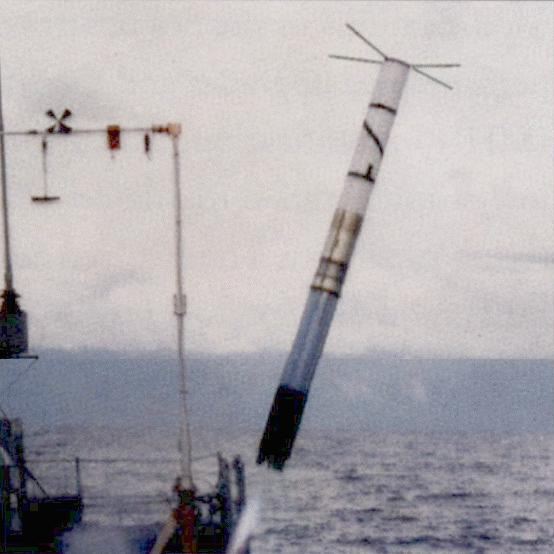
(click to view larger)
BAE recently announced that Australia’s Defence Materiel Organisation (DMO) had awarded a 12th successive annual contract to produce Nulka (Abor. “be quick”) hovering decoy rockets for the Australian, American, and Canadian navies. The A$ 40 million (about $35 million) “Option 20” deal extends production to 2013.
The SEA 1937 Nulka project was conceived as an Australian/American joint effort, and began with a Memorandum of Understanding in 1986. The Mk.53 Nulka system was designed to supplement “hard kill” systems like missiles and Phalanx guns, and standard chaff/flare decoy systems, with a slightly different approach. The Nulka rocket is launched from the ship, then flies a controllable semi-hover pattern in the air for a while, emitting confusing I/J-band (8-20 GHz) signals designed to decoy incoming anti-ship missiles away from the ship – and toward the Nulka. This gives ships an option against passive decoy rejection and active angular deflection measures in modern missiles, while overcoming chaff’s issues with wind, slow reaction time, and doppler discrimination ECCM(Electronic Counter Counter-Measures).
To date, BAE says that over 940 of their Mk.234/ Mk.250 Nulka rockets have been produced and deployed on more than 130 surface ships, earning more than A$ 800 million over the program’s lifetime. BAE Systems is the prime contractor, Lockheed Martin makes the electronic warfare payload, and Aerojet makes the rocket motor.